Methods of vineyard frost protection: what actually works
TL;DR
- Vineyard frost protection breaks into seven methods: site selection, delayed pruning, wind machines, helicopters, overhead sprinklers, heaters and frost candles, and row covers.
- Each works in a different damage window at a different cost.
- Wind machines are the most common active tool.
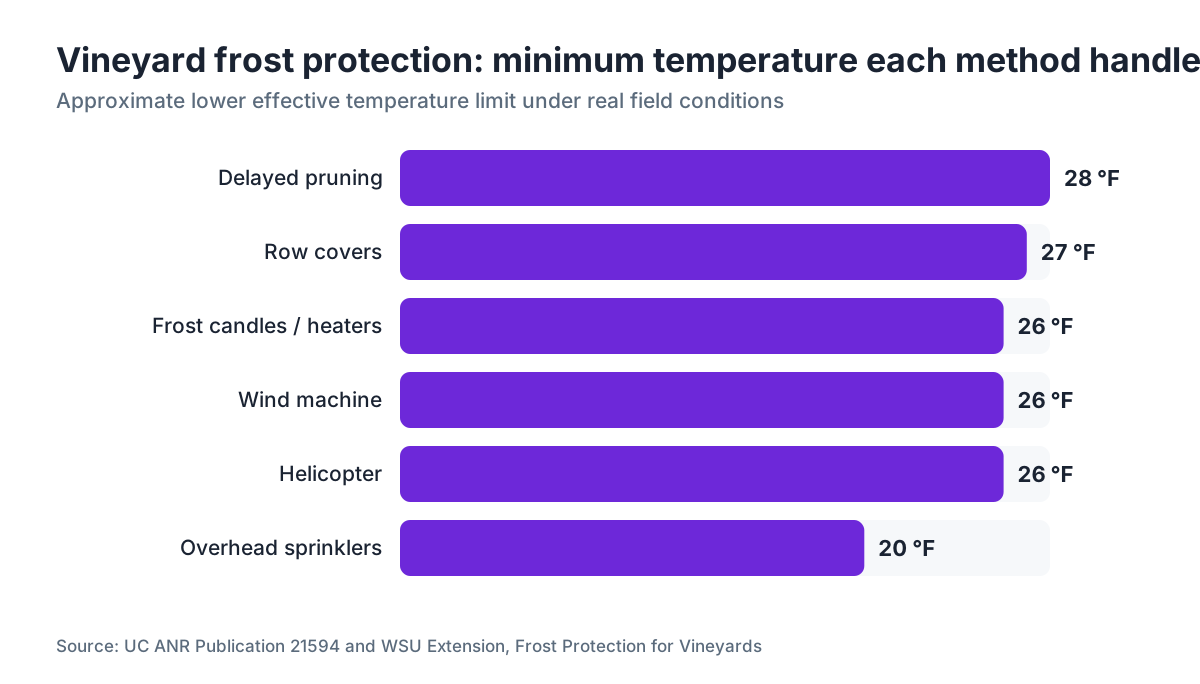
- Sprinklers are the only method that reliably protects below 26°F.
- No single method fits every site.
Why does frost kill vines, and what temperature actually causes damage?
Frost kills vines by rupturing cells, not by cold alone. When ice forms inside plant tissue, the expanding crystals tear cell walls. Shoot tissue doesn't die because the air is cold. It dies because the water inside the cells freezes. That one distinction drives every method that follows.
Critical temperatures move with growth stage. Dormant buds shrug off temperatures well below 0°F. Once budbreak happens, the threshold climbs fast. A fully swollen bud takes damage around 28°F (-2.2°C). An open green tip dies at 30-31°F (-1°C). A shoot with two to four inches of growth is the most exposed stage of all, with damage starting near 28-30°F depending on variety [1].
Duration matters as much as the low itself. Thirty minutes at 28°F does less harm than three hours at 28°F. That's why monitoring earns its keep. You need to know more than when you hit the threshold but how long you sit there.
Radiation frost and advective frost are two different animals, and confusing them wrecks your night. Radiation frost is the common one in vineyards: clear skies, calm air, and heat radiating off the ground drop temperatures near the surface while warmer air floats higher up. Advective frost rides in on a cold air mass and chills the whole air column. Wind machines and helicopters do nothing against it. Knowing which one you're facing changes every call you make.
What are all the vineyard frost protection methods available?
Here's the full list, roughly cheapest to most expensive per acre:
- Passive site selection (avoid frost pockets)
- Delayed pruning to push budbreak past peak frost risk
- Row covers and vine wraps
- Frost candles (orchard heaters) and propane heaters
- Wind machines (towers)
- Helicopters
- Overhead irrigation sprinklers
Each one works on a different physical principle. Passive methods pull the vine out of harm's way before frost ever arrives. Heaters add energy to the air around the vines. Wind machines and helicopters drag warmer air from above the inversion layer down to canopy level. Sprinklers protect through the latent heat of fusion: as water freezes on the vine, it releases 144 BTUs per pound and pins tissue temperature at 32°F for as long as ice keeps forming and water keeps flowing [2].
Most commercial vineyards in hard-frost country run at least two methods. A wind machine handles the mild to moderate radiation events. A backup (sprinklers or heaters) covers the harder freezes or the odd advective night. Betting a whole crop on one active system with no fallback is a gamble you'll eventually lose.
How do wind machines work for frost protection, and are they worth the cost?
A wind machine (growers call it a frost tower) is a big propeller, usually 20-24 feet across, sitting on a 30-40 foot tower and driven by a diesel engine or electric motor. It pulls warmer air down from the temperature inversion that forms above the vineyard on a radiation frost night and mixes it into the cold surface layer. One machine covers roughly 10-20 acres depending on terrain, tower height, and how strong the inversion runs [3].
Wind machines do their best work when the inversion is strong, meaning 5°F or more of warmer air sitting 30-50 feet above the canopy. They protect down to about 26-28°F in most events. Below that, or when there's no inversion at all (common in advective frost), they give you almost nothing.
Cost is the main objection. A new electric or diesel machine runs roughly $30,000-$60,000 installed, and the per-acre number drops fast as your protected acreage grows. On a 10-acre parcel that's $3,000-$6,000 per acre of capital. Spread three machines over a 50-acre block and the math looks very different. Washington State University extension notes that wind machines are among the most cost-effective active tools for blocks of 15 acres or more in areas with frequent radiation frost [3].
Maintenance is the cost people forget. Diesel machines need oil changes, fuel treatment, and a full mechanical check before frost season. The worst thing that can happen at 2 a.m. in April is a machine that won't turn over. Budget $1,500-$3,000 per machine per year and be honest about it.
Automatic start systems, triggered by temperature sensors, come standard on modern machines and pay for themselves the first time you sleep through an alert. Manual starting is fine as a backup. As a primary system, it fails.
Do frost candles and orchard heaters still make sense in a modern vineyard?
Frost candles and orchard heaters still earn a place, but mostly as a supplement, not a primary system. They work by direct radiant and convective heat. You set them in the rows between vines, light them, and each one burns 6-8 hours. Old oil smudge pots are mostly gone, replaced by paraffin wax candles that burn cleaner and throw less smoke.
The physics is sound. Heaters add real BTUs to the air. The catch is distribution. A candle placed 6-8 feet from a vine lifts vine-level temperature by only 2-4°F in calm air, and that warm envelope is small. You need a crowd of them for real coverage, typically 50-100 per acre for a moderate frost, which is expensive in both material and labor.
At roughly $1.50-$3.00 per single-use paraffin candle, protecting 10 acres with 60 candles per acre costs $900-$1,800 per event in candles alone, before labor to place and light them. Three events in a season and the bill stacks up fast. Reusable propane heaters have better long-run economics but need storage, maintenance, and fuel management.
Candles shine in small blocks, high-value varieties, or as a targeted patch when your main system falls a little short. A grower with wind machines over most of the vineyard and one stubborn 2-acre low spot will often keep candles or a few propane heaters just for that block. That's the honest use case.
Burn permits and air quality are a live compliance issue in some regions. California air districts require permits to run heaters in many areas, and open burning of any kind can be restricted on high-pollution days. Call your local air quality management district before you count on any combustion method [4].
How does overhead sprinkler irrigation protect against frost?
Overhead sprinklers protect vines by soaking them continuously with water. As that water freezes, it releases the latent heat of fusion, 144 BTUs per pound, and holds tissue temperature right at 32°F for as long as ice keeps forming and water keeps coming [2]. The vine ends up sheathed in ice, but the ice is acting as a thermal buffer. Cut the water off before temperatures climb back above freezing and you can do more damage than if you'd never started, because the ice melting pulls heat out through evaporative cooling and can briefly drag tissue below 32°F.
Sprinklers handle a wider range of frost severity than any other active method. Done right, they protect vines down to 20-22°F, far past what wind machines or heaters manage. UC Davis cooperative extension data shows systems designed at 0.10-0.15 inches per hour protect to about 28°F, with higher rates of 0.15-0.20 inches per hour reaching lower [1].
Application rate is everything. You have to apply enough water continuously to keep ice forming on the vine. Too little, and evaporative cooling off the wet tissue actually drops temperature below the surrounding air and makes the damage worse. Under-application is the classic sprinkler mistake, and it's a bad one, because it turns your protection system into a weapon against your own crop.
Water volume and pump capacity are the hard limits. A block of overhead sprinklers running at 0.15 inches per hour needs serious pump and pipe infrastructure. If your well or water district can't hold that flow through a 6-8 hour event, overhead irrigation isn't a standalone answer. Pressure matters too. Uneven pressure means uneven coverage, and one dry vine in the middle of an iced block still dies.
Installation cost swings hard with terrain, water source, and block size, but UC Davis extension estimates put complete systems at $1,500-$3,500 per acre for design, pipe, heads, and pump infrastructure, with the pump and mainline driving most of it [1]. Built and maintained properly, it's the most reliable protection money can buy in hard frost country.
Can helicopters protect a vineyard from frost, and when is that practical?
Helicopters run on the same physics as wind machines. They push warmer inversion air down to vine level. A helicopter flying at 50-150 feet over the vineyard in a grid pattern can lift vine-level temperature by 2-5°F in a good inversion.
The appeal is flexibility. Nothing to install. You call a helicopter service when frost is forecast, they fly your vineyard through the night, and you pay for flight hours. For growers with small acreage, rare frost risk, or no fixed system, that flexibility is worth real money.
The economics get slippery fast. Helicopter frost protection typically runs $150-$350 per hour of flight time, and covering a 50-acre vineyard through a 5-hour frost night can mean multiple passes and a minimum-hours contract. WSU extension notes that helicopter protection tends to pencil out mainly for high-value wine grapes in small blocks, where the crop's replacement value justifies the hourly cost [3].
Same limit as wind machines: no inversion, no benefit. And a helicopter's availability on a cold April night, when every vineyard in the county is dialing the same number, is not something you can count on. Growers who lean on helicopters carry a standing contract with a local ag aviation operator, signed well before frost season.
For most operations with more than 20 acres of high-risk ground, installed equipment pays for itself in a few seasons. Treat helicopters as emergency backup, or as the only realistic option for growers with scattered small blocks.
What does delayed pruning do for frost risk, and is it worth disrupting your schedule?
Delayed pruning is the cheapest frost tool there is, and for early-budding varieties it should be your baseline. Unpruned vines push budbreak 7-14 days later than pruned vines, because the intact cane wood carries compounds that hold back early growth. Wait to prune until closer to your region's average last frost date and you slide the vulnerable budbreak window off the worst of the frost risk [5].
The trade-off is real. Later pruning shortens the growing season by a few days, makes canopy management harder because everything happens faster and denser at once, and can collide with other farm work. In high-risk regions it's still worth it as a first line that costs nothing but a schedule shuffle.
Double pruning refines the idea. You rough-prune to 3-4 buds per spur in February, then come back for detail pruning in late March or early April. That slows early bud development while still controlling canopy density. Cornell's viticulture and enology team at Cornell CALS has documented the technique and its results in New York wine regions [5].
For the frost-prone early budders (Chardonnay, Pinot Noir, Merlot), delayed or double pruning should sit under whatever active system you install, not instead of it.
What are the real costs of each frost protection method per acre?
The numbers below come from university extension cost estimates and published industry data. Treat them as ranges, not quotes. Local labor, water infrastructure, and terrain all move the real figures hard.
| Method | Capital cost per acre | Annual operating cost per acre | Effective down to |
|---|---|---|---|
| Delayed pruning | $0 | $0-$50 (adjusted labor) | ~28-30°F |
| Row covers / vine wraps | $200-$800 | $100-$300 (install/remove labor) | ~26-28°F |
| Frost candles (paraffin) | $0-$100 (storage) | $90-$300 per event | ~26-28°F |
| Wind machine | $1,500-$4,000 | $150-$300 | ~26-28°F |
| Helicopter | $0 | $150-$350/hr (flight time) | ~26-28°F |
| Overhead sprinklers | $1,500-$3,500 | $200-$500 | ~20-22°F |
The wind machine capital figure assumes one machine covers 15 acres at $30,000-$60,000 installed. Sprinkler figures assume a complete system with adequate water supply. Helicopter cost is pure operating cost with no capital.
Here's the line that should shape your decision: overhead sprinklers are the only method that reliably holds vines below 26°F, so if your site sees temperatures in the low 20s during the frost window, everything else is a supplement at best.
How do you monitor a vineyard overnight to know when to activate frost protection?
Monitoring is where most operations under-invest relative to what they spent on equipment. A $50,000 wind machine is only as smart as the temperature data telling it when to run.
The floor is two thermometers at vine height (about 3 feet above the soil) in different parts of the block, one at the lowest point (always the coldest) and one in a typical mid-block spot. Most growers now run wireless sensing stations with data logging and alerts that text or call when temperature crosses a set line, usually 34-35°F as a wake-up alert and 32°F as the action trigger.
Putting sensors only at the vineyard office or the high point is one of the most common and expensive mistakes. Cold air drains downhill. The warmest corner of your vineyard can read 34°F while the frost pocket at the bottom is already sitting at 29°F.
Vineyard-specific forecasting has gotten a lot better. Services like DTN and the regional NWS agricultural weather pages give zone-specific forecasts with a 24-36 hour outlook, enough lead time to ready equipment and line up labor [6]. The NWS also puts out agricultural freeze watches and warnings that are free and usually solid inside the 24-48 hour window.
If you want your frost data living next to everything else, logging events alongside spray and scouting records builds a full season picture. Tools like VitiScribe let you record temperature events and protection activations right beside your regular field logs, which pays off when you're trying to match spring damage patterns to weather history at season's end.
One habit worth building: write down the time you started each system, the reading when you started, and the low it bottomed out at. A basic paper log of that, season over season, beats any single sensor for figuring out what your site actually does.
What does OSHA and the EPA worker protection standard require when using frost protection equipment at night?
Most frost protection work doesn't trigger heavy Worker Protection Standard requirements, but nighttime safety, combustion hazards, and equipment guarding are real obligations that belong in your written safety plan. Night operations bring risks that get shrugged off in the rush of a frost event.
The EPA Worker Protection Standard at 40 CFR Part 170 covers any worker applying pesticides, including, under some readings, materials run through irrigation lines during chemigation [7]. A pure-water frost event doesn't trigger the WPS. Run fertigation or chemigation through the same lines, though, and the WPS recordkeeping rules apply.
For combustion heaters and frost candles, OSHA's general duty clause requires employers to provide a safe workplace. Workers positioning and lighting orchard heaters at night need training on heat hazards, fire-proximity rules, and access to extinguishers. Cal/OSHA publishes specific guidance on nighttime agricultural operations and lighting that California growers have to follow [8].
Carbon monoxide is a genuine hazard around propane heaters in enclosed or dead-air conditions. It matters more in orchards than open vineyards, but a frost hollow with calm air can let CO build around workers tending several heaters at once. Train them on CO symptoms and set spacing protocols.
For diesel wind machines, keep workers clear of the propeller during startup and operation, and guard the machine per manufacturer specs. OSHA's agricultural machinery standards at 29 CFR 1928 cover guarding for rotating equipment, wind machines included [9].
How do you choose the right frost protection method for your specific vineyard?
The right system comes down to four things: how severe and how often frost hits your site, the crop's value, your water infrastructure, and how many acres are exposed. Start with data, not regional reputation.
Pull historical frost data for your site. If you have 10 years of temperature logs (or can grab NWS climate data for your area), count the events per season below 30°F, below 26°F, and how many hours each ran. A site with two events a season at 28-30°F is a completely different problem than one that regularly hits 22°F for four hours in late April.
For mild, infrequent radiation frost (one to three events a season, rarely below 26°F), a wind machine plus delayed pruning is almost always the answer. The capital hurts, but you recover it in one or two seasons of saved crop.
For high-risk sites, especially valley floors in regions like Carneros, the Russian River Valley, or the Columbia Valley floor, overhead sprinklers are the right primary system. Yes, they cost more to install. But if you're regularly seeing 24°F events without sprinklers, you're betting your crop on equipment never built for that exposure.
Small blocks under 5 acres of high-value grapes are often the best fit for row covers plus frost candles. Labor is high, but it's variable cost you only pay on frost nights, not fixed capital.
For Paso Robles wineries and warmer regions where spring frost is occasional rather than structural, a phone-alert system and a contracted helicopter service may be all you need. The move is to know your real historical risk, not lean on what the region is known for.
For planning and documentation, VitiScribe field operations logs let you record frost event details, method used, timing, temperatures reached, and any vine damage alongside your regular crop records, which makes year-end review and insurance paperwork easier.
Starting from scratch? Run the sequence in order. Map your frost pockets with multiple thermometers across two full seasons before you spend a dollar on equipment. Put money into monitoring before hardware. Match your primary active system to your realistic worst case, not your average night.
What are the most common mistakes vineyard operators make with frost protection?
Under-monitoring is the most expensive mistake in the book. Growers who start their systems too late, because they trusted a single thermometer in the wrong spot, lose crops to events their installed equipment could have handled if it had come on 30-40 minutes sooner.
Second most common: stopping sprinklers too early. Shut off overhead irrigation while ice still coats the vines and temperatures sit below freezing, and evaporative cooling can drag tissue below the lethal line. The rule is simple. Keep running until all the ice has melted and temperatures hold reliably above 35°F. Basic physics, violated constantly, because operators are exhausted at 6 a.m. and want to be done.
Relying on one method for every scenario is a structural risk. Wind machines fail at 26°F without a good inversion. Heaters can't cover a big block evenly. Sprinklers need working pumps and enough water. Any operation with real frost exposure needs a primary system and a defined backup.
Skipping pre-season equipment checks is its own category of pain. Diesel machines never serviced since last spring, propane tanks at 20%, sprinkler heads clogged from last season's irrigation: all of it fails on the one night you can't tolerate failure. A mandated equipment check in March, before any frost risk shows up, heads off most mechanical trouble.
And not keeping records is a missed opportunity you'll regret at claim time. Crop insurance documentation and year-over-year improvement in your frost response both depend on a written record of what happened, when, and how it came out. A vineyard that can show five years of documented frost events and protection logs is in a far stronger position filing a crop loss claim than one that can only say the spring was rough.
Frequently asked questions
At what temperature do grapevine buds get damaged by frost?
Fully dormant buds handle temperatures well below 0°F. After budbreak the threshold rises quickly. A swollen bud is at risk around 28°F (-2.2°C). An open green tip is damaged at 30-31°F. A shoot with 2-4 inches of growth faces serious damage at 28-30°F depending on variety. Duration matters too: 30 minutes at 28°F does far less harm than three hours at the same temperature.
How many acres does one wind machine protect?
A standard wind machine with a 20-24 foot propeller on a 30-40 foot tower protects roughly 10-20 acres under good conditions, meaning a strong temperature inversion and fairly flat terrain. Broken terrain, big grade changes, or weak inversions cut coverage. WSU extension recommends sizing coverage conservatively and factoring in the lowest point of each block, which always runs coldest.
What is the latent heat of fusion and why does it matter for sprinkler frost protection?
The latent heat of fusion is the energy released when water turns from liquid to solid. Water releases 144 BTUs per pound as it freezes. Overhead sprinklers use this by continuously freezing water on vine tissue, releasing that heat and holding tissue temperature at 32°F. The system only works while water is actively freezing, which is why continuous application and a proper rate (0.10-0.20 inches per hour) are mandatory.
Are vineyard frost candles still legal in California?
Combustion heaters and paraffin frost candles are regulated by local air quality management districts in California, not banned statewide. Many districts require a permit to run them, and burning may be prohibited on Spare the Air days or high-pollution episodes. Check with your specific AQMD before relying on candles or propane heaters. Cleaner-burning paraffin candles face fewer restrictions than old oil smudge pots.
What is advective frost and why doesn't a wind machine help?
Advective frost arrives with a cold air mass that chills the entire atmospheric column, more than the surface layer. A wind machine works by mixing warmer air from the inversion layer (sitting 30-50 feet up) down to vine level. In advective frost there's no warmer air above the vineyard to pull down, so the machine just shuffles equally cold air around and gives you no temperature benefit.
How much does it cost to install overhead frost sprinklers per acre?
Published UC Davis extension estimates put complete overhead frost irrigation systems at $1,500-$3,500 per acre, covering design, pipe, sprinkler heads, and pump infrastructure. The pump and mainline drive most of the cost. Sites with existing water infrastructure and enough supply land at the low end. Sites needing new well capacity or long mainline runs can top $4,000 per acre.
What is double pruning and how does it reduce frost damage risk?
Double pruning is a rough first pruning to 3-4 buds per spur in late winter, then a final detail pruning 4-6 weeks later, close to the average last frost date. The cane wood left on after the first pass slows budbreak by 7-14 days, sliding the vulnerable growth window past the worst frost risk. Cornell's viticulture extension program has documented this for New York wine regions. It costs nothing but adjusted labor scheduling.
How do I know if my frost event is a radiation frost or an advective frost?
Radiation frost happens on clear, calm nights when heat radiates from the ground into a clear sky. Look for calm wind, clear skies, and temperatures dropping steadily after sunset with warmer air above vine level. Advective frost rides in on a cold air mass, often with wind, overcast skies, and a drop across the whole column. If your thermometers at vine level and at 40 feet read similarly cold, you're likely in advective conditions.
What minimum water application rate do sprinklers need to protect vines from frost?
UC Davis cooperative extension data indicates 0.10-0.15 inches per hour protects to roughly 28°F, while 0.15-0.20 inches per hour reaches lower. Applying too little water is worse than none: evaporative cooling off insufficiently wetted tissue can drop the vine surface below the surrounding air temperature and cause more damage. Always start sprinklers before temperatures reach 32°F.
Do I need to keep records of frost protection events for insurance or compliance purposes?
No federal law mandates frost event logs specifically, but crop insurance claims under USDA RMA programs require documentation of loss events, protective measures taken, and timing. Many policies require you to show that industry-standard measures were taken before a loss is covered. State pesticide records may apply if you run chemigation through irrigation lines. A simple dated log of temperatures, method used, and duration protects you in both cases.
What worker safety rules apply when lighting frost candles at night?
OSHA's general duty clause requires employers to protect workers from recognized hazards. For combustion-based frost protection, that means fire hazard training, access to extinguishers, defined spacing protocols, and adequate lighting for night work. Cal/OSHA has specific agricultural nighttime work guidance. Carbon monoxide exposure around multiple heaters in calm air is a documented risk; workers should be trained to recognize CO symptoms and follow defined exposure limits.
How early in the season should I have frost protection equipment ready?
For most northern hemisphere wine regions, equipment should be fully operational by March 1 in a high-frost-risk area, or by March 15 in moderate-risk regions. That means diesel machines serviced and started, sprinkler systems flushed and pressure-tested, propane tanks refilled, and sensors calibrated and transmitting. Late March and April frost events are the most damaging because vines are actively growing, so the equipment has to be ready before that window opens.
Can row covers protect vines against frost, and how effective are they?
Row covers (spunbond polypropylene fabric) give 3-5°F of protection depending on fabric weight and how tightly they seal around the vine. They work for mild events and are common on newly planted vines and high-value small blocks. The labor to install and remove them is the main limit at commercial scale. Material costs run $200-$800 per acre depending on fabric weight, and install and removal can add $100-$300 per acre per season.
Sources
- UC Davis Cooperative Extension, Frost Protection for Vineyards: Budbreak temperature thresholds for grapevines and overhead sprinkler application rate recommendations (0.10-0.20 inches per hour)
- UC ANR Publication 21594, Frost Protection: Fundamentals, Practice, and Economics: Latent heat of fusion of water is 144 BTUs per pound; overhead sprinklers work by holding tissue temperature at 32°F while ice is forming
- Washington State University Extension, Frost and Freeze Protection for Washington Vineyards: Wind machines protect roughly 10-20 acres per unit and are cost-effective for blocks of 15 acres or more in radiation frost areas; helicopter protection is most practical for high-value small blocks
- California Air Resources Board, Agricultural Burning Permits: Combustion-based orchard heaters require air district permits in California and may not be used on restricted burn days
- Cornell CALS Viticulture and Enology, Delayed and Double Pruning for Frost Avoidance: Delayed and double pruning shifts budbreak 7-14 days later, reducing exposure to peak spring frost risk in New York wine regions
- NOAA National Weather Service, Agricultural Weather: NWS publishes agricultural freeze watches and warnings providing 24-48 hour advance notice of frost risk at the local zone level
- EPA, Worker Protection Standard, 40 CFR Part 170: EPA WPS at 40 CFR Part 170 governs training, PPE, and notification requirements for pesticide-related activities including chemigation through irrigation systems
- Cal/OSHA, Agricultural Operations Safety Guidelines: Cal/OSHA has specific requirements for nighttime agricultural operations including lighting and heat hazard training for workers using combustion equipment
- OSHA, 29 CFR 1928, Occupational Safety and Health Standards for Agriculture: OSHA 29 CFR 1928 covers guarding and safety requirements for rotating agricultural machinery including wind machines
- USDA Risk Management Agency, Crop Insurance Handbook: USDA RMA crop insurance claims for frost loss require documentation that industry-standard protective measures were taken
- Cornell Cooperative Extension, Orchard and Vineyard Frost Protection Methods: Row covers provide approximately 3-5°F of protection and cost $200-$800 per acre in materials depending on fabric weight
Last updated 2026-07-09