Vineyard frost protection sprinklers: the complete field guide
TL;DR
- Overhead sprinklers protect budding vines by releasing latent heat as water freezes on tissue, holding buds at 32°F even when air drops to 28°F or lower.
- A properly sized system runs 35 to 50 gallons per minute per acre, costs $1,500 to $3,500 per acre installed, and must run without stopping once started, because shutting off mid-freeze makes damage worse fast.
How do frost protection sprinklers actually protect grapevines?
Freezing water warms your buds. That sounds backward, but the physics is settled. When liquid water turns to ice it releases 80 calories of latent heat per gram, and if you keep a thin film of liquid water forming continuously on bud tissue, that phase-change energy pins the tissue surface at 32°F (0°C) even as the air three feet away drops well below freezing. The bud doesn't read the thermometer. What kills a bud is its own tissue temperature falling past a critical damage point, and constant ice formation on the outside keeps that from happening [1].
This is the latent-heat-of-fusion principle, and it makes overhead sprinklers the most reliable active frost protection a vineyard can run. Wind machines and heaters work too, but they need a temperature inversion to lean on. Sprinklers make their own heat at the point of contact. No inversion required.
One hard rule falls straight out of the physics. Once you start, you cannot stop until the ice melts on its own in the morning.
Shut off water while the air is still below freezing and evaporative cooling takes over within minutes, dragging tissue temperatures several degrees below ambient. UC Cooperative Extension puts it plainly: stopping sprinklers prematurely does more harm than never starting them [1]. That single fact sets your water supply requirements, your pump sizing, and the stakes of a power failure at 3 a.m.
What temperature is too cold for grapevine buds and when does damage start?
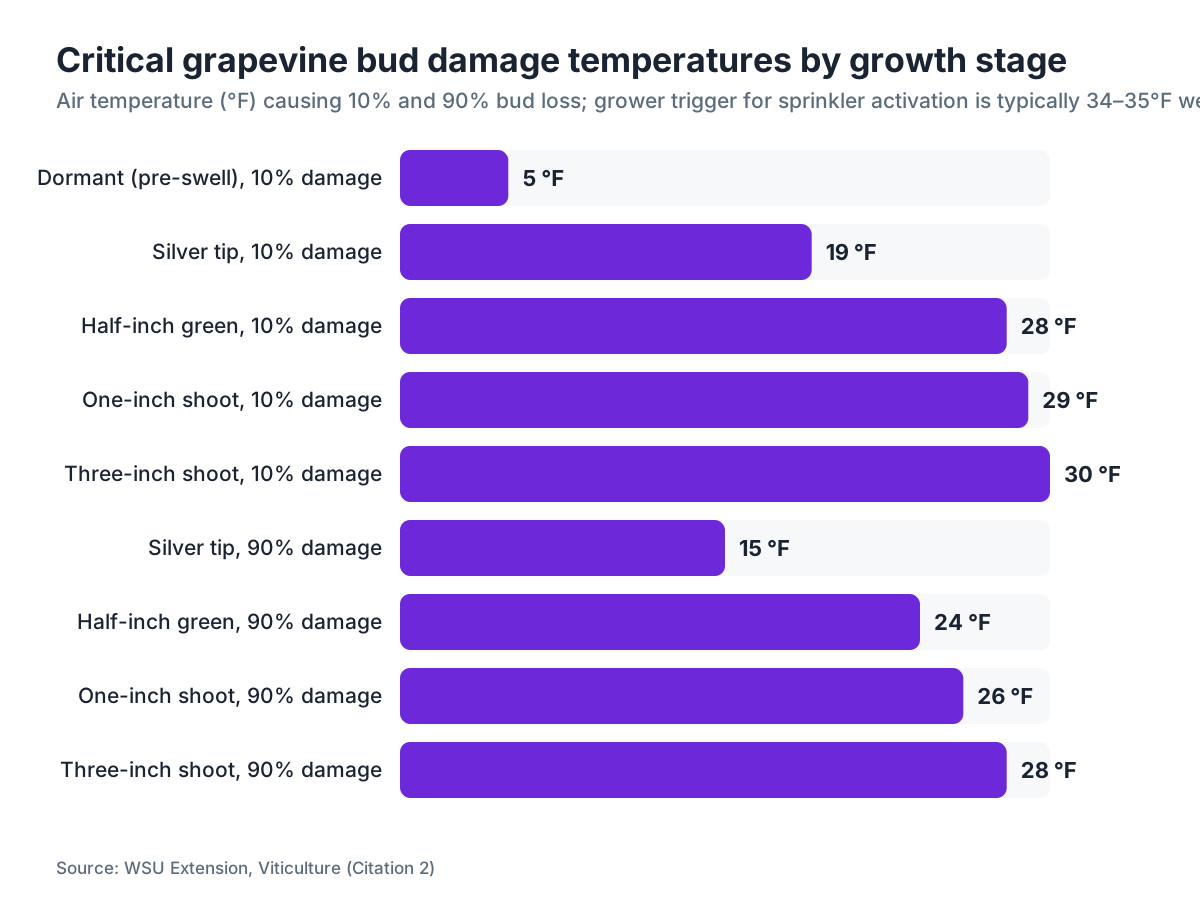
The growth stage matters more than the air temperature. A dormant bud in January in Washington State shrugs off -5°F. That same vine in April, showing half-inch green tissue, can die at 31°F if the cold holds for more than 30 minutes [2].
WSU Extension publishes critical temperature tables by variety and growth stage [2]. Here are the breakpoints most managers work from:
| Growth Stage | Approximate Kill Temperature (10% bud damage) | Approximate Kill Temperature (90% bud damage) |
|---|---|---|
| Dormant (pre-swell) | 0°F to 5°F | -10°F or below |
| Silver tip | 19°F | 15°F |
| Half-inch green | 28°F | 24°F |
| One-inch shoot | 29°F | 26°F |
| Three-inch shoot | 30°F | 28°F |
Variety shifts these numbers. Chardonnay buds are more cold-sensitive than Merlot at the same stage. Riesling and Gewürztraminer break dormancy early in spring, which stretches their window of exposure [2]. So a freeze that causes zero loss in February can wipe out your crop in April at 30°F with one-inch shoots showing.
For the on-off decision, most operators trigger on a wet-bulb temperature of 32°F rather than dry-bulb. Wet-bulb accounts for evaporative cooling and gives a more conservative read on damage risk [1]. A digital wet-bulb/dry-bulb station in the block costs $200 to $400 and pays for itself the first event.
How much water do vineyard frost protection sprinklers need per acre?
Application rate is where most DIY systems fall apart. UC Davis and WSU Extension both recommend 0.1 inches per hour of water application, which works out to roughly 35 to 50 gallons per minute per acre depending on your sprinkler layout and head spacing [1][3]. Extreme cold (below 26°F) or high wind can push that up to 0.16 inches per hour.
Rate matters because half-frozen buds die. Apply water too slowly and the ice shell forms on one side of the bud while evaporative cooling from the dry side drives tissue temperature below ambient. You end up worse off than with no water at all. The film has to stay liquid at the interface the whole time.
A 10-acre block needs a pump delivering 350 to 500 gpm at the pressure your head type wants. Most micro-sprinklers and rotating impact heads built for vineyard frost run best at 25 to 50 psi at the head. Account for pressure losses in your mainline and laterals, then size the pump with at least a 15% margin above your calculated demand [3].
Some operators run one pump across several blocks on rotation, switching every 30 to 45 minutes. It can work. It is also a gamble: get the rotation interval wrong against your refreezing rate, or have a valve stick, and you lose buds. For frost-sensitive blocks, dedicated coverage with no rotation is the safer bet.
Water source decides everything. Municipal water at low flow cannot feed a real frost system. Commercial operations pull from ponds, tanks, or high-capacity wells. WSU Extension recommends calculating total event demand for an 8-hour event minimum and having that full volume on hand before the season [3].
What does it cost to install a vineyard frost protection sprinkler system?
Ranges without context mislead, so here is what actually moves the number.
A basic overhead impact-sprinkler system on established vines runs $1,500 to $3,500 per acre installed in California wine regions as of 2023 to 2024 [4]. That covers mainline pipe, lateral pipe, sprinkler heads, risers, valves, and labor. It does not cover the pump station, which adds $15,000 to $60,000 or more depending on flow demand and whether you need a booster pump or generator backup.
Under-vine microsprinkler systems built for frost (not irrigation) cost less on heads and pipe, around $1,000 to $2,000 per acre, but their coverage is narrower and they lose ground fast in wind. They shine in the calm radiation-frost conditions common on valley floors.
Pump and power is where costs run away from you on larger sites. A diesel backup generator big enough to run a 500 gpm pump is a $30,000 to $80,000 item. Grid power is cheaper to operate, but a grid outage during a running frost event is a crisis with a clock on it. Most serious operations carry generator backup for exactly that reason.
Automation, temperature sensors, and remote alarms add $5,000 to $20,000 for a reasonably instrumented block. That is cheap insurance against sleeping through the trigger temperature.
Maintenance runs $100 to $300 per acre per year depending on water hardness and how often heads clog. Hard water is the enemy. Micro-sprinkler emitters in high-calcium water may need cleaning two or three times a season and replacement every 3 to 5 years [4].
Overhead sprinklers vs. wind machines vs. heaters: which frost protection method works best?
There's no single winner. Each method beats the others under specific conditions, and matching the method to your site is the whole game.
Overhead sprinklers are the most reliable in calm radiation-frost conditions, still air and clear sky, inversion or not. They protect down to 24°F or lower when application rate holds [1]. Their weaknesses are real: heavy water demand, the stopping-is-worse trap, and the weight of ice on trellis and canes. Ice loading breaks wires. Some training systems handle that load better than others.
Wind machines (propeller fans on towers) only work when a temperature inversion exists, meaning warmer air sits 50 to 150 feet up. The fan mixes that warm air down to vine level. In a true advective frost, a cold air mass moving in with no inversion, a wind machine does almost nothing [5]. UC Cooperative Extension notes that wind machines are effective when inversions provide 4 to 8°F of warmer air above vine level; when the inversion is shallow or absent, you get 1 to 2°F of protection at best [5].
Heaters (frost candles, smudge pots, LPG heaters) work without an inversion and protect small blocks well, but fuel cost per acre-night is steep, the labor to deploy them is real, and smoke and air quality rules increasingly restrict them across California, Oregon, and Washington [6].
So what would I actually do? If you have the water and the capital, overhead sprinklers give you the deepest, most reliable protection. Wind machines make a smart lower-cost complement on sites with consistent inversions. Heaters fill gaps or cover a small high-value block. Plenty of serious operations run a hybrid: sprinklers on the most vulnerable blocks, wind machines on the rest.
How do you design a vineyard frost sprinkler layout that actually covers your block?
Design starts with a distribution uniformity target: you want water application within each zone at 80 to 85% uniformity, meaning the driest spot gets at least 80% of what the wettest spot gets. Fall below that and you get cold spots that never build enough ice to hold the latent-heat mechanism [3].
Head spacing drives uniformity. Most rotating impact heads for vineyard frost run on a square or triangular pattern. Square spacing at 40x40 feet is common for heads rated at 0.1 in/hr at that spacing. Triangular patterns can buy you better uniformity at slightly wider spacing. Pull the manufacturer's distribution data and overlay it on your block map before you order a single head. The overlap circles have to close.
Riser height matters. Heads need to throw water over the canopy, not into it, to reach shoot tips and the actual bud zone. For VSP-trained vines that usually means heads at 6 to 8 feet. GDC or high-wire systems may need taller risers or a different placement strategy.
Dead-end laterals cause pressure variation. Loop your laterals where you can, or run pressure-compensating heads. String 20-plus heads on one long dead-end lateral and the last head sits at much lower pressure than the first, so your coverage goes lopsided. Cornell's viticulture program covers lateral pressure management in its irrigation design material [7].
Slope changes everything. Cold air pools in low spots, so your most frost-sensitive ground is usually your lowest sub-block. Design for those first. On slopes above about 5%, sprinkler distribution goes asymmetric, so on-slope calibration testing before your first frost season is worth the afternoon.
For record-keeping on design and water use, VitiScribe can log sprinkler activation times, run duration, and water volume pulled per event, which helps both for operational review and for showing due diligence on regulatory compliance.
What are the rules for running frost protection sprinklers in terms of water rights and permits?
Water law varies hard by state, but frost protection is almost always treated as its own water right category or requires specific notation on an existing right. Assume it applies to you until you confirm otherwise.
In California, large-volume pumping from rivers and streams requires a water right from the State Water Resources Control Board, and frost protection is an explicitly listed use type [8]. Pumping from your own pond or tank still needs the diversion right for however you filled it, a distinction that catches a lot of growers. Your well permit may also cap pumping rates a frost system would blow past.
Oregon and Washington regulate frost protection under their own water rights frameworks, and some regions carry seasonal restrictions on surface water diversion [3]. Washington's Department of Ecology handles water rights, and WSU Extension has primer material on where irrigation rights and frost use meet [3].
Permit timing is the real operational squeeze. A new water right application in California can take 12 to 36 months to process. If you're building a new system, start the water rights paperwork before you pour the first concrete pad for the pump station.
Local air quality matters too. Frost practices that involve burning carry explicit permit requirements, but pure water sprinkler systems generally do not trigger air quality permits. Call your county air district anyway, especially if you run a hybrid setup.
How do you operate a frost sprinkler system safely and protect your workers?
Frost events hit at 2 a.m. in April. Darkness, ice, sleep deprivation, and fast decisions stacked together are the real hazard profile for anyone responding to a frost alarm.
EPA's Worker Protection Standard doesn't cover frost equipment operation as such, but general OSHA standards for agricultural work at night and in hazardous conditions still apply [9]. Slick footing around pump stations and ice-coated vine rows are genuine slip-and-fall hazards. Ice builds fast on walkways, pump pads, and wires when a system runs in sub-freezing air.
Ice loading is a structural hazard too. Wire breakage under ice load is common on long events (6-plus hours below 28°F). If wires start snapping, keep workers out of the block until the event is over and the ice has cleared. A snapped trellis wire under tension is a projectile.
Here is the protocol most experienced operators run: set up a check-in system for anyone working a frost event solo. A manager should know who is in the field and should expect a call every 30 to 45 minutes. Automated remote monitoring cuts the need for anyone to be physically present mid-event, which is the whole point of installing it.
Pesticide safety is a separate intersection. Wet foliage during a sprinkler event does not typically re-mobilize foliar residues in ways that affect workers during frost coverage. But re-entry intervals from any recent spray still apply if workers enter the block during or after the event. Track your spray dates and REIs carefully [9].
For wineries running estate vineyards, the paperwork where pesticide records, water use logs, and equipment maintenance logs meet gets tangled fast. Growers in regions like Paso Robles wineries that face both spring frost and warm-season water restrictions often find one consolidated record system keeps them current across all of it.
How do you maintain a frost protection sprinkler system between seasons?
Systems lose performance in the off-season, quietly, before anyone notices. Slow-clogging heads, weakening gaskets, and mainline fittings that start seeping will all show up as thin coverage on the exact night you need full coverage.
End-of-season flush. After your last frost risk date, run clean water through the whole system and blow out laterals if winter freezes your pipes. Trapped water in dead-leg sections splits PVC and HDPE when it freezes.
Head inspection and cleaning. Pull 10 to 15% of your heads and check emitter orifices for mineral buildup. In hard-water areas, soak heads in a 1:10 white vinegar solution for 30 to 60 minutes, rinse, and reinstall. Replace any head with cracking, worn bearings (on rotating impact types), or a deformed deflector plate. One bad head creates a cold spot you won't catch until you find dead vines.
Pre-season activation test. Run the full system before bud break, usually late February or early March across most of California and Oregon. Look for full pressure at the farthest heads, no stuck valves, no pipe that didn't survive winter, and uniform distribution in every zone. Walk the block while it runs. Do not run this test for the first time the night of your first frost alarm.
Pump service. Service the pump and motor on the manufacturer's interval, usually annually for pumps that work hard. Change oil, inspect seals, test the pump curve. A pump delivering 10% under rated flow can push you below your minimum coverage threshold. Get pump performance tested every 3 to 5 years by a certified technician.
Generator backup. Load-test it quarterly. Start it under full load, not idle. Generators that never get load-tested fail under full electrical demand during frost events at a high rate, which is the worst possible time to learn that.
Can under-vine microsprinklers provide enough frost protection for grapevines?
Under-vine microsprinklers cost less to install and use less water, which makes them tempting. The physics sets hard limits on what they can actually protect.
Microsprinklers under the trellis wire at vine level protect the trunk and cordon zone reasonably well by building a warmer microclimate near the ground through latent heat release. In calm radiation-frost conditions with a temperature differential of 3 to 5°F (ambient dropping to 28 to 29°F when bud damage starts at 28°F), that can be enough [1].
Shoot tips are the problem. With VSP training, shoot tips sit 4 to 6 feet above the under-vine emitter, and the spray never reaches them in any useful way. You're protecting basal buds and trunk tissue while the primary shoot tips, where your crop load actually originates, hang out at ambient temperature.
For Chardonnay or Pinot Noir on a site where temperature routinely drops to 26°F during bud break, under-vine microsprinklers alone are probably not enough. For a Cabernet block where frost is rare and temperature rarely dips below 29°F with tissue showing, they may cover your risk fine.
Where under-vine systems earn their keep is as a supplement to overhead on blocks where water supply caps your overhead coverage rate. Run both at once for redundant protection. Some operators put overhead on their most exposed rows and microsprinklers on interior rows where temperature holds a bit warmer.
If your operation ties into a broader estate or hospitality business like a vineyard with public programming, frost damage carries operational weight beyond the crop. A lost year shows up in tasting room inventory two and three years down the line.
How do you monitor for frost and decide when to start your sprinkler system?
A good weather station at the right spot costs $500 to $2,000 and is the best money in your whole frost program. Most growers underinvest here, then guess in the dark.
The station has to be in the block at canopy level, not at an airport or a regional weather service site miles off. Cold air pools locally. Temperature differences of 5 to 8°F across a half mile of topographic variation are common, so what the nearest airport reports at 4 a.m. tells you almost nothing about your lowest block.
Measure wet-bulb, more than dry-bulb. Dew point helps too. The trigger most operators use: if wet-bulb at canopy level is falling toward 34°F with the forecast calling for more cooling, start the system at 34 to 35°F wet-bulb. That gives you the few minutes the system needs to pressurize and push water to every head before damage temperatures reach the bud [1].
Remote alarm systems that text or call when temperature crosses your trigger are cheap and reliable. Most modern weather stations ($300 and up) carry cellular data. Set two alarm levels: a warning at 36°F and a run-now alarm at 34°F wet-bulb. Test the alarm before bud break, not during your first event.
Log the start time, the readings that triggered startup, the run duration, the estimated water volume applied, and the post-event field notes (visible bud damage, ice loading, wire issues). Those records matter for crop insurance claims and for tuning your response thresholds over time. VitiScribe's field log tools are built for this kind of time-stamped event documentation, which earns its keep when you're filing a claim or working out what went wrong after a partial loss.
For multi-block operations in varied terrain, like many mountain winery properties, you may need three or four station locations to actually cover your microclimate spread.
Frequently asked questions
At what temperature should I start my frost protection sprinklers?
Start when wet-bulb temperature at canopy level reaches 34 to 35°F and is still falling. This gives your system time to pressurize before buds reach their critical damage threshold. Dry-bulb air temperature at a remote weather station is not a reliable trigger. Put a sensor in the block at vine height. UC Cooperative Extension recommends a wet-bulb trigger, not dry-bulb, for exactly this reason.
Can I turn off my frost sprinklers once it warms up slightly during the night?
No. Once you start a sprinkler system during a frost event, do not shut it off until ice has naturally melted in the morning warmth. Stopping while air temperature is still below freezing causes immediate evaporative cooling that can drop tissue temperature several degrees below ambient within minutes. Premature shutdown commonly causes more damage than a late or no-start decision.
How much water does a vineyard frost system use per night?
Plan for roughly 35 to 50 gallons per minute per acre at the standard 0.1 inch per hour application rate. An 8-hour event on a 10-acre block pulls 168,000 to 240,000 gallons. Make sure your storage or pumping capacity covers a full event before the season starts. Running out of water mid-event is a serious problem.
What is the difference between radiation frost and advective frost for vineyard protection purposes?
Radiation frost occurs on calm, clear nights when the soil and vines radiate heat into a clear sky with no wind to mix warm air down. Advective frost is a cold air mass moving in with some wind. Overhead sprinklers handle both. Wind machines only help with radiation frost when a temperature inversion (warmer air above colder air) exists. Advective frosts with no inversion make wind machines largely ineffective.
How long does a vineyard frost protection sprinkler system last?
Mainline and lateral PVC or HDPE pipe typically lasts 20 to 30 years with proper winterization. Sprinkler heads last 5 to 15 years depending on water hardness and maintenance frequency. Pumps last 10 to 20 years with proper annual service. The weakest link is usually head emitters in hard-water areas, which can clog or fail in 3 to 5 years without regular cleaning.
Do frost protection sprinklers need a backflow preventer?
Yes, if they connect to any potable or shared water supply. Most states require a reduced-pressure backflow prevention assembly on agricultural systems that connect to a pressurized water supply. If you're drawing from a dedicated pond or tank, the requirement may not apply, but check with your local water utility and county environmental health department. Installation typically costs $300 to $800 for the assembly alone.
What is ice loading damage from frost sprinklers and how do I prevent it?
Ice loading is the weight of accumulated ice on vine structure, trellis wire, and posts during a long sprinkler event. At 0.1 inches per hour over 8 hours, significant ice mass builds on horizontal wires. Wire breakage and cane snapping are real risks. To reduce loading, ensure your trellis wire gauge is appropriate (12.5 gauge minimum for catch wires), inspect and re-tension wires pre-season, and consider reducing application rate slightly if below-28°F events run longer than 6 hours.
Can a vineyard frost sprinkler system also be used for summer irrigation?
Technically yes, the same overhead infrastructure can apply water in summer. In practice, overhead irrigation is agronomically problematic for most wine grape production: it wets foliage, increases disease pressure (especially Botrytis and powdery mildew), and applies water inefficiently compared to drip. Most frost systems are designed and maintained strictly for frost use, with a separate drip system handling summer irrigation. Combining the two is an operational compromise that works better in some regions than others.
How do I calculate the pump size I need for a frost protection system?
Multiply your target application rate (typically 35 to 50 gpm per acre) by your total acres. Add 15% safety margin. Then calculate pressure requirements based on head operating pressure plus friction losses in your mainline and laterals. A 10-acre block at 45 gpm/acre needs a 450 to 520 gpm pump at your required operating pressure. Have a licensed pump engineer or your local irrigation supplier verify this before you purchase.
Are there any grants or cost-share programs to help pay for vineyard frost protection systems?
USDA's NRCS Environmental Quality Incentives Program (EQIP) has historically included irrigation and water management practices that may cover frost system components, with payment rates and eligibility varying by state and year. California's CDFA and some county Farm Bureaus have also offered one-time frost-related programs after severe events. Contact your local NRCS field office directly for current payment schedules. Eligibility criteria and funding availability change annually.
Does crop insurance cover frost damage if I have sprinklers but they fail?
USDA's Federal Crop Insurance (Multi-Peril Crop Insurance for wine grapes) covers frost damage as a covered cause of loss. Whether a sprinkler system failure is treated as a preventable vs. unpreventable loss depends on the specific policy language and the adjuster's determination. Documenting your system maintenance records, your frost event response log, and the specific cause of failure (power outage, mechanical failure, etc.) is essential for a successful claim. Talk to your crop insurance agent before the season.
What varietals are most at risk from spring frost and need sprinkler protection most urgently?
Early-budding varietals are the highest risk. Chardonnay, Pinot Noir, Pinot Gris, Gewürztraminer, and Riesling break dormancy 1 to 3 weeks earlier than later varieties like Cabernet Sauvignon, Merlot, and Zinfandel. If you're prioritizing sprinkler coverage across a mixed block, those early-budding blocks need coverage first. WSU Extension publishes variety-specific critical temperature tables by growth stage that are the best reference for your specific situation.
How far apart should frost sprinkler heads be spaced in a vineyard?
Typical spacing for rotating impact sprinklers in vineyard frost systems is 30 to 50 feet in a square or triangular pattern, depending on the head's throw radius at your operating pressure. The goal is 80 to 85% distribution uniformity across the zone. Pull the manufacturer's precipitation-rate and distribution data for your specific head at your operating pressure and verify that overlap is adequate. Do not estimate: under-coverage creates cold spots that you will find the hard way.
Sources
- UC Agriculture and Natural Resources, Frost Protection for Vineyards: Overhead sprinklers use latent heat of fusion to hold bud tissue at 32°F; stopping application while temperatures are still below freezing causes evaporative cooling and worsens damage; wet-bulb temperature is the recommended trigger.
- Washington State University Extension, Viticulture: Critical kill temperatures for grapevine buds by growth stage, including that half-inch green tissue sustains 10% damage at 28°F and 90% damage at 24°F; early-budding varietals including Chardonnay and Riesling have extended vulnerability windows.
- Washington State University Extension, Irrigation and Water Management for Vineyards: Standard frost sprinkler application rate recommendation of 0.1 inches per hour; pump sizing guidance; water rights intersection with frost protection use in Washington State.
- University of California Cooperative Extension, Sample Cost Studies for Wine Grape Production: Installed cost of overhead frost sprinkler systems in California wine regions of $1,500, $3,500 per acre; maintenance cost ranges and emitter replacement intervals.
- UC Cooperative Extension, Wind Machines for Frost Protection: Wind machines require a temperature inversion of 4 to 8°F above vine level to be effective; in advective frost conditions with no inversion, protection is limited to 1 to 2°F.
- California Air Resources Board, Agricultural Burning Regulations: Smoke and air quality regulations increasingly restrict use of heaters and smudge pots for frost protection in California, Oregon, and Washington.
- Cornell University, Viticulture and Enology, Irrigation Management: Lateral pressure management in vineyard irrigation and frost system design, including pressure variation in dead-end laterals with multiple heads.
- California State Water Resources Control Board, Water Rights: Large-volume pumping for frost protection in California requires a water right; frost protection is an explicit listed use type; processing can take 12 to 36 months.
- US EPA, Worker Protection Standard for Agricultural Pesticides: Re-entry intervals from pesticide applications apply to workers entering blocks during or after frost sprinkler events; general WPS requirements govern worker safety in agricultural settings.
- USDA National Agricultural Statistics Service, Grape Acreage Report: National wine grape acreage and production data supporting the economic stakes of spring frost events for vineyard operations.
- USDA Risk Management Agency, Federal Crop Insurance for Wine Grapes: Multi-Peril Crop Insurance for wine grapes covers frost as a cause of loss; documentation of prevention efforts supports claims.
Last updated 2026-07-09