Vineyard frost protection equipment: what actually works and what it costs
TL;DR
- The four main vineyard frost protection methods are wind machines (overhead fans), heaters, overhead sprinklers, and helicopters.
- Wind machines run $15,000 to $60,000 installed and protect 10 to 30 acres each.
- Sprinklers work down to about 25°F.
- Heaters cost least upfront but most per season.
- No single method wins every night; serious operations layer two.
What temperature actually damages grapevines, and when does frost protection kick in?
Grapevine cold damage depends entirely on growth stage. Dormant canes survive temperatures well below 0°F in mid-winter. Once the vine breaks dormancy, the math changes fast. Newly emerged shoots die at 31°F. Young shoots two to four inches long die at 28°F. Flower clusters and small berries are lost at 28 to 29°F [1].
UC Cooperative Extension identifies 28°F as the standard critical threshold for most Vitis vinifera shoot tissue, held for 30 minutes or more [1]. That's the number to set your alert system around, though delicate varieties like Chardonnay and Pinot Noir in early spring can show tissue damage slightly above 30°F.
Radiation frost is the common type in vineyards. On calm, clear nights, heat radiates off the soil surface, the air above cools unevenly, and the coldest layer sits just above the canopy. That inversion layer is exactly what wind machines exploit.
Advective frost is a different animal. It rides in on a cold air mass moving across a whole region, hits when surface winds run above 5 mph, and is much harder to fight mechanically. If the forecast says winds stay above 5 to 7 mph at 2 a.m., wind machines alone won't save you that night. Know which one you're facing before you plan the equipment.
How do vineyard frost protection fans (wind machines) work, and what do they cost?
Wind machines, also called frost fans or vineyard frost protection fans, mix the warmer air from the inversion layer (usually 4 to 8°F warmer just 30 to 50 feet above the vine) down into the cold air sitting near the canopy. The fan makes no heat of its own. It stirs what's already there. That's why they fail in advective frost, where no inversion exists.
A typical propeller-style wind machine sits on a tower 30 to 40 feet tall, spins a two- or three-blade propeller 16 to 24 feet across, and runs on either a diesel engine or an electric motor. Diesel units stay independent of the grid, which matters at 3 a.m. when your utility power has already browned out. Electric units cost less to run but need serious electrical infrastructure.
Protection radius in calm radiation frost conditions runs roughly 10 to 15 acres per machine for standard units, up to 20 to 30 acres for larger high-output machines [2]. Washington State University Extension puts the effective protection zone at 8 to 15 acres for most commercial units under ideal inversion conditions [2]. Don't bank on the top of that range unless you've walked your specific block at night and measured the inversion with a thermometer on a pole.
Cost is the question people ask first. Here's an honest range.
| Configuration | Typical installed cost | Annual operating cost |
|---|---|---|
| Diesel wind machine, standard (10-15 ac) | $20,000 to $40,000 | $500 to $1,500 (fuel + maintenance) |
| Electric wind machine, standard | $15,000 to $30,000 | $200 to $600 (power + maintenance) |
| Large-diameter diesel unit (20-30 ac) | $40,000 to $60,000 | $1,000 to $2,500 |
| Used/reconditioned unit | $8,000 to $18,000 installed | Variable |
Those ranges come from WSU Extension cost-of-production data and regional dealer quotes. Actual pricing shifts with region, site access, and whether you need a new concrete pad or an electrical service upgrade [2]. If a salesperson quotes you well below the low end, ask about the warranty and parts availability.
One detail catches new buyers off guard. Most automatic wind machines turn on at a preset temperature, often 34°F, but you still want a person physically checking the block at least once during the event. Sensors fail. Thermometers ice over. The machine can run perfectly while a low pocket 200 yards from the sensor drops through the critical threshold.
What are the other main frost protection methods and how do they compare?
Wind machines get most of the press. Three other methods are common in commercial vineyards, and each has a real use case.
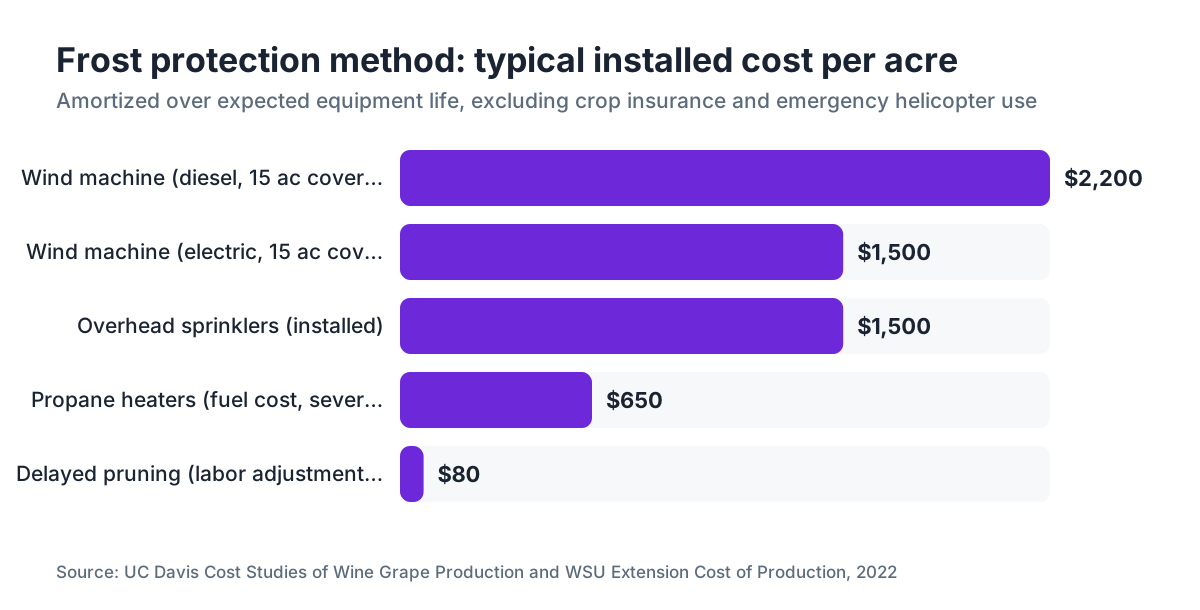
Overhead sprinklers. Water releases heat as it freezes, about 0.8 BTU per gram. Sprinklers protect vines by continuously coating tissue with ice that holds at 32°F as long as water keeps flowing [3]. Cornell University's viticulture program specifies that application rates must stay continuous at 0.1 inches per hour or more. Stopping before temperatures rise above freezing collapses the ice layer and speeds up tissue damage [3]. Sprinklers work reliably down to about 25°F with an adequate application rate, and they're highly effective. The downsides are real: you need a serious water source and pump system (typically 50 to 100 gallons per minute per acre), installation runs $1,000 to $2,000 per acre, and in a long severe event the weight of accumulated ice can break canes and trellis wire. They also complicate disease management by soaking the canopy.
Heaters. Propane or liquid propane (LP) heaters placed between vine rows have been used for over a century. They add real heat, which helps in advective frost when wind machines can't do anything. The problems are cost and labor. Fuel during a single serious frost event runs $150 to $300 per acre, and you need someone moving through the vineyard to light, monitor, and adjust them [4]. Return-stack heaters ("smudge pots" burning oil) are now largely prohibited on air quality grounds in California and Oregon. Propane heaters stay legal in most states but are getting uneconomical for large blocks.
Helicopters. Used mainly in large operations with no other option, helicopters mix the inversion layer the same way wind machines do, but they cover ground fast. One helicopter treats 100 to 300 acres in a pass. Cost runs $300 to $600 per hour or more depending on aircraft and region, which makes them a last resort or a supplement for blocks too far from a fan. They earn their keep in big valley-floor vineyards where installing enough wind machines would cost millions.
Passive methods. Some growers use site selection (avoiding frost pockets), delayed pruning to push budbreak later, or frost cloth row covers for small high-value blocks. These aren't equipment in the usual sense, but delayed pruning is free and underused. WSU research shows delaying pruning by two to three weeks can shift budbreak four to eight days later in many varieties, which matters where the last frost date lands in mid-April [2].
How much acreage does a single wind machine protect?
A standard commercial wind machine covers 10 to 15 acres on flat ground with a reliable temperature inversion. On sloped ground, effective coverage often drops to 6 to 8 acres, because cold air drains downhill and pools. This is the sizing question every buyer needs answered before ordering, and the honest answer starts with your terrain.
On slopes you often need machines positioned to interrupt that cold air flow before it settles in low areas. A fan placed to break drainage patterns protects more than a fan dropped at the geometric center of the block.
WSU Extension recommends walking the block at night during frost conditions before finalizing your machine layout, using a minimum of four temperature measurement points per block [2]. If one corner runs 4°F colder than the rest every night, that corner is your placement anchor.
For a 40-acre block on flat ground, budget for three to four machines, not two. Undersizing is the most common and most expensive mistake. Losing a crop to a system that almost worked costs far more than one extra machine.
If you're managing records and alerts across multiple blocks, tracking which machines fired on which nights and for how long is exactly the kind of field log that matters during a crop insurance claim or a compliance audit. Tools like VitiScribe tie equipment run-time logs to block-level records, which saves real time when your adjuster asks for documentation three weeks after the event.
What are the real costs of frost protection per acre per year?
Amortized over equipment life, frost protection runs roughly $150 to $400 per acre per year for wind machines or sprinklers in premium wine grape production, per UC Davis cost-of-production data [4]. Heater-heavy approaches in a bad frost year spike to $500 to $800 per acre for fuel alone in a single season. Nobody has clean apples-to-apples data across regions, because costs depend on how many frost nights you face, your energy prices, and your crop value.
UC Davis's cost-of-production studies for North Coast wine grapes put that $150 to $400 figure across capital depreciation, maintenance, and operating costs [4]. That's for wind machines or sprinklers.
The math between wind machines and sprinklers flips on water access. With abundant cheap water rights and infrastructure already in place, sprinklers often pencil out better per acre over a 15-year horizon. Where water is expensive or limited, wind machines win on operating cost despite the higher upfront price.
For premium wine grapes at $2,000 to $5,000 per ton and up, even $500 per acre per year in protection is a small fraction of what one unprotected frost event costs you. At that math, the question isn't whether to protect. It's which system to buy.
Crop insurance under USDA's Whole-Farm Revenue Protection or the NAP program can cover frost losses, but only if you have documentation of the event, your management practices, and your yield history [5]. One more reason to keep event logs from your wind machines.
Which frost protection method works best for radiation frost versus advective frost?
Radiation frost and advective frost need completely different responses, and mixing them up costs growers crops every year. Wind machines and sprinklers handle radiation frost. Heaters are the only real tool for advective frost.
Radiation frost forms on calm, clear nights when there's no wind to mix air layers. The inversion is strong, sometimes 8 to 12°F warmer 40 feet up than at vine level. Wind machines were built for this. Sprinklers work well too. This is the most common spring frost type in most wine regions.
Advective frost arrives with the cold air mass. Surface winds run 5 mph or above. There's no inversion to exploit. Wind machines do essentially nothing, because the warm layer they'd pull down has already been mixed away by the wind itself. In advective events, heaters are the primary tool, or in severe cases you accept the loss. Some growers in Napa and the Willamette Valley keep a small propane heater reserve for the one or two advective events per decade that blow through.
Most events in commercial wine country are radiation frosts, or start advective and settle into radiation as the air mass calms and winds drop before dawn. Your equipment investment should track your local frost climatology, meaning the typical event type, more than the average last frost date. Your local Cooperative Extension office or the National Weather Service regional climate center usually has this data for established wine regions [10].
What are the worker safety and compliance requirements for vineyard frost protection equipment?
Running equipment and heaters at 3 a.m. with workers in the vineyard creates real safety exposure, and there are actual regulatory requirements you need to know. The big ones are EPA's Worker Protection Standard, OSHA combustion equipment rules, and Cal/OSHA's Injury and Illness Prevention Plan mandate in California.
The EPA's Worker Protection Standard (WPS) under 40 CFR Part 170 governs agricultural worker safety broadly. Its bearing on frost protection shows up in two places: pesticide-treated equipment (some sprinkler heads get cleaned periodically with registered chemicals, which triggers re-entry intervals) and the requirement that workers have training plus emergency access to water and first aid [6]. The WPS requires decontamination supplies within a quarter-mile of where workers are working.
For heater operation, OSHA's general industry standards on combustion equipment apply to commercial agricultural operations. Propane manifolds and lines need regular inspection, and workers running them at night need training on fire hazard recognition and what to do when a unit fails or flares.
Electric wind machines carry their own compliance issues. Underground wiring to remote towers needs permits and inspection in most jurisdictions, and workers who monitor the machines should understand lockout-tagout basics for the electrical shutoffs.
California growers face extra state requirements. Cal/OSHA's agricultural safety standards under Title 8 of the California Code of Regulations require written Injury and Illness Prevention Plans that address nighttime operations [7]. All-night frost watches with employees are a covered activity.
One compliance point that's often missed: if your diesel wind machine engines burn off-road diesel, your fuel purchase and use records may be needed for air district reporting in non-attainment areas. Keep those receipts.
How do you decide which frost protection system to buy for a new vineyard?
The decision is simpler than the equipment sales pitch makes it sound. Answer four questions first: your frost type, your water situation, your terrain, and your crop value.
One: what's your frost type? Mostly radiation frost on calm nights means a wind machine is your primary tool. Significant advective events mean you add a heater budget.
Two: what's your water situation? Good water rights and a pump system that handles 50 to 100 GPM per acre make sprinklers worth serious thought, especially for smaller blocks. Scarce water sends you to a wind machine.
Three: what's your terrain? Flat ground favors wind machines. Complex slopes with obvious cold air drainage may need sprinkler placement to intercept pooling air, or multiple fans positioned to break the drainage pattern.
Four: what's your crop value? Low-value juice grapes at $200 per ton run a very different ROI than Pinot Noir at $3,000 per ton. Some juice grape operations genuinely make more money accepting occasional frost losses than sinking $50,000 into equipment.
For most new plantings of vinifera varieties in regions with a meaningful frost window, the standard answer is one wind machine per 10 to 15 acres as the primary system, with an overhead sprinkler backup for the coldest 10% of the block if your water supports it. That's where WSU and UC Davis extension recommendations generally point [1][2].
Get a site assessment from your local Farm Advisor or Cooperative Extension viticulture advisor before you sign any purchase order. They know your local frost climatology and terrain in a way no equipment dealer does.
How should you maintain and test frost protection equipment before the season?
Pre-season checks are the most under-appreciated part of frost management. A wind machine that hasn't run in eight months will fail on a 28°F April night. Guaranteed, if you skipped the March test.
For wind machines, the standard pre-season checklist is an engine oil and filter change, propeller blade inspection for cracks or nicks, gearbox oil check, thermostat calibration test, automatic start test at a controlled temperature, and tower anchor bolt inspection. Diesel machines need fresh fuel and a fuel filter check. Stored diesel degrades and grows microbial contamination over the off-season [4].
Run the machine at full speed for at least 30 minutes before you need it. Listen for bearing noise in the gearbox. Confirm the automatic temperature controller actually fires the machine at the setpoint you programmed.
For sprinkler systems, run the full system and walk every head. Look for clogged nozzles, broken heads, and mainline leaks. Pressure-test at the pump and at the far end of the block. Pressure drop over distance is the most common reason far-block coverage fails on cold nights.
For heaters, test ignition on every unit before the season. Replace any regulators showing cracking or corrosion. Store propane away from heat sources and in line with your state fire code.
Document every test and service in your equipment maintenance log. If you ever file a crop insurance claim, that log is evidence you exercised reasonable management. It also helps you spot patterns before they bite: a bearing that fails every two years, a sensor that drifts by March.
Keeping those logs in a digital field record system like VitiScribe makes them searchable and time-stamped, which beats a paper binder that lives in the pickup.
What emerging technology is changing vineyard frost protection?
The equipment itself hasn't changed much in 40 years. The monitoring and decision-support layers around it have. Better sensors and smarter controllers don't warm your vines, but they stop you from running a fan six needless hours and they wake you the night it counts.
Wireless temperature sensor networks are now genuinely affordable. Systems using LoRaWAN or cellular-connected nodes let you monitor temperature at multiple points in a block, in real time, on your phone. Companies like Sencrop, Davis Instruments, and Onset Computer offer vineyard-specific solutions in the $500 to $3,000 range for a small network. That's a real step up from a single thermometer at the frost alarm.
Automatic wind machine controllers have gotten smarter too. Most modern controllers now pull in weather station data instead of a single thermometer, and some connect to regional weather network APIs to pre-stage the machine before vine-level temperature hits the setpoint.
Drone-based thermal imaging is being tested for night frost monitoring, with thermal cameras mapping canopy temperature across a block in real time. The technology works. The complexity of flying at night during a frost event is significant, and FAA Part 107 rules add another layer. Right now it's more useful as a post-event diagnostic than a live operations tool.
Nobody has great published data on the ROI of smart monitoring versus traditional fixed-sensor systems in terms of actual frost outcomes. UC ANR has ongoing applied research here [1]. The honest answer: better monitoring doesn't protect vines directly, but it means you're not burning fuel on a night that never dropped below 34°F, and you don't sleep through the night it did.
What do UC Davis, Cornell, and WSU actually recommend for frost protection?
All three programs agree on one thing above all: site selection is the most powerful frost protection tool, and the only one with zero operating cost. Beyond that, UC Davis leans wind machines, Cornell leans sprinklers, and WSU is the most explicit about the limits of wind machines in advective events.
UC Davis and the UC Cooperative Extension ANR program have long recommended wind machines as the primary investment for radiation frost protection in California wine regions, with sprinklers as the secondary system for high-value blocks with water access. Their cost-benefit work consistently shows wind machines as the best long-term investment for blocks over 10 acres [1][4]. They also recommend integrating frost protection with phenological tracking, knowing where you are in budbreak relative to your historical frost window.
Cornell's viticulture program, focused on the Northeast's tough frost environment, emphasizes sprinklers more heavily for cold-climate variety programs where events can be severe and sprinkler systems are already installed for irrigation. Their application-rate guidance (minimum 0.1 inches per hour, continuous) is the most precise published specification available [3].
WSU Extension, covering the Columbia Basin and eastern Washington's high-desert vineyards, has produced detailed cost-of-production guides that break out frost protection capital and operating costs by method. They're also the most explicit about the limits of wind machines in advective events and the value of site-selection decisions before planting [2].
If you haven't planted yet, spend time walking potential sites at night during spring frost events before you sign a land lease. The WSU and UC Davis extension programs are both free online and worth bookmarking for your farm advisor conversations [1][2].
Frequently asked questions
At what temperature should I turn on my vineyard frost protection equipment?
Set your automatic wind machine or alarm to trigger at 34°F measured at vine height. That gives you time to respond before tissue damage starts. UC Cooperative Extension identifies 28°F as the critical kill threshold for young shoot tissue, so you want equipment running well before that point. Some growers use 35°F during critical early-season periods when tissue is most tender.
How much does a vineyard wind machine cost to install?
A standard diesel wind machine runs $20,000 to $40,000 installed, including the tower, engine, controls, and concrete pad. Electric units run $15,000 to $30,000 but need electrical infrastructure that adds cost in remote blocks. Large-diameter units protecting 20 to 30 acres run $40,000 to $60,000. Used reconditioned machines start around $8,000 to $18,000 installed but carry warranty risk.
Can I use overhead sprinklers and a wind machine at the same time?
Yes, and this combination is the most reliable protection in severe events. The wind machine reduces cold air pooling while the sprinkler coats tissue with ice that holds at 32°F. The main caution is that sprinkler water hitting a running wind machine can ice the propeller and mechanical parts. Position machines so they aren't directly in the sprinkler throw pattern where possible.
How many acres does one vineyard frost fan protect?
A standard commercial wind machine covers 10 to 15 acres on flat ground under ideal radiation frost conditions, per WSU Extension. On sloped terrain with cold air drainage, effective coverage can drop to 6 to 8 acres. Large-diameter high-output units cover 20 to 30 acres. Plan your layout on the low end of the range; undersizing is the most common and costly mistake.
Do helicopter frost protection services actually work?
Yes, for radiation frost events with a strong temperature inversion. A helicopter mixes warm air from 30 to 50 feet above vine level down to the canopy, identical in principle to a wind machine. One aircraft treats 100 to 300 acres per pass. Cost runs $300 to $600 per hour or more depending on region and aircraft. It's practical for large operations as a supplement or for blocks where installing fans isn't feasible.
Are smudge pots and oil heaters still legal in vineyards?
Return-stack oil heaters (smudge pots) are effectively banned in California and Oregon on air quality grounds enforced by regional air quality management districts. Propane heaters stay legal in most states but face restrictions in some California air districts during Spare the Air alerts. Check with your local air quality management district before buying heater equipment. Propane heaters are the standard legal option where heaters get used.
What is the minimum water flow rate for frost protection sprinklers to work?
Cornell University's viticulture program specifies a minimum continuous application rate of 0.1 inches per hour. Stopping water flow before temperatures rise above freezing causes ice to collapse onto the vine, speeding damage rather than preventing it. Most commercial overhead frost sprinkler systems are designed for 0.1 to 0.15 inches per hour. Water demand runs 50 to 100 gallons per minute per acre depending on head spacing.
Does frost protection equipment affect my crop insurance eligibility?
USDA's crop insurance programs, including Whole-Farm Revenue Protection and NAP, require growers to demonstrate good management practices to be eligible for indemnity payments after frost losses. Installing frost protection equipment appropriate to your region and crop value is part of that. Documentation matters just as much: equipment run-time logs, temperature records during events, and maintenance records all support your claim and show you acted reasonably.
How do I know if my site gets radiation frost or advective frost?
Radiation frost happens on calm, clear nights with surface winds below 3 to 5 mph. You'll see clear sky, no wind, and a measurable temperature inversion above the vines. Advective frost arrives with an air mass, with surface winds above 5 mph and no inversion. Your National Weather Service regional office and local Cooperative Extension can provide historical frost event type data for established wine regions. Most California and Pacific Northwest spring frosts are radiation events.
What are OSHA and EPA requirements for workers during nighttime frost protection operations?
The EPA's Worker Protection Standard (40 CFR Part 170) requires decontamination supplies within a quarter-mile of workers and appropriate training. OSHA's agricultural safety standards apply to nighttime operations. California growers must maintain a written Injury and Illness Prevention Plan under Cal/OSHA Title 8 covering nighttime field operations. Propane heater operators need combustion hazard training. Workers running electrical equipment need lockout-tagout awareness.
How effective is delayed pruning as a frost protection strategy?
Delayed pruning pushes budbreak back by roughly half the number of days pruning is delayed, depending on variety and climate. WSU research indicates a two- to three-week pruning delay can shift budbreak four to eight days later in many varieties. It costs nothing and helps most where the last frost date lands mid-April or later. It works best combined with double-pruning: leave extra canes until frost risk passes, then cut to the final configuration.
What maintenance does a diesel wind machine need before frost season?
Before each frost season a diesel wind machine needs an oil and filter change, fresh fuel with a treated filter (stored diesel degrades), propeller blade inspection for cracks and nicks, gearbox oil check, thermostat calibration test, and a minimum 30-minute full-speed test run. Check tower anchor bolts and the automatic start at a controlled setpoint. Document every step. A machine that fails on a 28°F April night is almost always one that wasn't tested in March.
Is a used wind machine a good investment for a small vineyard?
A reconditioned used wind machine in the $8,000 to $18,000 installed range can make sense for a small block where a new unit is hard to justify against crop value. The risks are parts availability, warranty coverage, and the condition of the engine and gearbox. Have a qualified mechanic inspect any used unit before purchase, specifically the gearbox, propeller hub, and engine compression. Buying through a dealer who reconditions machines is lower risk than buying privately.
Can frost protection fans damage vines or spread disease?
Wind machines don't mechanically damage vines under normal operation. The main disease concern is the moisture from overhead sprinklers, which can worsen Botrytis pressure if events occur late in the season near bloom or fruit set. Sprinkler water on foliage after frost risk has passed should factor into your disease management calendar. Some growers set a conservative last-sprinkler date and rely on wind machines alone once canopy density increases.
Sources
- UC Agriculture and Natural Resources, Frost Protection for Deciduous Orchards and Vineyards: 28°F is the critical kill threshold for young Vitis vinifera shoot tissue held for 30 minutes or more; newly emerged shoots are killed at 31°F
- Washington State University Extension, Frost Protection for Pacific Northwest Vineyards: Wind machines effectively protect 8 to 15 acres under ideal inversion conditions; delayed pruning can shift budbreak four to eight days
- Cornell University College of Agriculture and Life Sciences, Viticulture and Enology Program: Overhead frost sprinklers require a continuous application rate of at least 0.1 inches per hour; stopping before temperatures rise above freezing accelerates tissue damage
- UC Davis, Cost Studies of Wine Grape Production: Frost protection infrastructure amortized over equipment life runs roughly $150 to $400 per acre per year for wind machines or sprinklers in North Coast wine grape production
- USDA Risk Management Agency, Whole-Farm Revenue Protection Policy: USDA crop insurance programs require documentation of management practices including frost protection to support indemnity claims after frost losses
- US EPA, Agricultural Worker Protection Standard (40 CFR Part 170): WPS requires decontamination supplies within a quarter-mile of workers and appropriate safety training for agricultural workers and handlers
- California Department of Industrial Relations, Cal/OSHA (Division of Occupational Safety and Health): Cal/OSHA Title 8 requires written Injury and Illness Prevention Plans covering nighttime agricultural field operations for California growers employing workers
- National Weather Service: Regional frost event type data including radiation versus advective frost frequency by geographic area for wine regions
Last updated 2026-07-09