Vineyard frost protection: every method ranked for your site
TL;DR
- Grapevine buds start dying at 28°F (-2.2°C) once they swell in spring, and primary shoots go below 26°F (-3.3°C).
- Site selection beats every active method for new plantings.
- Wind machines ($15,000-$30,000) work on radiation frost.
- Sprinklers and heaters work on advective frost too.
- Match the tool to your frost type, acreage, and water before you spend a dollar.
What temperatures actually damage grapevines, and when?
Frost injury in grapes has no single number. It shifts with growth stage, variety, and how long the cold sticks around. Dormant buds shrug off -10°F (-23°C) or colder in mid-winter. Once buds swell in spring, the math changes fast. Green tissue at half-inch budbreak dies at about 28°F (-2.2°C) held for two hours. Full bloom tissue dies at 29-30°F (-1.7°C). Post-bloom clusters take a little more punishment, surviving short dips to 28°F, but not much below. [1]
The high-risk window for most wine grapes in California, Oregon, and Washington runs from late March through mid-May. In New York's Finger Lakes, Cornell data puts the worst window from early April into May, and some years bring damaging events as late as Memorial Day weekend. [2]
Two frost types exist, and they answer to different tools. Radiation frost happens on calm, clear nights when heat radiates off the soil and canopy into a cold sky. An inversion forms: air 30-50 feet above the rows often sits 5-10°F warmer than air at bud height. That warm layer is exactly what wind machines pull down. Advection frost rides in with a cold air mass, wind and all. No inversion forms. Wind machines do almost nothing. Heaters and sprinklers are your only real options during advective events.
Which type you get most often decides your whole capital spend. Pull historical records from the nearest NOAA cooperative station or your state's ag weather service before you buy anything. [3]
What are the main frost protection methods for vineyards?
Five methods cover almost all commercial vineyard practice. They aren't mutually exclusive. Plenty of growers layer two or three.
Wind machines. A propane or electric fan on a tower 30-40 feet high pulls that warmer inversion air down and mixes it through the canopy. One unit covers 10-30 acres depending on terrain and obstructions. Capital cost runs $15,000-$30,000 per machine installed, sometimes more with an electrical hookup. Operating cost per event is low. They only work during radiation frosts with a real inversion, usually at least a 3-4°F differential. [4]
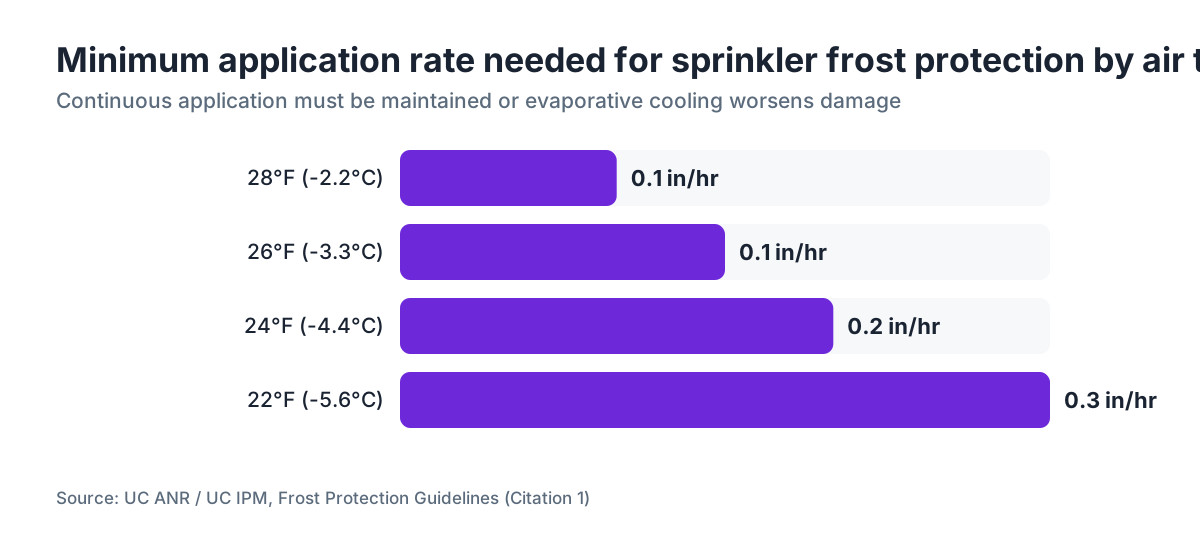
Overhead sprinklers. Water releases latent heat as it freezes (about 144 BTUs per pound), holding tissue at 32°F as long as ice keeps forming and the application rate keeps pace with the cold. You need roughly 0.1 inches per hour at 28°F, and that climbs steeply as it drops: 0.15 in/hr at 26°F, 0.3 in/hr at 22°F. [1] This wants a water source with enough volume and pressure to run all night. It works during both radiation and advection events. Here's the trap: stop applying while tissue is still below 32°F and evaporative cooling kills more than doing nothing would.
Heaters. Return-stack or radiant heaters (propane or fuel oil) warm the air directly. They're labor-heavy and need enough units per acre to matter (historically 25-30 per acre for older smudge-pot style, fewer for modern return-stack designs). They work in advective frosts where wind machines fail. Propane prices have made large-scale heater operations costly to run.
Under-vine heating cables or buried pipe. More common in ultra-premium blocks and European AOC vineyards than in broad American practice. Upfront cost is high. They fight radiation frost by warming the soil and the air around the cordon.
Helicopters. A helicopter mixes the inversion the same way a wind machine does. Cost runs around $400-$800 per hour, and on a standby contract you pay whether the frost hits or not. Practical for small or terrain-tough blocks that can't hold a tower. Noise and neighbor relations are real.
Site selection is the zero-cost method that beats them all for new plantings. Cold air drains downhill like water and pools in low spots, swales, and behind windbreaks. A 50-foot rise on a slope can mean 3-5°F warmer minimums on a radiation frost night. Put your most frost-sensitive varieties on slopes with clean cold-air drainage. Extension programs at UC Davis and WSU call this the foundation of any frost plan, and they're right. [4][5]
How do wind machines perform compared to sprinklers and heaters?
The honest answer is it depends on the frost you mostly get. Wind machines dominate radiation frost and do nearly nothing in advection. Sprinklers and heaters cover both but cost more to run.
| Method | Radiation frost | Advection frost | Coverage per unit | Capital cost | Operating cost per event |
|---|---|---|---|---|---|
| Wind machine | Excellent | Poor | 10-30 acres | $15,000-$30,000 | Low |
| Overhead sprinkler | Good | Good | Depends on system | $1,500-$3,500/acre installed | Moderate (water, pumping) |
| Propane heaters | Good | Good | 1-3 acres per unit cluster | $50-$200/unit | High (fuel) |
| Helicopter | Good | Poor | 20-40 acres per flight | None (contract) | $400-$800/hr |
| Under-vine heat | Good | Limited | Block-by-block | Very high | Moderate |
These are general industry ranges. Sprinkler installation swings hard with water source distance, pump size, and whether you're retrofitting an existing drip line or building dedicated frost plumbing from scratch.
Most California coast range and Central Valley producers see radiation frosts 80-90% of the time, so a wind machine plus a monitoring system is the standard answer. Willamette Valley growers who catch advective Arctic outflows lean harder on a sprinkler system or heater backup. Cornell's viticulture program is blunt that no single method protects the Finger Lakes reliably across the range of event types it faces. [2]
How do you know a frost event is coming in time to act?
Monitoring is where most frost losses actually happen. The vine doesn't care that the forecast said 33°F. It cares what the temperature was at bud height in your specific block at 4 a.m.
Commercial weather station networks (Davis Instruments, Onset HOBO, Campbell Scientific) place sensors at several canopy heights, log at 5-minute intervals, and fire SMS or email alerts when temperature crosses a threshold you set. [6] A station with alerting runs roughly $500-$1,500 for the hardware, depending on sensor count and connectivity.
Wet bulb temperature matters as much as dry bulb for sprinkler timing. Sprinklers have to be running before tissue temperature reaches 32°F. Wait for the dry bulb to hit 32°F before you flip the pump on and you're already late. A common rule of thumb: start sprinklers when the wet bulb hits 34-35°F. [1]
The National Weather Service issues frost and freeze advisories for ag areas, but the grid covers many square miles. Your block might sit 4°F colder than the nearest NWS observation point because of local drainage. Your own station data beats any regional forecast for the call you make at 3 a.m.
Run multiple blocks at different elevations? Log data from at least three positions across one to two full seasons. That's what tells you which blocks need active protection and which coast on site advantage alone.
What does frost protection equipment actually cost, and what's the ROI calculation?
The math works only when you put a number on what you're protecting. Start there, not with equipment brochures.
A 20-acre block yielding 4 tons per acre at $800 per ton (a modest price for most wine grapes) carries $64,000 in potential annual gross revenue. One total frost loss wipes that out. A single wind machine at $25,000 installed, amortized over 15 years, costs roughly $1,700 a year before fuel. On that block, breakeven is less than one partial loss event every three years.
Premium varieties tilt the math harder toward active protection. An acre of Pinot Noir or Chardonnay in an established Willamette Valley or Sonoma vineyard can carry $4,000-$8,000 in fruit value per acre. One severe spring frost in an unprotected block can set you back multiple seasons, because secondary buds often produce less than half the crop of primary buds.
Timing drives the ROI too. A frost at half-inch budbreak hurts more than one at tight cluster because shoot recovery is harder. A frost at bloom is often a disaster: secondary flowers set fewer berries, and in cooler climates secondary clusters may never ripen.
Nobody has great industry-wide numbers on average annual frost losses across U.S. wine grape acreage. The closest systematic tracking comes from USDA's National Agricultural Statistics Service crop loss data and USDA Risk Management Agency records for insured vineyards, but both aggregate across events and don't cleanly separate frost from other perils. [10][7] USDA Multi-Peril Crop Insurance does cover freeze loss for wine grapes in most production counties, and the premiums are priced by regional frost risk, which gives you one more read on how often your area historically gets hit.
How does site selection reduce frost risk before you plant?
Site selection is the highest-leverage frost decision you'll ever make. You make it once, and it works every spring for the 30-to-50-year life of the vineyard.
Cold air is denser than warm air. It flows downhill and pools against fences, hedgerows, roads, buildings, and the bottom of slopes. A classic frost pocket forms wherever drainage is blocked. UC Davis viticulture extension documents the effect plainly: a block at the bottom of a slope with a road or windbreak across the drainage path can sit 5-8°F colder on a radiation frost night than a block 50 feet higher on the same hillside. [4]
East and southeast-facing slopes warm faster after a cold night, which cuts how long tissue stays below the critical temperature. South and west aspects in the Northern Hemisphere tend to bring warmer overall growing conditions but don't necessarily drain cold air better. That depends on the terrain below them.
Water bodies moderate the extremes. The Finger Lakes and Lake Erie in New York, Lake Michigan, and Puget Sound in Washington all build mesoclimates that push last frost dates weeks earlier than inland sites at the same latitude. [2]
For existing vineyards you can't move, canopy height still helps. Low-trained vines (bilateral cordon at 24 inches) keep buds in the cold layer near the soil. High trunk systems at 36 inches or above can lift the bud zone above the coldest air stratum on radiation frost nights. The gain is usually 1-3°F, often enough to dodge damage at a 28-29°F event.
What are the worker safety and regulatory requirements for frost protection operations?
Frost work happens at night, in cold and wet, with machinery running. The hazard is real and so is the paperwork.
The EPA Worker Protection Standard (WPS) applies whenever any pesticide (fungicide or herbicide included) has been applied and a restricted entry interval is still in effect. Running wind machines or sprinklers during a WPS REI isn't itself a violation, but a worker entering the treated area is, unless that worker has handler training and the right PPE. Frost events that need someone lighting or repositioning heaters put people in the field. Keep your REI records current. EPA guidance states the standard is "designed to reduce the risk of pesticide poisoning and injury among agricultural workers and pesticide handlers." [8]
OSHA general industry and agricultural standards cover equipment operation. Wind machine towers need safe climbing access for anyone doing inspections. Propane heater handling carries storage and transport rules under DOT regulations.
California growers answer to the California Department of Pesticide Regulation and county agricultural commissioners, who add oversight of heater operations, especially where air quality districts restrict open burning. Several San Joaquin Valley air districts have banned or restricted traditional return-stack heaters during high-pollution periods. Call your local air quality management district before you buy any heater inventory. [9]
Records matter for crop insurance claims and, more and more, for buyers who ask for production records. Log the date, time, temperatures observed, equipment run time, water volume applied, and fuel used. That gives you documentation for an adjuster and the history to sharpen your protocols. A field operations platform like VitiScribe logs frost events alongside spray records and equipment maintenance, so it's all in one place for compliance and claim support.
WSU's viticulture extension program has published guidance on frost event documentation as part of GAP (Good Agricultural Practices) compliance for wineries pursuing food safety certification under the Food Safety Modernization Act. [5]
Can delayed pruning or variety selection reduce frost risk?
Yes to both. These are real tools, not theory.
Delayed pruning (sometimes called double pruning) goes like this. You make a rough pre-pruning pass in late winter, leaving more canes than you'll keep. Then you wait for the early-breaking buds on those sacrificial canes to push. Once they've cleared the highest-risk window or been killed off, you go back for the final pruning. The buds on your selected canes are often 1-2 weeks behind the pre-pruned material and may have dodged the worst.
The cost is labor, roughly 30-50% more hours per acre for two passes instead of one. It fits vineyards with a clear history of one or two damaging events per decade, where the labor buys real insurance. For sites that see frost risk every single year, it stops working as a primary strategy.
Variety selection is the long game. Late-budding varieties like Cabernet Sauvignon, Grenache, and Mourvèdre break dormancy weeks after early ones like Chardonnay, Merlot, or Pinot Noir. In marginal frost climates, planting late-breakers is direct risk reduction. UC Davis extension tables on variety budbreak timing by accumulated growing degree days give you a solid starting point for comparing varieties on a single site. [4]
Rootstock nudges budbreak timing too, though the effect is smaller than variety. Some clones within a variety bud later than others. If you're replanting a chronic frost block, that level of selection detail is worth a conversation with your nursery.
How do you run overhead sprinklers for frost protection without causing more damage?
Sprinklers are the method most likely to cause catastrophic damage when you run them wrong. The physics doesn't forgive.
The principle: freezing water releases 144 BTUs per pound of latent heat. As long as water keeps freezing on the tissue, the tissue stays at or very near 32°F. But if application stops while temperature is still below 32°F, evaporative cooling drops tissue temperature below the surrounding air, sometimes by 2-4°F. Worse than no treatment.
Application rate climbs steeply as temperature falls. WSU extension data and the UC IPM guidelines both reference rate tables showing roughly 0.1 in/hr sufficient at 28°F ambient, about 0.2 in/hr needed at 25°F, and at 22°F or below most standard systems simply can't keep up. Sprinklers may not be viable at that point. [1][5]
Distribution uniformity matters a lot. A system with a Christiansen uniformity coefficient below 80% leaves dry spots where ice buildup fails and tissue cooks. Get a system audit if your install is old.
Ice load is the other hazard. A long or severe event can pile hundreds of pounds of ice on vines and wire, snapping cordons and pulling staples. Heavier gauge wire or a dual-wire cordon and good canopy distribution cut that risk but don't erase it. After a sprinkler event, walk every row before you assume everything held.
One more thing. You need a water source that won't run dry at 3 a.m. Size your pump and reservoir for the worst realistic event at your site. Running a pump into cavitation because the pond ran low is expensive, and it leaves vines exposed at the exact wrong moment.
What do growers in specific high-risk regions do differently?
Regional practice tracks frost type, regulations, and crop value. Here's how the big wine regions actually handle it.
Willamette Valley, Oregon. The valley gets both radiation and occasional advective frosts. Most established estates run overhead sprinklers as primary protection, with some adding wind machines on blocks with real inversion potential. The OSU extension network reports heavy investment in on-vineyard weather station networks after severe frost events in 2008 and 2012. [11]
Napa and Sonoma, California. Radiation frost dominates. Wind machines are the primary tool for most mid-valley operations, with sprinklers common on valley floor blocks that have water access. Air quality constraints limit heater use in some areas. Growers on mountain winery sites and hillside blocks often have better natural drainage and less frost than valley floor neighbors at the same latitude.
Finger Lakes, New York. Lake effect moderates the worst cold, but spring frost risk runs high for early-budding varieties. Cornell viticulture extension has documented that Chardonnay and Riesling are the most frost-exposed varieties in the region. Wind machines run on some estates, but the broken terrain limits coverage. Sprinklers show up where water access allows. [2]
Central Coast California (Paso Robles and south). Inland Paso Robles and south coast winery operations see more frost nights than coastal growers because of continental air influence. Radiation frost with clear inversion potential makes wind machines effective. Some Paso Robles wineries with elevation on the eastern hills report rarely needing active protection at all.
How should you document frost events for insurance and compliance purposes?
Crop insurance adjusters and buyers who require GAP documentation want the same thing: a clear, time-stamped record of what happened, what you did, and what the outcome was.
At minimum, log the date and start/end time of each event, temperature readings at bud height every 30-60 minutes during the event (from your station), equipment activated (which wind machines, which sprinkler zones, fuel burned), observable damage (percentage of shoots affected, hardest-hit blocks), and the follow-up assessment date with a damage estimate.
The USDA Risk Management Agency requires timely notice of loss, generally within 72 hours of becoming aware of damage, for Multi-Peril Crop Insurance claims. [7] Waiting until harvest to document a spring frost is a claim-killer. Submit notice right away, even while you're still assessing severity.
In California, the county agricultural commissioner's pesticide use reporting system doesn't require you to report frost protection activities. But if you applied any pesticide immediately before or after a frost event and workers entered during an REI, those records have to be current. [9]
Digital record-keeping beats paper here. A platform like VitiScribe keeps time-stamped frost logs next to your spray records, so pulling documentation for an adjuster or a GAP audit doesn't mean reconstructing events from memory weeks later.
WSU extension guidance suggests attaching weather station export files straight to event records instead of transcribing temperatures by hand. An automated export is harder to dispute and takes three minutes instead of an hour. [5]
Frequently asked questions
At what temperature do grapevine buds get damaged by frost?
Bud damage starts at about 28°F (-2.2°C) at half-inch budbreak, with most primary shoot tissue killed below 26°F (-3.3°C). Bloom-stage tissue is slightly more sensitive, taking damage at 29-30°F. Dormant mid-winter buds tolerate far colder, sometimes below -10°F (-23°C) for cold-hardy varieties, but that hardiness disappears within days of visible budbreak.
How many acres does one wind machine protect in a vineyard?
One wind machine typically covers 10 to 30 acres, depending on terrain, planting density, and obstruction by hills or windbreaks. Flat open sites with clear inversion potential get the most coverage. Broken terrain or trees on the upwind side can drop that to 8-10 effective acres. Manufacturers publish coverage estimates, but local trials or a neighbor's experience in your area beat spec sheets.
What is the difference between radiation frost and advection frost in vineyards?
Radiation frost happens on calm, clear nights when soil and plant surfaces radiate heat into a cold sky, often leaving warmer air 30-50 feet above the canopy. Wind machines exploit that warm layer. Advection frost arrives with a moving cold air mass, often with wind, and no inversion forms. Wind machines do very little during advective events. Sprinklers and heaters are the practical options when cold air is moving rather than settling.
Can you use sprinklers for frost protection if you don't have a large water supply?
Not safely. Sprinkler protection needs continuous application of at least 0.1 inches per hour at 28°F, climbing sharply as temperature drops. If your pump or pond runs low and application stops while temperatures sit below 32°F, evaporative cooling drops tissue temperature below the ambient air, making damage worse than no protection. Size your water supply and pump for the coldest realistic event before committing to this method.
Does delayed pruning actually work to reduce frost injury?
Yes, with caveats. A rough first pruning in late winter leaves sacrificial canes whose buds break early. You finish pruning after those early buds clear peak risk or get hit. The remaining buds break 1-2 weeks later. The downside is 30-50% more labor hours per acre for two passes. It fits vineyards with infrequent but severe frost events, not sites that see late frost risk every single year.
Which grape varieties are most resistant to spring frost damage?
Late-budding varieties offer the most natural frost avoidance. Cabernet Sauvignon, Grenache, Mourvèdre, and Carignan typically break dormancy 2-4 weeks later than Chardonnay, Pinot Noir, or Merlot. In frost-prone sites, that timing gap can be the difference between a full crop and total loss. UC Davis extension tables on variety budbreak by growing degree day accumulation help you compare options for a specific site's spring temperature pattern.
What worker safety rules apply during vineyard frost protection at night?
EPA Worker Protection Standard rules apply if a pesticide with an active REI has been applied. Workers entering during a frost event to light heaters or move equipment must meet those REI and PPE requirements. OSHA agricultural standards cover equipment operation. California growers also face air quality district rules restricting certain heater types. Always check local air district regulations before purchasing heater equipment.
How much does a vineyard frost monitoring weather station cost?
Basic on-site stations with temperature logging and SMS alerting cost roughly $500-$1,500, depending on sensor count, connectivity (cellular vs. Wi-Fi), and brand. Systems from Davis Instruments, Onset HOBO, and Campbell Scientific cover the practical range for vineyard use. Ongoing cost is usually a data subscription of $10-$50 per month for cloud logging and alerting. The hardware pays back fast if it catches one event you'd otherwise miss.
Does grape vine training height affect frost susceptibility?
Yes, meaningfully. On radiation frost nights, the coldest air layer often sits within 18-24 inches of the soil. Raising the cordon from 24 inches to 36-40 inches can lift the bud zone 1-3°F above the coldest air stratum. That won't replace active protection in severe events, but it cuts the number of nights needing intervention and improves survival in mild events that would otherwise cause partial damage.
What records do I need for a frost crop insurance claim?
USDA Multi-Peril Crop Insurance requires notice of loss within 72 hours of discovering damage. Useful supporting documentation includes time-stamped temperature logs from an on-vineyard station, equipment operation records (wind machine run times, sprinkler zone logs, fuel burned), a post-event damage assessment with percentage of shoots affected by block, and photos with GPS coordinates and timestamps. Documentation reconstructed from memory doesn't hold up with adjusters.
Are propane heaters still a viable frost protection option in California?
In parts of California, open-burning heaters are heavily restricted or banned by local air quality management districts, especially in the San Joaquin Valley. Modern return-stack heaters produce less particulate than older smudge pots, but you have to confirm compliance with your specific air district before buying or operating them. Heaters remain viable in many areas but require checking current district rules, which change periodically. Contact your county ag commissioner for the current status.
How does site selection reduce frost risk in a new vineyard planting?
Cold air drains downhill like water and pools in low spots, against windbreaks, roads, and structures. A block 50 feet higher on a slope can run 3-8°F warmer on a radiation frost night than a valley floor block of the same variety. Slopes with unobstructed cold-air drainage, proximity to moderating water bodies, and an east or southeast aspect for faster morning warming all cut active protection needs over the vineyard's life. Site selection is the only frost tool with zero ongoing cost.
What role do helicopters play in vineyard frost protection?
Helicopters mix the warmer inversion layer into cold canopy air, the same principle as a wind machine but without permanent infrastructure. Cost runs $400-$800 per hour on standby contracts, depending on region. They fit small, isolated, or terrain-complex blocks where installing a wind machine tower is impractical. They work only during radiation frosts with a clear inversion. Noise and neighbor relations can be an issue, and not every area has agricultural helicopter services available on short notice.
How do I calculate whether frost protection equipment investment is worth it for my vineyard?
Start with your block's annual gross revenue potential: tons per acre times price per ton times acreage. A total loss wipes that out. A wind machine at $25,000 amortized over 15 years costs roughly $1,700 a year before fuel. If your frost risk is realistic even once every five years, the economics favor protection. For premium varieties at $4,000-$8,000 per acre value, breakeven comes faster. Factor in any crop insurance premium reduction too.
Sources
- UC ANR / UC IPM - Frost Protection for Citrus and Other Tender Perennial Crops (application rate and temperature threshold tables applicable to wine grapes): Grapevine bud damage begins at 28°F at half-inch budbreak; sprinkler application rates needed at various temperatures (0.1 in/hr at 28°F, increasing sharply below 26°F).
- Cornell University Extension - Viticulture and Enology, Frost and Freeze Protection for New York Vineyards: Highest frost risk window in Finger Lakes runs April into May; Chardonnay and Riesling most exposed; no single protection method adequate across event types.
- NOAA National Centers for Environmental Information - Cooperative Observer Network: Historical temperature records at NOAA cooperative stations used to assess local frost frequency and severity.
- UC Davis / UC Agriculture and Natural Resources - Viticulture Extension, Site Selection and Frost Management: Wind machine inversion requirements, site selection frost drainage effect (5-8°F difference by elevation), and variety budbreak timing tables.
- Washington State University Extension - Viticulture and Enology, Frost Protection in Pacific Northwest Vineyards: Application rate requirements, documentation guidance, and advective vs. radiation frost management approaches for Pacific Northwest conditions.
- Onset HOBO Data Loggers - Agricultural Monitoring Systems: On-vineyard weather station hardware cost range and 5-minute logging capability for frost monitoring.
- USDA Risk Management Agency - Multi-Peril Crop Insurance for Wine Grapes: 72-hour notice of loss requirement for Multi-Peril Crop Insurance; freeze listed as covered peril for wine grapes in most production counties.
- EPA - Agricultural Worker Protection Standard (40 CFR Part 170): WPS restricts worker entry during active REIs; the standard is designed to reduce the risk of pesticide poisoning and injury among agricultural workers and handlers; workers entering treated vineyards during frost operations must have handler training and appropriate PPE.
- California Department of Pesticide Regulation - Pesticide Use Reporting: California county agricultural commissioners oversee pesticide use reporting and heater operation compliance; air quality districts restrict certain heater types in San Joaquin Valley.
- USDA National Agricultural Statistics Service - Crop Loss Data: USDA NASS tracks aggregate crop losses including freeze events; systematic frost-specific loss data across U.S. wine grape acreage not separated cleanly from other perils.
- Oregon State University Extension Service - Viticulture, Willamette Valley Frost Event Documentation: Significant investment in on-vineyard weather station networks in Oregon following severe frost events in 2008 and 2012.
Last updated 2026-07-09