Copper spray in the vineyard: what actually works

TL;DR
- Copper fungicides (bordeaux mixture, copper hydroxide, copper octanoate) protect grapevines against downy mildew, Botrytis, and bacterial diseases.
- The EPA caps copper at 6 lb of metallic copper per acre per year on most labels.
- Timing beats rate: spray at 2 to 4 inches of shoot growth, before and after rains, and around bloom.
- Organic growers can use copper, but the same annual cap applies.
Why do vineyard managers spray copper in the first place?
Copper ions kill fungal and bacterial pathogens by denaturing their enzymes and wrecking their cell membranes. In the vineyard, the targets are downy mildew (Plasmopara viticola), bunch rots including Botrytis cinerea, and bacterial problems like crown gall. Copper is purely protectant. It has to be sitting on the leaf before spores land and germinate. Once an infection is underway, copper does almost nothing.
That's the one fact about copper you cannot forget. Timing is everything. Spray a day after a major infection event and you've basically thrown the product on the ground.
Growers have used copper on grapes since the 1880s, when French researchers noticed that vines dusted with a copper-lime mix along roadsides stayed clean while untreated blocks got flattened by downy mildew. That accidental roadside observation became Bordeaux mixture, and the chemistry has shaped viticulture ever since [1].
Today both conventional and certified organic vineyards lean on copper. It's one of the few active ingredients approved under the USDA National Organic Program that actually works against downy mildew. That makes it hard to replace for organic growers, even as concern over copper piling up in soils has pushed the whole industry toward lower rates and sharper timing.
What diseases does copper fungicide control in grapevines?
Copper earns its keep on four diseases, and it's worthless on a fifth. Downy mildew is the big one. Phomopsis and bunch rots follow. Powdery mildew is the one where copper simply doesn't work.
Downy mildew is the main reason most growers reach for copper. Plasmopara viticola is an oomycete (a water mold, not a true fungus) that can wreck shoots, leaves, and clusters within days of a major infection event during warm, wet weather [2]. Copper is reliably effective as a protectant at labeled rates.
Botrytis bunch rot (Botrytis cinerea) responds only moderately to copper. Dedicated botryticides like fenhexamid or pyrimethanil control it better at the timings that matter. Copper still pulls its weight in a rotation, though, especially early on shoots and leaves.
Phomopsis cane and leaf spot is the disease growers forget about. Early copper sprays, timed from budbreak through 4-inch shoot growth, suppress Phomopsis viticola, which overwinters in infected wood and colonizes young tissue during wet springs [3].
Powdery mildew (Uncinula necator) is where copper falls flat. Don't count on it. Use sulfur, DMIs (sterol inhibitors), QoI fungicides, or another registered chemistry for powdery.
Some growers also spray copper against bacterial canker and early-season Eutypa, but the evidence there is thin. The strongest case for copper is always downy mildew and Phomopsis. That's where your money comes back.
How much copper can you legally apply per acre per year?
The cap is 6 pounds of metallic copper per acre per year on most copper labels registered for grapes [4]. That's metallic copper equivalent, not the weight of the formulated product. Miss that distinction and you can blow past the limit without knowing it.
This is where a lot of growers get burned, because the limit is real and it's enforced. Different copper compounds contain different percentages of metallic copper, so you have to run the math for the specific product in your tank.
The European Union went harder. It capped copper at 4 kg (about 8.8 lb) per hectare over 7 years, roughly 0.57 kg/ha/year, in its 2018 copper regulation revision. The EU annual figure is stricter than the U.S. per-year label limit, though the comparison isn't clean because the EU averages differently [5].
For USDA-certified organic operations here, the National Organic Program requires that copper use be documented and that you work to hold down accumulation over time. There's no separate annual cap written into the NOP rule itself, but the EPA label limit still governs, and certifiers increasingly want records showing you track cumulative applications.
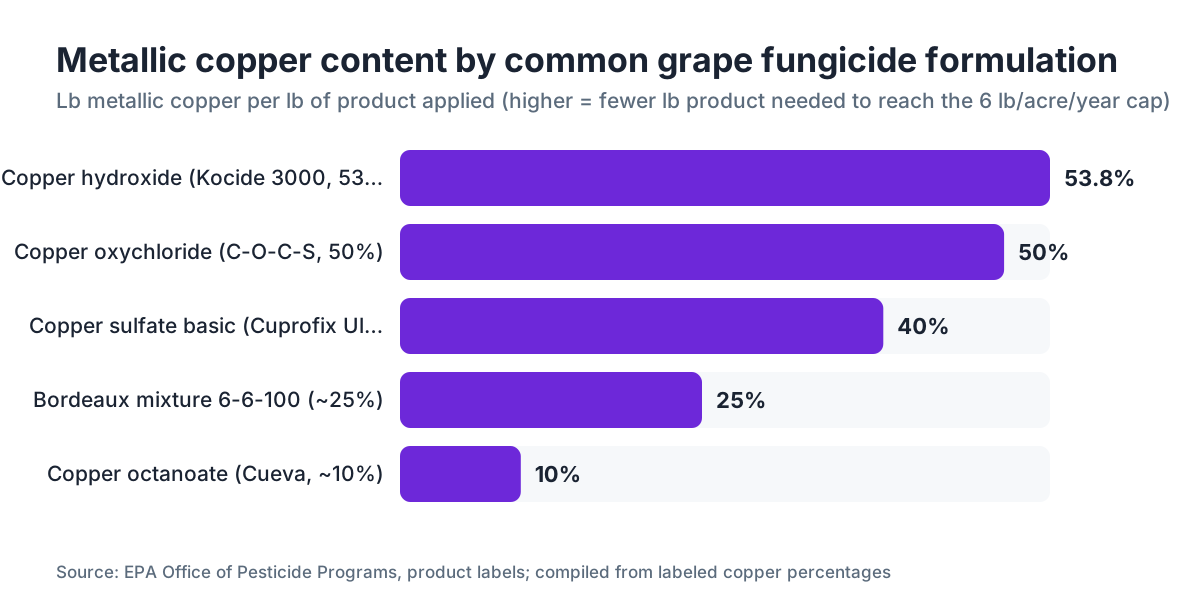
Here's the conversion table for common formulations:
| Formulation | % Metallic Cu | Lb metallic Cu per lb product |
|---|---|---|
| Bordeaux mixture (6-6-100) | ~25% Cu by weight | ~0.25 |
| Copper hydroxide (e.g., Kocide 3000 53.8%) | 53.8% | 0.538 |
| Copper sulfate (basic) (e.g., Cuprofix Ultra 40D) | 40% | 0.40 |
| Copper octanoate (e.g., Cueva 10%) | 10% | 0.10 |
| Copper oxychloride (e.g., C-O-C-S WDG) | 50% | 0.50 |
Apply 4 lb/acre of Kocide 3000 and you've used 2.15 lb of metallic Cu per acre (4 x 0.538). Do that four times and you're at 8.6 lb, well over the 6 lb cap. That's the arithmetic that surprises people every season.
Keep a running tally. Seriously. It's the kind of thing that's easy to skip mid-spray-season and brutal to reconstruct after the fact.
When is the best time to apply copper in the vineyard?
The copper calendar follows disease pressure, not the date on the wall. Four timings earn their keep in almost every program: the Phomopsis window at budbreak, the first downy mildew spray around 4 to 6 inches, the pre-bloom to post-bloom stretch, and a post-harvest application before leaves drop.
Budbreak to 2-inch shoot growth. This is your Phomopsis window. One well-timed copper spray at this stage, especially in a wet spring, pays off in fewer cane infections and cleaner fruit later. WSU extension guidance calls out this exact timing for Phomopsis control in Pacific Northwest vineyards [3].
4 to 6 inch shoot growth. Downy mildew risk starts here once soil temperature climbs above 50 degrees F and you've had rain. This is usually the first spray aimed squarely at downy mildew.
Pre-bloom (5 to 10% cap fall) through just after bloom. High infection risk for both downy mildew on clusters and Botrytis. Clusters are most vulnerable right around bloom and stay that way until berries touch. Cornell's extension team recommends holding a copper or copper-plus-mancozeb program through this window in Eastern regions with real downy pressure [2].
Post-harvest, before leaf fall. In aggressive downy mildew country (most of the East Coast, the Pacific Coast in wet years), a late spray protects leaves while the vine is still pushing carbohydrates into canes and trunk. Healthy leaves in that window mean a healthier vine next spring.
Between those anchors, you reapply based on rain and the forecast models your local extension service runs. The Goidanich Rule of 10 (spray when temperature times humidity hours crosses a threshold) is old but still handy as a rough gauge. NEWA (Network for Environment and Weather Applications, run by Cornell) gives downy mildew infection risk alerts you can tie straight to spray decisions [6].
Rain washoff is the other driver. Copper sticks fairly well but starts losing punch after about 1 inch of rain. The threshold most advisors use: more than 1 to 1.5 inches, reapply during high-risk periods no matter how recently you sprayed.
What copper formulation should you choose?
There's no single right answer, and anyone selling you one is oversimplifying. Your pick depends on disease pressure, your rotation, organic status, and how much material you feel like hauling through the block.
Bordeaux mixture (copper sulfate plus hydrated lime) is the original. It's cheap, it works, and it leaves a blue film you can actually see on the canopy. The catch: you mix it yourself, it clogs screens, and it burns tender shoots if you botch the ratios. In wet, disease-prone regions some growers still swear by it against downy. A standard 6-6-100 mix (6 lb copper sulfate, 6 lb lime, 100 gallons water) delivers about 1.5 lb metallic Cu per 100 gallons.
Copper hydroxide products (Kocide 3000, Champion WP, others) are the workhorses of most commercial programs. They come as wettable powders or dispersible granules, stay suspended in the tank, and deliver reliable control. Kocide 3000 at 53.8% metallic Cu is one of the more concentrated options, so per-acre rates run lower by weight, which trims phytotoxicity risk.
Copper octanoate (Cueva, Previsto) carries only about 10% metallic copper, so you need more product volume to hit the same metallic Cu rate. It's gentler on foliage, though, and often has a different re-entry interval on the label. Some organic programs favor it in sensitive windows.
Copper oxychloride products (C-O-C-S, others) sit in the middle on both activity and burn risk. Common in Europe, less so in the U.S.
One point that gets skipped: particle size drives both efficacy and burn. Smaller particles mean more surface area and better contact activity, but also more chance of scorching foliage under hot, dry conditions after application. The newer micro-encapsulated and nano-copper formulations under study at several university programs aim at that tradeoff, but they aren't widely on the market yet.
For most conventionally run California or Northwest vineyards with moderate downy pressure, a copper hydroxide product like Kocide at 0.75 to 1.5 lb/acre (actual product) sprayed 3 to 5 times a season keeps you comfortably under the cap while giving solid protection. Track it through a system that calculates metallic Cu for you. VitiScribe's spray record module does that conversion automatically, which matters when you're juggling multiple blocks and multiple products.
What are the risks of copper to vine health and soil?
Copper is toxic to plants at high rates. Full stop. This is not a soft warning.
Phytotoxicity usually shows up as leaf burn, worst on young shoots in hot weather after a spray that dried fast. Classic scenario: you spray Bordeaux in the morning, it hits 95 degrees F by afternoon, and the next day your shoot tips have necrotic margins. The lime in Bordeaux buffers this a bit, which is part of why the formula included lime from day one. Modern formulations can still burn at too-high rates, in hot conditions, or on stressed vines.
The longer game is soil accumulation, and it's the bigger worry. Copper doesn't degrade. Every pound you apply stays in the top few inches of soil unless it leaches (copper mostly resists that) or you actively remediate. After decades of annual sprays, many European vineyard soils, especially in Bordeaux and Burgundy, run above 100 mg/kg copper, and some sites top 300 mg/kg in the top 10 cm [5]. At those levels copper turns toxic to earthworms and beneficial soil microbes, including the mycorrhizal fungi that feed vine roots.
U.S. vineyard soils generally aren't that extreme, because American vineyards are younger and modern labels cap annual rates. But older California and New York sites, where Bordeaux went on heavy for decades, can show elevated topsoil copper. Run a baseline soil test if you've taken over a property with a long spray history.
To hold accumulation down: spray the minimum effective rate, rotate to non-copper materials during low-risk stretches (copper isn't your only downy option; phosphonates, cymoxanil, and mancozeb all help), and build organic matter with cover crops, which binds copper and cuts its bioavailability.
What are the re-entry interval and worker safety requirements for copper?
Most copper products on grapes carry a 24-hour restricted-entry interval under the EPA Worker Protection Standard, though some drop to 4 hours under specific low-exposure conditions listed on the label [7]. Copper is no exception to the rule; the WPS covers every agricultural pesticide.
Always read the specific product label, because this is one place where labels split. Some copper products allow the shorter 4-hour REI only when the material is dry and dust exposure is low.
The WPS requires annual pesticide safety training for workers and handlers, posting of treated areas (or notification through a central system), and decontamination supplies in the field. For copper, handlers who mix, load, and apply must wear at minimum: chemical-resistant gloves, protective eyewear, long sleeves and pants, and shoes with socks. Some labels add a respirator for mixing and loading because of dust inhalation risk.
The WPS revision that took full effect in 2017 added designated-representative access to application records and made owner-operators responsible for keeping trained workers out of treated areas during the REI [7].
In practice: post your applications, tell your crew the REIs, and keep the paper. In California, pesticide application records also go to the county agricultural commissioner under the California Department of Pesticide Regulation system, and copper applications above certain acreage thresholds trigger extra reporting [8]. Other states run their own frameworks. Check your department of agriculture.
Every spray record should capture: date, product name and EPA registration number, application rate (product and metallic Cu per acre), field or block ID, crop growth stage, applicator name, and REI posted. That record is a legal document, so treat it like one.
How do you apply copper spray correctly for coverage and efficacy?
Coverage is the whole game. Copper doesn't move systemically, so any surface you miss is a surface with no protection. Get the material onto every leaf and cluster face, or don't bother.
For most vineyards, an airblast sprayer calibrated to deliver 50 to 100 gallons per acre (dilute equivalent) covers a trained, full canopy well. Some research backs concentrate spraying at lower volumes if droplet size and air assist are dialed in, but that takes careful calibration, and you should verify coverage with water-sensitive paper before you trust it on high-value blocks.
Droplet size matters. Too fine (under 100 microns VMD) and you get drift, which is both a neighbor problem and wasted money. Too coarse (above 400 microns VMD) and it runs off before it penetrates. Most standard airblast nozzles at rated pressure land in the 150 to 300 micron range, which works for copper.
Canopy density is the real variable. Dense, wire-trained high-cordon systems are notoriously hard to penetrate. Above 10 to 12 shoots per foot of row, no sprayer gives you reliable internal coverage. Pulling basal leaves before bloom doesn't only help fruit set and disease microclimate, it opens the cluster zone so spray actually reaches it. That practice pays for its labor several times over.
Time of day counts too. Spray early morning or evening, below 85 degrees F, to cut evaporation and burn risk. Keep wind under 10 mph. If you can smell copper drifting, you're losing product and building a neighbor complaint.
Tank pH affects copper stability. Bordeaux holds up at alkaline pH because the lime supplies it. Commercial copper hydroxide products are usually formulated to stay stable in the tank, but check compatibility before you mix anything else in. Some surfactants and acidifiers will knock copper out of suspension, cut efficacy, or cause burn.
Does copper spray work for organic vineyard management?
Yes, and it's the backbone of most organic downy mildew programs. The USDA National Organic Program allows copper materials for plant disease control under 7 CFR 205.601(i), with the requirement that use is documented and that you take steps to minimize accumulation [9]. The rule's language is plain: copper is permitted "as a plant disease control" provided you address buildup in the soil.
For USDA Organic and most third-party certifiers (CCOF, Oregon Tilth, others), you list copper on your organic system plan by brand name and rate, and the certifier reviews it annually. There's no separate NOP annual cap on rate, but the EPA label limit (6 lb metallic Cu/acre/year) still applies as a legal floor, and certifiers increasingly expect you to track cumulative use and show you're working toward reduction.
Copper paired with sulfur (which does handle powdery mildew) anchors most organic programs, with biofungicides like Bacillus subtilis products (Serenade) or potassium bicarbonate filling supporting roles. UC Davis Cooperative Extension has published guidance on organic wine grape production that walks through this program structure in California conditions [10].
The honest tradeoff for organic growers: you lean on copper harder than a conventional grower who can rotate systemics. That makes timing and canopy management even more important. Miss the window in a high-pressure year and copper can't bail you out the way a systemic can.
Organic paperwork also runs heavier than what most conventional growers keep. If you're farming a vineyard with both certified and non-certified blocks, split your records by block and product. It's the only way an audit goes smoothly.
How should you track copper applications for compliance?
Keep a spray record for every application that captures the fields sprayed, the product and EPA reg number, the rate per acre (product units and metallic Cu equivalents), date and time, growth stage, applicator, weather, and the REI posted. This is the unglamorous part that costs growers money when they skip it.
In states with pesticide use reporting (California is the most demanding, but many states require at least annual reports), these records feed straight into your regulatory submissions [8].
The metallic Cu conversion is where paper records collapse. Run three copper products across a season, each at different rates, and computing cumulative metallic Cu per acre by block by hand gets tedious and error-prone fast. A spreadsheet helps. Software that stores each registered product's metallic Cu percentage and sums it automatically is better.
VitiScribe builds this tracking into its spray record module. Cumulative copper accounting by block is exactly the thing that slips through a general spreadsheet, so it's worth naming. It's not the only tool out there, but if you're running more than a few blocks, you want the math done for you.
Retention rules differ by program. USDA organic records must be kept for 5 years after the operation applies for or receives certification [9]. California pesticide use reporting generally runs a 2-year retention period. Federal WPS records require 2 years minimum [7].
Keep digital copies somewhere else. A field notebook riding in the spray rig cab is not a backup.
What does the research say about copper rates and efficacy?
The research runs one direction: lower copper rates applied more often, with better timing, match the control you'd get from higher, less frequent rates, and they leave less burn and less soil loading behind. The ceiling rate doesn't buy protection. It buys copper in the dirt.
A 2016 review in Pest Management Science pulled together trials across European wine regions showing that programs applying 1.5 to 3 kg metallic Cu/ha/year (roughly 1.3 to 2.7 lb/acre/year) with good timing matched the downy mildew control of programs running 6 kg/ha/year with poor timing [5]. Same protection, less copper.
UC Cooperative Extension work in California points the same way: 2 to 3 targeted sprays at key growth stages (budbreak, pre-bloom, post-bloom) give adequate protection in moderate-pressure years, compared with calendar programs that dump more material more often [10].
The data gets murky in high-pressure years. 2019 and 2023 were both brutal downy mildew years across many California coastal regions, and growers running lean programs got hurt in some blocks. Nobody has clean data on exactly where the line sits between lean-but-adequate and lean-and-not-enough in a bad year. The best guidance available: in high-pressure years, push toward the higher end of the labeled rate without exceeding the annual cap, and never trade timing for rate.
The WSU viticulture extension team at Prosser has published Washington-specific guidance noting that downy mildew pressure in Eastern Washington runs lower than coastal regions, which allows for even more conservative copper programs in that climate [3]. California's North Coast is a different animal.
Frequently asked questions
How many times should you spray copper on grapevines per season?
Most commercial programs apply copper 3 to 6 times per season, with frequency driven by disease pressure, rainfall, and growth stage rather than a fixed schedule. High-pressure regions (North Coast California, most of the Eastern U.S.) may need 5 to 7 applications in wet years. Low-pressure regions like Eastern Washington may get by with 2 to 3 targeted sprays. Every application should be justified by a disease risk window, not the calendar.
Can copper spray damage grapevines?
Yes. Copper causes leaf burn (phytotoxicity) at high rates in hot conditions, worst on tender shoot tips or stressed vines. Risk peaks with Bordeaux mixture or copper hydroxide applied above labeled rates when temperatures top 85 to 90 degrees F. Diluting to the lower end of the label rate, skipping mid-day application in hot weather, and irrigating vines adequately before spraying all cut the risk.
Is copper spray safe around harvest?
Copper products registered on grapes carry pre-harvest intervals (PHIs) ranging from 0 to 7 days on most labels, with some listing up to 14 days. Check the specific product label. Copper residue on harvested fruit is regulated by the EPA tolerance for copper, set at 50 ppm in or on grapes under current tolerance levels. Applying at labeled rates well before harvest keeps you inside tolerance with plenty of margin.
How does copper compare to synthetic fungicides for downy mildew control?
Systemic fungicides (phosphonates, cymoxanil) have some kick-back activity and can stop an infection already in progress, while copper is purely protectant. High-pressure conventional programs often pair copper with systemics to cover both pre- and post-infection windows. For organic growers who can't use synthetics, copper's protectant activity is adequate if timing is precise. No copper formulation beats a systemic once infection has started.
What is Bordeaux mixture and how do you mix it?
Bordeaux mixture combines copper sulfate and hydrated lime in water, developed in the 1880s in France. The standard 6-6-100 formula uses 6 lb copper sulfate and 6 lb hydrated lime per 100 gallons of water. Dissolve the copper sulfate and the lime separately in equal portions of water first, then combine them. Adding copper sulfate straight into lime solution (or the reverse) without diluting each first makes an unstable mix and raises burn risk.
Does copper spray wash off after rain?
Copper has moderate rain fastness. Most extension programs recommend reapplication after 1.0 to 1.5 inches of rainfall, especially during high-risk growth stages. Copper hydroxide and copper oxychloride formulations generally stick better than Bordeaux mixture. Some labels give rain-fastness guidance based on drying time; product that dries before rain hits the canopy holds far better than product that gets rained on within an hour of application.
How do copper sprays affect soil health and earthworms in the vineyard?
Copper accumulates in topsoil and turns toxic to earthworms and mycorrhizal fungi at elevated concentrations. European vineyard soils with long Bordeaux histories have recorded copper above 100 mg/kg at some sites, where earthworm populations drop measurably. U.S. vineyards with shorter histories usually show lower accumulation. Minimizing annual load, rotating to non-copper fungicides when risk is low, and building organic matter (which binds copper) all reduce bioavailability.
What is the re-entry interval (REI) for copper fungicides on grapes?
Most copper products registered on grapes carry a 24-hour re-entry interval under EPA Worker Protection Standard rules, though some allow a 4-hour REI under specific low-exposure conditions listed on the label. Handlers mixing and loading concentrate must wear chemical-resistant gloves, protective eyewear, long-sleeved clothing, and in some cases a respirator for dry formulations. Always read the specific product label. REIs are product-specific, not chemical-class-specific.
Can you mix copper with sulfur in the same tank?
As a rule, don't tank-mix copper and sulfur together. The combination raises burn risk, especially in warm temperatures. If you want both materials in the same window, spray them separately with 7 to 14 days between applications. Some programs put copper on one block visit and sulfur on the next pass. Always check the product labels and run a small jar test before any new tank mix.
Do you need a pesticide applicator license to spray copper in a vineyard?
It varies by state. In California, applying any restricted-use pesticide requires a licensed pest control adviser recommendation and, for commercial operations, a qualified applicator license or certificate. Most copper products are general-use pesticides, which don't require a restricted-use license, but state rules for commercial agricultural applications may still apply. Check your state department of agriculture. Federal WPS compliance is required no matter your state license status.
How do organic vineyards track copper use to stay within NOP requirements?
The USDA NOP requires certified operations to keep records sufficient to show compliance with their approved organic system plan, retained for 5 years. For copper, certifiers expect documentation of product name, EPA registration number, rate per acre, date, block, and cumulative annual use. Many certifiers also ask growers to show they're working toward lower copper loading over time. A spray log that computes metallic copper per acre per block is the practical tool.
What happens if you exceed the 6 lb copper per acre per year label limit?
Exceeding the label rate violates federal pesticide law under FIFRA (Federal Insecticide, Fungicide, and Rodenticide Act). Penalties run from written warnings to fines, and for certified organic operations an exceedance can trigger decertification if the certifier decides it undermines your organic plan. California's county agricultural commissioner reporting system also flags exceedances. Most growers hit phytotoxicity or a certifier audit finding first, before any federal enforcement, but the legal liability is real.
Sources
- Cornell University Extension, Grape Disease Management: Downy Mildew: Cornell recommends maintaining copper or copper-plus-mancozeb programs through the pre-bloom to post-bloom window for downy mildew control in Eastern U.S. vineyards
- Washington State University Extension, Pacific Northwest Pest Management Handbooks: Grape: WSU extension identifies budbreak through 2-inch shoot growth as the key timing for Phomopsis control with copper in Pacific Northwest vineyards
- EPA, Office of Pesticide Programs: Copper Compounds Registration Status: The EPA caps copper fungicide use at 6 pounds of metallic copper per acre per year on most labels registered for use on grapes
- Pest Management Science, Vol. 72(8), 2016: Copper use in European viticulture and soil accumulation: A 2016 Pest Management Science review found programs applying 1.5-3 kg metallic Cu/ha/year with good timing achieved equivalent downy mildew control to programs using 6 kg/ha/year with poor timing; some European vineyard soils exceed 100 mg/kg copper in the top 10 cm
- Cornell University, Network for Environment and Weather Applications (NEWA): NEWA provides real-time downy mildew infection risk alerts for vineyards that can be used to time copper spray applications
- EPA Worker Protection Standard (40 CFR Part 170): EPA WPS requires 24-hour REI for most copper products, annual worker safety training, and records retention for 2 years minimum; designated representative access to application records required under 2017 WPS revisions
- California Department of Pesticide Regulation, Pesticide Use Reporting: California requires commercial pesticide applicators to submit pesticide use reports to county agricultural commissioners; copper applications above threshold acreage trigger mandatory reporting
- USDA National Organic Program, 7 CFR 205.601: The USDA NOP permits copper-based plant disease controls under 7 CFR 205.601(i) with documentation requirements; certified organic operations must retain records for 5 years
- UC Cooperative Extension, Organic Winegrape Production in California: UC Cooperative Extension research shows 2-3 targeted copper applications at key growth stages provide adequate downy mildew protection in California in years with moderate disease pressure
Last updated 2026-07-10