Vertical shoot positioning (VSP) trellis system: the complete grower's guide
TL;DR
- Vertical shoot positioning (VSP) trains shoots straight up between pairs of moveable foliage wires, making one flat canopy wall.
- It suits most cool-climate varieties, works with mechanical harvesters, and is the default trellis from Burgundy to the Finger Lakes.
- Aim for 12-18 shoots per meter of cordon, a fruiting zone at 70-100 cm, and establishment costs near $3,000-$6,000 per acre in the US.
What exactly is a VSP trellis system and how does it work?
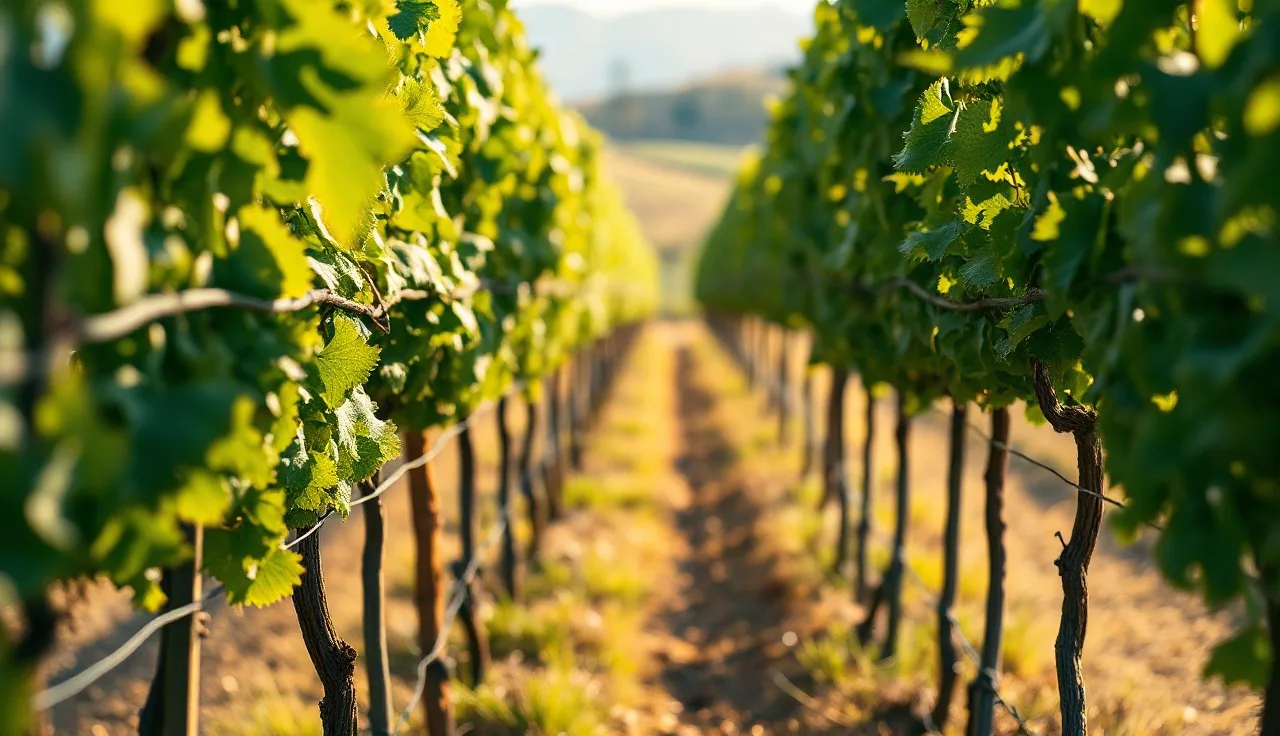
VSP stands for vertical shoot positioning. The system trains each season's shoot growth straight up from a horizontal cordon or a low head, then holds those shoots between pairs of catch wires as they stretch through summer. The result is a thin, upright leaf wall with fruit hanging in a clean, defined zone below the lowest foliage wire, roughly 70-100 cm off the ground depending on the site.
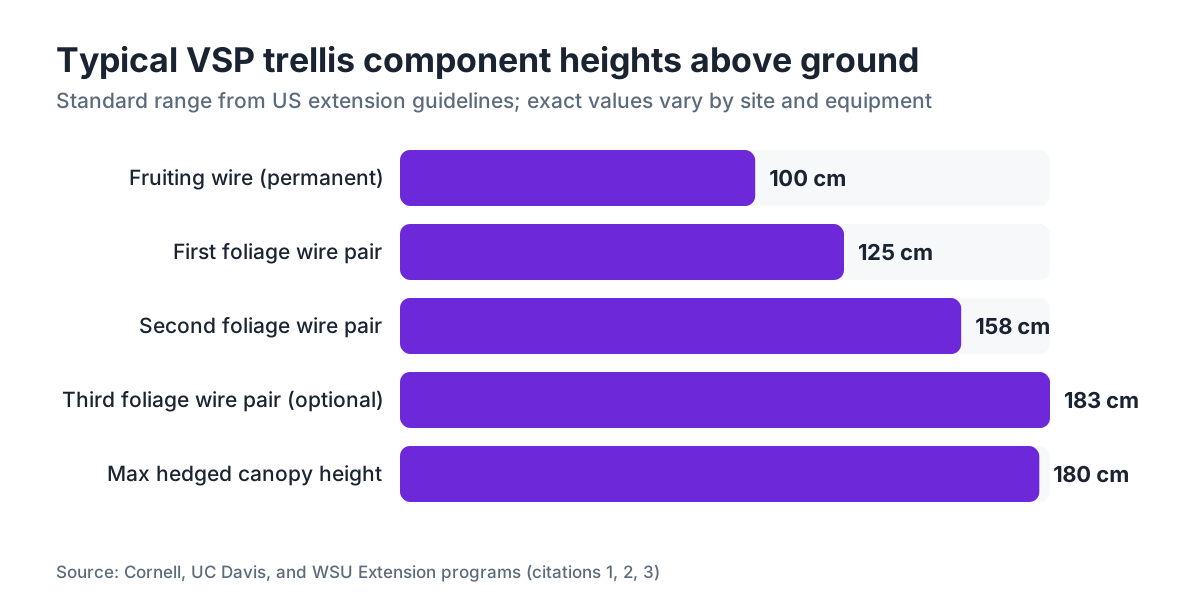
The mechanics are simple. A permanent fruiting wire, usually at 90-110 cm, carries either a bilateral cordon or trained canes. As shoots push in spring, a first pair of moveable foliage wires gets clipped or dropped around them, generally when shoots reach 30-40 cm. A second pair, sometimes a third, goes on 20-30 cm above the first as the season runs on. By the time vines hit 150-180 cm, the canopy is fully enclosed and workers or machines can pass the row without tearing it up.
The wall geometry is what makes VSP so popular. Sunlight hits both faces of the canopy through the day, air moves through the fruit zone, and every shoot is within reach for hedging. That consistency is why VSP is the baseline system at most research stations, and why extension guides from Cornell, UC Davis, and WSU all treat it as the standard other systems get measured against [1][2][3].
One thing to be clear about. VSP is not a single fixed geometry. Wire heights, cordon height, row spacing, and shoot density all shift by region, variety, and equipment. What stays constant is the orientation: shoots go up, fruit stays low, the canopy stays narrow.
Where did VSP come from, and which regions use it most?
Training shoots vertically against wires goes back to 19th-century European viticulture. The term 'vertical shoot positioning' became standard in North American literature largely through work at Cornell and through Richard Smart's 1991 book 'Sunlight into Wine,' which measured canopy microclimate in a way that gave growers a real basis for choosing a trellis [4].
Today VSP is the dominant system across Bordeaux, Burgundy, Champagne, the Finger Lakes, the Willamette Valley, most of New Zealand, and much of California's North Coast. In cool climates with moderate vigor, it fits almost every situation. In hotter, higher-vigor sites like parts of the San Joaquin Valley or Australia's Riverland, it tends to make overcrowded canopies unless rows are wide and shoot loads are managed hard.
The Willamette Valley shows the fit well. Pinot Noir there is almost all VSP, with cordons at 90-100 cm and row spacing usually 1.5-1.8 m. Growers went VSP in part because narrow rows allow high vine density (2,000+ vines per acre) while keeping canopy work manageable. The same system in Paso Robles at the same density, in a hot year, makes heavy shade and higher disease pressure unless summer hedging is aggressive. Visit Paso Robles wineries to see how that region's growers have adapted.
What are the standard wire heights and spacing for a VSP setup?
Here are the parameters you'll see in extension literature, though regional conventions vary:
| Wire / Component | Typical height above ground | Notes |
|---|---|---|
| Fruiting wire (permanent) | 90-110 cm | Some growers run 80 cm for mechanical harvest clearance |
| First foliage wire pair | 120-130 cm | Applied when shoots reach 30-40 cm above fruiting wire |
| Second foliage wire pair | 150-165 cm | Applied 3-5 weeks after first pair |
| Third foliage wire pair (optional) | 175-190 cm | High-vigor sites; needed to hold late-season shoots |
| Post spacing | 5-8 m | End posts must be heavier; H-braces or anchor required |
| Row spacing | 1.5-3.0 m | Narrower in cool, low-vigor sites; wider in hot, high-vigor sites |
The fruiting wire height matters more than most growers realize. Put it at 80 cm and you give mechanical harvesters plenty of clearance, but you also put fruit close to splash-back and heat radiating off the soil. Push it to 110 cm and you cut that risk but raise the center of gravity for canes, which can throw off shoot orientation in spring.
Post spacing is a cost lever. Going from 5-meter to 8-meter post spacing cuts post cost by roughly 37%, but it demands stiffer wire (12.5-gauge high-tensile is the standard in WSU's recommendations) and careful tensioning to keep wires from sagging under shoot weight in summer [3]. End-post assemblies are non-negotiable. A VSP row under full canopy load pulls hard, and an undersized end post leans a little more every season.
Foliage wire is typically 12.5 or 14 gauge high-tensile, with catch wires held by clips or a commercial foliage wire system. Some growers run smooth wire on the bottom pair and twisted wire up top to hold shoots firmer. Twisted or barbed wire grips better, but it raises hand-injury risk for crews doing summer work.
How do you prune a VSP-trained vine, and what's the right shoot density?
VSP works with two pruning approaches: spur pruning and cane pruning. The choice matters a lot for vine longevity and crop consistency.
Spur pruning is simpler to mechanize and faster by hand. You leave two-bud spurs spaced 8-15 cm apart along the cordon. Each spur throws two shoots, so a 1-meter cordon with spurs at 10 cm gives you roughly 15-20 shoots on that arm. The target for most varieties is 12-18 shoots per meter of canopy [2]. Go denser and you get shade, poor fruit quality, and higher Botrytis pressure. Go sparser and you leave yield on the table while driving too much vigor into fewer shoots.
Cane pruning replaces the fruiting wood each year with a long cane of 8-15 nodes. It tends to give more even fruitfulness on varieties where basal nodes carry little fruit (Gewurztraminer, some Pinot Gris clones). It takes longer, it can't be fully mechanized, and it takes more skill. But for some varieties it makes better fruit than spur pruning, and it gives the vine a renewal path that dodges spur-zone dieback over time.
Winter pruning timing is its own debate. Standard guidance is to prune after the coldest part of winter passes but before bud swell, generally February through March in most US wine regions. Some growers delay pruning on purpose to reduce frost risk, staggering it across a block to spread the frost window. Cornell extension materials document this as a real risk-reduction approach in frost-prone sites [1].
Shoot thinning in spring, once you can see which shoots are fruitful, is the next adjustment. Pull blind shoots (the non-fruitful ones), pull doubles, and thin to your target density. Do it at 15-25 cm of shoot length. Skip it and you'll fight a crowded canopy all summer.
What does it cost to install a VSP trellis system per acre?
Installation cost swings with terrain, post material, wire grade, and whether you do the labor or hire it out. The range in current US conditions is wide.
A basic VSP trellis on flat or gently rolling ground, using treated wood end posts, steel T-posts at 5-6 m spacing, and high-tensile wire, runs roughly $3,000-$5,000 per acre in materials and contractor labor at 2023-2025 prices. Steep terrain, rock drilling, or rocky soils that force mechanical post-driving can push that to $6,000-$8,000 per acre or beyond.
Vine cost is separate. Certified planting material runs $3-$6 per vine from most US nurseries depending on variety and clone, and at 1,000-2,000 vines per acre you're adding $3,000-$12,000 per acre before you touch the trellis.
Where do the trellis dollars go? End-post assemblies (heavy posts plus deadman anchors or H-braces) cost a lot per unit, and you need them at every row end and at intervals if rows are long. A 500-foot row might carry two end assemblies and 10-12 line posts. Wire is often the cheapest component per foot but needs tensioning and connections that aren't free. Labor to tension, clip, and adjust foliage wires repeats every season, roughly 3-8 hours per acre per wire-moving pass depending on mechanization.
UC Davis Cooperative Extension publishes cost-of-production studies for California wine grape regions that itemize trellis establishment. Those are the most reliable regional benchmarks available in the US [5].
One opinion. Do not cut budget on end-post assemblies and proper deadman anchors. A row that leans from a weak end post costs you every year in wire sag, uneven canopy geometry, and eventual re-installation. The wire itself is where you can sometimes buy commodity grade without paying for it later.
What are the advantages of VSP over other trellis systems?
VSP's biggest advantage is labor tractability. A vertical canopy wall is the easiest geometry to hedge by machine, the easiest for crews to reach through for leaf removal or cluster thinning, and the most compatible with over-the-row harvesters. That's no small thing. Labor is often the largest single cost in grape growing, and anything that trims hand-work time shows up on the books.
Canopy microclimate in a well-managed VSP is good. The thin wall means both leaf surfaces catch direct sun at some point in the day, which speeds drying after rain, cuts Botrytis pressure, and improves color and phenolics in the fruit zone. Cornell's viticulture program cites target leaf area index (LAI) values of 1.5-2.0 for an open VSP canopy, with shoot density and leaf removal dialed to hit that range [1].
VSP also gives you the most room to mechanize. Mechanical shoot positioning (a brush machine that tucks shoots between wires), mechanical leaf removal, mechanical trimming, and mechanical harvest all work with standard VSP geometry. That fit with the full equipment lineup is why VSP is effectively the default for any new planting where the grower expects even partial mechanization.
And it's simply well understood. There are decades of published variety-specific guidance for VSP from every major wine region. Growing Cabernet Sauvignon in Napa or Riesling in the Finger Lakes? Someone has already worked out the spur spacing, shoot density, and wire heights for your climate. That body of knowledge doesn't exist for less common systems.
For growers tracking canopy timing, spray applications, and labor hours across blocks, a system like VitiScribe puts wire-moving dates, shoot density counts, and canopy notes next to your spray records, all in a format that meets state and federal compliance requirements.
When is VSP the wrong choice for a vineyard?
VSP fails in high-vigor situations. Deep, fertile soils, high water-holding capacity, and warm nights mean you fight overcrowded canopies every year on VSP. The shoots keep going, you hedge, they answer with lateral growth, and by August you have a green wall with fruit buried in shade. Disease pressure climbs, fruit ripens unevenly, and you burn summer labor just to stay even.
In those conditions a divided canopy system is usually the right call. The Scott Henry and Smart-Dyson systems take VSP shoots and split them into upward and downward curtains, roughly doubling leaf area per vine without raising density. The Geneva Double Curtain (GDC) splits the cordon at the top of a high trellis and drops two curtains, allowing very high yields at adequate quality for high-volume production. These systems came out of Cornell research aimed at high-vigor American varieties and sites [1].
VSP also underperforms on very narrow (under 1.5 m) row spacing in hot climates, because the canopy shades itself and adjacent rows compete hard for light. On Napa's warmest valley floors at 1.5 m spacing, some growers have moved to wider rows and more canopy per vine rather than fighting small, dense VSP.
Here's the blunt test. If shoot length at the end of August is consistently over 180 cm before hedging, and you're hedging more than twice a season, VSP is probably wrong for your site. Get a canopy assessment before you replant.
UC Cooperative Extension has published free guidance on canopy management alternatives that includes this kind of site-matching logic [2].
How does VSP affect spray coverage and worker protection compliance?
A clean VSP canopy is one of the easier situations for spray coverage. The thin vertical wall lets air-blast sprayers reach both leaf surfaces when nozzle position and fan angle are right. You want droplets on the underside of leaves, where powdery mildew and downy mildew sporulate, and an open VSP makes that reachable at lower water volumes than a congested canopy.
EPA's Worker Protection Standard (WPS), revised in 2015 and enforced under 40 CFR Part 170, sets requirements for restricted-entry intervals (REIs), pesticide safety training, and posting that apply no matter the trellis [6]. But VSP's accessible fruit zone raises one specific compliance point. Leaf removal and cluster thinning often happen inside a fungicide or insecticide REI window, and crews in a well-opened VSP canopy touch more treated leaf surface than they would in a denser system. Make sure your REI postings and records are current before any hand-work crew enters.
Spray records must note the block, product, rate, REI, and application date. A vertical shoot positioned trellis with clean rows and open geometry makes block boundaries easier to define precisely, which helps when you need to document that an adjacent block went untreated. WSU Extension has detailed guidance on spray record formats that satisfy Washington's WSDA requirements and line up with federal WPS documentation [3][10].
One practical note on water volume. In a well-managed VSP block at 15 shoots per meter with two leaf-removal passes done, you often need 40-80 gallons per acre at moderate pressure for full coverage. Overcrowded VSP blocks frequently need 100+ gallons per acre to penetrate, which raises cost and drift risk. Canopy management and spray efficiency are tied together directly.
How do you convert an existing trellis to VSP or upgrade an old VSP system?
The usual scenario is an old vineyard with rotting posts, sagging wires, and a mishmash of wire heights layered on over decades. Before you spend on materials, check whether the existing end-post assemblies can stay. End posts in solid shape save the most money in a renovation, because they cost the most per unit to replace.
Converting from a high-wire system (a simple Geneva Double Curtain or a spur-pruned head-trained vine) to VSP means retraining the vine over one to two seasons. You pick the strongest shoot off the existing trunk, stake it to a new cordon height, and start building the cordon that same season. Expect reduced yield for two years through the transition. This isn't a short-term win. You do it for long-term canopy and quality, not next year's tonnage.
Upgrading an existing VSP with poor geometry usually comes down to a few fixes: swap worn catch-wire clips for a mechanical foliage-wire system, add a third foliage wire pair on high-vigor blocks, and tighten post spacing if wire sag is chronic. Re-tensioning existing high-tensile wire with a wire strainer is cheap and often skipped.
Moving from hand-managed foliage wires to a mechanical shoot-positioning machine is a capital buy that typically pencils out above 15-20 acres in a single variety block. Below that, hand-positioning plus clips is still easier to justify.
For growers sizing up vineyards with established VSP plantings, resources like vineyard overviews help frame what a healthy, mature VSP block looks like before you commit to renovation spending.
What shoot density and leaf area targets should you aim for in VSP?
The quantitative targets in VSP management come mainly from Richard Smart's canopy assessment methods, which Cornell and other institutions have turned into practical on-farm tools.
The key targets for a well-managed VSP canopy:
- Shoot density: 12-18 shoots per meter of row (some cool-climate Pinot programs run 15-20 per meter on purpose)
- Interior leaves with no sun exposure: ideally under 10% of total leaf area
- Leaf layers at the canopy center: no more than 1-2 when you push your hand into the wall
- Fruit exposed to direct sun: 50-80% of clusters should get some direct sun during ripening
- Leaf area index (LAI): 1.5-2.0 for a balanced VSP [1]
The pencil test is still useful. Push a pencil horizontally into the canopy at the fruit zone. If it hits 3 or more leaf layers before it reaches the cordon, the canopy is probably too dense for good spray penetration and fruit quality.
Leaf removal in the fruit zone, done at or just after fruit set, is the single highest-value canopy practice in VSP. UC Davis research has shown repeatedly that pulling 3-6 leaves per shoot on the sun-exposed side at fruit set improves color, cuts Botrytis, and costs little yield when timed right [5]. Early leaf removal at or before bloom can also loosen clusters in tight-clustered varieties like Pinot Gris and Sauvignon Blanc.
Log these targets by block every season. Comparing shoot density at positioning time and at harvest, year over year, calibrates your winter pruning and catches blocks drifting toward overcrowding before quality drops.
How does VSP interact with frost protection and microclimate management?
VSP's low fruiting wire, typically 90-110 cm, sets developing shoots and eventually fruit into the coldest air layer near the ground during late-frost events. Cold air drains into low points and pools near the soil. A fruiting wire at 90 cm sits more exposed to that cold layer than a high-wire system at 150 cm.
This matters most during budbreak and the first 4-6 weeks of shoot growth. At VSP shoot densities the exposed bud zone also sits on a single horizontal wire, so one localized frost can wipe out the entire fruiting potential of that cordon in a single pass. Divided canopy or high-wire systems spread the fruiting zone vertically, giving partial protection from radiation frost.
Standard mitigation for VSP in frost-prone sites runs to three tools. Overhead sprinkler systems are the most reliable but cost the most to install and operate. Wind machines work on sites with temperature inversions. Delayed pruning pushes budbreak later. Leaving long, unpruned canes through the coldest weeks and pruning in late February or March can delay budbreak by 7-14 days, enough to clear the worst frost window on many sites [1].
Some growers in marginal frost areas raise the VSP fruiting wire from the standard 90-100 cm up to 110-120 cm to reduce frost risk. The 10-20 cm gain is modest, but it does cut exposure during radiation frosts where the temperature gradient near the ground is steep.
On mountain or hillside blocks, watch cold-air drainage. A VSP block at the base of a slope, in a frost pocket, faces a different frost reality than one 30 meters upslope, no matter the trellis height. Mountain winery sites deal with exactly this, and it shapes how they set trellis height.
What research and extension resources are most useful for VSP management?
The three US extension programs with the deepest published VSP resources are Cornell (cool-climate varieties and frost management in the Northeast and Finger Lakes), UC Davis (California varieties and Mediterranean climates), and WSU (the Pacific Northwest and high-altitude sites). All three publish free online guides.
Cornell's Grapes and Wine program, run through its Viticulture and Enology group, includes Smart's canopy assessment method adapted for farm use plus region-specific shoot density and pruning guides [1]. Its frost management bulletins are the best free resource for VSP growers in frost-prone areas.
UC Davis Cooperative Extension publishes detailed cost-of-production studies for major California wine grape regions. They itemize per-acre trellis installation, annual canopy labor, and spray costs in a form you can adapt to your own numbers [5]. The UC Integrated Pest Management (IPM) program adds spray timing and canopy guides tied to VSP geometry [8].
WSU Extension's wine grape guides cover VSP in depth for the Columbia Valley, Walla Walla, and Yakima Valley, including high-desert adjustments to wire height and shoot density [3]. They're also among the clearest sources for spray record formats that meet both WPS and state requirements [10].
Beyond extension, the American Journal of Enology and Viticulture (AJEV) has run dozens of peer-reviewed VSP canopy studies over the past 40 years. To go deep on specific variety responses or microclimate modeling, that's the journal to search [7].
For day-to-day record-keeping as you put this into practice, VitiScribe is built for vineyard operations teams who need canopy events, spray applications, and compliance records in one place, without copying the same data across paper and spreadsheets.
Frequently asked questions
What is the ideal fruiting wire height for a VSP trellis?
Most VSP guidelines set the fruiting wire at 90-110 cm above the ground. The lower end (80-90 cm) works better for mechanical harvest because it gives the harvester head more clearance. The upper end (100-110 cm) cuts splash-back from soil and slightly reduces frost exposure. In frost-prone sites some growers push to 110-120 cm for that reason.
How many shoots per meter should a VSP vine have?
The standard target is 12-18 shoots per meter of canopy. Cool-climate Pinot Noir programs sometimes run 15-20 per meter on purpose to build leaf area in short seasons. Above 20 shoots per meter the canopy closes fast, spray penetration drops, and Botrytis risk climbs sharply. Shoot thinning at 15-25 cm of shoot length is the best time to hit your target.
Can VSP work with mechanical harvesters?
Yes. VSP is one of the most harvest-friendly systems available. The fruit zone sits at a consistent height, shoots are held vertically clear of the harvest head, and row geometry is predictable. Most over-the-row harvesters are built around VSP geometry as the default. A fruiting wire at 90-100 cm gives standard harvest machines adequate clearance and good cluster access.
What is the difference between spur-pruned and cane-pruned VSP?
Spur-pruned VSP keeps two-bud spurs on a permanent cordon, is faster to execute, and is easier to partly mechanize with pneumatic shears. Cane-pruned VSP replaces the fruiting wood each winter with a long cane, which works better for varieties with low basal-node fruitfulness like Gewurztraminer and some Pinot Gris clones. Cane pruning takes longer and more skill but avoids the spur-zone dieback that shortens cordon life.
How much does it cost to install a VSP trellis system per acre in the US?
On flat to gently rolling terrain with treated wood end posts and steel T-posts, installed VSP trellis runs roughly $3,000-$5,000 per acre in current US conditions. Steep terrain, rocky soil, or premium galvanized post systems push that toward $6,000-$8,000 per acre. UC Davis Cooperative Extension publishes cost-of-production studies by California region that are the most reliable regional benchmarks available.
What wire gauge should I use for VSP foliage wires?
12.5-gauge high-tensile steel wire is the standard recommendation for the fruiting wire and the lower foliage wires in most US extension guides. WSU recommends 12.5-gauge for structural wires with post spacing of 5-8 meters. Some growers use 14-gauge for the upper catch-wire pairs where load is lighter, but 12.5-gauge throughout simplifies repairs and spares inventory.
Does VSP work well for high-vigor sites?
Not without real modification. High-vigor sites on deep, fertile soils tend to grow shoots that overwhelm a single VSP curtain, giving dense, shaded canopies, poor spray penetration, and higher disease pressure. In those situations a divided canopy system like Scott Henry, Smart-Dyson, or Geneva Double Curtain usually performs better by spreading shoot load over two vertical planes instead of one.
What spray record-keeping requirements apply to VSP vineyard blocks?
Federal WPS rules (40 CFR Part 170) require documentation of product, rate, REI, application date, and treated area for every pesticide application regardless of trellis. Most states add their own spray record requirements on top of that. Defining precise block boundaries, which VSP's clean row geometry makes easier, matters for showing that adjacent untreated areas were not exposed.
How do you prevent VSP canopy overcrowding?
Start with winter pruning to the right spur count or cane length for your target shoot density. Thin shoots to 12-18 per meter at 15-25 cm of growth. Do at least one leaf-removal pass in the fruit zone at or after fruit set. Hedge twice a season in high-vigor blocks. If you still hit more than two leaf layers at the canopy center in August, the real issue is probably too much vine spacing or too narrow a row, and you need a structural fix.
How does VSP compare to Scott Henry or Geneva Double Curtain?
VSP runs one vertical curtain per row. Scott Henry divides shoots into upward and downward curtains, doubling effective leaf area per row. Geneva Double Curtain splits the cordon at the top of a high post and drops two curtains, built for high-vigor native American varieties. VSP wins on simplicity and mechanization fit. Scott Henry and GDC win on managing excessive vigor without giving up too much yield.
What canopy assessment method works best for VSP blocks?
Richard Smart's point quadrat method, documented in Cornell and UC Davis extension materials, is the most practical field tool. You insert a point (or pencil) at many spots across the canopy, recording whether it hits a leaf, a cluster, or open space. From that you calculate a leaf area index and the percentage of exposed clusters. Targets are LAI 1.5-2.0 and 50-80% cluster sun exposure for most VSP blocks.
When should foliage wires be moved up during the season?
Apply the first foliage wire pair when shoots reach 30-40 cm above the fruiting wire, typically 4-6 weeks after budbreak. The second pair goes on 3-5 weeks later as shoots near the first pair's height. A third pair, if used, goes on when the canopy climbs above the second pair. Timing shifts by year and variety; the trigger is shoot length, not calendar date.
How does VSP affect Botrytis and powdery mildew risk?
A well-managed VSP with proper shoot density and fruit-zone leaf removal actively lowers Botrytis risk by improving air movement and drying time after rain or dew. Overcrowded VSP with too many shoots per meter does the reverse, building humid microclimates that drive Botrytis infection. Powdery mildew control is also better in open VSP canopies because spray reaches both leaf surfaces consistently.
What are the frost risks specific to VSP and how do you reduce them?
VSP concentrates the fruiting zone at a single low wire (90-110 cm), sitting in the coldest air layer during radiation frosts. Mitigation options include overhead sprinklers, wind machines for sites with temperature inversions, and delayed pruning to push budbreak by 7-14 days past the worst window. Raising the fruiting wire from 90 to 110-120 cm gives a modest but real reduction on marginal sites.
Sources
- Cornell University Cooperative Extension, Viticulture and Enology Program: Canopy assessment targets (LAI 1.5-2.0, shoot density 12-18 per meter), delayed pruning for frost risk reduction, and Smart canopy assessment methodology adapted for VSP
- University of California Cooperative Extension, Viticulture Publications: VSP as baseline trellis system in California; shoot density, leaf removal guidance, and canopy management alternatives for VSP blocks
- Washington State University Extension, Wine Grape Production: 12.5-gauge high-tensile wire recommendation for VSP, spray record-keeping formats, and Columbia Valley VSP management guidance
- Smart, R. and Robinson, M., Sunlight into Wine: A Handbook for Winegrape Canopy Management, 1991, Winetitles: Origin of quantified canopy microclimate principles and the VSP system as documented benchmark in North American viticulture literature
- UC Davis Cooperative Extension, Grape Cost and Return Studies: Per-acre trellis establishment costs, canopy management labor, and spray costs itemized by California wine grape region; early leaf removal research showing reduced Botrytis incidence with minimal yield penalty
- US EPA, Worker Protection Standard (WPS), 40 CFR Part 170: Federal requirements for REI documentation, pesticide safety training, and posting requirements for agricultural pesticide applications including vineyards
- American Journal of Enology and Viticulture, AJEV: Peer-reviewed VSP canopy management studies on microclimate, variety response, and fruit quality outcomes over four decades
- University of California Integrated Pest Management Program, Grapes: Spray timing, canopy management recommendations, and disease pressure modeling for VSP geometry in California vineyards
- Cornell University, Canopy Management for Grape Production, extension bulletin: Scott Henry and Geneva Double Curtain systems as alternatives to VSP for high-vigor sites; spur vs. cane pruning comparisons
- WSU Extension, Pesticide Record-Keeping for Agricultural Producers: Spray record formats satisfying Washington WSDA requirements and aligned with federal WPS documentation standards
Last updated 2026-07-09