Trellis design systems for vineyards: how to choose and build one right
TL;DR
- A vineyard trellis design system is the combination of post spacing, wire configuration, and canopy training method that physically shapes vine growth.
- The right system depends on variety, vigor, slope, mechanization goals, and budget.
- Installation costs run roughly $3,000 to $12,000 per acre.
- Decisions made at planting are nearly impossible to reverse cheaply, so getting this right before the first post goes in the ground matters enormously.
What exactly is a trellis design system in a vineyard?
A trellis design system is the whole structural and training framework that holds up grapevines from the first growing season to the day you pull the block out. It has two parts. The physical trellis is posts, anchors, and wires. The training system is how you position, prune, and orient the vine wood on top of that infrastructure.
People swap the words 'trellis' and 'training system' like they mean the same thing. They don't. The trellis is hardware. The training system is the management philosophy you're imposing on that hardware. A vertical shoot-positioned (VSP) trellis and a Scott Henry trellis both use posts and wires, and both grow the same variety, but they produce completely different canopies, different labor bills, and often different wine styles.
The design system also sets row orientation, row spacing, vine spacing within the row, and the height of the fruiting zone off the ground. All of it interacts. Narrow rows with close vine spacing cost more per acre but can lift fruit quality on moderate-vigor sites. Wide rows with long canes suit machine harvest but demand more canopy labor when the vines run hot.
Every choice here locks in your cost structure, your harvest options, and your canopy exposure for the next 20 to 30 years. You don't get a cheap redo. Cornell's viticulture program notes that changing a training system mid-life can cost about as much as replanting once you count the lost production years [1].
What are the main trellis and training systems used in commercial vineyards?
There are more named training systems than any sane grower needs to memorize. A handful cover most commercial North American vineyards, and those are the ones worth knowing cold.
Vertical Shoot Positioning (VSP) is the default in cool climates and for premium wine. The fruiting wire sits about 18 to 24 inches off the ground, and movable catch wires above it hold shoots upright. The canopy is a narrow ribbon, usually 8 to 12 inches wide, which gives clean sun exposure and air movement through the fruit zone. VSP shines on moderate to low vigor varieties like Pinot Noir, Chardonnay, and Riesling. It falls apart on high-vigor sites because the narrow canopy can't absorb the vine's energy, so you get shading and poor fruit set [2].
Scott Henry splits the canopy into two layers, one trained up and one trained down, which roughly doubles leaf area without widening the row. Washington State University extension recommends it for high-vigor sites where VSP would shade itself out [3]. It's harder to prune and train, but it can move the needle on fruit quality when the vigor is there.
Geneva Double Curtain (GDC) uses a T-bar header to divide the canopy into two downward-hanging curtains. Cornell developed it for high-vigor American and hybrid varieties. It handles mechanical harvest beautifully. The catch is a wide, expensive trellis head and a downward shoot orientation that can hurt quality on some vinifera.
Lyre (U system) opens the canopy into a U by spreading two fruiting wires wide on an extended header. It's good for moderate to high vigor sites where you want VSP-grade fruit but need more canopy room. It costs more than VSP to install.
Sprawl or minimal pruning works for high-volume production in warm climates. It needs almost no trellis and doesn't apply to most premium operations.
| System | Vigor suitability | Mechanical harvest | Relative install cost | Best climate match |
|---|---|---|---|---|
| VSP | Low to moderate | Difficult | Low to moderate | Cool to moderate |
| Scott Henry | Moderate to high | Moderate | Moderate | Variable |
| GDC | High | Excellent | Moderate to high | Warm to hot |
| Lyre | Moderate to high | Difficult | High | Moderate |
| Smart-Dyson | High | Difficult | Moderate | Moderate to warm |
How much does a vineyard trellis system cost to install per acre?
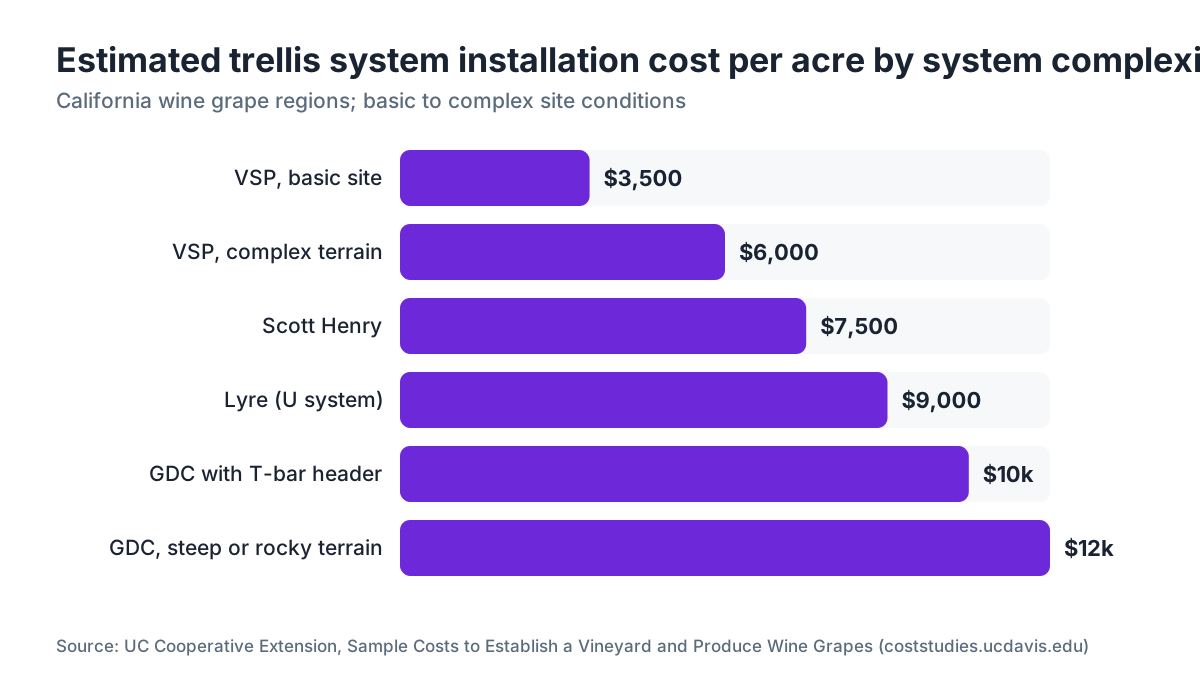
Real installed costs swing hard on post material, wire gauge, terrain, regional labor rates, and how much of the work you do yourself. Extension cost studies give you a workable range anyway. Basic VSP runs roughly $3,000 to $6,000 per acre; complex systems on rough ground push toward $12,000.
UC Cooperative Extension's sample costs for establishing a wine grape vineyard in California put trellis material and installation (posts, wire, anchors, staples, and the labor to set it all) at $3,000 to $6,000 per acre for a basic VSP system [4]. More complex systems, or rocky and steep terrain, run $7,000 to $12,000 per acre once you add equipment rental and slower labor.
Post material is the biggest variable. Steel T-posts are cheap but hold wire tension worse than round wood. Treated wood line posts run $8 to $18 each. End posts and anchor assemblies are where the money piles up: a properly anchored end post with a deadman anchor or diagonal strut can run $150 to $400 per row end, and a long block has a lot of row ends.
Wire is the other big material line. Twelve-gauge high-tensile wire runs about $0.03 to $0.05 per foot at bulk pricing. That sounds like nothing until you multiply by 6 to 10 wires per row across every foot in even a 5-acre block.
Hire a vineyard contractor and you're paying $60 to $120 per hour for skilled labor across most California, Oregon, and Washington markets as of 2024. Trellis work is slow and hands-on. Nobody has published a clean national average for total installed cost per acre across all systems and regions. The closest consistent data set is the UC Davis sample cost studies, updated periodically by farm advisors for specific California regions [4].
How does row orientation affect trellis system performance?
Row orientation is one of the most permanently fixed decisions you'll ever make, and one of the most consequential for fruit quality over the vineyard's life. You set it once. You live with it for decades.
North-south rows put photosynthetically active radiation on both canopy faces through the day. Each face gets morning sun on one side and afternoon sun on the other, which tends to ripen fruit evenly. In most cool and moderate climates, north-south is the default, and it's what UC Davis and WSU extension both recommend unless the site argues otherwise [2][3].
East-west rows give one face strong afternoon sun and can sunburn fruit in warm climates. Growers sometimes pick them on purpose on hillside sites where the slope faces a certain direction and you want to catch or dodge solar load.
Slope rewrites the math. On anything steeper than about 8 to 12 percent, running rows across the slope (on contour) beats compass orientation, because rows running up and down slope create erosion and make tractor work dangerous. Plenty of hillside vineyards end up running northeast-southwest or northwest-southeast as a compromise between contour and sun.
Wind matters too. In coastal California and the Columbia Valley, afternoon wind is strong enough to snap shoots when rows run parallel to it and the trellis offers no shelter. Orient rows perpendicular to the prevailing wind and shoots lean into the wire instead of getting pushed sideways off the catch wires.
What post spacing and wire configuration should you use?
Standard line post spacing in VSP vineyards runs 16 to 24 feet between posts, and most California and Pacific Northwest consultants land on 18 to 20 feet as the practical compromise [4]. Closer spacing costs more in materials but holds wire better, which matters most on long rows or under heavy wire loads.
Post height above ground follows the training system. For VSP with two pairs of catch wires, total post height of 7 to 8 feet is typical, with 2 to 2.5 feet of that in the ground. GDC with a T-bar needs a taller post plus a structural header that adds material and installation complexity.
Wire configuration for a standard VSP uses one or two fruiting wires at cordon or cane height (18 to 30 inches above ground, depending on frost risk and equipment clearance), then two pairs of movable foliage wires above that. The foliage wires sit at roughly 6-inch intervals and move up as shoots grow.
High-tensile gauge 12 is the standard for fruiting and support wires. Some growers drop to gauge 14 for upper foliage wires to save money, which is fine. Never buy the cheap galvanized fencing wire from the farm supply store. It doesn't have the tensile strength or corrosion resistance vineyard wire needs, and you'll be re-stringing it in 5 to 8 years.
End post anchoring is where DIY trellis jobs die. A weak end assembly lets the whole row sag under wire tension within two or three growing seasons. Diagonal strut anchors need the strut post driven at the right angle and the assembly tension-balanced. Deadman anchors, meaning a buried horizontal log or concrete block tied to the end post, work well in loose soils where you can't drive a strut post.
How do you match trellis system to grape variety and vine vigor?
This is the core design question, and blowing it is expensive. The mismatch between trellis system and site vigor is probably the single most common structural problem in established vineyards. Fix it at planting or fight it forever.
Vigor comes from rootstock, soil fertility, water, and variety. A Zinfandel on a deep, well-irrigated loam with a high-vigor rootstock like 1103 Paulsen will bury a VSP system. The canopy goes dense, airflow stops, disease pressure climbs, and you spend money hedging the canopy without ever really fixing it. That same Zinfandel on a Scott Henry or lyre would run an open canopy on the same vine.
Flip it. A low-vigor Pinot Noir on shallow, thin soil with a dwarfing rootstock like 101-14 Mgt doesn't need a divided canopy. It can barely fill a VSP. Put it on Scott Henry and half your shoot wires stay empty, which wastes the trellis investment and adds pruning complexity for nothing.
WSU's viticulture extension suggests using expected shoot length at your target shoot density as a proxy for vigor class. Expect shoots to hit 40 or more inches in a season and you're in moderate to high vigor territory, so consider a divided or expanded canopy [3]. Shoots under 30 inches at the same density are low vigor and belong in VSP.
Rootstock and trellis design pull on each other, so make both calls together before planting. Changing a rootstock means replanting. Changing a training system after the fact runs nearly as disruptive. Decide them at the same time, with a viticulture consultant who knows your soil series.
What labor and mechanization tradeoffs come with different trellis systems?
Machine harvesting needs specific trellis geometry and is close to impossible with some systems. If mechanical harvest lives anywhere in your 10-year plan, it has to be a design constraint from day one, not a retrofit.
Mechanical harvesters straddle the row and shake the canopy. The fruit zone needs to sit in a set height range (usually 24 to 48 inches above ground, depending on the machine), and the wires have to be placed so the harvester's fingers don't keep ripping out whole foliage wire assemblies. GDC and Scott Henry are engineered for this. VSP can be machine-harvested with the right calibration, but it's rougher on vines and equipment.
Mechanical pruning is spreading too as labor costs climb. Spur-pruned cordons on VSP or GDC are far easier to clean up after mechanical pre-pruning than cane-pruned systems. If a variety will eventually get mechanically pruned, plan for spur pruning now, because it drives your cordon wire height and post spacing.
Hand labor intensity varies by system. Lyre and Scott Henry demand more skilled shoot positioning and tucking because the geometry is fussier. VSP is the easiest system to train workers on. Where you lean on seasonal crews with mixed experience, simpler systems cut your training time and your quality variation.
If you run spray operations across different trellis configurations, tracking your applications and re-entry interval (REI) compliance by block is cleaner when the blocks map to their specific canopy systems. EPA's Worker Protection Standard [5] requires workers to have access to pesticide application information, including the REI, and block-level records tied to your trellis system keep that documentation clean. Field operations software like VitiScribe can tie spray records to specific blocks with their training systems, which matters when adjacent blocks carry different REIs and get harvested by different methods.
How do trellis systems affect disease pressure and spray coverage?
Canopy architecture controls the microclimate inside the cluster zone, and that microclimate drives Botrytis, powdery mildew, and downy mildew pressure more than any other single factor. Change the canopy and you change the disease math.
Dense, shaded canopies hold moisture, stay humid long after rain, and physically block spray from reaching the clusters. VSP, managed well, gives you an open narrow canopy with real airflow. But VSP on a high-vigor site with weak shoot thinning produces the worst disease environment there is: a wall of vegetation the sprayer can't get through.
Divided canopy systems like GDC and Scott Henry open the interior by spreading vegetation over more area. Cornell's work on high-vigor hybrid varieties shows measurably lower Botrytis incidence in well-managed GDC compared to unmanaged dense canopies [1].
Spray coverage is a function of canopy density, application volume, and equipment. Air-blast sprayers deposit less material in dense canopies no matter your travel speed or nozzles. The most accurate way to check coverage is water-sensitive paper cards placed at several canopy depths, which UC IPM recommends [6]. Knowing your canopy architecture by block lets you set application volume with intent instead of spraying every block at one rate.
Re-entry intervals under the EPA Worker Protection Standard [5] apply after any pesticide application regardless of canopy system, but exposure risk during the application itself changes with canopy density. Someone entering a dense, poorly penetrated canopy right after spraying faces different exposure than someone in an open VSP. Your application records should document application method and canopy conditions.
What are the frost protection implications of trellis height and design?
Frost is where trellis height turns into a save-the-crop decision for early-budding varieties. Cold air pools at the lowest points of a site and along the ground. The fruiting zone's height sets how much of that coldest air the buds sit in during a frost event.
On low-lying sites or in cold pockets, raising the fruiting wire from 18 inches to 30 or even 36 inches can meaningfully cut frost damage. The temperature gap between 18 inches and 36 inches above ground on a still, clear radiation frost night can run 2 to 4 degrees Fahrenheit, which is enough to save or lose a crop of early-budding Chardonnay or Merlot [2].
The cost of higher fruiting wires is that the whole trellis has to be taller to carry the canopy above the fruit zone, which adds post cost. You also push the canopy into more wind on exposed sites, and wind snaps shoots.
On flat valley-floor sites with known frost risk, raising the fruiting wire is cheap insurance. On well-drained slopes where cold air drains off on its own, standard wire heights are fine. Map the frost before you finalize the design: a simple min-max thermometer network across the block through late winter gives you real data on where the cold air pools.
How do you document and manage your trellis system for compliance and recordkeeping?
Good trellis documentation is dull work that pays off every time you pull a permit, apply for crop insurance, walk a buyer through your farming practices, or hand the block to a new vineyard manager who doesn't know its history. Write it down once and stop relying on memory.
At a minimum, keep a block map showing row orientation, vine spacing, row spacing, training system by block, rootstock, and variety. Simple to describe. Surprisingly rare in practice, because a lot of established vineyards store this across three people's heads instead of one document.
For compliance, your pesticide application records need to tie to specific blocks, and each block's canopy system feeds your spray volume calculations and coverage documentation. California's DPR requires written pesticide use reports tied to specific field identification within 7 days of application [7]. Oregon and Washington run similar rules. Block-level trellis and canopy documentation makes those records defensible when an audit asks you to justify a rate.
Gap assessment for the FDA's Produce Safety Rule under FSMA requires knowing your irrigation water sources and field conditions, and block-level documentation including trellising fits into the farm plan that covered operations have to keep [8].
For operations running multiple blocks with different trellis systems and different spray programs, VitiScribe ties spray records, canopy notes, and worker entry records to block-level trellis configurations, which speeds up end-of-season compliance reporting.
If you want to see how other established vineyards structure their blocks across AVAs, operations in Paso Robles or the Gervasi Vineyard model for mixed-use estates show how trellis decisions collide with visitor experience and production goals.
What does research say about trellis system effects on fruit quality and yield?
The research here is real and specific enough to use. It's also context-dependent, so don't treat any single study as a universal prescription. Read the site conditions before you borrow the conclusion.
Cornell's work on the Geneva Double Curtain, published through its viticulture program, showed GDC out-yielding VSP by 30 to 100 percent on high-vigor sites growing Concord and other American varieties, without giving up Brix [1]. For high-vigor sites, that's a strong case. For low-vigor vinifera, GDC's advantage shrinks or vanishes.
WSU research on divided canopy systems in Washington found that canopy systems delivering more light to the cluster zone consistently produced higher anthocyanin in red varieties and better terpene development in aromatic whites [3]. The mechanism is settled: UV light drives anthocyanin synthesis, and the temperature swing from shade affects acid retention.
UC Davis work on row spacing and canopy management found that narrower rows (5 to 6 feet) with VSP scored higher on fruit quality than wider rows (10 to 12 feet) with unmanaged canopies. But the gap closed once the wide-row systems got proper shoot thinning and leaf removal [2]. The takeaway: management intensity can substitute for tight row spacing to a real degree, which matters if you want to hold down per-acre planting costs.
Nobody has run a clean randomized trial comparing all the major systems on one site, one variety, over a full 10-year stretch. The closest data sets are the long-term block comparisons at research stations like UC Davis's Oakville station and Cornell's Geneva station. Site-specific consultant experience fills the gaps the published work leaves open.
What are the most common trellis installation mistakes and how do you avoid them?
Underbuilt end post assemblies top the list. Growers see the cost of a properly anchored end and cut the corner, then spend years watching row tension go slack and wire sag into the canopy. Budget end assemblies as a fixed, non-negotiable cost.
Setting line posts before establishing grades is the next common miss. Post tops need to sit at consistent heights relative to ground level so your wire runs stay even, not relative to some arbitrary benchmark. On any site with terrain variation, a laser level or even a string line before driving posts saves the rework.
Using the wrong wire keeps happening. Vineyard-specific high-tensile wire from a viticulture supplier is worth the premium over generic fencing wire. The tensile rating matters because cordon and fruiting wires carry serious tension across a 20-plus year life.
Ignoring thermal expansion and contraction bites growers in climates with big temperature swings. Wire tensioned in the cold goes dangerously tight in summer heat; wire tensioned in summer sags in winter. Proper tensioning accounts for the install temperature and adjusts.
And skipping the finished map creates problems for everyone who manages the vineyard after you. Take the 30 minutes after installation to record post locations, wire heights, and spacing in a permanent document. Future managers, crop insurance adjusters, and compliance auditors will thank whoever made that record.
Frequently asked questions
What is the difference between a trellis system and a training system in a vineyard?
A trellis is the physical infrastructure: posts, wires, and anchors that hold up the vine. A training system is how you shape and position vine wood on that infrastructure through pruning and shoot management. VSP describes both the trellis configuration and the training approach. They're related but separate decisions. You can run cane pruning or spur pruning on the same physical VSP trellis, producing different fruiting structures.
How far apart should trellis posts be in a vineyard?
Line post spacing of 16 to 24 feet is standard, with 18 to 20 feet the most common choice in California and Pacific Northwest VSP vineyards. Closer spacing improves wire support but raises material costs. Longer rows benefit from closer spacing to prevent sag under tension. End posts are always more substantial than line posts and need proper anchoring regardless of spacing.
Can I change my trellis system after vines are established?
Yes, but the cost and disruption run high enough that getting the design right at planting almost always wins. Converting from VSP to a divided canopy mid-life means restructuring the cordon framework, replacing or adding posts and wires, and accepting 1 to 3 years of reduced production during retraining. Cornell's viticulture program estimates conversion costs can approach replanting costs in some scenarios.
What trellis system works best for steep vineyard slopes?
On slopes steeper than about 10 to 12 percent, row orientation on contour takes priority over training system choice. VSP is the most practical system for steep slopes because it needs minimal trellis width, which keeps tractor and hand labor on contour rows manageable. Terracing allows wider systems but adds heavy site development cost. Erosion control beneath the rows matters as much as the trellis design itself.
How does trellis design affect mechanical harvesting compatibility?
Mechanical harvesters need the fruiting zone at a consistent height between roughly 24 and 48 inches above ground, with foliage wires placed so the machine can shake the canopy without destroying the trellis. GDC and Scott Henry are most compatible. VSP can be machine-harvested but is harder on equipment and vines. If mechanical harvest is part of your 10-year plan, design for it from the start, because retrofitting is difficult.
What wire gauge should I use for vineyard trellis construction?
Gauge 12 high-tensile galvanized wire is standard for fruiting wires and permanent support wires. Some growers use gauge 14 for upper foliage wires to cut cost, which is fine for wires carrying only shoot weight. Never use standard fencing wire; it lacks the tensile strength for long-term vineyard use. Buy from a viticulture-specific supplier, not a general farm supply store, to get the right specifications.
How does trellis height affect frost damage risk?
Cold air sits lowest on still, clear nights. Raising the fruiting wire from 18 inches to 30 or 36 inches can put buds 2 to 4 degrees Fahrenheit above the coldest air layer during a radiation frost. For early-budding varieties like Chardonnay in frost-prone valley-floor sites, the extra height is cheap insurance. On sloped sites where cold air drains naturally, standard wire heights are usually adequate.
What does a vineyard trellis system cost per acre to install?
UC Cooperative Extension vineyard establishment cost studies put basic VSP trellis materials and installation at roughly $3,000 to $6,000 per acre in California. Complex systems, steep terrain, or high regional labor rates can push costs to $7,000 to $12,000 per acre. End post anchor assemblies and high-tensile wire are the largest material cost components. Vineyard contractor labor runs $60 to $120 per hour in most West Coast markets.
How do I match a trellis system to vine vigor?
Assess expected shoot length at your target shoot density. Shoots reaching 40 or more inches in a season indicate moderate to high vigor and call for a divided or expanded canopy like Scott Henry or GDC. Shoots under 30 inches at the same density work well in VSP. Rootstock, soil depth, fertility, and irrigation all drive vigor. Make your rootstock and trellis decisions together before planting; changing either later is expensive.
How do I document my trellis system for pesticide records and compliance?
Create a block map recording training system, row and vine spacing, row orientation, rootstock, and variety for every block. California DPR requires pesticide use reports tied to specific field identification within 7 days of application. FDA Produce Safety Rule farm plans under FSMA benefit from block-level canopy documentation as well. Tying spray records to specific trellis configurations helps justify application rates and volumes during compliance audits.
Does row orientation north-south versus east-west actually matter for wine quality?
It matters, but not as much as canopy management does. North-south rows spread sunlight more evenly across both row faces through the day, which supports even ripening. East-west rows give one side strong afternoon sun and can sunburn fruit in warm climates. On hillside sites, contour orientation for erosion control usually overrides compass orientation. UC Davis and WSU both default to north-south for flat to gently sloping sites.
What is the Geneva Double Curtain trellis system and when should I use it?
The GDC uses a T-bar header post to support two downward-hanging canopy curtains spaced roughly 4 feet apart. Cornell developed it for high-vigor American and hybrid varieties. It excels at canopy management on vigorous sites and ranks among the best systems for mechanical harvesting. The tradeoff is higher installation cost and complexity. It's poorly suited to low-vigor vinifera, where the divided canopy offers no real benefit over VSP.
How does canopy architecture from my trellis system affect spray coverage?
Dense canopies block spray from reaching the cluster zone regardless of application volume. Air-blast sprayers deposit dramatically less material inside a thick, unmanaged canopy than in an open VSP or divided system. UC IPM recommends water-sensitive paper cards at multiple canopy depths to measure actual coverage. Your trellis system sets baseline canopy architecture; shoot thinning and leaf removal then refine it each season.
What are the EPA Worker Protection Standard requirements related to vineyard operations?
EPA's Worker Protection Standard (40 CFR Part 170) requires that workers have access to pesticide application information including the product used, application date, and restricted-entry interval (REI) before entering treated areas. Employers must post this information at a central location and provide decontamination facilities. REI compliance applies regardless of trellis system, but canopy density during application affects operator exposure risk and should be documented in your application records.
Sources
- Cornell University Cooperative Extension, Viticulture Program: Cornell developed the Geneva Double Curtain for high-vigor varieties and has published long-term block comparison data showing 30 to 100 percent yield advantages over VSP in high-vigor sites; training system conversion costs can approach replanting costs.
- UC Davis Department of Viticulture and Enology: UC Davis research supports north-south row orientation as the default for flat to gently sloping sites and documents the temperature benefit of raising fruiting wires above cold air layers during frost events.
- Washington State University Extension: WSU recommends Scott Henry and divided canopy systems for high-vigor sites and documents that higher light exposure in the cluster zone produces higher anthocyanin levels in red varieties and better terpene development in aromatic whites.
- UC Cooperative Extension, Sample Costs to Establish a Vineyard and Produce Wine Grapes: UC Davis Cooperative Extension cost studies put basic VSP trellis materials and installation at roughly $3,000 to $6,000 per acre in California wine grape regions.
- US EPA, Worker Protection Standard (40 CFR Part 170): EPA's Worker Protection Standard requires that agricultural workers have access to pesticide application information including the product used, application date, and restricted-entry interval before entering treated areas.
- UC Integrated Pest Management Program (UC IPM): UC IPM recommends the use of water-sensitive paper cards placed at multiple canopy depths to quantify actual spray coverage in vineyard applications.
- California Department of Pesticide Regulation, Pesticide Use Reporting: California DPR requires written pesticide use reports tied to specific field identification to be filed within 7 days of application.
- US FDA, FSMA Produce Safety Rule: FSMA's Produce Safety Rule requires covered farms to maintain farm plans addressing irrigation water sources and field conditions; block-level documentation including trellising fits naturally into required farm plan records.
- Cornell University, Vineyard Training Systems (Appellation Cornell series): Cornell's published viticulture guidance documents the shoot length threshold of 40 or more inches per season as an indicator of moderate to high vine vigor warranting a divided or expanded canopy trellis system.
- WSU Extension, Wine Grape Varieties and Trellis Systems for Washington State: WSU extension documentation establishes that Scott Henry divided canopy systems are specifically suited for high-vigor Washington wine grape sites where VSP produces excessive shading and canopy density.
Last updated 2026-07-09