Cover crops for vineyard loam soils: what actually works
TL;DR
- On loam vineyard soils, cereal rye or barley mixed with a legume (crimson clover or hairy vetch) is the most reliable place to start.
- Loam holds enough moisture that water competition stays manageable, but terminate or mow before soil moisture in the top three feet drops below 50% of field capacity.
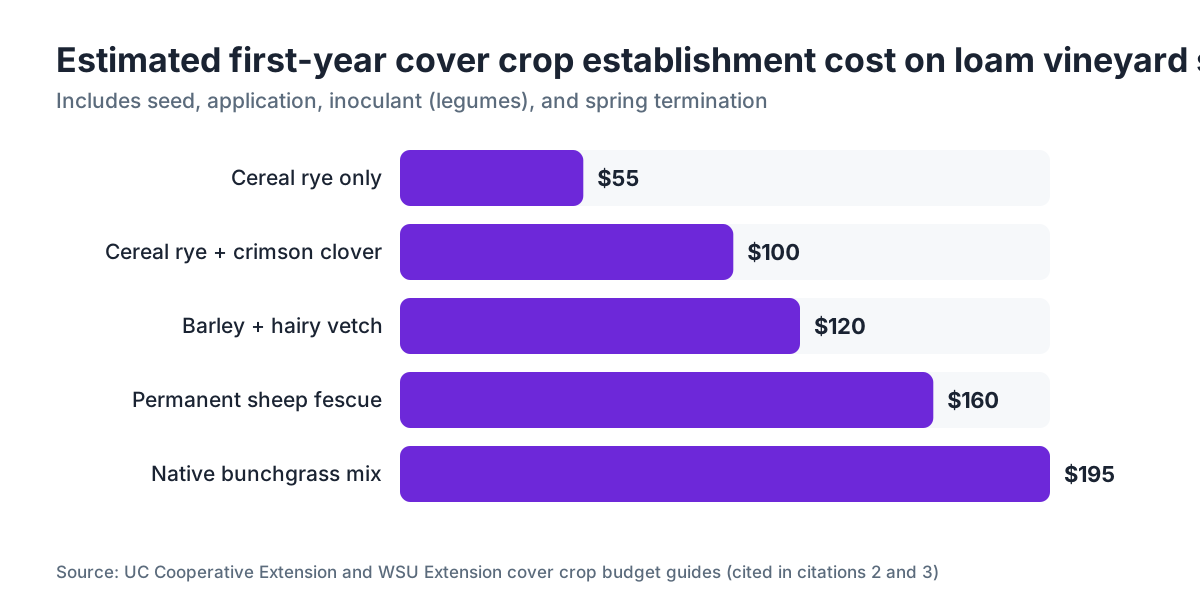
- Establishment costs $80 to $200 per acre depending on the seed mix and region.
Why loam soil changes your cover crop decisions
Loam sits in the middle of the texture triangle, roughly 25 to 50% sand, 25 to 50% silt, and 10 to 30% clay by weight. That mix holds water well without the compaction risk of heavy clay or the fast drainage of sandy ground [1]. The middle-ground behavior matters because the vine-versus-cover-crop water question gets more nuanced on loam than it does on either extreme.
On a sandy loam in a dry summer region like Paso Robles or the central San Joaquin Valley, even a modest rye stand can pull real soil moisture away from vines during fruit development. On a silt loam in the Willamette Valley or the Finger Lakes, that same stand threatens almost nothing through a normal June. Same species, different outcome. Texture controls how long available water lingers in the profile.
This is why extension recommendations from UC and WSU don't collapse into a single prescription [2][3]. They hand you a framework instead: know your soil's plant-available water capacity, know your rainfall distribution, then match species and timing to both. Loam vineyards in regions with 18 to 20 inches of annual rainfall can usually carry a permanent or semi-permanent cover in every other row with no measurable yield penalty. Drier sites need resident vegetation managed hard, or bare soil in the vine row and a cover only in the drive row.
Loam also makes establishment easier than clay or sand. Seeds germinate reliably because the surface holds enough moisture for a clean strike, and seedling roots push through without the shear stress of hard clay or the missing capillary rise of coarse sand. You get a stand faster. That speed matters when you're seeding into a narrow autumn window.
What cover crop species work best in loam vineyard soils?
There's no perfect species. There are good fits for your climate, your goals, and your management calendar. The table below lays out the main candidates and how they behave on loam.
| Species | Type | Seeding rate (lbs/ac) | Biomass (tons/ac, dry) | N fixed or added | Best climate fit | Key risk |
|---|---|---|---|---|---|---|
| Cereal rye | Winter annual grass | 90-120 | 2-5 | None (scavenges N) | Cold winter regions, PNW | Water competition in dry springs |
| Barley | Winter annual grass | 80-100 | 1.5-3.5 | None | Arid/semi-arid, short winters | Lower biomass than rye |
| Crimson clover | Winter annual legume | 15-20 | 0.8-1.5 | 50-150 lbs N/ac | Mild winter, SE and CA coast | Reseeds aggressively |
| Hairy vetch | Winter annual legume | 20-30 | 1-3 | 80-200 lbs N/ac | Wide range, cold-tolerant | Can become weedy |
| Mustard (Brassica spp.) | Winter annual broadleaf | 5-8 | 1-3 | None (biofumigant) | CA, OR, cool springs | Allelopathic to some vine roots at high rates |
| Fescue (tall or sheep) | Perennial grass | 20-30 | 0.5-1.5/year | None | Humid, cool summers | Lowest water demand of perennials |
| Subterranean clover | Annual legume | 20-30 | 0.5-1.2 | 40-100 lbs N/ac | Mediterranean climate | Low on cold tolerance |
| Phacelia | Annual broadleaf | 6-10 | 0.5-1.2 | None (pollinator) | CA, PNW | Short window, reseeds less than clovers |
Source data: UC Cooperative Extension cover crop guides [2], WSU viticulture extension resources [3].
For most loam vineyards in the mid-Atlantic, Pacific Northwest, or northern California, the mix that holds up best in the field is cereal rye or barley overseeded with crimson clover or hairy vetch at a 60/40 ratio by pure live seed weight. The grass germinates fast and gives you erosion control and firm ground for traffic. The legume fills in behind it and fixes nitrogen you'd otherwise buy. Cornell's viticulture team recommends similar grass-legume mixes for New York vineyards because loam soils there take the nitrogen credit and the organic matter without the vine stress you'd get from a straight legume [4].
Perennial grasses, mainly sheep fescue and hard fescue, are the pick for permanent drive-row covers where you want low input and low water demand. They fix no nitrogen, but on loam that already has decent organic matter, that's usually fine. UC's sustainable agriculture research has documented that fescue-based permanent covers on loam vineyards in Napa and Sonoma held vine productivity even with bare-ground controls when drip irrigation supplied the water [2].
How do you manage water competition on loam?
Water competition is the most common reason cover crops fail in vineyards. It's also the most overstated worry once you have loam. Both things are true at once, so let's be plain about each.
A cover crop transpires. On loam, a mature stand of cereal rye in March uses 0.15 to 0.20 inches of water per day during rapid growth [3]. If rain drops an inch every five to seven days, you're fine. If the spring turns dry and you haven't terminated, you have a problem. The rule most extension advisors use is simple: terminate or mow hard before soil moisture in the top three feet drops below 50% of field capacity. On a typical loam holding 1.5 to 2.0 inches of plant-available water per foot, that threshold gives you a cleaner decision point than sand or clay ever would.
Mowing is not termination. Mowing knocks back top growth and cuts transpiration for a while, but the roots keep living and keep drinking. To actually stop the water draw you need a herbicide burndown (glyphosate at label rate, or an approved contact herbicide for organic), or mowing followed by tillage, or a roller-crimper pass for certified organic ground. The roller-crimper does well on mature cereal rye on loam because loam gives the equipment enough footing to hold steady downforce.
Every-other-row management is the most common approach in established loam vineyards. You keep cover in the drive row and either bare soil or shallow-cultivated soil in the vine row. That cuts overall cover water demand by roughly half and pushes any competition into rows where vine root density is naturally lower.
Drip irrigation buys you flexibility. Competition from a managed cover can often be offset with a modest bump in drip run time, though nobody has clean data on the exact offset ratio across soil types. The closest documented work is a UC study in Napa loam that found cover crops raised total vineyard evapotranspiration by roughly 15 to 25% over bare ground in spring months [2]. That's a real number. Active irrigation scheduling handles it.
What seeding rates and timing work for loam vineyard establishment?
Timing is where most cover crop programs fall apart, not species choice. Loam needs soil temperature in the 40 to 65 degrees F range for cool-season covers to germinate reliably. In practice that means seeding from mid-September through early November in most temperate wine regions.
Seed too early and summer annual weeds germinate faster and outrun your cover. Seed too late and the stand goes into winter thin and patchy, leaving you erosion risk and weak spring biomass. Aim for 6 to 8 weeks of growth before a hard freeze, enough for roots to set before top growth goes dormant.
Loam doesn't need deep incorporation. A light disc pass to open a 1 to 2 inch seedbed, then a cultipacker or ring roller to firm the seed zone, is plenty. Loam gives better seed-to-soil contact than sand (too loose) or clay (prone to crusting). Seeding into existing resident vegetation? A slit seeder or aerator-seeder usually beats broadcast because it cuts through thatch.
Practical seeding rates for common mixes on loam:
- Cereal rye + crimson clover: 80 lbs rye + 15 lbs clover per acre
- Barley + hairy vetch: 70 lbs barley + 20 lbs vetch per acre
- Sheep fescue (permanent): 20-25 lbs per acre, often two full seasons to full cover
- Phacelia (pollinator focus): 6-8 lbs per acre, overseed into an existing grass mix
These rates assume fresh seed germinating above 85%. Old seed or bin-run grain needs more. A quick germination test (the AOSA method: 100 seeds on a moist paper towel at 68 degrees F for seven days) takes almost no time and can save you from a failed stand [5].
Does organic matter actually build on loam with cover crops?
Yes, but slowly. And the rate depends more on how you manage the cover than on which species you plant.
A cereal rye cover producing 3 tons of dry biomass per acre adds roughly 2.5 tons of organic material to the surface when mowed and left as mulch. Loam's microbes break that down faster than clay would, slower than sand. Net organic matter accumulation, meaning what stays after decomposition, runs about 3 to 8% of biomass added per year. So a single cover crop cycle leaves something like 150 to 600 lbs of stable organic matter per acre per year [6]. That's real, not dramatic. Moving soil organic matter by a full percentage point takes five to ten years of consistent cover cropping, and that timeline shows up in both California and Pacific Northwest loam vineyard studies.
Legume covers add a twist. Their biomass has a lower carbon-to-nitrogen ratio, so it decomposes faster: less stable organic matter per ton, more nitrogen released during the growing season. On loam with baseline organic matter above 2.5%, the nitrogen credit from a hairy vetch cover, which can fix 80 to 200 lbs N per acre depending on inoculation and conditions [6], is often worth more to your vine nutrition budget than the organic matter would be.
Inoculate your legume seed. On loam that hasn't grown that specific legume before, this is non-negotiable. Rhizobium inoculants cost $5 to $15 per acre of treated seed, and the gap between inoculated and uninoculated vetch or clover on a new site shows within a month. Without the right rhizobia strain, the plant fixes no nitrogen. None.
How do cover crops affect erosion and compaction on loam vineyard soils?
Loam erodes. It lacks sand's permeability to soak up intense rain fast, and it lacks clay's cohesion to hold together when saturated. On sloped ground, anything over 3 to 5% grade, a bare loam interrow during winter rains is a genuine erosion problem. This is where cover crops pay off fastest and clearest.
A 70 to 80% cover density cuts interrow soil loss by roughly 60 to 90% compared to bare cultivated ground, based on USDA NRCS erosion data from California and the Pacific Northwest [7]. Those numbers make sense. Ground cover intercepts raindrops before they splash soil loose, slows surface flow, and roots hold aggregate structure together. On loam you don't even need a thick stand. A thin volunteer grass cover at 40% density already makes a measurable difference.
Compaction is the other side of the coin, and it's where loam can trip you. Loam compacts readily when you drive on it wet. A permanent fescue cover in drive rows keeps tires on a resilient mat instead of bare saturated soil, which cuts surface compaction. Roots below the grass root zone (typically below 8 to 12 inches on perennial grasses) can still compact, though. If vine performance drops and penetrometer readings run above 300 PSI in the vine root zone, investigate compaction with a full-profile soil assessment before you blame water or nutrients.
Deep-rooted covers like tillage radish or turnip can fracture compaction layers in loam, but the evidence for lasting improvement is mixed. WSU trials in loam found tillage radish improved water infiltration in the top 12 inches, then the benefit largely disappeared after one dry summer [3]. Treat it as a periodic renovation tool, not a permanent fix.
Which cover crops are safe around pesticide applications and spray records?
This is where your compliance calendar and your agronomic calendar have to talk to each other. It's also where a lot of smaller operations leave gaps.
The EPA Worker Protection Standard (WPS) covers agricultural workers who enter treated areas, and cover crop workers mowing, rolling, or seeding fall under that definition when they enter after a pesticide application [8]. The restricted-entry interval (REI) on the label of whatever you sprayed governs when they can go back in. Most vineyard fungicide labels carry REIs of 4 to 24 hours for early-entry work with the right PPE, but some materials (certain organophosphates used for leafhopper) carry 24 to 48 hours. If you contract out your cover crop mowing, the contractor's workers are still under WPS, and you're responsible for posting and notifying correctly.
Herbicides bring a second problem. Some vineyard weed-control herbicides injure or kill cover crop species. Preemergent herbicides applied to the vine row can move laterally in loam (moderate herbicide mobility, more than sand) and damage the cover stand next to it if timing and placement aren't managed. UC IPM lists simazine and flumioxazin as the most common offenders in California loam vineyards [9]. Read the label. The label is a federal legal document.
For records, you need spray application records documenting every pesticide application in the vineyard, and cover crop termination with herbicides counts as an application you have to record. A paper log per block works fine when you run a few blocks. The more blocks you add, the harder that paper system is to keep consistent. VitiScribe's spray record module is built for block-level tracking, so if you're juggling cover crop termination herbicides alongside fungicide and insecticide programs across several loam blocks, it's worth seeing how an integrated log handles the compliance calendar.
Certified organic vineyards limit cover crop termination to mechanical options (mowing, rolling, tillage) or approved materials on the National List. Hairy vetch and cereal rye take well to roller-crimping at anthesis (full flower for vetch, grain fill for rye), the timing that builds the most effective mulch mat on loam.
How much do vineyard cover crops cost per acre to establish?
Real cost ranges matter here because marketing numbers rarely match what growers actually pay.
Seed is the most variable input. Certified cereal rye runs $0.20 to $0.35 per lb, so an 80-lb rate costs $16 to $28 in seed alone. Add 15 lbs of crimson clover at $1.80 to $3.00 per lb and the mix hits $43 to $73 in seed. Hairy vetch costs more, often $1.50 to $2.50 per lb, pushing a rye-vetch mix to $50 to $80 per acre in seed. Perennial fescues for permanent covers run $2.00 to $4.00 per lb, so a 20 to 25 lb rate lands at $40 to $100.
Equipment and custom application add $20 to $60 per acre depending on whether you own the seeder or hire it out, plus fuel and labor. Inoculant for legumes adds $5 to $15. Spring termination (mowing, roller-crimp, or herbicide) adds another $15 to $40 per pass.
Total first-year establishment runs $80 to $200 per acre for most loam vineyard situations. Permanent covers cost more upfront but less per year over five years. Annual covers at $100 to $150 per year including termination is the figure I see most in extension budgets from UC Cooperative Extension and WSU [2][3].
Here's the payback math. A hairy vetch cover fixing 120 lbs N per acre saves roughly $60 to $90 in purchased fertilizer at current urea prices of $0.50 to $0.75 per lb of N. That doesn't cover year-one establishment on its own. Add erosion control value, organic matter, and cost-share (USDA EQIP funds cover crop establishment in many counties [10]), and the economics turn positive over a three to five year rotation.
USDA EQIP's Conservation Cover practice (code 327) and Cover Crop practice (code 340) both pay at rates that vary by state and county. In California, EQIP cover crop payments have ranged from $75 to $150 per acre in recent cycles [10]. Call your local NRCS office for current rates.
What are the best cover crop mixes for specific wine regions with loam soils?
Region matters as much as texture. Here's how the major loam wine regions sort out.
Napa and Sonoma (CA): Mediterranean climate, wet winters, dry summers. Valley-floor loams are often well-drained Pleasanton or Yolo series. Best fit is a winter mix of cereal rye or barley with crimson or subterranean clover, seeded in October and terminated late April to early May before vine water demand peaks. Run permanent fescue in drive rows where drip carries vines through summer.
Willamette Valley (OR): Cool, wet winters, drier summers. Jory soils are volcanic, but many sites have true loam alluvials. Hairy vetch-rye mixes work well because the long wet season lets legumes fix more nitrogen. Terminate in May. Perennial ryegrass permanent covers are common but need steady mowing because they grow hard in this climate.
Finger Lakes and Hudson Valley (NY): Cold winters, humid summers. Cornell recommends cereal rye, oats, or winter wheat as winter covers, with legume additions where nitrogen is short [4]. Loam here benefits more from a winter cover than a warm-season one, because summer humidity and fungal pressure mean you want open canopies and airflow, not tall resident vegetation under the vines.
Walla Walla and Columbia Valley (WA): Low rainfall, hot dry summers. Many loam sites are wind-deposited silt loam (Palouse-type). Water competition is a real concern. WSU recommends native bunch grasses or low-water annual covers that terminate by May, with bare ground or heavily mowed resident vegetation through summer [3].
Paso Robles (CA) and Temecula Valley: Warm and dry, some sites irrigated, some dry-farmed on sandy loam to loam. On dry-farmed sites, cover crops compete hard for water unless terminated by early April. Irrigated loam sites can run modest covers with careful irrigation management. See paso robles wineries for site-specific context.
How does no-till or minimal-till cover cropping work on loam?
Loam is probably the best texture for no-till cover cropping in vineyards. It's forgiving enough to take broadcast seed into an existing sward, it holds enough structure to support equipment without the rut-forming habit of clay, and it dries fast enough after rain to give you a workable window.
The standard no-till approach on loam: mow existing vegetation short in late August or early September, broadcast or slit-seed straight into the stubble, then run one cultipacker or ring roller pass for seed-to-soil contact. The organic matter already in loam usually gives you clean germination without extra bed prep.
The honest trade-off is weed pressure. No-till leaves weed seed near the surface where it germinates readily. On loam, perennial weeds like field bindweed and nutsedge hang on hard because loam holds enough moisture for them to survive between cultivation events. If your loam blocks have a history with these species, a one-time shallow tillage pass before you go no-till is worth considering to set the seed bank back.
Minimal-till, which many growers call strip-till, is a good middle path. You till only the vine row and seed the drive row without tillage. On loam this runs clean because the two zones behave similarly enough that one seeder pass covers both. The vine row stays cultivated for weed control, the drive row builds cover, and you get both sets of benefits.
How should you monitor and evaluate your cover crop program over time?
You can't tell if your cover crop program is working without measuring something, and most growers measure nothing.
Track three things each season, minimum. Cover crop biomass, using a simple bag-dry-weigh method on a one-square-meter quadrat at three to five spots per block before termination. Soil moisture at 12 and 24 inches going into the vine water demand window (April and May in most regions). And a baseline soil organic matter test every three years. None of this needs expensive gear. A moisture meter, a paper bag, and a basic soil test from a lab running Walkley-Black or loss-on-ignition covers all three.
Pests and disease cut both ways on loam. Cover crops can harbor beneficial insects and problem insects alike. Leafhoppers overwinter in grasses, and UC research has documented cereal rye covers raising grape leafhopper populations in adjacent vine rows in California loam vineyards [9]. Whether that's a deal-breaker depends on your leafhopper pressure going into the season. In high-pressure blocks, rolling or mowing the cover before budburst rather than at bloom disrupts overwintering habitat without giving up much of the agronomic benefit.
Record everything. Application dates, seeding rates, termination methods, and every pesticide application to the cover or the vine canopy belong in your block records. This is the documentation a compliance inspector asks for, and it's what lets you improve your program year over year instead of repeating the same guesses. VitiScribe's block-level operations log handles this kind of multi-event timeline per block, which helps when your cover crop calendar overlaps with your spray program across several loam blocks with different termination timing.
Are there any native plant or wildflower options for loam vineyard covers?
Yes, and the gap between marketing and agronomic reality is wide here. Native wildflower mixes look great in a tasting room brochure and on social media. They are genuinely harder to establish than cereal rye.
Native species often carry strict germination requirements: cold stratification, specific light conditions, or narrow soil temperature windows. On loam, first-year establishment failure rates for native mixes can hit 50% or higher without careful site prep, irrigation during establishment, and patience for a two to three year fill-in.
Once established, though, native bunchgrass and wildflower covers on loam are low maintenance and pay real ecological dividends: habitat for beneficial insects (including grape moth predators), lower water demand than aggressive annual grasses, and long-term soil stability. The Xerces Society publishes region-specific native plant guides for agricultural sites, including species suited to California, Oregon, and Washington loam [11]. If you go this route, start with a single drive row as a test before you commit whole blocks to native seed.
The practical hybrid: establish a base of sheep fescue or a native California bunchgrass (Nassella pulchra in CA, blue wild rye in the PNW) as the permanent cover, then broadcast native wildflowers into the stand in patches. The grass gives you immediate cover and firm ground; the wildflowers fill in over time without you depending on them to carry the cover.
Frequently asked questions
What is the best cover crop mix for a loam soil vineyard?
Cereal rye plus a legume (crimson clover or hairy vetch) is the most reliable start for loam vineyard soils in most temperate wine regions. The rye germinates fast, controls erosion, and supports traffic. The legume fixes 80 to 200 lbs of nitrogen per acre when properly inoculated. Seed at 80 lbs rye plus 15 to 20 lbs legume per acre. Terminate before vine water demand peaks in spring.
Will cover crops steal water from my vines on loam soil?
They can, but loam's water-holding capacity gives you more buffer than sandy soil. A mature cereal rye stand uses roughly 0.15 to 0.20 inches of water per day in spring. Terminate or mow hard before soil moisture drops below 50% of field capacity in the top three feet. Drip-irrigated loam vineyards can usually offset cover water use with modest irrigation adjustments through the critical spring period.
When should I seed cover crops in my vineyard?
Seed cool-season covers when soil temperature drops to 40 to 65 degrees F, typically mid-September through early November in most temperate wine regions. That gives 6 to 8 weeks of growth before hard frost. Seed too early and summer annuals outrun your cover; seed too late and the stand is too thin to protect soil through winter. Loam establishes covers faster than clay because it doesn't crust as severely.
How do I terminate a cover crop without herbicides in an organic vineyard?
Roller-crimping works well on mature cereal rye (at grain fill) and hairy vetch (at full flower, anthesis). Loam gives enough footing for consistent roller pressure. Mowing followed by tillage also works but damages soil structure more. Timing matters: roll or mow before the cover sets viable seed. On organic loam vineyards, pairing roller-crimping with shallow cultivation in the vine row covers both termination and weed management.
Do I need to inoculate legume seeds for vineyard cover crops?
Yes, if the soil hasn't grown that specific legume before. Hairy vetch needs Rhizobium leguminosarum bv. viciae; crimson clover needs a different Rhizobium strain. Without the correct rhizobia, the plant fixes no nitrogen no matter how healthy it looks. Inoculants cost $5 to $15 per acre of treated seed. On loam new to legume covers, the difference between inoculated and uninoculated plants shows within four to six weeks.
Can cover crops fix compaction problems in loam vineyard soils?
Partly. Tillage radish and turnip can fracture compaction in the top 12 inches of loam, and WSU trials found improved water infiltration after a single tillage radish season. But the benefit largely disappeared after one dry summer. For persistent subsoil compaction below 12 inches on loam, deep ripping or subsoiling stays more effective. Cover crops help prevent new compaction in drive rows but don't reliably fix existing deep compaction.
What cover crops work in hot, dry wine regions with loam soil?
In arid regions like Paso Robles or the Columbia Valley, limit cover crops to drive rows only and terminate by early April before vine water demand peaks. Barley is more drought-tolerant than rye and produces usable biomass in shorter wet windows. Native bunchgrasses or low-growing annual ryegrass work as permanent drive-row covers with minimal water draw if managed with aggressive spring mowing. Skip legumes as the primary cover on dry-farmed loam sites.
How does a cover crop program affect my pesticide record-keeping requirements?
Cover crop termination with herbicides is a pesticide application and must be recorded like any fungicide or insecticide. The EPA Worker Protection Standard requires you to post treated areas and notify workers of restricted-entry intervals before letting cover crop crews back into the block. On loam, some preemergent herbicides used for vine row weed control can move laterally and injure cover stands, so track application timing and placement per block.
How long does it take for cover crops to build organic matter in loam vineyard soils?
Expect five to ten years of consistent cover cropping to move soil organic matter by a full percentage point on loam. Each annual cover cycle adds roughly 150 to 600 lbs of stable organic matter per acre after decomposition, about 3 to 8% of the dry biomass added. Loam's active microbial community breaks biomass down faster than clay, so decomposition is quicker but stable carbon accumulation is slower than on heavier soils.
What USDA cost-share programs help pay for vineyard cover crops?
USDA EQIP (Environmental Quality Incentives Program) covers vineyard cover crops under practice codes 327 (Conservation Cover) and 340 (Cover Crop). Payment rates vary by state and county; California EQIP rates have ranged from $75 to $150 per acre in recent cycles. Contact your local NRCS office for current county-level payment schedules and application deadlines. Organic operations often qualify for higher rates under the EQIP Organic Initiative.
Will cover crops increase leafhopper pressure in my vineyard?
Possibly. UC research documented cereal rye covers in California loam vineyards raising grape leafhopper populations in adjacent vine rows in some trials. If your block has historically high leafhopper pressure, mow or roll the cover before budburst rather than at bloom to disrupt overwintering habitat. Or use broadleaf covers (clovers, phacelia) instead of grasses as your primary cover in high-pressure blocks, since leafhoppers prefer grass hosts.
Are native wildflower mixes practical for loam vineyard covers?
Practical but slow. Native species often carry germination requirements (cold stratification, precise soil temperature) that push first-year establishment rates to 50% or lower even on cooperative loam. The Xerces Society publishes region-specific guides for agricultural sites. A better approach: establish a base of low-water bunchgrass first for firm ground and erosion control, then seed native wildflowers into the established stand over two to three seasons.
How much does it cost to establish a cover crop program per acre?
First-year establishment on loam vineyard ground runs $80 to $200 per acre, including seed, application, inoculant for legumes, and spring termination. Seed alone ranges from $43 to $100 per acre depending on the mix. Perennial fescue-based permanent covers cost more upfront but less per year over five years. USDA EQIP cost-share can offset $75 to $150 per acre in eligible California and Pacific Northwest counties.
Sources
- UC Division of Agriculture and Natural Resources - Cover Crops for Vineyards: UC Cooperative Extension documents that fescue-based permanent covers on loam vineyards in Napa and Sonoma maintained similar vine productivity to bare-ground controls when water was supplied by drip irrigation; also that cover crops increased total vineyard ET by roughly 15-25% compared to bare ground in spring months.
- Washington State University Extension - Viticulture and Cover Crop Resources: WSU recommends grass-legume cover mixes terminated by May for Columbia Valley loam sites due to water competition risk; WSU tillage radish trials found improved water infiltration that largely disappeared after one dry summer.
- Cornell Cooperative Extension - New York Viticulture Cover Crop Recommendations: Cornell's viticulture team recommends grass-legume mixes (cereal rye or oats with clover or vetch) for New York loam vineyards because the nitrogen credit and organic matter addition can be achieved without vine water stress.
- USDA Sustainable Agriculture Research and Education (SARE) - Managing Cover Crops Profitably: Hairy vetch can fix 80-200 lbs of nitrogen per acre depending on inoculation and growing conditions; net organic matter accumulation from cover crops runs roughly 3-8% of biomass added per year.
- US EPA - Worker Protection Standard for Agricultural Pesticides: The EPA Worker Protection Standard requires growers to post treated areas, maintain application records, and observe restricted-entry intervals before allowing agricultural workers including cover crop management crews into treated vineyard areas.
- UC IPM Online - Pest Management Guidelines: Grape: UC IPM documents simazine and flumioxazin as common preemergent herbicides with lateral mobility in California loam vineyard soils that can damage adjacent cover crop stands; UC Davis research documented cereal rye covers increased grape leafhopper populations in adjacent vine rows in some California loam vineyard trials.
- Xerces Society - Pollinator and Beneficial Insect Plant Lists for Agriculture: The Xerces Society publishes region-specific native plant guides for agricultural sites including species appropriate for California, Oregon, and Washington loam vineyard soils.
- UC Davis Department of Viticulture and Enology - Sustainable Winegrowing: UC Davis sustainable agriculture program research documents cover crop establishment, management, and termination timing recommendations for California loam vineyard soils.
Last updated 2026-07-10