Cretaceous plutonic soil for vineyards: what it means and why it matters
TL;DR
- Cretaceous plutonic soils are ancient granite and related igneous rocks, 66 to 145 million years old, weathered into coarse, low-fertility, well-drained ground.
- Vines here run deep roots, sit under moderate water stress, and give concentrated, lower-yield fruit.
- Several top California regions, including parts of Paso Robles and the Santa Cruz Mountains, sit directly on these formations.
What exactly is cretaceous plutonic soil?
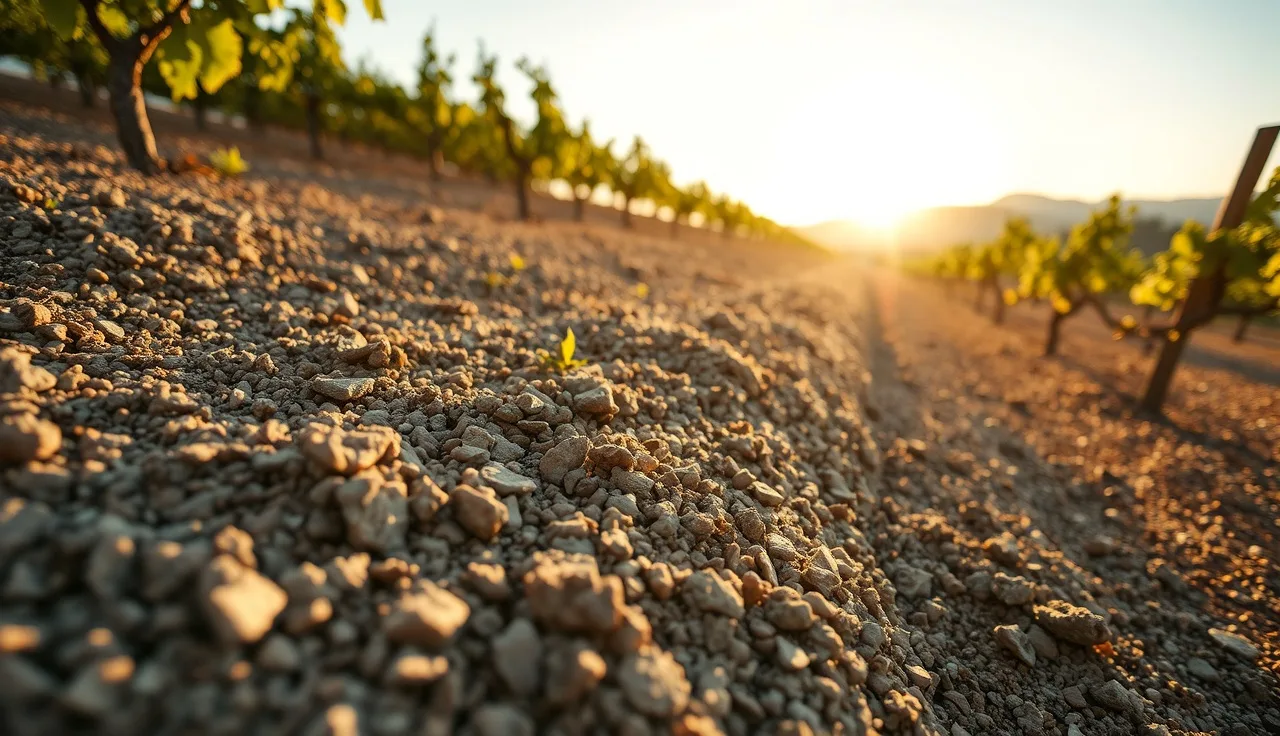
Cretaceous plutonic soil is ground weathered from granite (or related igneous rock) that cooled slowly underground during the Cretaceous period, 145 to 66 million years ago [1]. The result on a vineyard is coarse, gritty, fast-draining material with low fertility. 'Plutonic' just means the magma cooled deep down and never erupted as lava.
Granite is the familiar example, but the category also includes granodiorite, diorite, and tonalite, all of which show up in California's Coast Ranges and the Sierra Nevada foothills.
When you read 'cretaceous plutonic soil' on a vineyard data sheet or a winery's terroir blurb, it means one thing: bedrock that started as a slow-cooling igneous intrusion during the age of dinosaurs, got pushed to the surface by tectonic uplift, and has spent millions of years breaking down into the gritty ground you can dig into today.
The weathering is what matters. Granite breaks down into grus, a sandy, gravelly decomposed granite that drains fast, holds little water, and carries almost no organic matter. What's left is quartz-heavy, with some feldspars and micas. Nitrogen and phosphorus run low compared to sedimentary soils.
None of this is exotic. You're farming on very old, very coarse, fast-draining ground with little natural fertility. That's the whole story, and everything else follows from it.
Where do cretaceous plutonic formations show up in wine country?
The biggest concentrations in North American wine country are in California, anchored by the Sierra Nevada batholith. That massive Cretaceous-age granitic complex underlies the Sierra Foothills AVA and its sub-regions in El Dorado, Amador, and Calaveras counties [2]. Parts of the Santa Cruz Mountains AVA sit on Cretaceous-age granitic and metamorphic basement rock too, including hillside sites above the fog line that have made well-regarded Pinot Noir and Chardonnay.
In Paso Robles, the Willow Creek and Templeton Gap districts hold pockets of decomposed granite from Cretaceous intrusions mixed with calcareous sedimentary material. The mix is patchy, so you won't find a clean line on a vineyard map, but the granitic influence is real across parts of the west side [3].
Outside California, Baja California's Guadalupe Valley sits largely on decomposed granite of similar age. Australia's McLaren Vale and Clare Valley have zones of pre-Cambrian and Cambrian crystalline basement, older than Cretaceous but geologically analogous in how they behave. In France, Alsace's lower slopes and parts of Corsica have granitic soils that act much the same, though the exact Cretaceous-period attribution varies by sub-zone.
Want to check your own parcel? A quick look at the USDA Web Soil Survey [4] shows the mapped soil series for any U.S. vineyard block. Look for series names like Chaix, Josephine, or Auberry, common decomposed granite series in California vineyard country. The parent material field in the survey description tells you whether you're on plutonic, sedimentary, or mixed origin.
How does plutonic granite soil affect vine growth and root behavior?
The single biggest effect is drainage. Decomposed granite does not hold water. A soil with 60 to 80 percent coarse fragments drains fast after rain or irrigation, and the vine has to hunt for moisture. That drives deep, exploratory root systems, often reaching 6 to 12 feet or more into fractured bedrock on established vines [5].
Deep roots on a tight water budget make smaller berries with thicker skins, higher skin-to-juice ratios, and more concentrated phenolics. That's the mechanism behind the 'mineral, structured' descriptor you hear on wines from granitic sites. No magic involved. It's water stress and small cell size.
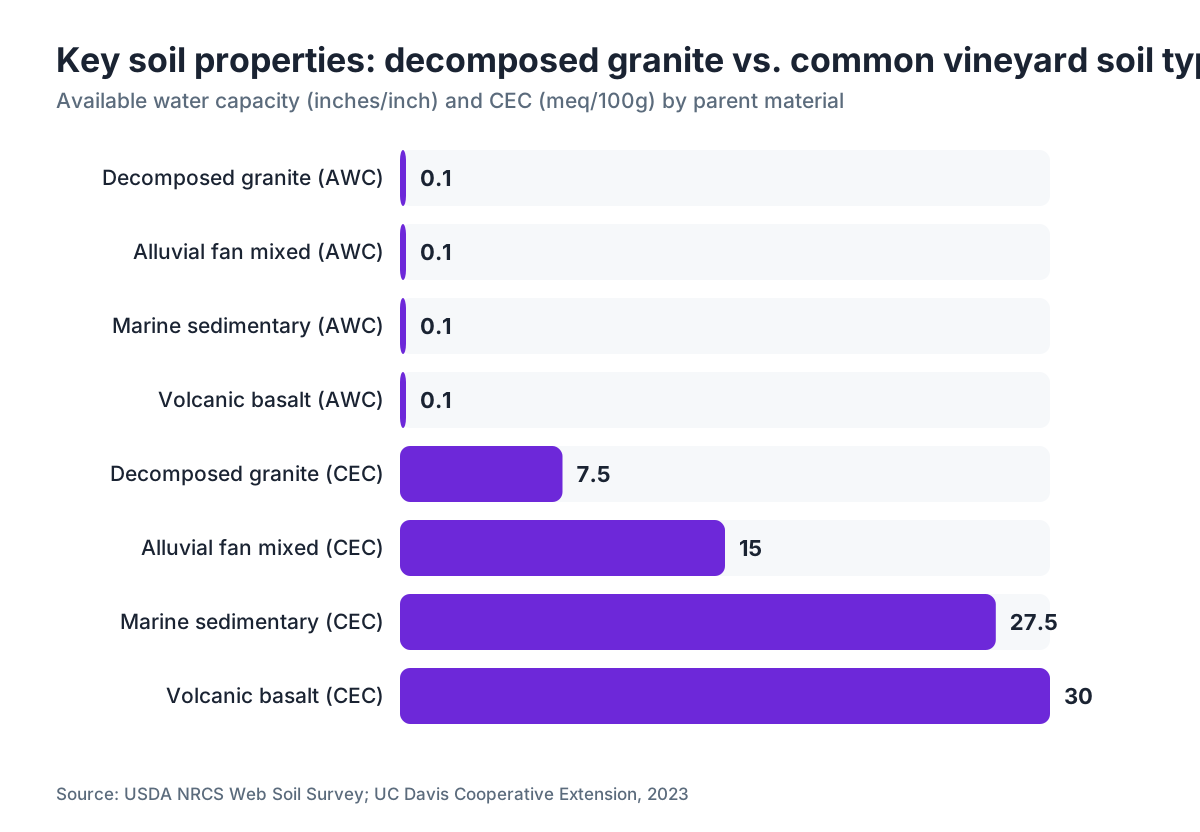
Fertility is genuinely low. Soil organic matter on decomposed granite sites often runs below 1 percent. Cation exchange capacity (CEC) is minimal, 5 to 10 meq/100g is common, against 20-plus on clay-rich sedimentary soils [6]. The soil can't hold nutrients in reserve the way a loamy, alluvial soil can. What you apply, the vine has to take up quickly or it leaches past the root zone.
pH tends to sit mildly acidic, typically 5.5 to 6.5, which suits Pinot Noir and Syrah well. You may need lime to nudge pH up for Cabernet Sauvignon if you're targeting above 6.0, but plenty of growers on granite leave it alone.
One more thing worth knowing. These soils heat up fast during the day and cool fast at night. The coarse mineral matrix has low heat retention. That diurnal swing helps hold acid in warm regions, one reason West Side Paso Robles and parts of the Sierra Foothills can turn out Zinfandel and Grenache with livelier acidity than the daytime highs would predict.
Which grape varieties perform best on cretaceous plutonic soils?
No controlled trial isolates variety performance on Cretaceous plutonic soils specifically, so be skeptical of anyone who hands you a tidy ranked list. What we have is accumulated grower experience and a few regional datasets. That's enough to say some varieties clearly do well here.
Syrah comes up over and over in talk about granitic terroir. The Rhone Valley's Crozes-Hermitage and Saint-Joseph appellations, which include big granitic zones, built Syrah's reputation for earthy, peppery complexity on this ground. Paso Robles growers on granite often report that Syrah and Grenache ripen evenly, without the green notes that show up on heavier clay [3].
Zinfandel has a long track record in the Sierra Foothills on decomposed granite. Some of California's oldest Zinfandel vines, pre-Prohibition plantings in Amador County, grow in this material and have survived over a century on minimal irrigation. Whether that's the granite, the old-vine genetics, or both is hard to separate.
Pinot Noir on granite is well established in Alsace and Burgundy's southern granite zones (Moulin-a-Vent, Fleurie, Morgon). In California, some Santa Cruz Mountains producers report that Pinot Noir off their granitic hillside sites has firmer tannin and better aging potential than fruit from valley-floor alluvial soils.
Chardonnay, Grenache Blanc, and Viognier also do fine here, usually with lower aromatics but more texture and mineral edge than on richer soils.
What struggles: high-vigor, water-hungry varieties. Muscat wants more fertile ground. Riesling can work but needs careful water management, because drought stress at the wrong point in a short growing season does more harm than good.
For how site conditions interact with variety selection in specific regions, the Paso Robles wineries page covers the west side and east side soil contrast in useful detail.
What are the irrigation and water management implications?
Low water-holding capacity is the fight you'll pick every season. The USDA Natural Resources Conservation Service puts available water capacity (AWC) for decomposed granite soils at 0.05 to 0.08 inches of water per inch of soil [4]. A loam holds 0.15 to 0.20 inches per inch. You're working with roughly half the reservoir, and it empties fast.
For dry-farmed sites, vine survival depends on real winter rainfall, roots deep enough to reach fracture zones where water collects, or both. The Sierra Foothills at higher elevations (1,500 to 3,000 feet) often get 30 to 45 inches of rain a year, which can carry dry farming on established vines. Low-elevation granitic sites in drier climates need supplemental irrigation.
If you're irrigating, watch the soil, not the calendar. Fast drainage means a single heavy application can push water below the root zone before the vine uses it. Deficit irrigation protocols, holding soil water potential between -0.4 and -1.0 MPa during the growing season, are documented in UC Davis viticulture extension materials [5]. That moderate stress band is exactly where you want to be on granite: stressed enough to concentrate the fruit, not so stressed you trigger defoliation or sunburn.
Capacitance-based sensors (Sentek, Irrometer) work well in coarse granitic soils. Tensiometers get tricky, because the coarse texture makes good soil-to-cup contact harder. Set monitoring at two depths: 12 inches for the active feeder root zone, and 24 to 30 inches to catch deep percolation events before they cost you water.
How should you manage nutrition and pH on plutonic soils?
Low CEC means low buffering capacity, and that cuts both ways. You can correct deficiencies faster because there's less soil to change. You can also create toxicity faster if you over-apply. Restraint pays here.
Start with a full soil analysis every two to three years and a petiole sample at bloom and veraison every year. On low-CEC granitic soils, petiole testing matters more than usual, because the soil test alone won't tell you what the vine is actually taking up. UC Cooperative Extension publishes reference values for grape petiole nutrient sufficiency ranges [6]. Those are the benchmarks to use.
Nitrogen is usually the most limiting macronutrient. Organic matter decomposes slowly here, and there's not much of it to begin with. Most granitic blocks need some nitrogen, but the rates run lower than on sedimentary soils because you're not competing with a large microbial biomass for it. Twenty to 40 pounds of actual N per acre per year is a reasonable starting range. Adjust from petiole results.
Boron deficiency shows up often on granitic soils, especially in wet years when leaching runs high. Watch for poor fruit set and misshapen berries. A foliar boron spray at pre-bloom (around 0.2 to 0.3 pounds of actual boron per acre) fixes it fast.
Potassium is interesting. Feldspar weathering releases potassium, so some granitic soils carry adequate K even at low CEC. Check the soil test and don't supplement blindly. High K in the vine pushes juice pH up at harvest, a winemaking headache you'd rather skip.
Raising pH if you need to: ag lime works but moves slowly in coarse soil. Work it into the top 12 inches before planting. Post-plant corrections take two to three years to register in the root zone, so plan ahead.
What are the erosion and cover crop considerations for granitic vineyards?
Decomposed granite erodes fast once you disturb it. The coarse particles don't bind the way silt or clay do. On any slope over 5 percent, bare granitic soil in winter is a liability. You'll lose topsoil and, eventually, the thin organic layer that took decades to build.
Cover crops are standard practice on granitic hillside sites. A mix of cereal rye and legumes in winter protects the surface and puts organic matter back. In drier regions, a cereal-only cover that terminates by late April won't compete with vines for spring soil moisture. WSU viticulture extension has practical guidance on cover crop selection for different rainfall zones [7].
On steeper sites (above 15 to 20 percent slope), inter-row grass strips or permanent cover with mowing beat annual termination. Some Paso Robles hillside growers on granite run permanent native grass between rows and mow in spring. It builds organic matter over years and slows the runoff that carves rills.
One record-keeping note. If you're in a region with agricultural water quality management requirements, such as California's Irrigated Lands Regulatory Program, you need to document your erosion control practices. This is where a tool like VitiScribe earns its keep: logging cover crop species, termination dates, and field observations in one place makes annual report prep much less painful.
For building organic matter, compost at 2 to 4 tons per acre in alternate rows on a two-to-three year cycle is a reasonable, evidence-based approach. Don't expect miracles. Getting from 0.5 percent to 1.5 percent organic matter on coarse granitic soil takes a decade of steady management.
How does cretaceous plutonic geology affect wine style and flavor?
Here's where you have to be careful about overclaiming. The direct mechanistic link between specific rock minerals and wine flavor compounds is not established by controlled science. Nobody has proven that the potassium feldspar in your granite shows up as a specific aromatic compound in your Syrah. Anyone who says otherwise is selling you terroir mysticism.
What is well established: soil physical properties (drainage, water holding, fertility) drive vine physiology, which drives berry composition, which drives wine style. The granite connection to wine character runs through those farming variables, not through minerals migrating into the grape.
With that caveat stated plainly, wines from granitic sites do tend to share traits in blind tasting. Lower pH (higher acidity), firmer tannin structure, more restrained aromatics in youth, and a texture tasters often call 'stony' or 'mineral' show up again and again. A 2021 study in the American Journal of Enology and Viticulture looked at Syrah from different soil parent materials in California and found measurable differences in tannin polymerization and anthocyanin concentration that tracked with soil texture, with coarser soils (including decomposed granite) producing higher skin tannin extraction [8]. Not every granitic soil in that dataset was Cretaceous-age, but the physical texture is comparable.
The practical takeaway is simple. If your granite site turns out wines that taste sharper and more structured than the regional norm, that's the farming system working as designed. Adjust your winemaking (extended maceration, careful oak, longer bottle age) to work with the structure instead of fighting it.
How do you evaluate a site with cretaceous plutonic soils before planting?
Site evaluation on any granitic block has to go deeper than a standard ag soil test. Four things matter most, and none of them show up in a lab report.
First, dig a soil pit to at least 4 feet, or to refusal if bedrock is shallow. You want depth to bedrock, degree of weathering at each horizon, any clay accumulation layers (argillic horizons from ancient weathering can act as perched water tables or block roots), and the overall texture profile. Photograph the pit walls.
Second, check fractured versus intact bedrock. Fractured Cretaceous granite at 4 to 8 feet is a vine asset: roots explore the fracture zones for water and nutrients. Unfractured massive rock at 3 feet is a ceiling that caps root depth no matter what you do above it.
Third, map topography and aspect. Granitic soils on south-facing slopes in warm climates push heat accumulation hard. The same soil on a north-facing slope in a cooler climate might be the better block for earlier-ripening varieties.
Fourth, pull a water chemistry analysis if you plan to irrigate. Granitic aquifers in some California regions carry elevated sodium or boron. The USGS National Water Information System [9] holds historical groundwater chemistry data for most counties, a reasonable starting point before you drill a well.
The USDA Web Soil Survey [4] gives you mapped series and interpretations for any U.S. parcel in minutes. Cross-reference the survey with your physical pit: survey data is interpolated and can miss local variability, especially on complex hillside terrain.
For new vineyard development decisions, Cornell's viticulture extension has a useful site evaluation framework that scores geology, climate, and topography [10].
What does spray and pesticide record-keeping look like on granitic vineyard sites?
Cretaceous plutonic soils don't change your pesticide regulatory requirements, but they do change some application decisions in ways that matter for your compliance records.
These soils drain fast and hold little organic matter, and organic matter is what binds pesticides. So leaching potential for mobile compounds runs higher than on clay or organic-rich soils. Pesticides with high Koc values bind to organic matter; on a 0.5 percent OM granitic soil, that binding is minimal. The EPA Worker Protection Standard (WPS) requires you to keep pesticide application records including product name, EPA registration number, active ingredient, application date, location, rate, and restricted entry interval (REI) for each application [11]. Those records must be kept for two years.
California layers its DPR pesticide use reporting (PUR) requirement on top, with submission to your county agricultural commissioner within 30 days of application [12]. The fields overlap heavily with the federal WPS records but add acreage and commodity.
For granitic sites specifically: if you're applying mobile herbicides like glyphosate or simazine near a water feature, the fast-draining soil raises runoff and leaching risk. Your records should document buffer distance, wind speed, and equipment calibration, because if a water quality complaint ever lands, that documentation is your defense.
Record-keeping is the unglamorous backbone of compliance on any commercial vineyard. VitiScribe is built for exactly this: spray logs, REI tracking, and PUR-ready export, so the paperwork doesn't pile up between applications.
In regions with Irrigated Lands Regulatory Program requirements (most of California's ag areas), soil-specific leaching risk assessments may be required as part of your water quality management plan. Granitic soils often land in the 'high leaching potential' bucket, which means more documentation scrutiny, not less.
How does this soil type compare to other common vineyard geology?
A side-by-side comparison puts the numbers in context. Granite sits at the extreme end of nearly every property that matters for farming decisions.
| Soil Parent Material | Texture | Typical AWC (in/in) | Typical CEC (meq/100g) | Typical pH | Common AVA examples |
|---|---|---|---|---|---|
| Cretaceous plutonic (decomposed granite) | Sandy loam to coarse loam | 0.05 to 0.08 | 5 to 10 | 5.5 to 6.5 | Sierra Foothills, parts of Santa Cruz Mtns |
| Calcareous limestone/chalk | Clay loam to clay | 0.10 to 0.15 | 15 to 30 | 7.0 to 8.2 | Napa Coombsville, parts of Willamette Valley |
| Marine sedimentary (Monterey Shale) | Clay loam | 0.08 to 0.12 | 20 to 35 | 6.5 to 7.5 | Edna Valley, Sta. Rita Hills |
| Alluvial fan (mixed origin) | Sandy loam to loam | 0.12 to 0.18 | 10 to 20 | 6.0 to 7.5 | Much of Napa Valley floor |
| Volcanic (basalt/andesite) | Clay to clay loam | 0.10 to 0.16 | 20 to 40 | 5.5 to 7.0 | Willamette Valley, parts of Sonoma |
Data sources: USDA NRCS soil series descriptions [4]; UC Davis viticulture extension soil profiles [6]
The table makes the granitic case plain: lowest water holding, lowest nutrient buffering, generally lowest pH. That's the combination that forces stress-driven quality when water management is right, and forces vine failure when it's wrong. There's not much middle ground.
If you're evaluating a property in Paso Robles wineries country, or looking at hillside sites near a mountain winery operation, knowing where your parcel falls on this spectrum before you sign anything is basic due diligence.
Are there any downsides or risks to farming on cretaceous plutonic soils?
Granite terroir gets romanticized in wine media, so let's be honest about the harder parts. There are several, and they cost real money.
Yield variability is real. In dry years without supplemental irrigation, granitic sites can produce 30 to 50 percent lower yields than the same variety on a water-retentive alluvial soil. For a small operation, that revenue swing is hard to absorb. Dry-farmed granite sites are not for growers who need predictable volume.
Erosion risk on slopes needs active management, as noted earlier. Neglect your cover cropping for two or three seasons and you'll lose topsoil depth that took centuries to accumulate. Thin topsoil on granite is hard to rebuild quickly.
Nutrient deficiencies demand more monitoring than fertile sedimentary soils do. Boron, zinc, and manganese are the common surprises. Miss a deficiency early and you get reduced fruit set or uneven ripening that's hard to correct mid-season.
The coarse, rocky soil makes some mechanical work harder. Tillage equipment wears faster. Post-driver penetration gets inconsistent where you hit shallow bedrock. Trenching for drip lines is sometimes genuinely expensive on sites with bedrock at 3 to 4 feet.
One last point, and it's underappreciated. Not all decomposed granite is the same. Granodiorite weathers differently from pure granite; tonalite carries a different mineral suite. Cretaceous-age intrusions vary in original composition depending on the magma source. Blanket advice about 'granitic terroir' can mislead you if your parent material differs from the site that advice came from. Get your own soil and bedrock characterized before you plant.
Frequently asked questions
What does 'cretaceous plutonic' mean on a vineyard soil report?
It means your soil's parent material is igneous rock, typically granite or granodiorite, that formed from slow-cooling magma during the Cretaceous period (66 to 145 million years ago) and has since weathered into coarse, well-drained ground. The practical result is fast drainage, low water-holding capacity, low natural fertility, and mild soil acidity, usually pH 5.5 to 6.5.
Is cretaceous granitic soil good or bad for wine grapes?
It depends on what you're growing and how you manage water. For varieties that benefit from moderate vine stress, including Syrah, Zinfandel, Grenache, and Pinot Noir, granite soils can produce concentrated, structured fruit. For high-vigor, water-hungry varieties, the low water holding is a liability. It's good soil in skilled hands with proper irrigation management, and a liability without it.
Which California wine regions have cretaceous plutonic soils?
The Sierra Foothills AVA (El Dorado, Amador, Calaveras counties) sits largely on the Sierra Nevada batholith, a Cretaceous-age granitic complex. Parts of the Santa Cruz Mountains AVA have granitic and metamorphic basement rock of similar age. The west side of Paso Robles has pockets of decomposed granite. The USDA Web Soil Survey lets you check any parcel for confirmed parent material.
How deep do vine roots go in decomposed granite?
On established vines with fractured bedrock below, root systems commonly reach 6 to 12 feet or more. In unfractured granite bedrock, roots stay limited to the weathered layer above it, sometimes only 2 to 4 feet on some sites. The fractured versus unfractured distinction is one of the most important things to assess before planting, and you can only see it in a soil pit.
Can you dry-farm a vineyard on cretaceous plutonic soil?
Yes, but it depends heavily on rainfall and vine age. The Sierra Foothills at 1,500 to 3,000 feet often gets 30 to 45 inches of rain a year, enough to support dry farming on established vines with deep roots. In lower-elevation, drier regions like parts of Paso Robles, dry farming on granite works for some old-vine blocks but is risky for young plantings. The low water-holding capacity leaves little buffer in dry years.
What cover crops work best in granitic vineyard soils?
Cereal rye mixed with a legume (crimson clover or vetch) is a standard winter cover that protects the surface from erosion and builds some organic matter. In drier climates, terminate the cover by late April to avoid competing with vines for spring soil moisture. On steeper slopes, a permanent grass cover with spring mowing protects better than annual termination. WSU viticulture extension publishes cover crop guides suited to different rainfall zones.
What nutrients are most likely to be deficient on plutonic granite soil?
Nitrogen is usually most limiting because organic matter is low and CEC is minimal. Boron deficiency is common, especially in high-rainfall years when leaching runs high; watch for poor fruit set. Zinc and manganese deficiencies also appear more often on granitic sites than on clay or loam. Run petiole samples at bloom and veraison every year, which beats a soil test alone for catching deficiencies before they affect the crop.
How do I find out if my vineyard parcel has cretaceous plutonic parent material?
Start with the USDA Web Soil Survey at websoilsurvey.nrcs.usda.gov. Enter your parcel location, pull the soil map unit, and read the series description. The 'parent material' field indicates whether it's plutonic, sedimentary, or mixed. Follow up with a physical soil pit to at least 4 feet to confirm what the survey shows, especially on complex hillside terrain where mapped units get generalized.
Does granitic soil affect pesticide leaching risk in vineyards?
Yes, significantly. Low organic matter means fewer binding sites for pesticides with high Koc values. Fast drainage means mobile compounds can move below the root zone or toward groundwater faster than on clay or loam. The EPA Worker Protection Standard and California's DPR pesticide use reporting both require detailed application records, and on high-leaching sites like granite vineyards, keeping those records carefully matters most if water quality questions come up.
What irrigation scheduling approach works best on decomposed granite vineyard soils?
Soil moisture monitoring beats calendar scheduling here. Available water capacity on decomposed granite runs only about 0.05 to 0.08 inches per inch of soil, roughly half that of a loam. Capacitance-based sensors at 12 and 24 to 30 inches let you see drainage events and time irrigations to hold a moderate deficit, around -0.4 to -1.0 MPa, without pushing the vine into severe stress. UC Davis extension publishes deficit irrigation protocols for California vineyards.
What wine styles does cretaceous granitic terroir tend to produce?
The soil's physical properties drive the style, not direct mineral migration. Wines from these sites tend toward higher acidity (lower pH), firmer tannin structure, smaller berry character, and what tasters call 'stony' or 'mineral' texture. Those traits come from vine stress, small cell size, and high skin-to-juice ratio, all consequences of the low water-holding, low-fertility environment. The style rewards aging and pairs better with extended maceration than with early release.
How does cretaceous plutonic soil compare to volcanic soil for viticulture?
Volcanic soils (basalt, andesite) tend to have higher CEC (20 to 40 meq/100g versus 5 to 10 for granite), more clay, and better water retention. Granitic soils drain faster and hold fewer nutrients. Both are associated with quality viticulture, but they need different management. Granite favors moderate deficit irrigation and close nutrition monitoring; volcanic soils give you more buffer but can suppress the vine stress that concentrates fruit.
Do I need special record-keeping for vineyards on high-leaching soils?
In California, vineyards in regulated watersheds under the Irrigated Lands Regulatory Program may need a water quality management plan that includes a leaching risk assessment. Granitic soils often score as high leaching potential in those assessments. Federal EPA Worker Protection Standard records (product, rate, REI, location, date) must be kept for two years regardless of soil type. On high-leaching sites, documenting buffer distances and application conditions adds protection if a water quality complaint arises.
What should I look for in a soil pit evaluation on a granitic vineyard site?
Dig at least 4 feet, or to refusal. Look for depth to bedrock, whether bedrock is fractured or massive (fractured is good for root penetration), any argillic (clay accumulation) horizon that could impede drainage or roots, texture changes by depth, and roots at each horizon. Fractured Cretaceous granite at 4 to 8 feet is an asset. Unfractured rock at 3 feet is a hard ceiling on root development, no matter what you do at the surface.
Sources
- USGS Geologic Time Scale, Cretaceous Period: The Cretaceous period spans from approximately 66 to 145 million years ago
- USGS, Sierra Nevada batholith geology overview: The Sierra Nevada batholith is a Cretaceous-age granitic complex underlying the Sierra Foothills region
- UC Davis Viticulture and Enology, Paso Robles AVA soil and climate profiles: The west side of Paso Robles including Willow Creek and Templeton Gap districts contains pockets of decomposed granite from Cretaceous-age intrusions
- USDA Natural Resources Conservation Service, Web Soil Survey: Available water capacity for decomposed granite soils runs 0.05 to 0.08 inches of water per inch of soil; the Web Soil Survey provides mapped soil series and parent material for any U.S. parcel
- UC Agriculture and Natural Resources, Regulated Deficit Irrigation for Vineyards: UC extension documents deficit irrigation protocols recommending soil water potential between -0.4 and -1.0 MPa during the growing season; established vine root systems can extend 6 to 12 feet or more into fractured bedrock
- UC Agriculture and Natural Resources, Nutrient Management in Vineyards publication: Cation exchange capacity on decomposed granite soils commonly ranges from 5 to 10 meq/100g; UC Cooperative Extension publishes grape petiole nutrient sufficiency reference values
- Washington State University Extension, Cover Crops for Vineyards: WSU viticulture extension provides practical guidance on cover crop species selection for different rainfall zones in wine country
- American Journal of Enology and Viticulture, soil texture and Syrah tannin study (2021): A 2021 AJEV study found measurable differences in tannin polymerization and anthocyanin concentration in Syrah correlated with soil texture, with coarser soils producing higher skin tannin extraction
- USGS National Water Information System, groundwater chemistry data: The USGS NWIS provides historical groundwater chemistry data including sodium and boron concentrations for county-level aquifers, useful before drilling a well in granitic terrain
- Cornell College of Agriculture and Life Sciences, vineyard site evaluation resources: Cornell viticulture extension provides a site evaluation framework scoring geology, climate, and topography for new vineyard development
- EPA Worker Protection Standard for Agricultural Pesticides (40 CFR Part 170): The EPA WPS requires vineyard operators to maintain pesticide application records including product name, EPA registration number, active ingredient, application date, location, rate, and REI for at least two years
- California Department of Pesticide Regulation, Pesticide Use Reporting: California DPR requires pesticide use reports to be submitted to the county agricultural commissioner within 30 days of each application, with required fields including acreage and commodity
Last updated 2026-07-10