Inter-row soil cultivation for small vineyards: a practical guide
TL;DR
- Inter-row cultivation means managing the soil and plants between vine rows by mowing, tilling, cover cropping, or a mix.
- Small vineyards under 20 acres pick between permanent sod, annual cover crops, clean tillage, or mowing resident vegetation.
- The right system depends on slope, soil type, irrigation, and weed pressure.
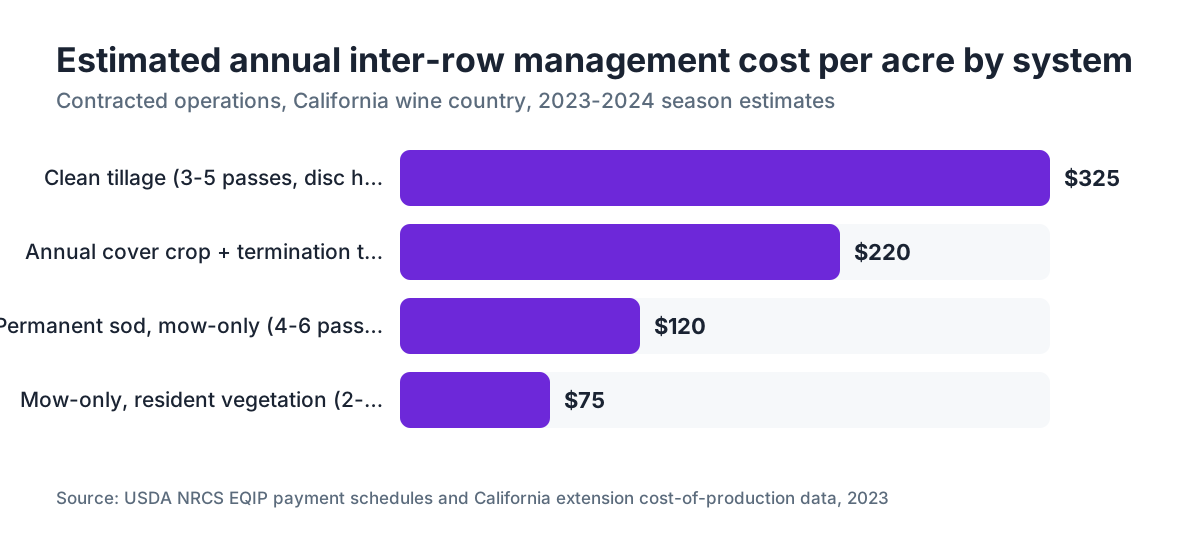
- Costs run $75 to $325 per acre per year.
What is inter-row soil cultivation and why does it matter in small vineyards?
Inter-row cultivation is any mechanical operation that disturbs, cuts, or manages the soil and plants in the mid-row zone, the strip of ground running between two rows of vines. It leaves out the ground directly under the vine canopy. That's the in-row zone, and you handle it separately with under-vine cultivation or herbicides.
The mid-row decision shapes almost everything downstream. It sets how much water soaks in versus runs off, how fast organic matter builds, what your labor and equipment cost, and whether you get erosion on sloped blocks. It also decides the physical access for every spray pass, harvest machine run, or hand crew walking through.
The California Department of Food and Agriculture reports that roughly 85 percent of California's wine grape acreage uses some form of cover cropping in the inter-row zone, though management intensity varies enormously [1]. That number covers everything from an unmanaged weed population mowed twice a year to a seeded permanent sod with weekly flail mowing in wet springs.
Small operations, say two to fifteen acres, run a different math than large estates. You probably don't own a purpose-built vineyard disc or a French inter-row cultivator. You might share equipment with a neighbor or contract out tillage passes. A $14,000 specialty cultivator only pencils out when you can spread that cost across enough acres.
What are the main inter-row management systems and how do they differ?
There are four broad systems. Most vineyards run some hybrid of two of them depending on the block, the season, or the year's rainfall.
Clean cultivation (tillage-based floor): You disk, rototill, or cultivate the mid-row repeatedly through the season to hold a bare soil surface. This ran California's San Joaquin Valley through the 1980s and still makes sense in very arid blocks where you want to kill all competition for water. It draws down the weed seed bank over time if you're consistent. It also wrecks soil structure when overdone, kicks up dust, causes erosion, and strips beneficial insect habitat.
Permanent sod: You establish a perennial grass or grass-legume mix and mow it all season. UC Davis recommends permanent sod on slopes above 5 percent specifically to prevent erosion [2]. The tradeoff is real water competition in dry summers, which can stress shallow-rooted vines in drought years or on sandy soils. Sod also compacts under tractor traffic if you're not aerating.
Annual cover crop with seasonal tillage: You seed a mix in fall (commonly a cereal grain like barley or oats, sometimes with legumes like bell beans or vetch), let it grow through winter and early spring, then disk or flail it down before it sets seed and dries out. This is the most popular approach in Northern California coastal regions. Cornell Cooperative Extension recommends similar winter annual systems for Finger Lakes vineyards to catch snowmelt and cut compaction in heavy clay [3].
Permanent mow-only, no tillage: You let resident vegetation establish, mow it enough to keep it from seeding out or competing during the stress period, and never cultivate the mid-row. This works when your resident population is genuinely low-vigor and you're on drip. It falls apart when strong perennial broadleaf weeds like bindweed or nutsedge move in, because mowing doesn't touch them.
The table below compares the four systems on the factors that actually change your season.
| System | Water competition risk | Erosion risk | Equipment cost | Soil organic matter over time |
|---|---|---|---|---|
| Clean cultivation | Low | High (bare soil) | Moderate | Declining without compost inputs |
| Permanent sod | High in dry years | Very low | Low (mower only) | Improving |
| Annual cover crop + tillage | Moderate (seasonal) | Low to moderate | Moderate to high | Improving |
| Permanent mow, no tillage | Low to moderate | Low | Low (mower only) | Stable to improving |
When should you till inter-row soil and when should you avoid it?
Timing is where small growers make the most avoidable mistakes. The two big ones are tilling too wet and tilling too late in the season.
Tilling wet soil, soil that holds its shape when you squeeze it, creates compaction layers (sometimes called tillage pans) at plow depth. These layers stick around for years. WSU Extension found that repeated wet tillage in Washington Riesling blocks created compaction layers at 6 to 8 inches that cut deep root exploration and raised drought stress in dry summers [4]. Fixing a tillage pan means deep ripping, which costs money and is itself a disturbance risk.
Here's a field test. Grab a handful of mid-row soil and squeeze it. If it forms a ribbon more than an inch long when you press it between your thumb and forefinger, it's too wet to till. Wait.
The other trap is tilling too late in spring after a wet winter. If you run a winter annual cover crop and let it grow past the point where it's tying up real soil moisture in late March or April, you can open a deficit the vines can't recover from before bloom. In Napa Valley benchland, where water-holding capacity is high, late tillage is often fine. In Sonoma sandy loam, it can create measurable stress.
Fall tillage timing matters too. If you're prepping a seedbed for a winter cover crop, till close enough to your expected first real rain that weed seeds don't germinate and establish ahead of your cover crop. In most California coastal regions, that means the first or second week of October for seedbed prep, then seeding right away.
Skip mid-summer tillage on most sites. Tilling in June or July in a hot climate burns off soil moisture, breaks up aggregates, and can trigger a nitrogen flush that goes nowhere useful.
What equipment works for inter-row cultivation on small vineyards?
Equipment scale is the practical constraint that shapes every small vineyard's floor program.
For pure mowing, a standard offset flail mower in the 60 to 72 inch cut width, run from a compact tractor in the 40 to 60 HP range, handles most mid-row work fine. Good flail mowers from Trimax, Orsi, or Berti cost $4,000 to $9,000 new. A decent used unit runs $1,500 to $3,500. Mowing frequency for a managed sod or resident floor runs four to eight passes per season depending on rainfall and vigor.
For tillage, the most common small-operation tools are a disc harrow (offset or tandem), a rototiller, or a spring-tine cultivator. Offset disc harrows work fast and handle moderate residue, but they move soil sideways and can bury surface fertilizers or organic matter instead of mixing them evenly. A rototiller gives better residue incorporation and a finer seedbed for cover crop establishment, but it's slower, burns more fuel, and can over-till if you make too many passes.
Specialty inter-row cultivators, tools built for vineyard mid-row work like the Clemens or the Bosch-Rexroth swing-out types, hold a precise working width and protect the trunk zone. These start around $8,000 for basic hydraulic swing models and run $20,000 and up for GPS-guided units. Overkill for most small operations unless you're on very tight row spacing or the tool doubles as your under-vine cultivator.
For truly small plantings, under five acres, a BCS two-wheel tractor or a compact Kubota or Yanmar with a belly-mount or three-point tiller can be surprisingly effective and costs far less to keep running than a full-size tractor. Row width has to be at least 60 inches to work a two-wheel machine safely.
How does inter-row management affect vine water use and soil moisture?
Most small growers underrate this until they hit a dry summer with a permanent sod that's pulling hard.
Cover crop water use depends heavily on species, growth stage, and rooting depth. A mature stand of tall fescue or perennial ryegrass can use 1.5 to 2.5 inches of water per month during peak growth. That's meaningful competition in a vine root zone that reaches 3 to 4 feet deep. The same soil volume your vine roots explore, the cover crop roots explore too.
Research at UC Davis found that in unirrigated Cabernet Sauvignon blocks, permanent perennial grass cover crops reduced vine water potential (made vines more stressed) by 0.2 to 0.4 MPa compared to clean cultivation during July and August in dry years [5]. That extra stress isn't always bad. Mild to moderate water stress improves berry skin-to-pulp ratios and anthocyanin concentration in reds. But if you're already running dry, a permanent sod can push you past mild stress into actual vine shutdown.
The practical fix is timing. On a drip-irrigated block committed to a sod floor, stop mowing in late May or early June and let the sod go summer-dormant. That drops its active water demand a lot. Mowing sends growth energy back into leaf area, which transpires more water.
On non-irrigated hillside blocks, plenty of experienced growers run a hybrid: permanent sod on the uphill inter-rows where erosion risk is higher, and clean cultivation or mow-plus-till on the downhill inter-rows where water competition is easier to manage.
What are the soil health benefits of good inter-row management?
The long-term case for managed cover crops over clean cultivation is well-supported by published research, and university extension programs agree on the direction of the effect even where they hedge on the magnitudes.
Organic matter builds slowly. You're looking at 0.1 to 0.3 percent organic matter gain per decade under good cover cropping and no-till practices, depending on soil type and climate [6]. That sounds tiny. But a 0.1 percent increase in organic matter in a sandy loam roughly adds 0.25 inches of available water-holding capacity per foot of soil depth, which matters a lot in dry years.
Cover crops and permanent sod feed the mycorrhizal networks that vine roots lean on for phosphorus uptake. Clean cultivation tears those networks up mechanically and repeatedly. That's part of why biodynamic and organic vineyards run without synthetic inputs and with continuous sod for a decade or more often show higher mycorrhizal colonization rates in root samples.
Soil compaction from tractor traffic is real and unavoidable on any mechanically managed block. The standard fixes are to cut passes, run the lowest tire pressure that keeps traction and steering honest, and run a subsoiler or deep-ripper through problem areas every five to seven years. If you're logging passes, a tool like VitiScribe helps you track cumulative traffic by block and flag compaction-prone zones before they turn into yield loss.
Earthworms are a useful field indicator. Healthy mid-row soil under permanent sod or a managed cover crop should turn up 8 to 15 earthworms in a 12-inch-deep, one-square-foot sample. Fewer than five is a signal that your floor management is suppressing biological activity.
How does inter-row cultivation interact with pest and disease management?
The pest and disease angle of floor management gets ignored by most small growers until it bites them.
Leafhopper populations in California grapevines are tied directly to mid-row management. Dense permanent sod harbors predatory insects, especially Anagrus parasitic wasps that parasitize leafhopper eggs. UC Davis research in the 1990s established that sod floors with flowering cover crops raised Anagrus populations enough to measurably cut leafhopper damage in adjacent vine rows [7]. That's one of the strongest field-validated biological control examples in viticulture.
On the disease side, the link between floor management and bunch rot (Botrytis cinerea) is indirect but real. Dense, poorly mowed vegetation in the mid-row slows airflow through the canopy, which raises humidity at cluster level and stretches out the leaf wetness period. Keeping the inter-row floor open and well-mowed before harvest is basic Botrytis management that costs nothing extra.
Gophers and voles are a more immediate problem in any block with dense floor vegetation. Permanent sod, especially in high-rodent years, can shelter populations that ring-bark young vines or chew drip tubing. In a high-pressure rodent zone, that's a genuine argument for keeping the mid-row thinner or running bait stations as part of your integrated pest management program.
EPA's Worker Protection Standard (WPS) covers pesticide applications in the vineyard, including herbicides sprayed on inter-row vegetation. Restricted-entry intervals (REIs) for contact herbicides run from four hours to several days depending on the product. Any spray inside the WPS-covered vineyard needs the right notification, training, and PPE, whether the target is a weed or a fungal pathogen [8].
What cover crop seed mixes work best for inter-row in small vineyards?
There's no universal answer, but there are well-tested options that extension programs keep recommending.
For California coastal regions, a common small-vineyard starting point is a cereal grain (barley at 60 to 80 lb/acre or oats at 80 to 100 lb/acre) mixed with a legume (bell beans at 80 to 100 lb/acre or purple vetch at 20 to 30 lb/acre). The cereal germinates quick, protects against erosion, and puts down bulk biomass. The legume fixes nitrogen and adds the diversity that supports beneficial insects. UC Cooperative Extension Sonoma County has published local seed rates and species picks that match coast-range conditions specifically [2].
For New York and the northeastern U.S., Cornell Cooperative Extension recommends cool-season grasses like perennial ryegrass or hard fescue for permanent sod, or winter rye as an annual cover crop in blocks where frost heave is a concern and you want something winter-hardy that establishes fast before the ground freezes [3].
For the Pacific Northwest, WSU Extension recommends a similar winter annual approach in Washington's Columbia Valley, with close attention to termination timing ahead of bud break so you avoid early-season water competition in blocks without irrigation [4].
Seeding rate and establishment are the two failure points. Most small growers seed too light (go with the high end of extension recommendations, not the low end) and over-till the seedbed before seeding, which buries small-seeded legumes too deep. Seed legumes at 0.25 to 0.5 inches deep, no more. Cereals can go 1 to 1.5 inches.
Seed for a mid-row zone on a 10-acre block runs roughly $50 to $150 per acre depending on the species mix and whether you buy commercial blends or components separately. Budget $75 to $200 per acre installed, seed plus one seeding pass.
How do you manage inter-row cultivation on sloped vineyard blocks?
Slope changes everything. The USDA Natural Resources Conservation Service (NRCS) recommends permanent vegetation in inter-rows on any slope above 3 percent as a standard erosion practice for vineyards [9]. That's a low threshold. A surprising number of blocks that feel flat are running 3 to 5 percent.
On steeper blocks, 8 percent and above, bare-soil winters are basically untenable for erosion. A single heavy storm on a 10-percent bare slope can move a measurable amount of topsoil. Napa Resource Conservation District data from the early 2000s showed bare inter-row soil on 10-percent slopes losing 5 to 10 tons of soil per acre in single heavy storm events during El Nino years.
On sloped blocks the real question is what kind of permanent or semi-permanent cover works in your rainfall without creating too much water competition. In wetter climates (40 inches or more of annual rainfall), permanent sod is usually fine and gives the best erosion protection. In drier climates, a winter annual that terminates in spring before it uses summer-stored soil moisture is the compromise.
Mowing direction matters on slopes. Mowing across the slope (on contour) beats up-and-down for soil stability and spreading out compaction. Mow up-and-down and your tractor wheels slip on wet grass, carving concentrated traffic lanes that compact faster than the soil around them.
For very steep terrain (above 15 to 20 percent), equipment safety becomes the binding constraint before agronomy does. Check your tractor's certified stability angle. Most compact tractors have rollover protection structures (ROPS) and certified slope ratings in the operator's manual. Don't exceed them.
What does inter-row cultivation cost and how do you calculate it for your vineyard?
Cost accounting for floor management is more useful than most growers bother with, mostly because the baseline (doing nothing) is also a choice with costs.
Owning a dedicated flail mower on a small vineyard might run $800 to $1,500 per year in depreciation, maintenance, and storage if you manage it yourself. Add $15 to $25 per hour in tractor fuel and wear. At four passes per season over 10 acres at one acre per hour, that's roughly $600 to $1,000 per season in direct operating cost plus the depreciation.
Contract mowing in California wine country typically runs $60 to $120 per acre per pass as of 2023 to 2024. Four passes per season on 10 acres comes to $2,400 to $4,800 per season. Whether that beats owning depends on your acreage and whether you can share equipment.
Cover crop seeding adds $50 to $150 per acre in seed plus a seeding pass at $40 to $80 per acre contracted, or $15 to $30 per acre if you own the seeder. Budget $100 to $250 per acre per season for a managed annual cover crop system versus $40 to $100 per acre for a mow-only permanent sod system.
Clean tillage with a disc harrow runs $50 to $100 per acre per pass contracted in California, with typical programs running three to five passes per season. Total cost $150 to $500 per acre per season. That's often higher than a mow-and-cover-crop approach once you add up every pass.
The hidden cost is erosion. Replacing topsoil isn't a realistic option. Lost topsoil is a permanent productivity cut with no good economic remedy.
What records do you need to keep for inter-row cultivation and cover crop work?
Record-keeping requirements for cultivation vary by your state, your certification status, and your sales channel.
If you sell grapes or wine under a certified organic label, the USDA National Organic Program (NOP) requires you to document every input, every practice, and every field activity in enough detail to support your certification audit. Cover crop seed has to come from untreated sources (or you document why treated seed was used and get prior approval). Tillage passes need dates and equipment notes [10].
If you apply pesticides, including herbicides in the inter-row zone, the EPA Worker Protection Standard and most state departments of agriculture require you to keep pesticide application records for at least two years, often longer. California requires three-year retention for agricultural pesticide use reports under the Department of Pesticide Regulation's County Agricultural Commissioner reporting system [11].
For cover crop cost-share through NRCS (EQIP), you'll need to document what you planted, when, at what rate, and what happened to the crop (terminated or incorporated). Those records tie directly to payment eligibility.
Traceability for wine sales increasingly wants vineyard practice documentation down to the block level, and that's where a structured system pays off. VitiScribe tracks cultivation passes, input applications, and cover crop activity at the block level with date and operator stamps, which makes certification and compliance audits faster to prep for.
At minimum, log this for every operation: date, block or row range, operation type (mow, disc, seed, and so on), equipment used, and operator. A simple spreadsheet works. The point is having the record when you need it, not whether the software is fancy.
Are there government cost-share programs that help pay for inter-row soil management?
Yes, and small vineyards leave a lot of this money on the table.
USDA NRCS's Environmental Quality Incentives Program (EQIP) offers cost-share for cover crop establishment under Practice Standard 340. Payment rates vary by state and county, but they typically cover 50 to 75 percent of cover crop establishment costs up to a per-acre cap. In California, EQIP cover crop payments have historically ranged from $60 to $150 per acre for annual establishment [12]. You apply through your local NRCS service center. The program is competitive and funds fill up, so apply early in the signup window.
The USDA Conservation Stewardship Program (CSP) pays producers who maintain and enhance existing conservation activities including cover cropping and reduced tillage. CSP payments are annual and calculated on the conservation value of your management system. Small vineyard operators with documented multi-year cover crop histories can qualify for meaningful per-acre payments.
State programs add to this. California's Healthy Soils Program, run by CDFA, pays incentives specifically for practices that sequester carbon and improve soil health, including cover cropping, compost application, and reduced tillage. Payment rates in recent cycles have ranged from $200 to $700 per acre for qualifying practice combinations [13].
Most of these programs need a current farm number from USDA Farm Service Agency and a basic conservation plan. Getting set up takes a few hours and opens years of potential cost-share. Contact your local NRCS or farm bureau office for current payment schedules, since they update every year.
Frequently asked questions
How many times should I mow the inter-row in a season?
Most managed vineyards run four to eight mowing passes per season. Two passes minimum (late spring and midsummer) keeps cover from setting seed or growing tall enough to cut airflow. In wet years or on high-vigor permanent sod, you might mow six to eight times from March through August. After midsummer on drip-irrigated blocks, letting sod go dormant saves water and cuts mowing labor.
Can I use a standard farm tractor for inter-row cultivation or do I need specialty equipment?
A standard compact tractor in the 35 to 60 HP range works fine for inter-row mowing and basic tillage on most small vineyards. You need row spacing of at least 8 to 9 feet for a standard compact tractor to fit safely. Narrower rows (6 to 7 feet) may need a high-clearance narrow-track machine or a two-wheel tractor for some operations. Specialty swing-out cultivators help but aren't required for basic floor management.
Will a cover crop compete with my young vines for water?
Yes, especially in the first two to three years after planting when vine root systems are still shallow. Most extension programs recommend keeping a weed-free or low-vegetation zone in the inter-row next to young vines, or terminating cover crops early in spring before the stress period. Once vines are established with deep roots, moderate cover crop competition has less measurable effect on vine stress.
What's the difference between a flail mower and a rotary mower for vineyard use?
A flail mower uses multiple small hammers or blades on a rotating drum and mulches material finely. It handles heavy residue, tall cover crops, and uneven terrain better than a rotary mower and discharges downward rather than sideways, which cuts the risk of throwing rocks into the vine canopy. Rotary mowers (finish mowers, bush hogs) are cheaper but less suited to the irregular terrain and heavy residue of a vineyard floor.
Do I need to report herbicide use in my vineyard inter-rows?
In California, all agricultural pesticide applications including herbicides must be reported to your County Agricultural Commissioner within 30 days of application under CDFA and DPR rules. Most other wine-producing states have similar requirements. EPA's Worker Protection Standard also requires pesticide application records to be kept for at least two years. Check your state's specific retention rules. California requires three years.
How do cover crops affect Botrytis risk in my vines?
Cover crops don't infect vines with Botrytis directly, but dense, tall, unmowed vegetation slows airflow through the canopy, which stretches leaf wetness duration and raises humidity at cluster level. Both conditions favor Botrytis. Keeping inter-row vegetation mowed low, especially in the 30 to 60 days before harvest, is a cheap way to cut ambient humidity in the canopy without any fungicide input.
What slope is too steep to till the inter-row?
USDA NRCS recommends permanent vegetation rather than tillage on slopes above 3 percent as a baseline erosion measure for vineyards. Practically, most experienced managers stop tilling bare-soil mid-rows on slopes above 5 to 8 percent and switch to mow-only or cover crop programs. Above 15 to 20 percent, equipment safety and tractor stability certification limits become the binding constraint before agronomy does.
What is the best cover crop for a dry-farmed vineyard?
Winter annuals are nearly always the right answer for dry-farmed blocks. Barley or oats as a cereal component establish fast, protect soil through winter, and dry down naturally by May or June with minimal soil moisture use compared to perennial grasses. Terminate them by mowing or light tillage before they set seed and before soil moisture depletion gets significant. Avoid aggressive legumes like hairy vetch in very dry years; they stay green longer and pull more water.
Are there USDA cost-share programs for cover crops in vineyards?
Yes. USDA NRCS's EQIP program (Practice Standard 340, Cover Crop) offers 50 to 75 percent cost-share for cover crop establishment, with per-acre rates varying by state and county. California's CDFA Healthy Soils Program adds incentive payments for cover cropping and reduced tillage, with recent rates ranging from $200 to $700 per acre for qualifying practice combinations. Apply through your local NRCS service center early in the signup window.
How deep should I till the inter-row for cover crop establishment?
For seedbed prep before cover crop seeding, tillage to 3 to 5 inches is usually enough and avoids unnecessary disruption of deeper soil structure. Going deeper than needed wastes fuel, opens more chances for weed seed germination, and risks moisture loss. A single pass with a shallow-set disc, or a rototiller on its shallowest setting, works if the surface isn't badly compacted. Fine seedbeds are needed for small-seeded species like clovers; coarser is fine for cereal grains.
How do I know if my inter-row soil is compacted?
A soil penetrometer gives a quantitative reading; resistance above 300 psi at 6 to 12 inches depth is a standard threshold for concern in viticulture. Without one, push a metal rod or rebar by hand into moist (not wet) soil. If you can't push it past 8 to 10 inches without real effort, compaction is likely. Pooling water after moderate rain in the mid-row and shallow root systems visible in soil cores are additional field signs worth taking seriously.
What do I do if bindweed or nutsedge is taking over my inter-row?
Both bindweed (Convolvulus arvensis) and nutsedge (Cyperus spp.) are notoriously hard to control with mowing alone. Bindweed needs either systemic herbicide (glyphosate or triclopyr) or repeated cultivation at short intervals to exhaust root reserves, which takes two to three seasons of consistent effort. Nutsedge isn't a true grass, and most pre-emergent herbicides registered for vineyards don't control it well. Halosulfuron (Sandea) is one of the few post-emergent options labeled for nutsedge suppression in vineyards; verify your state registration before use.
How does inter-row management affect mycorrhizal fungi in vineyard soil?
Repeated tillage tears up the physical hyphal networks that mycorrhizal fungi form in soil, cutting their colonization of vine roots. Research consistently shows no-till or low-tillage vineyards with permanent sod or minimum-disturbance cover crops have higher mycorrhizal colonization rates than frequently tilled blocks. The practical effect is better phosphorus uptake efficiency in vines, though the magnitude varies by soil type and existing mycorrhizal populations.
Sources
- California Department of Food and Agriculture, CDFA: Approximately 85 percent of California's wine grape acreage uses some form of cover cropping in the inter-row zone
- UC Cooperative Extension, Cover Cropping in Vineyards: UC Davis recommends permanent sod on slopes above 5 percent to prevent erosion and provides seeding rate and species recommendations for California coastal regions
- Cornell Cooperative Extension, Viticulture Program: Cornell recommends cool-season perennial grasses and winter rye as annual cover crops in Finger Lakes vineyards to capture snowmelt and reduce compaction in clay soils
- Washington State University Extension, Viticulture and Enology: WSU found repeated wet tillage in Washington Riesling blocks created compaction layers at 6-8 inches reducing deep root exploration and increasing drought stress, and recommends cover crop termination before bud break
- UC Davis Department of Viticulture and Enology, research on cover crop water use: Permanent perennial grass cover crops reduced vine water potential by 0.2 to 0.4 MPa compared to clean cultivation in unirrigated Cabernet Sauvignon during July and August in dry years
- UC Statewide Integrated Pest Management Program, UC IPM: Sod floors with flowering cover crops increased Anagrus parasitic wasp populations enough to measurably reduce leafhopper damage in adjacent vine rows in California vineyards
- EPA Worker Protection Standard, 40 CFR Part 170: EPA Worker Protection Standard requires notification, training, and PPE compliance for all pesticide applications in covered vineyards, with restricted-entry intervals ranging from four hours to several days depending on product
- USDA National Organic Program, NOP Regulations 7 CFR Part 205: NOP requires certified organic producers to document every input, practice, and field activity including cover crop species, seeding dates, and rates to support certification audits
- California Department of Pesticide Regulation, Pesticide Use Reporting: California requires agricultural pesticide use reports to be filed with the County Agricultural Commissioner within 30 days of application and records retained for three years
- California Department of Food and Agriculture, Healthy Soils Program: California Healthy Soils Program offers incentive payments of $200 to $700 per acre for qualifying practice combinations including cover cropping, compost application, and reduced tillage
Last updated 2026-07-10