Is arsenic common in soil in vineyards? What growers need to know
TL;DR
- Arsenic is moderately common in vineyard soils.
- Background levels in agricultural soils typically run 1 to 10 mg/kg, but vineyards with a history of lead arsenate pesticide use can exceed 100 mg/kg.
- That matters for worker safety, regulatory compliance, and in some cases grape uptake.
- Testing your soil is the only way to know where you stand.
What are typical arsenic levels in vineyard soils?
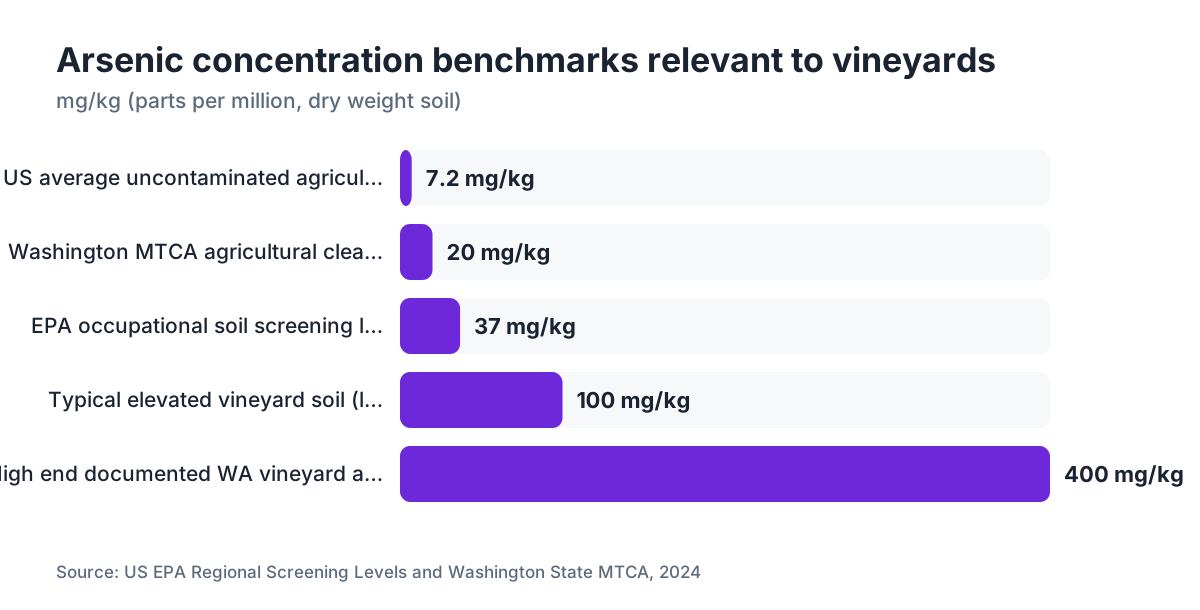
Background arsenic in US agricultural soil usually runs 1 to 20 mg/kg (parts per million, dry weight), and the EPA cites an average near 7.2 mg/kg for uncontaminated North American sites [1]. Vineyards often sit outside that range. Sometimes way outside it.
The reason is history. For much of the late 19th century and the first half of the 20th, lead arsenate was the go-to pesticide for codling moth, grape berry moth, and a handful of other pests. Growers sprayed the same ground year after year. Lead and arsenic both bind tightly to soil particles, especially iron oxides and clay minerals, so they don't leach away fast. They stay right where they landed.
A survey of orchard and vineyard soils in Washington State found arsenic ranging from below detection to over 400 mg/kg in blocks with documented lead arsenate history [2]. California surveys show similar spread. The point isn't that every vineyard has a problem. It's that the variance is enormous, and you can't guess your number.
Washington's Model Toxics Control Act sets a cleanup threshold of 20 mg/kg for agricultural soil used to grow food, and the EPA's residential screening level for arsenic sits near 0.68 mg/kg [1][3]. A vineyard block with a century of lead arsenate use can blow past both without anyone noticing until a test comes back.
Where does arsenic in vineyard soil come from?
Two broad categories. Geogenic arsenic comes from the parent rock. Anthropogenic arsenic comes from human activity. In vineyards where levels are high, the human source almost always wins.
Lead arsenate was the driver. Registered for use on grapes in California as early as 1892 and not formally cancelled by the EPA until 1988, it was applied at rates reaching 50 to 100 pounds of product per acre per season in heavy-use blocks [4][11]. Each pound of lead arsenate holds roughly 0.11 pounds of elemental arsenic. Do that for 40 or 50 years and the math gets ugly.
Other inputs are quieter. Phosphate fertilizers carry trace arsenic because arsenic and phosphorus behave alike geochemically, and phosphate rock picks up both. Wood preservatives on CCA-treated posts, end posts, and stakes shed small amounts over time, though posts contribute little next to a spray history. Some old copper-based fungicides carried arsenical impurities, but modern registered products don't.
Geogenic arsenic matters in the right geology. Volcanic parent material, serpentine soils, and some sedimentary formations raise baseline arsenic on their own. Parts of Northern California and the Pacific Northwest sit on ground that contributes meaningful background arsenic before anyone ever sprayed a vine.
How does soil arsenic affect grapevines and grape arsenic levels?
Here's where growers usually exhale, and the science backs the relief. Grapevines are poor arsenic accumulators. The roots take up arsenic through the same transporters they use for phosphate, but the vine holds most of what it absorbs in root tissue instead of moving it into shoots, leaves, or fruit [5].
Research in the Journal of Agricultural and Food Chemistry found that grape berries from vines grown in soil above 100 mg/kg arsenic still typically showed fruit arsenic below 0.1 mg/kg fresh weight, well under EU and FDA food thresholds [5]. The soil-to-fruit transfer factor for arsenic in grapes stays low across the literature, somewhere between 0.001 and 0.01 depending on soil pH, organic matter, and iron content.
Wine drew more attention. A 2015 class-action lawsuit in California alleged elevated arsenic in certain California wines, and the episode prompted independent testing by the FDA and TTB. The FDA found most domestic wines fell below its 10 micrograms per liter (10 ppb) action level for bottled water, though a subset, mostly inexpensive California reds, came in higher [12]. The TTB has not set a maximum residue level for arsenic in wine as of mid-2026, which leaves that corner of the picture unsettled.
So elevated soil arsenic doesn't automatically mean elevated fruit arsenic. It doesn't guarantee safety either. Soil pH, phosphate levels, and organic matter all move uptake around, and any block with very high soil arsenic earns routine fruit and wine monitoring.
What are the health and safety risks for vineyard workers?
For workers, the pathway that matters isn't eating grapes. It's dust. Inhalation and skin contact during tillage, vine training in dry conditions, or anything that disturbs the top few inches of soil where arsenic concentrates.
Inorganic arsenic is a known human carcinogen, classified as Group 1 by the International Agency for Research on Cancer [6]. Long-term exposure at elevated levels is tied to lung, bladder, and skin cancer, plus peripheral neuropathy and cardiovascular effects. The EPA's maximum contaminant level for arsenic in drinking water is 10 micrograms per liter, which reflects the agency's read that even low chronic exposure carries real risk [1].
The EPA's Worker Protection Standard (WPS), revised in 2015 and enforced by state lead agencies, sets no specific soil arsenic threshold. It does require that workers be told about pesticide-related hazards on the operation, and that includes residual pesticide contaminants left in the soil from historical applications [7]. Growers miss this one all the time. WPS training and hazard communication can reach back to legacy soil contamination, more than this season's sprays.
The highest-risk tasks are mechanical cultivation in dry conditions in old blocks, harvest work that kicks up a lot of ground, and any renovation (pulling vines, subsoiling, grading) in blocks with confirmed elevated arsenic. Dust suppression, respiratory protection when dust is heavy, and the hand-washing facilities WPS already requires handle most of the exposure.
Which vineyard regions have the highest arsenic risk?
Any region with a long commercial history and pre-1960s farming carries real risk of elevated soil arsenic from lead arsenate. That points at California's North Coast (Napa, Sonoma), Lodi and the Central Valley, the Columbia Valley and Yakima Valley in Washington, the Willamette Valley in Oregon, the Finger Lakes and Hudson Valley in New York, and the older wine areas of New Jersey (producers like Renault Winery worked ground farmed since the 1860s). If vines went in before WWII, assume lead arsenate got used until you learn otherwise.
Washington State has done the most systematic survey work. The Washington State Department of Agriculture and WSU Extension published guidance for orchardists and vintners on lead-arsenate contamination in the early 2000s, and WSU's work is still among the most citable in the field [2][3].
Slopes add complexity because erosion carries arsenic-laden topsoil downhill. A block that was never sprayed can pick up arsenic from an upslope block that was. In Paso Robles and other Central Coast areas, some blocks sit on naturally arsenic-enriched geology independent of spray history, so a real assessment has to weigh both pathways.
Flat, heavily irrigated regions with young vines (post-1990 plantings on ground never farmed with arsenical pesticides) carry the lowest risk. Not zero, though. Phosphate rock fertilizers and background geology still add a little.
How do you test vineyard soil for arsenic?
Standard agricultural soil tests from your county extension office or a commercial lab don't include arsenic. You have to ask for it. Most accredited environmental labs run total arsenic by EPA Method 3051A (microwave-assisted acid digestion) followed by ICP-MS or ICP-OES, and costs generally run $15 to $40 per sample depending on turnaround and lab [8].
Sampling strategy counts as much as the lab method. Lead arsenate residue concentrates in the top 6 to 12 inches of soil and varies across a block because spray patterns, runoff, and tillage all move it around. One composite sample from a 10-acre block can hide a hot spot. WSU Extension recommends at least one composite sample (5 to 10 cores) per 2 to 5 acres for initial screening, with follow-up grid sampling in any block that comes back above 20 mg/kg [3].
Buying or leasing a vineyard with pre-1960s history? Get arsenic testing done before you sign. Phase I Environmental Site Assessments done for lenders often flag lead arsenate use as a recognized environmental condition, and Phase II sampling follows. Even when a lender doesn't require it, knowing your baseline keeps you from inheriting someone else's liability.
UC Davis and UC Cooperative Extension publish sampling protocols for California growers, and Cornell's viticulture extension program covers New York-specific issues [8][9]. State departments of agriculture in Washington and Oregon maintain lists of certified labs.
What are the regulatory thresholds and compliance requirements?
There's no single federal standard for arsenic in agricultural soil. The patchwork of state rules, EPA guidance values, and worker protection requirements is genuinely fragmented, and that breeds confusion.
At the federal level, the EPA's Regional Screening Levels are the most-used reference. For agricultural soil where workers have regular contact, the 2024 EPA RSL for inorganic arsenic is 37 mg/kg under a non-residential/occupational scenario and 0.68 mg/kg under a residential child scenario [1]. The occupational number is the relevant one for vineyard crews, but it's a screening level, not an enforceable standard. Exceeding it triggers a recommendation to investigate, not an automatic action.
State rules vary a lot. Washington's Model Toxics Control Act sets 20 mg/kg as the agricultural cleanup level for food-production soil, one of the stricter state numbers [3]. California's DTSC works from site-specific cleanup levels that range from about 0.39 mg/kg (residential) up to higher industrial and commercial values depending on land use. Oregon's DEQ defaults to EPA RSLs. New York's NYSDEC uses a soil cleanup objective of 16 mg/kg for agricultural land.
Under the EPA's Worker Protection Standard, no magic arsenic number triggers mandatory remediation, but hazard communication and handler training obligations kick in when workers may contact pesticide residues in soil [7]. California's Department of Pesticide Regulation layers on more requirements for pesticide-residue sites.
Honest answer: most vineyard operators aren't actively regulated for soil arsenic unless they're selling the property, applying for certain permits, or facing a complaint. That's not the same as having no exposure liability. Worker health matters whether or not an inspector shows up.
Can you remediate arsenic-contaminated vineyard soil?
Yes, but the options run from practical to painful, and none of them are clean.
Phytoremediation, using plants to pull arsenic out of soil, shows up in academic papers but works slowly and works better for some metals than others. Arsenic phytoextraction with hyperaccumulating ferns (Pteris vittata) can lower soil arsenic over 5 to 10 years of treatment, but running a fern cover crop through a vineyard isn't a normal operation, and the extracted biomass has to go out as hazardous waste. Not realistic for most growers.
Soil washing and excavation work, and they cost a fortune. Digging up and hauling contaminated topsoil from a 10-acre block can run $50,000 to $200,000 or more depending on depth, haul distance, and disposal fees. That's before you buy clean soil to replace what left.
In-place immobilization is the most practical route for a working vineyard. Iron-rich amendments (water treatment residuals, iron sulfate, or iron-bearing minerals) raise the soil's capacity to bind arsenic tightly, which cuts plant uptake and bioaccessibility. Phosphate does the opposite. It competes for binding sites and can release arsenic, so your fertilizer program matters here. Lime and organic matter shift pH, which moves arsenic mobility too. This approach doesn't remove arsenic. It lowers exposure and uptake.
Cover cropping and minimum tillage help by keeping dust down. Keep the soil covered and disturb it as little as possible in high-arsenic blocks and you cut worker inhalation exposure without spending a dime on remediation. That's usually where I'd start.
How should you document and record arsenic testing for compliance?
Documentation is the part growers underfund, and it's the part that matters most the day a worker complaint, a property sale, or a regulatory inquiry lands.
Keep copies of every soil test report with location data (GPS coordinates or a clearly marked vineyard map showing sample points), the lab's chain-of-custody forms, and any written interpretation from a certified professional. Date everything. Take a follow-up action like an amendment application, a dust suppression protocol, or a PPE requirement? Document that too, including product, rate, and who applied it.
WPS hazard communication records should note that workers in affected blocks have been told about the potential for pesticide residues in the soil. Many growers fold this into annual WPS safety training. The WPS requires that training happen before workers enter treated areas, and the EPA's guidance for the revised 2015 rule makes clear that historic soil residues count [7].
This is where a field operations record system earns its keep. Soil test results, block maps, amendment records, and worker training logs in one searchable, exportable place is the kind of thing that looks obvious the moment you're scrambling to pull records during a sale or a complaint. VitiScribe's record-keeping tools are built around block-level documentation, tying your soil data to your spray and amendment history in one place.
Cornell Cooperative Extension's Vineyard Notes and UC Davis's Division of Agriculture and Natural Resources both publish record-keeping templates that include fields for soil contamination data [9][10]. A structured template, whatever system you like, beats a folder of PDFs with names that made sense at the time.
What should you tell your workers about arsenic in vineyard soil?
Be direct. Workers who know why they're wearing a dust mask or washing their hands before lunch actually do it. Vague warnings get ignored. Specific, honest information gets respected.
The core messages are simple. Arsenic in some vineyard soils comes from pesticides used decades ago, long before anyone here farmed the ground. The soil won't hurt you from walking through it. The risk comes from breathing dust off disturbed soil over many years, and from skipping handwashing before you eat or touch your face. A well-fitted N95 during tillage or renovation in high-arsenic blocks, plus the handwashing stations WPS already requires, handles most of the risk.
In California, Proposition 65 (Health and Safety Code Section 25249.5 et seq.) lists inorganic arsenic as a carcinogen and reproductive toxicant [4]. If your soil exposure exceeds the no-significant-risk level, you may have Prop 65 warning obligations. The arsenic threshold is low, 0.15 micrograms per day for inhalation cancer risk, and figuring out whether your site triggers it takes an exposure assessment, more than a soil test. A certified industrial hygienist or environmental consultant can run that calculation if you're in California with confirmed elevated arsenic.
WSU Extension's worker safety materials cover arsenic and heavy metals in agricultural soil in plain language, in English and Spanish, which is worth knowing if you have Spanish-speaking crews [2].
Is arsenic in vineyard soil a problem for the wines you sell?
Probably not for most growers. The question still deserves a straight answer instead of a pat on the head.
The soil-to-wine pathway has several steps, and each one shaves the final number down: root uptake (low for arsenic in grapes), translocation to fruit (lower still), fermentation (arsenic doesn't volatilize or break down, but dilution happens), and fining (bentonite and other agents can pull out some arsenic). Wine arsenic ends up roughly 10 to 100 times lower than soil arsenic on a comparable basis.
The FDA's action level for arsenic in bottled water is 10 micrograms per liter (10 ppb) [1]. Wine isn't bottled water, and the FDA hasn't set an arsenic action level for wine. The TTB, which regulates wine in the US, defers to FDA guidance and hasn't issued a specific rule. The EU's maximum for arsenic in wine is 200 micrograms per liter, far more permissive than the bottled-water number and well above what independent testing shows for nearly all commercial wines.
The 2015 California wine arsenic episode was real, but context matters. The wines that tested highest in independent analysis were high-volume, inexpensive table wines [12]. The episode pushed some larger wineries to tighten internal QC, and it's a fair prompt to test your finished wine if you're farming blocks above 50 mg/kg soil arsenic. Wine arsenic testing costs $20 to $60 per sample at most accredited labs.
For a smaller vineyard, the order of operations is clear. Test the soil first. Understand your numbers. Monitor fruit or wine only if the soil results warrant it. Document all of it.
Frequently asked questions
What is the average arsenic level in vineyard soil in the US?
Background arsenic in US agricultural soils averages around 7.2 mg/kg per EPA data, but vineyard soils with lead arsenate pesticide history regularly show 50 to 200 mg/kg, and some blocks in Washington and California have tested above 400 mg/kg. The average is nearly useless without knowing your specific block's history.
Does high soil arsenic mean my grapes or wine will have high arsenic?
Not necessarily. Grapevines are poor arsenic accumulators. Published research shows soil-to-fruit transfer factors of roughly 0.001 to 0.01, meaning grape berries typically hold 100 to 1000 times less arsenic than the surrounding soil. Wine arsenic runs lower still. Blocks above 100 mg/kg soil arsenic warrant fruit or wine testing, but elevated soil alone doesn't make the wine unsafe.
Is arsenic in old vineyard soil a worker safety issue?
Yes, mainly through dust inhalation. Inorganic arsenic is a Group 1 human carcinogen (IARC), and repeated breathing of arsenic-laden dust during tillage or renovation work in old blocks is the main exposure route for vineyard crews. Dust suppression, N95 respirators during high-disturbance tasks, and WPS-required handwashing stations are the practical controls.
Where does arsenic in vineyard soil come from?
Mostly from lead arsenate pesticides applied heavily from the late 1800s into the mid-1900s, not formally cancelled by the EPA until 1988. Secondary sources include naturally occurring arsenic in certain geologic formations, trace arsenic in phosphate fertilizers, and small contributions from CCA-treated wooden posts. In most elevated-arsenic vineyards, historic pesticide use dominates by a wide margin.
What soil arsenic level is considered safe for farmworkers?
The EPA's Regional Screening Level for inorganic arsenic in soil under an occupational scenario is 37 mg/kg as of 2024. That's a screening level, not a legal standard. Washington State's cleanup threshold for food-production farmland under the Model Toxics Control Act is 20 mg/kg. Neither number is a bright line that guarantees safety or forces action. Both are triggers for further evaluation.
Do I need to disclose soil arsenic to vineyard workers?
Under the EPA's Worker Protection Standard (revised 2015), you must inform workers of pesticide-related hazards on the operation, and the EPA's guidance makes clear this covers historic pesticide residues in soil, more than current-season sprays. California's DPR adds requirements. Best practice is to include documented arsenic information in annual WPS safety training, with records kept on file.
How much does it cost to test vineyard soil for arsenic?
Most accredited environmental labs charge $15 to $40 per sample for total arsenic by EPA Method 3051A, depending on turnaround. A meaningful survey of a 20-acre block might take 4 to 10 composite samples, so basic screening runs $60 to $400. Speciated arsenic (inorganic vs. organic) or bioaccessibility testing costs more, typically $75 to $150 per sample.
Which vineyard regions in the US are most likely to have arsenic in the soil?
Any region with pre-1960s commercial viticulture carries real risk: Napa, Sonoma, Lodi, and the Central Valley in California; Yakima and Columbia Valley in Washington; the Willamette Valley in Oregon; the Finger Lakes and Hudson Valley in New York. Some Central Coast California areas also have naturally elevated geogenic arsenic. Younger plantings on land never farmed with arsenical pesticides carry the lowest risk.
Can you remediate arsenic in vineyard soil?
Yes, but no option is cheap or fast. Excavation and disposal is effective and can cost $50,000 to $200,000 or more per block. In-place immobilization with iron-bearing amendments lowers bioaccessibility without removing arsenic. Phytoremediation with hyperaccumulating ferns works but takes years and generates hazardous waste biomass. The practical first step for a working vineyard is minimizing soil disturbance and controlling dust.
Does California Proposition 65 apply to arsenic in vineyard soil?
Potentially. Inorganic arsenic is listed under Proposition 65 as a carcinogen and reproductive toxicant. If worker arsenic inhalation exposure from contaminated soil exceeds the no-significant-risk level (0.15 micrograms per day for cancer), warning obligations may apply. Determining that takes an exposure assessment by a qualified professional, more than a soil test. Growers with confirmed high-arsenic blocks in California should consult a certified industrial hygienist.
What records should I keep about arsenic in my vineyard soil?
Keep all soil test reports with GPS-referenced sample locations, lab chain-of-custody forms, written interpretations, and any amendment or remediation records (product, rate, date, applicator). Document worker hazard communication in your WPS training records. If you test fruit or wine, keep those results too. Organized block-level documentation protects you in property transactions, worker complaints, and regulatory inquiries.
How often should vineyard soil be tested for arsenic?
There's no universal requirement for routine retesting. WSU Extension recommends initial screening for any block with pre-1960s farming history, plus follow-up grid sampling if results exceed 20 mg/kg. After in-place remediation or amendment application, retesting at 2 to 3 years makes sense to verify bioaccessibility changed. For blocks with clean results and no renovation planned, one-time baseline testing is generally enough.
Is arsenic in wine from California actually dangerous?
Independent FDA testing found most California wines fall below the 10 ppb bottled-water action level for arsenic, though a subset of high-volume inexpensive wines tested above it in 2015. The EU limit for arsenic in wine is 200 ppb, far more permissive. Regular consumption of wine near or modestly above the bottled-water standard adds a small incremental exposure, which is not the same as acute poisoning. The TTB has not set a formal wine-specific standard.
What extension resources exist for vineyard arsenic testing guidance?
WSU Extension has published soil testing guidance specifically for lead arsenate contamination in orchards and vineyards in the Pacific Northwest. UC Cooperative Extension covers California-specific sampling protocols and amendment options. Cornell Cooperative Extension addresses New York conditions. All three maintain online publications and can connect growers with regional certified labs and agronomists who know legacy pesticide contamination.
Sources
- US EPA, Regional Screening Levels for Chemical Contaminants at Superfund Sites: Background arsenic in uncontaminated US soil averages approximately 7.2 mg/kg; EPA RSL for occupational soil exposure to inorganic arsenic is 37 mg/kg (2024) and 0.68 mg/kg for residential child scenarios; EPA MCL for arsenic in drinking water is 10 micrograms per liter
- Washington State University Extension, Lead Arsenate Soil Contamination in Orchards and Vineyards: Washington State vineyard soil arsenic concentrations range from below detection to over 400 mg/kg in blocks with documented lead arsenate history; WSU recommends one composite sample per 2-5 acres for initial screening
- Washington State Department of Ecology, Model Toxics Control Act Cleanup Regulation: Washington's MTCA sets 20 mg/kg as the agricultural soil cleanup level for land used to produce food
- California Office of Environmental Health Hazard Assessment, Proposition 65 Listed Chemicals: Inorganic arsenic is listed under California Proposition 65 as a carcinogen and reproductive toxicant; no-significant-risk level for inhalation is 0.15 micrograms per day; lead arsenate was registered for use on grapes in California as early as 1892
- Journal of Agricultural and Food Chemistry, arsenic uptake and transfer in grapevines study: Grape berry arsenic concentrations from vines grown in soil above 100 mg/kg arsenic typically remain below 0.1 mg/kg fresh weight; soil-to-fruit transfer factor for arsenic in grapes ranges from 0.001 to 0.01
- International Agency for Research on Cancer, IARC Monographs Volume 100C, Arsenic and Arsenic Compounds: Inorganic arsenic is classified as a Group 1 human carcinogen by IARC, associated with lung, bladder, and skin cancer
- US EPA, Worker Protection Standard for Agricultural Pesticides (40 CFR Part 170): EPA WPS (revised 2015) requires hazard communication to workers regarding pesticide-related hazards including historic pesticide residues in soil; handwashing facilities required regardless of current spray activity
- UC Cooperative Extension (UC ANR), Soil Sampling and Testing for Vineyards: Commercial lab cost for total arsenic by EPA Method 3051A is $15 to $40 per sample; UC Davis and UC Cooperative Extension publish sampling protocols for California growers
- Cornell Cooperative Extension, Vineyard Management Resources: Cornell Cooperative Extension covers New York vineyard soil contamination considerations and publishes record-keeping templates including fields for soil contamination data
- UC Agriculture and Natural Resources (UC ANR): UC Davis's Division of Agriculture and Natural Resources publishes vineyard record-keeping templates that include fields for soil contamination data
- US EPA, Pesticide Registration and Registration Review: Lead arsenate was not formally cancelled by the EPA until 1988; application rates historically reached 50 to 100 pounds of product per acre per season in heavy-use blocks
- US FDA, Testing of Domestic and Imported Wines for Arsenic: FDA testing found most domestic wines fell below the 10 micrograms per liter action level used for bottled water; a subset of inexpensive California red wines tested above that threshold in 2015 testing
Last updated 2026-07-09