Is Willakenzie soil good for vineyards? A grower's honest look
TL;DR
- Yes.
- Willakenzie is a well-drained silt loam formed from marine sedimentary rock that stresses vines just enough to concentrate flavor.
- It drains faster than Jory basalt soils, warms earlier in spring, and suits Pinot Noir, Chardonnay, and Pinot Gris.
- It's one of the most sought-after soil series in Oregon's Willamette Valley, and the reasons are agronomic, not marketing.
What is Willakenzie soil and where does it come from?
Willakenzie is a fine-textured silt loam. In the USDA soil taxonomy it's a fine-silty, mixed, superactive, mesic Xeric Haplohumult. That mouthful means it's an Ultisol, an older, leached soil developed from marine sedimentary parent material, specifically the Eocene-age Tyee and Yamhill formations that underlie much of the Coast Range foothills in Oregon's Willamette Valley. [1]
The geology is the whole story. Willakenzie sits on sedimentary rock, not the volcanic basalt that formed Jory, the red soil most people associate with the Dundee Hills. Sedimentary versus igneous. That single difference shows up in texture, drainage, pH, and how the vine behaves through the season.
Typical Willakenzie profiles run 20 to 40 inches deep before they hit fractured siltstone and sandstone. The surface horizon is dark silt loam. It transitions to a silty clay loam subsoil with real clay accumulation in the B horizon. That clay layer drives water retention and vine stress, and it's worth coming back to. [1]
Willakenzie covers roughly 14,000 acres across Yamhill, Washington, and Polk counties, per Oregon State University Extension. That puts it in the core of the Willamette Valley AVA and across the McMinnville, Yamhill-Carlton, and Chehalem Mountains sub-AVAs. [2]
What makes Willakenzie soil particularly good for wine grapes?
Three things set Willakenzie apart: drainage, moderate fertility, and early soil warming. Take them in order.
Drainage first. Willakenzie sheds water faster than Jory in the upper profile because the silt loam surface doesn't grip water the way volcanic clay does. Fast drainage through the Willamette's wet winters and springs keeps roots oxygenated, cuts Phytophthora risk, and lets the soil dry to a workable state earlier. Growers on Willakenzie can often get a tractor into the vineyard one to two weeks before neighbors on heavier Jory or Nekia. That window is gold when you're racing to finish pruning or land an early disease spray before budbreak. [2]
Fertility is moderate, not high. The marine sedimentary parent material doesn't load the profile with basalt-derived minerals the way Jory does, so vines don't get lazy. Shoot growth stays controlled, canopies are easier to manage, and fruit-to-leaf ratios come out favorable without heavy crop-load manipulation. Nobody has published a clean yield comparison across Willamette soil types that I've found, but the pattern is consistent enough that it shows up in AVA petition arguments for sub-appellations like Yamhill-Carlton, where Willakenzie and Peavine dominate. [3]
Soil warming is the third piece. Well-drained sedimentary soils warm faster in spring than wet, clay-heavy volcanic soils. Earlier warming nudges the whole phenological calendar forward a bit, and in a marginal climate like western Oregon that isn't trivial. An extra week of degree-day accumulation before harvest can be the line between adequate ripening and excellent ripening.
Willakenzie also runs a lower pH than Jory, usually 5.0 to 6.0 in the surface horizon. [1] That slight acidity suits Pinot Noir and Chardonnay fine, and the natural low pH means you're rarely liming unless you've pushed organic matter hard. Free-draining sedimentary soils also tend to give wines stronger linear acidity and tighter structure in the early years, the exact profile Willamette Valley Pinot is known for.
How does Willakenzie compare to Jory and other Willamette Valley soils?
This is the question growers argue about over harvest dinner. Here's an honest side-by-side across the characteristics that actually change how you farm.
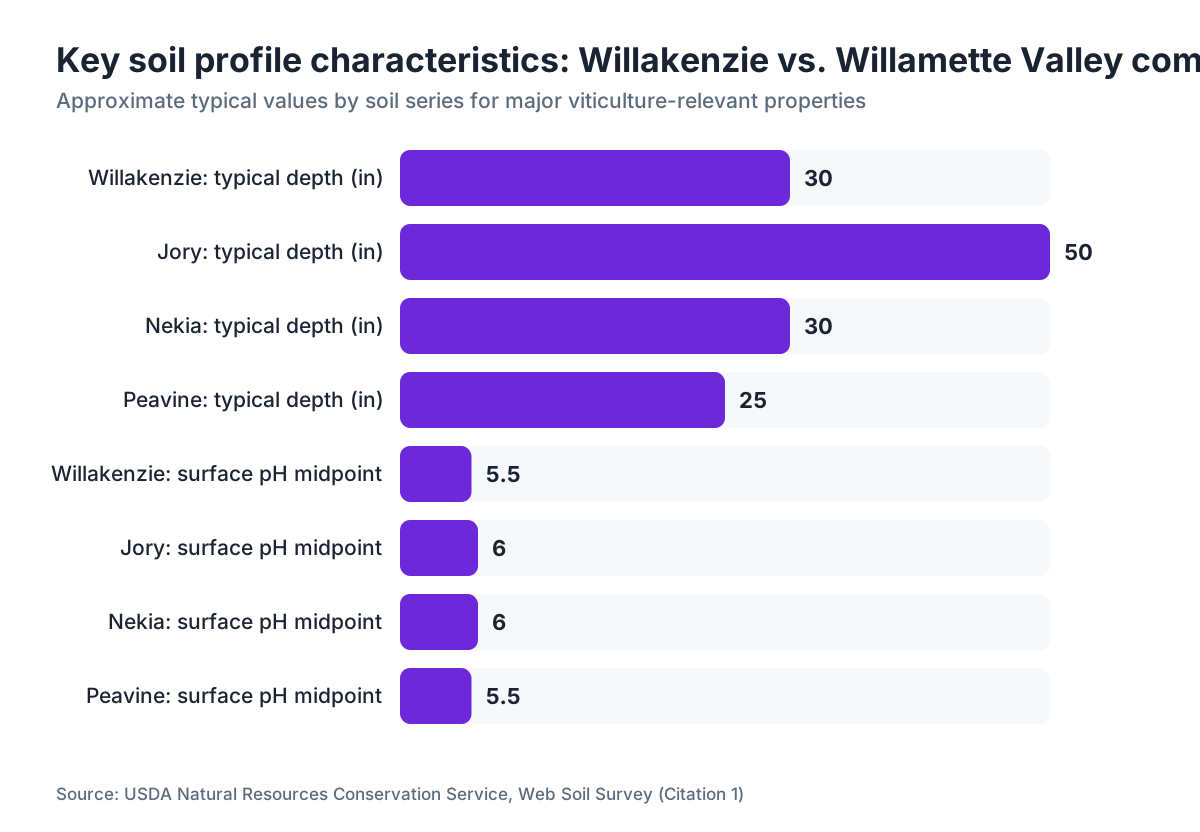
| Characteristic | Willakenzie | Jory | Nekia | Peavine |
|---|---|---|---|---|
| Parent material | Marine sedimentary | Volcanic basalt | Volcanic basalt | Marine sedimentary |
| Typical depth | 20-40 in | 40-60+ in | 20-40 in | 20-40 in |
| Texture | Silt loam / silty clay loam | Clay loam to clay | Clay loam | Silty clay loam |
| Drainage class | Moderately well to well | Well | Moderately well | Moderately well |
| Surface pH range | 5.0-6.0 | 5.5-6.5 | 5.5-6.5 | 5.0-6.0 |
| Spring warm-up | Earlier | Later | Later | Earlier |
| Iron content | Moderate | High (red color) | High (red color) | Moderate |
Sources: USDA Web Soil Survey [1], Oregon State University Extension [2], Yamhill-Carlton AVA petition [3]
Jory gets more press because it's the signature soil of the Dundee Hills, the region that first put Oregon Pinot on the international map. It's deeper, holds more water through summer drought, and makes wines many tasters read as more voluminous and structured in youth. Willakenzie isn't the lesser soil. It's a different soil. The lighter texture and faster drainage make it more forgiving in wet years and can give wines more aromatic lift and earlier-accessible tannins.
Peavine is Willakenzie's closest relative. Same marine sedimentary origin, same neighborhood in Yamhill-Carlton. Peavine tends to be shallower and stonier, so it pushes vine stress higher. Some growers love that. Others find it too limiting in dry years.
Nekia is shallow-to-basalt Jory, the same volcanic parent with less depth. It stresses vines earlier in summer and yields less. Good for quality. Painful if you're chasing consistent tonnage.
The honest answer: no single series reliably makes better wine than the others across all vintages. Willakenzie's real edge is consistency. Its drainage buffers both wet and dry extremes reasonably well, so it rarely gives you a disaster year.
Which grape varieties perform best in Willakenzie soil?
Pinot Noir is the obvious answer, and not because of a marketing brochure. Pinot Noir wants moderate stress, sharp drainage, and controlled vigor, which is what Willakenzie hands you. The vine doesn't throw massive shoot growth, so you spend less time hedging and more time on the fruit zone. Cluster weights on Willakenzie Pinot run on the smaller side, which concentrates flavor. [2]
Chardonnay does very well here too. The soil's native acidity carries into the wine, which cuts the need for acidification and gives winemakers room on malolactic decisions. Oregon Chardonnay off Willakenzie has looked serious over the last decade as the state moved past the Dijon clones' early reputation for leanness.
Pinot Gris sits on meaningful Willakenzie acreage, especially in Yamhill-Carlton, and it shows the same controlled vigor. The wines run a touch richer in texture than Pinot Gris off volcanic soils, probably because earlier spring warming buys the variety more time to build sugar.
Estate blocks on Willakenzie have produced benchmark bottlings for years. To see what the soil does at its best, look at vineyard operations in Yamhill-Carlton and McMinnville where growers hold decades of Willakenzie-specific block data.
Riesling and Gewurztraminer are less common but far from poorly suited. The limit is market demand, not soil performance. Growers who've tried them on Willakenzie report acceptable vigor and good aromatic expression.
What are the limitations and challenges of farming Willakenzie soil?
No soil is free, and Willakenzie charges you in a few specific places.
Shallow depth is the big one. At 20 to 40 inches, the rooting zone above fractured rock is a lot smaller than Jory's 40-plus-inch profile. In dry years, vines hit water stress faster and harder. Oregon doesn't get California droughts on a regular schedule, but the 2021 heat dome and the dry fall that followed reminded everyone that irrigation infrastructure on Willakenzie blocks isn't optional anymore. [4] Drip as a backup, even if you never touch it in a normal year, earns its capital cost.
The clay subsoil can perch water in exceptionally wet winters. Fast surface drainage is great, but if the B horizon is saturated and can't drain laterally, you get temporary anaerobic conditions in the root zone. Tiling or deep ripping at establishment is worth considering on flat Willakenzie sites. On hillsides with natural lateral drainage, it's a much smaller worry.
Erosion is real. Silt loam surfaces on steep hillsides erode under heavy Pacific winter rain. Cover cropping isn't a nice-to-have on Willakenzie slopes. A mowed grass cover between rows is the floor. Plenty of growers run a permanent grass-legume mix to add nitrogen and build soil structure over time, and OSU Extension's seed-mix guidance is a fair starting point. [2]
Nutrient cycling runs differently than on volcanic soils. The marine sedimentary parent is lower in some micronutrients, boron and zinc especially, which show up deficient often on Willamette sedimentary ground. Petiole testing at bloom is the only reliable way to catch a deficiency before it hits fruit set. Soil tests alone won't cut it for micronutrient management on Willakenzie.
How do you manage irrigation and water stress on Willakenzie blocks?
Because the rooting zone is shallower than Jory, Willakenzie vines answer irrigation decisions faster and harder. You have less buffer. That's useful if you're watching closely, because tiny amounts of water make precise moves on vine water status. A 0.25-inch event that barely registers on a deep Jory block can meaningfully shift midday leaf water potential on Willakenzie in August.
UC Davis's Viticulture and Enology program has published widely on regulated deficit irrigation, targeting water potential values that suppress vegetative growth without tanking fruit quality. [5] The general guidance for Pinot Noir is mild to moderate stress (stem water potential around -10 to -14 bar at midday) through veraison, then easing off severe stress after veraison. On Willakenzie you reach mild stress sooner than growers on deeper soils, so your first irrigation triggers land earlier in the season.
Practically, pressure bomb readings every five to seven days through summer on Willakenzie blocks aren't overkill. They're the minimum to keep from shoving vines into severe stress during a heat event. A decent field pressure bomb runs $700 to $1,200 used. Buy it.
Drip is the only practical system for hillside Willakenzie blocks. Overhead or under-vine sprinklers waste water and raise foliar disease pressure in a region already fighting Botrytis and downy mildew. Single-emitter drip at one gallon per hour per vine is the standard start. Some growers add a second emitter on especially shallow or rocky Willakenzie profiles.
What does Willakenzie soil mean for your spray program and compliance records?
Soil type shapes disease pressure, and disease pressure feeds straight into spray program design and the records you're required to keep.
Faster-draining Willakenzie means slightly lower canopy humidity than heavier, wetter soils, all else equal. Lower sustained humidity narrows Botrytis spore germination windows. That doesn't mean you skip your Botrytis program. It means your timing has a bit more slack and your total fungicide applications in a normal year might run one fewer than on a heavier soil. In wet vintages like 2011 or 2017, that difference mostly vanishes.
Powdery mildew (Erysiphe necator) doesn't care about your soil. It tracks temperature and susceptible tissue. Your powdery mildew program on Willakenzie looks nearly identical to any other Willamette site.
On records, the EPA Worker Protection Standard requires you to keep pesticide application records including the product name, EPA registration number, active ingredient, amount applied, application date, location, and the applicator's name. [6] Oregon's Department of Agriculture requires those records be kept for a minimum retention period, and pesticide sensitive-registrant and use-reporting rules are enforced at the state level. [7] Soil type doesn't change the recordkeeping requirement, but it does change which products you're using and when, which changes how your records read year over year.
Keeping those spray records organized and searchable is harder than it sounds when you're running multiple blocks with different soil types on one property. Tools like VitiScribe let you tag spray events by block and soil type, which makes an end-of-season compliance audit faster than digging through a paper log.
Managers running Willakenzie blocks in Yamhill-Carlton should also know that if you're applying for appellation-specific labeling, your records can be requested. Documented block-level data, soil type included, makes decent supporting material.
How does Willakenzie soil affect wine style and flavor profiles?
Here's where growers hold strong opinions and the data goes thin. Terroir research is hard to run rigorously because you can't randomize soil type across otherwise identical vineyards. What we have is observational data, repeated tastings, and a lot of consistent anecdote.
Willakenzie Pinot Noir tends to show more red-fruit aromatics, higher natural acidity, and finer tannin texture than Pinot off deep volcanic Jory. Jory leans toward darker fruit, more body, and firmer tannin in youth. These are tendencies, not laws. Clone, vine age, farming philosophy, and winemaking all bend the soil signal.
The acidic pH of Willakenzie (5.0 to 6.0) may lift tartaric acid retention in the fruit, though the mechanism isn't settled. Lower soil pH can shift potassium uptake, which changes juice pH and acid balance. Cornell's viticulture team has useful work on soil pH and mineral nutrition in cool-climate vines if you want the biochemistry. [8]
For Chardonnay, Willakenzie tends to produce a saline or chalky mineral texture, often paired with citrus and stone fruit. Whether that comes from the soil directly or from the drainage-stress-root-depth combination is an open question.
A grower in McMinnville with 15-year-old Pinot Noir on Willakenzie is farming genuinely distinctive conditions. The wine in the bottle carries those conditions whether the label says so or not. Sub-AVA designations like Yamhill-Carlton exist partly to signal that soil-driven distinction to buyers.
What do you need to know before planting a vineyard in Willakenzie soil?
Start with the USDA Web Soil Survey. Pull your parcel, find the Willakenzie mapping units, and note the depth-to-restrictive-layer and drainage class for each polygon on your site. Don't assume the whole property is one soil. Plenty of Willamette Valley parcels carry Willakenzie on the slopes and something else in the flats, sometimes Quatama or Woodburn, which are poorly drained and much less suited to grapes. [1]
Dig a soil pit before you plant. A backhoe cut to 48 inches, one per significant mapping unit, tells you more than a stack of soil tests. Look for depth to clay pan, mottling that flags seasonal saturation, and rock fragment content. Mottling in the top 24 inches is a red flag on any site you plan to farm without tile drainage.
Clone and rootstock selection should respect the shallow profile. Moderate-vigor rootstocks like 3309 Couderc, 101-14 Millardet et de Grasset, and 420A are common in Oregon on Willakenzie. High-vigor stock like 110R or 1103P is overkill here and pushes more vegetative growth than you want. OSU Extension has published rootstock trial data for Oregon conditions worth reading before you commit. [2]
Row orientation carries more weight on Willakenzie slopes because of erosion. North-south rows on moderate slopes are standard. On steeper ground, across-slope orientation with aggressive cover cropping may be the only way to stop rill erosion during winter rain.
Run the irrigation infrastructure at establishment. It's far cheaper than retrofitting. Even if you plan to dry-farm, lay the mainline and set the pressure regulators. The capital cost at planting is a fraction of threading irrigation through an established vineyard, and dry-year frequency in the Willamette is trending up. Shallow Willakenzie soils show it first. [4]
For recordkeeping from day one, a block map that identifies soil series by polygon makes your future spray records, yield logs, and any AVA petition documentation far cleaner. That's where a field operations platform like VitiScribe pays back fast. Enter the soil type once and let it populate every record tied to that block.
How does Willakenzie soil fit within Oregon's AVA system?
Oregon leans on soil series in its AVA petitions more than most American wine regions. The Yamhill-Carlton AVA petition named Willakenzie and Peavine soils as the defining characteristic separating it from the Jory-dominated Dundee Hills and the Jory-and-Nekia Eola-Amity Hills. [3]
The TTB approved the Yamhill-Carlton AVA in 2005, partly on the strength of that soil argument. The petition held that the sedimentary parent material of Willakenzie and Peavine produced a distinct viticultural environment compared to the volcanic soils of neighboring sub-AVAs. That's a real, legally recognized soil-based distinction sitting inside federal AVA regulations. [3]
For winery owners and vineyard managers, this has a practical edge. If you source fruit from Willakenzie-dominant vineyards and want a sub-AVA claim on the label, you need documentation that the fruit came from inside the approved boundaries. Knowing your block's soil series isn't agronomic trivia. It's part of your label compliance file.
The Chehalem Mountains AVA also holds Willakenzie soils alongside Laurelwood (wind-deposited loess over basalt) and Jory, which makes it one of the more geologically mixed sub-AVAs in the valley. That soil diversity is part of its petition identity. [3]
The Oregon Wine Board publishes resources on the link between soil series and sub-AVA identity. It's not regulatory on its own, but it's useful context if you're trying to explain soil-based terroir to trade buyers or consumers. [12]
What does current research say about sedimentary soils and wine quality in cool climates?
Rigorous peer-reviewed research aimed specifically at Willakenzie soil and wine quality is thin. Most of what exists is observational, producer-reported, or embedded in AVA petition documents that don't meet academic standards of evidence. That's an honest limit worth naming out loud.
Broader research on sedimentary versus volcanic soils in cool-climate viticulture points in consistent directions without settling the matter. A 2015 study in the American Journal of Enology and Viticulture examining Oregon Pinot Noir across multiple soil types found significant differences in wine composition tied to soil texture and drainage class, though the authors flagged climate, clone, and winemaking practice as confounding variables they couldn't fully control. [9]
Cornell's cool-climate viticulture program has published on how soil water-holding capacity in shallow soils drives vine stress timing and, downstream, berry chemistry, particularly anthocyanin accumulation and malic acid. [8] The steady finding is that moderate water stress during berry development concentrates phenolics and shrinks berry size, both good for red wine quality. Willakenzie's shallow profile and fast drainage build those conditions naturally in most years.
Washington State University Extension's viticulture resources, aimed mostly at eastern Washington, cover how sedimentary soils differ from volcanic in nutrient availability and pH buffering. [10] The principles carry to Oregon sedimentary soils reasonably well, though the rainfall patterns are very different.
Nobody has published a controlled trial where identical clone, age, and training system were grown on Willakenzie versus Jory under identical management and the wines evaluated blind by a panel. That study would be expensive and take 15 years to run properly. Until someone does it, practitioners lean on the consistent observational record, and that record points clearly toward Willakenzie being excellent for cool-climate Pinot Noir.
How do you find and verify Willakenzie soil on your property?
The USDA Web Soil Survey is the primary tool. It's free, mapped at 1:24,000 scale across most of Oregon's farmland, and the interface lets you define an area of interest by drawing a polygon or entering a legal description. [1] Pull the map, look for the Willakenzie series codes (typically WkC, WkD, WkE by slope class), and read the profile description and interpretations.
The Web Soil Survey isn't gospel. Much of the mapping came from aerial photo interpretation with limited field verification, so boundary lines can miss by tens of meters in complex terrain. Ground-truthing still matters.
For field verification, the simplest move is a soil probe or auger to 36 inches. Willakenzie shows the dark silt loam surface, the reddish-brown silty clay loam subsoil, and eventually fractured siltstone or sandstone. The reddish-brown subsoil (Munsell hue around 5YR to 7.5YR) and the non-volcanic texture tell it apart from Jory, which runs redder (2.5YR) and stickier when moist. [11]
Oregon State University's soil science program maintains resources on Willamette Valley soil identification, and OSU Extension agents in Yamhill County have real experience helping growers pin down series boundaries. Worth a call before you finalize planting blocks. [2]
Most serious Oregon vineyards already have their soil series mapped and documented at the block level. If you're buying an established vineyard, ask for that documentation. If it doesn't exist, budget for a soil survey as part of due diligence.
Frequently asked questions
Is Willakenzie soil only found in Oregon's Willamette Valley?
Willakenzie is mapped mainly in Yamhill, Washington, and Polk counties in Oregon's northern Willamette Valley, where it covers roughly 14,000 acres. It's a named soil series specific to that region's marine sedimentary geology. You won't find the same named series in California or Washington, though comparable marine-sedimentary silt loam soils exist elsewhere in the Pacific Northwest under different series names.
What rootstocks work best in Willakenzie soil?
Moderate-vigor rootstocks are the standard for Willakenzie's shallow profile. 3309 Couderc and 101-14 Millardet et de Grasset are the most widely used in Oregon's sedimentary soils. They give adequate drought tolerance without pushing excess vegetative growth. High-vigor rootstocks like 110R are generally avoided, because Willakenzie's fertility and drainage already produce well-controlled vine growth without extra rootstock vigor.
Can you dry-farm Pinot Noir on Willakenzie soil in Oregon?
In normal rainfall years, yes. The Willamette Valley typically gets 40 to 60 inches of annual precipitation, most of it October through April, which charges the profile before the growing season. Willakenzie's shallow profile depletes that stored water faster than Jory, so dry-farming carries real risk in drier years. Given recent drought trends, keeping irrigation infrastructure available, even if rarely used, is increasingly standard on Willakenzie blocks.
How does Willakenzie soil pH affect fertilizer and amendment choices?
Willakenzie surface horizons typically run pH 5.0 to 6.0, within the acceptable range for wine grapes without liming. Below pH 5.5, molybdenum availability drops and aluminum solubility rises, which can stress vines. Petiole testing at bloom is the reliable way to catch micronutrient deficiencies. Boron and zinc are the most commonly deficient micronutrients on Oregon sedimentary soils and belong on your petiole panel.
Does Willakenzie soil require tile drainage?
On hillside sites with natural lateral drainage, tile usually isn't needed. On flat or gently sloping Willakenzie where a clay pan can perch water seasonally, tile at 18 to 24 inch depth improves root zone aeration through wet winters. If you see mottling (gray or rusty splotches) in the top 24 inches during a winter soil pit, that signals seasonal saturation, and tile drainage deserves serious thought.
What cover crops work well between vine rows on Willakenzie soil?
Permanent grass-legume covers are the standard for erosion control on Willakenzie slopes. OSU Extension points to species like hard fescue, creeping red fescue, and common vetch for Willamette Valley conditions. The legume component fixes some nitrogen that offsets cover crop competition with vines. On steeper slopes, a denser grass stand takes priority over nitrogen contribution, because stopping erosion during heavy Pacific winter rain is the main job.
How does Willakenzie soil compare to the soils in Paso Robles?
Very different environments. Paso Robles soils are mostly calcareous clay loams and sandy loams, marine-derived too, but in a Mediterranean climate with far lower rainfall and higher heat. Willakenzie is a cool, wet-winter silt loam built for cool-climate varieties like Pinot Noir. Paso Robles sedimentary soils grow Cabernet Sauvignon, Zinfandel, and Rhone varieties well, and those would struggle to ripen on a Willakenzie site. For contrast, the paso robles wineries context is useful.
Are there specific pesticide restrictions that apply to Willakenzie soil because of its drainage characteristics?
No soil-type-specific pesticide restrictions apply to Willakenzie under federal law, but faster-draining soils generally raise leaching risk for mobile pesticides like certain herbicides. The EPA label is the legal minimum, and the Worker Protection Standard requires all pesticide applications to be recorded regardless of soil type. Oregon's Department of Agriculture enforces state pesticide rules, and some groundwater protection areas in the Willamette Valley carry extra restrictions that apply regardless of soil series.
What grape varieties besides Pinot Noir do well on Willakenzie soil?
Chardonnay and Pinot Gris are the most widely planted alternatives on Willakenzie in the Willamette Valley, both with proven track records. Pinot Blanc grows well here too. Riesling and Gewurztraminer sit on small acreage with good reported results, though market demand caps expansion. Sparkling base wine from Pinot Noir and Chardonnay on Willakenzie has been growing as Oregon's sparkling category develops, and the soil's acidity retention suits early-harvested sparkling fruit.
How do I know if my vineyard is in the Yamhill-Carlton AVA if it has Willakenzie soil?
Soil type alone doesn't determine AVA membership. AVA boundaries are TTB-approved geographic lines, not soil series. Yamhill-Carlton happens to be dominated by Willakenzie and Peavine, which is part of its petition argument, but the legal boundary is a mapped geographic area. Check the TTB's AVA boundary description or the Oregon Wine Board's AVA map against your parcel's coordinates. Your county assessor's parcel map and a TTB boundary map together give a definitive answer.
Is Willakenzie soil a factor in Oregon wine label regulations?
Indirectly, yes. Willakenzie is the defining geographic characteristic of sub-AVAs like Yamhill-Carlton, and a sub-AVA claim on your label requires that 85 percent or more of the grapes come from within that AVA's boundaries. Since Willakenzie dominates those boundaries, your block's soil type and location together decide whether you can make the claim. The soil series itself isn't named in TTB label rules, but it's embedded in the AVA's identity and petition rationale.
What should I look for in a soil test before planting on Willakenzie?
A pre-plant soil test for Willakenzie should include pH, organic matter, CEC (cation exchange capacity), macronutrients (N, P, K, Ca, Mg, S), and a micronutrient panel covering boron, zinc, manganese, iron, and copper. A texture analysis to confirm the silt loam classification helps if you haven't dug a pit. Test at 0-12 inches and 12-24 inches separately, because subsoil chemistry often differs from the surface on Willakenzie profiles with a developed clay B horizon.
How does vine age interact with Willakenzie soil characteristics?
Older vines on Willakenzie push deeper root systems into the fractured sedimentary rock below the soil profile, drawing water and nutrients from a larger effective volume. That moderates both the drought sensitivity and the early-spring water excess that can hit younger vines. Vines over 15 to 20 years old on Willakenzie tend to hold more stable water potential through the season and more consistent crop load year to year than younger plantings on the same soil.
Sources
- USDA Natural Resources Conservation Service, Web Soil Survey: Willakenzie soil series description: fine-silty, mixed, superactive, mesic Xeric Haplohumult, 20-40 inch depth, pH 5.0-6.0, formed from marine sedimentary parent material in the Willamette Valley
- Oregon State University Extension Service, Willamette Valley viticulture resources: Willakenzie soils cover approximately 14,000 acres in Yamhill, Washington, and Polk counties; OSU rootstock trial data and cover crop recommendations for Oregon sedimentary soils
- Alcohol and Tobacco Tax and Trade Bureau (TTB), Yamhill-Carlton District AVA final rule, 27 CFR Part 9: The Yamhill-Carlton AVA petition identified Willakenzie and Peavine sedimentary soils as distinguishing characteristics from the volcanic Jory-dominated Dundee Hills; approved 2005
- Oregon Climate Change Research Institute, Oregon State University: Increasing frequency of dry summers and drought conditions in western Oregon, including the 2021 heat dome event and subsequent dry fall
- University of California, Davis, Department of Viticulture and Enology: Regulated deficit irrigation guidance for Pinot Noir: maintain mild to moderate stress (stem water potential around -10 to -14 bar at midday) through veraison, then avoid severe stress post-veraison
- US EPA, Agricultural Worker Protection Standard: WPS requires pesticide application records including product name, EPA registration number, active ingredient, amount applied, application date, location, and applicator name
- Oregon Department of Agriculture, Pesticides Program: Oregon Department of Agriculture enforces state pesticide use and recordkeeping rules for commercial applicators
- Cornell University, School of Integrative Plant Science, Horticulture Section: Soil pH affects potassium uptake and juice pH; shallow soils with moderate water stress during berry development concentrate phenolic compounds and reduce berry size
- American Journal of Enology and Viticulture, soil type and Oregon Pinot Noir composition study (2015): 2015 AJEV study found significant differences in Oregon Pinot Noir wine composition attributable to soil texture and drainage class, with climate, clone, and winemaking as noted confounding variables
- Washington State University, Viticulture and Enology Extension: WSU Extension viticulture resources on how sedimentary soils differ from volcanic soils in nutrient availability and pH buffering
- USDA NRCS, Official Soil Series Description for the Willakenzie series: Munsell hue of Willakenzie subsoil approximately 5YR to 7.5YR, distinguishing it visually from redder volcanic Jory soils at 2.5YR; silty clay loam B horizon with significant clay accumulation
- Oregon Wine Board, Willamette Valley AVA and sub-AVA resources: Oregon Wine Board documentation of soil-based sub-AVA distinctions in the Willamette Valley, including Willakenzie and Peavine in Yamhill-Carlton and the mixed geology of Chehalem Mountains
Last updated 2026-07-09