Cup pruning grape vines: the complete how-to guide
TL;DR
- Cup pruning (also called gobelet or head training) cuts every cane back to 2-bud spurs on a short, free-standing trunk with no trellis.
- It suits dry-farmed, low-vigor sites and varieties like Grenache, Mourvèdre, and Zinfandel.
- You leave 4 to 8 spurs per vine, 8 to 16 buds total, and an experienced hand prunes one vine in 1 to 3 minutes.
What is cup pruning and how does it differ from other pruning systems?
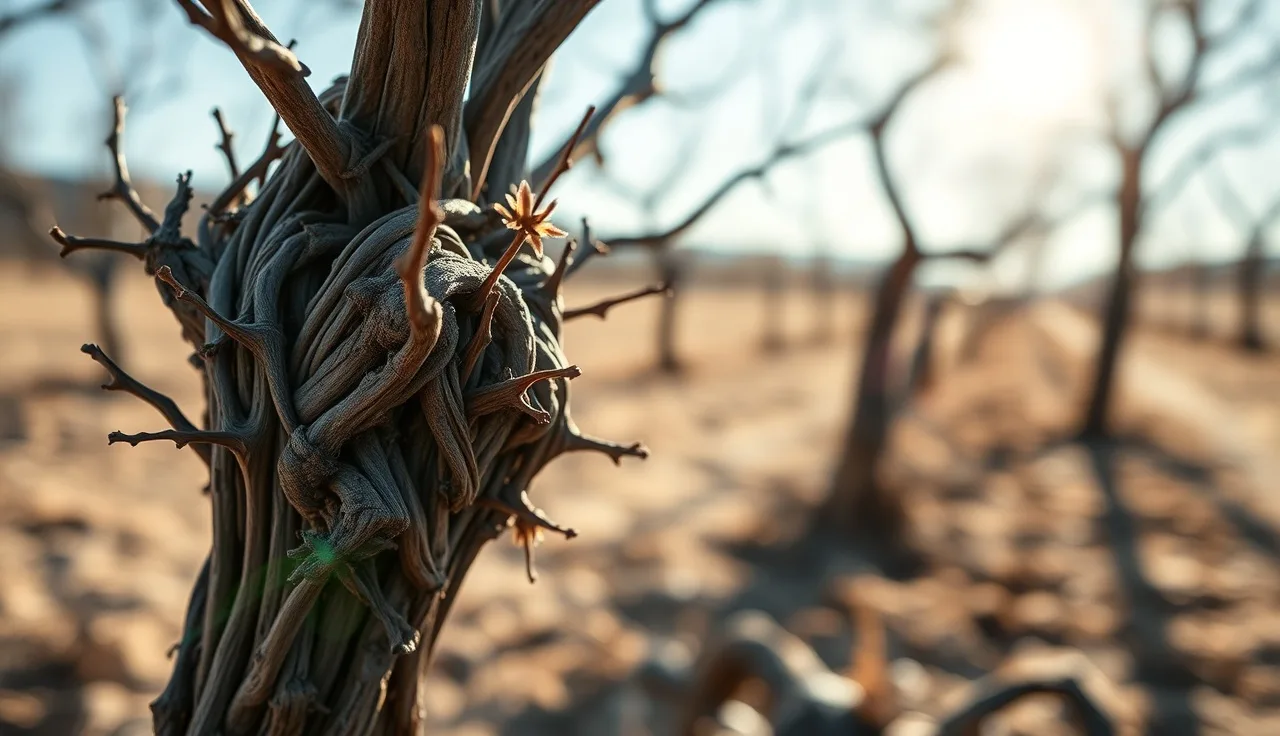
Cup pruning keeps every shoot growing from one upright trunk with no wires and no cordon arms. In the technical literature it goes by gobelet or head training. The finished vine looks like a small tree, or if you squint, an open cup. You leave 4 to 8 short spurs, each carrying 2 buds, and the whole structure stays under 3 feet tall on most sites.
The contrast with cordon-trained systems is basic. Spur-pruned cordons also use 2-bud spurs, but they run those spurs along horizontal arms tied to a trellis. Cane-pruned systems like the classic Guyot replace canes every year and need even more wire and labor. Cup-pruned vines need no trellis at all. That's the whole point on steep, rocky hillsides where running wire costs a fortune, or on dry-farmed sites where the exposed canopy and low yields are what you're after.
Gobelet is the dominant system in the southern Rhône and much of Spain, and it's common in old-vine Zinfandel blocks in Lodi, Amador County, and Paso Robles. Visit the Paso Robles wineries region and you'll see it on nearly every old-vine block that predates modern trellis installation.
The free-standing structure means the vine holds itself up entirely, so wood quality matters more than in a trellised system. A weak, over-cropped vine on gobelet falls apart fast.
Which grape varieties are best suited to cup pruning?
Grenache, Mourvèdre, Cinsault, Zinfandel, and Carignan are the classic cup-prune varieties. They share two traits: moderate-to-low vigor and a semi-erect to upright shoot growth habit. Varieties with strong pendant or weeping shoots are a problem because the canes droop, fruit hangs near the ground, and you get rot, poor air movement, and a mess at harvest.
A lot of growers learn this the hard way.
The ones that genuinely work:
- Grenache (noir, blanc, gris): arguably the best cup-prune variety. Its naturally upright shoots hold themselves up.
- Mourvèdre: low-moderate vigor, tight clusters, does well on dry-farmed gobelet.
- Cinsault: traditional in southern France on this system.
- Zinfandel: old California blocks on gobelet are some of the most planted vines in the state. Modern clones run more vigorous and are harder to manage.
- Carignan: used widely in Languedoc and old California plantings.
- Monastrell (same grape as Mourvèdre): common in Jumilla, Spain on this system.
The ones that struggle:
- Syrah: shoots droop sharply and the vine wants to sprawl. You can do it, but yields suffer and canopy management is a fight every year.
- Cabernet Sauvignon: high vigor on most sites. The trunk gets top-heavy and laterals run everywhere.
- Merlot: same issue as Cabernet.
- Pinot Noir: shoot angle is fine, but it's usually higher vigor and more disease-sensitive in a closed canopy.
WSU Extension's viticulture program notes that shoot positioning gets much harder without support wires on high-vigor varieties, which is exactly the trap on gobelet [1].
How do you actually execute a cup prune: step-by-step?
The mechanics are simpler than any other system, and that's part of the appeal. Here's how a competent pruner works through a mature vine.
- Stand back and read the vine. You want to see the head (the gnarly knob at the top of the trunk), last year's spurs, and the one-year-old wood coming off each spur. That one-year-old wood is what you cut back to 2 buds.
- Choose which spurs to keep. On a mature vine you'll have more material than you need. Keep 4 to 8 spurs, spaced as evenly around the head as you can. You want them in a circle. That's what gives the system its cup shape and lets light into the center.
- Cut each kept spur back to 2 buds. Count from the base. The basal bud is the first bud at the base of last year's shoot, and it counts as bud 1. Cut just above bud 2, leaving a short snag a few millimeters above the bud so you don't cut into it.
- Remove all other wood. Everything that didn't make the cut comes off clean at the collar. Don't leave long stubs. They die back and turn into wood disease entry points.
- Check spur placement. After cutting, you should see daylight through the center of the vine. If you can't, you've left too much.
Wound management matters more on gobelet than on almost any system, because the head piles up cuts year after year. UC Cooperative Extension's trunk disease work on Esca and Eutypa shows that large pruning wounds on a compact head create a high-risk zone for infection [2]. Use a registered wound sealant (Topsin-M paste or a commercial pruning sealant) on any cut larger than a pencil diameter. This is doubly true in wet-winter regions like the North Coast.
Timing: most California growers prune cup-trained vines in January and February. On frost-prone sites, or in a year with a warm forecast, delayed pruning is worth a look. More on that below.
How many spurs and buds per vine should you leave?
Leave 4 to 8 spurs and 8 to 16 buds on a mature gobelet vine, then adjust for vine balance. No formula replaces reading the vine, but there are real starting points from the research.
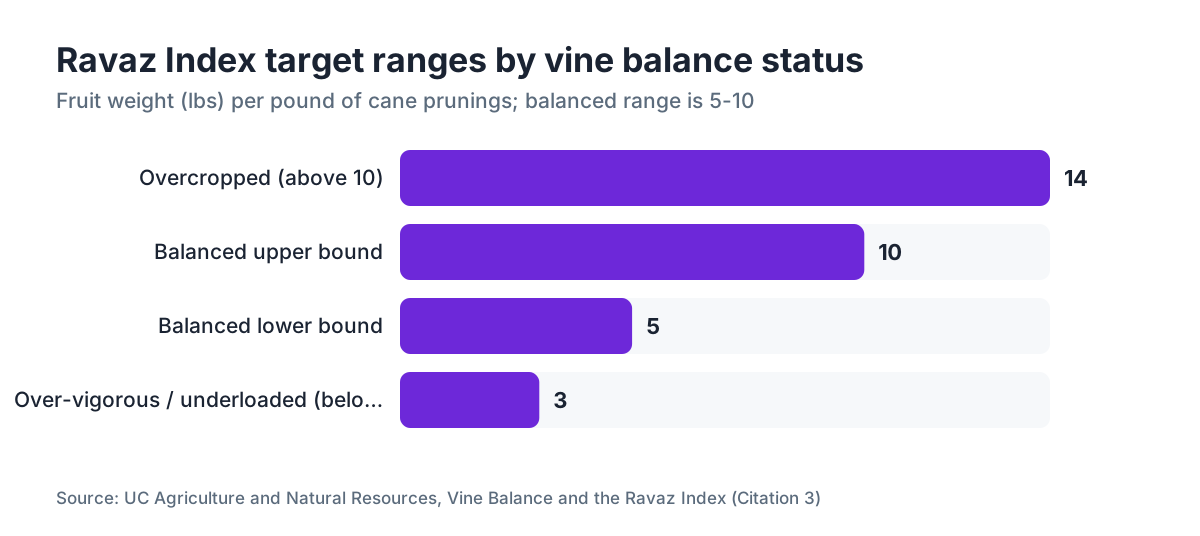
The standard reference for balance is the Ravaz Index, the ratio of fruit weight harvested to cane pruning weight. A balanced vine produces 5 to 10 pounds of fruit for every pound of cane prunings [3]. Above 10, you're overcropping. Below 5, you're overleafing. The practical translation:
- Measure cane pruning weight per vine for a block over 2 to 3 seasons.
- For every pound of pruning weight, you can leave roughly 10 to 20 buds.
- Divide your target bud count by 2 (each spur carries 2 buds) to get spur count.
A low-vigor dry-farmed Grenache averaging 0.4 lb of cane prunings per vine lands at 8 to 16 buds total, which is 4 to 8 spurs. A more vigorous vine at 0.8 lb per vine can carry 16 to 24 buds.
Young vines (years 1 to 4) are about building structure, not cropping. Leave 2 to 4 spurs maximum in year 2, then add 1 to 2 spurs per year as the trunk thickens to at least 1 inch diameter at the base.
| Vine age | Target spurs | Target buds | Expected yield (tons/acre, dry-farmed) |
|---|---|---|---|
| Year 2 | 2-3 | 4-6 | 0 (no crop) |
| Year 3 | 3-4 | 6-8 | 0.5-1.0 |
| Year 4 | 4-6 | 8-12 | 1.0-2.0 |
| Mature (5+) | 4-8 | 8-16 | 1.5-3.5 |
What does delayed pruning mean and does it reduce frost risk on cup-trained vines?
Delayed pruning is exactly what it sounds like. You push pruning back from the usual January-February window to March or even early April, after bud swell has started on the unpruned vines. Vines that have already begun pushing growth on their unpruned canes get ahead. Once you finally cut, the vine slows down and pushes from the retained spurs, which delays bud break by 1 to 3 weeks compared to early-pruned vines [4].
The frost logic is simple. If your last average frost date is April 15 and normal bud break on early-pruned vines is April 5, you have a problem. Delayed pruning can shift bud break to April 18 to 20, past the danger. The delay is real but variable. Cornell Cooperative Extension trials in the Finger Lakes documented shifts of 7 to 14 days, often enough to matter [4].
On gobelet vines there's one practical catch. The vine has already pushed shoots on all that unpruned one-year-old wood. Some of those shoots run 4 to 8 inches long by the time you get in there. You snap them off as you handle the canes, which wastes the vine's stored carbohydrates and bruises material near the spurs you meant to keep.
Work carefully, or run a double-pruning approach: a rough cut in January (pull 80 percent of the wood but leave the canes longer than final length), then a return in late March for the final spur cuts. UC Cooperative Extension advisors have recommended this technique for frost-prone North Coast blocks [5].
Delayed pruning has a cost too. It compresses your labor calendar. On 40 acres of gobelet, January pruning takes 6 to 8 weeks. Wait until March and you're pruning during or after bud swell, maybe at the same time you're doing other spring work. Do the labor math before you commit.
How do you build a cup-trained vine from a new planting?
Year 1 is almost all patience. Plant a certified budded vine or rooted cutting. If it pushes multiple shoots in the first season, keep the single strongest and let it run. Stake it with a bamboo cane or wooden stake to hold it upright. No pruning during the year 1 growing season.
Winter of year 1: cut back to 2 or 3 buds above the graft union, or 2 or 3 buds on the planted cutting. You're setting the base of what becomes the trunk.
Year 2 growing season: let the single strongest shoot grow to your target trunk height (typically 18 to 28 inches for gobelet). Once it hits that height, pinch or cut the tip. That pushes lateral growth, which becomes your first spurs. Aim for 3 to 5 laterals spaced around the top of the trunk.
Winter of year 2: cut each lateral back to 1 or 2 buds. You now have your first real spur positions. This is a structure year, not a crop year.
Years 3 and 4: each spur pushes 2 or 3 shoots. In winter, prune each spur back to the two-bud spur closest to the head. You're selecting the spur you want long-term and building the gobelet head. In year 3 you might allow a light crop (1 to 2 clusters per spur) if the vine is well-established.
Year 5 onward: full cropping and the annual maintenance pruning described above.
The biggest training mistake is cropping too early. A vine that carries a full crop in year 3 builds a weak trunk, gets stressed, and sets itself up for slow growth and trunk disease. The payoff for patience is a vine that lasts 50 to 100 years. The 80-year-old gobelet Zinfandel in Amador County is proof enough.
What tools and worker safety rules apply to cup pruning?
The tools are simple: bypass hand pruners (Felco, ARS, or equivalent), loppers for wood thicker than 1 inch, and a pull saw for trunk repairs. Quality matters. A dull blade crushes wood tissue instead of cutting it clean, and crushed tissue is a direct invitation to Eutypa and Botryosphaeria.
Sharpen blades daily during pruning season. Disinfect between vines in blocks with known trunk disease using a 10 percent bleach solution or a registered disinfectant. UC Cooperative Extension recommends this in its trunk disease management guidance [2].
Worker safety runs through the EPA's Agricultural Worker Protection Standard (WPS), 40 CFR Part 170. It applies to any vineyard that uses pesticides, which is nearly every commercial operation. Under WPS, workers must get safety training within a set window of first entry into a treated area, and that training has to be documented. Pesticide application records must be available to workers and their designated representatives on request [6].
For pruning crews specifically:
- Provide clean water, soap, and single-use towels at each field location (a WPS requirement).
- Post pesticide application information at a central location (the pesticide safety information and application/hazard information requirements under WPS).
- Keep decontamination supplies within a quarter mile of where crews are working.
Repetitive-strain injury is a real occupational hazard for pruning crews. Cal/OSHA's repetitive motion standard (Title 8, Section 5110) requires employers to identify and correct musculoskeletal injury risk factors in jobs with repetitive motion [7]. For pruning, that means rotating workers between vine types, capping continuous pruning at roughly 2-hour blocks where you can, and matching pruner handle size to worker hand size.
Tracking pruning activity, timing, and worker hours in a platform like VitiScribe keeps you WPS-ready without three separate spreadsheets, which matters most when a state inspector wants records on short notice.
What are the main problems and disease risks with cup pruning?
Trunk disease is the biggest risk by a wide margin. Because gobelet vines pile up pruning cuts in a tight zone over decades, the head becomes a dense cluster of wound sites. The four main trunk diseases in California and the Pacific Northwest are Eutypa dieback (Eutypa lata), Esca (a complex of several fungi), Botryosphaeria dieback, and Phomopsis cane and leaf spot [2].
Eutypa does the most economic damage in cool, wet-winter regions. UC Cooperative Extension describes Eutypa-infected vines as showing "stunted shoots with small, chlorotic, tattered leaves," and notes that wounds stay open to infection for several weeks after pruning [2]. The fungus spreads through airborne spores released during and after winter rains. That's why wound sealants earn their keep on gobelet more than on other systems.
A practical trunk disease routine for gobelet:
- Prune during dry weather when no rain is forecast for 48 to 72 hours. Eutypa spore release peaks within hours of a rain event.
- Apply a wound protectant (Topsin-M 70W paste at registered rates, or a commercial pruning sealant) to all cuts within 30 minutes.
- In established blocks with visible disease, use remedial surgery: cut out infected wood below the canker margin, repaint at once, and train a sucker from below the graft union into a replacement trunk.
Canopy management is the second headache. Without a trellis, shoots growing inward shade the fruit zone. Shoot positioning on gobelet is entirely gravitational and habitual. You can't clip a shoot to a wire that isn't there. The fix is consistent spur placement around the head (not bunched on one side) and holding your bud count. Overcropped gobelet vines throw weak shoots that droop inward and build the humid, shaded microclimate that powers Botrytis.
Soil erosion is a real problem on steeper gobelet blocks. The lack of trellis lines lets mechanical cultivation run in any direction, and cover crop management under free-standing vines is fiddly. The UC Agriculture and Natural Resources guide on cover crops addresses this for dry-farmed systems [8].
How does cup pruning affect wine quality and yield?
Gobelet's quality reputation comes from low yields, sun exposure, and the vine types it usually gets paired with. A dry-farmed Grenache on gobelet in a warm interior valley averages 1.5 to 3 tons per acre. A trellised, irrigated Grenache block might hit 5 to 7 tons per acre. The concentration difference is not subtle.
The exposure effect is real. WSU's viticulture group has documented that exposed clusters in a warm mesoclimate develop higher sugars, more anthocyanins in red varieties, and greater phenolic ripeness than shaded fruit [9]. A gobelet canopy, managed right, gives close to 360-degree sun exposure on clusters, especially in the morning when temperatures stay moderate.
The yield tradeoff is the honest counterweight. For a grower selling to the bulk market, gobelet is often economically irrational. At $300 to $600 per ton for bulk red fruit (varies by appellation and vintage), a 1.5-ton-per-acre block earns $450 to $900 per acre. That can't cover a typical Napa or Sonoma cost of production, which UC Davis's Agricultural Issues Center pegged in the range of $4,000 to $8,000 per acre for established blocks in recent studies [10].
The math works when fruit price is high (old-vine designate programs, direct-to-winery contracts for premium blocks) or when you're vertically integrated and capturing the winery margin.
For estate wineries, the old-vine gobelet story is a genuine marketing asset. Visitors touring properties like South Coast Winery or the hill estates near Mountain Winery see these blocks all the time, and gnarly ancient vines communicate age and quality in a way a flat trellised block just doesn't.
Can you convert an existing trellised vineyard to cup pruning?
Technically yes. Practically, with big caveats. Converting a cordon-trained vine to gobelet means removing the cordon structure and rebuilding the head, which usually means starting a new trunk from a sucker, or cutting back hard to a point below the existing cordon and retraining from there. Plan on 3 to 5 years, and expect to lose production during that window.
The bigger question is whether the variety and site justify the conversion. Removing trellis infrastructure on a steep site is a legitimate reason. Wanting lower yields is not, because you can drop yield on a cordon system through green harvest without the upheaval.
Heavily irrigated, high-vigor vines make poor conversion candidates. You'd have to cut irrigation to knock down vigor, which stresses the vine mid-retraining. Severe pruning and an irrigation cut in the same two-year window kills a meaningful share of vines in some blocks.
If you do convert, remove one cordon arm per year rather than both at once. Let a strong sucker grow from the base of the remaining arm in year 1, train it to target trunk height, and cut the remaining cordon arm in year 2. Staggering the change keeps some leaf area on the vine while the replacement trunk establishes.
How should you record and track cup pruning work for compliance?
Pruning records do three jobs in commercial viticulture: labor compliance (Cal/OSHA ergonomics and piece-rate wage documentation under California Labor Code Section 226.2), pesticide records (WPS worker-entry rules after applications), and your own operational data (pruning dates, bud counts per block, pruning weights for the Ravaz Index).
California's piece-rate law, amended in 2016, requires employers to pay separately for rest and recovery periods and other nonproductive time for piece-rate workers [11]. Pruning on a per-vine or per-row piece rate is common. The records you must keep include total piece-rate units completed, the applicable piece rate, and total hours worked including rest time. Violations carry heavy penalties.
For WPS, your pesticide application records need the product name, EPA registration number, active ingredient, location treated, date and time, and the restricted entry interval (REI) [6]. If a pruning crew enters a block soon after an application, verify the REI has passed and document that verification.
Keeping all of this in one system instead of a paper binder plus a spreadsheet is where a tool like VitiScribe cuts real friction, especially when a county ag commissioner asks for three seasons of records on 48 hours' notice.
For Ravaz Index tracking, the minimum data is block-level pruning weight (weigh a representative sample from at least 10 vines per block) and block-level harvest weight from your crush receipts. Run it for 3 straight seasons to see real trends instead of year-to-year noise.
What do extension programs recommend for cup pruning in specific regions?
UC Davis and UC Cooperative Extension publish the most detailed region-specific guidance for California, where most US gobelet plantings sit. The UC Integrated Viticulture materials cover spur pruning mechanics and trunk disease management and are the standard reference for Coastal and Central Valley California viticulture [2].
Cornell Cooperative Extension's Finger Lakes and Hudson Valley guidance leans toward cane-pruning systems suited to cool climates, but its frost work applies directly to growers weighing delayed pruning on gobelet in frost-prone sites [4]. Cornell trials show double pruning (early rough cut, late final cut) can shift bud break 7 to 14 days without the yield penalty of full delayed pruning.
WSU's Pacific Northwest viticulture publications cover spur-count recommendations for the Columbia Valley, where some Grenache and Syrah blocks are cup-trained. Their canopy management and light interception work explains why the open gobelet canopy does well in high-radiation interior sites [9].
On dry farming, the UC Division of Agriculture and Natural Resources has published guides on water stress management in unirrigated vineyards, which speak straight to gobelet's typical use case [8]. The core point: dry-farmed gobelet vines need aggressive pruning to hold yields in balance with the water winter rain recharges. In low-rainfall years (below 12 to 14 inches in most California interior valleys), shoot or cluster thinning after set is often needed even when the vine looked balanced at pruning.
The Lodi Rules program, run by the Lodi Winegrape Commission, is not a university, but its certification standards address sustainable pruning and trunk disease management for old-vine gobelet blocks. Worth reviewing if you farm in that appellation [12].
Frequently asked questions
How many buds do you leave when cup pruning?
The standard is 2 buds per spur and 4 to 8 spurs per vine, giving 8 to 16 buds total on a mature vine. The right number depends on vigor: measure cane pruning weight and aim for a Ravaz Index (fruit weight to pruning weight) of 5 to 10. Low-vigor dry-farmed vines sit at the lower end; more vigorous vines carry more buds.
What is the difference between cup pruning and gobelet pruning?
They're the same thing. Gobelet is the French term, goblet is an English spelling variation, and cup pruning is the plain-English description. All refer to a head-trained, free-standing vine with no trellis, pruned to short 2-bud spurs arranged in a circle around the top of a single upright trunk.
Does cup pruning require a trellis?
No. That's the defining feature. Cup-trained vines are free-standing, so the trunk supports all shoot growth without wires. That makes gobelet practical on steep terrain where trellis installation costs a fortune, and on dry-farmed sites where low, exposed canopies are desirable. Young vines still benefit from a temporary stake during training to keep the trunk upright.
When is the best time of year to cup prune?
Most California growers prune gobelet vines in January and February, after the coldest period and while vines are fully dormant. On frost-prone sites, delaying to late February or March can shift bud break 7 to 14 days and cut frost damage, based on Cornell Cooperative Extension trials. Prune during dry weather to reduce Eutypa infection, since spore release peaks right after rain.
How long does it take to cup prune one vine?
An experienced pruner takes 1 to 3 minutes per vine on a mature gobelet, depending on vine size and wood accumulation. A crew of 8 can cover 8 to 12 acres a day at a standard 8x10 foot spacing (roughly 544 vines per acre). Young vines with less wood go faster; heavy old-vine heads with a lot of deadwood removal take longer.
Can you cup prune Cabernet Sauvignon?
You can, but it's a poor fit. Cabernet Sauvignon is high-vigor on most sites, and its shoots droop and sprawl without wire support, building a dense, shaded canopy that promotes disease. Growers who try it usually report Botrytis problems and constant trouble managing shoot density. Cordon spur-pruning is the practical choice for Cabernet unless you're on a genuinely poor, low-vigor site.
What causes the knobby head on old cup-pruned vines?
The woody knob at the top of the trunk builds up over decades from accumulated spur stubs and callus tissue. Every year's cuts add a little mass. On well-managed vines the head stays fairly compact; on poorly managed vines with long stubs and dead wood pockets, it grows large and irregular, which raises trunk disease risk and makes spur selection harder each season.
How does delayed pruning work with cup-trained vines specifically?
On gobelet vines, delayed pruning means waiting until bud swell shows on the unpruned canes before making final spur cuts. That delays the cut vine's bud break 7 to 14 days versus January-pruned vines, cutting spring frost exposure. The catch is that you snap off small shoots during late pruning. A double-prune approach (rough cut in January, final cut in March) limits that damage and is the method UC Cooperative Extension advisors recommend in frost-prone California blocks.
What is spur binding and how do you fix it on old gobelet vines?
Spur binding happens when the head piles up so many old spur stubs over the years that there's no room for well-positioned new spurs. The fix is renewal pruning: select a vigorous shoot from low on the trunk or well away from the congested area, let it grow a season, and use it as a replacement spur position while removing the bound-up stubs. It takes 2 to 3 seasons but restores a workable head.
Do you need to seal pruning wounds on cup-pruned vines?
Yes, especially on large cuts and in wet-winter regions. UC Cooperative Extension research shows Eutypa lata infects wounds within hours of spore-laden rain, and the gobelet head concentrates multiple wounds in a small area. Apply a registered wound protectant such as Topsin-M paste to cuts larger than pencil diameter within 30 minutes of pruning. Prune during dry weather whenever you can.
How much does it cost to establish a cup-trained vineyard compared to a trellised one?
Trellis installation for a standard VSP (vertical shoot positioning) system runs roughly $3,000 to $6,000 per acre in California, based on UC Davis cost-of-production studies. Gobelet skips that cost. Temporary training stakes add $100 to $300 per acre. The saving is real but partly offset by higher per-acre labor in early training years, since each vine needs more individual attention with no wire to guide growth.
What is the Ravaz Index and how do you use it for cup pruning decisions?
The Ravaz Index is fruit weight harvested divided by cane pruning weight, both measured per vine or per block. A balanced vine scores 5 to 10. Below 5 means too much vegetative growth and not enough fruit; above 10 means overcropped. For gobelet, weigh prunings from 10 or more representative vines per block each year and compare to harvest weight. Three seasons of data gives you a reliable baseline for adjusting spur count.
Are there any WPS requirements specific to pruning crews?
WPS (40 CFR Part 170) applies to any agricultural worker entering treated areas, including pruning crews. Requirements include safety training before or soon after entry into a treated field, decontamination supplies within a quarter mile of work, and posted pesticide application information. Pruning entry dates must reconcile with your pesticide application records and their restricted entry intervals. California enforcement runs through county agricultural commissioners.
Sources
- Washington State University Viticulture and Enology Program: Shoot positioning becomes much harder without support wires on high-vigor varieties
- UC Statewide Integrated Pest Management Program, Grape Pest Management and Trunk Diseases: Eutypa-infected vines show stunted shoots with small, chlorotic, tattered leaves; wounds remain susceptible for several weeks after pruning; wound protectants and disinfecting tools are recommended
- UC Agriculture and Natural Resources, Vine Balance and the Ravaz Index: A balanced vine produces 5-10 pounds of fruit for every pound of cane prunings (Ravaz Index 5-10)
- Cornell College of Agriculture and Life Sciences, Cornell Cooperative Extension viticulture and frost management: Double pruning can shift bud break by 7-14 days in Finger Lakes trials
- UC Agriculture and Natural Resources, Cooperative Extension guidance on delayed and double pruning for frost avoidance: UC advisors recommend double-pruning technique (rough cut in January, final cut in March) for frost-prone North Coast blocks
- U.S. EPA, Agricultural Worker Protection Standard, 40 CFR Part 170: Workers must receive safety training before or soon after first entry into a treated area; pesticide application records must be available to workers on request; decontamination supplies required within 1/4 mile of work
- California Department of Industrial Relations, Cal/OSHA, Title 8 Section 5110 Repetitive Motion Injuries: Cal/OSHA requires employers to identify and correct musculoskeletal injury risk factors in jobs with repetitive motion, including agricultural pruning
- UC Agriculture and Natural Resources, dry farming and cover crops in vineyards: Dry-farmed gobelet vines need aggressive pruning to keep yields in balance with water available from winter rain recharge
- Washington State University Viticulture and Enology Program, canopy management and light interception: Exposed fruit clusters develop higher sugars, more anthocyanins, and greater phenolic ripeness than shaded fruit
- UC Davis Agricultural Issues Center, cost of production studies for wine grapes: Established vineyard cost of production in California estimated in the $4,000-$8,000 per acre range in recent studies
- California Labor Code Section 226.2, Piece-Rate Compensation: California employers must pay separately for rest and recovery periods for piece-rate workers; records must include total piece-rate units, applicable rate, and total hours worked
- Lodi Winegrape Commission, Lodi Rules Sustainable Winegrowing Program: Lodi Rules certification standards address sustainable pruning practices and trunk disease management for old-vine gobelet blocks
Last updated 2026-07-10