How long from veraison to harvest: what the research actually says
TL;DR
- For most wine grape varieties, the window from veraison to harvest runs roughly 40 to 70 days.
- Thin-skinned early varieties like Pinot Noir can be ready in 40 to 45 days.
- Late-ripening varieties like Cabernet Sauvignon and Syrah often need 55 to 70 days.
- Climate, crop load, and vine stress move that window earlier or later by a week or more.
What is veraison and why does it matter for timing harvest?
Veraison is the point when grapes stop being hard green acid factories and start ripening. In red varieties, anthocyanin production turns the berries purple or red. In whites the change is quieter: berries soften and go from opaque green to a translucent yellow-gold. Either way, the cellular machinery inside the berry flips, and sugar starts flowing in from the leaves instead of staying out.
This matters because veraison is the best field-observable trigger you have for counting down to harvest. Log it, and you have a working estimate of how many days remain. The estimate isn't perfect. It's still far better than watching a calendar from bud break.
University of California Cooperative Extension describes veraison as the onset of berry ripening, the moment when sugar accumulation begins in earnest, acids start falling, and berry weight climbs as water and sugars move in [1]. Washington State University Extension frames it the same way, noting that once veraison is complete across a block, the grower has a reliable baseline for predicting harvest [2].
You can't call a block fully at veraison until about 50% of berries show color change. That's the working field standard most managers use. Before that, you're watching a process that's still highly variable cluster to cluster.
How many days does it take to go from veraison to ripe?
The honest answer is 40 to 70 days, depending on variety, climate, and how you define ripe. For most cool-to-moderate climate production, the tighter real-world range is 45 to 60 days.
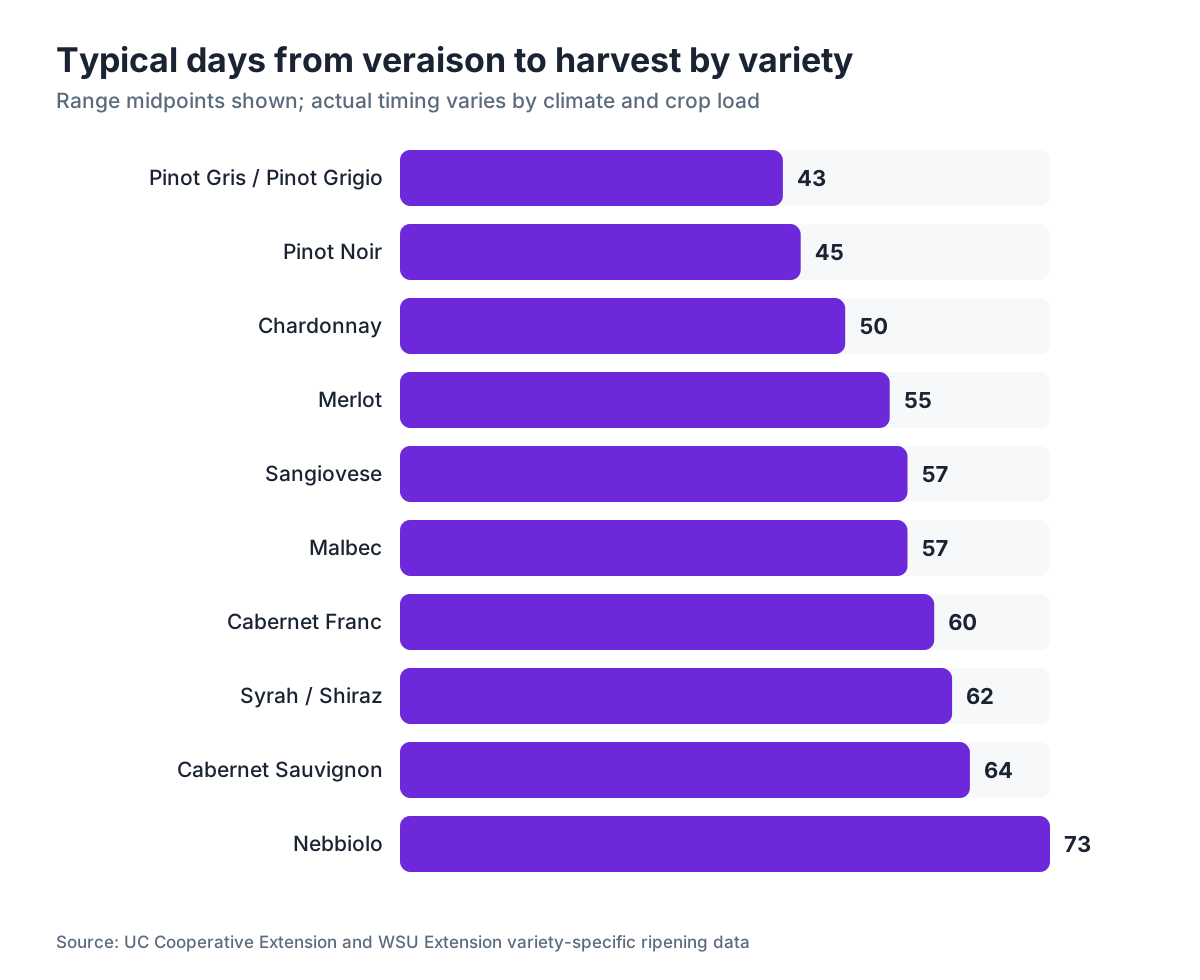
Here's the varietal breakdown field managers actually use:
| Variety | Typical Days Veraison to Harvest | Season Classification |
|---|---|---|
| Pinot Gris / Pinot Grigio | 38 to 48 | Early |
| Pinot Noir | 40 to 50 | Early |
| Chardonnay | 45 to 55 | Early-Mid |
| Merlot | 50 to 60 | Mid |
| Sangiovese | 52 to 62 | Mid |
| Malbec | 52 to 62 | Mid |
| Syrah / Shiraz | 55 to 68 | Mid-Late |
| Cabernet Franc | 55 to 65 | Mid-Late |
| Cabernet Sauvignon | 58 to 70 | Late |
| Nebbiolo | 65 to 80 | Very Late |
These ranges pull from UC Davis viticulture extension materials and WSU's variety-specific heat unit tables [1][2]. They're averages, not guarantees. A cool August in the Willamette Valley can add 10 days to a Pinot Noir estimate. A heat spike in late September in Paso Robles can compress a Cabernet's final two weeks hard.
Growing degree days (GDD) since veraison predict harvest better than calendar days alone. WSU extension research found that berry sugar accumulation rate tracks heat units more tightly than elapsed days [2]. If you're logging GDD in your blocks, aim for roughly 700 to 1,000 GDD (base 50 degrees F) from veraison to harvest, with later varieties sitting at the higher end [2].
Does the veraison-to-harvest window change by climate and region?
Yes, and this is where calendar-based rules break down fastest.
Cool climates stretch the window. Oregon's Willamette Valley sees Pinot Noir routinely running 50 to 60 days from veraison because nights stay cold and sugar accumulation slows. The same clone at Carneros in California might come in at 42 to 48 days. Cornell Cooperative Extension's work on New York viticulture shows that in the Finger Lakes, cool summers can push even early-ripening varieties past 60 days from veraison to harvest [3].
Hot climates compress it. In the San Joaquin Valley or in Arizona, summer heat keeps hammering well past veraison and sugar piles up fast. Growers there sometimes see Cabernet Sauvignon ready in 50 days because the heat load is so intense. The tradeoff is that acid drops fast too, so ripe by sugar and ripe by flavor can come apart.
Altitude and diurnal swing matter separately from raw heat. High-elevation sites like the Sierra Foothills or Walla Walla's Blue Mountain benchlands have warm days but cold nights. That diurnal swing (sometimes 40 degrees F or more) slows the process relative to a low-elevation site with the same daytime high, and it holds acid. Growers at those sites often say their window feels longer because the grapes ripen slowly but completely.
The practical takeaway: treat varietal averages as your starting point, then adjust by 5 to 15 days based on your site's heat accumulation from veraison onward.
What factors speed up or slow down ripening after veraison?
Several things push that timeline around, and most sit within a grower's partial control.
Crop load is the biggest one. Heavy crops ripen slower because the vine spreads its photosynthate across more berries. UC Davis extension research consistently shows that crop thinning at or just before veraison (removing whole clusters) can speed ripening by 5 to 10 days and improve color intensity in reds [1]. If you're dropping fruit at veraison, you're doing the right thing at the right time.
Leaf removal affects it too, but timing matters. Basal leaf removal done early in the season (pre-bloom to fruit set) opens up sunlight in the fruit zone and can modestly speed color development and ripening. Leaf removal done after veraison has less effect on timing but helps with disease pressure.
Water stress before veraison can actually push the onset of veraison earlier, getting you to that baseline sooner. Mild water stress during the lag phase (between fruit set and veraison) is a standard tool in regulated deficit irrigation (RDI) programs [10]. After veraison, heavy water stress slows sugar accumulation, and too much irrigation dilutes the fruit. Neither extreme is what you want.
Disease and pest pressure can wreck ripening timing without warning. A Botrytis outbreak in a Chardonnay block concentrates sugar as infected berries desiccate, but it also tanks acid and creates off-flavor compounds. That's a harvest decision that skips your normal ripeness metrics entirely.
Smoke exposure from wildfires is now a real factor across the West. Smoke-affected vines can produce grapes that look ripe by Brix but carry volatile phenol compounds (guaiacol, 4-methylguaiacol) that cause smoke taint in finished wine. No amount of extended hang time fixes that [4].
How do you actually measure ripeness in the weeks after veraison?
You need more than Brix. This is the mistake growers new to a variety make: they pick by sugar and get burned.
Brix (or Baume in some regions) tells you soluble solids, mostly sugar. It's cheap to measure with a refractometer and should be your most frequent field measurement starting about 3 weeks after veraison. Sample 100 to 200 berries per block, random, from every canopy position, more than the easy ones. Blend, squeeze, read. Commercial wine grapes typically harvest between 21 and 26 degrees Brix, but that range is wide for a reason: style and variety drive target Brix more than any universal rule.
Titratable acidity (TA) and pH matter as much as Brix for wine quality. As berries ripen, malic acid degrades (faster in heat) and potassium uptake drives pH up. TA falling below 5.0 g/L and pH climbing above 3.6 or 3.7 is a common trigger for an immediate pick in warm climates, regardless of Brix. Cornell extension notes that high-pH must is more prone to microbial instability and needs higher SO2 additions to compensate [3].
Flavor and seed color are the qualitative checks. Seeds that are fully brown and crack cleanly (rather than green and chewy) mean physiological maturity. Skin flavor should have lost the green bell-pepper notes of underripe fruit and should show the variety's real profile. This one is non-negotiable for quality-focused wineries.
You can also run a penetrometer to track berry firmness. Firmness drops sharply around veraison and keeps declining through ripening. Tracking firmness alongside Brix gives you a curve that helps predict when Brix accumulation will plateau.
Field note-taking across all these parameters is where something like VitiScribe earns its keep: logging weekly Brix, TA, pH, and berry evaluations block by block, so you watch the ripening curve develop instead of making harvest calls from isolated readings.
How do you track veraison date accurately in a mixed-ripening block?
Veraison isn't a single day in most blocks. It's a 7 to 21 day process, especially in older vines with mixed clonal material, or in varieties with naturally uneven ripening like Grenache.
The standard protocol is to flag sentinel vines, 10 to 20 spread across the block, edge rows and interior, different aspects. Walk them every 2 to 3 days starting about 45 to 50 days after fruit set. Record the percentage of berries showing color change or softening. Call veraison when 50% of berries on 50% of the sampled clusters have changed.
That 50/50 rule shows up all over California and Washington extension literature, though some researchers prefer a 100-berry random sample approach where you tag specific vines and count individual berries across multiple visits [2].
Date your record to the day veraison hits that 50% threshold. That date is your clock start for harvest prediction. If your block is badly uneven, think about a split harvest: sample early-ripening and late-ripening sections separately and treat them as two decisions.
Some larger operations use normalized difference vegetation index (NDVI) imagery from drone or satellite to spot within-block variability at veraison and steer their sampling. The tech is useful. The ground truth from walking the vines is still non-negotiable.
What does the research say about year-to-year variation in the veraison window?
Year-to-year variation in veraison timing can be big, and it's getting bigger with climate change.
A study in Global Change Biology found that veraison timing for major wine grape varieties across Europe advanced by roughly 6 days per decade from 1980 to 2009, driven mainly by rising temperatures [5]. The same study found harvest dates advanced by a similar margin, meaning the veraison-to-harvest interval itself stayed fairly stable even as both endpoints slid earlier in the year.
In California, UC Cooperative Extension data shows veraison in Napa Valley Cabernet Sauvignon has moved roughly 3 to 4 weeks earlier over the last 40 years, from a historical average around late August to late July or early August today [1]. The harvest window has compressed in hot years because the post-veraison heat load runs higher.
So you can't lean on historical average dates alone. Track GDD from January 1 (or a local reset date) every year. When you're within 80% of a variety's cumulative heat requirement for veraison, start walking blocks every 3 days. In a cool year that might put you out there in late August. In a hot year, early August or even late July.
Nobody has perfectly clean data on exactly how much climate variability shifts the veraison-to-harvest interval versus moving both endpoints equally. The balance of evidence points to the interval staying relatively fixed while both dates move earlier in hotter years.
How does veraison timing affect spray programs and worker safety compliance?
Veraison is a regulatory inflection point as much as a viticultural one.
Many fungicide programs run on phenological stages, and several products carry pre-harvest intervals (PHIs) counted from the last application to the projected harvest date. If veraison comes early, harvest can come early, and that catches you short on PHI compliance if you sprayed assuming a later pick.
The EPA's Worker Protection Standard (WPS) requires that pesticide application records include the product name, EPA registration number, application date, and the restricted-entry interval (REI) [6]. When crews enter the vineyard for berry sampling in the weeks after veraison, you have to confirm any REIs for recently applied products have elapsed. Sampling crews picking through canopy are in the treated area for WPS purposes.
Working rule: once you set your estimated harvest window from the veraison date, count back from that estimate using the PHIs of any fungicide or insecticide you're still considering. If Botrytis pressure is building and you're 35 days out, check that the product you want has a PHI of 7 days or less. Many Botryticides used from bunch closure through veraison have PHIs of 0 to 14 days. Some run longer.
WSU's pest management guides include variety-specific spray timing windows tied to phenological stages including veraison [2]. The UC IPM program keeps a similar online resource for California growers [7]. Both are worth pulling up before you lock your post-veraison spray calendar.
Can you use growing degree days to predict harvest date from veraison?
Yes, and it beats calendar days for most sites.
Growing degree days (GDD) use a base temperature of 50 degrees F (10 degrees C) for wine grapes in the U.S. standard model. Each day's GDD equals ((daily max + daily min) / 2) minus 50, with a floor of zero and usually a ceiling of 95 degrees F. Sum those daily values from a start date.
From veraison, most wine grape varieties need somewhere between 700 and 1,100 GDD (base 50 degrees F) to reach harvest maturity, with early varieties like Pinot Noir near the low end and late varieties like Cabernet Sauvignon and Nebbiolo near the high end [2]. The exact number for your site and variety needs calibration over several seasons, but even a rough estimate beats pure calendar counting.
Here's a working method: log your veraison date, pull your local weather station's daily temperature data (NOAA Climate Data Online is free and covers most agricultural areas [9]), and accumulate GDD from that date forward. When your cumulative GDD from veraison nears 800 (early variety) or 1,000 (late one), ramp Brix sampling up to every 3 to 4 days.
WSU's viticulture program has published degree day models for Pacific Northwest conditions with post-veraison heat requirements for the major varieties grown there [2]. UC Davis has parallel resources for California [1]. If you're in a region without local extension calibration, the numbers above are reasonable starting assumptions. Just know they'll need a season or two of ground-truthing on your specific site.
What are the signs that grapes are actually ripe and ready to pick?
Ripe means different things depending on what you're making, but a handful of physical signals hold broadly.
Sugar and acid are the numbers, and they should be moving in tandem. Brix climbing past target while TA is still high usually means physiological maturity hasn't caught up to sugar accumulation. That happens in cool, late-season conditions. The grapes aren't truly ripe even though they'd ferment fine.
Berry weight peaks, then holds steady or dips slightly. A manager tracking berry weights weekly from veraison sees a curve that levels off. That plateau tells you the berry is done taking on water and sugar.
Seeds read physiological maturity clearly. Green seeds with white or light tan centers mean you're early. Brown, brittle seeds that crack under pressure say the seed is mature. Do a quick crush-and-taste: mature seeds taste slightly nutty or neutral, immature seeds taste green and harsh.
Skin tannin shifts too. Early post-veraison tannins are harsh and grippy. As maturity develops, skin tannins polymerize and soften. Assess it by chewing berry skins separate from the pulp. Winemakers land in wildly different places here depending on style.
Brix at target, TA above 5.0 g/L (or the winery's minimum), pH below 3.6 (for standard table wine stability), seeds brown, skin flavor showing varietal character: that's the full picture. Most experienced managers don't wait for all of them to line up perfectly. They call it based on the factor they're most worried about given the season and the style.
How should you keep records from veraison through harvest for compliance?
Post-veraison is when your record-keeping load goes up, not down.
You're logging spray applications and their PHIs, weekly Brix and acid data by block, any fruit-thinning or canopy work, irrigation events, and any pest or disease observations that touch harvest timing. All of it dated, block-specific, and easy to pull back up.
On the regulatory side, pesticide application records must be kept for at least 2 years under federal WPS requirements, and many states require longer. California requires 3 years for pest control records under the California Department of Pesticide Regulation's rules [6][8]. Those records need the crop, location, product name, EPA registration number, amount applied, date applied, and the applicator's name.
Tracking all of that alongside ripeness data in one system makes the harvest window clearer and the compliance audit shorter. VitiScribe is built for exactly this block-by-block field record, letting you log Brix samples, spray events, and veraison dates in one place instead of juggling spreadsheets during the most chaotic weeks of the year.
If you're selling grapes to a winery, most buyers now want harvest documentation including spray records going back to veraison. Having those organized and exportable is a real edge when you're also trying to pick fruit at the right moment.
Frequently asked questions
How many days from veraison to harvest for Cabernet Sauvignon?
Cabernet Sauvignon typically runs 58 to 70 days from veraison to harvest under normal conditions. In hot climates like the San Joaquin Valley or parts of Paso Robles, post-veraison heat can compress that to 50 to 55 days. In cool climates or high-elevation sites, it can stretch to 75 days. Track growing degree days alongside calendar days for a better estimate on your specific site.
How many days from veraison to harvest for Pinot Noir?
Pinot Noir typically runs 40 to 50 days from veraison to harvest in moderate climates, one of the earliest-ripening reds. In cool climates like the Willamette Valley or the Finger Lakes, expect 50 to 60 days. UC Davis extension materials identify Pinot Noir as an early-season variety that needs close monitoring in warm years because its window narrows fast.
What is the average time from veraison to harvest for Chardonnay?
Chardonnay averages 45 to 55 days from veraison to harvest. It's an early-to-mid-season variety that ripens before most reds. Sparkling wine production usually targets the earlier end of that window, when Brix is around 18 to 20 and TA is still high. Table wine production generally waits for 22 to 24 Brix, pushing toward the 50 to 55 day mark.
Can veraison timing predict harvest date accurately?
Veraison date combined with growing degree day accumulation gives a reasonably accurate harvest estimate, usually within a 5 to 10 day range. Calendar days alone are less reliable because post-veraison heat varies a lot year to year. WSU extension research supports using GDD from veraison as a more consistent predictor than elapsed days. Ground-truth with weekly Brix sampling starting about 3 weeks after veraison.
What causes veraison to happen early or late in the season?
Early spring warmth and high GDD accumulation from bud break push veraison earlier. Cool, wet springs delay it. Vine stress (moderate water deficit during the lag phase between fruit set and veraison) can move veraison up by a few days. Heavy crop loads tend to delay it. The Global Change Biology study found veraison timing advanced roughly 6 days per decade from 1980 to 2009 across major European wine regions as temperatures rose.
How do I know if my grapes are ripe after veraison?
Use a combination: Brix (target varies by style, typically 21 to 26 degrees), titratable acidity (watch for TA falling below 5.0 g/L), pH (concern rises above 3.6 for reds), seed color (brown and brittle means physiological maturity), and skin flavor. No single metric is enough. Sample 100 to 200 random berries per block every 5 to 7 days from about 3 weeks post-veraison, then shift to every 3 to 4 days as you approach target.
Does crop load affect how quickly grapes ripen after veraison?
Yes, a lot. Higher crop loads slow ripening after veraison because photosynthate spreads across more berries. UC Davis extension research shows cluster thinning at or just before veraison can speed ripening by 5 to 10 days and improve color in reds. The standard recommendation is to hit your desired crop load before veraison rather than trying to catch up afterward.
What Brix should grapes be at veraison?
At veraison, berries typically measure between 5 and 10 degrees Brix. Sugar accumulation has barely started at this stage. The bulk of the increase happens over the following 4 to 8 weeks. A reading below 5 degrees Brix at apparent color change might mean you're catching early veraison in those berries. Full-block samples at veraison work better as a baseline than as a ripeness indicator.
How does smoke from wildfires affect ripening timing after veraison?
Smoke exposure doesn't meaningfully change when grapes hit sugar targets, but it can force an early pick regardless of ripeness. Grapes exposed to heavy smoke accumulate volatile phenol compounds (guaiacol, 4-methylguaiacol) that cause smoke taint in wine. There's no fix at the vineyard level after harvest. Some growers in high-risk regions now test for volatile phenol uptake starting at veraison in smoky years, then make harvest calls on taint risk rather than ripeness metrics.
What spray rules apply during the period from veraison to harvest?
Pre-harvest intervals (PHIs) on pesticide labels govern what you can apply and how close to harvest. Many fungicides used for late-season Botrytis have PHIs of 0 to 14 days. Some run longer. You must count back from your estimated harvest date based on veraison timing to confirm PHI compliance before any application. Under the EPA Worker Protection Standard, berry sampling crews entering treated areas must not re-enter before the restricted-entry interval (REI) has passed.
Is there a difference between veraison and physiological maturity?
Yes, and confusing them causes a lot of harvest timing errors. Veraison is the start of ripening, marked by color change and berry softening. Physiological maturity is the endpoint, where seeds are fully developed and brown, skin tannins have polymerized, and flavor compounds have come in. Sugar targets (Brix) can be reached weeks before physiological maturity, especially in warm years. Picking at Brix without checking seeds and flavors risks green, harsh wine.
How do you record veraison dates for multiple blocks?
Use a consistent protocol: flag sentinel vines in each block, walk them every 2 to 3 days starting around 45 days after fruit set, and record the date when 50% of berries on 50% of sampled clusters have changed color or softened. Record that date per block, not for the vineyard as a whole. Blocks with different varieties, rootstocks, or aspects hit veraison at different times. That block-level date is your countdown start for each unit.
Do white and red grapes ripen at the same speed after veraison?
Within the same variety, the post-veraison interval is similar for white and red grapes, but whites tend to be harvested earlier in the Brix range because high sugar in whites often means low acid and a flabby wine. Whites also lack the phenolic ripeness indicators (seed color, skin tannin quality) that extend hang time for reds. In practice, white grape harvest calls happen faster and with less room for extended hang time than reds.
Sources
- University of California Agriculture and Natural Resources, Viticulture and Enology: UC Cooperative Extension describes veraison as the onset of berry ripening, documents variety ripening ranges, cluster thinning effects, and shifts in Napa Cabernet veraison timing over 40 years
- Washington State University Extension, Wine Grape Varieties: WSU Extension documents GDD-based harvest prediction models and variety-specific heat unit requirements from veraison to harvest for Pacific Northwest wine grapes
- Cornell Cooperative Extension, New York State Integrated Pest Management: Cornell Cooperative Extension documents extended veraison-to-harvest windows in cool Finger Lakes conditions and notes high-pH must susceptibility to microbial instability
- UC Davis Department of Viticulture and Enology, Smoke Taint Research: UC Davis research identifies guaiacol and 4-methylguaiacol as volatile phenol compounds absorbed by grapes during smoke events, causing smoke taint that cannot be remediated post-harvest
- Global Change Biology, Schultz and Jones 2010, 'Climate-induced historic and future changes in viticulture': Global Change Biology study found veraison timing for major wine grape varieties across Europe advanced by roughly 6 days per decade from 1980 to 2009
- U.S. EPA, Worker Protection Standard for Agricultural Pesticides: EPA WPS requires pesticide application records including product name, EPA registration number, application date, REI, and applicator name; records must be kept for at least 2 years
- UC IPM Online, Grape Pest Management Guidelines: UC IPM provides variety-specific spray timing windows tied to phenological stages including veraison for California wine grape growers
- California Department of Pesticide Regulation, Pesticide Use Reporting: California DPR requires pest control records to be retained for 3 years, including application date, location, product, EPA registration number, and amount applied
- NOAA Climate Data Online: NOAA Climate Data Online provides free daily temperature records usable for growing degree day calculations at agricultural weather stations
- UC Davis Viticulture and Enology, Regulated Deficit Irrigation in Vineyards: UC Davis documents that mild water stress during the lag phase between fruit set and veraison accelerates veraison onset under regulated deficit irrigation programs
Last updated 2026-07-09