Decontamination site documentation requirements for vineyard pesticide use

TL;DR
- Under EPA's Worker Protection Standard (40 CFR Part 170), vineyard operators must provide and document decontamination sites within a quarter mile of workers handling pesticides.
- Records must show site location, water supply, soap, and single-use towels, and they must be kept at least two years.
- California, Washington, and New York often demand more.
What is the EPA Worker Protection Standard and why does it apply to vineyards?
The EPA Worker Protection Standard, codified at 40 CFR Part 170, is the federal rule that sets the minimum safety requirements for agricultural workers and pesticide handlers. It applies to any agricultural establishment where pesticides are used, and a vineyard is one. If you grow grapes commercially and you hire even one worker who enters treated blocks or handles pesticides, WPS applies to you. Full stop.
The standard was rewritten in 2015 and took effect January 2, 2017 for most provisions, after EPA concluded the original 1992 rule had gaps in worker training and notification [1]. The revision tightened training, notification, application exclusion zones, and decontamination. Nobody carved out grapes. Farm 5 acres in the Finger Lakes or 500 acres in Paso Robles, and the same federal floor applies.
WPS splits the people on your farm into two groups. Agricultural workers do tasks like hand-harvesting, pruning, or suckering in treated areas. Pesticide handlers mix, load, apply, or flag. Both groups get decontamination rights. Handlers get more of them, and more specific ones, during the actual application window. Your spray crews are handlers under this definition, almost without exception.
That means every vineyard using a WPS-covered pesticide (which is nearly all of them, since WPS covers any pesticide with an agricultural use pattern) has to think about decontamination sites every time it sprays. This is not a once-a-season checkbox. It is per-application, every application.
What exactly does a compliant decontamination site require?
The WPS spells out the physical contents of a decontamination site at 40 CFR 170.411 for handlers and 40 CFR 170.237 for workers [1]. Each site has to carry all of the following, at minimum.
- Water: enough for routine washing and emergency eye flushing. The rule sets at least one gallon per worker for washing, plus a separate eyewash supply for handlers working with Category I or II products. EPA guidance recommends a full eye-flush bottle per handler on those higher-toxicity jobs.
- Soap: any hand-washing soap. Antibacterial isn't required.
- Single-use towels: paper towels or similar disposables. Reusable cloth towels don't pass, because the cross-contamination risk is real.
- A clean change of clothes: handlers only, not workers doing field tasks.
- A place to change with privacy: also handler-specific.
The water temperature line trips people up. Handler decontamination water during applications has to be, in the rule's words, "of a temperature that would be conducive to washing." Not scalding, not ice-cold. Water straight off a hose bib in November in Sonoma technically fails if it's so cold nobody will use it. EPA allows some flexibility, but the safe answer in cold weather is a portable water heater or an insulated container.
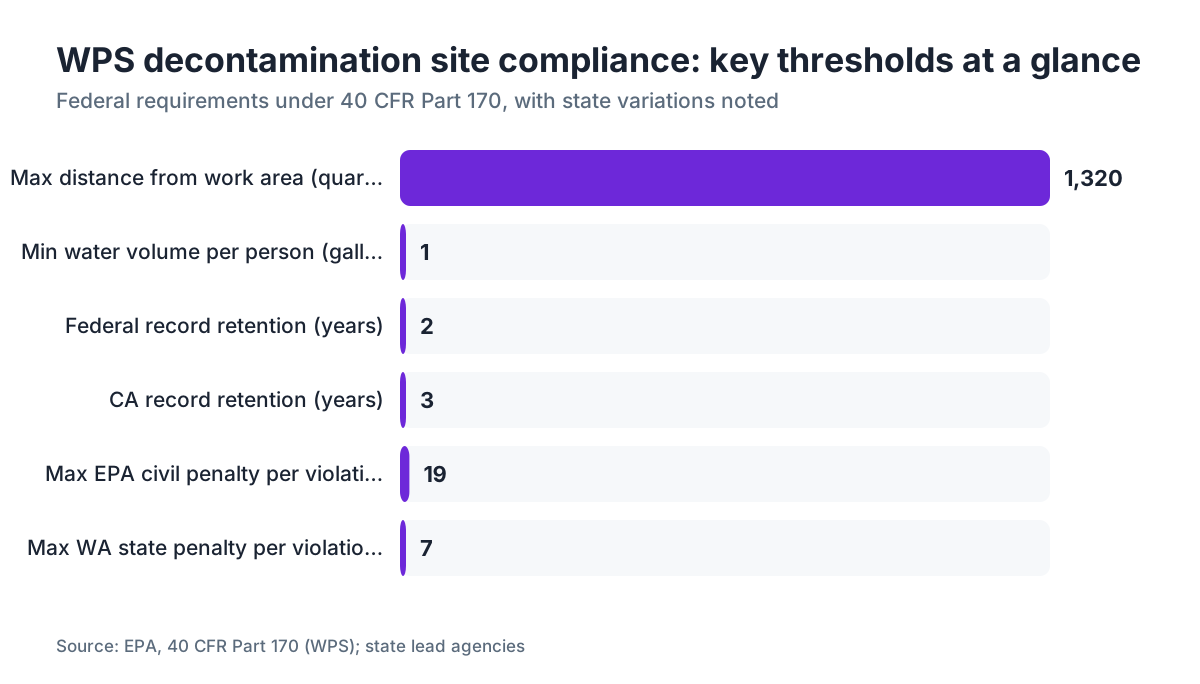
Distance matters as much as contents. Handler supplies must be at the application site or within a quarter mile of the handler's work area, whichever is closer. Worker sites must be within a quarter mile of where workers are working. That quarter-mile rule catches operators who set up one central water station at the barn. If your block sits 0.3 miles out, you're out of compliance.
The site also has to be reasonably accessible. Water jugs on the far side of a locked gate do not count.
What decontamination records does a vineyard actually need to keep?
This is where operators get confused, because the WPS decontamination paperwork is indirect compared to other record-keeping rules. There is no pre-printed federal "decontamination site log." The documentation lives in three places instead.
First, your pesticide application records have to be complete enough to reconstruct what decontamination sites you provided. Under 40 CFR 170.501, agricultural employers keep records of each application for at least two years [1]. Those records include the product name, EPA registration number, active ingredient, the location and description of the treated area, the date, start and end time, and the total amount applied. The decontamination link comes from cross-referencing these with your WPS compliance documents.
Second, several state lead agencies (California's DPR, Washington's WSDA, New York's DEC) want decontamination site location captured in the application record itself. California's pesticide use reporting system requires site-of-application data that effectively records where the work and its supporting facilities sat [2].
Third, your written pesticide safety program (required under WPS) should describe your standard decontamination setup: how many sites, how you pick locations, how you stock them, how you verify supplies before each application. EPA inspection checklists look for that written program more than they hunt for after-the-fact application records.
A practical system for most vineyards is one page: a pre-application checklist confirming supplies, location, and distance from the work area, filed with the application record and kept two years. Some operators photograph the site setup on a phone. A timestamped photo is worth having if an inspector ever shows up.
The two-year retention minimum is federal. California requires three years for some records. Washington requires two years under WAC 16-228 [3]. Use the longer state number whenever your state beats the federal floor.
How do decontamination documentation requirements differ by state?
States that run their own EPA-approved lead agencies under WPS can set stricter rules than the federal baseline, and several do. Here's how the states where most commercial viticulture happens actually compare.
| State | Minimum record retention | Decontamination-specific documentation | Agency |
|---|---|---|---|
| Federal (EPA) | 2 years | Implied through application records and written safety program | EPA |
| California | 3 years for some records | PUR requires site info; DPR inspection protocols include decon site verification [2] | CA DPR |
| Washington | 2 years | WAC 16-228-1985 requires handler training and facility records; decon documented in safety plan [3] | WA WSDA |
| Oregon | 2 years | ODA follows federal WPS; written safety plan required | OR ODA |
| New York | 2 years | DEC follows federal WPS; Cornell extension guidance recommends block-level decon logs [4] | NY DEC |
California is the strictest in practice. The Department of Pesticide Regulation uses county agricultural commissioners to run on-site WPS inspections, and their checklist verifies decontamination supplies, confirms the site was within a quarter mile of the work area, and checks that the record was made contemporaneously. That word, contemporaneously, is the one that bites. Filling in a decontamination log the night before an inspection is exactly what commissioners are trained to spot.
Washington State University Extension has published guidance for Yakima Valley grape and tree fruit operations noting that WPS compliance is one of the most common findings in state agricultural inspections [3]. Decontamination site location gets flagged over and over when operators assume one central farm facility covers every block.
New York's DEC follows the federal standard, but Cornell Cooperative Extension's WPS guidance recommends block-level decontamination logs as best practice, especially for operations using Restricted Use Pesticides, where documentation expectations run higher [4].
What are the documentation requirements for Restricted Use Pesticides at vineyards?
Restricted Use Pesticides carry extra record-keeping on top of WPS. Under FIFRA and the regulations at 40 CFR Part 171, only certified applicators or people under their direct supervision can apply RUPs, and specific records have to be kept for those applications [5].
RUP records include the name and certification number of the certified applicator, the commodity or crop treated, the total amount applied, the location, and the date. These stay on file two years at the federal level and are open to inspection by EPA and state lead agencies.
Here's where it touches decontamination. RUP applications often use higher-toxicity products. Many vineyard fungicides (mancozeb, chlorothalonil) are Category III or IV, but some insecticides sprayed during bloom land in Category I or II. Handler decontamination gets more demanding when the product carries a "Danger" or "Warning" signal word, especially around eye protection and emergency eyewash.
Apply a Category I pesticide ("Danger" signal word, which includes some concentrated copper formulations) and handlers must have eye-flush water immediately available, more than at the decontamination site. That's an on-person or on-equipment requirement, and proving you provided it is part of your RUP compliance picture.
Keep RUP records and decontamination records in the same file, not separate binders. An inspector who pulls an RUP record for a date and then asks for the decontamination documentation for that same date wants the two to tell one consistent story.
What are the penalties for inadequate decontamination site documentation?
EPA can assess civil penalties under FIFRA for WPS violations. The maximum per violation for commercial agricultural producers is $19,162 as of the 2023 inflation adjustment [6]. That's the ceiling per violation per inspection, and EPA can cite several violations in one visit.
In practice, a first-time paperwork violation with no evidence of harm usually draws a warning letter and compliance assistance, not a maximum fine, especially for a small farm. California's county agricultural commissioners run harder. They can issue stop-use orders that halt every pesticide application on the property until the deficiency is fixed, which hurts an operation faster than any fine.
The decontamination violations that trigger serious enforcement are rarely paperwork alone. They're paperwork gaps stacked on top of workers who actually lacked water, soap, and towels. Picture a commissioner walking a block, finding 15 people pruning with no decontamination supplies inside a quarter mile, and then pulling your records to see a pesticide went down there three days ago while the REI was still active. That combination is a serious violation.
Washington's WSDA has published enforcement data showing pesticide safety violations, decontamination failures among them, make up a meaningful share of agricultural citations each year [9]. Dollar amounts vary by case, but WSDA can pursue penalties up to $7,200 per violation under state law. Lower than the federal ceiling, still real money for a small vineyard.
Then there's the part that dwarfs any fine. A worker injured or sickened because decontamination access wasn't there creates civil liability far past any regulatory penalty. This is where documentation earns its keep. Contemporaneous records showing you provided a compliant site are your first defense against a negligence claim.
How should vineyard managers set up a practical decontamination site documentation system?
The most common failure in the extension literature is an operator who understands the physical requirements (water, soap, towels) but has no written system for confirming and recording them before each application. A real decontamination site with no record of it is much harder to defend than a documented one.
Here's a system that works for most mid-sized vineyards.
Start with a block map that pre-identifies quarter-mile radii from your likely decontamination locations, usually the farm road closest to each block or an equipment shed. This doesn't need to be a GIS product. A hand-annotated aerial printout works fine. It gives you a standing answer to "is this site within a quarter mile of Block 7?" before spray season starts.
Next, build a one-page pre-application checklist tied to your application record. It confirms the site GPS coordinates or block-specific location, the estimated distance from the farthest worker or handler, the water supply type (tank, hose bib, portable jug) and volume, soap present, single-use towels present, a change of clothes for handlers if required, and who ran the check. The person who set up the site signs it.
File that checklist with the application record for the same date. Keep them together for the whole retention period, three years in California, two years otherwise.
Digital tools, VitiScribe among them, can attach the decontamination checklist straight to the spray record, which makes the cross-reference audit-ready and kills the "where did I put that paper" problem that surfaces in nearly every inspection described in extension literature. WSU Extension's WPS guidance recommends digital logs for exactly this reason [3].
On multi-block days, document a separate site check for each block where work happens. One record for a day when crews moved across four blocks doesn't prove the quarter-mile rule held at each spot.
What training records are required alongside decontamination documentation?
WPS training and decontamination documentation are joined at the hip, because you can't send a worker into a treated area without both the training and the access. Under 40 CFR 170.501, employers keep WPS safety training records for two years, including the trainee's name, the training date, and the name and certification number of the trainer [1].
The training itself has to cover decontamination: where the sites are, what they hold, and how to reach them in an emergency. Train workers in January but never update them on which sites cover which blocks that season, and EPA guidance treats the training as incomplete for compliance.
Cornell Cooperative Extension's WPS training materials for New York put it plainly: training records and site-specific decontamination information should connect in your files, because an inspector asks two questions. Did you train this worker? And did this worker know where to find water if they needed it? [4]
Handler training has to happen before any handling activity and be delivered by a trained trainer, someone who finished a WPS train-the-trainer course. Handler training records carry the same elements as worker records, plus confirmation that handlers got the application-specific decontamination information.
UC Davis Cooperative Extension WPS resources for California grape growers note that training record deficiencies are among the most common WPS citations in county agricultural commissioner inspections, usually because operators train verbally and never write it down [7]. Verbal-only training that leaves no paper or digital trail is invisible from a compliance standpoint.
What does EPA guidance say about emergency decontamination versus routine decontamination?
WPS covers two distinct situations. Routine decontamination is washing up after work or after handling pesticides. Emergency decontamination is a spill, splash, or exposure that needs an immediate response. The physical standards and the documentation differ between them.
Routine decontamination sites are the ones this article keeps circling back to. They have to be available during and after application, and maintained through any REI period when workers are in treated areas.
Emergency decontamination sits at 40 CFR 170.411 for handlers [1]. Handlers applying pesticides with a "Danger" or "Warning" signal word (Categories I and II) must have emergency eyewash water immediately available, meaning within a set distance of the handler during application. This stacks on top of the routine site. It does not replace it.
EPA's rule formalizes emergency decontamination documentation less than routine, but it still belongs in your written safety program. That program should state how you provide emergency eyewash: personal eyewash bottles carried by handlers, or a pressurized eyewash station on the spray rig. Your application records confirm it indirectly by noting the signal word of the products applied.
EPA's guide, "How to Comply with the 2015 Revised Worker Protection Standard" (available at EPA.gov), states: "If handlers are using pesticides that have the signal word 'Danger' or 'Warning' on the label, you must have an ample supply of water for emergency eye flushing immediately available to the handler." [8] That's the agency's own language, and it's worth printing straight into your written safety program.
How do you handle decontamination site requirements during the restricted entry interval (REI)?
An REI is the window after an application when workers can't enter the treated area without specific PPE and early-entry protections. REI lengths sit on every pesticide label and run from 4 hours (many fungicides) to 5 days (some soil fumigants). In vineyards, common REIs are 4 to 48 hours for fungicides and 12 to 48 hours for most insecticides.
During the REI, decontamination sites stay in place if any worker enters the treated area under early-entry rules. This catches operators who assume the decontamination obligation ends when the spray rig leaves the block. It doesn't. If a crew enters a block 6 hours after a sulfur application with a 4-hour REI (past the REI, no early-entry protections needed), the obligation shifts back to the general worker decontamination standard rather than the stricter handler one. Enter before the REI ends, and handler-level provisions apply.
Documenting this means your records show the REI length from the label, the date and exact time the application ended, and, if workers entered during the REI, confirmation that early-entry requirements including decontamination were met. This is where logging exact start and end times pays off, more than dates. A record showing a sulfur application ended at 10:00 AM and the crew entered the next morning at 7:00 AM on a 4-hour REI product is clean. "Applied Tuesday" and "workers in the block Wednesday" leaves a hole.
WSU Extension's Yakima Valley grape pest management guides flag the REI documentation gap as a recurring finding in Washington vineyard audits [3]. The fix is boring and effective: log your application start and end times, every time.
What do UC Davis, Cornell, and WSU extension programs recommend for vineyard WPS compliance?
The three university extension programs serving the main viticulture regions have all published WPS guidance, and their decontamination recommendations land on a few shared points.
UC Davis Cooperative Extension, through its Integrated Pest Management program and joint resources with the California Department of Pesticide Regulation, recommends a WPS compliance binder holding the written safety program, training records, decontamination site logs tied to each application record, and the central posting of pesticide safety information [7]. County agricultural commissioner inspections in California are typically unannounced, which makes a pre-organized binder the practical safeguard.
Cornell Cooperative Extension's WPS resources for New York grape growers stress that bilingual documentation matters. Many vineyard workers in the Finger Lakes and Hudson Valley speak Spanish as a first language, and WPS requires safety information, decontamination site instructions included, in a language the worker understands [4]. Your system should confirm the language requirement was met, more than that information was handed out.
Washington State University Extension's viticulture and pesticide safety resources for the Columbia Valley and Yakima Valley keep identifying decontamination site distance as the most misunderstood requirement [3]. Their guidance tells operators to physically walk or drive the distance from the planned site to the farthest point of the block, at least once per season per block, to confirm the quarter-mile rule holds. Do it once, note it in your written safety program, and you've got a defensible record.
All three programs agree on one thing that's easy to miss. The WPS obligation does not transfer to a labor contractor. Hire an FLC to bring a pruning crew, and you, the agricultural employer, are still responsible for having decontamination sites in place and documented. The FLC shares responsibility for worker safety, but you can't outsource the WPS compliance obligation away.
Is there a standard form for decontamination site records, or do you create your own?
EPA publishes no mandatory decontamination site form. There's no federal form number you fill out and file. That cuts both ways. Good, because you can build a system that fits your operation. Bad, because "we didn't know there was a form" is no defense when an inspector finds nothing at all.
Several state agencies offer optional templates. California's DPR makes available pesticide safety program templates and inspection checklists with decontamination site sections [2]. Download them even outside California, because they show what inspectors actually check.
Cornell Cooperative Extension publishes a WPS compliance checklist with a decontamination section through its extension resources [4]. WSU Extension offers a WPS employer checklist with decontamination line items [3].
For most vineyards, the workable move is a one-page decontamination site log that rides along with the spray records. Capture the date, the block or area treated, the site location (GPS coordinates or a plain description like "south end of Block 7, next to the dirt road"), the distance estimate from the farthest work point, the water source and volume, the supplies present (soap, towels, change of clothes for handlers), and the signature of whoever set it up. Keep it to one page. A form that takes 90 seconds is the form that actually gets filled out.
VitiScribe includes a decontamination site log inside its spray record workflow, linking the setup confirmation to the application record automatically. That kind of integration keeps records from drifting apart over a two- or three-year retention period, which is a genuine problem with paper systems out in the field.
Frequently asked questions
How far must a decontamination site be from where workers are working in a vineyard?
Under 40 CFR 170.237 and 170.411, decontamination sites must be within a quarter mile of workers' and handlers' current work area, or at the application site for handlers, whichever is closer. Many vineyards fail this by relying on a central barn or shop more than a quarter mile from remote blocks. Measure the actual distance and log it in your pre-application checklist.
How long do vineyards have to keep pesticide application and decontamination records?
The federal WPS minimum is two years under 40 CFR 170.501. California requires three years for pesticide use reports. If you operate in California, use three years. Elsewhere, confirm your state's requirement with your lead agency, and always use the longer of the state or federal period. Keep decontamination logs with the matching application records so they produce together.
Does the WPS decontamination requirement apply during the restricted entry interval, more than during application?
Yes. If any worker enters a treated area during the REI under early-entry provisions, handler-level decontamination requirements apply. Your records should capture the exact application end time so the REI window is clearly established. Workers entering after the REI ends fall under the standard worker decontamination requirement, which is less stringent than the handler rules but still requires a site within a quarter mile.
What water supply counts as compliant for a decontamination site in a vineyard setting?
Any clean, non-contaminated water counts, including portable jugs, pressurized tanks, or hose bibs. Volume must be enough for routine washing, at least one gallon per person. For Category I and II applications, handlers need extra eye-flush water immediately available, beyond the decontamination site. Water has to be at a temperature conducive to washing, which means insulated containers in cold-weather climates.
Does the decontamination site requirement apply if I'm the only person applying pesticides on my vineyard?
A self-employed owner-operator with no employees or workers is generally outside WPS as a worker, but WPS applies the moment anyone else enters treated areas. A family member, employee, or labor contractor worker entering a treated block triggers the requirements. If you're genuinely a sole operator with no other entrants into treated areas, confirm your situation with your state lead agency.
Can a vineyard use a reusable cloth towel at a decontamination site to reduce waste?
No. WPS requires single-use towels at decontamination sites. Reusable cloth towels create cross-contamination risk and don't satisfy the requirement. Paper towels are the standard solution. Some vineyards use individually packaged wipe packets, which also qualify. Document the type of toweling provided if your state lead agency inspection protocols ask for that detail.
What is the penalty for not having a decontamination site log at a vineyard?
EPA can assess civil penalties up to $19,162 per violation under FIFRA Section 14 (2023 adjusted figure). In practice, first-time paperwork-only violations often draw warning letters. California county agricultural commissioners can issue stop-use orders halting all applications, often a more immediate problem than a fine. Civil liability from worker injury tied to missing decontamination access can far exceed any regulatory penalty.
Do I need separate decontamination site documentation for each block treated on the same day?
Yes, if workers or handlers work in multiple blocks that aren't all within a quarter mile of the same site. You need documentation showing each work area had a compliant site within a quarter mile. One central record for a multi-block day only works if every block falls within the quarter-mile radius of the documented site, which you should confirm and note explicitly in your log.
What language must decontamination site information be provided in?
WPS requires safety information, including decontamination site location and access instructions, in a language the worker understands. In practice that means bilingual English and Spanish documentation and verbal instruction for most California, Washington, and New York vineyard workforces. Your written records should confirm the language used during training and site orientation, more than that information was provided.
Does a farm labor contractor's WPS responsibility remove my obligation to document decontamination sites?
No. As the agricultural employer (the entity that owns or controls the establishment where pesticides are applied), you keep WPS compliance responsibility, decontamination site documentation included. Farm labor contractors share responsibility for worker safety, but you can't fully transfer your WPS obligations to an FLC. Both parties can be cited in an enforcement action.
What specific records do California vineyards need for WPS decontamination compliance?
California requires pesticide use reports for every application, three-year retention for those reports, a written pesticide safety program, WPS training records, and contemporaneous decontamination site logs. County agricultural commissioners run unannounced inspections using a detailed WPS checklist that verifies site location, distance from the work area, and supply confirmation. DPR publishes inspection protocols online worth reviewing as a self-audit tool.
Where can I find official decontamination site log templates for vineyard WPS compliance?
There is no federally mandated form. California DPR, Cornell Cooperative Extension, and WSU Extension all publish optional WPS compliance checklists with decontamination sections you can adapt. EPA's "How to Comply with the 2015 Revised Worker Protection Standard" lays out the requirements for building a custom log. The key fields: date, site location, distance from farthest work point, water supply details, supplies present, and the name of whoever set it up.
How does the decontamination requirement differ for pesticide handlers versus agricultural workers in vineyards?
Handlers (those who mix, load, or apply pesticides) face stricter rules: a site at or within a quarter mile of the application site, a change of clothes, a private place to change, and for Category I/II products, emergency eyewash immediately available. Workers doing general field tasks during or after REI entry need a site within a quarter mile with water, soap, and single-use towels, but not a change of clothes or a private changing area.
Sources
- EPA, Agricultural Worker Protection Standard (40 CFR Part 170): WPS requirements for decontamination sites including water, soap, single-use towels, distance (quarter mile), and handler-specific requirements at 40 CFR 170.411 and 170.237; record retention minimum of two years at 40 CFR 170.501
- California Department of Pesticide Regulation: California requires pesticide use reports for every agricultural application with site-of-application data; DPR inspection protocols include verification of decontamination site records; three-year retention for pesticide use reports
- Washington State University Extension: WSU Extension notes decontamination site distance (quarter-mile rule) is a recurring compliance finding in Washington vineyard inspections; WAC 16-228 requires two-year record retention for handler training and safety facility records
- Cornell Cooperative Extension: Cornell Extension WPS guidance recommends block-level decontamination logs as best practice and notes bilingual documentation is required for workforces where Spanish is a primary language
- EPA, Pesticide Applicator Certification (40 CFR Part 171): RUP application records must include certified applicator name and certificate number, commodity treated, total amount applied, location, and date; retained for two years
- EPA, Enforcement (FIFRA Section 14 civil penalties): Maximum civil penalty per WPS violation for commercial agricultural producers is $19,162 under 2023 inflation adjustment to FIFRA Section 14
- University of California Agriculture and Natural Resources (UC IPM): UC IPM and UC Davis Cooperative Extension recommend WPS compliance binders including written safety program, training records, decontamination site logs tied to each application record; training record deficiencies are among the most common WPS citations in California county agricultural commissioner inspections
- EPA, How to Comply with the 2015 Revised Worker Protection Standard: EPA guidance states: 'If handlers are using pesticides that have the signal word Danger or Warning on the label, you must have an ample supply of water for emergency eye flushing immediately available to the handler'
- Washington State Department of Agriculture, Pesticides and Fertilizers: WSDA can pursue pesticide safety violation penalties up to $7,200 per violation under Washington state law; WPS decontamination failures are among agricultural citations documented in WSDA enforcement reports
- California Department of Pesticide Regulation, Worker Health and Safety: California WPS inspection protocols require contemporaneous decontamination records; county agricultural commissioners conduct unannounced inspections; California record retention is three years for pesticide use reports
Last updated 2026-07-11