Respirator fit test documentation requirements for vineyard pesticide applicators

TL;DR
- OSHA 29 CFR 1910.134 requires annual fit testing for any worker who wears a tight-fitting respirator, done qualitatively or quantitatively.
- Fit test records stay for the length of employment.
- Medical evaluation records stay 30 years past employment.
- The EPA Worker Protection Standard adds handler training records kept two years.
- Keep everything on site and ready for inspection.
What federal rules actually govern respirator fit testing for pesticide applicators?
Two federal frameworks hit vineyard applicators at once, and mixing them up is how records end up with holes.
OSHA's Respiratory Protection Standard, 29 CFR 1910.134, is the primary rule. It applies to any employer whose workers wear respirators on the job, farms included. It sets the fit testing protocol, the medical evaluation sequence, and the recordkeeping. The standard defines a fit test as "a test of the seal between the respirator facepiece and the face," and it splits testing into qualitative fit testing (QLFT, a pass/fail method that relies on the wearer detecting a challenge agent like isoamyl acetate or Bitrex) and quantitative fit testing (QNFT, which uses instruments to measure actual leakage). [1]
The EPA Worker Protection Standard (WPS), revised in 2015 and codified at 40 CFR Part 170, sits on top of OSHA for agricultural pesticide handlers. The WPS does not spell out fit testing protocols. It does require that handlers get safety training before touching pesticides and that the training gets documented. When a pesticide label calls for a respirator, the WPS and OSHA together mean you need both the training record and the fit test record.
California, Washington, and several other big wine states run their own OSHA-approved plans that meet or beat the federal rule. In California, Cal/OSHA's CCR Title 8 Section 5144 mirrors 29 CFR 1910.134, and Cal/OSHA has historically pushed harder on agriculture than federal OSHA does. [11]
Here is the short version. If anyone on your crew wears a half-face or full-face air-purifying respirator while handling pesticides, you need OSHA-compliant fit test records. No exceptions for size or season.
Which vineyard workers actually need a fit test?
Only tight-fitting respirators trigger a fit test. That covers half-face filtering facepiece respirators (N95s and similar), elastomeric half-face respirators, and full-face respirators. Loose-fitting hoods and helmets running on supplied air or powered air-purifying systems are exempt under 29 CFR 1910.134(f)(1). [1]
In a vineyard, the usual case is a spray operator wearing an elastomeric half-face respirator with OV/P100 cartridges during fungicide, herbicide, or insecticide work. Scouting staff usually stay clear of the requirement, unless a label specifically mandates respirator use and they enter treated ground inside the restricted-entry interval.
Voluntary use is the other trigger, and it works in your favor. OSHA 1910.134(c)(2) says that if an employee wants to wear a filtering facepiece respirator on their own, even when you never required it, you only have to hand them Appendix D of the standard. No formal fit test. But the moment you require the respirator, or the label requires it, the full program kicks in: medical evaluation, fit test, training, and records.
Read every label you use. If a label says "wear a NIOSH-approved respirator with organic-vapor cartridges," that is a legal requirement under the WPS, not a suggestion. UC Davis's Agricultural Health and Safety Center is blunt about it: label language binds the handler, so a label-required respirator means a required fit test for every person who wears it. [4]
What does the fit test record have to include?
OSHA 29 CFR 1910.134 Appendix A, section I(A)(12), lists what goes into the record after each test: the employee's name, the type of test (QLFT or QNFT), the specific make, model, style, and size of the respirator, the date, and the pass/fail result. For QNFT, log the fit factor too, because it shows how much margin you have above the minimum passing score (100 for a half-face, 500 for a full-face). [1]
Here is the plain checklist every fit test record needs:
| Field | Required by | Notes |
|---|---|---|
| Employee name | OSHA 1910.134 App. A | Full legal name |
| Test date | OSHA 1910.134 App. A | Must retest annually |
| Respirator make, model, style, size | OSHA 1910.134 App. A | Exact model tested is the only approved model |
| Test type (QLFT or QNFT) | OSHA 1910.134 App. A | |
| Challenge agent used (QLFT) or instrument used (QNFT) | OSHA 1910.134 App. A | |
| Pass/fail result | OSHA 1910.134 App. A | |
| Fit factor (QNFT only) | Best practice | Numerical score |
| Tester name and credentials | Best practice | Not federally required, but some state plans want it |
| Employer / operation name | Best practice | Needed for multi-vineyard operators |
Here is the thing vineyard managers miss the most. The record has to match the exact respirator the worker will actually wear in the field. Fit test on a 3M 6502, then hand your worker a Moldex 7002 on spray day, and that fit test means nothing for compliance. The make and model have to match. Exactly.
How long do you have to keep fit test records?
OSHA splits retention by document type, and the split matters for anyone running seasonal crews.
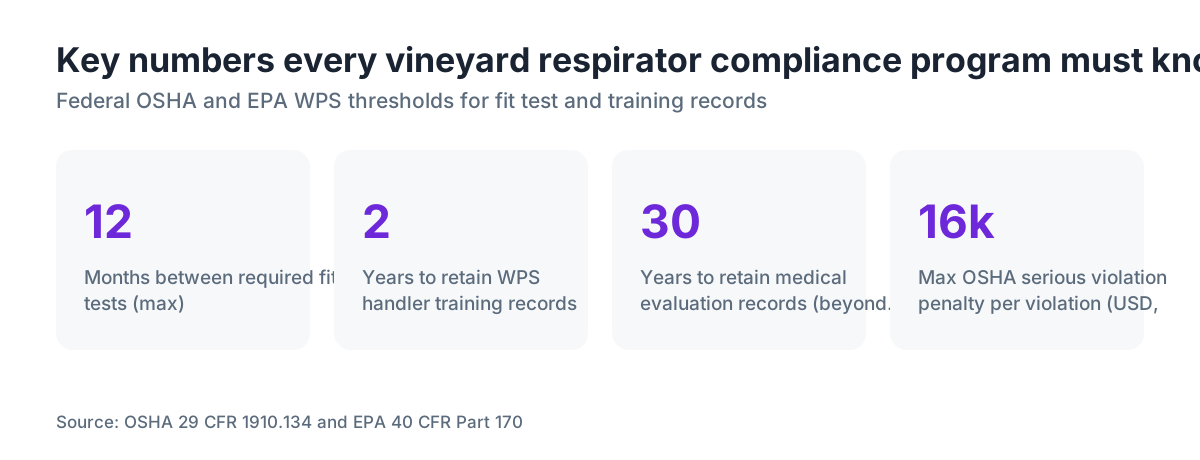
Fit test records stay for the length of employment. OSHA sets no minimum beyond active employment for the fit test record itself, but OSHA's small business guidance recommends holding them at least a year past the last day worked, since inspections tend to lag the event. [5]
Medical evaluation records are a different animal. They fall under OSHA's medical records rule, 29 CFR 1910.1020, which requires keeping them for the length of employment plus 30 years. The physician or licensed healthcare professional (PLHCP) questionnaire that has to come before any fit test counts as a medical record here. [6]
WPS handler training records stay two years from the training date, per 40 CFR 170.315. [2]
California adds another layer. Cal/OSHA requires that respiratory protection program records be available at the worksite or retrievable within a reasonable time for inspection. Pesticide Use Report records filed with the California Department of Pesticide Regulation carry a three-year retention period. [7]
For most small vineyards the safe rule is simple. Keep fit test records three years minimum, medical evaluation records for employment plus 30 years, and put them somewhere you can actually reach during a surprise Cal/OSHA or CDPR visit.
How often do vineyard applicators need to be retested?
Annual is the floor. OSHA 1910.134(f)(3) requires a fresh fit test at least every 12 months for each tight-fitting respirator. The clock is unforgiving. If the last test was March 15, 2024, the worker cannot wear that respirator after March 15, 2025 without a new test on record. [1]
Four things force an immediate retest, no matter when the last annual test happened. The employee reports the respirator does not seem to fit right. The employee goes through a physical change that could move the seal, including a big weight change (20 pounds is the common clinical threshold), dental work, scarring, or major surgery. The employer sees or has good reason to think the seal has changed. Or a different respirator model gets assigned.
Seasonal operations feel this as a real scheduling headache. Bring the same spray operator back each April and last year's test has probably lapsed over the winter. Retest before the first spray. Cornell's Pesticide Management Education Program recommends folding fit testing into your spring equipment prep checklist instead of treating it as a stray paperwork task. [8]
Some vineyards run sulfur from April through September, then swing to dormant oil or copper in November, and find it easier to test twice a year just to kill the scheduling risk. Not required. Cheap insurance.
What is the medical evaluation requirement before a fit test can happen?
This is the step small vineyards skip most, and the one OSHA cites most in agricultural respiratory protection inspections.
Before any fit test, the employee has to complete a medical evaluation using at least the OSHA questionnaire in Appendix C of 1910.134, reviewed by a physician or licensed healthcare professional. The PLHCP has to clear the worker for respirator use in writing. You cannot fit test first and handle the medical part later. The order is fixed. [1]
The questionnaire is confidential. You give it to the worker, the worker sends it straight to the PLHCP without you reading it, and the PLHCP tells you only one thing: cleared, cleared with conditions, or not cleared. OSHA is explicit that employers do not get to see the medical answers.
For small vineyards this usually means contracting with an occupational medicine clinic or a mobile health service that covers farm sites. Several California counties run agricultural worker health programs that handle respirator clearances. Cost varies a lot. In the Central Coast and Napa regions, occupational medicine clinics often charge somewhere between $50 and $150 per employee for questionnaire review and a clearance letter, though those figures come from general market reports and will move with your provider.
One more piece. If a worker's health changes in a way that could affect safe respirator use, OSHA requires a follow-up evaluation. That includes new symptoms reported during the annual fit test or a training session.
What does a written respiratory protection program need to cover?
The fit test record lives inside a bigger required document: the written respiratory protection program. OSHA 1910.134(c)(1) requires any employer with required respirator use to keep a written program covering respirator selection, medical evaluations, fit testing, field use, maintenance and care, breathing air quality for supplied-air systems, training, and program evaluation. [1]
For most vineyards the written program runs two to five pages. It does not have to be fancy. It does have to be specific to your operation. A template pulled off the internet that still reads "Acme Manufacturing" in the header is not compliant, and an inspector will spot it in a second.
The program has to name a program administrator. That person makes sure fit tests happen on schedule, records stay complete, and respirators stay maintained. At a small vineyard that person is usually the manager or the owner.
WSU's Pesticide Safety Education Program publishes a fillable written respiratory protection program template built for agricultural operations, covering the required elements under federal OSHA and Washington State OSHA. UC Davis's Agricultural Health and Safety Center has similar resources for California operators. [3][4] Starting from an extension template is legitimate and saves real time, as long as you fill in the operation-specific fields.
The written program has to be available to employees and to OSHA or state plan inspectors on request.
How do you document fit testing for seasonal or H-2A workers?
Seasonal and H-2A guest workers are covered by OSHA's Respiratory Protection Standard exactly like permanent employees. No agricultural exemption for the medical evaluation or the fit test. If the worker will wear a required respirator, the paperwork has to exist before their first spray day.
The H-2A program requires that workers get the safety equipment and training required by federal and state law, per 20 CFR 655.122(e). That includes respiratory protection documentation. [9]
Timing is the hard part. If your H-2A crew lands April 1 and spraying starts April 3, there is no time to schedule and receive a medical clearance through a clinic. The fix is to build the medical evaluation and fit test into pre-season logistics, not the arrival week. Some growers coordinate with occupational medicine providers in workers' home states, or run medical evaluations over telehealth where the PLHCP is licensed in the workers' home state, though OSHA has issued no formal guidance confirming telehealth as fully compliant here. The safest route is an in-person evaluation at an occupational health clinic within the first day or two after arrival, before any application.
For multi-vineyard operations or labor contractors, write down who holds the records. The employer of record under the WPS owns the documentation. If you use a farm labor contractor, the contract should name who keeps the records, in plain language.
What records does the EPA Worker Protection Standard separately require?
The WPS handler training record is separate from the OSHA fit test record, and you need both. Under 40 CFR 170.315, agricultural employers must keep records of pesticide handler safety training: the training date, the trainer's name and credentials, the topics covered, and the name of each handler trained. Keep them two years. [2]
The WPS also requires that handlers can get to site-specific safety data sheets for the pesticides they handle, and that central posting of application information happens as specified. None of these WPS records replace the OSHA fit test record. They cover different ground.
When a pesticide label calls for a respirator, the WPS training record should show the handler got instruction on selecting, donning, doffing, and seal-checking the respirator. That content overlaps with OSHA 1910.134 training, so one combined session can satisfy both, as long as the record documents the specific elements each standard demands.
State pesticide rules can pile on more. California's Pesticide Use Reports, filed with county agricultural commissioners, capture application details but not individual fit test data. CDPR enforcement on handler records includes checking that handlers had the required personal protective equipment, which means your fit test documentation should be within reach if your records get audited alongside a PUR. [7]
This is the exact multi-standard overlap a field-level compliance system like VitiScribe is built for, since the records sit in separate regulatory silos but get audited together.
What happens if you fail an OSHA inspection on fit test records?
OSHA citations for 29 CFR 1910.134 violations in agriculture run from "other-than-serious" (minor paperwork gaps) to "serious" (missing medical evaluations, or no fit test at all for workers using required respirators). Serious violations carry a maximum penalty of $16,131 per violation as of 2024, adjusted every year for inflation under the Federal Civil Penalties Inflation Adjustment Act Improvements Act of 2015. [10]
Repeat or willful violations reach $161,323 per violation. OSHA can count each worker without proper documentation as a separate violation, so the numbers stack fast.
Citations become public record. Under some state agricultural licensing programs, an OSHA citation can trigger a county agricultural commissioner follow-up inspection for pesticide compliance.
Liability is the sharper risk. If a spray operator develops a respiratory illness and your fit test records are gone or expired, your exposure in a workers' compensation or civil suit is a lot worse than if the records are clean.
Fixing a gap is straightforward. Get the missing medical evaluations and fit tests done immediately, document them, and update your written program. OSHA generally weighs a good-faith correction effort during inspections, especially for small agricultural employers with no prior citations. Just know that "we didn't know" is not a defense when the standard has been on the books since 1998.
What does a compliant fit test record-keeping system look like in practice?
The simplest compliant system is a paper binder with five sections: the written respiratory protection program, medical evaluation clearance letters (not the questionnaires, which stay with the PLHCP), fit test records sorted by employee, annual training records, and respirator inspection and maintenance logs.
Run more than a few spray operators and a digital system makes the annual audit far faster. Retrieval on demand is the core requirement. If an OSHA inspector walks in during harvest and asks for the fit test record on your lead applicator, you need to produce it in minutes, not days.
Date tracking matters most. Each employee record needs a visible expiration date for both the medical clearance and the fit test, so you can see at a glance which ones are coming due. A spreadsheet with conditional formatting handles this fine. Purpose-built vineyard compliance platforms like VitiScribe build in these expiration alerts alongside spray records and WPS training logs, which helps when you are juggling five or six overlapping compliance calendars.
Cornell's Pesticide Management Education Program recommends keeping a copy of each respirator model's NIOSH approval documentation with your written program, since the approval number on the respirator has to match an active NIOSH listing. Small detail, but it matters if a model gets discontinued and a worker swaps in a similar-looking unit without the same approval. [8]
Back up digital records offsite or in the cloud. An equipment shed fire has ended more than one vineyard's clean compliance streak.
Frequently asked questions
Does the OSHA fit test requirement apply to small vineyards with fewer than 10 employees?
Yes. OSHA's Respiratory Protection Standard, 29 CFR 1910.134, applies to agricultural employers regardless of size. The only partial small-employer exemption in OSHA is for injury and illness recordkeeping under 29 CFR 1904, not for safety standards like respiratory protection. If any employee wears a required tight-fitting respirator, the full fit test and written program requirements apply.
Can a vineyard owner self-administer a qualitative fit test, or does it have to be done by a certified professional?
OSHA does not require an external certified professional for qualitative fit testing. The administrator has to be trained in the specific test protocol and follow Appendix A of 1910.134 exactly, including proper challenge agent concentration and exercise sequence. Some state plans add requirements; California does not require external certification for QLFT. Quantitative fit testing usually needs specialized equipment and gets contracted out.
What's the difference between a fit test and a fit check, and do I need records for both?
A fit test is a formal protocol done at least annually, with documented results. A fit check (user seal check) is the quick positive- and negative-pressure check the wearer does every time they put the respirator on. OSHA requires that employees be trained to perform seal checks before each use, but there is no requirement to document individual seal checks. The fit test record is the one you file and retain.
If a worker fails a fit test on one respirator model, what are the documentation requirements for the retest?
A failed fit test is a pass/fail for that specific model, not for the worker. The procedure is to try different makes, models, and sizes until one passes or you determine the worker cannot be safely fitted. Document the failed test (model, date, result), then document the successful retest separately. Keep both. OSHA Appendix A requires that at least three different respirator models be tried before concluding a worker cannot be fitted.
Do N95 disposable respirators used during pesticide applications require fit testing?
Yes, if the N95 is required for the application (the label specifies an N95 or equivalent particulate respirator), a fit test is required, because N95s are tight-fitting facepieces. Many pesticide labels that require respirators call for OV/P100 combination cartridges, not bare N95s, because pesticide vapors need organic vapor protection that an N95 alone does not provide. Confirm the label language before selecting any respirator.
How long before the spray season should fit testing be scheduled?
Schedule fit testing at least three to four weeks before first spray. That window lets you get medical evaluations processed by the PLHCP (which can take a week or more through a clinic), complete the fit test, order replacement parts or a different unit if a worker's fit needs one, and document everything before anyone picks up a spray gun. For H-2A workers arriving close to spray season, coordinate with the clinic before arrival.
Are there specific OSHA training records required alongside fit test records for pesticide applicators?
Yes. OSHA 1910.134(k) requires documented training for all respirator users covering why the respirator is necessary, its limitations, how to use it, how to inspect it, how to perform seal checks, and what to do when it malfunctions. This training record is separate from the fit test record and from the WPS handler training record, though one combined session can cover all three if the content and documentation satisfy each standard.
What respirator maintenance records do vineyards need to keep alongside fit test records?
OSHA 1910.134(h) requires that tight-fitting respirators be inspected before each use and during cleaning, with defects corrected before use. There is no explicit requirement to document each inspection, but it is strongly recommended. Many written programs include a simple inspection log noting the date, the inspector, and the result. Document cartridge change-out schedules too, especially for high-exposure tasks like enclosed spraying.
What does the EPA WPS require specifically for respirator training documentation?
Under 40 CFR 170.315, employers must document pesticide handler safety training and keep those records two years. When a pesticide label requires a respirator, training on its proper use should be included and documented. The WPS training record must show the handler's name, training date, trainer's name and credentials, and topics covered. The WPS training record and the OSHA respiratory protection training record serve different regulatory purposes but can be created in one session.
Can I use a single fit test record to cover multiple pesticide applications throughout the season?
Yes. One annual fit test record for a specific respirator model is valid for all applications during the 12 months following the test date, as long as the worker uses that exact model and no triggering event (big weight change, new model, reported poor fit) forces an interim retest. You do not need a new record for each application. The annual test is the recurring compliance event.
What records are required if a vineyard worker voluntarily wears a respirator during pesticide handling?
If the respirator is voluntary and the label does not require it, OSHA 1910.134(c)(2) only requires that you give the worker Appendix D of the standard, the informational document for voluntary users. A formal fit test and medical evaluation are not required for voluntary use of a filtering facepiece respirator. The moment you require the respirator, or the label requires it, voluntary use no longer applies and the full program triggers.
Where can I find a free respirator fit test record template for agricultural operations?
UC Davis's Agricultural Health and Safety Center and WSU's Pesticide Safety Education Program both publish free templates built for agricultural operations, including fit test record forms and written respiratory protection program outlines. OSHA's site has Appendix A of 1910.134, which specifies required record content. County farm bureaus and agricultural commissioners in California often distribute state-specific templates as well.
Do vineyard owners who personally apply pesticides need a fit test if they require themselves to wear a respirator?
OSHA standards generally apply to employees, not self-employed individuals with no employees. But a sole proprietor with even one employee triggers coverage for that employee. If a vineyard owner applies pesticides alongside employees, OSHA coverage applies to the whole crew, and practically speaking the owner should keep the same records for continuity and to set the example during inspections. Many state programs explicitly include working owners in coverage.
Sources
- OSHA, 29 CFR 1910.134 Respiratory Protection Standard: Annual fit testing required for tight-fitting respirators; Appendix A specifies required record content including employee name, respirator make/model/size, test type, date, and result
- EPA, 40 CFR Part 170 Worker Protection Standard: WPS requires pesticide handler safety training records to be kept for two years, covering training date, trainer credentials, and topics including required PPE
- WSU Pesticide Safety Education Program: WSU Extension provides agricultural respiratory protection program templates for Washington-plan state compliance and recommends annual fit testing as part of spring equipment preparation
- UC Davis Agricultural Health and Safety Center: UC Davis advises that pesticide label language requiring a respirator is legally binding for handlers under the WPS, triggering OSHA fit test requirements
- OSHA, Small Business Compliance Guide for Respiratory Protection: OSHA guidance for small businesses recommends retaining fit test records for at least one year beyond the last date of employment
- OSHA, 29 CFR 1910.1020 Access to Employee Exposure and Medical Records: Medical records including PLHCP respirator clearance evaluations must be retained for the duration of employment plus 30 years
- California Department of Pesticide Regulation: CDPR requires pesticide use reports to be retained for three years and that pesticide handlers possess required PPE, making fit test documentation relevant during agricultural pesticide enforcement audits
- Cornell Pesticide Management Education Program: Cornell recommends building fit testing into spring equipment prep schedules and retaining NIOSH approval documentation for respirator models used in the field
- DOL ETA, 20 CFR 655.122 H-2A Program Requirements: H-2A program regulations at 20 CFR 655.122(e) require employers to provide safety equipment and training required by federal and state law, including respiratory protection documentation
- OSHA, Civil Monetary Penalties 2024 Adjustment: OSHA serious violation maximum penalty is $16,131 per violation as of 2024, adjusted annually under the Federal Civil Penalties Inflation Adjustment Act Improvements Act of 2015; repeat or willful violations reach $161,323 per violation
- Cal/OSHA, CCR Title 8 Section 5144 Respiratory Protection: California's state OSHA plan at CCR Title 8 Section 5144 mirrors federal 29 CFR 1910.134 requirements and mandates that respiratory protection program records be available at the worksite for inspection
Last updated 2026-07-10