How to document biodynamic preparation applications in vineyard records

TL;DR
- Document each biodynamic preparation with the prep number (BD 500 through BD 508), application date and time, lunar calendar day type, dilution ratio, stirring duration and direction, water volume, application method, block ID, and applicator name.
- Keep records at least three years to satisfy Demeter USA certification and EPA Worker Protection Standard requirements.
Why do biodynamic preparation records need their own documentation approach?
Standard spray logs were built for pesticides and fungicides, products with EPA registration numbers, signal words, and REIs printed on the label. Biodynamic preparations have none of that. A conventional spray log leaves out half the meaningful data and can actually confuse an audit.
Certification bodies like Demeter USA make applicants prove that preparations were made and applied according to the Biodynamic Farm Standard. That standard is procedure-heavy, not product-heavy. The auditor wants to know when you stirred, how long, which lunar day type you chose, and what dilution you used. None of those fields exist on a typical pesticide application record.
There's a practical reason too. Say a cover crop fails to establish after a BD 500 application. Your notes are the only way to reconstruct whether the prep went out at a biodynamically appropriate time or whether the stirring conditions were off. Good records are your diagnostic tool first and your compliance paperwork second.
Under the EPA Worker Protection Standard (40 CFR Part 170), any agricultural employer who directs workers into fields where pesticides have been applied has to keep application records [1]. Biodynamic preparations with no registered pesticide ingredients (which is most of them) fall outside WPS scope. But the moment you spray a Demeter-approved copper or sulfur material next to a prep, that material triggers WPS recordkeeping. A unified log closes the gap before it opens.
What fields belong in a biodynamic preparation application log?
Build the record in three layers: identity, procedure, and placement. Miss any one layer and the auditor has a question you can't answer.
Identity fields name what you applied. That means the preparation number (BD 500 through BD 508 for Demeter-recognized preps, or a descriptive name like "horn manure" or "barrel compost"), the source or batch number if you made or bought it, and the lot date if you track fermentation batches.
Procedure fields capture how you applied it. These separate a biodynamic record from a conventional one: stirring start time, stirring duration in minutes, stirring method (hand-stirred, flow-form, electric stirrer), whether you alternated directions and how often, water temperature at the start of stirring, water source (well, rainwater, municipal), total volume stirred, dilution ratio (for example, 25 g per 10 gallons for BD 500 in field spray), application equipment type, and application end time.
Placement fields answer where and when. Block or row ID, GPS coordinates if you run precision viticulture, total acres treated, application start and end time (separate from stirring time), and the applicator's name and signature.
The field most growers skip is lunar calendar day type: root, flower, fruit, or leaf. Biodynamic practice pairs different preparations with different day types. BD 500 (horn manure) usually goes out on root days, BD 501 (horn silica) on fruit or flower days [2]. Logging the day type next to the application lets you and your certifier confirm the timing principle was followed, and it gives you something to analyze if yields or vine health shift.
| Field | Why it matters | Required by Demeter? |
|---|---|---|
| Prep number / name | Identifies the preparation | Yes |
| Batch / lot number | Traceability to source or making date | Recommended |
| Stirring duration (minutes) | Core procedural requirement | Yes |
| Stirring method | Verifies rhythmic chaos principle | Yes |
| Water volume and source | Part of dilution verification | Yes |
| Dilution ratio | Confirms correct dosage | Yes |
| Application date and time | Compliance timeline | Yes |
| Lunar day type | Biodynamic timing principle | Recommended |
| Block / row ID | Field placement traceability | Yes |
| Acres treated | Dosage calculation check | Yes |
| Applicator name | WPS and certification accountability | Yes |
| Weather at application | Efficacy and liability context | Recommended |
Which preparations require documentation and what are the standard dilution rates?
Demeter USA recognizes eight core preparations numbered BD 500 through BD 508, plus barrel compost (sometimes called BCSD) as an approved alternative [3]. Each has its own typical dilution rate, though growers adjust by vineyard context.
BD 500 (horn manure) is the field spray you'll apply most. The typical rate is 25 to 50 grams stirred in 3 to 4 gallons of water per acre, put on moist soil in late afternoon. BD 501 (horn silica) uses far less, roughly 1 gram per 10 to 13 gallons of water per acre, sprayed in early morning while dew still sits on the leaves.
The compost preparations, BD 502 through BD 507, go into compost piles rather than onto fields, so the format shifts. You record the compost pile ID, the insertion date, and which preparation went into which spot in the pile instead of an acreage or dilution ratio.
BD 508 (horsetail tea, Equisetum arvense) is sprayed on vines and soil as a fungal-weather treatment. Typical concentration is about 10 grams of dried horsetail boiled in 1 liter of water, then diluted roughly 1:10 for field application. Horsetail tea gets made on-farm and carries no product label, so your record of how you made it (quantities and method) is the only documentation that will ever exist.
Barrel compost gets documented differently again: the record needs the barrel filling date, the preparations inserted into it, and the barrel opening date, plus field application records once the finished material is sprayed.
Nobody has perfectly standardized these rates across all certifiers. Demeter International and Demeter USA guidance differs slightly in places, and individual advisors adjust dosages by soil type or vine age. The closest authoritative public reference is the Demeter Farm Standard [3], which sets minimum procedural requirements without pinning down gram-per-acre rates as hard rules.
How does the lunar calendar connect to record-keeping requirements?
The biodynamic calendar, most often the Stella Natura or the Maria Thun Biodynamic Calendar, gives each day a dominant element: earth (root), water (leaf), fire (fruit/seed), or air (flower). Growers time preparation applications to match the crop part they're after.
You don't have to prove the calendar system works scientifically. You have to prove to a certifier that you followed the practice as the standard describes it. That means logging the day type shown in whatever calendar you used, naming the calendar, and recording the application time so a reviewer can cross-check it.
Maria Thun's multi-decade trial work in Germany, summarized in her 2003 book "The Biodynamic Year," is the most cited practitioner research on timing effects, though academic peer review of that work is thin. WSU Extension's organic farming resources describe biodynamic timing as a practitioner principle with documented use but note that controlled replicated trials are sparse [4]. Log it honestly as a management choice, not a proven mechanism.
Record three things: calendar name and edition (for example, "Stella Natura 2025"), the day type shown for your application window, and the time you started field application. Three data points. That's enough for a Demeter auditor and enough for your own analysis down the road.
What format should the actual record take, paper or digital?
Paper logbooks still work, and plenty of small vineyards use them. A paper record with a wet signature is hard to dispute. But paper doesn't tie into block maps, can't total your dilutions automatically, and has a habit of getting left in the truck.
If you go paper, use a dedicated biodynamic application log with pre-printed columns for every field listed in the second section above. Keep it in a weatherproof binder in the winery or farm office, not in the field. Scan or photocopy it at least monthly.
Digital records earn their keep at certification. You can attach photos of the stirring setup, link weather station data, and pull block-level reports for a Demeter audit in minutes instead of hours. Field-to-office sync is the real payoff: an applicator logs the entry on a tablet or phone right after stirring, and the timestamp lands automatically.
VitiScribe (vitiscribe.com) includes a customizable field activity log where you can add biodynamic-specific fields like lunar day type and stirring duration next to standard spray records, so the whole operation lives in one place. Whatever software you pick, confirm it exports a dated PDF a certifier can actually read.
Whichever format you choose, retention matters. Cornell Cooperative Extension recommends keeping all farm records a minimum of three years, ideally five, for organic and transitional operations, since certifiers may ask for historical records at re-certification [5]. Demeter USA's audit process commonly requests two to three years of application records at initial certification.
How do biodynamic records satisfy EPA Worker Protection Standard requirements?
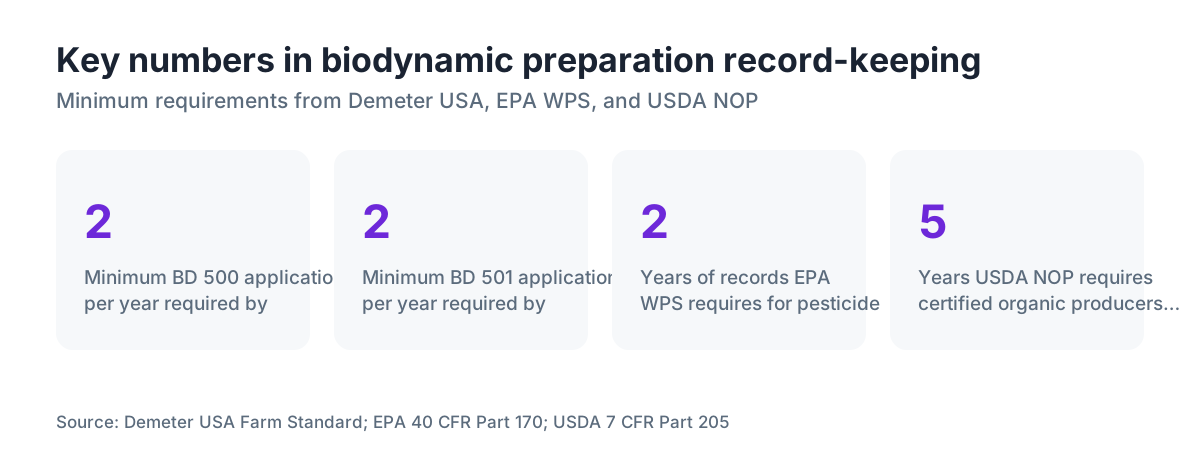
The EPA Worker Protection Standard (40 CFR Part 170), last revised in 2015 with later amendments, makes agricultural employers keep records of pesticide applications for at least two years and make them available to workers, their representatives, or treating medical personnel on request [1].
Most biodynamic preparations contain no EPA-registered pesticide active ingredients, so BD 500 through BD 508 applied as pure preparations generate no WPS records on their own. The record requirement kicks in for any product carrying a pesticide registration number, and many biodynamic programs also run copper hydroxide, elemental sulfur, or lime sulfur. All three carry registrations and trigger WPS obligations.
Here's the practical move: keep your biodynamic prep records in the same logbook or software as your WPS-covered pesticide records, labeled clearly. When an auditor or a worker's physician asks for records, you hand over everything without a scramble to sort out what counts as a pesticide application.
The WPS record fields required are product name, EPA registration number, active ingredient, location treated, date of application, and applicator's name [1]. For biodynamic preps with no registration number, write "no EPA registration number, biodynamic preparation" in that field. That one notation makes the record explain itself.
What do Demeter USA certification auditors actually look for in preparation records?
Demeter USA runs annual on-site inspections for certified operations. The inspector checks your operation against the Demeter Farm Standard, which requires the core field preparations BD 500 and BD 501 to be applied at least twice per year, and compost preparations to be used in all compost made on the farm [3].
Auditors zero in on four things. Frequency: can you show at least two documented BD 500 applications and two of BD 501 in the production year? Procedure: does each record show stirring time and method, dilution, and volume? Timing: are the application dates spread across the growing season in a way that reads as intentional practice rather than one catch-up spray at the end? Traceability: can you show where the preparation came from, either a purchase receipt from a supplier like the Josephine Porter Institute or a batch record for on-farm preparation?
Inspectors also cross-reference your preparation records against your production records. Farm 20 acres, apply BD 500 at 40 grams per acre, and you should have purchased or prepared at least 800 grams, plus extra for BD 501 and compost work. A wide gap between volume on hand and acreage treated raises a flag.
Demeter USA posts the current Farm Standard on its website [3]. Reading that document once a year and checking your record format against it is the most efficient certification prep you can do.
How should you document homemade or on-farm preparations differently from purchased ones?
On-farm preparation making is common in biodynamic viticulture, and it adds a manufacturing record on top of the application record. You're now documenting how the material was born, more than how it went out.
For BD 500, the making record needs the date the horn was filled, the manure source (your own animals or purchased, with supplier name), the burial date, the depth and orientation of burial, the burial location (block or GPS), the exhumation date, and the condition at exhumation (color, texture, odor, crumble). Store the finished prep with its batch number and exhumation date on the container.
For BD 501, record the grinding date, the source of the quartz if purchased, the horn filling date, the burial date and location, and the exhumation date.
Compost preparations BD 502 through 507 each carry their own sourcing story: yarrow flowers in a stag bladder, chamomile in a cow intestine, and so on. Record the plant material source (wildcrafted, purchased, grown on-farm), the harvest or purchase date, and the date each sheath was prepared and buried. Most small vineyards keep these poorly, and they're exactly what a Demeter auditor notices.
Buy your preparations from a supplier like the Josephine Porter Institute or the Pfeiffer Center, and the purchase invoice is your sourcing documentation. The invoice date, preparation type, and quantity replace the making record. Attach them to the relevant application records or cross-reference by batch number.
How do you handle record-keeping during transition to biodynamic certification?
Demeter USA requires a three-year conversion period before a vineyard can use the Demeter label, mirroring USDA organic certification's three-year transition [3]. During conversion, your records pull double duty: they document compliance with the organic base requirements (Demeter certification requires current USDA organic certification or compliance with the NOP rule [8]), and they build the preparation application history your first full audit will comb through.
Start your biodynamic preparation records on day one of conversion, even if the first application is rough. An imperfect record from year one beats a clean record that only begins in year three. Auditors read a continuous, improving record as evidence of genuine practice.
UC Davis Cooperative Extension recommends that transitioning vineyards keep complete field records from the first day of any new management approach, since record gaps during transition are a common cause of delayed certification [6]. The same logic holds for biodynamic transition.
One tip that saves you at audit time: assign a transition start date, write it in the front of your logbook, and reference it on every annual summary. When the first Demeter auditor shows up, you can point to three years of dated records starting from that page.
What common record-keeping mistakes cause problems at biodynamic certification audits?
The most common problem is missing stirring data. Growers log the application date and block but skip stirring duration, method, or water temperature. That gap makes it impossible to verify the preparation was dynamized correctly, and a Demeter auditor may reject the application as non-conforming.
Second most common is the wrong form. A grower keeps impeccable conventional spray records, then drops biodynamic prep applications in as a line item with no extra fields. The certifier sees an application of "BD 500" and has zero procedure data to evaluate.
Third: no sourcing documentation. Make your own preparation with no making record, or buy it with no invoice, and the certifier has no way to confirm the preparation was legitimate.
Fourth: inconsistent block identification. A record that says "south block" in one entry, "Cabernet block" in another, and "block 3" in a third creates reconciliation work at every audit. Pick a naming convention at the start of the season and hold to it. Use a numbered block map, then reference those numbers everywhere.
Fifth: no co-application records. Plenty of growers apply BD 500, then follow a few days later with a sulfur spray. Put the sulfur in the pesticide log and the BD 500 in a separate notebook, and a reviewer has to cross-reference two systems just to understand what hit a block that week. One unified log, or a clear cross-referencing system, kills that confusion.
Where can you find record-keeping templates and guidance for biodynamic vineyards?
The best free starting point is the Demeter USA Farm Standard document itself, available from demeterusa.org [3]. It lists the preparation requirements in plain language and gives you the framework for what your records need to demonstrate.
WSU Extension's sustainable agriculture pages include general organic farm record-keeping templates you can adapt for biodynamic use [4]. They don't publish biodynamic-specific templates, but the underlying field log structure transfers directly.
UC Davis has published guides through its Sustainable Agriculture Research and Education Program and its Cooperative Extension on wine grape production record-keeping, including transition documentation [6]. They don't cover biodynamic specifics but give you a solid base for block-level record systems.
Cornell Cooperative Extension covers organic certification record-keeping requirements and offers templates built for New York growers, many of them biodynamic producers in the Finger Lakes and Hudson Valley [5].
For vineyard-specific digital record-keeping, VitiScribe lets you customize field activity forms to add biodynamic fields alongside your standard spray and canopy management records, so everything lives in one dated, exportable system.
The Josephine Porter Institute, which prepares and sells Demeter-recognized preparations in the US, publishes application guidance that includes typical dilution rates and timing recommendations. Print it and keep it in your logbook as a reference, though it isn't a regulatory document.
See also: vineyard
Frequently asked questions
How long do I need to keep biodynamic preparation application records?
Keep them at least three years. Demeter USA audits typically request two to three years of records at initial certification and one to two years at annual re-inspection. EPA Worker Protection Standard requires two years for pesticide records, and while pure biodynamic preps aren't pesticides, matching that retention for everything is the cleanest policy. Five years is safer if you also sell to a certified organic winery that may request historical records.
Do I need a separate log for biodynamic preparations or can I combine them with my pesticide spray records?
You can combine them in one log, but you need fields standard pesticide records don't have: stirring duration, stirring method, lunar day type, and water source. Most pesticide log formats lack those columns. Either add custom columns to your existing form or use a separate biodynamic application log and cross-reference it to your pesticide log by date and block. Either approach works for a Demeter audit.
What is the minimum number of BD 500 and BD 501 applications per year required by Demeter?
Demeter USA's Farm Standard requires a minimum of two applications each of BD 500 (horn manure) and BD 501 (horn silica) per production year. Your records need at least four dated preparation entries per season, two for each, spread across the growing season. More applications are allowed and common. Document each one separately even if two happen within a short window.
Do I need to record the lunar calendar day type for every biodynamic preparation application?
Demeter USA recommends but doesn't strictly mandate logging lunar day type. That said, the biodynamic timing principle is core to the practice, and auditors expect evidence that you considered it. Logging the day type (root, leaf, flower, fruit), the calendar you used, and the application time takes about 30 seconds per entry and gives you and your certifier something concrete to evaluate.
What should I write in the EPA registration number field when logging biodynamic preparations?
Write 'No EPA registration number, biodynamic preparation, not a registered pesticide' in that field. Most biodynamic preparations (BD 500 through BD 508 applied as pure preparations) have no EPA registration and aren't regulated as pesticides. The notation makes the record self-explanatory for any reviewer, whether a pesticide inspector or a Demeter auditor. If you mix a prep with a registered material like copper hydroxide, create a separate record for that registered product.
How do I document BD 502 through 507 compost preparations if they're applied to a pile, not a field?
Create a compost preparation record that logs the compost pile ID or location, the date each preparation was inserted, which preparation number went into which insertion point, and who did the work. Link this record to your compost batch record so you can trace finished compost back to the preparations it received. When you apply that compost to a vineyard block, reference the compost batch ID on the field application record.
Can I use a phone or tablet to record biodynamic preparation applications in the field?
Yes, and it's generally better than paper for completeness and traceability. Mobile entry timestamps automatically, syncs to a central record, and lets you attach photos of the stirring setup. The key requirement is that the digital system exports a dated, readable report for a certifier. Keep a backup: cloud sync or a regular PDF export, since a crashed phone holding three years of unsynced records is a real problem that happens.
What's the difference between a biodynamic preparation application record and an organic spray record?
An organic spray record covers registered materials with EPA numbers: copper, sulfur, spinosad, and similar. A biodynamic preparation record covers materials with no pesticide registration that require procedure documentation instead: stirring method, duration, dilution, and lunar timing. They overlap when a biodynamic program also uses registered organics, which is common. Keep both sets of data, either in one log with clear labeling or in two linked systems.
Does Demeter certification require me to record the water source and temperature when I stir preparations?
Demeter's Farm Standard emphasizes proper dynamization (stirring) procedure without setting exact temperature or source requirements as hard rules. But recording water source (well, rainwater, municipal) and temperature at stirring start is recommended practice. Many advisors suggest unchlorinated water at roughly 37 degrees C (body temperature) for BD 500. Logging it shows intentional practice and gives you diagnostic data if applications don't perform as expected.
How do I handle a situation where I applied a biodynamic preparation but forgot to log it the same day?
Log it as soon as you remember and note both the actual application date and the record creation date, for example: 'Applied 2025-05-14, record entered 2025-05-16.' Don't backdate records to look contemporaneous. Late records are acceptable; falsified dates are not. If you can corroborate the application date with a weather record, a purchase receipt, or a coworker's recollection, note that in the comments field.
What if I'm not certified biodynamic but I use biodynamic preparations in my vineyard? Do I still need records?
You're not legally required to keep these records without pursuing certification, but doing so still pays off. Good records let you track which practices correlate with vine health, soil biology results, or yield quality over time. If you later decide to pursue certification, a multi-year record history from before your formal transition is strong evidence of genuine long-term commitment to the practice.
How do biodynamic preparation records interact with California Department of Pesticide Regulation requirements?
California's Department of Pesticide Regulation requires records for any pesticide with a California registration number, with records kept two years and reported to the county agricultural commissioner monthly (DPR mandates county pesticide use reporting for commercial applicators) [7]. Pure biodynamic preparations with no EPA or California registration don't trigger this. If you apply a registered organic material like copper sulfate alongside preparations, that material requires full DPR reporting. Keep preparation records clearly separate to avoid confusion during county inspector visits.
Should I photograph my biodynamic preparation applications for documentation purposes?
Photos are optional but genuinely useful. A photo of the stirring setup, the preparation vessel, the spray equipment, and the field being treated adds verification written records can't provide and takes about two minutes per application. Store photos linked to the application record by date and block ID. During a Demeter audit, a photo of horn manure being stirred is more convincing than a written description of the same process.
What records do I need if I hire a biodynamic consultant or contractor to apply preparations?
The contractor should give you a written record of each application covering all the standard fields: prep number, stirring data, dilution, block, date, and their applicator name and signature. As the farm operator, you're responsible for retaining those records even if you didn't apply the preparation yourself. Require this documentation in your service agreement before the season starts, not after the applications are done and the contractor has moved on.
Sources
- U.S. EPA, Worker Protection Standard for Agricultural Pesticides (40 CFR Part 170): EPA WPS requires agricultural employers to maintain pesticide application records for at least two years and make them available to workers, their representatives, or treating medical personnel.
- Josephine Porter Institute, Biodynamic Preparations Overview: BD 500 (horn manure) is typically applied in late afternoon and BD 501 (horn silica) in early morning; timing is coordinated with lunar calendar day types.
- Demeter USA, Biodynamic Farm Standard: Demeter USA recognizes eight core preparations (BD 500 through BD 508) plus barrel compost, and requires BD 500 and BD 501 to be applied at least twice per production year with a three-year conversion period before label use.
- Washington State University Extension, Organic and Sustainable Farming Resources: WSU Extension notes that biodynamic timing practices are documented in practitioner literature but that controlled replicated trials on lunar timing effects are sparse.
- Cornell Cooperative Extension, Organic Farm Record-Keeping Guide: Cornell Cooperative Extension recommends retaining all farm records for a minimum of three years, and ideally five years, for organic and transitional operations.
- UC Davis Cooperative Extension, Wine Grape Production and Organic Transition: UC Davis Cooperative Extension recommends that transitioning vineyards keep complete field records from the first day of any new management approach, as record gaps during transition are a common cause of delayed certification.
- California Department of Pesticide Regulation, Pesticide Use Reporting: California DPR requires commercial pesticide applicators to report applications to the county agricultural commissioner monthly, with records retained for two years.
- USDA National Organic Program, Organic Regulations (7 CFR Part 205): USDA NOP requires certified organic producers to maintain records that fully disclose all activities and transactions for five years past their creation, providing the underlying record framework for Demeter-certified operations.
- Demeter International, Biodynamic Farm Standard (International): Demeter International's farm standard specifies procedural requirements for preparation making and application, including stirring method and timing principles, that national certifiers like Demeter USA implement.
- UC Davis Department of Viticulture and Enology, Sustainable Winegrowing Resources: UC Davis viticulture resources document the growing adoption of biodynamic practices in California wine grape production and the associated record-keeping demands during certification transition.
Last updated 2026-07-10