Horn manure application timing records for biodynamic vineyard compliance
TL;DR
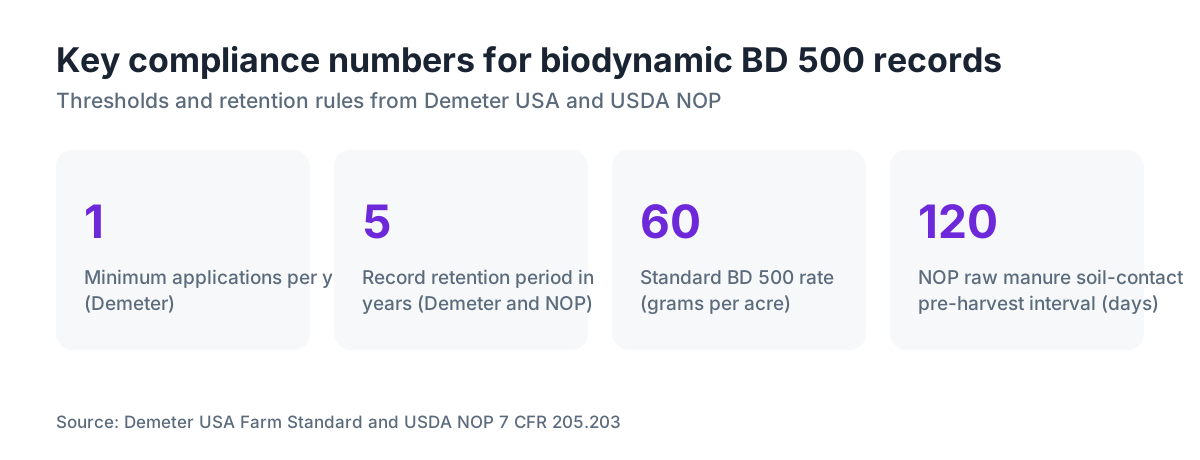
- Log every horn manure (BD 500) application with date, lunar calendar timing, preparation lot, dilution rate, application method, and acreage.
- Demeter USA audits these entries against your field maps and purchase invoices.
- USDA organic rules apply on top.
- Incomplete records are the most common reason Demeter suspends a biodynamic certification, and the fix costs a few minutes per application.
What is horn manure (BD 500) and why do the records matter so much?
Horn manure, called BD 500 in biodynamic shorthand, is cow manure fermented inside a cow horn over winter, then stirred into water and applied to soil. It is the base preparation of Demeter-certified biodynamic farming. One horn holds roughly 80 to 100 grams of finished preparation, enough to treat about an acre at the common 60 gram per acre rate, though practitioners vary this [1].
The records matter for two reasons that do not line up cleanly. Demeter USA wants documented proof you actually applied BD 500 at the approved rates and timings, as a condition of certification. Their Farm Standard requires that all preparations get applied at least once a year, and that applicants hand over application records on request during the annual audit [2]. Separately, depending on your state and how you classify the material, horn manure can fall under pesticide or soil amendment registration rules with their own paperwork mandates.
California growers are often surprised here. The California Department of Pesticide Regulation does not treat BD 500 as a pesticide, yet the agency still expects spray records for any material applied to a commercial crop when that material is meant to affect plant growth [6]. That gray zone means the safe move is to keep full records no matter how your state has ruled.
So here is the real stakes. The audit risk is not abstract, and thin records are the single most common reason Demeter suspends a certification.
What does Demeter USA actually require you to record for each BD 500 application?
Demeter USA's Farm Standard wants each preparation application documented with a minimum set of fields. For BD 500, based on the current standard, log these [2]:
- Date and time of application
- Lunar and astronomical calendar timing (whether you applied on a "root day" or at a descending moon, which the standard recommends)
- Field or block identifier
- Acres treated
- Preparation lot number or source (where the horn manure came from, which must be a Demeter-certified source if you buy rather than make it)
- Amount applied per acre (grams of preparation before dilution)
- Dilution volume and stirring time
- Application method (backpack sprayer, tractor-mounted sprayer, hand application)
- Applicator name
Demeter inspectors can cross-reference these entries against your field maps and your purchase invoices for the preparation. If you made your own BD 500 on-farm, the records also need to show when the horns went into the ground, the horn count, the exhumation date, and how you stored the finished material. That is a separate but connected record set.
One thing growers get wrong. Demeter does not force you to apply on a specific lunar day, but it does require you to document the lunar calendar context of every application. Applied on a day the calendar does not usually recommend? Note why (weather, equipment down). Inspectors want a good-faith record, not perfection.
How do lunar calendar timing windows affect your application schedule and records?
The biodynamic calendar, usually the Thun calendar or the Stella Natura calendar in North America, splits the year into root, flower, leaf, and fruit days based on the moon's position against the zodiac constellations and its perigee/apogee cycle [3]. BD 500 horn manure goes on during descending moon days, which come around twice a month for roughly two weeks at a stretch, and ideally on root days inside that window.
The windows are short. A descending moon root day might last 24 to 48 hours before the calendar shifts.
For a Sonoma County vineyard, once you account for descending moon periods, root days, weather, and soil moisture, you might get four to eight workable application windows across a growing season. That is not many. Miss a couple to rain and your schedule gets tight fast.
Your records need the specific Thun or Stella Natura designation for the date you applied. Do not guess it later. Print the calendar page for that week, keep it in your compliance file, and write the designation ("descending moon, root day" or "ascending moon, deviation noted") right on the application log. If an inspector questions a date that looks off, your printed page plus a one-line note is the whole defense.
Timing also matters because USDA NOP organic rules run at the same time if you hold organic certification, and they carry their own re-entry and pre-harvest intervals for soil amendments. BD 500 is generally low-risk under NOP, since it is a raw manure-derived preparation applied to soil rather than to plants. The NOP does require that raw manure applied to crops where the edible portion touches the soil be incorporated at least 120 days before harvest [4]. Grapes hang above the ground, so that rule usually does not bite, but your records should plainly show you applied to soil, not to vines or fruit.
What does a compliant BD 500 application log entry look like in practice?
Here is a sample format that satisfies Demeter USA, USDA NOP, and typical state requirements at once. Adapt it to any paper or digital system.
| Field | Example Entry |
|---|---|
| Date | April 3, 2025 |
| Start time | 4:45 PM |
| End time | 6:30 PM |
| Block ID | Block 7, Cabernet Sauvignon, North Slope |
| Acres treated | 3.2 acres |
| Preparation | BD 500 horn manure |
| Lot / Source | Lot HM-2024-B, sourced from (farm name), Demeter certified |
| Amount (dry weight) | 192 grams (60 g/acre x 3.2 acres) |
| Dilution volume | 16 gallons (5 gallons per acre) |
| Stirring method | Hand-stirred, 20 minutes |
| Application method | Backpack sprayer, coarse droplet |
| Lunar calendar day | Descending moon, Root day (Thun calendar, April 3 2025) |
| Soil conditions | Moist, air temp 58F, no wind |
| Applicator | [Name] |
| Supervisor sign-off | [Name] |
Keep the stirring method and time even though Demeter does not always formally require it. If a question ever comes up about whether the preparation was properly activated, that line is your evidence. Same logic for the soil condition notes. They cost you ten seconds and can settle a dispute that might otherwise cost you your certification.
Managing multiple blocks across varieties and rootstocks? A spreadsheet or vineyard platform that lets you attach a calendar screenshot to the record is genuinely useful. VitiScribe's record-keeping module, for one, logs preparation applications with all these fields and attaches a scanned calendar page as a file, so everything sits in one place for an audit.
One caution on format. Do not fold multiple blocks into a single log entry to save time. Demeter inspectors want block-level records, and one line that reads "all blocks, 12 acres" is exactly the shortcut that draws a deficiency notice.
How do USDA NOP organic rules interact with your biodynamic BD 500 records?
If you hold both Demeter biodynamic certification and USDA National Organic Program certification (most Demeter farms do, since Demeter requires NOP organic as a baseline), your BD 500 records have to serve both at once [4].
Under NOP, certified operations must keep records that "fully disclose all activities and transactions" for at least five years. The Organic System Plan (OSP) you file with your certifying agent has to list BD 500 as a soil amendment, and each application gets recorded in the format your certifier prescribes. Many NOP certifiers use their own log forms, and those forms often skip the lunar calendar fields Demeter needs. The answer is to keep both logs, or build one log that carries every field from both systems.
The NOP's rules at 7 CFR 205.203 govern soil amendments for organic crop production. The regulation says a producer must manage plant and animal materials to maintain or improve soil organic matter content, and that raw manure may be used if it meets the timing rules [4]. Demeter-certified BD 500 counts as a plant and animal material under that framework, but your certifier still needs to see it listed in your OSP [10].
One practical note from extension work. UC Davis's Agricultural Sustainability Institute recommends growers keep a single integrated farm log instead of separate logs per certification, because duplicate records are where errors slip in [5]. Build one format that covers every required field, and both certifiers pull what they need from the same document.
Do state pesticide or worker protection rules apply to BD 500 applications?
It depends on your state, and honestly the answer is murky in several places. Here is the straight picture.
In California, the Department of Pesticide Regulation keeps a list of exempt materials. Under current CDPR guidance, biodynamic preparations including BD 500 are not registered as pesticides, but California Agriculture Code Section 12841 defines pesticides broadly enough that some county agricultural commissioners have asked growers to keep application records for any material applied to a commercial crop [6]. The safe play in California is to keep records that match your county commissioner's expectations for pest control advisors, even if you do not have a PCA.
The EPA's Worker Protection Standard (WPS) covers agricultural establishments where workers handle pesticides. BD 500 does not require a Safety Data Sheet, since it is not a registered pesticide. WPS still requires employers to give workers information about agricultural chemicals applied where they work, and some WPS trainers fold biodynamic preparations into worker notification as a best practice [7]. Cornell's IPM program has noted that growers sometimes face WPS audit questions about soil amendments that are not technically pesticides but ride through the same sprayer that handles pesticides [8].
Washington State runs the same logic. WSU Extension's organic viticulture guidance says biodynamic preparations should show up in your farm records to satisfy both NOP and state department of agriculture audit requests, even when the preparations themselves are not regulated as pesticides [9].
Keep the records. The cost is a few minutes per application. A deficiency notice or an audit dispute costs you weeks.
How long do you need to keep BD 500 application records?
Three retention clocks run at once for most biodynamic vineyard operators.
Demeter USA requires applicants to hold all farm records for at least five years and to produce them on request [2]. NOP also mandates five years [4]. California DPR requires pesticide use records for three years, but since you are already keeping NOP records, defaulting to five years is the sensible move.
The five-year rule matters most when you have a certification gap. Lose Demeter certification for any reason and later reapply, and the certifier will want your historical records to confirm you kept biodynamic practices going during the gap. Growers who let record-keeping lapse during that gap often cannot get recertified for years, because they cannot prove continuous compliance.
Store records in at least two formats. A paper binder in the farm office and a digital backup (scanned PDFs are fine). Cloud storage adds a layer. If everything lives in one binder and the barn burns down, you have a real problem.
What are the most common record-keeping mistakes that cause biodynamic certification problems?
Drawing on Demeter USA's published standards and extension guidance from Cornell and WSU, these gaps turn up most often during audits [2][8][9]:
- Missing lot numbers for purchased preparations. Bought BD 500 from another farm? You need a receipt or delivery note showing that farm's Demeter status and the preparation lot. No lot number means the inspector cannot verify the source.
- No lunar calendar documentation. Plenty of growers log the date and acres but forget the calendar context. The inspector sees a date in March with no way to confirm you applied on a descending moon day.
- Consolidated block entries. As noted, "all blocks" lines are a red flag.
- Gaps between application records and field maps. If your field map shows 18 blocks and your records only ever name 12, an inspector will ask what happened in the other 6.
- No record of who applied. The applicator's name is a required field in most certification systems, and it is good practice for labor law reasons too.
- Incomplete records for on-farm preparation. If you make your own BD 500, the burial and exhumation records carry the same weight as the application records. A clean application log falls apart if you cannot prove the preparation itself was properly made [11].
- Records stored in one place only. Paper only, or one laptop with no backup, is a single point of failure.
The fix for all of these is one standardized form you fill out the day of application, not from memory a week later. Print a stack at the start of each season and stash them in the equipment shed.
How should you record BD 500 applications if you are also spray-recording under a pest control adviser?
California growers with a licensed Pest Control Adviser (PCA) usually submit spray records to their county agricultural commissioner for every pesticide application. BD 500 is not a registered pesticide, so it does not go on the standard DPR pesticide use report. But your PCA may include it in a farm record system for completeness, and that opens a version-control problem. Now you have application data in two places that have to match.
The clean solution is to keep BD 500 records in your primary farm log, share copies with your PCA or certifier as needed, and make block identifiers and dates match exactly across every document. Mismatched dates or acreages between your DPR records for other materials and your biodynamic logs are exactly what triggers a longer audit.
Managing this by hand? A shared spreadsheet with view-only access for your PCA works fine. For operations running more than 20 or 30 acres under biodynamic management, a vineyard platform that keeps spray and preparation records in the same database and generates reports in multiple formats saves real time. VitiScribe supports both pesticide use report formats and biodynamic preparation logs in one record, which kills the reconciliation problem.
See also our overview of vineyard field operations records if you are building a record-keeping system from scratch.
How do you document BD 500 timing against the astronomical calendar for a skeptical auditor?
Some certifiers and inspectors, especially those from a conventional agriculture background, are unfamiliar with biodynamic calendar systems. Deal with an NOP certifier new to biodynamic operations, and you may need to explain why your records carry a field labeled "Thun calendar day."
Be direct. In your Organic System Plan or in a cover note to your Demeter application, add a one-paragraph explanation of what the biodynamic calendar is and how you use it. Attach a copy of the Thun or Stella Natura calendar for the year in question. When your log says "root day, descending moon," the calendar page gives independent verification. The inspector can find April 3 on the page and confirm it is marked as a root day.
If you use a printed calendar, keep all twelve months for the year in your binder, not only the pages that hold your application dates. A partial calendar can look like you kept the "good" pages and tossed the rest.
For growers who prefer digital tools, the Thun calendar comes out annually in print and the Stella Natura calendar is distributed by the Biodynamic Association of North America [3]. There is no government or university source for the biodynamic calendar, because it is not a regulatory requirement. The requirement is to document your adherence to whatever timing method your Demeter plan specifies, and the calendar is your evidence.
What does a five-year compliant record archive look like for a Demeter audit?
When Demeter sends an inspector, they usually ask for the current certification year plus the two most recent prior years. Keep all five years on hand anyway, even if they only look at three.
A well-organized archive for a mid-size biodynamic vineyard (say 25 acres, six to eight BD 500 applications a year) should hold:
- Individual application logs for every BD 500 application, filed chronologically by year and then by date
- Annual Thun or Stella Natura calendars with application dates circled or highlighted
- Purchase receipts or delivery notes for any BD 500 sourced externally, showing the supplier's Demeter certification
- On-farm preparation records if applicable (horn burial dates, exhumation dates, storage notes)
- Field maps with current block identifiers that match the identifiers in the logs
- A one-page summary table per year showing total applications, total acreage, and total preparation used
Demeter does not require the summary table, but auditors visibly appreciate it, because it lets them cross-check totals fast without reading every log. Say your summary shows 1,500 grams of BD 500 across 25 acres over six applications, and your lot receipts show you bought 1,600 grams with 100 left. The math ties out and the audit moves quickly.
Building this archive is not hard. It is consistent paperwork done the same way every time. The vineyards that fail audits are almost never the ones where something improper happened. They are the ones where nothing improper happened but nobody kept the paper trail.
Frequently asked questions
How many times per year does Demeter require BD 500 to be applied?
Demeter USA's Farm Standard requires BD 500 at least once per year across all certified farmland. Most practitioners apply it twice, once in spring and once in autumn, to line up with traditional descending moon periods. Your records must show at least one documented application per season per block. Skipping a year on any block can trigger a certification deficiency.
Can I apply BD 500 on any day or does it have to be a specific moon phase?
Demeter does not mandate a specific moon phase as a hard rule, but the biodynamic calendar tradition strongly favors descending moon periods and root days for BD 500. What Demeter does require is that you document the calendar context of each application. If you applied off-calendar because of weather or equipment issues, note it in your log. Inspectors check for documentation and good faith, not perfection.
Does horn manure application require a pesticide use report in California?
No. BD 500 is not a registered pesticide in California and does not go on a DPR pesticide use report. However, California Agriculture Code Section 12841 is broad, and some county agricultural commissioners have requested records for any material applied to a commercial crop. Keep a full application log regardless, because Demeter and NOP require it anyway and complete records protect you if a county official asks questions.
What lot number information do I need if I buy BD 500 from another farm?
You need the supplier's name, their Demeter certification number or status, the preparation lot identifier, the purchase or delivery date, and the quantity. Keep the invoice or delivery receipt in your compliance file next to your application logs. Without this chain of custody, an inspector cannot verify that the preparation used was Demeter-certified, which is a required sourcing standard under the biodynamic farm standard.
How do USDA NOP raw manure rules apply to BD 500 applied to a vineyard?
NOP at 7 CFR 205.203 requires that raw manure applied to crops where the edible portion contacts the soil be incorporated at least 120 days before harvest. Grapes hang on the vine above the soil, so that specific 120-day requirement usually does not apply to wine grapes. Your records should clearly document that you applied BD 500 to the soil surface, not to vines or clusters, to remove any ambiguity during an NOP audit.
How many years of BD 500 application records do I need to keep?
Both Demeter USA and USDA NOP require a minimum of five years. California DPR requires three years for pesticide records, but since BD 500 is not a registered pesticide, the NOP five-year rule governs most biodynamic vineyards. Keep paper and digital copies. If you lose certification and later reapply, historical records are often the only way to show continuous biodynamic practice.
What happens if I miss a required BD 500 application in a certification year?
Demeter's Standards require at least one application per year across all certified acreage. Missing a year can bring a deficiency notice, a corrective action requirement, or in repeated cases, suspension of certification. If you could not apply because of genuine circumstances like drought or equipment failure, document the reason in writing at the time. Certifiers review the explanation, but the default outcome for undocumented omissions is a deficiency.
Do I need to record BD 500 applications separately from other biodynamic preparations like BD 501?
Yes. Each preparation has different timing, method, and purpose, and Demeter requires separate documentation for each. BD 501 horn silica goes on during ascending moon periods and targets the aerial parts of plants, while BD 500 goes to the soil during descending moon. Combining them into one log entry muddies timing, rates, and compliance, and risks a deficiency if the inspector cannot separate the applications.
Can I use a digital app or spreadsheet for BD 500 records or does Demeter require paper?
Demeter USA accepts digital records as long as they are complete, organized, and available for inspection. A spreadsheet, farm management software, or a scanned PDF of hand-written logs all work. What matters is that every required field is present and that you can produce the records quickly during an audit. Many growers keep both a paper log on the farm and a digital backup off-site for redundancy.
What does the EPA Worker Protection Standard require for BD 500 applications?
BD 500 is not a registered pesticide, so WPS pesticide labeling and re-entry interval rules do not directly apply. WPS does require employers to inform workers about any agricultural chemicals applied in their work area. Many WPS compliance programs recommend including biodynamic preparations in worker notification as a best practice, especially if the same sprayer handles both BD 500 and registered pesticides. Cornell extension cites this as a common audit question.
How do I prove the biodynamic calendar timing to a skeptical NOP certifier?
Print the full Thun or Stella Natura calendar for the year and file it in your compliance binder. On your application log, record the specific calendar designation for the application date. In your Organic System Plan, add a brief explanation of the biodynamic calendar and reference the Biodynamic Association of North America as the source. An inspector who can see the calendar page next to the log entry has everything needed to verify your timing claim without ambiguity.
Does making my own BD 500 on the farm require additional records beyond application logs?
Yes. On-farm preparation requires a separate record set covering horn burial dates, horn source and count, burial site location, exhumation date, the appearance and smell of the finished preparation, and storage conditions and duration. Demeter inspectors treat these records as proof the preparation was properly made. Missing preparation records undermine even perfect application logs, because an inspector cannot verify the quality of what you applied.
How does WSU Extension recommend handling biodynamic preparation records for Washington State growers?
WSU Extension's organic viticulture guidance recommends that biodynamic preparations appear in the farm's primary record-keeping system and in the NOP Organic System Plan filed with the certifier. The Washington State Department of Agriculture does not currently regulate BD 500 as a pesticide, but WSU advises growers to keep application records consistent with NOP standards as a baseline, and to document the preparation source to satisfy both Demeter and state audit requests.
Sources
- Biodynamic Association of North America, Demeter USA, preparation application rate guidance: Standard BD 500 application rate is approximately 60 grams per acre, with one horn holding 80 to 100 grams of finished preparation
- Demeter USA, Biodynamic Farm Standard: All Biodynamic preparations must be applied at least once per year; applicants must provide application records on request during the annual audit; records must be retained for five years
- Biodynamic Association of North America, Stella Natura calendar: The Stella Natura calendar divides the year into root, flower, leaf, and fruit days based on the moon's position relative to zodiac constellations, used for biodynamic application timing
- USDA National Organic Program, 7 CFR 205.203, National List soil amendment rules: NOP requires certified operations to keep records that fully disclose all activities for at least five years; raw manure applied where edible portion contacts soil must be incorporated 120 days before harvest
- UC Davis Agricultural Sustainability Institute, organic farming record-keeping guidance: UC Davis organic farming program recommends growers keep a single integrated farm log rather than separate logs for each certification to reduce errors
- California Department of Pesticide Regulation, California Agriculture Code Section 12841: CDPR does not classify BD 500 as a registered pesticide; California Agriculture Code 12841 defines pesticides broadly and some county agricultural commissioners request records for any material applied to a commercial crop
- EPA, Worker Protection Standard for Agricultural Pesticides: WPS requires employers to inform workers about agricultural chemicals applied in work areas; WPS compliance trainers include biodynamic preparations in worker notification protocols as best practice
- Cornell University, New York State Integrated Pest Management Program, viticulture compliance guidance: Cornell viticulture extension notes that growers sometimes face WPS audit questions about soil amendments applied with equipment that also handles pesticides, and that missing lot numbers and lunar calendar documentation are common biodynamic record deficiencies
- Washington State University Extension, organic viticulture guidance: WSU Extension organic viticulture guidance recommends biodynamic preparations appear in the farm's primary record system and NOP Organic System Plan to satisfy both Demeter and state department of agriculture audit requests
- USDA Agricultural Marketing Service, NOP Organic System Plan requirements: NOP requires certified operators to file an Organic System Plan listing all materials used as soil amendments, which must include BD 500 for biodynamic operations
- Demeter USA, Biodynamic Farm Standard, on-farm preparation documentation requirements: Demeter requires on-farm BD 500 preparation records including horn burial dates, horn count, exhumation date, and storage conditions as part of the certification audit
Last updated 2026-07-10