Do grape vines swell before bud break? What growers need to know
TL;DR
- Yes.
- Grape vines swell visibly before bud break in a predictable sequence.
- The process starts when accumulated heat units push buds through swelling, then wool, then green tip emergence.
- Depending on variety and climate, this takes 2 to 4 weeks.
- Recognizing each stage matters because frost vulnerability, dormant oil timing, and early fungicide windows are all tied to specific growth stages, not calendar dates.
Do grape vines actually swell before bud break?
Yes, absolutely. Bud swell is not a sudden event. It's a slow, staged process you can watch unfold over days and weeks, starting with barely perceptible changes and building to the recognizable green tip that most growers think of as "bud break."
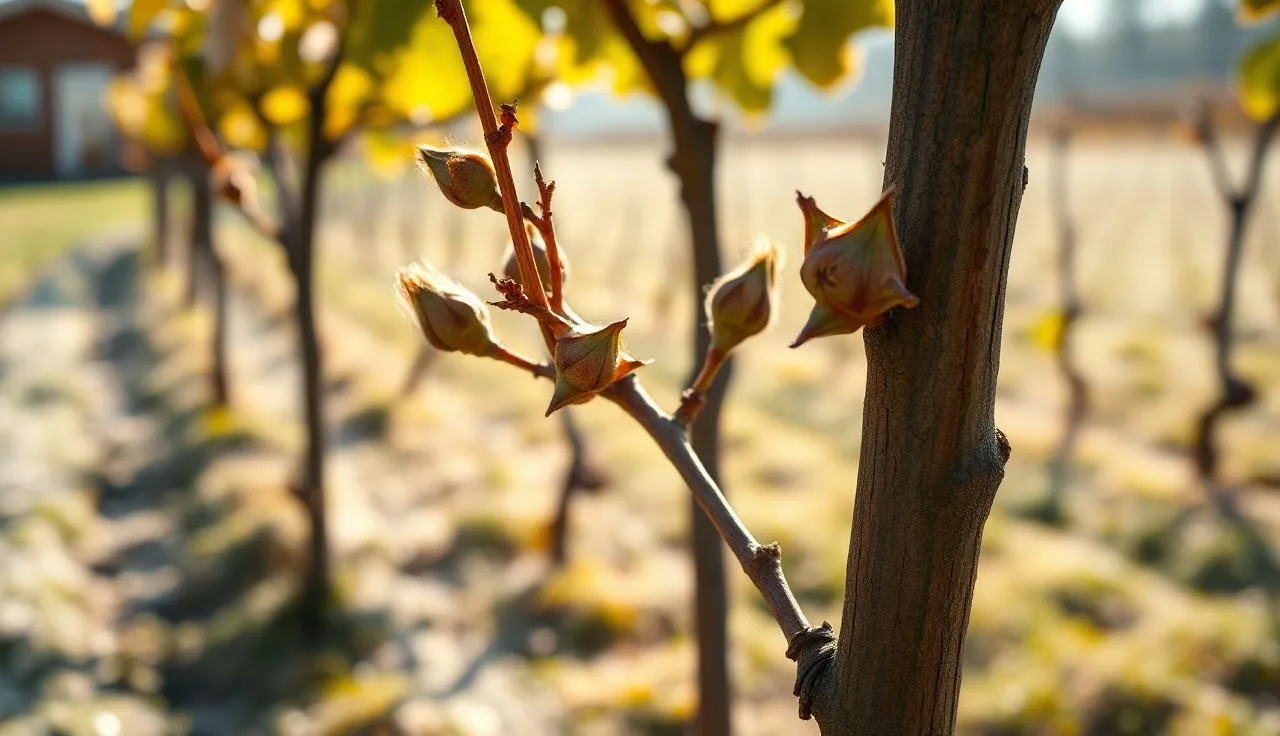
The bud itself is a compressed, dormant structure protected by brown scales. As the vine accumulates heat units through late winter, cellular activity inside that bud increases and the tissue begins to expand. The scales separate. The bud takes on a rounded, swollen profile. If you look closely, you can usually see this happening 2 to 4 weeks before any green tissue is visible [1].
This matters for a few reasons. First, swollen buds are more frost-sensitive than fully dormant buds. Second, some spray materials, especially dormant oils and copper fungicides, have strict windows tied to these early stages. Apply too late and you risk phytotoxicity. Third, understanding this sequence lets you predict when full bud break is coming so you can get labor and equipment ready.
The swelling phase is sometimes called "bud swell" or "pre-budbreak" and it corresponds to Eichhorn-Lorenz (E-L) stages 1 through 4 in the standard phenological scale used by viticulture researchers at Cornell, UC Davis, and WSU [2].
What are the stages of bud development before and after bud break?
The Eichhorn-Lorenz (E-L) scale is the standard phenological framework for grapevine growth stages. Researchers at WSU, Cornell, and UC Davis all reference it in pest and disease management recommendations [2][3].
Here are the key early-season stages most relevant to field operations:
| E-L Stage | Name | What you see | Frost injury threshold |
|---|---|---|---|
| 01 | Winter dormancy | Dormant bud, scales closed | Very low risk |
| 02 | Bud swell begins | Bud swells, scales still closed | Low risk |
| 03 | Bud swell advanced | Scales separate, woolly interior visible | Moderate risk, around 20°F (-7°C) |
| 04 | Bud burst / green tip | First green tissue just visible | Moderate risk |
| 05 | Woolly bud | Shoot and leaf tips still cottony | Higher risk, around 28°F (-2°C) |
| 07 | First leaves unfolding | Small leaves spreading | High risk |
| 09 | 2-3 leaves unfolded | Shoot actively elongating | High risk |
The temperature thresholds in that table come from extension guidance from Cornell Cooperative Extension and are approximate; actual injury depends on duration at low temperature, wind, variety, and vine health [3].
Practically speaking, E-L stages 01-04 are what growers call "bud swell," and E-L 04 through 07 is what most growers mean by "bud break." The distinction matters because dormant oil applications need to happen before E-L 04, while sulfur programs typically start at E-L 05 or later to avoid phytotoxicity.
What causes grape vines to swell and break dormancy?
Dormancy release in grapevines happens in two phases. First, the vine has to satisfy its chilling requirement, which is the accumulated hours below a threshold temperature (commonly 45°F / 7°C) during winter. Once chilling is satisfied, the vine is "ready" to grow. Second, warmth accumulated as growing degree days (GDD) triggers the actual developmental sequence [1][4].
The chilling requirement varies by variety. Most Vitis vinifera cultivars need somewhere between 1,000 and 1,500 chilling hours [4]. Varieties bred for cold climates, like Marquette or Frontenac, often have lower requirements and can break dormancy early in regions with mild winters. That's a real management risk.
Once the chilling requirement is satisfied, growing degree accumulation does the work. Most models use a base temperature of 50°F (10°C). When daily average temperatures stay above 50°F for enough days, cellular activity in buds increases, carbohydrate reserves mobilize, and the bud begins to swell.
The GDD threshold for visible bud swell varies by variety and model, but bud break (E-L 04) typically occurs somewhere in the range of 50 to 150 GDD accumulated from January 1 (base 50°F) in most California and Pacific Northwest vineyards [4]. Washington State University's extension resources offer GDD tracking tools specific to Pacific Northwest conditions [3].
Soil temperature also matters. Vines with root zones above roughly 55°F (13°C) tend to break dormancy faster and more uniformly than vines in cold, wet soils. That's part of why vineyard aspect, cover crop management, and drainage can shift your break timing by one to two weeks even within the same block.
How does bud break timing differ by variety and region?
Variety is the biggest single driver of bud break timing, and the range across commercial cultivars is wide. Chardonnay and Pinot Noir break early, sometimes dangerously so in marginal climates. Cabernet Sauvignon and Grenache break later. In California's Central Coast, Chardonnay can reach E-L 05 in early to mid-March, while Cabernet Sauvignon in the same vineyard might not get there until late March or early April [4].
Region shapes the picture too, of course. In the UK, bud break for most Vitis vinifera varieties typically falls between mid-April and mid-May, with Pinot Noir and Chardonnay on the earlier end and Bacchus or Seyval Blanc showing slightly more variability depending on the season. English viticulture programs have tracked this phenology as plantings have expanded over the past two decades, though detailed published datasets from UK vineyards are still sparse compared to continental Europe.
In Washington State, Riesling and Chardonnay in the Yakima Valley typically reach bud break in early to mid-April. In the Willamette Valley of Oregon, Pinot Noir is often at green tip by early to mid-March in warm years [3].
For growers in the eastern United States, particularly in Virginia and New York's Finger Lakes region, spring conditions are less predictable and frost events after bud break are a serious recurring risk. Cornell extension resources specifically address this [3].
Nobody has great global comparison data in a single clean dataset, so if you're establishing benchmarks for your block, the most useful thing you can do is start a phenology log now and record actual stage dates by variety and location year over year. Even three seasons of records will tell you more about your specific site than any model.
What is the frost risk during bud swell and after bud break?
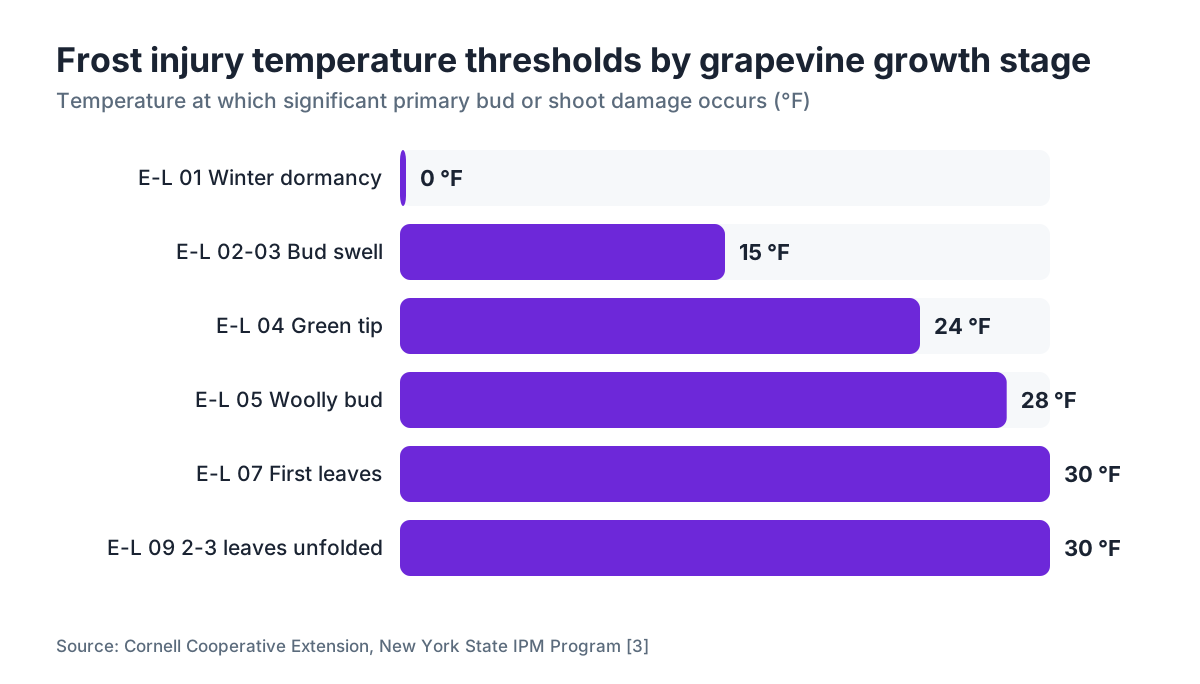
This is where bud swell turns from an interesting observation into a real operational concern. Dormant buds can tolerate temperatures well below freezing, but once swelling begins, cold tolerance drops sharply [3].
At E-L 02-03 (early swell, scales separating), buds can typically tolerate down to about 15-20°F (-9 to -7°C) without significant primary bud kill. By E-L 05 (woolly bud, green tissue emerging), damage can occur at 28°F (-2°C) with even brief exposure. By E-L 07-09 (small leaves unfolded), 30°F (-1°C) sustained for more than a few hours causes economic damage [3].
The trouble is that in most wine regions, the 30 to 40 days following bud break carry real frost risk. You can't stop the vine from growing, so you have to manage the risk. Common options include:
Wind machines are effective over moderately sized areas when a temperature inversion exists (warm air aloft, cold air pooled near the surface). They're expensive to install, running $25,000 to $50,000 per unit depending on size and terrain, but they protect large blocks and need no water supply.
Over-vine sprinklers protect buds by coating them in ice that holds at 32°F (0°C) as long as water is running. Timing is critical: you have to start when temperatures hit 34°F and keep running until ice melts. Applying too late or shutting off too early causes worse damage than no protection at all.
Site selection remains the cheapest frost mitigation of all. Cold air drains downhill. Vineyards on slopes with good air drainage and no obstructions downslope are structurally safer than valley floor sites, regardless of what equipment you deploy.
When should you start your spray program relative to bud swell?
Most dormant-season spray windows close at or before E-L 04. If you're running a delayed-dormant oil or lime-sulfur application targeting overwintering mite eggs or powdery mildew cleistothecia, you need to be done before green tissue is visible. UC IPM guidelines are specific on this: oil sprays after bud swell has advanced risk phytotoxicity, particularly in cool, slow-drying conditions [5].
Copper fungicides for downy mildew or Botrytis base can start once shoots are 2 to 3 inches long (roughly E-L 07-09), but the pre-bloom window is where the most disease protection is built, so start tracking as early as E-L 05 in high-pressure regions.
Early sulfur applications for powdery mildew are typically timed to E-L 04-05. WSU's powdery mildew risk model, which is integrated into many Pacific Northwest advisory services, keys its first application recommendation to shoot length rather than calendar date, because calendar date doesn't account for year-to-year variability [3].
For insect pests like grape leafhopper overwintering on debris, timing isn't tied to bud stage, but early-season monitoring should begin at bud swell so you have baseline counts before population growth starts.
One practical note: if you're managing spray records for compliance, keeping your application logs tied to observed growth stage (more than calendar date) makes end-of-season audits much cleaner. Tools like VitiScribe let you log E-L stages alongside each spray application, which is exactly what you'd want if you're subject to state pesticide record-keeping requirements or a third-party sustainability audit.
EPA Worker Protection Standard rules apply as soon as workers enter treated areas after any pesticide application, including early-season materials. The restricted-entry interval (REI) for many dormant-season materials is 4 to 12 hours, but check every product label because exceptions exist [6].
How do you identify bud swell vs. bud break in the field?
This is a practical skill that takes one or two seasons to internalize, but the markers are clear once you know what to look for.
Dormant bud (E-L 01): tight, pointed, hard. The scales are brown and fit snugly. If you press on the bud it feels firm.
Early swell (E-L 02-03): the bud is visibly rounder and slightly larger than in full dormancy. Scales separate slightly. The bud may have a faintly woolly appearance if you look closely at the gaps between scales. This stage can last one to three weeks depending on temperature fluctuation.
Green tip / bud burst (E-L 04): you can clearly see green tissue. It's a tiny point of color visible at the tip of the bud. This is the stage most growers call "bud break" and it's the trigger for many spray and frost management decisions.
Woolly bud (E-L 05): the emerging shoot tip and first leaf primordia are visible but still covered in fine white-gray wool. The overall appearance is fluffy. At this point you're past the dormant spray window.
For monitoring, check a consistent sample of buds (at least 20-30 across the block) on the same spur or cane positions each time. Count the percentage at each stage. When 50% of your sample buds reach E-L 04, call that your official block bud break date. That's the standard phenological convention used in research [2].
In a commercial operation, do this walk two or three times per week once temperatures start consistently clearing 50°F. You can go from E-L 03 to E-L 05 in 48 hours during a warm spell.
Can cold temperatures reverse or delay bud swell once it starts?
Cold temperatures can slow development, but they cannot reverse it. Once cellular expansion has begun, the bud will not close back up. A hard freeze at E-L 03 or later will kill the primary bud tissue, and the vine will respond by pushing secondary and tertiary buds [3].
Secondary buds are present in every compound bud structure on a grapevine. They're insurance. They will push if the primary bud is killed, but secondary buds generally carry significantly lower cluster counts, often 50-70% less than primary buds in varieties like Chardonnay and Cabernet Sauvignon [3]. So a mid-swell frost event doesn't necessarily mean zero crop, but it likely means a substantially reduced one.
Tertiary buds are a last resort. They produce mostly vegetative growth and rarely set commercial crop. If you're pushing tertiaries, it was a genuinely bad frost year.
Temporary cold snaps below 50°F, the kind that are common in spring in most northern hemisphere wine regions, will slow heat unit accumulation and stretch the swell-to-break window. The vine is not harmed, just delayed. This is one reason why calendar-based spray scheduling is unreliable: a cold snap in late February can push bud break two weeks later than the long-term average, and your spray timing needs to move with it.
How do you track heat units and predict when bud break will happen?
Growing degree day (GDD) models are the standard tool for predicting bud break timing. The basic formula: GDD per day = ((daily high + daily low) / 2) minus the base temperature (50°F or 10°C). You accumulate those daily values from a start date, typically January 1 in the northern hemisphere.
Most models predict bud break (E-L 04) at somewhere between 50 and 150 GDD (base 50°F) from January 1, but this varies by variety, region, and model assumptions. The Grapevine Phenology Model developed through work at UC Davis and other institutions provides more variety-specific estimates, though getting precise numbers requires calibration against local data [4].
Free GDD tracking resources include:
- NOAA's Climate Data Online for historical and current weather data at stations near your vineyard [7]
- WSU's AgWeatherNet, which provides GDD summaries for Washington State [9]
- UC IPM's degree-day calculator, which works for California sites [5]
- The Mesonet systems in many states provide hourly data at fine geographic resolution
For UK growers, the Met Office provides historical temperature records and forecast data, and several UK viticulture researchers at Plumpton College and the University of Brighton have published work on phenology modeling for English vineyards, though GDD thresholds calibrated for English conditions are not as well-published as those for California or Washington.
The honest answer on model precision: GDD accumulation models get you to the right week, usually. They won't get you to the right day. Soil temperature, vine water status, rootstock, and microclimate variation within your block all add real scatter. Use the model to set your monitoring schedule, then confirm with field observation.
What vine management tasks are tied to bud swell timing?
Several important field tasks need to be completed before or during the bud swell window, and a few more should start immediately after.
Pruning completion. You should finish dormant pruning before bud swell advances past E-L 03. Late pruning is a legitimate tool for frost-risk management in cold climates (it delays bud break by days to weeks), but it increases the risk of spreading Eutypa lata and other trunk diseases through fresh pruning wounds. If you're in a high Eutypa pressure area and pruning late, apply a wound protectant [10].
Trellis and wire repair. Once buds swell, working around the vines without breaking tender growth becomes much harder. Complete all wire tensioning, stake replacement, and trellis work before E-L 04.
Fertilizer applications. Foliar zinc applied at early bud swell is a common practice for improving fruit set in varieties prone to poor set like Grenache and Chardonnay. Timing is typically E-L 04 to E-L 05.
Soil work. Deep tillage, sub-soiling, or any equipment operation in row middles that could damage surface roots should happen before soils warm above 50°F and root activity accelerates.
Scouting baselines. Collect overwintering mite egg samples at E-L 02-03 to set a baseline before population growth begins. A population above 5-10 mite eggs per bud on Willamette mites is generally considered an action threshold for early-season miticide timing [5].
For growers managing a vineyard with multiple variety blocks, mapping your block-by-block expected bud break sequence in early winter and building a field calendar around it will prevent the chaos of everything happening at once.
Does bleeding (sap flow) from pruning wounds mean bud break is near?
Yes, vine bleeding is a reliable indicator that the vine has resumed active root pressure and is pushing water and dissolved solutes up through the xylem. It typically starts 2 to 4 weeks before visible bud break and represents one of the earliest observable signs that the vine is leaving dormancy [1].
Bleeding is not harmful to the vine. The popular belief that bleeding vines are "losing energy" is not supported by research. The fluid lost is mostly water with small concentrations of sugars and minerals, and the vine has abundant reserves relative to what bleeds out.
If your vines are bleeding, you're in the E-L 01-02 window. Bud swell visible stages are probably 1 to 3 weeks away, depending on temperature trajectory. This is a good prompt to check your dormant spray calendar, confirm frost protection equipment is operational, and get your first field walk scheduled for bud monitoring.
Bleeding is also useful for diagnosing trunk disease. Cut a bleeding arm or spur and look at the cross-section. Healthy wood is cream to light yellow. Brown or black staining in the cross-section, especially in a wedge pattern, suggests wood disease. Knowing this before the season ramps up gives you time to make replanting or remediation decisions before you've invested a full season's inputs in a declining vine.
Frequently asked questions
How many weeks before bud break does bud swell start?
Typically 2 to 4 weeks before visible green tip (E-L 04). The exact window depends on temperature variability. A smooth warming trend compresses the window. A cold snap in the middle of spring stretches it. Monitoring twice a week once temperatures consistently clear 50°F will give you more reliable timing than any fixed-week estimate.
At what temperature do grape buds start to swell?
Bud swell begins when average daily temperatures consistently stay above 50°F (10°C). That's the base temperature used in most growing degree day models. Brief warm spells above 50°F early in the season may produce slight cellular activity but typically don't result in visible swell unless the warmth is sustained over several consecutive days.
What is the difference between bud swell and bud break?
Bud swell (E-L 02-03) is the phase where the bud expands and scales separate but no green tissue is yet visible. Bud break (E-L 04, also called green tip or bud burst) is when the first green tissue becomes visible at the bud tip. Most growers and researchers define bud break as E-L 04, and it's the standard reference point for phenology records and spray timing guides.
Can you delay bud break in grape vines to avoid frost?
You can delay it modestly. Evaporative cooling with overhead sprinklers in late winter can slow heat unit accumulation around buds. Delaying pruning until late winter keeps buds cooler (unpruned wood delays break by days to a couple of weeks in some varieties and climates). Kaolin clay applications have been studied with mixed results. No method guarantees a delay of more than one to two weeks under real field conditions.
What does grape vine bleeding from pruning cuts mean?
Bleeding (xylem sap flow from pruning wounds) means root pressure has resumed. The vine is out of full dormancy and actively transporting water and dissolved reserves upward. It's not harmful. Bleeding usually starts 2 to 4 weeks before visible bud swell. It's a useful field cue to begin monitoring for bud stage progression and to confirm frost protection equipment is ready.
When does bud break happen in UK vineyards?
In UK vineyards, bud break for Vitis vinifera varieties typically falls between mid-April and mid-May. Pinot Noir and Chardonnay tend to break on the earlier end of that range. Exact timing varies substantially by year and site. UK springs are often cool enough that the swell-to-break window stretches longer than in warmer Continental regions, giving growers more time to prepare but also extending frost risk into May.
Which grape varieties break bud earliest?
Chardonnay, Pinot Noir, and Merlot are among the earliest budding Vitis vinifera varieties. Cabernet Sauvignon and Grenache tend to break later. Cold-climate hybrid varieties like Marquette and Frontenac have lower chilling requirements and can break dormancy very early if temperatures warm prematurely, which creates frost risk. Within a variety, rootstock choice also affects timing slightly.
Is it too late to prune after bud swell has started?
Late pruning during bud swell is practiced intentionally in frost-prone sites because it delays bud break on the pruned shoots. The trade-off is real: you'll knock off some swollen buds mechanically, and fresh wounds in wet spring conditions create entry points for Eutypa and Botrytis. If you must prune late, use a wound sealant, work quickly, and prioritize the blocks with the earliest frost exposure.
What spray materials can be applied during bud swell?
Dormant oils and lime-sulfur applications targeting overwintering pests and diseases should be completed before E-L 04 (green tip). Copper fungicides can be applied from E-L 04 onward for downy mildew. Sulfur programs for powdery mildew typically start at E-L 04-05. Always check product labels for stage-specific restrictions. UC IPM guidelines provide California-specific timing charts for most major materials.
How do you record bud break stages for compliance or audit purposes?
Record the E-L stage observed, date, block or variety name, and number of vines assessed. Standard practice is to call block bud break when 50% of sampled buds reach E-L 04. Keep records linked to your spray applications so auditors can verify application timing against growth stage. Many growers photograph representative buds on each monitoring date as supporting documentation.
Does frost during bud swell kill the whole crop?
Not necessarily. Grapevines have compound buds with primary, secondary, and tertiary growing points. If a frost kills primary buds, secondary buds push. Secondary buds carry 50 to 70% fewer clusters than primary buds in most wine varieties, so crop loss is real but often partial. Tertiary buds produce mostly vegetative growth with little commercial fruit. The actual outcome depends on frost duration, temperature reached, and variety.
How accurate are growing degree day models for predicting bud break?
GDD models reliably get you to the right week but not reliably to the right day. Soil temperature, rootstock, vine water status, and microsite variability all add scatter. Use GDD accumulation data from a local weather station to set your field monitoring schedule. Then confirm actual stage with direct observation. No model replaces twice-weekly bud walks as you approach the expected break window.
What does woolly bud look like and which E-L stage is it?
Woolly bud is E-L stage 05. The shoot tip and first leaf primordia are emerging from the bud scales but are still covered in fine white-gray wool or fuzz. The overall look is soft and cottony. At this point you're past the dormant oil spray window. Frost damage can occur at 28°F (-2°C) with brief exposure at this stage. Most powdery mildew spray programs begin at or just before E-L 05.
Sources
- Cornell University College of Agriculture and Life Sciences, Grapevine Physiology and Dormancy resources: Vine bleeding and bud swell are early observable signs of dormancy release, typically occurring 2 to 4 weeks before visible bud break.
- Australian Wine Research Institute, Eichhorn-Lorenz (E-L) modified grapevine growth stage system: The Eichhorn-Lorenz scale defines E-L 01 through E-L 47 growth stages; bud swell corresponds to E-L 02-03 and bud break to E-L 04.
- Cornell Cooperative Extension, New York State Integrated Pest Management Program, Grape guidelines: Frost injury thresholds by growth stage: E-L 05 buds damaged at 28°F; E-L 07-09 shoots damaged at 30°F; secondary buds carry 50-70% fewer clusters than primary buds.
- University of California Agriculture and Natural Resources, grapevine phenology and chilling/GDD research: Most Vitis vinifera cultivars need 1,000 to 1,500 chilling hours; bud break (E-L 04) typically occurs at 50 to 150 GDD (base 50°F) from January 1 in California and Pacific Northwest vineyards.
- UC IPM, Grape Pest Management Guidelines: Dormant oil applications must be completed before E-L 04; oils applied after visible green tissue risk phytotoxicity. Overwintering mite egg threshold of 5-10 eggs per bud.
- EPA, Worker Protection Standard for Agricultural Pesticides: The EPA Worker Protection Standard mandates restricted-entry intervals (REIs) for pesticide-treated areas, including early-season materials applied at bud swell and bud break.
- NOAA National Centers for Environmental Information, Climate Data Online: NOAA Climate Data Online provides historical and current daily temperature data for GDD calculation at weather stations near vineyards.
- Washington State University AgWeatherNet: AgWeatherNet provides real-time and historical GDD accumulation data for Washington State vineyard sites.
- University of California Agriculture and Natural Resources, grapevine trunk disease management: Late pruning increases Eutypa lata infection risk through fresh pruning wounds; wound protectants are recommended when pruning during or after bud swell.
- Oregon State University Extension Service, Willamette Valley vineyard phenology resources: Willamette Valley Pinot Noir reaches green tip (E-L 04) in early to mid-March in warm years.
Last updated 2026-07-09