Documenting wind speed and direction in spray application records
TL;DR
- Most pesticide labels prohibit application above 10 mph wind speed, and EPA's Worker Protection Standard requires that application records capture the conditions of each application.
- Log wind speed in mph, wind direction (compass bearing or cardinal direction), measurement method, measurement time, and where on the field you measured.
- Records must be kept for at least two years under 40 CFR Part 170.
Why does wind speed and direction belong in your spray records at all?
Because federal law says so, and because a pesticide label is law.
EPA's Worker Protection Standard (WPS) at 40 CFR Part 170 requires agricultural employers to keep records of each pesticide application, including the conditions under which it was made. Wind is a condition. If a state department of agriculture audits you, or a neighbor files a drift complaint, your records are the first thing anyone asks for. Vague wind data is the fastest way to lose a compliance argument you could have won. [1]
The FIFRA label is a federal legal document. When it says "do not apply when wind speed exceeds 10 mph" or "apply only when wind speed is between 3 and 10 mph," that instruction is mandatory. Recording the wind at the time of application proves you followed it. Skip the record and you're relying on memory in front of a regulator holding a formal complaint.
There's a liability angle too. Drift onto a neighbor's organic vineyard, a beekeeper's hives, or a school is a civil matter as well as a regulatory one. Documented wind conditions are your defense. Undocumented conditions are their argument.
What wind speed limits do pesticide labels actually set?
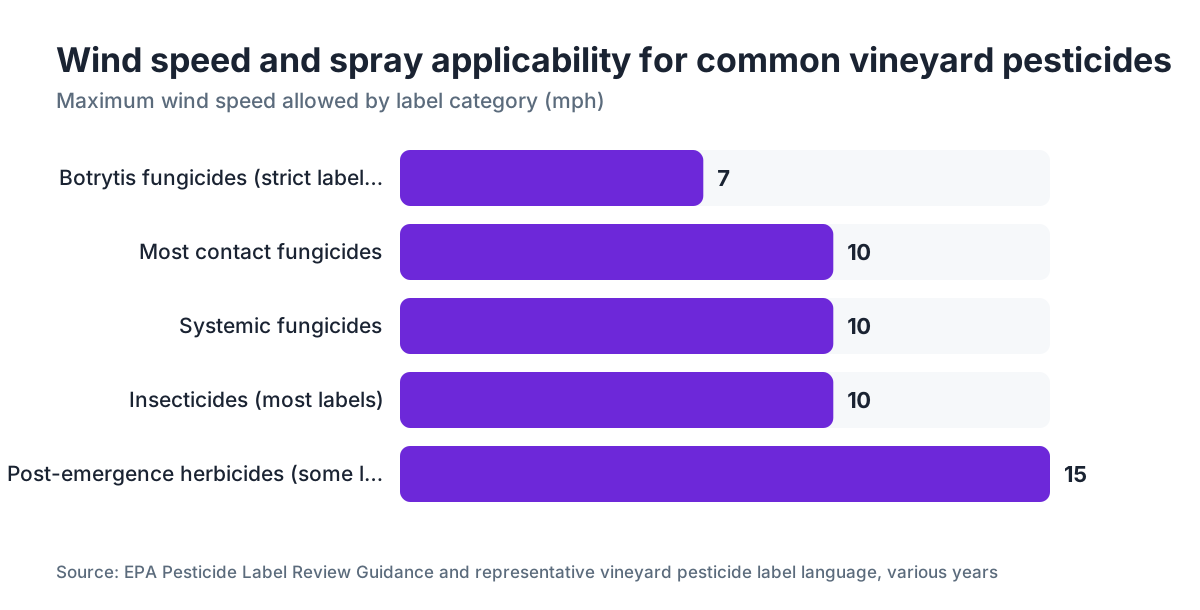
Most labels for conventional vineyard pesticides cap application at 10 mph, though the exact number changes by product and formulation. Some fungicides in high-value Botrytis programs set a tighter 7 mph limit. A few herbicides go up to 15 mph. Read the label for the product in the tank that day, because two products you tank-mix can carry different wind restrictions, and the stricter one governs. [2]
EPA's label review guidance has pushed registrants toward specific wind speed language, so labels issued or revised in the last two decades are more likely to carry a numeric threshold. Older labels sometimes just say "avoid application during windy conditions," which gives you less clarity but doesn't erase your obligation to make a judgment call and record it.
State rules add another layer. California's Department of Pesticide Regulation has wind speed requirements for certain restricted materials that run stricter than the federal label. Washington State's Department of Agriculture has its own drift minimization rules for some pesticide classes. Check your state before you assume the label is the only threshold that applies. [3][4]
A working wind-speed reference for vineyard operations:
| Wind speed range | Spray status | Why |
|---|---|---|
| 0 mph (dead calm) | Use caution | Temperature inversions; spray hangs in canopy, poor coverage, drift risk overnight |
| 1 to 3 mph | Generally acceptable | Light movement helps penetration without significant drift |
| 3 to 10 mph | Acceptable for most labels | Standard operating window for most vineyard pesticides |
| 10 to 15 mph | Check label; many prohibit | Drift risk climbs sharply; some labels allow up to 15 mph |
| Above 15 mph | Stop for essentially all products | Drift near certain; no vineyard-use label allows this |
The table reflects common label language across major vineyard-use pesticides. Always defer to the specific product label you are applying. [2]
What exactly do you need to record for wind in a spray log?
The floor, under 40 CFR Part 170 and most state equivalents, is three fields: wind speed (in mph or km/h), wind direction, and the time of measurement. That's the minimum. A complete entry goes further:
- Wind speed in mph (not "light" or "calm"; a number)
- Wind direction (compass bearing like 270 degrees or cardinal like WSW)
- Method of measurement (handheld anemometer, weather station, Beaufort estimate)
- Time of measurement (start, mid-application for long blocks, end if conditions shifted)
- Location of measurement (which block or row end, or GPS coordinates if you have them)
Say you spray multiple blocks across a three-hour window and the wind shifts from 4 mph out of the west to 8 mph out of the north. That shift belongs in the record. Two entries for a single application day is fine and honest. One entry that averaged conditions you never actually averaged is not.
The phrase to remember from the WPS is that records must reflect the conditions at the time of application. EPA raised that point repeatedly in the preamble to its 2015 WPS revision as an enforcement focus. [1]
For direction, record where the wind comes FROM, not where it's going. A west wind blows eastward, but you record it as "West" or "270 degrees." That distinction matters when you're assessing whether spray drifted toward a sensitive site to your east.
How do you accurately measure wind speed in a vineyard?
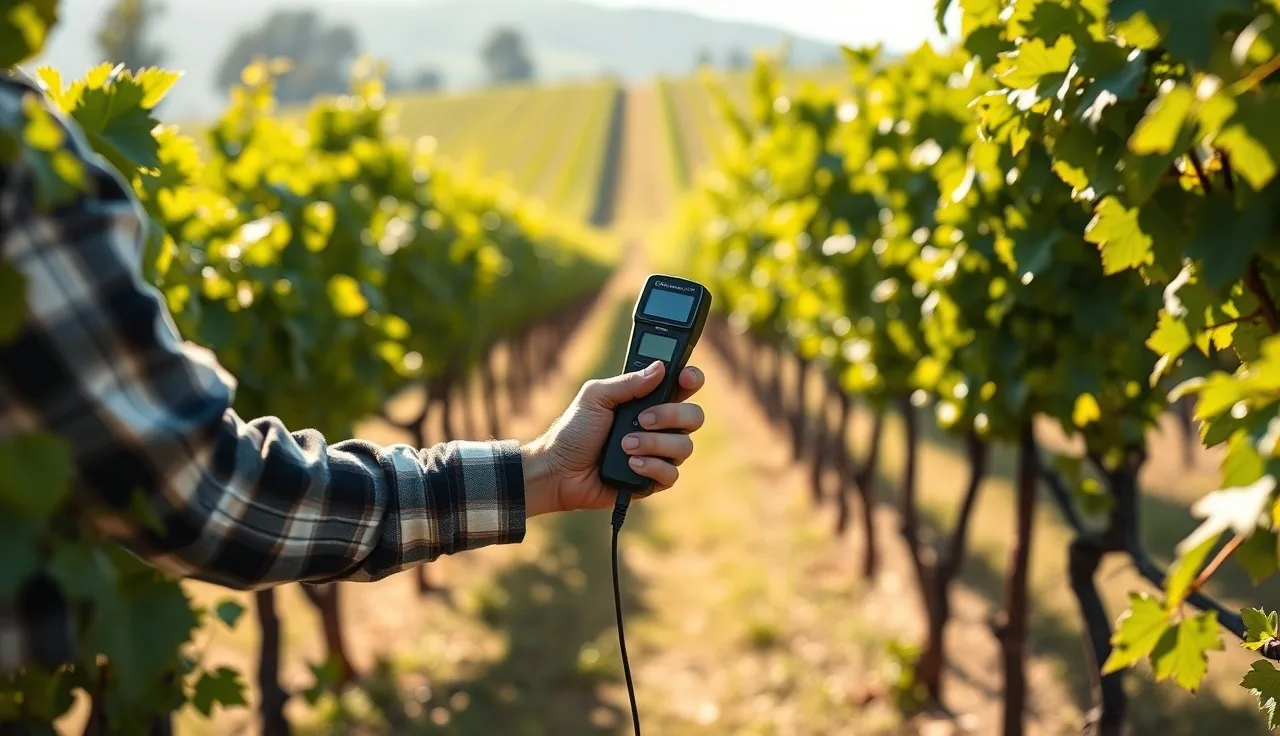
A handheld anemometer is the most defensible tool. Models from Kestrel, Skywatch, and similar brands run $50 to $300 and give you a digital reading you can log directly. The Kestrel 1000 (around $50 to $70) does wind speed only. The Kestrel 3000 and up add temperature, humidity, and dew point, which is genuinely useful since those affect spray efficacy and re-entry intervals. [5]
Hold the anemometer at canopy height, not shoulder height. Wind speed changes with height in a vineyard because the trellis and canopy create a boundary layer. Most labels were built around canopy-height conditions, so that's where you measure.
Weather station data from a nearby CIMIS station (California), AgWeatherNet station (Washington), or NEWA station (Northeast) can back up your records. But those stations may sit a mile away at a different elevation. Use them as corroboration, not as your only source. Regulators have generally accepted on-site measurements over nearby station data when the two disagree. [6][7]
Windsocks and Beaufort scale estimates (visual reads on leaf and branch movement) hold up in some states but are harder to defend in a dispute because they're subjective. If you use Beaufort, document which scale point you observed and its mph range. Beaufort 3 (leaves and small twigs in constant motion) is roughly 8 to 12 mph; Beaufort 4 (raises dust and loose paper, moves small branches) is 13 to 18 mph and sits above most label limits. [8]
For mountain or coastal vineyards where wind shifts direction across a block, log separately for each block rather than filing one field-wide entry.
How long do you need to keep spray records with wind data?
Under 40 CFR Part 170, agricultural employers must keep WPS-related records for at least two years. For commercial pesticide application records under FIFRA and most state pesticide rules, two years is also the federal minimum. [1]
California requires pesticide use reports filed with the county agricultural commissioner within one month of application, and county records stay on file for years. Washington State requires application records for at least two years. Cornell Extension notes that New York applicators must keep records for three years. Check your state's rule, because it may run past the federal minimum. [4][9]
Stored records have to be legible and retrievable. A paper log shoved in a barn that disintegrates in a flood is noncompliant even if you technically kept it for two years. Digital records with a backup (cloud or off-site hard copy) handle that cleanly. If you're managing records across seasons and blocks, tools built for vineyard compliance record-keeping, like VitiScribe, keep the data structured and retrievable so you're not digging through binders.
What's the best format for a spray record entry that includes wind data?
Consistency beats elegance. A spray log entry that survives an audit or a neighbor dispute carries these fields, in some order:
- Date
- Property/block/APN
- Pest or disease target
- Product name, EPA registration number, and formulation
- Rate (per acre or per 100 gallons)
- Total volume applied
- Method (airblast sprayer, backpack, boom, drone)
- Applicator name and license number (if required in your state)
- Wind speed (mph)
- Wind direction (compass or cardinal)
- Temperature (F)
- Relative humidity (%)
- Start time and end time
- Pre-harvest interval (PHI) confirmation
- Re-entry interval (REI) posted
Wind speed and direction land at item 9, but they belong on every entry, more than the ones where conditions were interesting. Selective recording looks suspicious. Regulators notice when wind data shows up only on entries with low wind speeds.
If you're using paper logs, the UC ANR spray record forms include environmental condition fields and are built to meet California requirements. WSU Extension has its own version for Washington applicators. Both are free to download. [6][9]
Does wind direction matter as much as wind speed for compliance?
Yes, and sometimes more. Wind speed tells you whether you're within label limits. Wind direction tells you where any spray that does drift goes.
In drift complaint investigations, wind direction at the time of application is often the deciding fact. If a neighbor's garden shows herbicide damage and the wind was blowing straight toward their property at 9 mph, your records need to show that. If the wind blew the other way, your records are your exculpatory evidence.
Some state rules, especially around endangered species areas or buffer zones near waterways, carry directional requirements. California's DPR sets setbacks for certain pesticides near water bodies, and wind direction affects whether a 200-foot buffer is enough on a given day. [3]
Direction also matters for worker protection. If you're applying on a block next to a crew doing manual canopy work, wind direction tells you whether REI concerns reach workers outside the treated area. The WPS has provisions about working next to a treated area during application, and both direction of application and wind are relevant. [1]
What happens if you miss or estimate wind data in your records?
Missing data isn't the same as a violation, but it weakens your position in any inquiry that follows. A state ag inspector reviewing records for completeness can flag missing environmental data as a deficiency. Add a drift complaint on top of that, and missing wind data shifts the presumption against you.
If you estimated wind speed (Beaufort scale, visual read) rather than measuring it, say so in the record. "Estimated 5 mph based on leaf movement; Beaufort 2" beats a blank field or a bare number with no method noted. Honest estimation, documented as estimation, is defensible. An invented number is not.
For retroactive corrections: if you realize you forgot to log wind data, note the correction date and your basis for it. Never quietly alter a prior record to look cleaner. That crosses into falsification, a separate and far more serious problem than an incomplete record. This isn't only legal advice. It's how records work in any regulated field.
How do changing wind conditions mid-application affect what you record?
Say you spray a block from 7 a.m. to 10 a.m. and the wind climbs from 4 mph to 12 mph at 9 a.m. You have an obligation to stop when you hit the label's limit and record what happened. The entry should show start conditions (time, speed, direction), the moment conditions crossed the label threshold, and the stop time.
If you kept going past the limit, document that honestly and note why (for example, you stopped the block but finished the last two rows before pulling the rig). Regulators are human. A record showing you managed a changing-wind situation responsibly reads far better than one showing a flat 5 mph for three hours when everyone knows the wind picked up that morning.
Practically: check wind before you start, again at the midpoint of a long application, and any time you notice conditions shifting. Three readings across a three-hour job isn't overkill. It's defensible documentation. A single 7 a.m. reading you stretch across a 10 a.m. finish is the kind of record that looks thin in a hearing.
WSU Extension guidance on application in windy conditions recommends checking at the field boundary where workers or bystanders could be exposed, more than at the sprayer. [6]
Does EPA's Worker Protection Standard specifically require wind data in records?
The WPS at 40 CFR Part 170.235 requires application records to include the date, start and end times, location, product information, rate, and other information the pesticide labeling specifies. If the labeling sets wind speed limits (most do), then meeting those limits is required, and documenting the conditions that prove it is the practical necessity. [1]
EPA's 2015 revision to the WPS, effective January 2017, expanded record-keeping requirements and raised the emphasis on complete environmental condition documentation. In the preamble to that rule, EPA stated that records must be sufficient to verify that an application was conducted in compliance with labeling requirements.
A verbatim quote from 40 CFR 170.235(a)(1) requires "the date and start and end times of the application, the location and description of the area treated, the product name, EPA registration number, and active ingredient(s), the amount of pesticide applied." Wind data falls under the broader compliance-condition documentation that flows from the label. [1]
States running their own WPS programs may add specificity. California's DPR training materials list wind speed and direction as required fields. New York DEC and Washington DOA track similar requirements in their state applicator guidance. [3][4][9]
Are there tools or apps that can automatically log weather conditions during spray applications?
Several approaches exist, and they range in cost and reliability.
The common entry point is a Bluetooth-connected anemometer paired with a phone app. Kestrel makes models that sync with their LiNK app and give you a timestamped log you can export. Figure $100 to $200 for the hardware.
Agriculture-specific weather stations from Spectrum Technologies (WatchDog series) or Davis Instruments (Vantage Pro) sit at a fixed vineyard location and log wind data every 5 to 15 minutes, so you get a continuous record to cross-reference against your spray log. These stations run $400 to $1,200 for a reasonable setup. [5]
Drone application equipment from providers like DJI Agras logs weather onboard, capturing wind during flight automatically. That's handy if you're already doing drone work.
To pull weather data into a complete spray record, vineyard compliance software like VitiScribe can attach station data to a spray entry alongside your other required fields, which cuts the odds of forgetting wind on a busy morning.
The honest caveat: automated data from a fixed station still needs a sanity check against actual conditions in the block. A station 400 meters away at the vineyard office reads differently than the far end of a hillside block. Use it as a backup, not a replacement for a field measurement.
Frequently asked questions
What wind speed is too high to spray a vineyard?
Most vineyard pesticide labels cap application at 10 mph. Some allow up to 15 mph, and a few fungicide labels restrict applications to below 7 mph. The specific product label governs, and if you're tank-mixing products with different limits, the stricter one applies. Check the label before you load the tank, not after.
Do I have to measure wind speed with an anemometer, or can I estimate it?
Estimation using the Beaufort scale holds up in most states but is harder to defend in a dispute. A handheld anemometer gives you a specific number and a clear method. If you estimate, document the Beaufort point you used and its mph equivalent. Most handheld anemometers start at $50 and are the cheapest insurance you can buy for your spray records.
How do I record wind direction in a spray log?
Record where the wind comes FROM, not where it's going. Use either a compass bearing (270 degrees for a west wind) or a cardinal/intercardinal direction (WSW). Both work. Consistency matters more than format. Pick one convention and use it across all your records so direction data stays interpretable season to season.
What does the EPA Worker Protection Standard say about spray record-keeping?
40 CFR Part 170.235 requires application records including date, times, location, product name, EPA registration number, active ingredient, and amount applied. Wind data is required indirectly, because most labels set wind speed limits and WPS compliance requires proof you met those conditions. Records must be kept at least two years and made available to EPA or state inspectors on request.
How often should I take wind readings during a long spray application?
At minimum, record conditions at the start. For applications longer than about 90 minutes, take a mid-application reading. Any time conditions change, take and log another. If wind climbs above the label limit at any point, stop, document the time and speed, and resume only when conditions return to within label limits.
Can I use a nearby weather station instead of measuring wind on-site?
Nearby CIMIS, AgWeatherNet, or NEWA station data can corroborate your records but shouldn't be your only source. Stations often sit away from your blocks at different elevations. Regulators have generally given more weight to on-site measurements when the two disagree. Use station data as a backup and note in your record that you used it, along with the station ID.
What happens if I applied a pesticide in winds above the label limit?
Applying outside label conditions violates FIFRA, which can bring civil penalties. If drift damaged a neighboring property, the violation complicates your civil liability significantly. Document what actually happened, contact your pest control adviser, and if you're in California, your county agricultural commissioner. Falsifying records after the fact is a separate and more serious offense.
How long must vineyard spray records be kept?
The federal minimum under FIFRA and the WPS is two years. New York applicators must keep records for three years under state rules. Washington State requires two years minimum. Always check your state's pesticide regulations, since state requirements can run past the federal floor, and the stricter rule governs.
Do drone spray applications require the same wind logging as ground rigs?
Yes. Drone applications are still pesticide applications subject to the same label requirements and WPS record-keeping rules. Wind speed matters even more for drones because they operate at canopy height or above, where drift risk can be higher. Some drone application labels cap wind speed at 10 mph or lower. Most commercial drone platforms log weather onboard, which you should export and attach to your spray record.
Does wind direction affect pesticide buffer zone compliance?
Yes, sometimes significantly. California DPR buffer zone requirements for certain restricted-use pesticides near water bodies and sensitive sites depend on wind direction as well as speed. If the wind blows toward a buffer zone boundary, conditions may require a larger setback or postponing application. Factor wind direction into your pre-application site assessment alongside wind speed.
What format should I use to record wind data in a paper spray log?
Log wind speed as a number in mph, wind direction as a cardinal bearing or compass degree, measurement method (anemometer model or Beaufort estimate), and time of measurement. Many paper log templates from UC ANR and WSU Extension include pre-printed environmental condition fields. Fill every field on every entry, more than the ones where conditions were unusual.
Can I use a mobile app to log wind during spray operations?
Yes. Kestrel's LiNK app pairs with Bluetooth-enabled anemometers and timestamps each reading. Some vineyard compliance platforms let you attach these readings directly to a spray record. The key is tying the data to a specific application entry, not stashing it in a separate app with no connection to the rest of your spray log. Integration beats filing two separate records.
Sources
- EPA, 40 CFR Part 170 Worker Protection Standard: WPS requires application records including date, times, location, product name, EPA registration number, active ingredient, and amount applied, and records must be kept for at least two years.
- EPA, Understanding Pesticide Labels: Pesticide labels are federal legal documents under FIFRA; following label directions, including wind speed limits, is mandatory.
- California Department of Pesticide Regulation, Pesticide Use Reporting: California DPR requires pesticide use reports to be filed with the county agricultural commissioner within one month of application, and wind speed and direction are required fields in application records.
- Washington State Department of Agriculture, Pesticide Recordkeeping Requirements: Washington State requires pesticide application records to be kept for at least two years and has drift minimization requirements for some pesticide classes.
- Kestrel Instruments, Kestrel 3000 Weather Meter product specifications: Kestrel handheld anemometers in the $50 to $300 range provide wind speed, temperature, humidity, and dew point, and Bluetooth-enabled models log timestamped readings to a smartphone app.
- Washington State University Extension, Reducing Pesticide Drift: WSU Extension guidance recommends checking conditions at the field boundary where workers or bystanders could be exposed, and provides spray record templates for Washington applicators.
- UC ANR, California Irrigation Management Information System (CIMIS): CIMIS stations provide regional weather data including wind speed that can corroborate on-site spray application records; UC ANR notes that on-site measurements are preferred when station data differs.
- NOAA National Weather Service, Beaufort Wind Scale: Beaufort scale 3 corresponds to roughly 8 to 12 mph (leaves and small twigs in constant motion); Beaufort scale 4 corresponds to 13 to 18 mph (raises dust, moves small branches).
- Cornell Cooperative Extension, Pesticide Record-Keeping Requirements in New York: New York pesticide applicators must keep application records for three years under state rules, exceeding the federal two-year minimum; Cornell Extension provides spray record templates meeting New York requirements.
- EPA, 2015 Revised Worker Protection Standard Final Rule Preamble: EPA stated in the preamble to the 2015 WPS revision that records must be sufficient to verify that application was conducted in compliance with labeling requirements, with increased emphasis on environmental condition documentation.
Last updated 2026-07-11