Grapevine fanleaf virus disease: what every vineyard manager needs to know

TL;DR
- Grapevine fanleaf virus (GFLV) is the most economically damaging virus in vineyards worldwide.
- It spreads almost only through the dagger nematode Xiphinema index, lives in infested soil for decades, and cuts yields by 30 to 80 percent.
- There is no cure.
- You pull infected vines, fumigate or fallow the ground, and replant certified virus-free stock.
What is grapevine fanleaf virus disease?
Grapevine fanleaf virus (GFLV) is a nepovirus, a nematode-transmitted polyhedral virus, and by most accounts the single most economically damaging viral disease of Vitis vinifera and related species grown commercially. Growers in European vineyards described it early in the twentieth century. Today it turns up on every continent where grapes go into the ground for wine. [1]
The virus sits in the genus Nepovirus, family Secoviridae. Its genome is bipartite, meaning the genetic material is split across two separate RNA strands packaged into separate particles, and both are needed for infection. That detail matters in the field. GFLV is extremely stable in plant tissue, which is exactly why it rides through infected propagation material so easily.
There are two main strain groups. The fanleaf strain produces the dramatic leaf distortion most growers recognize. The yellow mosaic strain causes bright chrome-yellow discoloration on leaves and shoots in spring. A third group, vein banding, shows up less often. All three cut vine productivity and shorten vine life. None of them are treatable once a vine is infected.
What does grapevine fanleaf virus look like in the field?
Symptoms shift with the strain and the season, which makes diagnosis trickier than it looks. In spring, infected vines often flush unevenly, some shoots lagging well behind healthy neighbors. That timing gap is your first field clue.
The fanleaf strain produces the disease's namesake symptom: leaves that are distorted, asymmetric, and fan-shaped, with teeth more pronounced and uneven than normal. Veins often sit at an abnormal angle. Internodes shorten, sometimes giving canes a zig-zag look. Clusters run smaller, set poorly, and mix shot berries with normal-sized fruit.
The yellow mosaic strain looks like a different disease entirely. Leaves, shoots, tendrils, and even flower clusters can flash intense yellow in early spring. That color fades as summer heats up, so you can miss it completely if you're scouting in July instead of April or May. Don't mistake it for nutrient deficiency. GFLV yellow mosaic tends to hit whole shoots and shows up in irregular patches across the vineyard rather than uniformly across a block.
Vein banding shows as yellow bands along primary and secondary leaf veins in spring. It's the subtlest presentation and the easiest to write off as something else.
Every strain leaves the same economic fingerprint: fewer clusters, poor fruit set, shot berries, and slow vine decline. A heavily infected vine doesn't die fast. It quietly produces less and less, and that slow bleed is how the disease does so much damage. Growers sometimes carry a declining block for years before they finally pull it. [2]
How does grapevine fanleaf virus spread?
This is where the disease cycle gets specific, and getting it wrong leads straight to replanting failures.
Xiphinema index is the vector. Period. This ectoparasitic dagger nematode feeds on grapevine roots, picks up the virus, and passes it on when it moves to a healthy root and feeds again. GFLV is not seed-transmitted in any way that matters commercially, is not carried by insects, is not splash-dispersed, and does not move through the air. If a vine has it, the nematode put it there, or the planting material already carried it in. [3]
Xiphinema index can acquire the virus after feeding for as little as one hour, though longer feeding raises transmission efficiency. The nematode holds the virus for months without losing the ability to pass it on. In the soil, X. index crawls slowly, usually no more than a meter or two a year on its own. That's why GFLV inside a vineyard spreads as expanding patches rather than random scattered vines.
The most dangerous pathway is human. Infected rooted cuttings, budwood, or rootstocks from virus-carrying mother blocks move GFLV between regions and countries far faster than any nematode could. Most new vineyard plantings in California and elsewhere got GFLV introduced this way before certification programs tightened up.
X. index also hangs on after you pull the vines. Grape roots decay slowly, and viruliferous nematodes survive on root fragments for years, sometimes past two decades, before you ever plant again. UC Davis research and extension guidance put the commonly cited minimum fallow before safe replanting at three to five years without fumigation, and some sources say even that falls short in heavy infestations. [4]
Other Xiphinema species exist, but only X. index transmits GFLV. That species-specificity is one reason the California Department of Food and Agriculture and others track X. index populations separately during pre-plant nematode surveys.
How much yield loss does GFLV actually cause?
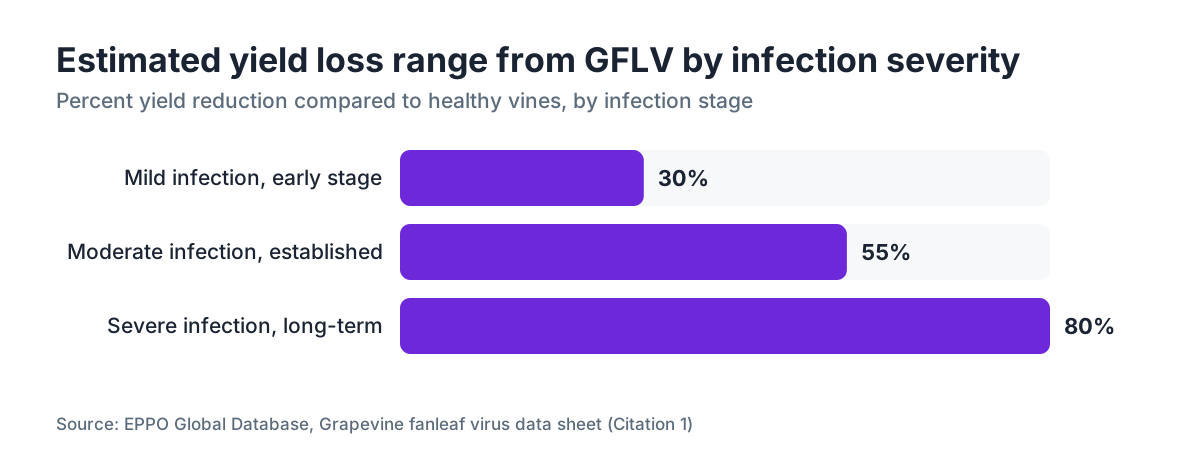
The numbers are not soft. GFLV-infected vines in commercial production typically show yield cuts of 30 to 80 percent against healthy vines in the same block, depending on strain virulence, cultivar susceptibility, vine age, and how long the infection has run. [1]
A 2021 review in the journal Pathogens cited estimates that GFLV causes losses over one billion dollars a year worldwide, though that figure is hard to verify precisely because it stacks losses across dozens of countries with different reporting standards. What nobody disputes: this is the most economically important grapevine virus on the planet, and the main reason national and regional certification programs for planting material exist at all.
Beyond raw yield, infected vines accumulate less sugar, color poorly in red varieties, and set fruit so unevenly that uniform ripening becomes nearly impossible. A grower trying to make quality wine off an infected block is fighting from both ends: less fruit, and what fruit there is comes in ragged.
Vine life takes a hit too. A healthy Cabernet Sauvignon vine on the right rootstock in a well-run California vineyard might produce commercially for 30 to 40 years or more. Heavily GFLV-infected vines often come out within 15 to 20 years. That pulls replanting costs forward and stretches the income gap while young vines establish.
For a small winery working its own estate fruit, the math is brutal. Run a 10-acre block at an expected 4 tons per acre, let GFLV knock it to 2 tons or less, and you're doing more than losing grapes. You're losing the economic case for that land in that vintage.
How is GFLV diagnosed accurately?
Visual symptoms are a starting point, not a diagnosis. Other grapevine viruses, nutrient shortages, herbicide damage, and even mite feeding throw leaf distortions that look a lot like GFLV. You need a lab test.
ELISA (enzyme-linked immunosorbent assay) is the standard diagnostic and runs at most university plant diagnostic labs and many commercial labs. It's sensitive, fairly fast, and cheap per sample. Cornell University's Plant Disease Diagnostic Clinic and UC Davis Foundation Plant Services both test for GFLV. [5][6]
RT-PCR (reverse transcriptase polymerase chain reaction) reads lower virus concentrations than ELISA, which matters when you're testing dormant canes or material from vines with mild or ambiguous symptoms. Some labs run both methods side by side.
When you scout for suspected GFLV, collect in spring when symptoms peak. Take leaf petioles and young growing tissue. Dormant cane tissue works for PCR but reads less reliably on ELISA. Ship samples on ice, labeled clearly with the vine's location in the block so you can map confirmed positives back to a GPS point or a row and vine number.
Nematode sampling is a separate job. A soil and root sample sent to a nematology lab tells you whether X. index is present and gives you a rough population density. UC Cooperative Extension recommends soil cores to 24 inches deep, several cores composited per sample zone, and sampling in fall when nematode populations tend to peak. [4] You need that X. index count to decide whether and how to fumigate before replanting.
What treatment options exist for infected vines?
None. Once a vine has GFLV, it has it for life. No systemic treatment clears the virus from infected tissue. This is the hardest part of GFLV management to swallow, especially when symptoms stay mild in year one and you're hoping the block might bounce back.
What you can do is manage the vector. Certain nematicides suppress X. index around existing vines and may slow GFLV spread within a block. Products registered for this use in California have changed over the years. Your county agricultural commissioner's office or the California Department of Pesticide Regulation keeps the current label-legal list. [7] Suppression is not eradication. Nematicides don't wipe X. index out of an established vineyard, and they do nothing to clean the virus out of infected vines.
Pulling individual infected vines and replacing them (roguing) makes sense early in an outbreak, when infection sits in a few scattered vines with healthy vines between them. Roguing slows spread, but only if the replacement is certified virus-free and you've also knocked down the local nematode population. Replanting into a hole where an infected vine just sat, with an untreated X. index population still in the soil, is an expensive lesson in how GFLV persistence works.
For a block with widespread infection, most viticulture advisors and the UC Davis guidelines point to one realistic path: remove the whole block, treat the soil, and start over with certified material. That's a multi-year, multi-dollar decision. Farming a heavily infected block usually costs more in the long run through compounding yield losses and deferred replanting.
How do you replant a GFLV-infected site correctly?
Replanting after GFLV runs through several steps, and skipping one is how the problem walks right back in.
Step one is vine removal and root extraction. Don't just cut vines at the soil line. Pull or grind every root you can reach. Roots left in the ground keep decaying slowly and keep feeding X. index for years. A thorough push-and-pull removal, sometimes with a subsoiler to lift deeper roots, cuts residual inoculum but never gets all of it. [4]
Step two is fumigation or fallow. Pre-plant soil fumigation with registered fumigants, once methyl bromide and now alternatives like metam sodium, chloropicrin, and 1,3-dichloropropene, cuts X. index populations and root pathogen loads hard. No fumigant clears X. index completely, especially at depth, but a well-executed job brings numbers low enough to give a new planting a real window before they build back. Check current California Department of Pesticide Regulation registrations for what's legal on your site. [7]
Skip fumigation and the fallow UC Cooperative Extension recommends runs a minimum of three to five years, the idea being that decaying roots starve the nematode population. Some research says five years beats three, especially in heavier soils where roots break down slower.
Step three is sourcing certified clean material. Foundation Plant Services at UC Davis certifies grapevine propagation material for GFLV and other viruses. Plant only from a certified source. Use budwood off your own vineyard or a neighbor's and you throw away the entire benefit of everything you just spent on site prep. [6]
Step four is rootstock selection. No commercial rootstock is immune to X. index feeding, but some tolerate GFLV infection better than others. Your UC Cooperative Extension farm advisor can match rootstock to your soil and nematode profile.
Step five is ongoing monitoring. Survey for nematodes every two to three years in replanted blocks to catch X. index rebound, and test vines for GFLV the moment you see anything suspicious during establishment. Catching reinfection at 5 percent of vines is a very different problem than catching it at 40 percent.
Write down where you sampled, what the results were, and what you applied. That's not optional. It's the only way to catch problems early in later seasons and to show due diligence for compliance or a sale. VitiScribe makes this block-by-block tracking a lot easier than a spreadsheet, especially when you're pulling nematode results and treatment records together for an advisor or buyer review.
How do certification programs protect against GFLV in new plantings?
Certified planting material is the single most important tool in GFLV prevention, and the system only works if you actually use it.
In California, Foundation Plant Services (FPS) at UC Davis runs the state's main grapevine certification program. FPS keeps mother vines tested and confirmed free of GFLV and other regulated viruses. Nurseries propagate from FPS-certified budwood and sell certified plants to growers. The FPS program tests for more than a dozen viruses, including GFLV, Grapevine leafroll-associated viruses, and Rupestris stem pitting-associated virus. [6]
Washington State University's Clean Plant Center Northwest offers similar certification for grapevine material and other tree fruits. Cornell University's viticulture extension program has worked with the New York wine industry on virus-tested propagation as well. [8][9]
The weak link is unverified material. Growers who take cuttings from old heritage vines, import budwood through informal channels, or accept cuttings from a neighbor without paperwork are rolling the dice. Heritage vines from pre-certification plantings carry GFLV at high rates, sometimes 80 to 100 percent of vines in old European-sourced blocks. If that budwood goes onto your rootstocks, no amount of soil prep saves the new planting.
Ask for and keep the nursery certification documentation for every block you plant. It should state the variety, rootstock, source mother vine number, and certification status. If a nursery can't hand you that paperwork, that's your answer.
What are the regulatory and compliance dimensions of GFLV?
GFLV itself is not a regulated quarantine pest in most U.S. states the way Pierce's disease or phylloxera are. Several regulatory frameworks still touch how you manage GFLV and its vector.
Pesticide application for nematode control falls under EPA and state registration rules. The EPA's Worker Protection Standard (WPS) at 40 CFR Part 170 requires training, posting, and reentry interval compliance any time a restricted-use pesticide or fumigant goes on in a vineyard. [10] Fumigants carry some of the toughest WPS requirements: early-entry restrictions, personal protective equipment mandates, and application-exclusion zone buffers that have to be documented and communicated to workers.
Soil fumigant applications usually require a Fumigation Management Plan and a certified applicator. In California, you must notify the county agricultural commissioner before fumigating with materials like chloropicrin or 1,3-dichloropropene. Penalties for breaking fumigant rules are serious.
For moving grapevine propagation material across state lines, USDA APHIS Plant Protection and Quarantine regulations apply. Clean plant programs exist partly to keep that interstate commerce compliant. Moving uncertified budwood across state lines can violate federal plant protection rules depending on the pest's status in the destination state.
Keep your pesticide application records (product, rate, date, applicator, reentry interval posted) as a habit. In California, the Pesticide Use Report system requires licensed applicators to report restricted material applications to the county. [7] Your records should match those reports.
What does GFLV cost to manage, and is it ever worth farming through?
Honest answer: nobody has a clean national dataset on total GFLV management costs, because they swing wildly by land value, grape price, fumigation method, and fallow length. What we do have are real cost pieces you can price out for your own site.
Fumigation alone, using a material like 1,3-dichloropropene with chloropicrin, typically runs $1,500 to $3,500 per acre in California, depending on application depth, soil type, and contractor pricing (UCCE cost studies from 2020 to 2023 put fumigation in that range for most wine grape regions). Tarped versus untarped application changes both cost and efficacy. Add root removal ($600 to $1,500 per acre for a thorough job) and young vine establishment ($10,000 to $20,000 per acre all in for California coastal regions), and you're looking at a big capital commitment before you pull a single ton of commercial fruit off the replanted block.
Farming through mild GFLV, meaning you accept the reduced yield and quality to dodge replanting costs, makes some economic sense in low-value grape regions or where land values won't carry the replanting bill. I wouldn't run it as a long-term strategy, but I'd be lying if I said no grower ever makes that call for real financial reasons.
In premium appellations where fruit fetches $3,000 to $8,000 per ton, the math flips fast. Lose 40 percent of expected yield in a block that should give 3.5 tons per acre and you're bleeding $4,200 to $11,200 per acre per year at those prices. Even with a four-year fallow, you could recover the replanting cost in three to four post-replant vintages.
If you track block-level yield over time and watch one section quietly slide year over year, good records let you make this call with real numbers instead of a hunch. Keeping spray records, nematode results, and yield data by block in one place, the kind of thing VitiScribe handles, can make the replanting decision clearer and earlier.
Can resistant rootstocks or new varieties help prevent GFLV?
Here's one area with real ongoing research and some honest uncertainty.
No commercial rootstock is immune to X. index feeding or GFLV infection. What some rootstocks offer is better tolerance, meaning the infected vine declines slower or shows less dramatic yield loss. Rootstocks with Vitis rotundifolia parentage (like Harmony and Freedom) showed some resistance to X. index in earlier research, but both carry other agronomic drawbacks, and neither counts as a durable solution to GFLV on high-pressure sites.
Research at UC Davis and in France (INRAE) has studied the genetics of X. index resistance and GFLV tolerance in Vitis for decades. There are promising wild Vitis accessions with resistance to X. index feeding, but moving those traits into useful wine grape varieties through conventional breeding takes generations. No resistant commercial cultivar is available for production planting right now. [11]
RNA-based approaches, including RNA interference (RNAi) strategies built to degrade GFLV RNA inside plant tissue, are an active research area. A 2019 paper in Plant Pathology reported experimental results with RNAi-mediated resistance to GFLV in transgenic rootstocks. Whether any such technology reaches commercial registration in the next decade is genuinely up in the air.
For now, the honest answer to a grower asking whether a resistant rootstock lets them plant their way out of an X. index problem is: not really. Clean material plus soil management is still the only combination that works consistently.
How do you monitor for GFLV in an established vineyard?
Routine monitoring is your early warning system, and it's cheaper than reacting after the disease has crossed 30 percent of a block.
For visual scouting, train your crew (or yourself) to flag abnormal shoots during the April-to-June window when fanleaf and yellow mosaic symptoms run sharpest. Walk every block at least twice in spring: once from budbreak through early shoot growth, and again at bloom. Mark flagged vines by GPS or row and vine notation. A distorted leaf doesn't prove GFLV, but don't wave it off either.
For a more systematic pass, a survey protocol some California advisors use pulls leaf petioles from every tenth vine along a transect in suspect areas, pools them into composite samples by zone, and submits for ELISA. If a composite tests positive, resample individual vines in that zone to pin down which ones are infected. That staged approach keeps testing costs sane on larger blocks.
Nematode monitoring runs in parallel. Pull soil cores in fall, composite by block section, and have them analyzed for Xiphinema index specifically. A population above 200 X. index per 250 cubic centimeters of soil is generally seen as economically significant for a replanting decision. Your lab gives you the population numbers. Your farm advisor helps you read the threshold for your soil and rootstock. [4]
Map everything. A paper map works, but a digital record tied to block coordinates gives you a time series that shows whether an infected patch is expanding or holding steady, which is real information. Visit a vineyard planning resource if you're thinking through how monitoring fits into larger block management.
Frequently asked questions
Can grapevine fanleaf virus spread from vine to vine without nematodes?
In commercial vineyard conditions, no. GFLV needs Xiphinema index to move from infected roots to healthy ones. It is not carried by insects, wind, or water splash. The one non-nematode pathway that matters is infected propagation material, budwood or rooted cuttings taken from infected vines. If you're not using certified clean plant material, you can introduce GFLV to a healthy site with no nematodes present at all.
How long can GFLV survive in soil after removing infected vines?
The virus doesn't persist freely in soil, but Xiphinema index, the nematode that carries it, survives on decomposing grape root fragments for more than 20 years. UC Cooperative Extension guidance recommends a minimum three to five year fallow without fumigation before replanting an infested site. Even with thorough fumigation, some X. index at depth may survive. That's why post-replant nematode monitoring every two to three years is worth doing.
What's the difference between grapevine fanleaf virus and grapevine leafroll disease?
They're separate diseases with different viruses, vectors, and symptoms. GFLV is spread by the dagger nematode X. index and causes leaf distortion, poor fruit set, and vine decline. Grapevine leafroll disease comes from a complex of closteroviruses spread mainly by mealybugs and soft scale insects. Leafroll mostly affects fruit ripening and color. A vineyard can carry both at once, and co-infection makes diagnosis harder.
Does grafting onto a different rootstock fix a GFLV problem in existing vines?
No. Grafting swaps the rootstock but doesn't clear the virus from the scion or the infected root system. If a vine is GFLV-infected, the virus is present throughout the plant. Topworking or reworking an infected vine just puts a new scion on an infected root system, in soil that still holds X. index. You're not solving anything. Removal, soil management, and replanting with certified clean material is the only effective path.
How do I read a nematode lab report for X. index in my vineyard soil?
Labs usually report X. index as the count per a fixed soil volume, often per 250 cubic centimeters or per 100 grams of soil. A count of zero doesn't guarantee absence; X. index populations are patchy and one sample can miss a pocket. Many California advisors treat populations above 200 X. index per 250 cubic centimeters in pre-plant soil as high enough to warrant fumigation before replanting. Ask your lab which extraction method they used, since extraction efficiency varies.
Is GFLV a reportable disease that I have to notify a government agency about?
In most U.S. states, GFLV is not a reportable quarantine pest requiring mandatory notification, unlike Pierce's disease or sudden oak death. If you're in a certified nursery program or state certification scheme, that program may carry disclosure requirements. If you move planting material across state lines, USDA APHIS interstate transport rules apply regardless. Check with your state department of agriculture for the current status where you farm.
What fumigants are currently registered for pre-plant nematode control before grapevine replanting?
As of 2025, registered options in California include metam sodium, metam potassium, chloropicrin, and 1,3-dichloropropene (Telone). These are all restricted-use pesticides requiring a licensed applicator and in most cases a county agricultural commissioner permit plus a Fumigation Management Plan. Methyl bromide, once the standard, is now limited to specific exempt uses under the Montreal Protocol. Check the California Department of Pesticide Regulation's current registration database before planning any fumigation.
Can I use cover crops or fallow plants to reduce X. index during the rest period between plantings?
Certain non-host plants help starve X. index during fallow by denying it a feeding source, which speeds population decline. Grasses are generally poor X. index hosts. Some broadleaf plants and perennial weeds, though, serve as alternative hosts and keep the nematode fed. UC Cooperative Extension recommends keeping fallowed ground weed-free or seeded to a confirmed non-host grass mix. Your farm advisor can give region-specific cover crop guidance.
How does GFLV affect wine quality beyond yield loss?
Infected vines build sugar slower, which can push harvest later or lower final Brix. Poor fruit set fills clusters with shot berries mixed among normal ones, so uniform ripeness becomes nearly impossible. Some winemakers report thinner color and lower tannin extraction from red varieties on heavily infected blocks, though controlled studies quantifying wine chemistry changes tied specifically to GFLV are limited. The yield impact is far better documented than the quality chemistry.
Where can I get grapevine budwood or rootstock certified free of GFLV?
In California, Foundation Plant Services at UC Davis is the main source of GFLV-certified propagation material. Nurseries licensed through FPS use that certified budwood to produce commercial plants. In Washington, the Clean Plant Center Northwest at WSU provides similar services. In New York, Cornell University's viticulture extension has worked with the state's certified planting programs. Always ask your nursery for documentation of the mother vine certification number before you order.
How do I train new vineyard workers to recognize GFLV symptoms?
Start with good reference photos: the UC Davis Grape Pest Management guidelines and the UC IPM Online database both carry clear images of fanleaf and yellow mosaic symptoms at various growth stages. Walk new workers through a known-infected block early in spring when symptoms show best. Drive home that GFLV patches cluster rather than scatter, and that timing matters, since yellow mosaic fades by summer. Pair the visual training with the rule that any flagged vine gets reported, not confirmed on the spot.
Is there any evidence that biostimulants or foliar nutrition can reduce GFLV symptom severity?
Nothing in the peer-reviewed literature suggests biostimulants, foliar nutrients, or plant growth regulators meaningfully reduce GFLV symptom expression or slow disease progression. Sound vine nutrition supports overall plant health, which can make symptomatic vines perform slightly better, but that's not treatment. Marketing claims for products that 'boost virus resistance' or 'suppress viral activity' in grapevines have no support from controlled trial data for GFLV.
Sources
- EPPO (European and Mediterranean Plant Protection Organization), EPPO Global Database: Grapevine fanleaf virus: GFLV is the most economically important grapevine virus worldwide, causing yield losses of 30 to 80 percent in infected vineyards
- UC IPM Online, UC Statewide Integrated Pest Management Program: Fanleaf Degeneration of Grape: Symptom descriptions of fanleaf, yellow mosaic, and vein banding strains of GFLV, including seasonal expression patterns
- Andret-Link P et al., 2004, Journal of General Virology: 'Xiphinema index is the sole vector of Grapevine fanleaf virus': Xiphinema index is confirmed as the exclusive natural vector of GFLV under field conditions
- UC Cooperative Extension / UC Agriculture and Natural Resources: Nematode Management in Vineyards, Preplant Considerations: Minimum fallow of three to five years recommended before replanting GFLV-infested sites without fumigation; X. index can survive on root fragments for more than 20 years
- Cornell University Plant Disease Diagnostic Clinic, Cornell CALS: ELISA-based GFLV testing offered through university plant diagnostic programs
- UC Davis Foundation Plant Services, Grapevine Certification Program: FPS certifies grapevine propagation material free of GFLV and other regulated viruses; mother vine records and certification numbers maintained for traceability
- California Department of Pesticide Regulation, Pesticide Registration Database: Current registered fumigants and nematicides for pre-plant soil treatment in California vineyards; county permit requirements for restricted materials
- WSU Clean Plant Center Northwest, Washington State University: WSU Clean Plant Center provides GFLV-tested certified grapevine propagation material for Washington and Pacific Northwest growers
- Cornell College of Agriculture and Life Sciences, Viticulture and Enology Extension: Cornell viticulture extension has supported virus-tested grapevine propagation programs for the New York wine industry
- EPA Worker Protection Standard, 40 CFR Part 170: WPS requires training, posting, and reentry interval compliance for restricted-use pesticides including fumigants applied in vineyard settings
- INRAE (French National Research Institute for Agriculture, Food and Environment), grapevine virology and nematode resistance research: Long-running research on X. index resistance and GFLV tolerance genetics in Vitis, including wild accessions with resistance to X. index feeding
- Gottula J and Fuchs M, 2009, Advances in Virus Research: 'A decade of advances in Grapevine leafroll disease research': GFLV disease cycle, symptom progression, and epidemiology distinguished from other grapevine viruses including Grapevine leafroll-associated viruses
Last updated 2026-07-09