Documenting tank mix combinations in spray records legally

TL;DR
- Federal law under 40 CFR Part 170 (EPA Worker Protection Standard) and most state pesticide rules require a separate record entry for every product in a tank mix.
- Each entry shows the product name, EPA registration number, rate applied, and total amount used.
- Leave one product off the written record and you have a recordkeeping violation, even if the application itself was legal.
What does federal law actually require in a spray record?
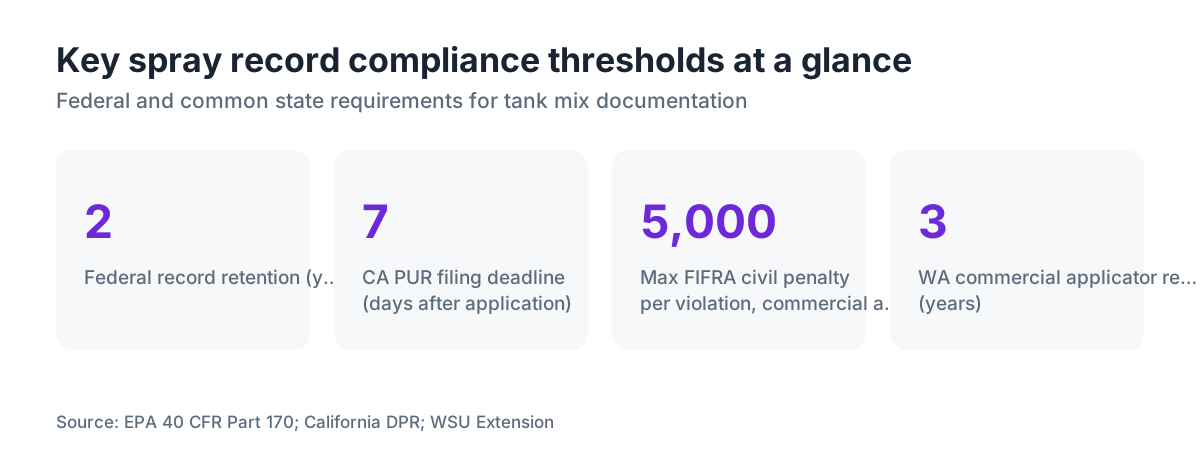
The EPA Worker Protection Standard, codified at 40 CFR Part 170, sets the federal floor for pesticide application records on farms. Under 40 CFR 170.309, employers must keep records of each pesticide application for at least two years [1]. The required fields are product name, EPA registration number, amount applied, location and size of the treated area, date of application, and the time the restricted-entry interval (REI) expires.
Read the regulation closely. It does not say "each application event." It says each product. That difference matters when you're running a tank mix with three or four actives. One spray pass equals one tractor pass, but it can equal three or four separate record entries.
Plenty of growers treat a tank mix as one log line, writing "Stylet-Oil + sulfur + copper" and calling it done. That fails a state ag department inspection almost everywhere. California's Department of Pesticide Regulation, for one, requires a separate pesticide use report for each product applied, even if they all went out in the same load [2].
The minimum fields under 40 CFR 170.309 apply everywhere in the U.S. States pile on more. Some want the applicator's license number, the equipment used, the target pest, wind speed and direction, temperature, and carrier volume per acre. Check your state's list before you assume the federal minimum covers you.
How do you list each product in a tank mix without creating a paperwork nightmare?
Use a tank mix block format. One header row carries the date, block, acres, equipment, and REI expiration. Then a sub-row for each product in the mix. The shared details get written once, and every product gets its own line for EPA registration number, rate per acre, and total volume or pounds used. That's the format most compliance-tested growers land on.
A simple pipe table replicates it on paper or in a spreadsheet:
| Application date | Block | Acres | REI expires | Product name | EPA Reg. # | Rate/acre | Total used |
|---|---|---|---|---|---|---|---|
| 2025-07-10 | Block 4N | 6.2 | 07-12 06:00 | Stylet-Oil | 48813-1 | 1 gal | 6.2 gal |
| 2025-07-10 | Block 4N | 6.2 | 07-12 06:00 | Microthiol Disperss | 70506-7 | 5 lb | 31 lb |
| 2025-07-10 | Block 4N | 6.2 | 07-12 06:00 | Nordox 75 WG | 34704-906 | 1 lb | 6.2 lb |
The EPA registration number trips people up more than any other field. It sits on the label as "EPA Reg. No. XXXXX-XXXX." Write it exactly as printed. If your mix has a generic sulfur and a proprietary adjuvant, both need EPA numbers recorded if both are registered pesticide products. Adjuvants listed as inert ingredients with no EPA registration number don't require an entry. When you can't tell whether something is registered or exempt, log it anyway and note "EPA exempt, 25(b)" if that applies [3].
WSU Extension's recordkeeping guidance is blunt about one thing: the amount applied is the actual quantity that left the sprayer into that block, not the amount mixed in the tank. Mix 100 gallons, apply 80 to one block and 20 to another, and each block record shows its proportional share [4].
What are the REI and label-reading requirements for mixed products?
Mix two or more pesticides and the REI that governs re-entry is the longest REI among all products in the tank. That's not a judgment call. It's the rule. 40 CFR 170.309 requires the record to show the REI expiration time, and that time has to reflect the most restrictive label in the mix [1].
Here's the classic miss. A grower logs the REI of the product they think of as the "main" fungicide and skips the copper, not noticing the copper label carries a 48-hour REI for early-entry workers while the sulfur runs 24. The recorded REI has to be 48 hours.
The label is the law under FIFRA Section 12(a)(2)(G), which prohibits use inconsistent with label directions [3]. For tank mix records that means you have to be able to show three things: every product went out at or below its labeled rate, no label specifically prohibited the combination, and the recorded REI covers all products applied. Cornell's pesticide management program recommends keeping a copy of the exact label revision you used with your records, because label language changes between formulation years and your record needs to hold up against the label current on the day you sprayed [5].
Does California (or your state) require more than the federal minimum?
California requires a lot more. Under California Food and Agricultural Code Section 12981 and related DPR rules, growers file a Pesticide Use Report (PUR) for each product applied, submitted to the county agricultural commissioner within seven days of application [2]. The PUR captures operator license number, site ID, specific crop, acres planted versus acres treated, pounds of active ingredient applied, and pesticide use type. California runs the most granular system in the country, and DPR publishes the statewide PUR data for anyone to read.
Oregon, Washington, and New York all layer state rules on top of 40 CFR 170.309. Washington requires private applicators to keep records two years and commercial applicators three [4]. New York requires records within two working days of application in some commercial categories.
Go straight to your state lead agency for pesticide regulation to nail down your exact obligations. The EPA lists these agencies [6]. Your state's university extension program also keeps current guidance. UC Davis IPM publishes detailed California recordkeeping requirements and updates them regularly, and WSU Extension covers Washington and the Pacific Northwest [4][7].
One thing holds everywhere. If a state inspector asks for your spray records and you can't produce them inside a reasonable window (state rules often set 24 to 72 hours), that failure is its own violation, separate from anything wrong inside the documents.
What happens if a tank mix product is missing from the record?
A missing product is a recordkeeping violation under both FIFRA and your state pesticide law. The penalties are real. California county agricultural commissioners can issue civil penalties starting around $500 per violation, and repeat offenses or violations tied to application errors can reach $5,000 or more per incident [2].
Federally, FIFRA Section 14 authorizes civil penalties up to $5,000 per violation for commercial applicators and $1,000 for private applicators, though the EPA has room in how it calculates and assesses them [3]. In practice, a first-offense recordkeeping slip on a small operation often draws a warning letter instead of a fine. That hinges on whether the inspector reads the violation as accidental or deliberate, and whether other violations came with it.
The bigger risk for most vineyards isn't the fine. It's what happens when a worker gets hurt and you can't produce a complete record. Workers have the right under 40 CFR 170.311 to request records of pesticide applications in areas where they worked, going back 30 years [1]. An incomplete record in that setting can read as negligence in civil litigation.
Organic certifiers add another layer. If your operation is certified or in transition, every input has to appear in the records you submit to your certifier. A tank mix with an unlisted product, even an allowed one, can trigger a violation of your certification plan. National Organic Program rules under 7 CFR Part 205 require that all materials used be documented and consistent with your organic system plan [8].
How do you handle partial tank loads and leftover mix?
This is where a lot of records fall apart. You mix a 200-gallon load, put 180 gallons on one block, then carry the remaining 20 to a neighboring block to finish it. Now you have two application records, each showing proportional product amounts. The first record gets 90% of each product's total; the second gets the last 10%. Simple enough until you're standing in the vineyard with a calibration sheet trying to back-calculate how much copper actually went on Block 7N.
Track water applied instead of mix ratio. It's cleaner. If your sprayer runs at a steady gallons-per-acre rate and you know how many acres you covered before stopping, you can calculate the proportional product on each block from the mix ratio. Record both the method and the result so any auditor can follow your math.
Tank rinsate is a separate problem. Rinsate applied to a field is a pesticide application if it holds active ingredient above a de minimis level. Many growers rinse over a non-crop area or a designated containment area precisely so they don't have to log the rinsate as a field application. Apply rinsate to vineyard blocks and you log it. The quantities are tiny. The requirement is identical.
Leftover mix held overnight is generally prohibited by the product label unless the label says otherwise. Read your labels. Hold mix overnight when a label prohibits it and you have a FIFRA violation, on top of any recordkeeping issue.
What records do you need for restricted-use pesticides in a tank mix?
Restricted-use pesticides (RUPs) in a tank mix carry extra recordkeeping requirements under 40 CFR Part 171 and most state commercial applicator rules. On top of the standard fields, an RUP application typically needs the name and certification number of the certified applicator who made or directly supervised it, the crop or commodity treated, and the county or geographic identifier [6].
One RUP and two general-use products in the same tank means the whole application event has to meet the RUP standard, at least for the RUP itself. Some states extend that stricter standard to every co-applied product in the load. Assume the strict standard covers the entire record and you'll stay safe.
Private applicators (growers spraying their own land) usually keep RUP records two years and make them available to state inspectors on request. Commercial applicators often keep them longer. The certified applicator's license number has to appear on each RUP record, more than on a spray season summary.
The EPA's pesticide registration and applicator certification pages lay out the federal framework, and your state lead ag agency has the specific form or field list for your situation [6].
How should tank mix records be stored and organized for inspections?
Two years is the federal floor under 40 CFR 170.309 [1]. Many states require three. California's PUR system holds data indefinitely on the state side, but you still keep your own copies. Store records somewhere dry, labeled by year and block, reachable without digging through a decade of field notes. Inspectors ask to see records on-site during unannounced visits. If your answer is "let me find that," you already have a problem.
Paper works fine legally. The EPA does not require digital records. But paper fades, gets wet, and is miserable to query when you need every application to Block 12S in the past 90 days for a pre-harvest review. A plain spreadsheet beats paper for most small operations. For a manager running more than one property or more than a dozen blocks, a purpose-built recordkeeping system takes the REI math, product lookup, and state-specific fields off your plate, which is where omissions usually creep in. VitiScribe is built for vineyard compliance and pre-fills EPA registration numbers and REI data when you pick a product, which cuts the odds of a field omission.
Whatever the format, every record has to read clearly to someone who wasn't there. Write block names, more than numbers. Write the full product name as it appears on the label, not a brand nickname. The person reviewing your records in 18 months might be an insurance adjuster or a certification auditor who has never set foot in your vineyard.
Are there specific label compatibility requirements to document when tank mixing?
Yes, and most growers underestimate this layer. FIFRA Section 12(a)(2)(G) prohibits use inconsistent with labeling [3]. Some labels flatly prohibit mixing with specific product categories. Copper labels often say do not tank mix with oil-based products. Certain biological fungicides prohibit mixing with low-pH products. If your record shows two label-incompatible products, that record is evidence of a FIFRA violation, more than a recordkeeping slip.
The EPA's standard is that any direction on a label binds you unless a different direction appears elsewhere on that same label. So a label reading "do not mix with copper" holds. You can't argue that a general use direction somewhere else on the label overrides it.
Documenting compatibility takes more than a jar test. Keep a note in your records of where you verified compatibility. The product label counts. A written recommendation from a licensed pest control adviser (PCA) counts. So does a published compatibility guide from a university extension program. UC Cooperative Extension publishes tank mix and compatibility guidance for key California wine grape pesticides, and noting that you referenced it is a defensible habit [7].
Some states require a PCA recommendation on file before you apply certain combinations. California requires a written recommendation from a licensed PCA for any pesticide application on agricultural land, and it has to specify the products and rates [9]. Keep the PCA recommendation with your spray records, not filed off somewhere else.
What's the right process for training employees on tank mix recordkeeping?
Under 40 CFR 170.311, agricultural employers have to provide pesticide safety training to workers before they enter areas treated within the last 30 days, and those training records stay separate from application records [1]. But the people actually filling out spray records, whether that's the vineyard manager, a crew lead, or a spray contractor, need their own training on what a legally complete record contains.
The common gap isn't ignorance of the law. It's sloppy habits that build up when nobody checks the records until an inspection. Put one person in charge of spray records. Review them weekly during spray season, not in December. Compare product names against the labels you have on file. Confirm the EPA registration number matches the container in hand, not a label from last year's purchase.
WSU Extension's pesticide safety training resources and the EPA's WPS training materials are both free and cover recordkeeping inside the broader compliance curriculum [1][4]. For crews whose primary language is Spanish or another language, the EPA's WPS materials come in multiple languages, which matters for compliance and for plain accuracy when a crew member is the one filling out field records.
One habit worth building: photograph the label of each product in a tank mix on the day of application and store that photo with the matching spray record. Label language changes. A time-stamped photo of the exact revision you worked from beats "I think it said that" two years down the road.
What does a complete, legally defensible tank mix spray record look like?
Here's a field-ready checklist for a complete three-product tank mix record. Every field is required somewhere in the U.S. Your state may not want all of them, but include them all and you're covered anywhere.
Application header (once per event):
- Date of application
- Start time and end time (some states require this)
- Applicator name and license or certification number
- Equipment used (type, ID number if applicable)
- Target block(s) and GPS or address-level location
- Acres treated (not total vineyard acres)
- Crop stage (bud swell, bloom, post-set, etc.)
- Target pest(s)
- Carrier volume per acre (gallons/acre water)
- Weather at application: temperature, relative humidity, wind speed and direction
- PCA recommendation on file (required in California)
Per-product rows (one per product in the mix):
- Product name (exactly as on label)
- EPA registration number (exactly as on label)
- Formulation type (WP, WG, EC, etc.)
- Rate per acre (with units: lb/acre, fl oz/acre, gal/acre)
- Total amount applied to the treated block(s)
- REI from this product's label
REI summary:
- Longest REI from all products in the mix
- Calculated REI expiration: date and time
- Whether early-entry PPE applies
Fill out every line for every application and you're in better shape than most operations that get cited. The citations almost always come from the same three misses: a missing EPA registration number, a missing total-amount-applied figure, or a single REI logged that doesn't match the most restrictive product in the mix. A checklist and a second set of eyes fix all three.
VitiScribe's spray record module is built around this exact field set, pulling EPA registration data and REI lookup straight into the form so the required fields stay visible. If you're ready to move past spreadsheets, there's a 14-day trial at vitiscribe.com.
Frequently asked questions
Do I need a separate record entry for every pesticide in a tank mix?
Yes. Federal rules under 40 CFR 170.309 and nearly all state pesticide laws require a record entry showing product name, EPA registration number, rate, and total amount applied for each product. Lumping two or three products onto one line is a recordkeeping violation in most states, even when the application itself was correct.
What EPA registration number format do I record for tank mix products?
Record it exactly as printed on the label: EPA Reg. No. XXXXX-XXXX. The first set of numbers is the registrant's company number; the second is the product number. Don't abbreviate or transpose. If the container is a different lot than a prior purchase, confirm the number hasn't changed, since reformulations can carry a new registration number.
Which REI do I record when my tank mix has products with different REIs?
Always record the longest REI among all products in the mix. If Product A has a 4-hour REI, Product B has 24 hours, and Product C has 48 hours, you record the 48-hour REI as the governing expiration for the whole application event. This is required by 40 CFR 170.309 and by the most restrictive label rule under FIFRA.
How long do I have to keep spray records for a vineyard operation?
Federal law under 40 CFR 170.309 requires two years minimum. Many states require three. California's county pesticide use report requirement doesn't reduce your own retention obligation. If your operation is certified organic, NOP rules under 7 CFR Part 205 effectively require longer retention as part of your certification documentation. When in doubt, keep five years.
What happens if a spray contractor applies the mix but I own the vineyard?
Responsibility depends on how the work is classified. A contractor applying pesticides as a commercial applicator carries recordkeeping obligations under their license. But as the agricultural employer and landowner, you also have obligations under 40 CFR 170.309 for your own WPS records. Get a copy of the contractor's spray record for every application. Don't assume their records exist if an inspector shows up.
Can I use a digital or app-based spray record instead of paper?
Yes. Neither the EPA nor any state currently requires paper. Digital records are legally equivalent as long as they capture all required fields and can be retrieved for inspection. The practical advantage is that required fields can be enforced at entry, which cuts the chance of a missing EPA number or REI. Back up digital records to a second location so a device failure doesn't create a two-year gap.
Do I need to record adjuvants or surfactants in a tank mix spray record?
If the adjuvant or surfactant carries an EPA registration number, treat it as a registered pesticide product and record it with all required fields. If it's an inert or exempt material with no EPA registration number (a 25(b) exempt product, for instance), it doesn't require a use record, though noting it is a good habit. When unsure, look for an EPA Reg. No. on the label.
What do California's pesticide use report requirements add beyond federal minimums?
California requires a Pesticide Use Report (PUR) filed with the county agricultural commissioner within seven days of each application, separately for each product. Required fields include operator license number, site ID, specific crop, acres planted versus treated, and pounds of active ingredient. This goes well past federal WPS minimums and applies to every agricultural pesticide application, not only restricted-use products.
Does a pre-mix product with two active ingredients count as one or two records?
A pre-mix that comes in one container with one EPA registration number counts as one product entry. You list the single EPA registration number and the product name as labeled. Both active ingredients appear on that label, so they're covered by the one entry. Add a second product to the tank and that second product gets its own record row.
What records do I need to keep when tank mixing for an organic operation?
Organic operations under USDA NOP (7 CFR Part 205) must document every input used, consistent with the approved organic system plan. Every product in a tank mix has to appear in your records with enough detail for a certifier to verify it's on the approved National List. Keeping the product's OMRI listing or your certifier's written approval alongside the spray record is what most certifiers expect.
Is there a federal form for pesticide application records, or do I make my own?
There's no mandatory federal form. 40 CFR 170.309 specifies the required fields but not the format. You can use paper, spreadsheets, or software. Some states offer optional forms through their agricultural department. California requires the specific PUR form for the county submission. For your own records, any format that captures all required fields legibly and in order is legally acceptable.
What should I do if I realize I left a product out of a spray record after the fact?
Correct the record as soon as you find the error, date the correction, and note that it corrects a prior entry. Don't backdate or alter the original entry. If the omission surfaces during an inspection, self-disclosure before the inspector catches it is generally treated more favorably than an auditor finding it. Document what you changed and why in a short note attached to the record.
Do spray records need to include weather conditions at time of application?
Federal WPS regulations don't specifically require weather data in the record, but many state rules do, and some labels allow application only within specific wind speed or temperature ranges. Apply under label-specified weather conditions and logging the weather at the time of application is the only way to show you complied. California recommends it; Washington requires wind speed and direction for certain application categories.
Sources
- EPA, 40 CFR Part 170 Worker Protection Standard: Employers must keep records of each pesticide application, including product name, EPA registration number, amount applied, treated area, date, and REI expiration, for at least two years under 40 CFR 170.309; workers may request records under 40 CFR 170.311.
- California DPR, Pesticide Use Reporting: California requires a separate Pesticide Use Report for each pesticide product applied, filed with the county agricultural commissioner within seven days, including pounds of active ingredient and acres treated.
- EPA, Federal Insecticide, Fungicide, and Rodenticide Act (FIFRA): FIFRA Section 12(a)(2)(G) prohibits use of any pesticide in a manner inconsistent with its labeling; Section 14 authorizes civil penalties up to $5,000 per violation for commercial applicators.
- Washington State University Extension, Pesticide Recordkeeping: The amount applied must be the actual quantity that left the sprayer into that block, not the amount mixed; Washington requires private applicators to keep records two years and commercial applicators three.
- Cornell University, Pesticide Management Education Program: Cornell's pesticide management resources recommend keeping the specific label revision used on the date of application with the spray record, as label language and requirements change between formulation years.
- EPA, Pesticides Program and State Lead Agencies: The EPA lists state lead agencies for pesticide regulation and outlines restricted-use pesticide recordkeeping requirements including certified applicator license number for each RUP application.
- UC Statewide IPM Program (UC ANR): UC Cooperative Extension publishes tank mix and compatibility guidance for California wine grape pesticides and details California-specific recordkeeping requirements updated regularly.
- USDA Agricultural Marketing Service, National Organic Program 7 CFR Part 205: NOP regulations under 7 CFR Part 205 require certified organic operations to document all inputs used, consistent with the approved organic system plan, with records available to certifiers on request.
- California DPR, Licensing and Certification Program: California requires a written recommendation from a licensed pest control adviser before applying pesticides on agricultural land, specifying products and rates; this recommendation must be kept with spray records.
- EPA, Pesticide Registration: EPA registration numbers appear on labels in the format EPA Reg. No. XXXXX-XXXX and must be recorded exactly as printed; reformulations may carry new registration numbers requiring updated records.
Last updated 2026-07-11