Recording wind speed and direction at time of vineyard spray application

TL;DR
- Most state pesticide regulations and the EPA Worker Protection Standard require applicators to record wind speed and direction at the time of each spray application.
- The practical threshold most extensions recommend is 0 to 10 mph for aerial and ground applications, with spraying generally stopped above 15 mph.
- Accurate, timestamped records protect your license, your workers, and your neighbors.
Why do you have to record wind speed and direction when you spray?
The law says so. And drift liability is real, so you'd want the record even if the law were silent.
The EPA's Worker Protection Standard (40 CFR Part 170) and most state departments of agriculture require that pesticide application records include weather conditions at the time of application. Wind speed and direction sit at the top of that list. The Federal Insecticide, Fungicide, and Rodenticide Act (FIFRA) also requires that applicators follow label directions, and pesticide labels increasingly include wind-speed limits as a condition of use. Spraying outside those limits while skipping the weather log is a double violation.
The practical reason matters just as much. Drift complaints are the number one neighbor dispute in agricultural areas next to residential development, and vineyards in California's coastal valleys, Oregon's Willamette Valley, and Washington's Yakima Valley sit right up against homes, schools, and organic operations. If a neighbor's garden dies or a beekeeper loses a hive, your spray record is the first document an investigator asks for. A clean, timestamped wind log showing 4 mph from the southwest is your best defense. A missing record reads as guilt.
Washington State University Extension has been explicit on this point for over a decade: "Complete records of each pesticide application, including weather conditions, are essential for demonstrating compliance and for troubleshooting if a problem arises" [1].
What wind speeds are actually safe for spraying in a vineyard?
There's no single federal number. But most university extension programs and pesticide labels converge on 3 to 10 mph as the sweet spot, with hard stops above 15 mph.
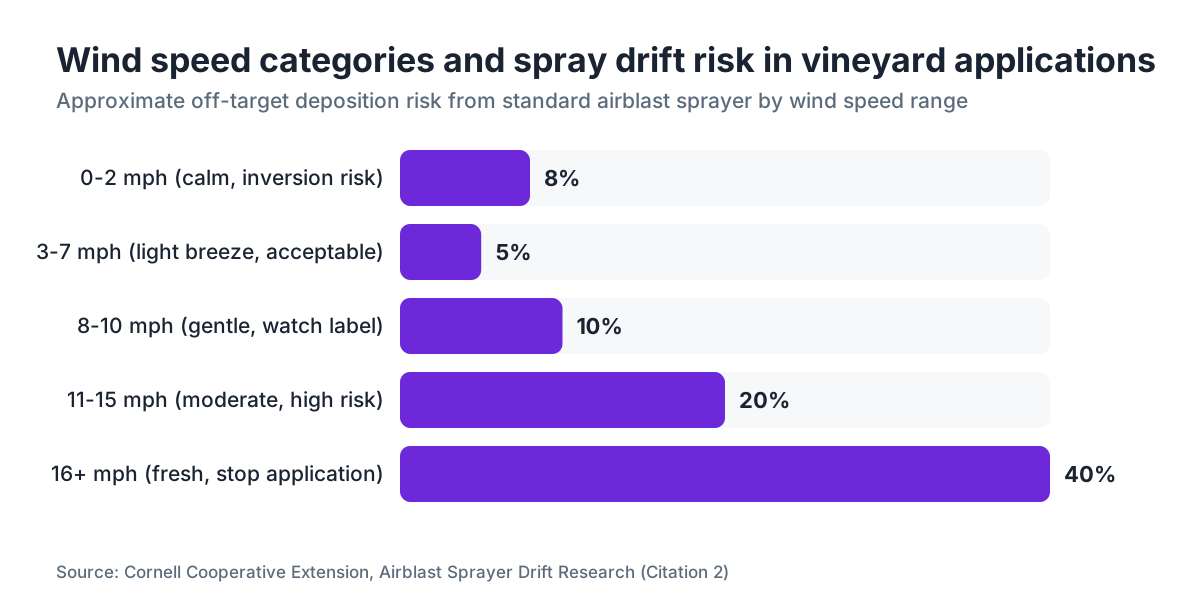
Here's why that range makes sense in practice. Below 3 mph (near-calm), temperature inversions and unstable air can carry fine droplets unpredictably, sometimes depositing them further from the target than a light breeze would. Between 3 and 10 mph, air movement is steady enough to carry the spray through the canopy and dissipate droplets before they travel far. Above 10 mph, fine droplets from most airblast sprayers and spray nozzles start moving off-target in measurable quantities. Above 15 mph, drift from a standard vineyard airblast sprayer can deposit product well beyond 100 feet from the application point, depending on droplet size and nozzle type [2].
UC Davis Cooperative Extension recommends that growers consult individual product labels, because some newer chemistries, particularly certain Group 3 fungicides and systemic insecticides, carry explicit label language capping applications at 10 mph or even lower [3]. If the label says 10 mph and you spray at 12, you are out of compliance regardless of what general guidance says. The label is the law.
For reference, here is how common wind categories map to spray risk:
| Wind Speed (mph) | Beaufort Description | Typical Spray Risk |
|---|---|---|
| 0-2 | Calm to light air | Moderate (inversion risk, unpredictable drift) |
| 3-7 | Light breeze | Low (generally acceptable) |
| 8-10 | Gentle breeze | Low to moderate (watch label limits) |
| 11-15 | Moderate breeze | High (many labels prohibit spraying) |
| 16+ | Fresh breeze or above | Very high (stop application) |
These thresholds assume standard airblast equipment. Drone and aerial applications carry stricter limits, often capped at 10 mph in FAA and EPA guidance [4].
What exactly do you need to record, and what format does it have to be in?
The minimum federal baseline comes from FIFRA and the EPA WPS. For any restricted-use pesticide (RUP) application, federal law requires the applicator to keep records that include the date, product, EPA registration number, total amount applied, location, and the name and certification number of the certified applicator. Weather conditions are required by most states on top of that baseline, and California, Washington, Oregon, and New York are among the states that explicitly require wind speed and direction in their commercial pesticide application records [5][6].
In California, the Department of Pesticide Regulation (CDPR) requires that the pesticide use report (PUR) submitted to the county agricultural commissioner include the wind speed and direction at the time of application. That is not optional. Growers who leave the field blanks consistently get flagged during routine audits [5].
No federal rule requires a specific form. Most states publish their own recommended record sheets, and your county ag commissioner likely has one. What matters is that the record is:
- Timestamped (date and approximate start time of application)
- Specific about location (block name, APN, or GPS coordinates)
- Recording wind speed in mph or km/h (more than "low" or "light")
- Recording the direction the wind is coming FROM (cardinal or intercardinal: N, NE, SW, etc.)
- Signed by the applicator or the certified private applicator responsible
The direction note trips people up. "Wind from the southwest" means spray is moving toward the northeast. That context matters enormously if a neighbor to your northeast files a drift complaint.
Records for restricted-use pesticides must be kept for at least 2 years under federal law [7]. Many states require longer, and California's PURs effectively create a permanent public record. Keep your own copies for at least 3 years regardless of what your state minimum says.
How do you actually measure wind speed in the field?
You have four realistic options, ranked from most to least reliable for a compliance record.
A dedicated weather station on the property is the gold standard. Stations from Onset HOBO, Davis Instruments, or similar manufacturers log wind speed and direction continuously, timestamp the data, and export it to a spreadsheet or cloud service. A basic station with a cup anemometer and wind vane runs $300 to $800 installed, and the data is automatically defensible because it is continuous and not manually entered [8]. If you are managing more than 20 acres with regular spray programs, this pays for itself in one avoided fine.
A handheld digital anemometer is the most common field tool. Models from companies like Kestrel or generic imports run $40 to $250. The Kestrel 1000 or 2000 series are popular with applicators because they fit in a shirt pocket, read in seconds, and are accurate to within about 3% for wind speed. The limitation is discipline. You have to remember to pull it out, read the number, and write it down, and the record is only as good as your habits.
A NOAA-certified nearby weather station works as a reference if it is within roughly 1 to 3 miles and at a similar elevation with no major terrain differences. The Western Regional Climate Center and NOAA maintain networks of public stations whose data is timestamped and publicly archived, which makes it auditable [9]. The problem in hilly wine country is that a station on the valley floor tells you almost nothing about wind at your ridge-top block. Use nearby stations only as a backup or cross-check.
The Beaufort scale visual estimate is technically an option, and some older record-keeping systems still reference it. It is the least defensible. "Leaves and small twigs in constant motion" (Beaufort 3, roughly 8 to 12 mph) is not a number. An inspector or plaintiff's attorney can pick it apart. Use a real anemometer.
Whichever tool you use, take the wind reading at the actual field block, not at the barn or shop, and record it at the start and end of the application at minimum. Long applications covering multiple blocks over several hours should log readings every hour or so, especially if conditions are variable.
Does wind direction matter as much as wind speed for compliance?
Yes. And it's the more legally interesting of the two.
Wind speed tells you whether drift is likely. Wind direction tells you where that drift goes. A 9 mph wind blowing from the north when your block's southern boundary abuts an organic vineyard is a compliance problem even if 9 mph is within your label's limit, because drift toward a certified organic operation can result in decertification of their crop and a tort claim against you. The California Organic Products Act and USDA's National Organic Program both hold that pesticide contamination from neighboring operations can affect organic certification status [10].
This is not hypothetical. There are documented cases in California's Paso Robles area and Sonoma County where drift complaints from organic neighbors led to county investigations and civil settlements. The spray record showing wind direction is often what decides whether the applicator was negligent.
For the spray record, you want three things: the direction the wind is blowing FROM (meteorological convention, so "NW" means wind coming from the northwest, moving toward the southeast), your block orientation, and a note about what sits downwind. Some applicators sketch a simple arrow on the record form. That takes ten seconds and is worth doing.
WSU Extension's pesticide application guidance notes that applicators should evaluate "the proximity of sensitive areas, including residences, schools, water bodies, and neighboring crops" as part of the pre-spray checklist, and wind direction is the variable that connects your spray block to those sensitive areas [1].
What happens if you spray and forget to record wind conditions?
A missing record isn't always a citation. But it's never good.
In California, a missing or incomplete pesticide use report is a violation of Food and Agricultural Code Section 12997. Penalties range from a written warning for a first offense to fines up to $5,000 per violation for repeat violations, and in cases involving drift incidents, the California Department of Pesticide Regulation can suspend or revoke an applicator license [5]. Washington and Oregon have similar penalty structures.
Beyond the regulatory risk, an incomplete record is a litigation liability. If a drift complaint is filed and your records show the spray date and product but no wind data, a reasonable assumption in any legal proceeding is that you did not check conditions. That is not where you want to be.
The fix is simple. Build wind recording into your spray checklist so it happens before the rig leaves the barn. The reading takes 30 seconds with a handheld anemometer. The record entry takes another 30 seconds. That minute of discipline covers years of exposure.
How do vineyard spray records differ from general pesticide records?
The underlying legal framework is the same. FIFRA, the WPS, and state regulations apply to vineyards exactly as they apply to any agricultural operation. But vineyards carry specific considerations that make accurate wind records more consequential.
First, the spray calendar is dense. A full-season Napa or Sonoma vineyard program might run 12 to 20 spray applications between budbreak and veraison. That is a lot of records, and the volume creates pressure to cut corners on weather data. Don't.
Second, airblast sprayers, the dominant equipment in most wine grape operations, produce a much wider range of droplet sizes than boom sprayers and can generate significant drift even at moderate wind speeds. Cornell Cooperative Extension's research on airblast drift found that without drift-reduction nozzles, 5 to 15% of applied product can be deposited outside the target zone under normal operating conditions [2]. Wind speed multiplies that percentage directly.
Third, many wine grape regions have terrain-driven wind patterns that are notoriously variable. Coastal California valleys get afternoon winds that regularly hit 15 to 25 mph. Yakima Valley corridors funnel northwest winds in the afternoon. If you spray in the morning calm and your records show 3 mph from the northwest, that's a clean record. If you sprayed at 2 pm and wrote nothing down, you have a problem.
For vineyard managers juggling multiple blocks, remote staff, or custom crush agreements where spray work is contracted out, record-keeping gets complicated fast. A field-level record form that contractors fill out on paper and photograph before leaving the block is a minimum standard. Digital tools that log GPS location, timestamp, and weather data automatically are genuinely useful here, and VitiScribe is built for this kind of vineyard compliance workflow, letting applicators capture weather data from a phone in the block and attach it to the application record in real time.
Can you use a weather app on your phone instead of a real anemometer?
You can, with caveats, and some inspectors will accept it. But it is not your best option.
Weather apps pull data from the nearest reporting station, which in wine country can be miles away and at a very different elevation. The National Weather Service and NOAA acknowledge that localized wind conditions in complex terrain can differ substantially from the nearest official observation point [9]. If your block sits in a narrow draw and the reporting station is on an airport four miles away, the app reading is essentially fiction.
That said, if you are in flat country, the reporting station is nearby, and the app shows the station name and a recent timestamp, a screenshot saved to your records beats nothing. Some growers use Weather Underground's Personal Weather Station network, which is denser than official NOAA stations and sometimes has a station a half mile away. That station data is archived and retrievable, which helps with an audit.
The honest answer is that a $40 handheld anemometer removes all of this uncertainty. It is the cheapest piece of equipment you can buy for compliance purposes, and it reads actual conditions at the actual block. There is no legitimate reason not to own one.
How do commercial vineyard operations handle wind records at scale?
Large operations, say 500 acres and up with multiple spray crews running at once, face a coordination problem that paper forms don't solve well.
The common approaches in commercial vineyard management are:
Fixed weather stations per zone. If your property has distinct microclimates across three ridges, a station on each ridge gives you localized, continuous data that is automatically timestamped and archived. The cost is real ($500 to $1,500 per station installed), but so is the legal protection.
Crew lead responsibility. The licensed applicator or crew lead owns the weather log entry. That person holds the anemometer, takes readings at each block, and enters the data before moving the rig. This works when there is clear accountability and falls apart when there isn't.
Integrated spray record software. Several platforms now connect field weather readings to application records, attach GPS coordinates, and push everything to a cloud record that is timestamped and auditable. For multi-block, multi-crew operations, this is where the industry is moving. The records are harder to lose, easier to produce in an inspection, and the audit trail builds itself.
Cornell's Integrated Pest Management program has published guidance on record-keeping for commercial operations that covers both the legal minimums and the practical systems larger growers use to stay organized across a season [11]. Their recommendation matches what most experienced vineyard managers already know: the system that actually gets used consistently beats the ideal system that falls apart under spray-season pressure.
VitiScribe's spray log module, to mention it once more, is built for exactly this, combining applicator certification tracking, product records, and timestamped weather capture in one place.
What does the EPA Worker Protection Standard say about spray conditions?
The WPS (40 CFR Part 170) focuses mostly on protecting agricultural workers from pesticide exposure rather than on environmental drift, but its requirements run straight into wind recording.
The WPS requires that when a pesticide application is taking place, workers in the area must be notified and exclusion zones around the application must be maintained. The size of those exclusion zones depends partly on the application method and the product, but wind conditions determine whether those zones are actually being honored in practice. A 25-foot exclusion zone means nothing if the wind is carrying spray 75 feet downwind to where your pruning crew is working.
The revised WPS that took effect in January 2017 added a requirement that handlers check and comply with all pesticide label application exclusion zones, including restrictions related to wind speed. The EPA's summary of the revised WPS states: "Handlers must not apply a pesticide in a manner that causes contact with workers or other persons" [12]. Wind speed and direction are what determine whether that standard is being met.
For employer recordkeeping under the WPS, application-specific information including the field and date must be available to workers and their representatives for 30 years. This is a much longer retention period than the 2-year federal minimum for pesticide use records, and it applies to any operation with more than 10 employees. Keep your spray records, including weather data, accordingly.
What's the best system for keeping wind records that will actually hold up in an audit?
The record that holds up is the one that was clearly made in real time, at the field, by the person doing the work.
Post-hoc reconstruction of weather conditions using historical data looks like exactly what it is. Inspectors have seen it. A record where every entry is tidy and all wind speeds happen to fall at exactly 5 mph from a favorable direction reads as suspicious. Real field records have some variability: 6 mph, then 8 mph at the next block, then conditions that shifted and the crew noted it.
A defensible system has these elements:
Timestamp at the block. Not "Monday morning" but "7:42 AM." If you use a phone, the metadata timestamp on a photo of the paper form or a digital entry records itself.
Actual measured values, not estimates. A number in mph, not "light" or "breezy."
The applicator's signature or initials. Someone takes responsibility for the data.
Consistency with product applied. If your record shows you sprayed a contact fungicide that has a 10 mph wind limit and your wind reading shows 12 mph, that is a self-incriminating record. Better not to have sprayed at 12 mph in the first place, but if conditions shifted unexpectedly mid-application, document it. "Wind increased to approximately 12 mph during application of southwest block; application halted at 10:15 AM" is a defensible note.
Backup with station data where possible. If you have a property weather station, cross-reference your manual log readings against it now and then to show your handheld anemometer is roughly calibrated. This is the kind of detail that impresses an inspector and signals you take the record seriously.
Frequently asked questions
Is recording wind speed legally required for every vineyard spray application?
For restricted-use pesticides (RUPs), yes, federal FIFRA records are required, and most states add wind speed and direction on top. For general-use pesticides, requirements vary by state. California requires wind data on all commercial pesticide use reports regardless of RUP status. Check your state's department of agriculture requirements. When in doubt, record conditions for every application. The habit costs almost nothing and protects you completely.
What wind speed should I stop spraying in the vineyard?
The practical answer is 10 mph for most applications, with a hard stop at 15 mph. Many product labels now set an explicit cap at 10 mph, and that label limit is legally binding under FIFRA. UC Davis Cooperative Extension recommends checking individual product labels because some newer chemistry groups carry lower wind limits. When conditions approach your label limit, stop, document the time and conditions, and resume when wind drops.
What direction do I record, the direction the wind is coming from or going to?
Standard meteorological convention records the direction the wind is coming FROM. A north wind blows from north to south. This is how NOAA weather stations report wind and how most state pesticide record forms expect the entry. Note it clearly on your form: "Wind from SW at 6 mph." This matters for drift analysis because it tells you exactly which direction spray is moving toward, which is what regulators and lawyers want to know.
Can I use historical NOAA weather data to fill in missing wind records?
Technically you can pull historical data from the nearest NOAA station, but using it to retroactively complete records you forgot to keep in the field is a compliance risk. Inspectors know that maneuver. If the station is very close and at similar terrain, the data has some probative value, but it should supplement real-time field measurements, not replace them. A missing record is better addressed by honest disclosure than by reconstruction that may not match actual conditions.
How long do I have to keep vineyard spray records?
Federal law requires 2 years for restricted-use pesticide records under FIFRA. The EPA Worker Protection Standard requires application records be available for 30 years for operations with more than 10 employees. California's pesticide use reporting system creates a permanent public record. As a practical rule, keep your own copies for at least 3 years. For records involving WPS-covered workers, keep them for 30 years or transfer them if you sell the operation.
Does wind direction matter if I'm just applying organic-approved products?
Yes. Even organic-approved inputs like copper, sulfur, and biological fungicides can cause neighbor relations and regulatory issues if they drift off-target. Copper drift onto a neighboring certified organic vineyard can create contamination concerns. Sulfur drift onto a beehive can cause significant bee mortality. The record-keeping obligation under state pesticide regulations usually applies to all registered pesticide products, including those on the OMRI or National Organic Program lists.
What's a good handheld anemometer for vineyard spray applications?
The Kestrel 1000 or 2000 series are the most commonly used by applicators in western wine regions. They read to within about 3% accuracy, are waterproof, and cost $40 to $120 depending on the model. Basic cup anemometers work fine too. The key features you want are digital display in mph, a fast response time, and durability. There is no regulatory requirement to use a specific brand or model. Calibration is not formally required, but checking your device against a reference occasionally is good practice.
What happens if a neighbor complains about drift and I don't have wind records?
Your county agricultural commissioner will investigate. Missing records significantly weaken your position because you cannot demonstrate that you followed label restrictions or operated under compliant wind conditions. In California, this can result in fines from a written warning up to $5,000 per violation, and in cases involving damage, civil liability exposure. With complete records showing compliant conditions, you have a factual defense. Without them, the complaint is much harder to rebut.
Do I need to record wind speed during both ground and aerial spray applications?
Yes, and aerial applications typically have stricter wind speed limits. FAA and EPA guidance for aerial applications commonly caps wind at 10 mph, and some products require less. Ground-rig airblast applications in vineyards generate significant drift above 10 mph due to the high-volume air delivery. Both application types require weather condition records in most states. The record for an aerial application should also note the height of application, as higher flights increase drift potential substantially.
How often should I take wind readings during a long spray application?
At minimum, record conditions at the start and end of each application session. For applications lasting more than two hours, or covering multiple blocks on opposite sides of a property, take readings at each block or every hour, whichever comes first. Wind conditions in wine country terrain can change substantially within an hour, especially in coastal valleys with afternoon sea breeze patterns. A morning reading does not represent afternoon conditions. Log times with each reading so the record reflects the actual application window.
Can contracted spray applicators use their own records, or do I as the grower also need records?
Both you and the contractor may have obligations. The certified commercial pesticide applicator is required to keep records under FIFRA and state law. However, California's pesticide use reporting system requires the grower or operator of the property to ensure reports are filed with the county commissioner. Get a copy of every spray record from your contractor at the time of application, including their weather data. Do not wait until an audit to discover the contractor's records are incomplete or lost.
Is there a required format for vineyard pesticide application records?
Federal law does not require a specific form, but most states publish recommended formats. California's pesticide use reporting requirements are codified in the Food and Agricultural Code, and the county agricultural commissioner provides standard forms. Washington's Department of Agriculture and Oregon's Department of Agriculture both have publicly available record templates. As long as your record includes the required data fields, including weather conditions, it does not have to be on a state-issued form. Digital records are generally acceptable if they are accurate and retrievable.
What's the difference between what the EPA WPS requires and what my state requires?
The EPA WPS sets a federal floor for protecting agricultural workers during and after pesticide applications. States can and routinely do add requirements on top of that. California, Washington, and Oregon have state pesticide regulations that require more detailed weather logging, faster reporting, and longer record retention than the federal baseline. When state requirements are stricter than federal, the state rules apply. Always consult your state department of agriculture's current applicator requirements, more than the federal WPS text.
Sources
- Washington State University Extension, Pesticide Application Records: Complete records of each pesticide application, including weather conditions, are essential for demonstrating compliance and for troubleshooting if a problem arises.
- UC Davis Cooperative Extension, Pest Management Guidelines: Grape: Individual product labels for newer fungicide chemistry groups carry explicit wind speed limits at or below 10 mph as conditions of application.
- EPA, Pesticide Registration Notice on Aerial Application Drift Reduction: Aerial pesticide applications are commonly subject to wind speed caps of 10 mph or lower per EPA and FAA guidance.
- California Department of Pesticide Regulation, Pesticide Use Reporting: California pesticide use reports submitted to the county agricultural commissioner must include wind speed and direction at the time of application; penalties for violations of Food and Agricultural Code Section 12997 range up to $5,000 per violation.
- Oregon Department of Agriculture, Pesticide Application Records Requirements: Oregon commercial pesticide application records must include weather conditions, including wind speed and direction, at the time of application.
- EPA, FIFRA Section 8 Record-Keeping Requirements for Certified Applicators: Federal law under FIFRA requires restricted-use pesticide application records to be retained for at least 2 years.
- Onset HOBO Data Loggers, Weather Station Product Information: Basic weather stations with cup anemometer and wind vane suitable for vineyard monitoring are available in the $300 to $800 installed price range.
- NOAA National Centers for Environmental Information, Local Climatological Data: Localized wind conditions in complex terrain can differ substantially from the nearest official NOAA observation point, particularly in hilly agricultural regions.
- USDA National Organic Program, Pesticide Contamination and Organic Certification: Pesticide contamination from neighboring non-organic operations can affect the organic certification status of a certified organic crop under the National Organic Program.
- Cornell Cooperative Extension, Integrated Pest Management Record-Keeping Guidance: Cornell IPM guidance recommends consistent, real-time field record systems over ideal systems that fail under operational pressure during spray season.
- EPA, Revised Worker Protection Standard (40 CFR Part 170), 2015: The revised WPS states: 'Handlers must not apply a pesticide in a manner that causes contact with workers or other persons'; application records under WPS must be available for 30 years for operations with more than 10 employees.
Last updated 2026-07-09