How long does veraison take in the vineyard?
TL;DR
- Veraison, the onset of berry ripening, runs 4 to 6 weeks from the first berries changing color or softening to the last clusters reaching full ripeness.
- It moves in two phases: a fast color-change and softening window of 7 to 14 days per cluster, then a slower stretch of sugar accumulation.
- Variety, heat units, crop load, and vine water status compress or stretch that timeline.
What exactly is veraison and when does it start?
Veraison is the French term, borrowed straight into English viticulture, for the onset of berry ripening. It marks the point where berries stop packing away malic acid and green compounds and start converting sugars, softening their skins, and, in red varieties, building anthocyanins. In whites you won't see a shift to red or purple, but you will watch the berries go from hard, opaque green to translucent yellow-green, soft enough to feel it between your fingers.
The trigger is not a calendar date. It's a thermal threshold. Grapevines accumulate growing degree days (GDD) from April 1 in the Northern Hemisphere using a base temperature of 50°F (10°C), and veraison onset tends to land somewhere between 1,400 and 2,200 GDD depending on variety and region [1]. Early-ripening varieties like Pinot Noir and Chardonnay hit veraison closer to 1,400 GDD. Late-ripening varieties like Cabernet Sauvignon and Mourvèdre often need 1,700 GDD or more before the first berries turn.
Within a single vineyard, veraison does not arrive all at once. A cluster usually shows its first colored or softened berries at the tip of the rachis, then color creeps toward the shoulders. One cluster takes 7 to 14 days to finish color change. Across a full block, with variation between rows, aspects, and vine vigor, the whole thing runs 3 to 4 weeks. Add the sugar accumulation period that follows and you're looking at 4 to 6 weeks before the block is ready to sample for harvest decisions [2].
How long does veraison last from first color to full ripeness?
Four to six weeks is the honest answer, and that range moves based on conditions you can actually measure.
Here's how the phases break down. In the first 7 to 14 days after onset, berries in the earliest clusters soften, lose chlorophyll, and start anthocyanin synthesis. Brix is still low, often 5 to 10°, and acid is still high. During weeks 2 through 4, the bulk of the block changes color. Sugar starts climbing, and this is when weekly Brix sampling gives you a real accumulation rate. During weeks 4 through 6, the last clusters finish, sugar accumulates at roughly 0.2 to 0.5°Brix per day in warm conditions, and pH rises as malic acid degrades [3].
If you track heat units, the stretch from veraison onset to commercial harvest is typically around 400 to 700 GDD (base 50°F), depending on your target ripeness and variety. UC Davis viticulture work has long used the Winkler Index, which sums GDD from April 1 through October 31, to characterize growing regions and predict how varieties behave in them [1].
Write this number down. A Brix accumulation rate below 0.1° per day late in the season means the vine is stalling, usually from water stress, disease pressure, or potassium deficiency. A rate above 0.6° per day during a heat spike means start sampling more often, because harvest can arrive faster than your schedule expects.
Does veraison timing differ by grape variety?
Yes, and it's the biggest single factor in when veraison starts relative to the calendar. Climate sets the pace, but variety sets the starting gun.
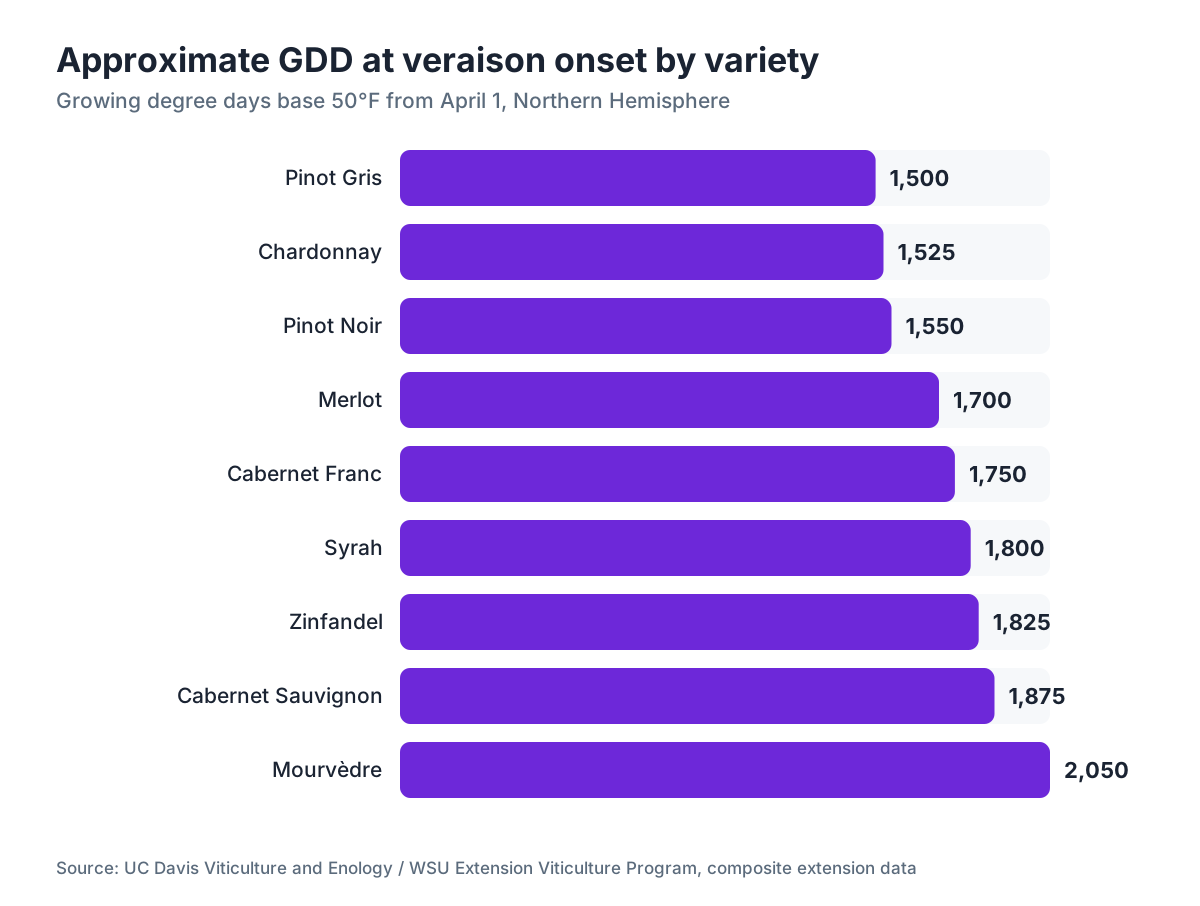
The table below gives approximate GDD (base 50°F, from April 1) at veraison onset for common varieties, drawn from UC Davis and WSU extension data [1][4]. These are ranges, not fixed points, because vine age, rootstock, and site all nudge the threshold.
| Variety | Ripening Group | GDD at Veraison Onset (approx.) |
|---|---|---|
| Pinot Gris | Early | 1,400 to 1,600 |
| Chardonnay | Early | 1,400 to 1,650 |
| Pinot Noir | Early | 1,450 to 1,650 |
| Merlot | Mid | 1,600 to 1,800 |
| Syrah | Mid-late | 1,700 to 1,900 |
| Cabernet Sauvignon | Late | 1,750 to 2,000 |
| Cabernet Franc | Mid | 1,650 to 1,850 |
| Mourvèdre | Late | 1,900 to 2,200 |
| Zinfandel | Mid-late | 1,700 to 1,950 |
The spread across varieties in one block can be 3 to 6 weeks of calendar time in a mixed planting. That's why estate vineyards with several varieties need block-by-block tracking, not a single farm-wide veraison date [4].
Some varieties earn a reputation for uneven veraison. Grenache and Zinfandel set berries at different developmental stages on the same cluster (millerandage when it comes from poor fruit set, hen-and-chick when it's more extreme). In those varieties, the window from first color to last color on one cluster can stretch past 20 days, which makes harvest timing a headache.
How does climate and heat affect how fast veraison moves?
Heat is the accelerator. A warm summer compresses the gap between fruit set and veraison, then between veraison onset and harvest. A cool, wet summer stretches both.
WSU extension research on Washington viticulture shows a 1°C rise in mean growing-season temperature can shift veraison 6 to 10 days earlier and advance harvest by about the same [4]. That matters when your crew is scheduled, your tank space is spoken for, and your crush equipment is reserved.
Extreme heat complicates all of it. A spike above 95°F (35°C) during early veraison can cause berry shriveling, uneven ripening, and in bad cases sunburn that leaves harsh phenolics in the finished wine. Berries in direct sun on the east or west faces of a canopy can run 10 to 20°F above ambient [11], so canopy calls made weeks earlier have a direct say in how cleanly veraison runs.
Cool nights during veraison are your friend. They slow malic acid degradation and give color more time to build, which is why cool-climate regions hold acid better and develop more aromatic complexity, even with a longer veraison window.
Water status matters here too. A mild deficit at veraison is common and often deliberate under regulated deficit irrigation. Moderate stress tells the vine to shift resources toward ripening the fruit. Severe stress, the kind that rolls leaves and pushes midday water potential below -1.4 MPa on a pressure bomb, can halt sugar accumulation and leave green, vegetative flavors in berries that read ripe on Brix. Nobody has a single agreed-on threshold for when stress turns harmful. Most extension programs put the danger zone at stem water potential below -1.2 to -1.4 MPa during ripening [5].
How does crop load affect veraison uniformity and speed?
Heavy crop loads slow veraison and make it less even. This is well documented and growers see it every year.
The reason is simple. A vine has a fixed capacity for making photosynthate, and a big crop competes with shoot growth, root activity, and ripening itself. Cornell's viticulture work has shown that overcropped vines reach veraison later, color more unevenly across the cluster, and often miss the Brix that appropriately cropped vines of the same variety reach by harvest [6].
Green harvest, or crop thinning, at or just before veraison helps some, but timing is everything. Thinning at veraison does less than thinning at fruit set, because by veraison the vine has already spent resources on every berry it's carrying. Dropping a cluster or half-cluster still helps, but you're cleaning up rather than managing crop load ahead of time.
A useful rule of thumb from UC Cooperative Extension: a balanced vine carries roughly 3 to 5 tons per acre in most California regions, depending on variety and quality target, with a leaf-to-fruit ratio near 7 to 10 cm² of leaf area per gram of fruit at harvest [5]. Vines well above that ratio at veraison are good candidates for some thinning even this late.
For records, the date of 50% veraison, when half the berries in a block have changed color or softened, is the standard phenological marker. Research comparisons, crop insurance files, and year-over-year climate-drift tracking all lean on it. If you're not writing that date down every year, you're skipping one of the most useful numbers your vineyard produces.
What does veraison look like, and how do you measure it in the field?
In reds the cue is obvious. Green berries turn red, purple, or nearly black depending on the variety. Walk your rows and look for the first clusters showing 1 to 5% color change. That's your veraison start date. When 50% of berries in a representative sample of 100 or more, pulled from across the block, have changed color, that's 50% veraison, your main record-keeping marker.
In whites you lose the color signal, so you feel for softness. A Chardonnay or Riesling berry at veraison gives slightly between your fingers in a way a pre-veraison berry won't. Some growers also catch the subtle translucency shift under good light.
Brix sampling should start at or just after 50% veraison. Brix will sit in the 5 to 12° range then, far below harvest targets, but the number matters less than the rate of change. Sample the same vines in the same spots each week. In a large block, sample multiple zones (top of slope, mid-slope, valley floor), because microclimate differences inside one block can open a 1 to 2 week veraison gradient end to end.
A refractometer is fine for weekly tracking. A full lab panel (Brix, pH, TA, YAN) should start 3 to 4 weeks after 50% veraison, or sooner if the season runs hot and fast. Many growers also log berry weight at veraison as a baseline, since it peaks at full ripeness and works as a second maturity check alongside Brix.
If you're managing spray schedules and ripening data together, a tool like VitiScribe can log veraison dates next to spray records and phenological notes in one place. That matters most for re-entry interval compliance under the EPA Worker Protection Standard during this busy stretch of the season [7].
What fieldwork and spray decisions happen during veraison?
Veraison is one of the busiest windows in the vineyard year, and one of the trickier ones for compliance.
Botrytis pressure often peaks as berries soften and clusters tighten. Many growers apply a protective fungicide at or just after 50% veraison, sometimes called the bunch closure spray or the veraison spray. Common choices are Botrytis-active materials like fenhexamid (Elevate), cyprodinil plus fludioxonil (Switch), or boscalid (Scala). Pre-harvest intervals (PHIs) matter here more than almost anywhere else. Switch, for one, has a 7-day PHI in grapes [8]. If veraison moves faster than you planned during a heat event, a spray applied at veraison can land inside your PHI window at harvest. Track your dates carefully.
The EPA Worker Protection Standard requires that workers entering treated areas within the restricted entry interval (REI) have WPS training, appropriate PPE, and a recorded pesticide use record for the application [7]. California's DPR rules stack state documentation on top of federal WPS, including the Pesticide Use Report submitted to the county agricultural commissioner. Get applications and dates recorded the same day they happen.
Leaf pulling and canopy work often run through early veraison to open up air flow and light. Cornell data suggests sun-exposed berry faces during early veraison can build higher anthocyanin concentrations in reds, but that same exposure after mid-veraison can raise volatile acidity and strip fresh fruit character from the finished wine [6]. There's a window. It's roughly the two weeks around 50% veraison.
Bird pressure spikes at veraison too. If you're netting, it goes on before the first color change, not after. By the time you see the first red berries, the birds already have.
How does veraison timing vary by region in the U.S.?
Regional variation is large and predictable once you know your GDD pattern.
In Napa Valley (a Region III to Region IV Winkler zone), Cabernet Sauvignon usually hits 50% veraison in late July to early August. In Paso Robles, warmer than Napa on the east side, veraison can arrive 1 to 2 weeks earlier for the same variety. Coastal Sonoma and Santa Barbara County, cooled by marine air, run later, sometimes mid to late August for Pinot Noir.
In Washington's Columbia Valley, summer heat piles up fast after a cool spring, and veraison for most red varieties falls in late July to mid-August. The Walla Walla Valley runs a touch warmer on the Washington side. WSU extension resources on degree day accumulation by site are among the most useful free tools a Pacific Northwest grower has [4].
In New York's Finger Lakes, a cool-climate area Cornell has studied hard, Riesling veraison typically lands in mid to late August, with harvest through September and October. Lake influence moderates temperature and lengthens the season, so flavor complexity develops even as heat units build slowly [6].
In Virginia and North Carolina, warm and humid, the challenge shifts. Veraison often arrives in July for early varieties, but Botrytis and downy mildew pressure can compress the usable harvest window hard. Timing spray programs relative to veraison is especially important in those states.
For a sense of how sites within a region handle ripening, look at how vineyards around Paso Robles or the mountain sites near the Bay Area talk about vintage timing year to year. Growers and estate managers in those regions often hold 10 to 20 years of site-specific phenological data that extension generalities can't match.
Can you speed up or slow down veraison if timing is off?
Mostly no, but there are levers on the margins.
You can't force a vine to hit veraison earlier through irrigation or nutrition tricks. The thermal requirement is set by the variety's genetics. What you can do is avoid delaying veraison through excessive vigor, high crop load, or severe water stress.
Heavy shoot growth, the kind that comes from over-irrigation or too much available nitrogen, delays veraison because the vine keeps chasing vegetative growth. Managing irrigation toward a mild deficit as the season runs is standard in most California programs. UC Cooperative Extension guidance on regulated deficit irrigation for wine grapes recommends imposing mild stress (stem water potential of -1.0 to -1.2 MPa) at or just before veraison to push sugar accumulation and hold berry size down [5].
On the other side, there's limited evidence that ethephon, an ethylene-releasing compound applied shortly before expected veraison, can advance color by a few days in reds. It shows up occasionally in table grape production but is rare in wine grapes, because its effect on ripening uniformity is unpredictable. I'd treat it as a last resort.
Want to slow ripening to match tank space or crew schedules? Your options are thin. You can't meaningfully slow sugar accumulation once it's rolling. Picking a little early and handling it in the cellar (acidification, cold soak temperature management) beats trying to hold fruit on the vine through a hot spell.
Record the date of 50% veraison every year. After five years you'll have a site-specific pattern worth more for planning than any regional average.
How do you use veraison dates for compliance and record-keeping?
Veraison date recording sits right between agronomy and legal documentation, and it's underrated on the compliance side.
For pesticide records, the date of 50% veraison sets the start of your pre-harvest interval countdown for any material applied at or after that point. If your PHI for a material is 14 days and you apply August 5, you can't harvest before August 19. Obvious on paper. But in a fast season where picking calls get made on a day's notice, growers get caught. The California Department of Pesticide Regulation requires that applications be reported to the county agricultural commissioner, and records must include date, field location, product name, EPA registration number, application rate, and acreage [9].
The EPA Worker Protection Standard, codified at 40 CFR Part 170, requires written application records for each application on an agricultural establishment. Records must be available to workers and their designated representatives on request, and kept at least two years [7]. The rule spells out what goes in each record: "the location and description of each treated area, the product name and EPA registration number, the active ingredient(s), the REI, the time and date of application, and the application rate."
Veraison date matters for crop insurance too. The USDA Risk Management Agency uses phenological data, veraison timing included, to assess claims tied to weather damage [10]. If you carry a policy and a heat event, frost, or hail hits during veraison, your recorded veraison date and the associated development stage become part of the evidence.
For year-over-year management, veraison dates paired with harvest dates let you calculate your variety's heat requirement from real site data. That beats extension tables for variety-specific planting calls in your location. Logging these notes consistently, in a form you can actually retrieve, is where a system like VitiScribe earns its keep. Searchable records beat a notebook in a filing cabinet every time you have to pull data for an insurance claim or a DPR inspection.
What can go wrong during veraison that affects wine quality?
Several things. Veraison is when the vine is most sensitive to stress, and the problems that show up here tend to stick.
Botrytis bunch rot (Botrytis cinerea) is the biggest quality risk during and after veraison in most regions. Softened or cracked berries, and tight humid clusters, are all easy targets. An infection that starts at veraison and goes uncontrolled can wipe out 20 to 60% of a crop before harvest. The key spray window is 50% veraison or bunch closure, whichever comes first [8].
Sunburn is common inland during heat events. Berry surface temperatures above 104°F (40°C) for sustained periods cause skin and pulp necrosis, raising phenolics and killing fruit character in the finished wine [11]. Kaolin clay applications (like Surround WP) reflect heat off berry surfaces, and there's reasonable evidence from UC Davis and other programs that they cut sunburn damage during heat events, though they add to harvest-day cleaning work.
Uneven ripening within clusters, worst in the varieties prone to it, can force you to pick before the lagging berries are ripe or hold the fruit until over-ripe berries start to raisin. Sorting tables and optical sorters help post-harvest, but they don't replace a clean veraison.
Sour rot is a secondary infection that rides in behind Botrytis or physical berry damage. It involves a complex of organisms including acetic acid bacteria and wild yeasts, and it can spike volatile acidity in the finished wine even when only a small share of the crop is hit. Once sour rot is in a block, picking speed becomes a quality factor, because it spreads fast in warm, humid weather.
Frequently asked questions
How long does veraison last for Cabernet Sauvignon specifically?
For Cabernet Sauvignon, the window from first color change to full ripeness usually runs 5 to 7 weeks, longer than early varieties because Cab is a late-season grape that needs 1,750 to 2,000 GDD (base 50°F) just to reach veraison onset. The 50% veraison marker in Napa Valley typically falls in late July to early August, with harvest 40 to 60 days later depending on the year's heat.
What is 50% veraison and why does it matter?
The 50% veraison mark is the point where half the berries in a representative block sample have changed color (reds) or softened noticeably (whites). It's the standard phenological benchmark used in research, crop insurance files, and year-over-year records. It also triggers the Botrytis spray window in most fungicide programs and starts your pre-harvest interval countdown for anything applied at that point.
Does veraison happen all at once or gradually?
Gradually, always. A single cluster takes 7 to 14 days to finish color change, usually starting at the tip and moving toward the shoulders. Across a full block, with variation in aspect, vine vigor, and row position, the process runs 3 to 4 weeks. In varieties prone to uneven ripening, like Grenache and Zinfandel, one cluster can show berries at several ripeness stages at once.
How do I know when veraison is starting in my vineyard?
Walk your rows 3 to 4 weeks before your historical veraison date and check daily once you're in range. In reds, the first sign is 1 to 5% of berries showing any color, starting with the most sun-exposed clusters. In whites, feel for softening instead of color. Record the date of first observation and 50% veraison separately. Both are useful for your records and spray timing.
Can hot weather speed up veraison and compress the harvest window?
Yes. A sustained heat event during veraison can push Brix accumulation to 0.5 to 0.6°Brix per day, against 0.2 to 0.3° in moderate conditions. That can compress the harvest window by 1 to 2 weeks. WSU extension data shows a 1°C rise in mean growing-season temperature shifts veraison 6 to 10 days earlier on average. Start sampling more often if a heat spike hits during early ripening.
What pesticides can I still apply after veraison?
It depends on the product's pre-harvest interval (PHI) and your estimated harvest date. Materials with PHIs of 7 days or fewer (some sulfur products, for example) stay in play through late veraison. Switch (cyprodinil plus fludioxonil) has a 7-day PHI in grapes. Always count backward from your earliest possible harvest date, and record every application with date, rate, and field location for CDPR and WPS compliance.
How does water stress at veraison affect berry ripening?
Mild stress (stem water potential of -1.0 to -1.2 MPa) at veraison is generally good, reducing berry size, concentrating flavors, and pushing sugar accumulation. Severe stress below -1.4 MPa can halt sugar accumulation, cause shriveling, and lock in green, vegetative characters. UC Cooperative Extension recommends a pressure bomb to monitor water status rather than guessing from visual symptoms alone.
Does veraison date predict harvest date?
It's a useful predictor, not a guarantee. In most regions, the interval from 50% veraison to commercial harvest runs 40 to 60 days for reds and 35 to 50 days for whites, but a heat spike or cool spell can move harvest 1 to 2 weeks either way. Your site data from five or more years of recorded veraison dates will beat any regional average for planning.
Should I do a green harvest at veraison to improve ripening?
Late thinning at veraison helps, but it does less than thinning at fruit set, because the vine has already allocated resources to every berry it carries. Cornell's viticulture research suggests the response is variety-dependent, with overcropped Chardonnay and Pinot Noir gaining more from late thinning than vigorous reds. If your block looks badly overcropped at veraison, removing whole clusters is still worth it.
How do I record veraison dates for compliance purposes?
Record the date of first observed color change and the date of 50% veraison for each variety and block separately. Tie these to your pesticide application records, since they set the phenological context for any PHI calculation during this period. Under the EPA Worker Protection Standard, application records must be kept two years and include date, location, product name, EPA registration number, active ingredients, REI, and application rate.
What is the difference between veraison and harvest readiness?
Veraison is the start of ripening, not the end. At 50% veraison in a red variety, Brix is typically 5 to 12°, well under the 22 to 28° range most wine grapes target at harvest. Harvest readiness comes down to Brix, pH, titratable acidity, and increasingly sensory checks of seed and skin tannin development. The gap between veraison onset and harvest usually runs 5 to 9 weeks depending on variety and climate.
Why do some berries in a cluster look ripe while others don't?
Uneven ripening within clusters, called millerandage or hen-and-chick in extreme cases, is most common in Grenache, Zinfandel, and Gewurztraminer. It comes from irregular pollination and fertilization at flowering, leaving berries of different sizes and stages. These varieties naturally have a longer, less uniform veraison window. Picking decisions in affected blocks often need sorting at harvest, because the berries simply don't ripen together.
Does organic or biodynamic farming change how long veraison takes?
The thermal requirement that drives veraison is genetic and physical, so the farming system doesn't change the timeline directly. What can differ is vine vigor and soil health. Biodynamic and organic programs that build organic matter tend to produce more moderate vigor, which can lead to slightly more uniform veraison than aggressively fertilized conventional vines. The difference is real but modest, not a primary driver.
Sources
- UC Davis Viticulture and Enology, Winkler Index and Degree Day Resources: GDD base 50°F from April 1 is the standard Winkler Index metric used to characterize California wine regions and predict variety phenology including veraison timing
- UC Cooperative Extension, Grape Pest Management, 3rd edition, overview of phenological stages: Veraison progresses from 7 to 14 days per cluster and 3 to 4 weeks across a full block, with full ripeness typically reached 4 to 6 weeks after onset
- UC Davis Viticulture and Enology, Berry Development and Ripening: Sugar accumulates at approximately 0.2 to 0.5 Brix per day in warm conditions during the ripening phase following veraison, while pH rises as malic acid degrades
- Washington State University Extension, Viticulture and Enology Program: A 1 degree Celsius increase in mean growing-season temperature can shift veraison 6 to 10 days earlier in Washington vineyards; variety-specific GDD accumulation tables provided for Columbia Valley sites
- UC Cooperative Extension, Regulated Deficit Irrigation for Wine Grapes: Mild water stress (stem water potential of -1.0 to -1.2 MPa) at veraison is recommended to encourage sugar accumulation; severe stress below -1.4 MPa can halt ripening
- Cornell University College of Agriculture and Life Sciences, Viticulture Program: Overcropped vines reach veraison later and show more uneven color development; leaf exposure at early veraison increases anthocyanin concentrations in red varieties
- EPA, Worker Protection Standard for Agricultural Pesticides, 40 CFR Part 170: WPS requires agricultural employers to maintain pesticide application records including location, product name, EPA registration number, active ingredients, REI, date and time of application, and rate; records must be kept two years
- UC IPM, Botrytis Bunch Rot Management in Wine Grapes: The key Botrytis spray window is at 50% veraison or bunch closure; Switch (cyprodinil plus fludioxonil) has a 7-day pre-harvest interval in grapes
- California Department of Pesticide Regulation, Pesticide Use Reporting: California requires pesticide applications to be reported to the county agricultural commissioner including date, field location, product name, EPA registration number, application rate, and acreage
- USDA Risk Management Agency, Grape and Vineyard Crop Insurance: USDA RMA uses phenological data including veraison timing to assess crop insurance claims related to weather damage in vineyards
- UC Davis Department of Viticulture and Enology, Canopy Management and Light Exposure: Berry surface temperatures can reach 10 to 20 degrees F above ambient in direct sunlight; temperatures above 104 degrees F cause berry necrosis and elevated phenolics
Last updated 2026-07-09