When does veraison occur and what does it mean for your vineyard?
TL;DR
- Veraison, the onset of grape ripening, usually happens 40 to 60 days before harvest.
- In the Northern Hemisphere that lands in late June through August, depending on variety, climate, and vine vigor.
- Early-ripening varieties like Chardonnay can show color in late June in warm regions.
- Late varieties like Cabernet Sauvignon may not turn until August.
- Every 1,000-foot gain in elevation pushes the date 1 to 3 weeks later.
What is veraison, exactly?
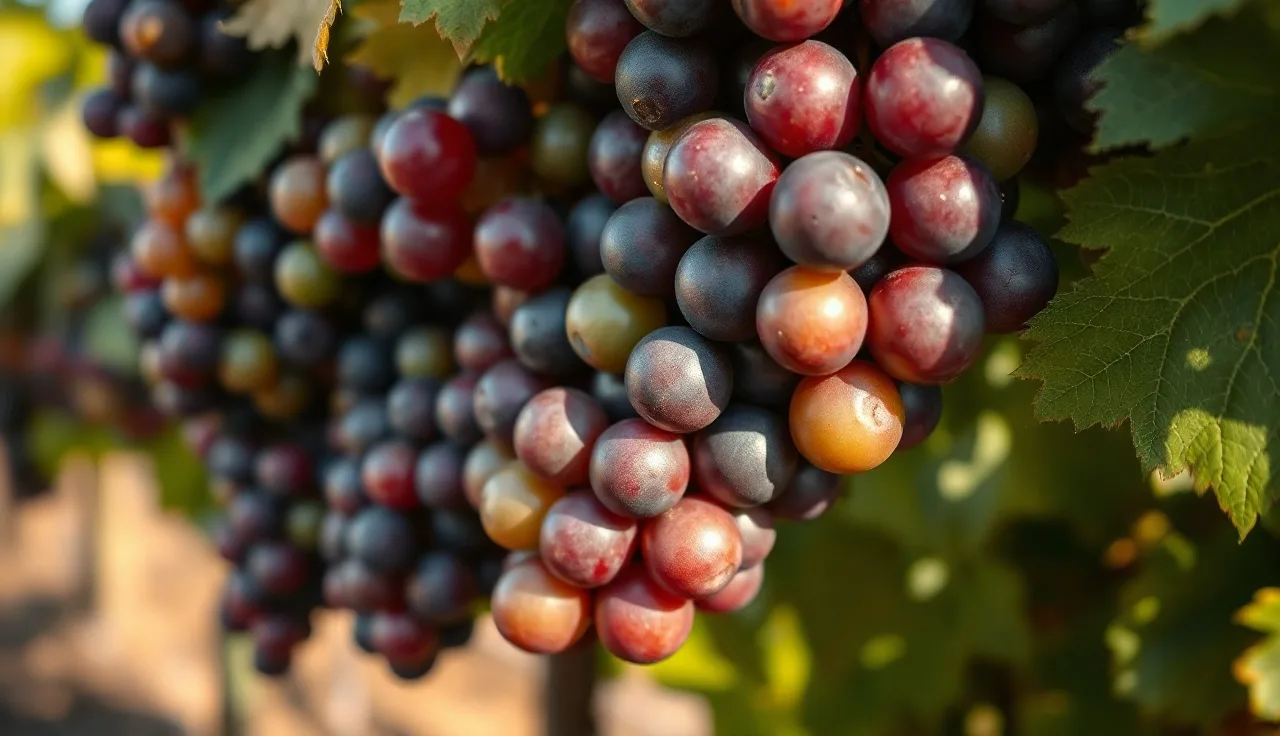
Veraison is the French word for the switch from berry growth to berry ripening. It's the moment grapes stop adding cells and start adding sugar. Color change is the sign everybody notices: red and black varieties shift from green to red or purple as anthocyanin pigments build, and white varieties go from hard waxy green to a translucent golden-yellow. The berries soften at the same time, and acids start dropping as sugar climbs.
The change underneath that color shift is bigger than it looks. The berry's plumbing switches from xylem-dominated (water transport) to phloem-dominated (sugar transport), which is why Brix climbs fast once veraison finishes [1]. Seed development is nearly done at this point, which tells the vine it can pour energy into fruit instead of seed protection.
Not every berry turns the same day. Not every cluster turns the same week. That spread, sometimes called straggler syndrome, matters a lot for harvest timing. A block that starts veraison over four weeks is harder to pick at one clean ripeness than a block that turns in ten days. Managing that spread is one of the underrated skills in vineyard work.
When does veraison happen in the Northern Hemisphere?
For most wine regions in North America and Europe, veraison lands between late June and late August. The range is wide because variety, rootstock, vine age, elevation, and microclimate all push the date around.
In California's warmer valleys, early white varieties like Chardonnay and Pinot Grigio commonly hit veraison by early to mid-July. In the same valley, Cabernet Sauvignon may not show real color until early August. Move up into the Sierra Foothills or the mountains above Napa and those dates slide 10 to 20 days later [2].
Washington's Columbia Valley sits at a higher latitude but still bakes in summer heat, and it usually sees veraison from late July through mid-August [9]. Cornell's viticulture team at the New York State Agricultural Experiment Station tracks Finger Lakes timings that often run two to three weeks behind Napa for the same variety, a reflection of cooler growing-degree accumulation [3].
Here's the rule most farm advisors use: count roughly 45 to 60 days back from your target harvest date, and that's about when veraison should begin. If your Cabernet Sauvignon harvest target is October 5, look for veraison around early to mid-August. That window isn't magic. But it helps you line up labor and spray programs before the season gets loud.
How does timing vary by grape variety?
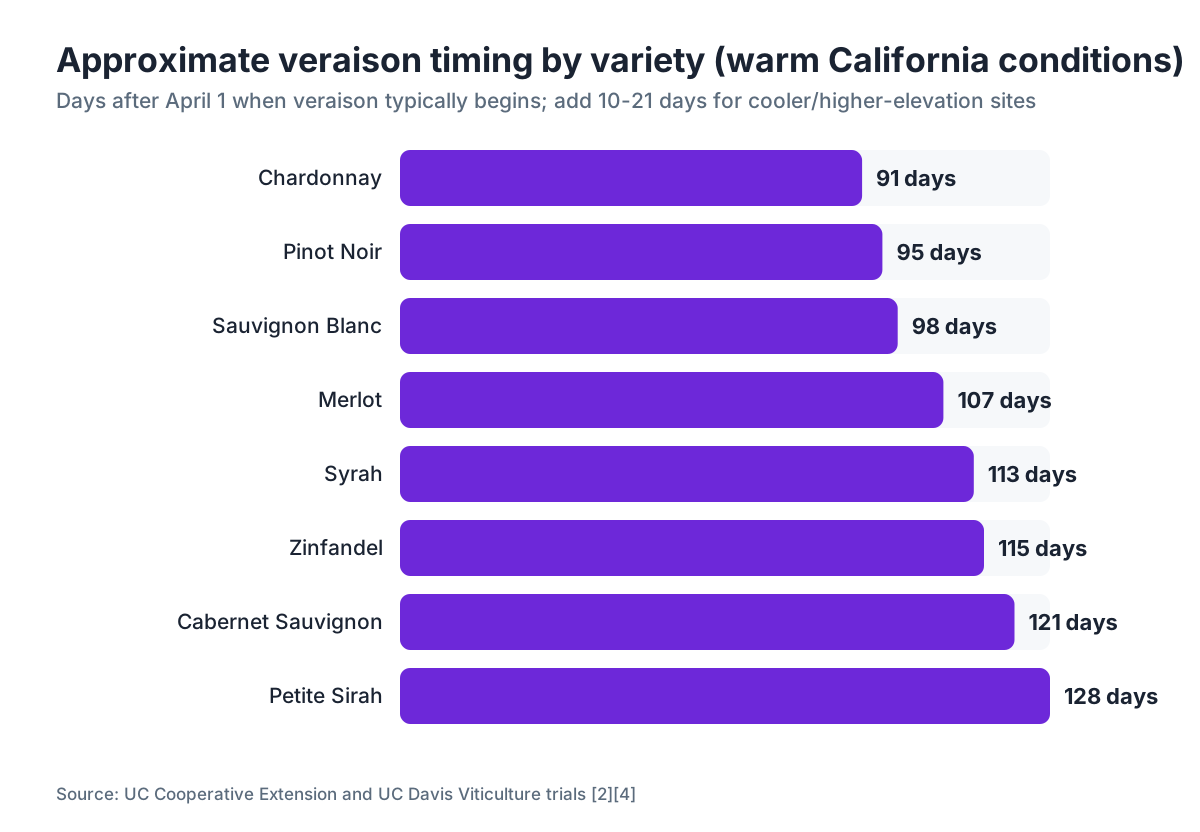
Variety is the single biggest driver of veraison date. The table below shows rough veraison windows for common cultivars in warm inland California. In cooler or higher sites, push every date 10 to 21 days later. In very hot desert sites like the Coachella Valley, pull it a week or more earlier.
| Variety | Approximate Veraison Window (warm CA) | Days to Harvest After Veraison |
|---|---|---|
| Chardonnay | Late June to early July | 45-55 |
| Pinot Noir | Late June to mid-July | 45-55 |
| Sauvignon Blanc | Early to mid-July | 45-55 |
| Merlot | Mid to late July | 50-60 |
| Syrah | Late July to early August | 50-60 |
| Zinfandel | Late July to early August | 50-65 |
| Cabernet Sauvignon | Early to mid-August | 55-65 |
| Petite Sirah | Mid to late August | 55-70 |
These windows assume a settled vine on a typical rootstock. Young vines and stressed vines often run a touch earlier than the table says, because a lighter crop load per vine speeds up the ripening signal. Heavily cropped vines lag by a week or more [4].
For varieties you don't know well, UC Davis's Viticulture and Enology department keeps variety-specific phenology data from its long-running trial blocks at the Oakville and Kearney research stations [2].
What growing degree days predict veraison onset?
Growing degree days (GDD), also called heat units, give you the prediction tool that carries best across different sites. The U.S. standard vine base temperature is 50 degrees Fahrenheit (10 degrees Celsius), so heat accumulation is [(daily high + daily low) / 2] minus 50, summed from April 1 forward [2].
Early varieties like Pinot Noir usually reach veraison after about 1,400 to 1,600 GDD (base 50 degrees F) from April 1. Mid-season varieties like Merlot need roughly 1,600 to 1,900 GDD. Late varieties like Cabernet Sauvignon run about 1,800 to 2,100 GDD [2]. These numbers shift with rootstock and training system, so treat them as starting estimates, not triggers you set your watch by.
A daily temperature log is the whole foundation of this. You can do it with a basic max-min thermometer in the vineyard, or with one of the low-cost weather stations now within reach for small operations. The data is worth more than most growers think. Track three or four seasons and you'll start to see how your specific site compares to the regional average, then adjust your expectations to match.
WSU Extension's AgWeatherNet runs more than 175 stations across Washington and gives any registered user real-time GDD accumulation for a chosen location [5].
What are the early signs of veraison to watch for?
Color change gets all the attention, but the earliest real signal is berry softening. Squeeze a berry gently between thumb and finger in the weeks before veraison and a pre-veraison berry pushes back with a firm, almost rubbery resistance. When that resistance starts to give, veraison is days to a week away.
Color is the most practical field check because you can walk a row and spot it at a glance. Look for the first hints of pink or purple on red varieties at the sun-exposed shoulder of clusters, usually on south- or west-facing sides. On white varieties the translucent yellowish shift is subtler, but you'll see it if you're looking. The first berry in a block to turn often shows up on a low-vigor vine or on clusters closest to the cordon.
Brix starts moving almost the moment color change begins. If you're checking a refractometer even weekly, a sudden 1 to 2 degree jump in a sample that had been flat for weeks is a clear veraison signal. Titratable acidity starts dropping at the same time, though the first-week change is gentler.
For blocks where timing precision pays off (picking decisions, spray cutoffs, labor scheduling), a formal veraison count earns its keep. Sample 200 berries across at least 20 representative clusters from several vine positions. Sort each as pre-veraison (firm, green or very hard red), at veraison (softening, showing color), or post-veraison (soft, full color). When 50% of berries are at or past veraison, the block is at veraison [4].
How does climate and elevation affect veraison timing?
Temperature is the lever. More heat, earlier veraison. Less heat, later. The relationship is roughly linear within normal growing-season ranges.
Elevation slows things down because temperature drops about 3.5 degrees F per 1,000 feet of gain (the standard environmental lapse rate). A Cabernet Sauvignon block at 2,000 feet in Napa sees veraison one to three weeks later than a similar block on the valley floor, which is exactly why mountain-grown wines carry different structure and later harvest dates [2]. You can watch it happen across appellations like Howell Mountain versus Rutherford.
Ocean influence matters too. Coastal sites with heavy afternoon fog or marine layer (Sonoma Coast, Santa Rita Hills, parts of the Willamette Valley) build GDD slowly and push veraison later than their latitude would suggest. Paso Robles's east side, which lacks that coastal cooling, runs warmer and earlier than the west side of the same appellation. Paso Robles wineries in different sub-zones can differ by two or more weeks in veraison timing for one variety.
A warming climate is squeezing the old calendar. A study in Nature Climate Change by Cook and Wolkovich found harvest dates in French wine regions advanced sharply through the late twentieth century, driven by higher growing-season temperatures [6]. Veraison dates have tracked the same trend. Nobody has clean site-by-site data on the exact shift, but the direction is settled: if your grandfather farmed the same ground, his veraison dates are probably running well ahead of what he wrote down in the 1970s.
Why does veraison timing matter for spray programs and worker safety?
Once veraison starts, your spray options get tight fast. Many programs call for a post-veraison window against Botrytis and other late-season diseases, but pre-harvest intervals (PHIs) turn into the hard wall. Copper and sulfur, still common in conventional and organic programs, carry PHIs from 0 to a few days, but most FRAC-coded synthetic fungicides run PHIs of 7 to 30 days, and a few stretch as long as 66 days [7]. If you don't know your harvest date yet, veraison is your best forward anchor: 45 to 60 days out is when to start counting PHIs backward from the target.
The EPA's Worker Protection Standard (WPS) covers every pesticide application in vineyards that employ agricultural workers. Under the revised WPS (effective January 2017), restricted entry intervals (REIs) must be posted on the treated block, and workers must get safety training plus access to application information [8]. The rule text is blunt about the goal: the WPS is designed "to reduce the risk of pesticide poisonings and injuries among agricultural workers and pesticide handlers." That doesn't change at veraison itself. But post-veraison applications draw more scrutiny because crews enter blocks more often for leaf pulling, sampling, and tying. Keep your spray records current and pull REI signage on time.
This is where a real-time spray log earns its money. Track applications in a vineyard record system and you can flag blocks where PHI windows are live, then block entry until the interval clears. VitiScribe was built around this kind of compliance tracking, tying spray events to block maps and running automatic PHI countdowns.
Botrytis pressure jumps once berries soften at veraison, because the same skin permeability that lets sugar in also lets fungal spores through. Getting your final protective spray on before that window closes (usually within one to two weeks of color change onset) is the standard recommendation from UC Cooperative Extension's plant pathology program [7].
How does veraison affect canopy management decisions?
Veraison is your cue to check canopy density one last time before harvest. Post-veraison leaf pulling in the cluster zone, mostly on the east side of rows in Northern Hemisphere vineyards, opens up air movement and cuts Botrytis risk. Timing is the whole game here: leaf removal after veraison is less likely to sunburn berries that have already firmed their skins a bit, while removal before veraison in hot climates leaves still-vulnerable berries exposed to direct sun [4].
Shoot positioning and hedging ease off at veraison. The vine is out of hard vegetative growth, so there's less urgency around shoot length. Any secondary shoots (laterals) still pushing hard can shade clusters, though, and those still need managing.
Water is the big call. Deficit irrigation timing around veraison is one of the most studied topics in applied viticulture. UC Cooperative Extension's general guidance: run some water stress (regulated deficit irrigation) between fruit set and veraison to hold back vegetative growth, then restore irrigation at or just after veraison to support berry expansion and vine health without watering down flavor [2]. The exact amount depends on soil type, vine water status (measured by pressure bomb or stem water potential), and the style you're chasing.
Check the vineyard calendar for your region hard at this stage, because the window between veraison and harvest compresses everything. Labor scheduling, equipment checks, tank prep, and sampling all have to be lined up within weeks of veraison starting.
How do you track and record veraison assessments in a vineyard block?
A formal veraison record hands you a seasonal baseline that pays off year after year. It doesn't need to be fancy. At minimum, log the date, block ID, variety, the percentage of berries at or past veraison from your 200-berry count, and your name.
Many farm advisors run a weekly count once early veraison shows up (usually that first scouting walk where you spot a few pink berries). The move from 0% to 100% usually takes 10 to 20 days in warm, uniform conditions. It can stretch past 30 days in a cool season or a block with big vigor swings. Tracking the percent complete each week tells you whether you're in a fast, even veraison (good) or a slow, straggling one (worth a closer look).
Using digital block records? Attach the veraison date as a phenology event tied to that block. Over three or four seasons those dates show patterns: whether your northwest block always runs five days behind the southeast block, whether a cool year pushed everything two weeks, and what that meant at harvest. That long view is hard to rebuild from memory.
For operations running multiple varieties across large acreage, VitiScribe's block-level event logging lets you record phenology stages from the field on a phone and see progress across every block on one dashboard. That matters most when you're managing 10-plus blocks with different varieties and need to keep straight which ones are entering their spray-sensitive post-veraison windows.
What's the relationship between veraison and harvest timing?
The 40-to-60-day post-veraison window is the most widely cited harvest prediction rule in working viticulture, and it holds up reasonably well across varieties and regions. The caveat is real: harvest timing comes down to actual Brix, pH, TA, and sensory tasting, not calendar math [4].
In the final weeks after veraison, sugar accumulation in well-managed blocks follows a roughly S-shaped curve: slow at first, then fast, then leveling off as the vine nears physiological maturity. Warm nights above 65 degrees F slow the acid drop less than warm days speed up sugar, which is why harvest calls in hot years get messy. You can have Brix right where you want it while pH runs high and TA runs low, because acid degraded faster than expected.
Frost is the hard stop in many regions. In the Finger Lakes, parts of Oregon, and higher-elevation California, growers watch the forecast all through late September and October, knowing a hard frost can end the season no matter where sugar sits. In those places veraison timing doubles as a frost-risk read: a late veraison year is a tense harvest.
The Alsace study by Duchene and Schneider found June-July temperatures explained more than 60% of harvest date variance over four decades of records [6]. Veraison, falling inside that June-August stretch, is the midpoint marker in that temperature-to-harvest chain.
Can you speed up or delay veraison deliberately?
This comes up more than you'd think, usually from growers who want to push veraison earlier to beat fall rains, or delay it to stagger harvest when they're short on crew.
Speeding it up: cluster thinning (crop thinning) is the most reliable move. Pull 20 to 40% of the crop load shortly after fruit set and you concentrate the ripening signal on fewer berries, which can advance veraison five to ten days. UC Cooperative Extension trials document this well [4]. Early leaf removal in the cluster zone at or before bloom has also advanced maturity in some varieties, notably Sangiovese and Sauvignon Blanc, though results swing by site.
Delaying it is harder. You can slow post-veraison sugar accumulation somewhat by over-irrigating (dilution), but that comes with real quality penalties and gets discouraged in quality-focused programs. Leaving more crop on the vine slows ripening, but if you're staggering harvest across a big operation that way, you buy yourself canopy and disease headaches.
Ethephon (a plant growth regulator that releases ethylene) has been tried experimentally to advance veraison and even out color in wine grapes, but commercial use in wine grapes is limited and registration varies by state. Check your state's pesticide registration list before you go near it.
Honestly, the practical answer is to work with your site's natural timing by planting varieties matched to your GDD. A variety that naturally hits veraison in mid-July in your region solves more problems than fighting a poorly-adapted one ever will.
How do Southern Hemisphere vineyards time veraison differently?
Southern Hemisphere seasons run six months opposite the North. Where Napa sees veraison in July and August, vineyards in Argentina, Chile, South Africa, Australia, and New Zealand see it in January and February, with harvest landing in March and April.
The variety and GDD relationships hold. The calendar is just flipped. Mendoza Malbec typically runs through veraison in late January. McLaren Vale Shiraz tends toward mid-February. Cooler South Island New Zealand Pinot Noir can push to late February or early March before real color shows.
For multi-hemisphere operations, or growers buying Southern Hemisphere fruit for blending, keeping both calendars straight is worth doing on purpose. The phenology relationships don't change, but the date references do, and mixing them up in spray records or vintage paperwork causes real problems.
Frequently asked questions
How many days after veraison is harvest?
Harvest usually follows veraison by 40 to 65 days, depending on variety and climate. Early varieties like Chardonnay and Pinot Noir run on the shorter end (40 to 55 days). Late varieties like Cabernet Sauvignon and Petite Sirah take 55 to 70 days. These windows assume you're targeting full physiological maturity, which is more than a single Brix number.
What percentage of berries marks the start of veraison?
There's no universal standard, but most viticulture extension programs use 50% of berries showing color and softening as the working definition of veraison onset for a block. Some researchers use 5 to 10% as initiation and 80 to 90% as completion. For spray-program timing, the 50% mark is the threshold most people apply.
Does veraison happen at the same time every year?
No. Year-to-year swings of two to four weeks are normal. A warm spring with fast GDD accumulation pushes veraison earlier; a cool, rainy spring delays it. Long-term Alsace records show harvest dates (and by extension veraison) shifted earlier through recent decades as growing-season temperatures rose, per a Nature Climate Change analysis.
Can veraison happen unevenly across a block?
Yes, and it's one of the more frustrating vineyard problems. Soil variability, irrigation uniformity, vine age, and vigor differences all cause different rows or sections to enter veraison at different times. High-vigor sections on deep, moist soils often lag a week or more behind low-vigor sections on thin soils. Crop thinning and irrigation management can narrow the spread.
What is veraison in white wine grapes?
White varieties don't turn red, obviously, but they still go through veraison. The visual cue is a shift from hard bright green to a softer, translucent golden-green or yellow-green. The berry also softens to the touch. Sugar accumulation, acid drop, and seed browning all run on the same schedule as red varieties. The 200-berry softness check is more reliable than color for whites.
How does crop load affect veraison timing?
Heavier crop loads delay veraison by spreading the ripening signal across more berries. Lighter loads, from cluster thinning, advance it. UC Cooperative Extension trials have shown crop thinning can advance veraison by five to ten days when done shortly after fruit set. The effect is bigger in high-vigor vines, where vegetative growth and fruit compete hard for the vine's resources.
What diseases are most dangerous at veraison?
Botrytis cinerea (gray mold) is the main worry. Berry skin permeability rises at veraison as berries soften, opening them to infection through the skin and through splits caused by fast water uptake after rain. Bunch rots from Aspergillus and other molds also climb. The last protective Botrytis fungicide is typically timed within one to two weeks of veraison onset, before the PHI window closes.
Should I adjust irrigation at veraison?
Standard California practice, backed by UC Cooperative Extension guidance, is regulated deficit irrigation (mild water stress) from fruit set to veraison to hold vegetative growth back, then restored irrigation at or shortly after veraison to support berry development. Over-irrigating post-veraison dilutes flavor and slows skin color. Stem water potential measurements are the most precise guide to irrigation calls.
How do I record veraison for compliance and vineyard records?
At minimum, record the date, block ID, variety, row count sampled, berry count assessed, and the percentage at or past veraison. Doing this weekly once veraison begins gives you a progression curve instead of a snapshot. That data feeds spray documentation (PHI compliance), harvest planning, and year-over-year comparison. Digital systems tied to block maps make it far easier to pull records during an audit.
What is the veraison date for Pinot Noir in Oregon?
Oregon's Willamette Valley sees Pinot Noir veraison typically between late July and mid-August, depending on the vintage. Warm years like 2014 and 2015 pushed it into early July; cool years like 2010 delayed it past mid-August. That's a wide swing. GDD accumulation from April 1 is a better guide than calendar date for any given year.
Can you estimate veraison date from budbreak?
Yes, roughly. Most wine grape varieties reach veraison about 90 to 110 days after budbreak, with early varieties on the short end and late varieties on the long end. This rule is less precise than GDD tracking, because the development rate between budbreak and veraison rides heavily on spring temperatures, which can be erratic. Use it as a sanity check, not a primary prediction.
Does veraison timing differ between old vines and young vines?
Old vines with lower natural vigor tend to carry lighter crop loads and often show slightly earlier or more uniform veraison than young, high-vigor vines. Young vines with vigorous roots and minimal crop can also run early. The most consistent, predictable veraison usually comes from mature vines (8 to 15 years old) with a balanced vine-to-crop ratio.
What role does rootstock play in veraison timing?
Rootstock affects veraison through its influence on vine vigor and water and nutrient uptake. High-vigor rootstocks like 110R or St. George can delay veraison slightly by keeping vegetative competition going longer. Lower-vigor rootstocks like 101-14 or 3309 tend to allow an earlier ripening signal. Variety is still the dominant factor, but rootstock adds a steady modifier of roughly three to seven days in most published comparisons.
When does veraison occur in the Southern Hemisphere?
Southern Hemisphere vineyards run six months opposite the North. Veraison in regions like Mendoza, McLaren Vale, Hawke's Bay, and the Western Cape falls between late December and late February. Harvest follows in March and April. The same variety-by-GDD relationships apply; the calendar is simply inverted relative to Northern Hemisphere growing seasons.
Sources
- UC Davis Viticulture and Enology, 'Grape Berry Development': At veraison the berry's primary vascular supply shifts from xylem to phloem-dominated transport, enabling rapid sugar accumulation
- UC Cooperative Extension, 'Wine Grape Varieties in California' and Kearney/Oakville phenology trials: GDD thresholds for veraison onset by variety (base 50 degrees F from April 1); deficit irrigation timing relative to veraison; elevation effects on ripening dates
- Cornell Cooperative Extension, New York State Agricultural Experiment Station, Viticulture Program: Finger Lakes veraison and harvest timing typically runs two to three weeks behind warm California regions for the same variety due to lower GDD accumulation
- UC Cooperative Extension, 'Grape Crop Load and Canopy Management' guidelines: 50% berry color change and softening used as practical veraison threshold; crop thinning advances veraison by five to ten days; post-veraison leaf pulling reduces Botrytis risk
- Washington State University Extension, AgWeatherNet: WSU's AgWeatherNet covers Washington State vineyards with over 175 stations providing real-time GDD accumulation data
- Cook B.I. & Wolkovich E.M., 'Climate change decouples drought from early wine grape harvests in France', Nature Climate Change, 2016; and Duchene E. & Schneider C., 'Grapevine and climatic changes', Agronomy for Sustainable Development, 2005: French wine region harvest dates advanced through recent decades driven by warmer growing-season temperatures; June-July temperatures explain more than 60% of harvest date variance in long-term Alsace records
- UC Cooperative Extension Plant Pathology, Botrytis Management in Wine Grapes: Final protective Botrytis fungicide application is recommended within one to two weeks of veraison onset; synthetic fungicide PHIs range from 7 to 66 days
- US EPA, Worker Protection Standard for Agricultural Pesticides (40 CFR Part 170, revised 2015, effective January 2017): WPS requires REI posting on treated blocks, safety training for agricultural workers, and access to pesticide application information; stated purpose is to reduce pesticide poisonings and injuries among agricultural workers and handlers; effective January 2017
- WSU Extension Viticulture, Columbia Valley Variety Phenology Reports: Washington State Columbia Valley veraison timing for common varieties, typically late July through mid-August
- UC Davis Department of Viticulture and Enology, 'Understanding Grapevine Phenology': General framework for calculating GDD base 50 degrees F from April 1 and its relationship to phenological stages including veraison
Last updated 2026-07-09