Identifying Downy Mildew in Vineyards: Field Guide
Downy mildew symptoms look different depending on when you're looking and what part of the vine you're examining. The white cottony sporulation that makes late-stage infections unmistakable only appears under humid conditions -- often overnight -- which means a morning scout gives you a very different picture than an afternoon walk.
TL;DR
- Oil spots (light yellow-green blotches on the upper leaf surface) are the first visible downy mildew symptom and appear 4-12 days after infection, depending on temperature
- White cottony sporulation on the underside of the leaf confirms active infection -- it only appears when relative humidity exceeds 95%, which means afternoon scouting on dry days will miss it; scout at 7 a.m. after a dewy night
- Cluster infection during bloom is the most economically damaging downy mildew scenario -- infected flower clusters turn brown and die, causing direct yield loss before any post-infection management can respond
- Downy mildew oil spots follow leaf veins and appear anywhere on the blade; potassium deficiency follows leaf margins and is consistent across the canopy -- this distinction prevents misidentification
- Post-fruit-set berry infections produce "leather rot" -- brownish, leathery berries that can cause off-flavors and accelerate cluster deterioration
- VitiScribe's scout report template records leaf incidence percentage, cluster incidence, and sporulation status with timestamped entries that tie field observations to weather event records
Here's how to identify downy mildew reliably, at every stage and on every tissue type.
Step 1: Know When Conditions Favor Downy Mildew
Scout proactively after:
- Rain events exceeding 0.1 inch
- Periods of extended dew or fog
- Overnight temperatures above 50°F combined with daytime temperatures below 85°F
The incubation period from infection to symptom expression is 4-12 days depending on temperature. You're scouting for symptoms from infections that happened nearly two weeks ago in cool conditions.
Step 2: Identify Symptoms by Tissue
Upper Leaf Surface -- "Oil Spots"
The first visible symptom. Look for:
- Light yellow-green to bright yellow blotches
- Irregular shape, often angular because the lesion follows leaf veins
- A slightly "oily" or water-soaked appearance -- this is the term to know
- Under bright light, hold the leaf up -- affected areas are translucent
Early oil spots are subtle. A seasoned grower can spot them; someone new to downy mildew often mistakes them for nutrient deficiency or sunburn.
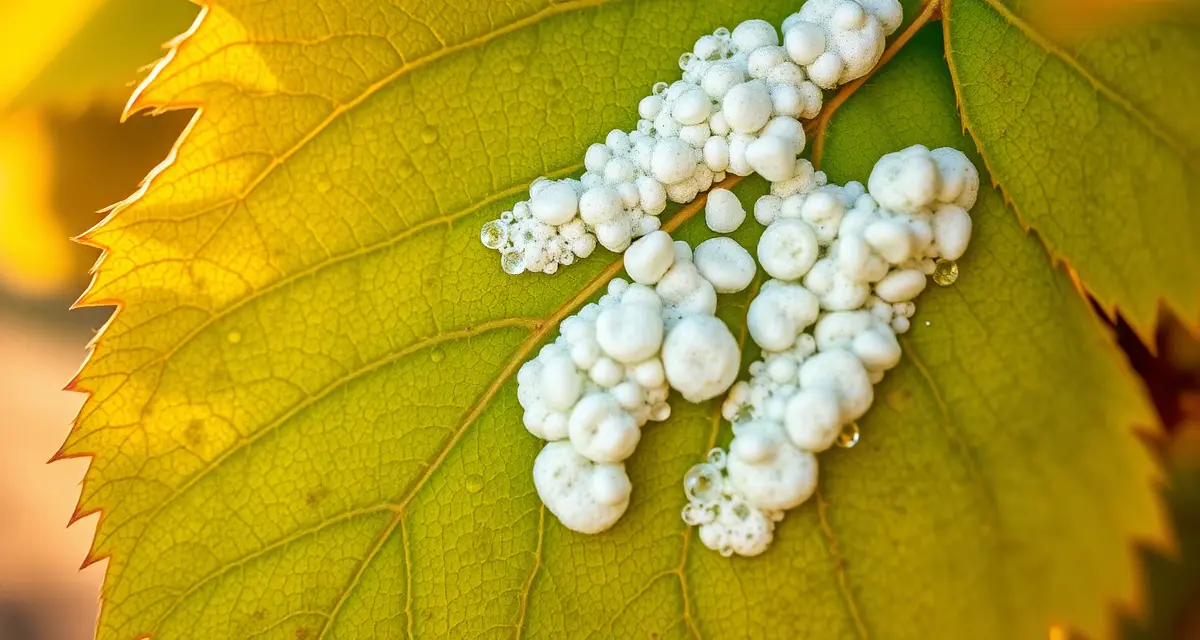
Lower Leaf Surface -- Cottony Sporulation
The confirmation. Under the oil spot, in humid conditions (early morning after dew, or inside your fist after you close your hand around the leaf), look for:
- White, cottony, wool-like mass
- This is the sporangiophores -- the fungal structures producing secondary spores
- Only present during sporulation conditions -- typically relative humidity above 95% overnight
If you scout at 2 p.m. on a dry day, you may see oil spots but no sporulation. Scout at 7 a.m. after a dewy night to confirm.
Cluster Infection ("Foliar Downy Mildew" of Clusters)
Infection during pre-bloom through bloom is the most damaging. Look for:
- Oil-spot appearance on immature cluster stems (rachis) and developing berries
- White sporulation inside clusters under humid conditions
- Infected flowers turn brown and die -- cluster becomes partially or completely brown
- Entire cluster death in severe cases ("chocolate berry" -- dark brown shriveled cluster)
Cluster infection during bloom causes more yield loss than post-fruit-set infections. Scout clusters closely from 10-inch shoot stage through 2 weeks post-bloom.
Berry Symptoms (Post-Fruit Set)
- Infected berries develop a brownish, leathery appearance ("leather rot")
- Berries may remain green while adjacent berries color at veraison
- White sporulation inside cluster during humid conditions
- Unlike botrytis (gray mold), downy mildew doesn't produce visible mycelium on berry exterior in the same way
Shoot and Tendril Symptoms
- White sporulation on succulent new growth
- Infected shoot tips may curl and die
- White woolly growth on tendrils
Step 3: Distinguish Downy Mildew From Look-Alikes
Downy Mildew vs. Powdery Mildew
Powdery mildew produces a dusty white coating on the upper leaf surface and doesn't cause oil spots. Downy mildew produces oil spots on the upper surface and cottony sporulation on the lower surface. They're visually distinct when you know what you're looking for.
In regions where both occur (New York, Oregon, Virginia), you'll often be dealing with both simultaneously. Identify them separately -- they require different management responses.
Downy Mildew vs. Potassium Deficiency
Potassium deficiency can cause yellow margins on leaves that could be confused with oil spots. Key difference: K deficiency follows the leaf margin and produces consistent yellowing across similar positions in the canopy; downy mildew produces irregular lesions anywhere on the leaf blade. No cottony sporulation occurs with K deficiency.
Downy Mildew vs. Sunburn
Sunburn produces bleached, white-to-tan areas on the sun-exposed side of leaves and berries. It's consistent in distribution (sun-facing) and doesn't show cottony sporulation. Downy mildew is distributed based on infection events, not sun exposure.
Step 4: Quantified Scouting
Record your findings with specific metrics:
- Leaf incidence: Percentage of leaves showing oil spots on your sample
- Cluster incidence: Percentage of clusters showing any symptoms
- Sporulation presence: Yes/No (indicates active sporulation condition)
Sample at least 10 vines across the block, checking 3-5 leaves and the developing cluster on each vine.
Document with VitiScribe's scout report template. Photograph oil spots and sporulation -- photos with timestamps tied to weather event records are valuable documentation of your management decision basis.
Related Articles
- Identifying Botrytis Bunch Rot in Vineyards
- Crown Gall in Vineyards: Identification and Management Guide
- Black Rot Management in Vineyards: Complete IPM Guide
- California DPR Reporting for Vineyards: Complete Guide to Pesticide Use Reporting
FAQ
What do the oil spots on grapevine leaves indicate?
Oil spots on the upper surface of grape leaves are the primary symptom of downy mildew infection (Plasmopara viticola). The oily appearance reflects the early stage of fungal development inside the leaf tissue. Turn the leaf over and look for white, cottony sporulation on the underside -- this confirms downy mildew. If you see oil spots without sporulation, scout again early in the morning after a humid night when sporulation is most visible.
How do I tell if downy mildew is sporulating in my vineyard?
Sporulation occurs during humid conditions, typically overnight and early morning when relative humidity exceeds 95%. Scout early in the morning -- by midday on a warm, dry day, sporulation may have dried up and be less visible. You can also confirm sporulation by placing a leaf with oil spots in a sealed plastic bag overnight with a damp paper towel -- if sporulation occurs, you'll see the white cottony growth on the lower leaf surface by morning.
Can downy mildew affect my grape clusters at harvest?
Yes. Late-season cluster infections cause "leather rot" -- berries develop brownish, leathery symptoms that indicate infected tissue. Affected berries can produce off-flavors and accelerate cluster deterioration. More significantly, infections during bloom (the most dangerous window) cause flower and cluster death that directly reduces yield. Prevent cluster infection by maintaining protectant coverage through bloom with copper or pre-activity systemic materials.
How many vines should I sample when scouting for downy mildew?
Sample at least 10 vines across the block for each scouting visit, checking 3-5 leaves per vine (including basal, mid, and shoot-tip leaves) and examining any developing clusters. A minimum of 100 leaves per block gives you a reliable incidence estimate for tracking disease progression. In blocks with previous downy mildew history, increase the sample size and pay particular attention to areas of the block where infection appeared in prior seasons. Record the number of vines sampled, leaves examined, and the incidence percentage in your VitiScribe scouting record so you have a consistent metric to compare across visits and seasons.
What scouting records support a post-infection kickback spray decision?
If you're applying a product with kickback activity after a known infection event, your scouting record should document: the weather event that triggered the application (qualifying rainfall amount and dates, temperatures during the wet period), whether oil spots are present on scouted leaves (confirming infection has occurred or is likely), and the date of the spray relative to the known infection event. This chain of records -- weather observation, scouting observation, spray decision -- is the documentation that shows your kickback application was a targeted response to an identified infection event, not a routine calendar spray. VitiScribe links scouting records and spray records in the same block timeline, making this connection visible in the block history.
What is Identifying Downy Mildew in Vineyards: Field Guide?
[FAQ_ANSWER_PLACEHOLDER: This answer needs to be generated by AI with specific data, examples, and actionable advice relevant to Identifying Downy Mildew in Vineyards: Field Guide. Target 50-150 words.]
How much does Identifying Downy Mildew in Vineyards: Field Guide cost?
[FAQ_ANSWER_PLACEHOLDER: This answer needs to be generated by AI with specific data, examples, and actionable advice relevant to Identifying Downy Mildew in Vineyards: Field Guide. Target 50-150 words.]
How does Identifying Downy Mildew in Vineyards: Field Guide work?
[FAQ_ANSWER_PLACEHOLDER: This answer needs to be generated by AI with specific data, examples, and actionable advice relevant to Identifying Downy Mildew in Vineyards: Field Guide. Target 50-150 words.]
Sources
- Oregon Department of Agriculture (ODA)
- UC Cooperative Extension Viticulture
- American Vineyard Foundation
- American Society for Enology and Viticulture (ASEV)
- Wine Institute
Get Started with VitiScribe
Downy mildew identification is the first step; the second is having a scouting record system that ties your field observations to weather data and spray decisions in a single block timeline. VitiScribe's scout report template captures leaf incidence, cluster incidence, sporulation status, and weather conditions in a timestamped record that connects your identification work to the spray decisions it informs. Try VitiScribe free and log your first downy mildew scouting event from the field today.