Drip irrigation chemical injection records for nutrient and pest management
TL;DR
- Federal law and most state pesticide codes require you to log every chemical injected through a drip system: product name, EPA registration number, rate, date, and applicator.
- Fertigation (nutrient) records have looser federal rules, but many states and every certified organic operation add their own.
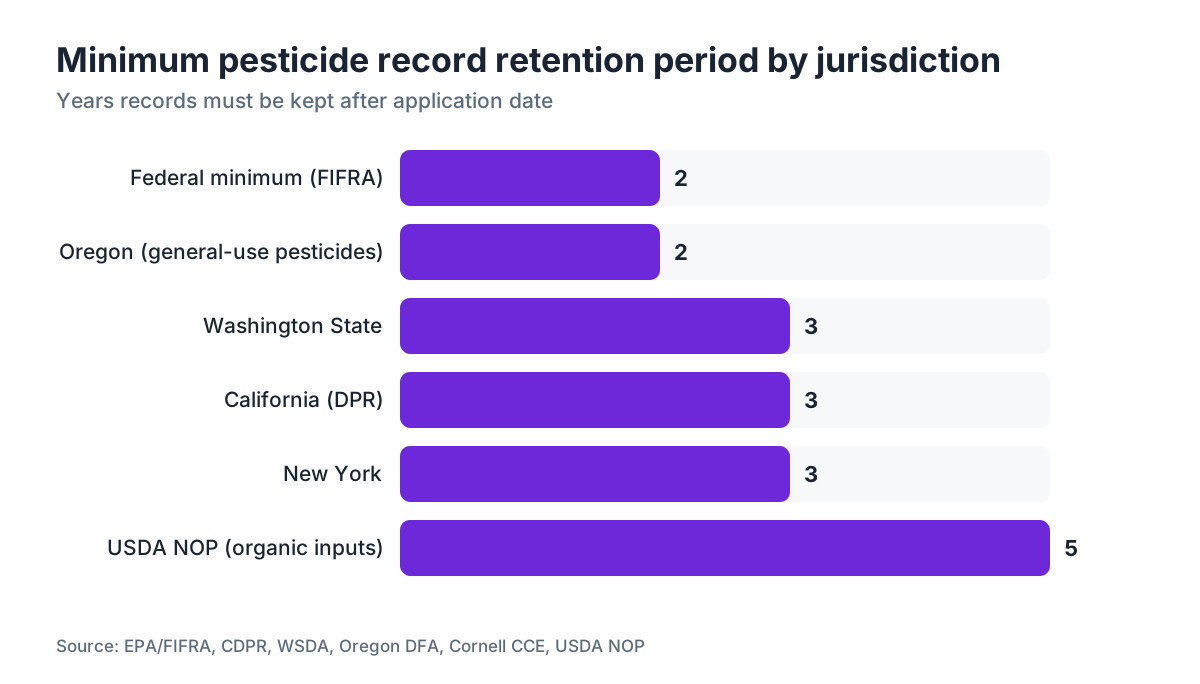
- Keep pesticide records at least two years.
- California, Washington, and New York require three.
- Organic records run five.
What exactly are drip irrigation chemical injection records?
Drip irrigation chemical injection records are written logs of every substance you push through your emitter system, whether that's a pesticide, a fertilizer, or a soil amendment. The term covers two activities that get conflated all the time: chemigation (injecting a registered pesticide through irrigation water) and fertigation (injecting nutrients, acids, or biostimulants). The recordkeeping rules for each are different. Mixing them up is where most vineyard managers get tripped up during an audit.
A complete injection record answers six questions. What did you inject, at what rate, into which block, on what date, who did it, and what conditions were present. That last item matters more for regulated pesticides than for fertilizers, but good agronomy says capture it either way.
Drip systems deliver product with precision, so these records carry value past compliance. Three years of fertigation logs tied to leaf tissue results and yield data will tell you whether your nitrogen program is actually working. Compliance gets all the attention. The operational payoff is the part that keeps you in business.
What federal laws govern pesticide injection through irrigation systems?
The main federal authority is FIFRA, the Federal Insecticide, Fungicide, and Rodenticide Act, run by the EPA [1]. Under FIFRA, applying a registered pesticide through irrigation is called chemigation, and it's legal only if the product label specifically permits it. The label is the law. If the label has no chemigation directions, you cannot inject that product through your drip system. No exceptions.
Application records for commercial pesticide use are required under 40 CFR Part 171 for certified applicators, and under most state equivalents for all commercial growers. EPA's Worker Protection Standard at 40 CFR Part 170 adds a layer: if a pesticide applied through irrigation has a restricted-entry interval (REI), the application information has to be available to workers and handlers who might enter the treated area [2]. The WPS was revised in 2015 and took full effect in January 2017. The core record rule is that application information must be posted or otherwise made available for 30 days after the REI expires.
EPA doesn't hand you a single universal form. What it mandates are the minimum data elements: product name and EPA registration number, crop and location treated, date, total amount applied, and the certified applicator's name or identifier. States pile fields on top of that.
For pesticides used near waterways, you may also have obligations under the Clean Water Act's National Pollutant Discharge Elimination System (NPDES) if your irrigation drains to surface water. Most subsurface drip systems in vineyards avoid that trigger [3].
What records do you need for fertigation specifically?
Fertigation, injecting fertilizers through irrigation, sits in a lighter regulatory zone at the federal level. FIFRA doesn't touch fertilizers, and EPA doesn't require commercial fertilizer application records the way it does for pesticides. Lighter isn't the same as none.
Four situations create real fertigation recordkeeping duties:
- Certified organic operations. The USDA National Organic Program (NOP) requires you to document every input applied to certified ground, all fertilizers included, at what rates, on which dates, to which blocks. Your certifier audits these records annually. Missing or incomplete fertigation logs are one of the most common reasons organic certification gets delayed or pulled [4].
- State nutrient management programs. States with serious agricultural water quality concerns, California's ILRP regions and the Chesapeake Bay watershed states among them, may require nutrient application records as a condition of a waiver or permit. In California's Central Coast ILRP, commercial grape growers above certain acreage thresholds must keep fertilizer records and report nitrogen applied every year [12].
- GAP and third-party food safety audits. GlobalGAP, PrimusGFS, and similar schemes require fertilizer records to certify. Wineries buying from multiple growers ask for them more and more.
- Worker safety with acidifying agents. Sulfuric acid and similar pH-adjustment or line-cleaning chemicals used in drip systems fall under OSHA Hazard Communication when workers handle them. Safety Data Sheets and exposure records can apply.
My honest take: keep fertigation records to the same standard as pesticide records even when the law doesn't force it. The agronomic payoff pays for the effort by itself, and you'll never scramble when a buyer or auditor asks.
What minimum data fields belong on every injection record?
Here's how the required fields stack up: EPA/FIFRA for pesticides, USDA NOP for organic inputs, and what a solid operational log looks like no matter what the rules demand.
| Field | EPA/FIFRA required | USDA NOP required | Best practice |
|---|---|---|---|
| Product name | Yes | Yes | Yes |
| EPA Reg. No. | Yes | N/A (non-pesticide) | Yes for pesticide |
| NOP-allowed input / OMRI listing | No | Yes | Yes if organic |
| Date of application | Yes | Yes | Yes |
| Crop / commodity | Yes | Yes | Yes |
| Block / zone ID | Yes (location) | Yes | Yes |
| Rate (oz or lb per acre) | Yes | Yes | Yes |
| Total volume injected | Yes | Yes | Yes |
| Irrigation run time | No | No | Yes |
| Injection rate (e.g., mL/min) | No | No | Yes |
| Water source / meter reading | No | No | Yes |
| Certified applicator name + license # | Yes | Yes | Yes |
| REI / re-entry date | WPS required | No | Yes |
| PHI (pre-harvest interval) | No (label controls) | No | Yes |
| Weather at application | No federal req. | No | Yes |
| Equipment calibration date | No | No | Yes |
| Lot / batch number of product | No | Some certifiers | Yes |
The best-practice column is what I'd build into any log form. The extra fields cost nothing to capture in the moment. They save real time when you're reconstructing what happened three seasons back, or explaining a residue result to a buyer [5].
How long do you have to keep these records?
Federal FIFRA rules require commercial pesticide application records be kept two years from the date of application [1]. That's the floor. Everything else builds up from there.
States set longer windows all the time. California requires three years under DPR's recordkeeping rules [6]. Washington requires three years under WAC 16-228. Oregon holds most growers to two years but requires three for certain restricted-use pesticides. Check your state ag department's pesticide program page, because this varies and the penalties for short retention are real.
USDA NOP organic records must be kept five years [4]. That's the longest standard retention most vineyard operations run into.
For fertigation records that aren't organic, two years is a practical minimum even without a hard federal rule. If you're in a California ILRP region or a similar state nutrient program, read your permit conditions; some require three years of nutrient records.
Store records so they survive. A binder in a barn that reeks of last season's spray is a compliance failure waiting to happen. PDF scans in a cloud backup, a field records app, or a flat spreadsheet on a backed-up drive all beat that. Paper is fine as the primary copy. You still need a backup.
What does a chemigation safety device requirement mean for your drip system?
Most growers miss this piece until an inspector shows up. The EPA requires, and nearly every state with a chemigation law mirrors, that drip and other irrigation systems used for pesticide application carry specific backflow prevention and safety equipment, installed and working [3].
The standard components are a check valve (anti-siphon device) between the injection point and the water source, a low-pressure drain or vacuum relief valve, an injection line check valve, and an interlocked shutoff that stops the injection pump if the irrigation pump fails. The interlock is the one that matters most. Without it, pesticide can pool in the system and flush into unintended areas when irrigation restarts.
Your records should carry a log entry for equipment inspection. Many state chemigation rules require you to verify safety devices are working before each application, and some require that check to be documented. Washington's chemigation rules under RCW 90.56 and WAC 173-200 are among the most specific about it [11]. California's chemigation guidance is less codified at the state level, but local county agricultural commissioners often run inspection programs.
WSU Extension's irrigation and chemigation guidance is one of the clearest practical resources going, covering both the legal side and the engineering of anti-siphon compliance [7].
How do state rules differ from federal minimums?
Federal rules are the floor. States can go further, and most do. Here's a quick sketch for the major wine grape states.
California: The Department of Pesticide Regulation (DPR) requires licensed Pest Control Advisors (PCAs) to make written recommendations before most restricted-use pesticide applications, and the grower must keep both the recommendation and the application record for three years [6]. County agricultural commissioners (CACs) maintain their own records of all restricted-use applications. Chemigation with certain pesticides needs a permit in some counties.
Washington: The Washington State Department of Agriculture (WSDA) requires applicator license numbers on records and three-year retention. The state runs a separate chemigation registration program; growers using irrigation for pesticide application must register their systems with WSDA [11].
Oregon: The Oregon Department of Agriculture follows a two-year retention rule for most pesticides and requires records be available for inspection on request.
New York: Cornell Cooperative Extension notes that New York requires pesticide applicator records be kept three years, and commercial growers must report certain restricted-use pesticide data to the state annually [8].
Arizona and New Mexico: Both run active chemigation laws with registration and inspection requirements for irrigation systems.
The safest posture is simple. Contact your county agricultural commissioner or state department of agriculture directly, get the current rules in writing, and build your system to the most demanding standard you'll face.
How do you build a practical log system for drip injection records?
Start with the block as your organizing unit. Every injection record should link to a specific block or management zone, because that's how you'll query it later: by block, by product, by season. Run multiple injection points across one block? Each point gets its own entry.
Paper forms work. They also create a retrieval problem. A spray binder sorted by date is close to useless when an auditor asks for every application of one product across all blocks over three years. Sort by block, then by date within block, and keep a master product-level index. That's the minimum paper setup that survives an audit.
Digital is better for retrieval. Managing more than about 20 acres, or running a complex fertigation program with multiple injections a week, the time you save on search alone justifies the switch. Systems like VitiScribe are built for this, with block-level record linking, regulatory field mapping, and audit export, so the record you keep is already formatted for what a DPR inspector or an organic certifier will ask to see.
Calibration is part of the record. A log that says "applied 2 oz/acre" is only as accurate as your injector calibration. Log your calibration check dates and results. UC Davis IPM guidance recommends calibrating venturi injectors and metering pumps at least monthly during active use, and after any pump maintenance [9]. If your calibration is off by 15%, your "compliant" rate might actually be a violation or an agronomic miss.
For vineyards with complex programs, build a pre-season injection schedule listing every planned product and rate, then use it as the template for actual logs. The gap between planned and actual becomes its own data point.
What are the WPS posting requirements when you inject a pesticide through drip?
The EPA Worker Protection Standard requires that, after any pesticide application with an REI, specific application information be available to workers and handlers who might enter the treated area [2]. That information includes the product name, the location treated, the date and time the application ended, and the REI expiration time.
For drip-applied pesticides, the location entry has to be specific enough that a worker can tell whether a given block is under REI. Block IDs, GPS coordinates, or a map reference all work. "East side" does not.
The WPS posting requirement runs 30 days after the REI expires. A product with a 24-hour REI means posting covers the application day plus 31 more. A 4-day REI means 35 days total.
EPA has stated that electronic records can satisfy WPS availability requirements as long as workers can actually reach them, in the field or at a central location. A locked-office binder workers can't see doesn't meet the "available" standard.
The 2015 WPS revision also strengthened handler training and decontamination supply rules. The rule states that "handlers must be provided with specific information about each pesticide application at the time they are to perform handling tasks" [2]. That's more than a record. It's an active communication duty.
What happens when you fail a pesticide records inspection?
Penalties are real and they scale fast. Under FIFRA, civil penalties for recordkeeping violations can run up to $5,500 per violation per day for commercial applicators [1]. States layer their own schedules on top. California DPR assesses penalties through the county agricultural commissioner; first violations for commercial operations often draw written warnings, but repeat violations, or violations involving restricted-use pesticides, can climb into tens of thousands of dollars.
The more common consequence isn't the fine. It's the operational chaos. A pesticide residue over tolerance on finished wine or on fruit you sold gets traced back through your application records. Incomplete records mean you can't show you followed label rates. That puts you in a bad spot with the buyer, with your state ag department, and possibly with FDA if the grapes crossed state lines.
Organic decertification is another scenario. USDA NOP lets certifiers suspend or revoke certification for inadequate recordkeeping even if no prohibited substance was ever used. The certifier simply can't verify compliance without the records.
My suggestion: treat a records audit as a fire drill you run once a year. Pull a random block's injection records for the past year and try to reconstruct every application from the records alone, no memory allowed. If you can't, fix the system before an inspector does it for you.
How does injection record keeping connect to pesticide residue management?
Every pesticide label carries a pre-harvest interval (PHI), the minimum days between the last application and harvest. For drip-applied systemic pesticides, the timing gets complicated because the chemical enters the plant through the roots over hours or days after the irrigation run ends. The nominal application date is the irrigation date, but uptake keeps going.
Your injection record has to capture the application date cleanly so you can calculate PHI compliance. Sounds obvious. But a drip program with automated timers and remote injection can make the actual date ambiguous. If an automated injection ran midnight to 4am on July 15, was that July 14 or July 15? The record has to answer that.
UC Davis IPM resources note that systemic pesticides applied through drip can have slower, more prolonged tissue uptake than foliar applications, which may shift residue curves [9]. Public data on this for wine grapes specifically is thin. If you're using systemic nematicides or certain fungicides through drip, talk to your licensed PCA about residue management past the label-minimum PHI.
For wine, TTB compliance doesn't directly regulate pesticide records (that's EPA and state ag territory), but buyers and importers increasingly require residue testing or at least a production record review. Your injection logs are the first thing you'll reach for in that conversation.
Are there good templates or software tools for injection record keeping?
Cornell Cooperative Extension has published paper field record templates that meet New York requirements and work as a starting point for any state [8]. UC Cooperative Extension farm advisors have similar resources through their county offices. USDA's SARE program has organic farm record templates that cover fertigation in an NOP-compliant format [10].
Software options are wider than they were five years ago. Farm management information systems, from general tools like Granular or AgWorld to vineyard-specific platforms, handle spray records reasonably well. Three questions to ask before you pick one. Does it capture injection-specific fields like injection rate and run time? Does it export records in a format your state ag department or organic certifier will accept? Can it flag PHI and REI dates on its own?
VitiScribe is built for vineyard operations and is worth a look if you're managing the full complexity of a drip-injected nutrient and pest program alongside your other field records.
Whatever you use, it has to survive a staff change. The muscle memory of how your current spray tech fills out records is not a system. Write your logging protocol down, train every person who might inject something through the drip, and audit the records quarterly.
WSU Extension's irrigation management and chemigation resources are free and specific to the Pacific Northwest wine grape context. They're the clearest I've seen at tying recordkeeping to actual irrigation system design [7].
Frequently asked questions
Do I need a pesticide applicator license to inject chemicals through my drip system?
It depends on the pesticide and your state. Restricted-use pesticides always require a certified applicator, either you or a licensed PCA or farm advisor supervising. General-use pesticides have looser rules, but many states require a commercial applicator license for any pesticide applied for hire or above a small acreage. Contact your state department of agriculture for the specific threshold where you farm.
Can I use any pesticide through drip irrigation if I want to?
No. Under FIFRA, the product label must explicitly authorize chemigation. If the label has no chemigation directions, using the product that way is an illegal application regardless of your license status. Read the Directions for Use section before injecting anything. Some nematicides and soil fumigants are labeled for drip application. Many foliar fungicides are not.
What's the difference between a spray record and a chemigation record?
They capture the same core data: product, rate, date, location, applicator. A chemigation record should also include irrigation details like run time, injection rate, and confirmation that anti-siphon and backflow devices were working. Some states have a specific chemigation registration and record form separate from general pesticide records. Check with your county agricultural commissioner.
How do fertigation records work for certified organic vineyards?
USDA NOP requires certified organic operations to keep records of all inputs applied to certified ground, fertilizers included, for five years. Log each fertigation event with product name, OMRI listing or certifier-approved status, rate, date, and block. Your certifier reviews these at annual inspection. Gaps in fertigation logs are a common reason organic certification is held up or denied.
What anti-siphon equipment is legally required for chemigation?
Most state chemigation laws require a check valve between the injection point and the water source, a low-pressure drain or vacuum relief valve, an injection line check valve, and an interlock that shuts the injection pump if the irrigation pump fails. Some states require formal registration of chemigation systems and inspections. Washington's chemigation rules are among the most detailed and make a useful reference even in another state.
How do I calculate and record the REI for a drip-applied pesticide?
The REI clock starts when the application ends, meaning when the irrigation run delivering the pesticide finishes, not when injection starts. Log the end time of that run and calculate the REI expiration from there. Post or make available the REI expiration date for the treated block. Under the EPA Worker Protection Standard, that posting must stay accessible for 30 days after the REI expires.
Do I need injection records for humic acid, fish emulsion, or other biostimulants?
Federally, no. These aren't regulated pesticides under FIFRA. But if you're certified organic, yes, because NOP requires records of all inputs. If you're in a state nutrient management program, some biologically active inputs may be reportable. Practically, logging all injected materials, even unregulated ones, protects you when a soil or tissue test comes back strange and you need to reconstruct what went into the system.
What records do I need if I hire a PCA or farm advisor to manage my drip injections?
Your PCA must issue a written recommendation before most restricted-use pesticide applications in California and several other states. Keep that recommendation with your application record. You or your licensed applicator must still complete the application record with actual rate, date, and quantity used. The PCA recommendation and the application record are separate documents; both must be retained for three years in California.
How do I handle incomplete or corrected injection records?
Never white-out or delete entries. Strike through errors with a single line, write the correction alongside, then initial and date it. For digital records, keep an edit history. Regulators distinguish an honest correction from an altered record. A crossed-out entry with a note is defensible. A missing record, or one that looks retroactively completed, is not.
What records does a buyer or winery typically ask for from contract growers?
Buyers increasingly request full pesticide application records for the growing season, chemigation events included, before harvest. Some also request pre-harvest residue testing with the injection records as supporting documentation. Third-party food safety schemes like GlobalGAP require fertilizer and pesticide records. Organic wineries buying certified fruit will want your NOP input logs for the full certification period, typically the last three to five years.
Can my injection records be kept digitally, or do they need to be on paper?
Digital records are acceptable under EPA and most state requirements as long as they're retrievable, accurate, and available for inspection on request. Some states require records be producible within a set time frame, often 72 hours, after an inspector asks. Back up digital records. A tablet app with no cloud sync that crashes and takes three seasons of records with it is a compliance failure.
Do injection records apply to micro or subsurface drip differently than surface drip?
The recordkeeping requirements are the same regardless of emitter depth. The agronomy differs: subsurface drip delivers product to the root zone with minimal surface residue, which can affect REI interpretation for workers doing overhead work above the block. EPA's WPS doesn't distinguish by application method, so the REI still applies and must be posted whether the chemical went in underground or not.
How do I find out which pesticides are labeled for drip irrigation in wine grapes?
Read each product label directly. The National Pesticide Information Retrieval System (NPIRS) and EPA's pesticide label search at EPA.gov let you search by crop and application method. Your state department of agriculture or county farm advisor can help identify which products in your program are chemigation-legal. UC IPM's wine grape guidelines list common products with application method information.
Sources
- EPA, Federal Insecticide, Fungicide, and Rodenticide Act (FIFRA) overview and recordkeeping requirements: FIFRA requires commercial pesticide application records be kept for two years; civil penalties for recordkeeping violations can reach $5,500 per violation per day for commercial applicators
- EPA, Worker Protection Standard (40 CFR Part 170): WPS requires pesticide application information be posted or made available to workers for 30 days after the REI expires; handlers must receive application information at the time they perform handling tasks
- EPA, Pesticides and safe pest control: chemigation overview: Chemigation requires anti-siphon devices and interlock shutoffs; drip irrigation to surface water may trigger NPDES obligations
- USDA Agricultural Marketing Service, National Organic Program recordkeeping requirements: USDA NOP requires certified organic operations to maintain records of all inputs applied to certified ground for five years
- UC Agriculture and Natural Resources, vineyard management and compliance resources: Complete injection records including equipment calibration date and lot number support residue traceability and audit defense
- California Department of Pesticide Regulation, pesticide application record requirements: California DPR requires pesticide application records, including PCA written recommendations, to be retained for three years
- Washington State University Extension, chemigation and irrigation management guidelines: WSU Extension covers anti-siphon compliance, chemigation system registration under WSDA, and three-year record retention requirements in Washington State
- Cornell Cooperative Extension, pesticide recordkeeping and New York State requirements: New York requires commercial pesticide applicator records be kept for three years; growers must report restricted-use pesticide use data annually to the state
- UC Statewide Integrated Pest Management Program, wine grape pest management guidelines: UC IPM recommends calibrating drip injectors at least monthly during active use; systemic pesticides applied through drip may have slower, more prolonged tissue uptake than foliar applications
- USDA SARE, organic farm record-keeping templates: USDA SARE has published organic farm record templates covering fertigation in an NOP-compliant format
- Washington State Legislature, RCW 90.56 and WAC 173-200, chemigation rules: Washington State chemigation rules require growers to register irrigation systems used for pesticide application with WSDA and verify safety devices before each application
- California State Water Resources Control Board, Irrigated Lands Regulatory Program (ILRP): California Central Coast ILRP requires commercial grape growers above certain acreage thresholds to maintain fertilizer application records and report nitrogen applied annually
Last updated 2026-07-10