Regulated deficit irrigation timing records for wine quality
TL;DR
- Regulated deficit irrigation improves wine quality by stressing vines on purpose at set growth stages, mostly veraison through harvest.
- Dated records of stem water potential, irrigation events, and vine response let you repeat results, pass audits, and defend water and pesticide compliance.
- Deficit targets for reds usually run -1.0 to -1.4 MPa.
What is regulated deficit irrigation and why does timing matter for wine quality?
Regulated deficit irrigation is controlled water stress on a schedule. You cut irrigation back sharply during set growth stages to push the vine toward smaller berries, thicker skins, and more concentrated phenolics, then resume normal watering before the vine takes lasting damage. The word 'regulated' earns its place. This is not neglect, and it is not skipping water on a hot day because the crew was short. It is a measured protocol with defined entry and exit points tied to vine physiology.
Timing decides the outcome. Stress too early, before berry set finishes, and you shrink cluster size in ways that cut yield with no quality payback. Stress too late, after sugar is already locked in, and you get raisining instead of concentration. The research consensus, documented across UC Davis, Washington State University, and work in the American Journal of Enology and Viticulture, is that the window from roughly two to four weeks before veraison through harvest is when controlled deficit does the most for anthocyanin concentration, tannin structure, and berry-to-seed ratio [1][10].
White varieties change the math. Moderate pre-veraison stress can hold acidity and terpenes, but the same post-veraison deficit that concentrates Cabernet tannins will drive a Chardonnay flabby and flat if you overshoot. Timing targets are variety-specific. There is no universal number.
What phenological stages should RDI records be anchored to?
Anchor every water decision to a growth stage, not a calendar date. Dates drift with the vintage. Stages do not. The ones that matter most for records are fruit set, the lag phase through pre-veraison, veraison itself, the post-veraison stretch to harvest, and post-harvest recovery.
Fruit set (roughly four to six weeks post-bloom) is where baseline irrigation holds to support berry development. The lag phase and pre-veraison window, about 40 to 60 days post-bloom, is where many growers start intentional deficit. WSU wine grape trials point to pre-veraison as the stage where mild to moderate stress most reliably shrinks berry size without dropping yield below what pencils out [2].
Growers usually sustain or nudge up the stress through early veraison, then manage it week by week with stem water potential through harvest. After harvest, full irrigation returns to rebuild carbohydrate reserves and root function before dormancy.
Your records should capture the date you called each stage, who called it, and what they used to make the call. 'Veraison began July 28, roughly 60 percent color change in Cabernet Franc block 4B, confirmed by three cluster samples' is a record. 'Started deficit late July' is a guess you will regret next year.
How do you measure vine water status and what thresholds should you record?
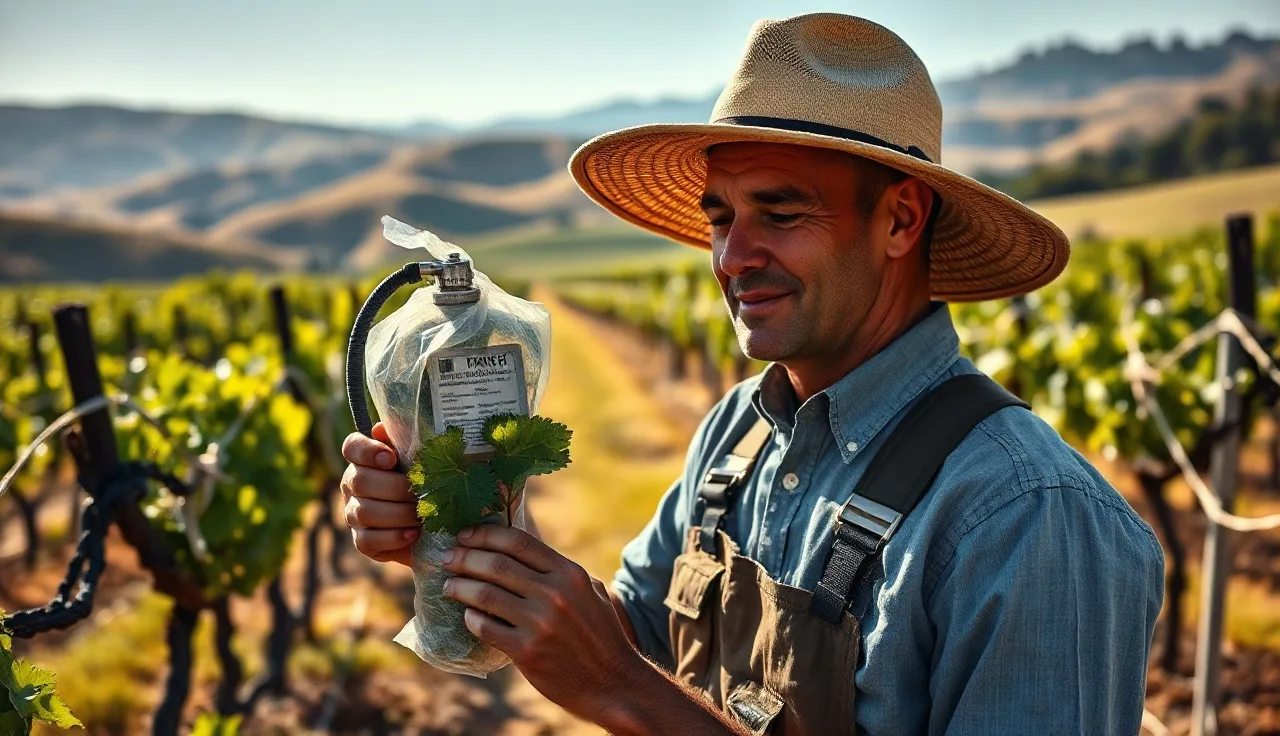
The pressure chamber, still called the pressure bomb by most crews, is the standard field tool for stem water potential (SWP). Midday SWP, read on shaded, bagged leaves near solar noon, gives you vine stress in megapascals (MPa). UC Cooperative Extension has published the most widely cited threshold framework in the country, and most California RDI protocols trace back to it [1].
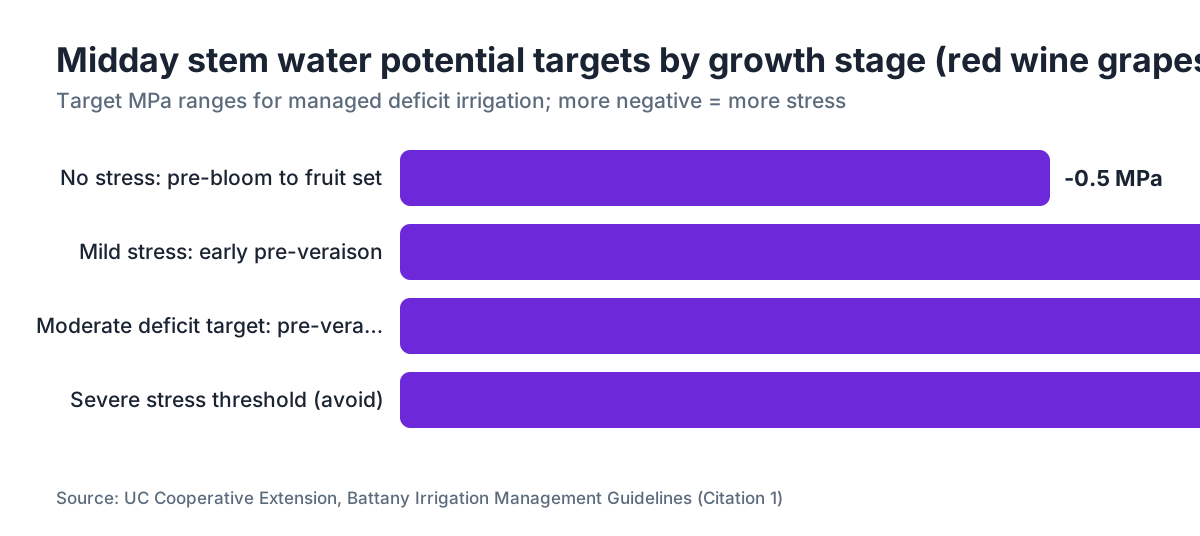
A working threshold reference for red wine varieties:
| Stress level | Midday SWP (MPa) | Typical period |
|---|---|---|
| No stress (baseline) | -0.4 to -0.6 | Pre-bloom to fruit set |
| Mild stress | -0.6 to -0.9 | Early pre-veraison |
| Moderate deficit (target) | -1.0 to -1.4 | Pre-veraison through veraison |
| Severe stress (avoid) | Below -1.4 | Any stage |
Those numbers come from UC Cooperative Extension irrigation guidelines [1]. They are not carved in stone. High-vigor sites on deep soils often shrug off slightly lower readings, while shallow, rocky Paso Robles ground can show leaf roll at -1.2 MPa. Record your site's response next to the number.
Baseline evapotranspiration (ETc) from your local CIMIS station, or the AgriMet network in the Pacific Northwest, adds a second data stream [3][11]. Track both ETc-based deficit and pressure bomb readings and you have corroborating evidence your stress was intentional and calibrated. That matters a lot during an audit.
Write down the time, the block, the row and vine number, the operator's name, the instrument serial number, and the reading. Date it. Sign it. That is the floor, not the ceiling.
What records do you actually need to keep for RDI programs?
No single federal rule mandates RDI records by name. The paperwork comes from overlapping demands: water district reporting, pesticide records that intersect with irrigation timing, USDA organic or sustainable certification audits, and buyer or winery contracts that spell out water-management protocols.
A defensible record set starts with an annual irrigation plan carrying block-level targets, SWP thresholds, and a planned deficit window tied to phenological stage. Add a field log with dates, ETc data, SWP readings (block, vine, time, operator, instrument), irrigation events (start and stop time, duration, flow rate or volume), and any plan deviations with written reasoning. Seasonal vine notes on leaf color, shoot tips, leaf rolling, and berry sampling dates fill in the rest. Calibration records for your pressure chamber and any drip-line flow meters close the loop.
If you farm in a state with water rights or groundwater reporting (California's SGMA counties, Oregon water rights), your volume records feed those reports too [4]. One well-kept field log covers several compliance needs at once, which is why it pays to run it right from the first irrigation of the season instead of reconstructing it at harvest.
For operations juggling multiple blocks with different variety targets, a spreadsheet or a dedicated platform beats paper. VitiScribe is built for vineyard field records and handles block-level irrigation entries next to spray logs and phenology notes, so everything sits in one place come audit season.
How does RDI interact with pesticide application records and worker protection compliance?
This crossover catches people off guard. The EPA Worker Protection Standard requires restricted entry intervals (REIs) be observed, and irrigating during an REI is not clearly allowed in every state if it means workers enter a treated area to adjust emitters, move solid-set heads, or check drip lines [5].
The problem shows up most with systemic fungicides applied right before or during the pre-veraison stress window, since that is peak disease pressure too. Say your plan calls for no irrigation July 1 through July 28, but you spray a 12-hour REI fungicide on July 20. You need a record showing that irrigation equipment checks during that window either did not happen or were done by trained handlers, not re-entry workers. The WPS text under 40 CFR Part 170 requires agricultural employers keep records of pesticide applications, including the product, rate, location, date, and applicable REI [5].
Cross-referencing your irrigation log against your pesticide log is the only way to prove REI compliance when spray and irrigation crews overlap. Some state agriculture departments, CDFA and the Oregon Department of Agriculture among them, inspect both logs side by side. If your spray record shows a Block 6 application on August 3 with a 48-hour REI, and your irrigation log shows drip maintenance on Block 6 on August 4, be ready to explain it.
How do growers in different regions calibrate RDI timing to local conditions?
Coast-influenced regions like the Sonoma Coast or Willamette Valley rarely need aggressive deficit because maritime fog and cool nights already hold vigor and berry size down. RDI in Oregon's Willamette Valley tends to stay mild, around -0.8 to -1.1 MPa in pre-veraison, and the window is short because the season is short [2].
Central Valley and inland California, along with eastern Washington's Yakima and Columbia valleys, face the opposite: high heat, low humidity, and deep sandy loams that drain fast. WSU irrigation work in the Yakima Valley found that pre-veraison SWP targets for Cabernet Sauvignon often need to sit between -0.9 and -1.2 MPa to shrink berries meaningfully without triggering sunburn, because the leaf rolling that comes with stress there exposes clusters to direct radiation [2].
Paso Robles has its own wrinkle. West-side growers at Paso Robles wineries often push deficit harder because afternoon wind and limestone soils moderate temperature stress on the vine. Their records have to capture soil type and depth alongside the SWP numbers, or the data will not translate block to block.
Cornell Cooperative Extension, covering New York's Finger Lakes and Hudson Valley, notes that RDI is far less common there because wet summers and disease pressure usually mean keeping vines healthy with adequate water to hold canopy function and fungicide performance [6]. Records in those regions more often document why deficit was not started during a given window, which is just as valid. Vineyards like Gervasi Vineyard in Ohio deal with the same thing, where summer humidity feeds disease pressure that fights against any aggressive deficit program.
What does good RDI record format look like in practice?
A record nobody can read is almost as useless as no record. Here is what one solid field-log entry should hold:
Date: August 6. Block: Cabernet Sauvignon, Block 3A (2.8 acres, planted 2011, SDI, 1 emitter/vine at 0.5 GPH). Phenological stage: post-veraison, about 14 days after 75 percent color change. SWP reading: -1.2 MPa, measured 12:10 PM, vine row 8 position 14 and row 16 position 22, bagged leaves, operator: Maria S., instrument: PMS Model 615 S/N 4412. ETc (CIMIS Station 52, Paso Robles): 0.27 in/day, five-day average 0.24 in/day. Irrigation event: none, on-plan deficit, continuing pre-harvest stress protocol. Vine observations: shoot tips dormant in about 90 percent of vines, no leaf roll, one vine in row 12 showing slight leaf curl flagged for recheck. Deviation from plan: none.
That entry takes about three minutes to write. It answers every question an auditor, a buyer rep, or a future winemaker might ask about that block on that day. The reading ties to an instrument serial number, a specific vine location, and a named operator.
Keep records at least three years for most pesticide and water compliance. California's pesticide use reporting rules require records be held three years from the date of application [7]. LODI Rules and SIP Certified programs generally expect two to three years of water management records for audit [8][12].
How do you use RDI records to actually improve wine quality year over year?
The record is only as good as the feedback loop around it. At harvest, pull the season's SWP logs next to your fruit analysis (Brix, pH, TA, berry weight) and your wine chemistry or sensory notes. Look at which blocks hit the target stress window on schedule, which ran late, and whether early or late deficit lined up with fruit weight and phenolic maturity differences.
Nobody has clean controlled-trial data from a single commercial vineyard year, because you cannot randomize treatments across working blocks the way a university can. But multi-year records from your own site earn their keep. If your three-year log shows Block 5 consistently hits -1.3 MPa at veraison with no adjustment while Block 2 never drops below -0.9 MPa on the same schedule, that is a management signal: Block 2 might have a leaking lateral, higher water-holding soil, or older vines. Your records found that. Intuition did not.
WSU's long-term research concluded that "deficit irrigation applied during the period from 30 days pre-veraison to harvest consistently reduced berry fresh weight and increased soluble solids compared to well-irrigated controls" [2]. That is the outcome you are chasing. Your records tell you whether you actually created the conditions that produce it.
Some managers build a one-page seasonal summary per block: target SWP range, dates the deficit window opened and closed, total water applied, peak SWP reached, berry weight at harvest, Brix at harvest. Maintained across four or five vintages, that single page becomes the most useful planning document you own. Estate operations at Ponte Winery in Temecula have built exactly this kind of block-level vintage history and pull it out during harvest calls.
What tools help with RDI record-keeping without overcomplicating things?
Paper field logs still work fine. A printed block map with a dated field sheet on a clipboard, filled in after each pressure bomb round and each irrigation event, is auditable and plain. The catch: reconciling paper against ETc data or winery lot records at year end eats real time.
Spreadsheets are the middle ground most managers actually run. A Google Sheet or Excel file with one tab per block, columns for date, stage, SWP, ETc, irrigation event, and notes, costs nothing and is searchable. Conditional formatting that flags readings outside your target range in red catches problems faster than scanning rows by eye.
Dedicated field platforms add block mapping, photo attachment, and integration with CIMIS or weather station APIs. Once you are past about 40 acres across multiple varieties and blocks, the time saved on audit prep and seasonal review starts justifying the cost. VitiScribe handles irrigation records alongside spray logs and compliance documents, so your RDI entries and pesticide records live in one system and cross-reference without digging through two filing cabinets.
Soil moisture sensors add another data stream and can automate some logging. They read soil water content, not vine water status, so they complement the pressure bomb rather than replace it. UC Davis has published guidance on reading capacitance probe data in vineyards, including calibration for different soil textures [1].
What are the most common RDI record-keeping mistakes and how do you avoid them?
The costliest mistake is measuring and not writing it down. A crew runs pressure bomb rounds, notes Block 3 at -1.1, then heads to the next block without logging it. Three days later nobody can say whether that reading came before or after the irrigation adjustment. The measurement is gone.
Second most common: logging only the irrigations, not the non-irrigation decisions. 'No irrigation applied, on-plan deficit' matters as much as logging an actual event. Auditors and future-you both need to know that gap was on purpose.
Third: not tying SWP readings to block geography. '-1.2 MPa today' with no block, no row, no vine means nothing once you run several blocks on different schedules.
Fourth, and this one is subtle: failing to note deviations and the reasoning. Your plan said hold deficit through August 10, but a heat spike with forecast temperatures above 108 degrees pushed you to apply 0.15 inches on August 5. Write it down. A deviation with written justification is defensible. A deviation with no record reads like negligence.
Last: not calibrating the pressure chamber and not recording calibration dates. Chambers drift. A gauge reading 0.2 MPa high will consistently show less stress than exists, and you will push vines harder than you meant to without knowing. Calibrate at the start of each season and log the date and the reference standard used.
How do sustainable and organic certification programs use RDI records?
LODI Rules Sustainable Winegrowing, one of the most widely adopted programs in California, requires growers keep irrigation records that document water use by block and show that decisions rest on crop water demand data [8]. The program does not mandate RDI, but it does require that applications be justified by measured data.
California Sustainable Winegrowing Alliance's SIP Certified carries similar requirements under its water and soil criteria [12]. Both run third-party audits, and auditors will ask to see irrigation logs and ask how you decided when to water and when not to.
USDA National Organic Program rules do not directly regulate irrigation timing, but the water source and any additives must comply with the allowed materials list [9]. Organic operators running RDI should still keep the same SWP and event logs, because an inspector who asks how you manage irrigation and hears 'we just do not water much in late summer' will not walk away satisfied.
The practical point: one good irrigation log format, kept consistently, satisfies almost every program's documentation demand. You do not need a separate log per certification. You need one thorough log. Operations at South Coast Winery in Temecula, running under several sustainability certifications, use exactly that approach: one master irrigation log that feeds every audit request from a single source.
Frequently asked questions
What is the ideal stem water potential target during the RDI deficit window for red wine grapes?
Most California and Pacific Northwest protocols target midday stem water potential between -1.0 and -1.4 MPa during the pre-veraison to veraison window for red wine varieties. UC Cooperative Extension research supports this range as the zone that shrinks berry size and raises phenolic concentration without causing irreversible vine damage. Readings below -1.4 MPa carry real risk of permanent stress effects, especially on young vines or shallow soils.
How long do I need to keep irrigation records for compliance purposes?
California pesticide use reporting rules require pesticide records be kept three years, and irrigation logs tied to those applications should match that period. LODI Rules and SIP Certified programs generally expect two to three years of water management records for audit. Keep at least three years as a practical minimum. If you're under a water district groundwater reporting requirement, check your basin's rules, since some require five years.
Can I use soil moisture sensors instead of a pressure bomb for RDI records?
Soil moisture sensors and pressure bomb (stem water potential) readings answer different questions. Sensors tell you how much water sits in the soil; the pressure bomb tells you how stressed the vine actually is. Both help, but most certification programs and extension guidelines treat SWP as the primary management metric. If you use sensors only, document the sensor type, depth, calibration, and how readings translate to irrigation decisions.
Does regulated deficit irrigation work for white wine grapes the same way it does for reds?
Partially. Moderate pre-veraison deficit can hold acidity and terpene concentration in whites like Sauvignon Blanc and Riesling. But the post-veraison severe deficit that concentrates red tannins can strip whites of fruit aromatics and speed sugar accumulation with no matching acid retention. Most extension guidelines recommend milder targets for whites, roughly -0.8 to -1.1 MPa, and a shorter window. Cornell Cooperative Extension covers Finger Lakes white variety irrigation specifically.
What CIMIS station data should I record alongside my SWP readings?
Record the station number, the reference ET (ETo) for the measurement day, the crop coefficient (Kc) you're using, and the resulting ETc estimate. Also note the five-day average ETc so you have context for whether one hot day is distorting your snapshot. CIMIS data is available daily at cimis.water.ca.gov. Pacific Northwest growers use the AgriMet network through the Bureau of Reclamation for equivalent data.
How do I document an emergency irrigation during a planned deficit period without undermining my RDI records?
Write a deviation entry in your log the same day. Note the trigger (forecast temperatures, observed severe leaf roll, an SWP reading below your emergency threshold), the amount applied, and the date you expect to return to deficit. A documented deviation with reasoning actually strengthens your records by showing the plan was being managed rather than ignored. Keep the weather data printout or screenshot with that entry.
Are there federal regulations that specifically require vineyard irrigation records?
No single federal regulation mandates irrigation records purely for water management. The paper trail comes from a mix of state water rights reporting, EPA WPS pesticide record rules under 40 CFR Part 170, USDA organic documentation requirements, and private certification audits. In Sustainable Groundwater Management Act basins in California, growers may also owe reporting to their local Groundwater Sustainability Agency.
How does RDI interact with canopy management decisions I should be recording?
Canopy management and irrigation stress interact directly. Hedging or leaf removal that raises cluster exposure will amplify temperature and evaporative stress on clusters during the deficit period. If your records show a severe SWP reading in a block where you also did heavy leaf pulling on a hot week, the two events together explain the outcome better than either alone. Record canopy work dates and methods in the same log next to your SWP entries.
What pressure chamber model is most commonly used in commercial vineyards and does the model matter for records?
The PMS Instruments Model 600 and Model 615 are the most widely used in California and Pacific Northwest vineyards. The model matters for records because calibration tolerances vary by instrument, and an auditor or consultant reviewing your data needs to know the measurement method. Always record the instrument model and serial number with readings. UC Davis extension materials reference these instruments in their SWP measurement protocols.
Do RDI records need to be signed or witnessed to be valid for certification audits?
Most certification programs (LODI Rules, SIP, CCOF organic) do not require a witness signature on daily field logs, but they do expect records to identify who made each measurement or decision by name or initials. The operator identity matters because it ties to training records, which WPS also requires. A named, consistent operator on each entry counts for more than a formal witness signature.
Can RDI timing records be used to support insurance or crop loss claims?
Yes, and it's an underappreciated benefit. If you lose crop to heat stress, frost, or disease during the season, your irrigation records can show management decisions were deliberate and defensible. A well-documented RDI program tells an insurer that stress events fell within your managed protocol rather than negligence. Talk to your crop insurance agent about what documentation they expect before a loss event, not after.
How do I structure an annual RDI plan document before the season starts?
Write one page per variety group (or block group with similar targets). Include the planned deficit window in phenological stages, target SWP range, the emergency threshold that triggers unplanned irrigation, the ETc data source you'll use, the irrigation system type and emitter flow rate, and who runs the weekly pressure bomb rounds. Review it with your winemaker before you start so quality targets align. Update it at season end with what actually happened.
What WSU research is most relevant to RDI timing for Pacific Northwest wine grapes?
WSU's Irrigation of Wine Grapes in Washington State publication, available through WSU Extension, covers variety-specific deficit targets and timing windows for Yakima Valley and Columbia Valley conditions. Its work on pre-veraison deficit in Cabernet Sauvignon and Merlot is directly applicable. Researchers including Nick Dokoozlian and later WSU-affiliated teams have also published in the American Journal of Enology and Viticulture on irrigation timing and berry composition.
Sources
- UC Cooperative Extension, Mark Battany, Irrigation Management for Winegrapes: Midday stem water potential thresholds for deficit irrigation in California wine grapes, including -1.0 to -1.4 MPa target range for moderate stress during pre-veraison to harvest window
- Washington State University Extension, Irrigation of Wine Grapes in Washington State: WSU research finding that deficit irrigation applied from 30 days pre-veraison to harvest consistently reduced berry fresh weight and increased soluble solids compared to well-irrigated controls; Yakima Valley SWP targets for Cabernet Sauvignon
- California Department of Water Resources, CIMIS Program: Daily reference evapotranspiration (ETo) data from CIMIS stations used as input for vineyard ETc calculations and irrigation scheduling records
- California Department of Water Resources, Sustainable Groundwater Management Act: SGMA requires groundwater reporting in designated basins, which includes agricultural irrigation volumes relevant to vineyard water records
- U.S. EPA, Agricultural Worker Protection Standard, 40 CFR Part 170: EPA WPS requires agricultural employers to maintain records of pesticide applications including REIs, affecting coordination of irrigation and spray crews during deficit windows
- Cornell Cooperative Extension, Vineyard Irrigation Management: Cornell extension guidance that RDI is less commonly practiced in New York's Finger Lakes and Hudson Valley due to disease pressure requiring vine health maintenance, and that records documenting why deficit was not initiated are valid documentation
- California Department of Pesticide Regulation, Pesticide Use Reporting: California requires pesticide use records to be maintained for three years from the date of application
- USDA Agricultural Marketing Service, National Organic Program: USDA NOP does not directly regulate irrigation timing but requires water source and any additives to comply with allowed materials lists; organic operators must document water management practices
- American Journal of Enology and Viticulture: Research published in AJEV on the effect of irrigation timing on anthocyanin concentration, tannin structure, and berry-to-seed ratio in wine grapes, supporting pre-veraison deficit as the quality-improvement window
- Bureau of Reclamation, AgriMet Pacific Northwest Agricultural Weather Network: AgriMet provides daily ET and weather data for Pacific Northwest vineyards, equivalent to California's CIMIS, used as input for irrigation scheduling records
- California Sustainable Winegrowing Alliance, SIP Certified Program: SIP Certified requires water management documentation under its water and soil criteria, including irrigation logs demonstrating decision-making based on measured data
Last updated 2026-07-10