Drone sprayer vineyard guide: costs, rules, and real-world results
TL;DR
- Agricultural drone sprayers cover 7 to 25 acres per hour in vineyards, cost $15,000 to $80,000 to buy, and require FAA Part 137 certification to spray for hire.
- They earn their keep on steep or fragmented terrain where a tractor can't work safely.
- Flat, road-accessible blocks rarely justify the money over a good airblast rig.
What is a drone sprayer and how does it work in a vineyard?
A drone sprayer is an unmanned aircraft carrying a liquid tank, a pump, and spray nozzles, flown along programmed GPS routes to put pesticides, fungicides, or foliar nutrients right over the vine canopy. Tank sizes run from 10 liters on entry machines to 40 liters on the larger platforms like the DJI Agras T40, which holds about 10 gallons per load [1]. The drone flies 2 to 7 meters over the canopy. Downwash off the rotors pushes spray down into the leaf layer instead of leaving droplets to fall on their own.
The mechanics matter. Rotor downwash makes a zone of turbulence that drives droplets down and sideways into the canopy, so you get some penetration into dense foliage that a plain overhead boom would miss. Does that penetration match an airblast sprayer? The honest answer is: it depends on canopy shape and growth stage. Early-season sprays on open canopies come closest. Dense hedgerow blocks late in the season are the hard case.
Here's the workflow for a vineyard manager. You load a field boundary and vine row coordinates into the drone's ground station software. The machine flies autonomous laps and lands for a refill every 10 to 20 minutes, depending on tank size and rate. One operator can run the whole thing, but a second person on refills saves real time. GPS accuracy on modern ag drones hits roughly 10 centimeters with RTK positioning, so overlap and skip between rows stay controllable [1].
Drone spraying isn't new to agriculture worldwide. Vineyard-specific adoption in the US is still young. California, Washington, and New York hold the largest clusters of trial users as of 2024, tracked loosely through FAA Part 137 certification data and university extension surveys [2].
How much does a vineyard drone sprayer cost to buy or hire?
Buying runs about $15,000 for a small 10-liter platform to $80,000 or more for the largest RTK-equipped commercial units. The DJI Agras T40 body alone sells around $13,000 to $17,000. Add the charging station, RTK base, spare batteries, and the accessories you actually need and a working setup lands closer to $25,000 to $35,000 [1]. Smaller operators on 8-liter machines from XAG or Hylio can get in around $15,000 to $20,000 all-in.
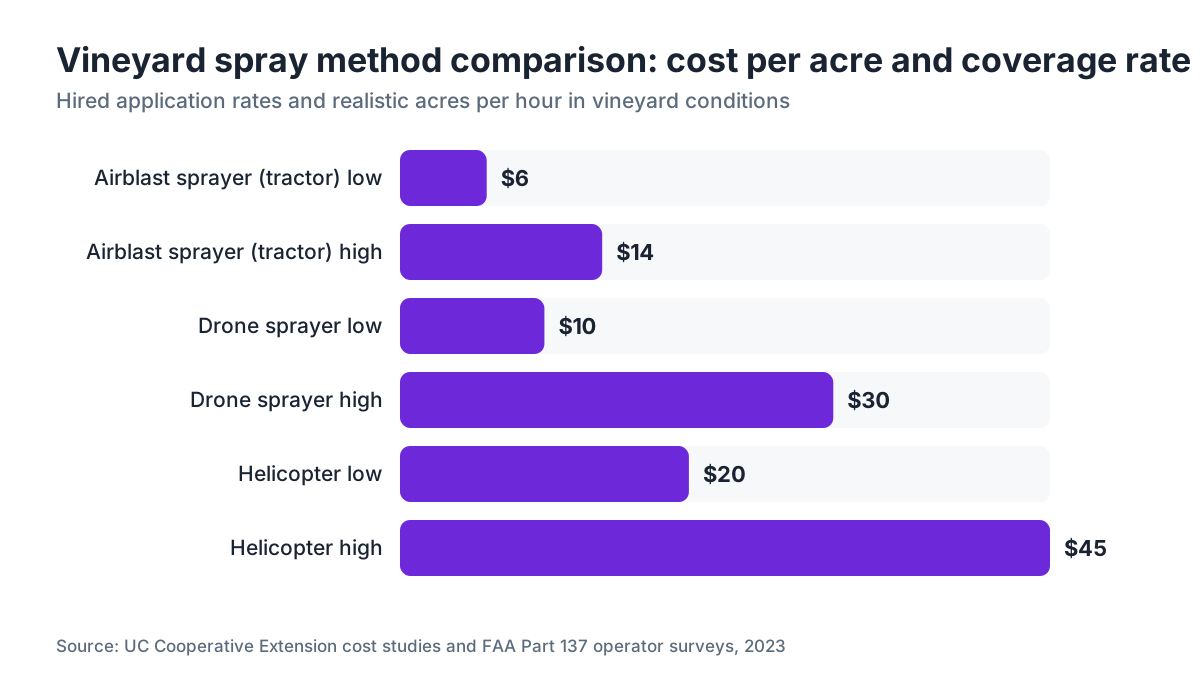
Contract drone spray services charge $10 to $30 per acre depending on region, terrain, and how complex the application is [3]. That's a fair bit more per acre than an airblast rig, which usually runs $6 to $14 per acre depending on the market. The comparison isn't always fair, though. A contract drone can reach a 40% slope that no ground rig touches safely.
Owning one adds up fast. Battery packs lose real capacity after 200 to 400 charge cycles, nozzles wear, and you pay for maintenance, insurance, and FAA renewals. A realistic annual operating budget for a working drone is $4,000 to $10,000 on top of the purchase price, before labor [3].
Return on investment comes down almost entirely to your ground. Own 20 acres of flat, tractor-friendly Cabernet? A drone is almost certainly a worse buy than a good airblast upgrade. Manage 60 acres across three steep hillside parcels that eat 8 hours of slow tractor time every pass? The math flips fast. Run a simple per-pass cost comparison before you spend a dollar.
| Application method | Typical cost per acre (hired) | Typical acres/hour | Slope limitation |
|---|---|---|---|
| Airblast sprayer (tractor) | $6 to $14 | 2 to 5 | Practical limit ~25 to 30% |
| Helicopter spray | $20 to $45 | 15 to 40 | Very low |
| Drone sprayer | $10 to $30 | 7 to 25 | Works above 45%+ |
| Backpack/hand gun | Labor only | 0.5 to 1 | Any |
Sources: UC Cooperative Extension cost studies [3], FAA Part 137 operator surveys [2].
What FAA certifications do you need to spray a vineyard with a drone?
This trips up a lot of growers, so watch for two separate regulatory tracks.
Every drone pilot flying commercially needs FAA Part 107 Remote Pilot certification. You pass a knowledge test at an FAA-approved testing center, pay the $175 fee as of 2024, and renew every 24 months through free online recurrency training [4]. Part 107 covers airspace rules, weather minimums, right-of-way, and operating limits. You also register any drone over 0.55 pounds with the FAA for $5.
Here's the part most growers miss. Applying pesticides from an aircraft, drone included, requires FAA Part 137 Agricultural Aircraft Operator certification if you're doing it for hire [2]. The FAA reads "for hire" broadly enough that spraying a neighbor's block for pay almost certainly triggers Part 137. The certificate takes a knowledge and skill review with an FAA inspector. Spraying your own land under Part 107 alone is legal in most readings, but custom application work for others needs Part 137. Full stop.
State aviation and pesticide rules stack on top of the FAA baseline. California requires that any aerial pesticide application on ag land be supervised by a licensed Pest Control Adviser and reported to the county agricultural commissioner [5]. Washington State Department of Agriculture requires aerial applicators to hold a Washington pesticide applicator license with an aerial endorsement [6]. Check your state department of agriculture for the applicator license category that covers drones. Most states updated their rules since 2020, but some still have fuzzy language around "unmanned aerial" systems.
Quick version. Own the land, spray your own vines: Part 107 minimum. Spray for hire: Part 107 plus Part 137 plus your state's aerial pesticide applicator license.
Does a drone sprayer give good spray coverage in a vine canopy?
Coverage is the real question, and the research is genuinely mixed. A UC Davis extension trial on Cabernet Sauvignon found drone-applied fungicide matched airblast for botrytis control during the pre-bloom and fruit set windows, but coverage fell off noticeably in dense canopies at veraison [7]. Application rates had to drop to 5 to 10 gallons per acre (ultra-low volume) against 50 to 100 gallons per acre for conventional airblast, which changes the math on adjuvants and label compliance.
Label compliance is a real constraint. Many pesticide labels set minimum water volumes or application methods. If a label says "apply by ground equipment or aircraft" and lists a minimum gallons per acre, your drone rate has to hit that number or you're off-label. EPA label requirements don't automatically make room for ultra-low-volume drone work, though some manufacturers have started seeking specific label language for drones [8]. Read the label, call the manufacturer's agronomic support line if you're unsure, and write down what they told you.
Droplet size matters a lot here. Drone nozzle kits tuned for penetration make finer droplets (roughly 100 to 200 microns) that ride the downwash into the canopy, but fine droplets also drift more. The EPA Worker Protection Standard limits applicator re-entry based on the product, not the application method [8]. Run coarser nozzles to control drift and you lose penetration. There's no magic setting. You dial in a compromise for the conditions in front of you.
WSU extension work in Washington's Columbia Valley found drone application in trellis-trained, vertically-shoot-positioned vines gave more consistent coverage than sprawling, non-trellised blocks [6]. Well-managed trellis systems with even canopy geometry beat poorly managed or non-trellised vines under a drone. Every time.
What does the EPA Worker Protection Standard say about drone pesticide applications in vineyards?
The EPA Agricultural Worker Protection Standard (WPS), 40 CFR Part 170, applies to any pesticide application in an agricultural setting, drones included [8]. The WPS requires that workers and handlers be told about applications, that restricted-entry intervals (REIs) be posted and observed, and that personal protective equipment follow the product label.
For drone work specifically, the handler running the drone wears the PPE the label lists for aerial application if it has one, or ground application PPE if there's no aerial handler PPE listed. EPA treats drone operators as handlers under the WPS when they're actively controlling the application. Minimum required training is WPS handler training, and you have to document it.
Every pesticide label carries the same line: "It is a violation of Federal law to use this product in a manner inconsistent with its labeling." That applies straight to application method and rate [8]. Use a drone to apply a product whose label only covers ground or conventional aerial equipment and you're in a gray zone at best, in violation at worst. The fix is to use products with broad application-method language, or ones with specific drone language added through a Section 24(c) state registration or an updated federal label.
Re-entry intervals don't change with application method. They change with the product. Log your application time and REI in your spray records. Cornell's extension program recommends keeping drone GPS flight logs alongside your spray records because they show exactly where you applied and help defend against drift complaints [9].
When does a drone sprayer make economic sense in a vineyard?
Be honest with yourself. Most vineyards on flat or gently rolling ground with decent road access will not see a clear economic win from buying a drone sprayer. The per-acre cost is higher, the water volume is lower (which hurts efficacy on some products), and battery swapping eats time.
Where drones actually earn their keep:
Steep terrain, 30% slope and up, where tractor-mounted airblast is dangerous or impossible. This is the clearest case. Safety alone pays for the drone in a lot of operations.
Fragmented blocks. Six separate 3-acre blocks scattered across a hillside with no connecting road? Moving an airblast rig takes longer than the spraying. A drone and two operators clear those blocks in one session without dragging heavy equipment around.
Tight timing. Botrytis management at berry touch or bloom is a narrow window. If wet, soft rows have kept your tractor parked and the calendar keeps moving, a drone doesn't need dry soil to fly.
Labor limits. One person can run a modern ag drone, though a second on refills is faster. A two-person drone crew replaces a tractor driver plus a helper in a lot of operations.
I'd be careful with the "precision" marketing pitch. Drones do log GPS tracks and can prove where they flew, which has real value for spray records (VitiScribe's field operations module can ingest drone flight data exports and auto-populate spray log entries, which saves real time during busy spray seasons). But droplet placement over a vine row isn't dramatically tighter than a well-calibrated airblast rig. The precision value is in documentation, not targeting.
For anyone managing a vineyard with mixed terrain, the honest answer is usually a hybrid: tractor airblast on the flat blocks, drone or spot sprayer on the steep and access-limited ground.
How do you choose the right drone sprayer for vineyard use?
Tank size is the first call. Smaller tanks (10 to 16 liters) mean more refill stops but lighter payload and longer flight time per battery. Bigger tanks (30 to 40 liters) cover more per load, drain batteries faster, and carry more weight in wind. For most vineyard blocks under 50 acres, a 16 to 20 liter tank hits a sensible middle.
Nozzle setup matters as much as tank size. Look for machines that take standard agricultural nozzle bodies so you can swap tip types by application. Rotary atomizer nozzles make very fine droplets with good coverage but high drift risk. Flat-fan tips give you more control over droplet size. Some platforms lock you into proprietary nozzles, which kills your flexibility.
RTK GPS is worth the premium on tight row spacings. Standard GPS on ag drones holds 1 to 3 meter accuracy, which on 8-foot rows means one row hit well and the next one inconsistent. RTK (Real-Time Kinematic) tightens that to 10 centimeters [1]. Rows wider than 10 feet? Standard GPS is probably fine.
Battery and charging infrastructure is the operational bottleneck nobody thinks about until they're standing in the field. One drone with three battery packs and a fast charger is the minimum for a half-day session. Serious operations run six or more packs with dual chargers, or a generator-powered rapid charging station.
Look hard at after-sale support. DJI Agriculture, XAG, and Hylio all sell into the US market as of 2024 with US service networks of varying depth [1]. A drone that sits broken for three weeks during bloom pressure is worse than not owning one. Ask the sales rep exactly where the nearest authorized repair center is and what the average turnaround runs.
How do university extension programs evaluate drone sprayers for vineyards?
Three land-grant programs have done the most relevant applied work in US vineyard conditions.
UC Davis and UC Cooperative Extension have published field trials since 2019 on drone efficacy, cost, and label compliance in North Coast and San Joaquin Valley vineyards [7]. Their general finding: drone application works well for early-season disease management, but efficacy against airblast depends on the product and the timing. They flag label compliance as the biggest practical barrier to wider use.
WSU extension in Prosser has focused on Columbia Valley conditions, meaning high wind, wide rows, and vertically-shoot-positioned Riesling and Chardonnay [6]. Their trials showed wind above 10 mph badly degrades uniformity and that early-morning windows are often the only option. They've also posted free cost comparison spreadsheets worth running with your own numbers.
Cornell Cooperative Extension has worked in the Finger Lakes and Hudson Valley, where steep slopes and small blocks make drones a more natural fit than the big flat regions [9]. Their 2023 guidance covers pesticide label compliance, NYS DEC registration, and WPS handler training specific to drone operations. Cornell also recommends growers keep GPS flight logs as part of their spray records, noting the logs satisfy the "application block" documentation requirement under New York's pesticide recordkeeping law.
All three agree on one point. There's no general recommendation to switch wholesale from airblast to drones. The advice is always to evaluate block by block on terrain, access, and labor.
What pesticide labels allow drone sprayer application in vineyards?
This is the practical bottleneck. As of 2024, a growing number of fungicide, insecticide, and foliar nutrition labels carry language covering unmanned aerial systems (UAS) or drones by name. The shift picked up after EPA's 2023 guidance acknowledging drones as a distinct application-method category [8].
Products with broad aerial language ("may be applied by air") generally cover drones, but check whether the label sets a minimum water volume an ultra-low-volume drone pass can't reach. Some fungicide labels for botrytis and powdery mildew list minimums of 20 to 50 gallons per acre, which a 5 gallon-per-acre drone pass doesn't meet.
The safe path: call the pesticide manufacturer's technical services line and ask flat out whether your planned drone rate and method fits the current label. Write down the call (date, name, what they said). Using a product under a California Section 24(c) registration or a supplemental label? Attach that document to your spray record.
Products most often flagged as drone-compatible in extension trials include sulfur-based fungicides, copper-based products, and some broad-spectrum insecticides where the label is permissive on method. Systemic fungicides with penetration requirements tend to carry more restrictive language. EPA's pesticide label search tool is your authoritative reference [8].
State registrations add another layer. California's DPR requires any new pesticide use pattern, drone application included, be evaluated at the state level even when the federal label allows it [5]. Washington WSDA holds a similar requirement [6]. Know your state rules before your first application.
How do you set up spray records for drone vineyard applications?
Recordkeeping for drone applications matches any pesticide application: product name, EPA registration number, application date, site, target pest, rate applied, total amount applied, and applicator name and license number [5]. Most states require records for at least two years. California requires three years under the county agricultural commissioner reporting system [5].
What's different with drones is the documentation you get for free. Modern ag drones generate GPS flight logs, spray logs showing pump rate, speed, altitude, and coverage area in real time, and sometimes tank usage records. That's more granular than anything a tractor-mounted sprayer produces, and it directly supports the block-level documentation state laws want.
Exporting that flight data and matching it to your spray records by hand is tedious. Do more than the occasional drone pass and a field operations platform that imports drone telemetry pays for the time. VitiScribe's spray record module takes field boundary and application event data and formats it for county reporting, which cuts the post-spray paperwork sharply.
A few things to put in a drone spray record you might not think of: wind speed and direction at application time (you'll want this if a drift complaint ever lands), battery numbers used (handy for maintenance tracking), operator Part 107 certificate number, and for hired work, the Part 137 operator's certificate number. Cornell's extension guidance [9] has a sample drone spray record template that covers most state requirements.
What are the real limitations of drone sprayers in vineyards that vendors won't volunteer?
Battery logistics kill productivity faster than anything else. A 10-liter drone with a 22-minute flight time and a 20-minute rapid charge covers two to three acres per battery cycle on a typical low-volume vineyard pass. Run three battery sets and you get six to nine acres before everything needs a full charge. A 30-acre block means multiple charging sessions, which is either a very long day or a serious battery investment up front.
Wind is the second real limiter. Most manufacturers rate their drones for winds up to 10 to 15 mph. Vineyard mornings in coastal California or the Finger Lakes regularly hit those limits by 9 or 10 a.m. You spray early (dew on leaves, which changes deposition) or you don't spray that day.
Nozzle clogging is underreported. Drone nozzles are fine and run at low pressure. Wettable powders and some suspension concentrates clog them. Stick to emulsifiable concentrates and suspension concentrates that pass through fine nozzles cleanly, or budget time for mid-session cleaning.
Mid-season canopy density makes coverage inconsistent in ways you can't see from the ground. Downwash on a DJI T40 at 3 meters makes decent turbulence, but a 5-foot-wide, fully leafed Cabernet canopy in July is a real wall. You can fly lower for more downwash or slow down to dwell longer, but both cost you coverage rate.
One more. FAA registration and operational rules are not optional and not trivially simple. Several growers have caught cease-and-desist letters from county ag departments after flying drone applications without the Part 137 certificate that hired work requires. The risk is real.
Frequently asked questions
Can I spray my vineyard with a drone without a commercial pilot's license?
Yes. FAA Part 107 Remote Pilot certification, not a full pilot's license, is the requirement for commercial drone operations including spraying your own land. You pass a 60-question knowledge test at an approved testing center and pay a $175 fee. If you're spraying other people's vineyards for compensation, you also need FAA Part 137 Agricultural Aircraft Operator certification, which requires a review with an FAA inspector.
How many acres per hour can a drone sprayer cover in a vineyard?
Realistic throughput in a vineyard is 7 to 15 acres per hour for most mid-sized platforms (10 to 20 liter tanks), counting refill and battery swap time. Manufacturer claims of 20 to 25 acres per hour assume open field conditions with a support crew. In a vineyard with turns at row ends, refill stops, and battery limits, plan on the lower end of the range for production scheduling.
Do drone sprayers work for applying sulfur in vineyards?
Wettable sulfur suspensions can work in drone sprayers but need frequent nozzle checks. Dry flowable sulfur mixed with water tends to settle and clog fine nozzle orifices during low-pressure drone application. Many operators use liquid-formulated or dispersible sulfur products to avoid this. Agitate the tank and test nozzle flow before starting a block. Check the label for minimum water volume, which some sulfur products specify.
What wind speed is too high to spray a vineyard with a drone?
Most agricultural drone manufacturers specify a maximum operating wind speed of 10 to 15 mph. Above 10 mph, spray drift climbs and coverage uniformity drops. EPA pesticide labels also prohibit application when wind exceeds label-specified limits, often 10 mph for aerial applications. WSU extension trials in the Columbia Valley found consistent quality degradation above 8 mph. Plan on early-morning windows in most US vineyard regions.
Does a drone sprayer require a pesticide applicator license in California?
Yes. California requires aerial pesticide applications, drone included, be supervised by a Pest Control Adviser (PCA) licensed by the California Department of Pesticide Regulation. The application must also be reported to the county agricultural commissioner. If you're doing custom work on other people's land for pay, you need a Qualified Applicator License or must work under one. Contact your county ag commissioner's office for current requirements.
How does drone spray coverage compare to airblast in a vineyard canopy?
UC Davis extension trials found comparable early-season fungicide coverage between drone and airblast, but drone coverage dropped noticeably in dense mid-season canopies. Drones apply at 5 to 10 gallons per acre versus 50 to 100 for airblast, which means higher concentrate formulations and potential label conflicts. Well-trellised, open canopies perform best. Dense, sprawling vines give uneven drone coverage. Airblast still holds a penetration advantage in heavily leafed canopies.
What is the difference between FAA Part 107 and Part 137 for vineyard drone spraying?
Part 107 is the standard commercial drone operator certification required for flying any drone commercially, including your own agricultural use. Part 137 is specifically for aerial agricultural applicators who apply pesticides for hire from aircraft, drones included. Spray only your own vineyard and Part 107 is the minimum. Spray any other grower's land for compensation and you need both Part 107 and Part 137, plus your state's aerial pesticide applicator license.
Can a single operator run a vineyard drone sprayer alone?
Technically yes, but it's slow. One person monitors the flight, manages battery swaps, and handles refills. The bottleneck is refill time: while you fill the tank, the drone sits idle. Most operations that use drones seriously run two people, one flying and one prepping the next battery set and refilling the mixing tank. Solo operation works for small blocks (under 10 acres per session) or when a second person truly isn't available.
Are there organic-approved pesticides I can apply by drone in a vineyard?
Yes. Many OMRI-listed products, including copper-based bactericides and fungicides, certain biological fungicides, and insecticidal soaps, carry label language permissive enough to cover drone application. The label compliance question is the same as for conventional products: confirm the label permits aerial or UAS application, check the minimum water volume, and document that your method is consistent with label directions. Copper hydroxide formulations have been used in drone trials at UC Davis.
How do I document drone spray applications to comply with state pesticide records laws?
Spray records for drone applications need the same fields as any pesticide application: product, EPA number, date, site, target pest, rate, total volume, and applicator credentials. Add drone-specific details: GPS flight log reference, wind speed and direction, operator Part 107 certificate number, and Part 137 certificate if applicable. Export the drone's flight data log and attach it to the record. California requires records for three years; most other states require at least two.
What drone sprayer brands are available for vineyard use in the United States?
The main platforms sold and serviced in the US as of 2024 are DJI Agriculture (T10, T25, T40 series), XAG (P40, V40), and Hylio (AG-130, AG-272). DJI has the widest US dealer and service network. XAG and Hylio offer competitive pricing and some US-based technical support. Other brands exist but have limited US parts and service, which is a real operational risk for a production vineyard.
Is drone spraying legal on steep vineyard slopes where no tractor can go?
Yes, and this is the best use case. FAA rules don't prohibit flying over steep terrain. OSHA and state labor rules make it increasingly hard to put workers or tractor operators on slopes above certain grades, which leaves drone application as one of the few practical options for very steep blocks. Confirm your FAA certifications, state pesticide applicator license, and label compliance as you would for any application.
Sources
- DJI Agriculture, Agras T40 product specifications: DJI Agras T40 carries a 40-liter spray tank with RTK positioning accurate to approximately 10 centimeters
- FAA, Agricultural Aircraft Operations (Part 137): FAA Part 137 certification is required for aerial pesticide application for hire, including by drone
- UC Cooperative Extension, Sample Costs to Establish and Produce Winegrapes: Custom application rates for airblast spraying run $6 to $14 per acre; drone spray service rates run $10 to $30 per acre in comparable markets
- FAA, Remote Pilot Certificate (Part 107): FAA Part 107 Remote Pilot certification requires passing a knowledge test and paying a $175 fee, renewed every 24 months
- California Department of Pesticide Regulation, Aerial Application Requirements: California requires aerial pesticide applications including drone applications to be supervised by a licensed PCA and reported to the county agricultural commissioner; records must be kept three years
- Washington State University Extension, Drone Application in Washington Vineyards: WSU extension trials found drone application quality degrades above 8 mph wind speed and that well-trellised VSP vines perform best under drone application
- University of California, Agriculture and Natural Resources (UC ANR), vineyard drone spray trial results: UC trial found comparable botrytis control between drone and airblast applications pre-bloom, with coverage declining in dense canopies at veraison
- EPA, Agricultural Worker Protection Standard and Pesticide Labels (40 CFR Part 170): WPS requires drone operators to wear label-specified PPE; labels stating 'use inconsistent with labeling is a violation of Federal law' apply to application method and rate for drone use
- Cornell Cooperative Extension, Drone Pesticide Application Guidance for New York Vineyards: Cornell extension recommends GPS flight logs be kept with spray records to document application boundaries and satisfy NYS pesticide recordkeeping law
Last updated 2026-07-09