Drones in viticulture: what they actually do and what they cost
TL;DR
- Vineyard drones split into two jobs.
- Imaging drones scout canopy vigor, water stress, and disease pressure.
- Spray drones apply pesticides or foliar nutrients from above.
- Imaging systems start around $1,500; spray rigs run $15,000 to $50,000 or more.
- FAA Part 107 certification is required for any commercial use.
- University trials show 20 to 30 percent input savings are realistic in some applications, but ROI depends heavily on vineyard size.
What can drones actually do in a vineyard?
Vineyard drones do two different jobs, and confusing them costs money. The first job is sensing. A drone carries a camera (RGB, multispectral, or thermal) over the canopy and generates maps you can act on. The second job is application. A spray drone carries a tank and disperses pesticides, fungicides, or foliar nutrients at low altitude.
Sensing drones are the mature technology. A multispectral sensor measures reflected light in bands like near-infrared and red-edge that track chlorophyll concentration and water content. Software turns that into NDVI (Normalized Difference Vegetation Index) maps that flag low vigor, disease pressure, or water stress before you can spot the problem from the ground [1]. A single flight over 20 acres takes 20 to 40 minutes depending on your flight plan and overlap settings.
Spray drones are the louder conversation right now, mostly because DJI Agras and XAG have built machines with real payload capacity. The DJI Agras T40 carries a 40-liter tank and covers 21 to 43 acres per hour at standard operating parameters according to DJI's published specs. That number sounds impressive until you remember most wine grape blocks run under 10 acres, often chopped up by access roads, guy wires, and end posts that wreck automated flight paths. Terrain-following matters enormously on hillsides.
Beyond scouting and spraying, a smaller set of jobs is picking up: canopy measurement for pruning weight estimation, vine counting for block inventory, frost monitoring with thermal cameras, even vine training assessment. Some of these earn their keep. Others are still research toys. The section below separates the signal from the noise.
What does the research say about drone benefits in vineyards?
Good controlled-trial data is still thin, and I'll say so plainly. But several institutions have published results worth quoting.
UC Davis and the UC ANR Cooperative Extension have tested multispectral drone scouting since at least 2018. Work from their viticulture programs found that drone NDVI imagery identified spatial variation in vine vigor that tracked yield variation at harvest, with correlation coefficients in the 0.6 to 0.8 range depending on variety and timing [1]. That's useful for variable-rate irrigation decisions or for deciding where to scout disease first. It does not replace a trained scout.
WSU Extension researchers looking at precision viticulture tools reported that remote sensing can cut field scouting time by roughly 50 to 80 percent for initial triage, but ground-truthing stays necessary to confirm what the imagery suggests [3]. You still walk the block. You just walk fewer of them.
On the spray side, a 2022 review in the journal Agronomy (MDPI) found that UAV sprayers matched ground equipment deposition in some canopy configurations, particularly open-lyre and vertical shoot positioning, but coverage on the interior of a dense bilateral Guyot canopy was clearly worse without dedicated air-assist [4]. The EPA Worker Protection Standard doesn't exempt spray drones from handler training, which matters for your compliance records [5].
Cornell's viticulture program has mapped disease pressure with drone imagery in the Finger Lakes and Hudson Valley, looking specifically at downy mildew and botrytis. Their guidance notes that thermal imaging at dawn can catch water stress 24 to 72 hours before visible wilting, buying you real lead time on irrigation [6].
Nobody has strong large-scale economic data on ROI across diverse vineyard types. The nearest honest estimate comes from stacking up university trial reports: vineyards over about 50 contiguous acres tend to see positive ROI on an owned imaging drone within two to three seasons. Smaller operations often come out ahead hiring a drone service provider per season instead of buying hardware.
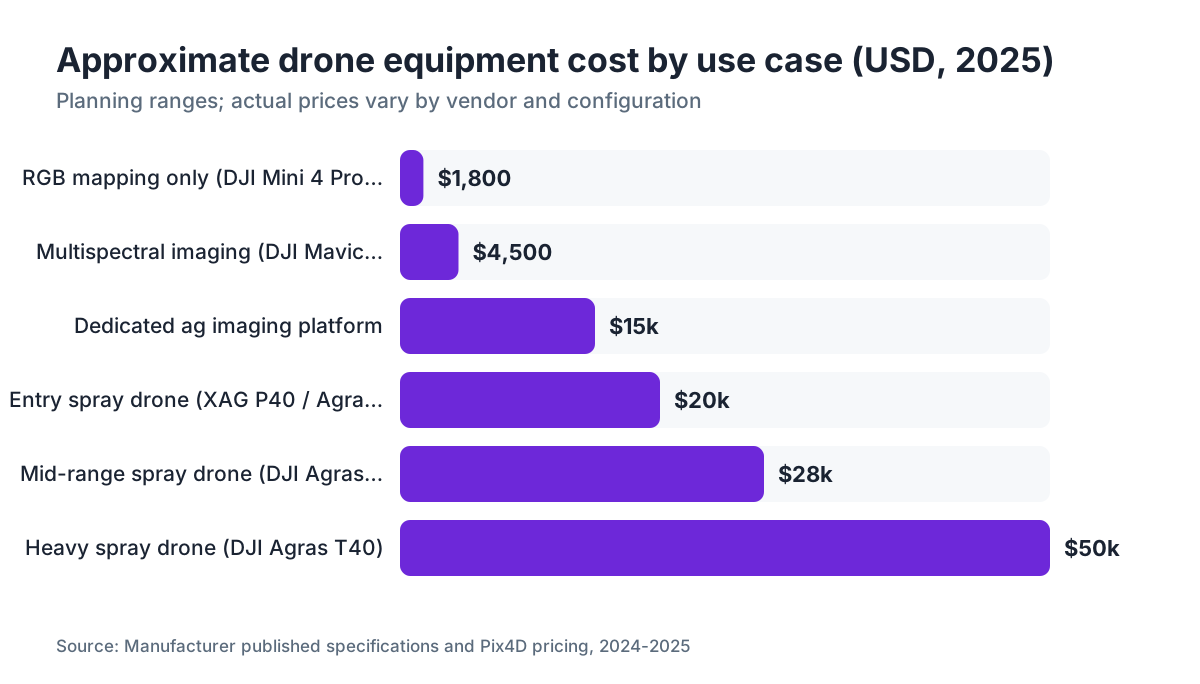
What does vineyard drone equipment cost in 2025?
Prices move as new hardware ships, so treat these as planning ranges, not quotes.
| Use case | Hardware example | Approximate cost (USD) | Notes |
|---|---|---|---|
| RGB mapping only | DJI Mini 4 Pro + Pix4Dfields subscription | $800 - $1,800 total | No multispectral; limited agronomic value |
| Multispectral imaging | DJI Mavic 3 Multispectral | $3,500 - $4,500 | RGB plus 4 multispectral bands |
| Dedicated ag imaging | senseFly eBee Ag or Parrot Sequoia+ | $5,000 - $15,000 | Higher overlap, better agronomic software |
| Entry spray drone | XAG P40 or DJI Agras T10 | $15,000 - $20,000 | 8-10 L tank, ~10 ac/hr |
| Mid-range spray drone | DJI Agras T25 | $22,000 - $28,000 | 20 L tank, better terrain following |
| Heavy spray drone | DJI Agras T40 | $35,000 - $50,000 | 40 L tank, 40+ ac/hr |
| Annual service contract | Varies by vendor | $1,500 - $5,000/yr | Firmware, calibration, parts coverage |
Software is an ongoing cost people forget. Pix4Dfields runs around $150 to $350 per month on subscription [7]. DroneDeploy's agriculture tier sits in the same neighborhood. If you fly multispectral data and never process it right, you wasted the sensor. Budget for software before you budget for hardware.
Batteries are consumables. A set of four Agras T40 batteries, which you need for continuous operation, costs $1,200 to $2,000, and capacity fades after 150 to 200 charge cycles depending on storage and operating conditions. That's a per-season line item that blindsides first-time buyers.
Service contracts matter more here than with most equipment. Spray drones fly in dusty, chemically contaminated air. The pumps, nozzles, and flow sensors need regular flushing and inspection. Skip that and you shorten the machine's life fast.
What FAA rules apply to vineyard drone use?
Fly for any commercial purpose, including saving your own business money, and you need FAA Part 107 certification [8]. Full stop. Recreational exemptions don't cover vineyard operations.
Part 107 requires passing a knowledge test at an FAA-approved testing center. The test covers airspace classifications, weather, emergency procedures, and drone regulations. It's not trivial, but it's no graduate exam. Study time for someone with no aviation background runs 10 to 20 hours. The test costs $175 as of 2024, and recertification comes due every 24 months.
Key operational rules under Part 107 [8]:
- Visual line of sight (VLOS) required at all times unless you hold a waiver
- Maximum altitude 400 feet AGL (above ground level), except within 400 feet of a structure
- No flight over people not directly taking part in the operation
- No night flight without a waiver (the rules loosened slightly in 2021 for certain anti-collision light requirements)
- Maximum airspeed 87 knots (100 mph)
If your vineyard sits near an airport, you need authorization through the FAA's LAANC (Low Altitude Authorization and Notification Capability) system before flying in controlled airspace. Plenty of Napa and Sonoma vineyards fall inside the Class D or Class E surface airspace of smaller airports. Check the FAA's B4UFLY app before your first flight in any new block.
Spray drones stack a state layer on top. Most states require a pesticide applicator license (or supervision by a licensed applicator) for any aerial application, and several state ag departments explicitly treat drone sprayers as aerial application equipment subject to the same rules as helicopters or fixed-wing aircraft. California's Department of Pesticide Regulation requires a licensed pest control operator for any aerial pesticide application [9]. Check your state ag department before you run product through a spray drone.
How do spray drones compare to ground rigs and traditional air for pest and disease management?
The comparison turns on what you're spraying, what your canopy looks like, and how good your ground access is.
Ground sprayers (airblast, speed sprayers) coat the interior canopy because they throw enough turbulence to physically move the leaves. That matters for contact fungicides like captan or mancozeb, where coverage on the underside of the leaf drives control of downy mildew and black rot. Drone spray systems apply from above, with rotor downwash doing the penetration work. In a wide-row open canopy like VSP at 8-foot rows, downwash does a decent job. In a Geneva Double Curtain or a high-density closed canopy, independent studies show coverage gaps on interior surfaces [4].
Manned helicopter application is the old tool for steep hillside vineyards where ground rigs can't safely run. Drone sprayers compete well with helicopters here, at a much lower per-acre cost. Helicopter application in wine country runs $25 to $60 per acre depending on region and operator. Drone spray service providers usually charge $12 to $25 per acre, and owned equipment amortized over 100-plus acres per season can drop to $8 to $15 per acre in direct costs.
Water volume is the other variable. Ground airblast sprayers apply 50 to 150 gallons per acre at standard dilutions. Spray drones typically apply 2 to 5 gallons per acre using concentrated formulations. That's ultra-low volume (ULV) application. Not every pesticide label allows ULV rates, and using a product at a rate or method the label doesn't permit is a federal violation under FIFRA [5]. Read the label for aerial application provisions before you load the tank.
For fungicide programs in moderate-pressure seasons, the data says drones can match efficacy with systemic materials (DMI fungicides, QoI strobilurin class) where complete coverage matters less than it does with contact materials. For heavy botrytis pressure in tight-clustered varieties like Pinot Gris or Gewurztraminer, I'd put ground equipment in the canopy rather than trust drone application from above.
How is NDVI mapping from drones actually useful for vineyard management?
NDVI maps are not magic. They tell you where vine vigor differs. They do not tell you why. The interpretation step is where most operations leave value on the table.
NDVI (Normalized Difference Vegetation Index) values run from -1 to +1. Healthy dense canopy usually reads 0.5 to 0.9 during the growing season. Stressed vines, bare soil, or disease pockets read lower. The map shows spatial pattern. Whether a low-NDVI zone comes from water stress, phylloxera, Pierce's disease, a soil type change, or a plugged dripper is something you sort out on the ground [1].
The workflow experienced operators actually use: fly a multispectral mission in late morning (skip the harsh shadows), process the data in Pix4Dfields or DroneDeploy, flag polygons that deviate more than one standard deviation from the block mean, then scout those polygons first. You're triaging scouting, not replacing it. In a 40-acre block that might save you two to three hours of walking.
Timing matters a lot. Flying during water stress events (typically afternoon) gives you more thermal contrast and clearer stress signals. Flying at peak season, veraison to harvest, when the canopy is fully closed, gives sharper NDVI discrimination than an early-season flight over patchy canopy. WSU Extension recommends at least three flights per season (pre-bloom, post-fruit set, mid-ripening) for meaningful trend data [3].
For variable-rate irrigation, the drone data has to talk to your irrigation control system. That integration comes through platforms like Fruition Sciences or Ceres Imaging, which add the agronomic interpretation layer on top of raw imagery. A raw NDVI map alone is not an irrigation prescription.
One genuinely underused trick is end-row detection. Vines at the ends of rows tend to stress more, from spray drift, traffic compaction, and different soil exposure. A quick NDVI pass before harvest lets you flag these zones and pull them out of your premium fruit blocks. That matters for winery contracts that price by quality zone.
What are the compliance and record-keeping requirements for drone spraying?
Spray drone records are pesticide application records. The same rules that govern your ground rig govern a drone. Under the EPA Worker Protection Standard (WPS), any restricted-entry interval (REI) on the label applies to the treated area no matter the application method [5].
For California operations, DPR requires licensed pest control operators to keep application records that include applicator license number, pest control business license number, site location, acreage, product name and EPA registration number, amount applied, and application date and time [9]. Drone applications count as aerial applications under California law and trigger extra notification requirements in some counties.
Federal FIFRA requires that pesticide application records for restricted-use products be kept for two years and stay available for inspection [10]. Some states demand longer. Three years is common.
The FAA also expects records for commercial Part 107 operations, including maintenance logs for the aircraft. Run a spray drone commercially and you should keep a flight log (date, location, pilot, weather conditions, flight duration) and a maintenance log (battery cycles, nozzle inspections, pump tests). The FAA doesn't prescribe a format, but you need something you can hand over if asked.
Keeping spray drone records in the same system as your ground equipment records makes audit prep painless. VitiScribe's field operations module handles spray records, REI tracking, and restricted-use product logs across every application method in one place, which helps when a regulatory inspection pulls both your aerial and ground records at once.
One record catches operations off guard: hire a drone service provider instead of running your own aircraft, and you're still the pesticide applicator of record as the property owner in most states. Get documentation from your provider that includes their applicator license number and a copy of the application record every time they spray.
What are the limitations and downsides of using drones in vineyards?
Battery life is the biggest operational constraint right now. Most spray drones run 10 to 15 minutes per charge at full load. In a large block you're swapping batteries constantly. Some crews find the rhythm exhausting; others adapt. Wind is a hard safety and efficacy limiter too. Most spray drone manufacturers say don't fly above 15 mph wind speed. In coastal Sonoma, Monterey, or the Columbia Gorge, that closes a lot of spray windows.
Accuracy in steep terrain is harder than on flat ground. GPS-guided flight in hillside vineyards with row slopes of 15 to 30 percent needs terrain-following radar (RTK drones have it; entry-level units don't), and the spray fan geometry shifts on steep faces in ways that hurt coverage. Some Napa Valley hillside producers went back to helicopter for their steep stuff after frustrating spray drone trials. That's not universal. It's just honest.
Spray drift is a real concern. Rotor wash can carry fine droplets farther than ground rig nozzle output under the same wind. If you border an organic block, a neighbor's garden, or a riparian buffer, your drift obligation doesn't shrink because you switched to a drone. Larger droplets (Dv50 over 200 microns) and flying below 15 feet AGL both cut drift risk.
For imaging drones, the choke point is the back end: processing time and interpretation skill. A 40-acre multispectral flight generates 2 to 5 GB of imagery. Processing takes 30 minutes to 2 hours depending on your software and computer. Then a human has to read it. Without someone who understands the agronomic meaning of the map, you're just making expensive pictures.
Data security is a newer worry. Drone imagery of your vineyard has commercial value. The dominant platforms are Chinese-made (DJI leads the global market), and federal debate continues over data privacy with Chinese-manufactured drones on US farms. The National Defense Authorization Act has restricted certain Chinese drones from US federal land. For private vineyards there's no current legal restriction, but some operations take it seriously anyway.
How do you build a practical drone program for a small to mid-size vineyard?
Start with imaging before spray. The learning curve, the regulatory load, and the capital cost of spray drones all run higher. An imaging drone gives you immediate value (triage scouting, vigor mapping, irrigation calls) at a fraction of the cost and complexity.
For a vineyard under 30 acres, the math usually points toward hiring a service provider instead of buying. Certified ag drone operators advertise multispectral imaging at $5 to $15 per acre per flight, or $150 to $500 per vineyard block per season for a subscription that covers processing and map delivery. Set that against the $3,500 to $4,500 hardware cost, the software subscription, your time studying for the FAA test, and ongoing battery and maintenance costs. Unless you'll fly 20-plus times per season, owned hardware may not pencil out for small acreage.
For operations over 50 to 75 contiguous acres, ownership starts to make sense. The Part 107 certification is a one-time study investment. The hardware pays back over two to three seasons if it replaces even a few days of scouting labor a year.
Before you buy any spray drone, fly three to five imaging missions over your blocks and actually use the data. That tells you whether your team has the workflow discipline to process and act on spatial data. Plenty of vineyard operations buy a mapping drone, fly it twice, and let it collect dust in the shed. That's a waste of money. Build the workflow habit first.
For records, wire your drone data into your existing field operations system from day one. Don't run spray records on a spreadsheet, imagery on a different platform, and flight logs on paper. The compliance load is manageable when it's integrated and becomes a mess at audit time when it's scattered. The back half of the season is a good stretch to evaluate record-keeping tools. VitiScribe ties spray applications, REI windows, and field observations into one audit-ready log, worth a look if you're setting up new systems.
Get your team trained. The Part 107 test covers the pilot-in-command, but anyone helping with battery swaps, loading, or spotting during a flight is a crew member who needs to know the WPS requirements and basic flight safety. That's a 30-minute training you document and file.
What drone applications are still mostly experimental in viticulture?
Autonomous vine health diagnosis using AI image classifiers is further from prime time than the vendor demos suggest. Several companies are training machine learning models to spot specific diseases (powdery mildew, leafroll virus symptoms, eutypa) from drone imagery. Published accuracy in controlled trials runs 70 to 90 percent for well-characterized conditions [11]. In the field, with variable lighting, variety differences, and overlapping symptoms, accuracy drops. You're probably five to ten years from a system reliable enough to hang a fungicide decision on.
Pollination-assistance drones, common in some orchard crops, have no use in vineyards. Grapevines are self-fertile and wind-pollinated.
Frost protection using drones to track thermal gradients is interesting on paper and limited in practice. A thermal-imaging drone can map inversion layers and frost pockets in real time, but frost events hit fast, at hours when battery-swapping in a cold vineyard is miserable. Most operations stick with thermal cameras on permanent masts or the old standby of wireless temperature sensors at multiple heights in frost-prone blocks.
Vine disease detection via hyperspectral imaging, going beyond the standard 4 or 5 multispectral bands, is showing real research promise. A 2023 paper in Remote Sensing (MDPI) found hyperspectral signatures detected Xylella fastidiosa infection (Pierce's disease) 2 to 3 weeks before visible symptoms, at roughly 85 percent accuracy in a controlled study [12]. Hyperspectral sensors that fly on a commercial drone still cost $20,000 to $80,000 and need specialized processing. Not a near-term tool for most vineyards, but real science worth watching.
Weeding with drones, mechanical or herbicide, exists in early commercial form in row crops. In vineyards with narrow rows and permanent trellis, it's not practical today.
Where can you get training and support for vineyard drone programs?
The FAA gives away Part 107 study material through its Airmen Testing Standards document and the FAA Safety Team (FAASTeam) online courses [8]. The knowledge test runs at PSI and Pearson VUE testing centers across the country.
UC Cooperative Extension has published viticulture-specific drone guidance through the UC ANR catalog and periodically runs workshops through local farm advisors in wine regions [2]. Cornell Cooperative Extension's viticulture team, based at the Geneva Experiment Station, has published practical guides on precision viticulture tools including remote sensing [6]. WSU's viticulture and enology extension program at Prosser has published research reports and practitioner-level guidance on UAV applications in Pacific Northwest wine grapes [3].
For pesticide licensing on spray drones, your state department of agriculture is the authoritative source. California DPR keeps a searchable database of licensed pest control operators and publishes guidance on aerial application requirements [9].
On the commercial side, the Association for Unmanned Vehicle Systems International (AUVSI) and the Drone Service Providers Alliance both keep directories of certified operators. Before you hire a service provider, ask for proof of Part 107 certification, a pesticide applicator license (for spray), and liability insurance ($1 million minimum is a reasonable ask). That's standard due diligence.
Frequently asked questions
Do I need a license to fly a drone over my own vineyard?
Yes, if the flight has any commercial purpose. Flying to scout your own crops, make irrigation calls, or apply pesticides counts as commercial under FAA rules. You need FAA Part 107 Remote Pilot certification, which requires passing a knowledge test for $175. Purely recreational flight with no operational tie to your business is the only exemption, and that's a hard standard to meet for a working vineyard.
What is the best drone for vineyard scouting?
For most operations the DJI Mavic 3 Multispectral is the practical pick: around $4,000, it captures NDVI-capable multispectral bands alongside RGB and works with Pix4Dfields and DroneDeploy. Larger operations with dedicated precision viticulture staff sometimes step up to senseFly or Parrot platforms for better overlap control. For RGB-only scouting on a tight budget, a DJI Mini 4 Pro works but gives you less agronomic data.
Can I use a spray drone instead of a traditional airblast sprayer?
For some applications, yes. Systemic fungicides and foliar nutrients work well with ULV spray drone application at 2 to 5 gallons per acre. Contact fungicides that need thorough canopy coverage, especially in dense bilateral canopies, show worse efficacy from drones than from ground airblast equipment in published studies. Most operations use spray drones to complement ground equipment, not replace it, mainly for access-limited hillside blocks.
How much does it cost to hire a drone service provider for a vineyard?
Imaging services typically run $5 to $15 per acre per flight, or $150 to $500 per block per season for a subscription with map delivery. Spray drone services run $12 to $25 per acre. For vineyards under 30 acres, hiring a provider usually beats buying and maintaining your own equipment once you factor in hardware, software, batteries, and FAA certification time.
Does the EPA Worker Protection Standard apply to spray drone applications?
Yes. The WPS covers any pesticide application to an agricultural establishment regardless of method. Restricted-entry intervals on product labels apply to drone-sprayed areas the same as ground-applied areas. Handlers loading product into spray drones need handler training. Fieldworkers cannot re-enter treated areas until the REI expires. The application method doesn't change your WPS obligations.
How accurate is NDVI drone mapping for detecting vineyard disease?
NDVI maps detect vigor differences reliably, but they identify stress rather than diagnose cause. Correlation with yield and stress events typically shows R-values of 0.6 to 0.8 in published UC ANR trials. For specific disease detection (Pierce's disease, leafroll), hyperspectral imaging shows 85 percent accuracy in controlled research but isn't commercially available at affordable prices yet. Treat standard multispectral drones as triage tools that direct your on-ground scouting.
What are the best times of year to fly drone imaging missions in a vineyard?
WSU Extension recommends at least three flights per season: pre-bloom (to set a baseline), post-fruit set (to catch early stress), and mid-ripening around veraison. Thermal stress mapping is most informative in early morning or late afternoon when temperature gradients peak. Avoid full midday sun on clear days, since shadows from posts and trellis wires create artifacts in the imagery.
Can drone data connect to variable-rate irrigation systems?
Yes, but it requires middleware platforms like Fruition Sciences, Ceres Imaging, or your irrigation controller's API. Raw NDVI maps from DroneDeploy or Pix4Dfields don't automatically become irrigation prescriptions. You need a platform that reads the imagery agronomically and turns zones into flow rate adjustments. The integration exists commercially but adds cost ($300 to $800 per season for interpretation services on top of imaging costs).
Are Chinese-made drones like DJI allowed for commercial vineyard use in the US?
Currently yes for private agricultural operations. DJI drones are restricted from certain US federal government purchases under the National Defense Authorization Act but not banned for private commercial use. Several federal bills to widen the restrictions have been proposed. Some operations are proactively shifting to US-made alternatives like Skydio for data security reasons, though those platforms currently carry fewer ag-specific features than DJI's Agras line.
How do I keep proper records for drone pesticide applications?
Treat drone spray records exactly like ground rig records. Log product name, EPA registration number, applicator license number, site location, acreage treated, application rate, date, time, and weather conditions. California additionally requires a licensed pest control operator and specific DPR reporting. Keep records at least two years federally; many states require three. The application counts as aerial under most state definitions, triggering any extra aerial notification requirements in your county.
What wind speed is too high for vineyard spray drone operations?
Most spray drone manufacturers set a recommended maximum of 15 mph (13 knots) for spray work. Above that, drift risk climbs sharply and rotor performance degrades in turbulence. The pesticide label's wind speed restrictions also apply. Some labels cap aerial application at 10 mph. The more restrictive of the manufacturer's recommendation and the label requirement controls. Flying in gusty rather than steady wind at any speed below the limit is also poor practice.
What ROI should I expect from an imaging drone in a small vineyard?
For vineyards under 30 acres, owned imaging hardware rarely pays back in under three seasons. Service providers at $5 to $15 per acre per flight usually cost less. For 50 to 100 contiguous acres, a $4,000 multispectral drone with a $200/month software subscription can break even in two seasons if it redirects even two to three days of scouting labor per year. The math improves sharply if the data also drives better irrigation or spray timing.
Do spray drones require a pesticide applicator license?
In most states, yes. Most state agriculture departments classify spray drones as aerial application equipment. California requires a licensed pest control operator for any aerial pesticide application. If you hire a drone spray service, the provider should hold both a Part 107 FAA certification and a state pesticide applicator or pest control operator license. Verify both before they put product over your vines.
What's the difference between multispectral and RGB drone imagery for viticulture?
RGB cameras capture the three visible bands your eye sees (red, green, blue) and produce photo-realistic imagery useful for canopy gap detection, vine counting, and visual inspection. Multispectral cameras add near-infrared and red-edge bands invisible to the eye, and those bands drive NDVI and other vegetation indices tied to chlorophyll content and water stress. For agronomic decisions, multispectral gives you much more, which is why the $3,500-plus price premium usually earns its keep for commercial vineyards.
Sources
- UC ANR Viticulture Cooperative Extension, UC Davis: NDVI imagery from drones identifies spatial variation in vine vigor correlating with yield variation, with correlation coefficients of 0.6 to 0.8 depending on variety and timing
- UC Agriculture and Natural Resources (ANR) publication catalog: UC ANR has published viticulture-specific drone and remote sensing guidance for California wine grape growers
- Washington State University Extension, Viticulture and Enology program: Remote sensing can reduce field scouting time by roughly 50 to 80% for initial triage; WSU recommends at least three flights per season for meaningful trend data
- Agronomy (MDPI), 2022 review of UAV sprayer performance in vineyard canopies: UAV sprayers achieved comparable deposition to ground equipment in open canopy configurations but showed significant coverage gaps on interior surfaces of dense bilateral canopies without dedicated air-assist
- US EPA Worker Protection Standard (40 CFR Part 170): WPS restricted-entry intervals apply to agricultural pesticide applications regardless of method; spray drone applications are subject to the same handler and fieldworker protection requirements as ground applications
- Cornell Cooperative Extension, Viticulture and Enology program, Lake Erie Regional Grape Program: Thermal imaging at dawn can detect water stress 24 to 72 hours before visible wilting in grapevines, providing actionable lead time for irrigation decisions
- Pix4D agriculture software pricing: Pix4Dfields multispectral processing software subscription runs approximately $150 to $350 per month
- FAA Part 107 Small Unmanned Aircraft Systems rule, 14 CFR Part 107: Commercial drone operations including agricultural scouting and spraying require FAA Part 107 Remote Pilot certification; the knowledge test costs $175 and recertification is required every 24 months
- California Department of Pesticide Regulation, pesticide use reporting and aerial application requirements: California DPR classifies drone sprayers as aerial application equipment requiring a licensed pest control operator and specific application record-keeping including applicator license number and EPA registration number
- US EPA, Federal Insecticide Fungicide and Rodenticide Act (FIFRA) record-keeping requirements: FIFRA requires pesticide application records for restricted-use products to be maintained for a minimum of two years and be available for regulatory inspection
- Remote Sensing (MDPI), machine learning disease detection in vineyard UAV imagery: AI image classifiers for drone-based vine disease detection achieve 70 to 90% accuracy in controlled trials; field accuracy drops due to lighting variation, variety differences, and overlapping symptom presentation
- Remote Sensing (MDPI), 2023, hyperspectral detection of Xylella fastidiosa in grapevines: Hyperspectral signatures detected Xylella fastidiosa (Pierce's disease) infection 2 to 3 weeks before visible symptom expression with approximately 85% accuracy in a controlled study
Last updated 2026-07-09