Durand-Wayland vineyard sprayers: a practical buyer's guide

TL;DR
- Durand-Wayland builds tower and axial-fan airblast sprayers made for tight rows and slopes, common in the eastern U.S.
- and Pacific Northwest.
- Tank sizes run 50 to 500 gallons.
- Calibration, nozzle choice, and EPA Worker Protection Standard compliance matter more than the badge on the tank.
- This guide covers the models, real performance, and what to check before you buy.
What is Durand-Wayland and what do they make for vineyards?
Durand-Wayland is a Georgia-based farm equipment maker that has built sprayers since the 1940s. Their vineyard line centers on tower sprayers and axial-fan airblast units built to drive spray into a grape canopy. The towers put upward-facing nozzle heads on a vertical boom, which lets you target the trellis zone directly instead of wasting volume the way older airblast designs do. The axial-fan models pull air through a fan and spread it out a wrap-around discharge manifold. [1]
Two product families do most of the work: the Super-Vee tower sprayer and the Airoscout axial-fan series. Tank sizes start at 50-gallon trailer units for small plots and go up to 500-gallon PTO-driven models for commercial blocks. Most units take a 3-point hitch or a pull-type cart frame. Frame weight runs roughly 800 to 2,400 pounds depending on tank size and fan setup.
Durand-Wayland also sells micron-output electrostatic sprayers. Those see little use in vineyards because coverage gets unpredictable on a dense Vitis canopy. The tower and axial-fan units are where most vineyard buyers land.
How does a tower sprayer differ from a traditional airblast sprayer?
A traditional airblast sprayer uses a big centrifugal fan to throw air outward in a radial pattern from the center of the machine, counting on air volume and speed to carry droplets into the canopy. Coverage is good when canopy density is moderate. Drift gets bad fast when wind climbs past 5 mph or the row is narrow. [2]
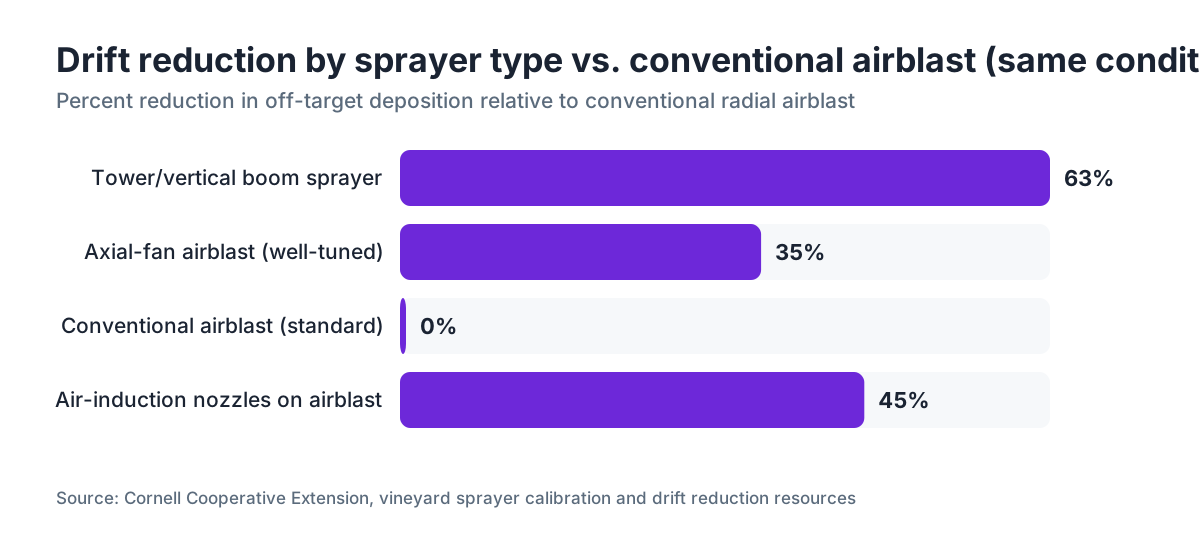
A tower sprayer puts vertical nozzle heads on a mast that rises next to the vine row and sprays sideways into both canopy walls from close range. Because the spray leaves the machine near the target, you can run lower pressures (often 40 to 80 PSI instead of 150-plus PSI on some airblast units) and smaller droplets without throwing spray a hundred feet downwind. Cornell research on vertical boom systems found they cut off-target deposition by 50 to 75 percent versus a conventional airblast sprayer in the same conditions. [3]
The trade-off is speed. A tower sprayer covers ground at 2 to 4 mph and stays effective there, while a well-tuned airblast unit runs 4 to 5 mph. On a small vineyard that gap means nothing. On 200-plus acres it adds hours to the spray day. Know your acreage and your canopy density before you choose.
What are the main Durand-Wayland vineyard sprayer models and specs?
The product line shifts every few years, so treat these numbers as a working baseline and confirm against Durand-Wayland's current catalog before you order. [1]
| Model | Tank Size (gal) | Fan Type | HP Required | Typical List Price Range |
|---|---|---|---|---|
| Super-Vee 50 | 50 | Tower nozzle | 25 PTO HP | $4,500 to $6,500 |
| Super-Vee 100 | 100 | Tower nozzle | 35 PTO HP | $6,000 to $8,500 |
| Super-Vee 200 | 200 | Tower nozzle | 45 PTO HP | $9,000 to $13,000 |
| Airoscout 200 | 200 | Axial fan | 45 PTO HP | $10,000 to $15,000 |
| Airoscout 300 | 300 | Axial fan | 60 PTO HP | $13,500 to $19,000 |
| Airoscout 500 | 500 | Axial fan | 80 PTO HP | $18,000 to $26,000 |
Those ranges reflect general dealer pricing across 2024 to 2025 and move with region, attachments, and dealer markup. Used units trade well below that. A 10-year-old 200-gallon Super-Vee in working shape commonly goes for $2,000 to $4,500 at farm auctions.
The horsepower figures are minimums at rated PTO speed (540 RPM standard). Put an underpowered tractor on the bigger units and fan speed drops, which breaks the airblast pattern and leaves coverage patchy. Match your tractor to the HP spec with at least 10 percent headroom.
How do you calibrate a Durand-Wayland vineyard sprayer correctly?
Calibration is the one step most growers skip or botch, and it costs them either efficacy or a drift violation. The point is to know exactly how many gallons per acre you're putting out, so the label rate gets met. The EPA requires application rates to match label instructions, and the label is a legal document. [10]
The catch-can method goes like this. Fill the tank with clean water. Run the sprayer at your intended field speed and pressure over a measured distance (200 feet works well in vineyards). Catch output from a representative nozzle in a graduated container for a timed interval, then work out per-nozzle output in gallons per minute. Multiply across all active nozzles, factor in ground speed and row spacing, and you have gallons per acre. Cornell Cooperative Extension has a free calibration worksheet that walks the math step by step. [3]
Durand-Wayland tower units need an extra check. The vertical nozzle stack means you check each height position on its own. Pressure drop from the bottom nozzle to the top can top 10 PSI on a 6-foot tower if the pump or hose sizing is marginal. Measure output at the top, middle, and bottom of the mast separately. If the top nozzles deliver 20 percent less than the bottom, you have a pump pressure problem, not a nozzle problem.
WSU Extension recommends recalibrating at least once a season, plus any time you swap nozzle tips, change products, or change travel speed. [5] Set a calendar reminder. Spray records are only as honest as the calibration behind them.
What nozzle types work best on Durand-Wayland vineyard towers?
The standard nozzle body on most Durand-Wayland tower units takes TeeJet or equivalent quarter-turn bayonet fittings. That's good news. It means a wide selection of aftermarket tips with no machine-specific parts to hunt down.
For most fungicide programs, hollow-cone nozzles (Disc-Core type, TeeJet D-series) make the fine droplets you need for coverage deep in a dense canopy. Flat-fan nozzles wear faster and suit herbicides on the vine row, not canopy spraying. Air-induction (twin-flat-fan) nozzles cut drift a lot but throw larger droplets that can skip interior canopy surfaces on dense VSP-trained vines.
UC Davis recommends hollow-cone tips at 40 to 60 PSI for powdery mildew programs because the fine atomization improves coverage on leaf undersides, where Erysiphe necator spores germinate. [6] That holds for most fungicide work on wine grapes.
Tips wear faster than people expect. Brass tips lose calibration after 25 to 40 hours of use. Stainless steel tips last 3 to 5 times longer. Ceramic tips last longer still and cost more upfront. On a busy operation running 20 to 30 spray events a season, ceramic tips earn back the premium in one year of skipped recalibration headaches.
How does the Durand-Wayland compare to other vineyard sprayer brands?
The honest answer: brand matters less than calibration, nozzle choice, and timing. A properly tuned 20-year-old Durand-Wayland tower beats a brand-new airblast sprayer run too fast. That said, here's where the brand sits.
John Bean (FMC) and rear-discharge units from Rears Manufacturing are the main domestic airblast competitors. Gregoire, Berthoud, and Hardi own most of the imported commercial market. Durand-Wayland's edge is price and parts availability across the eastern U.S. and Southeast, where its dealer network is established. In California wine country, finding a Durand-Wayland dealer is harder, and that market leans toward Rears and imports. [2]
On tower-style sprayers specifically, the main competition is Smart-Apply Intelligent Spray Control (a sensing system that bolts onto many frames) and the Gearmore Vine Ranger series. Neither is an apples-to-apples match, since they hit different price tiers. Smart-Apply adds electronic canopy sensing at a real premium (systems start around $15,000 installed, separate from the sprayer) and earns a look on operations over 50 acres where chemical cost is a big line item. [1]
For small operations under 20 acres, the Super-Vee 100 or 200 is a sensible pick. Build quality is solid, replacement parts are standard, and the company's tech support line answers. For operations over 50 acres, pull quotes from at least three brands and run them against your actual spray cost per acre before you sign anything.
What are the EPA Worker Protection Standard requirements when operating a vineyard sprayer?
The EPA Worker Protection Standard (WPS) covers all agricultural pesticide applications, which puts it squarely on anyone running a sprayer. The 2015 revision tightened rules on restricted-entry intervals (REIs), personal protective equipment (PPE), and decontamination supplies. [4]
Workers and handlers have to get pesticide safety training before they do any pesticide-related task. Handlers running the sprayer need handler training, which goes past basic worker training. Plenty of small operations miss that. The gap is real: handler training covers label comprehension, PPE, and emergency procedures at a deeper level than general worker training.
The rule states that agricultural employers must provide, at no cost to workers and handlers, all PPE required by the pesticide label and ensure that all required PPE is clean and in proper operating condition. That means the employer pays for gloves, respirators, goggles, and chemical-resistant suits where the label calls for them. It's not optional. [4]
The enclosed cab exemption matters for tractor operators. If your tractor has an enclosed cab with filtered, positive-pressure air, some labels allow reduced PPE inside the cab. The exemption applies to specific product categories, not every pesticide. Read the label language for your products every time. UC Davis Cooperative Extension has a WPS compliance guide for small and medium farms that lays this out in plain terms. [6]
WPS also requires a pesticide safety poster at the central location, a list of all applications with REI information posted within 24 hours, and emergency contact information displayed where people see it. This is where good spray record software earns its keep. VitiScribe tracks application records, REI windows, and WPS posting requirements in one place, so you're not chasing paper mid-spray.
See the overview on vineyard operations for how spray compliance fits your full field calendar.
What maintenance does a Durand-Wayland sprayer need to stay reliable?
Airblast and tower sprayers are mechanically simple and unforgiving of neglect. The common failures, in order of how often they show up: worn pump diaphragms or pistons, clogged screens, cracked or UV-degraded hoses, fan bearing failure, and corroded electrical connections on units with rate controllers.
At the start of each season, flush the whole system with clean water, run it to check pressure across all nozzles, inspect every hose clamp and fitting, and spin the fan by hand to feel for bearing roughness. Replace pump diaphragms on a schedule, not after they blow. On the Comet or AR pumps common on Durand-Wayland units, diaphragm kits run $40 to $100 and go in under an hour. Waiting for a diaphragm to fail means unplanned downtime during a spray window you can't move.
The end-of-season flush is not optional in a freezing climate. Water left in pump heads and hose lines will destroy them. Triple-rinse with clean water, blow the lines with compressed air, and add a little RV antifreeze to the pump if you're not draining it fully. That 45-minute job prevents a $400 to $800 pump replacement in spring.
Hit the grease fittings on the PTO shaft, fan hub, and wheel bearings (on pull-type units) every 50 hours of operation. Check the manual for exact intervals; Durand-Wayland lists them by component.
Nozzle screens clog from tank sediment and pesticide precipitate. Clean them at least every three applications. A 10-minute screen cleaning stops the quiet pressure drop that throws off calibration without warning.
How do you reduce spray drift with a vineyard tower sprayer?
Drift is the most common reason a spray fails, agronomically and legally. Pesticide labels carry mandatory language banning drift to non-target areas, and violations bring real penalties under FIFRA and state pesticide law. [10]
The physical levers are droplet size, carrier volume, wind speed, application height above target, and travel speed. Bigger droplets is the single most effective change. Moving from a fine (F) classification to a medium (M) drops off-target deposition sharply but can cut coverage on leaf surfaces. The right balance depends on mode of action: systemic fungicides tolerate larger droplets better than contact products.
On tower sprayers, matching nozzle height to canopy height is where money gets wasted. Run a 6-foot tower into a 4-foot canopy and the top nozzles spray clean over the vines. Adjust mast height as the season moves. Growers routinely underestimate how much canopy fills in between bloom and veraison.
Never spray when wind tops 10 mph. Most labels set a lower cap, often 5 to 8 mph. WSU Extension trials in Washington vineyards found drift at 10 mph ran 3 to 8 times higher than in calm conditions with the same equipment. [5] Check the hourly forecast, more than the morning glance out the window. Afternoon winds in most wine regions climb hard.
Buffers matter too. Within 150 to 300 feet of a water body, check your state's buffer rules and the specific product label. Some fungicides and all organophosphate insecticides carry mandatory no-spray buffers near water.
What records do you need to keep after each vineyard spray application?
Federal law requires commercial applicators (and in most states, private applicators using restricted-use pesticides) to keep spray records for at least two years. Many states push that to three or five. Records have to include the pesticide name and EPA registration number, application date and time, field location, crop and growth stage, rate per acre, total product used, application method and equipment, and the applicator's name. [4]
For WPS, you also record the REI, post that information at the central location within 24 hours, and keep it posted until the REI clears. Sell to a winery that runs audit programs, or carry any sustainability certification, and your records get reviewed. Incomplete records are the most common audit finding.
Paper logs work. They're just slow to search, easy to lose, and they force manual math for total product used per season, which matters for pesticide purchase reporting in some states. A digital system that ties each application to a field map, totals use automatically, and flags REI conflicts pays for itself in audits alone. VitiScribe does this and generates the record format state departments of agriculture actually ask for during inspections, which most general farm software gets wrong.
Organic growers need records that show approved-input status and an audit trail supporting National Organic Program (NOP) certification. Same record structure, plus one extra field for approved-input verification. [9]
Check your state department of agriculture site for state-specific forms. California, Washington, and New York all use mandatory formats that differ from the federal baseline.
Is a used Durand-Wayland sprayer worth buying, and what should you inspect?
Used Durand-Wayland gear is usually a fair buy. Parts are available and the machines are mechanically plain. A well-kept 10-year-old Super-Vee 200 at $3,000 to $4,500 does the same work as a new one on a small operation.
Before you buy used, run this inspection in person.
- Fill the tank with water and run the pump at full pressure. Watch every nozzle and every hose junction for drips, weeping, or pressure loss.
- Spin the fan by hand. Any grinding or wobble means a bearing replacement is coming (budget $150 to $400 for parts plus labor).
- Check the PTO shaft for play and U-joint wear. Worn U-joints are a safety hazard before they're a mechanical one.
- Inspect the whole hose run for cracking, especially near fittings and where hoses bend around frame members. UV-degraded hoses look fine and fail under pressure.
- Pull the pump access cover and look at the diaphragms. Cracked or stiff diaphragms need replacing now.
- Check the tank for crazing or delamination inside. Polyethylene tanks last 15 to 20 years in normal use, but UV and chemical residue speed the breakdown. Shine a flashlight inside and look for a white chalky surface.
A used sprayer that passes all six is a fair buy at the right price. One that fails two or more needs to be priced for the repairs, or walked away from.
Frequently asked questions
Where are Durand-Wayland sprayers made?
Durand-Wayland is based in Monroe, Georgia, where the company has built agricultural sprayers since the 1940s. Most of the vineyard line is made domestically at that facility. Parts availability across the eastern U.S. tends to beat imported brands because of the company's established regional dealer network.
What PTO horsepower does a Durand-Wayland vineyard sprayer need?
Required PTO horsepower runs from about 25 HP for the 50-gallon Super-Vee tower up to 80 HP for the 500-gallon Airoscout models. Always match your tractor with at least 10 percent more HP than the minimum spec. An undersized tractor drops fan RPM, which breaks the airblast pattern and leaves coverage uneven.
How many gallons per acre should a vineyard sprayer apply?
Most vineyard fungicide programs run 30 to 100 gallons per acre depending on canopy size, growth stage, and product. Dilute programs (100 GPA and up) suit dense canopy or contact products. Concentrate programs (30 to 50 GPA) work for systemic fungicides on a well-calibrated airblast unit. The label sets the legal minimum; calibrate to hit it.
Can a Durand-Wayland tower sprayer handle steep vineyard terrain?
Pull-type Durand-Wayland units handle moderate slopes (up to 15 to 20 percent grade) fine, but tank sloshing hurts spray consistency on steep sidehills. Above 20 percent, a 3-point mounted unit cuts the pendulum effect. If you're in steep terrain often, look at sprayers with agitation systems built for variable-grade work.
How often should vineyard sprayer nozzles be replaced?
Brass nozzle tips wear out after 25 to 40 hours of use. Stainless steel tips last 3 to 5 times longer. Ceramic tips last the longest and cost more upfront. Check output with a catch-can at the start of each season and any time coverage looks off. A 10 to 15 percent output deviation from spec is the standard threshold for replacement.
What is the restricted-entry interval for vineyard sprays and how is it tracked?
REI is set on each pesticide label and ranges from 4 hours for low-toxicity products to 48 hours or more for certain insecticides. Under the EPA WPS, you must post the REI at the central location within 24 hours of application. Workers can't enter treated areas until it clears. Digital records that auto-calculate REI expiration prevent early re-entry, a common WPS violation.
Does the EPA Worker Protection Standard apply to family farms?
The WPS applies to any farm employing agricultural workers or handlers who aren't members of the owner's immediate family. The regulation defines immediate family as a spouse, parent, sibling, child, or stepchild. Farms using hired labor, H-2A workers, or seasonal crews are fully covered regardless of size. Very small family operations with no outside labor get limited exemptions.
What is the best sprayer for a small vineyard under 5 acres?
For under 5 acres, a 50- to 100-gallon tower unit like the Super-Vee 50 or 100 is a practical size. A pull-type unit behind a 25 to 35 HP compact utility tractor covers that acreage well. Some growers at this scale use ATV-mounted boom sprayers on young vines, but canopy penetration on mature vines needs a tower or airblast unit.
How do you clean a vineyard sprayer after applying copper fungicides?
Triple-rinse the tank with clean water right after use. Run a dilute solution of 1 to 2 percent agricultural ammonia (if the pump materials allow) through the system to neutralize copper residue, then rinse again with clean water. Copper sulfate and copper hydroxide corrode brass and zinc parts over time. Check internal hose surfaces and filter screens after each copper application for early corrosion.
What spray records are required in California for vineyard pesticide applications?
California requires pesticide use reports (PURs) for all applications of any pesticide, restricted or unrestricted, on commercial agricultural land. Reports get filed monthly with the county agricultural commissioner for the prior month. Records must include the pesticide name, registration number, field location, acres treated, amount applied, and date. California's rules run stricter than the federal minimum. [11]
How do you winterize a vineyard sprayer in a freezing climate?
After the final application, triple-rinse with clean water and run the pump until no water comes from the nozzles. Blow compressed air through all lines. Add a quart of RV antifreeze to the pump and cycle it briefly if you can't drain the pump fully. Store with caps and plugs removed so any residual water escapes. Inspect diaphragms before storage so spring startup holds no surprises.
What's the difference between an axial-fan and a centrifugal-fan vineyard sprayer?
Axial-fan sprayers move high air volume at moderate velocity through a wrap-around discharge collar. They're energy-efficient and throw a wide, even blast. Centrifugal-fan units move lower air volume at higher velocity for a more concentrated blast. Axial units generally do better in dense canopy; centrifugal units suit open-canopy and orchard work. Most newer Durand-Wayland vineyard models use axial fans.
Can vineyard spray records be used as evidence in pesticide violation investigations?
Yes. State department of agriculture inspectors and EPA enforcement staff routinely pull spray records during investigations of drift complaints, REI violations, and label misuse. Accurate, contemporaneous records are your best defense. Records clearly filled in after the fact (same handwriting, same pen, all at once) get treated skeptically. Timestamp-verified digital records carry more evidentiary weight.
Sources
- Durand-Wayland Inc., company and product overview: Durand-Wayland manufactures tower and axial-fan vineyard sprayers in Monroe, Georgia, with tank sizes from 50 to 500 gallons
- UC Davis Statewide IPM Program, Grape Pest Management Guidelines: Conventional airblast sprayers rely on radial air volume to carry droplets into canopy, with drift risk increasing above 5 mph wind
- Cornell Cooperative Extension, vineyard sprayer calibration and drift reduction resources: Cornell research found vertical boom tower systems reduced off-target deposition by 50 to 75 percent versus conventional airblast; free calibration worksheet available
- U.S. EPA, Worker Protection Standard for Agricultural Pesticides (40 CFR Part 170): The EPA WPS requires handler training, employer-provided PPE, REI posting within 24 hours, and spray record retention
- Washington State University Extension, pesticide application and drift management in vineyards: WSU Extension data found drift at 10 mph was 3 to 8 times higher than at calm conditions; recalibration recommended at least once per season
- UC Davis, University of California Agriculture and Natural Resources, fungicide application recommendations for wine grapes: UC Davis recommends hollow-cone nozzle tips at 40 to 60 PSI for powdery mildew programs to improve coverage on leaf undersides
- USDA National Organic Program, record-keeping requirements for certified organic operations: NOP certification requires spray and input records that document approved-input status for all materials applied to certified ground
- EPA, Federal Insecticide Fungicide and Rodenticide Act (FIFRA), pesticide label as legal document: Under FIFRA, the pesticide label is a legal document and applying a product inconsistent with its label is a federal violation
- California Department of Pesticide Regulation, Pesticide Use Reporting Program: California requires monthly pesticide use reports for all commercial agricultural applications, filed with the county agricultural commissioner
Last updated 2026-07-09