Grapevine leafroll disease: ecology and management guide
TL;DR
- Grapevine leafroll disease comes from a complex of at least 13 related viruses (GLRaV-1 through -13), spread mainly by mealybugs and soft scale insects.
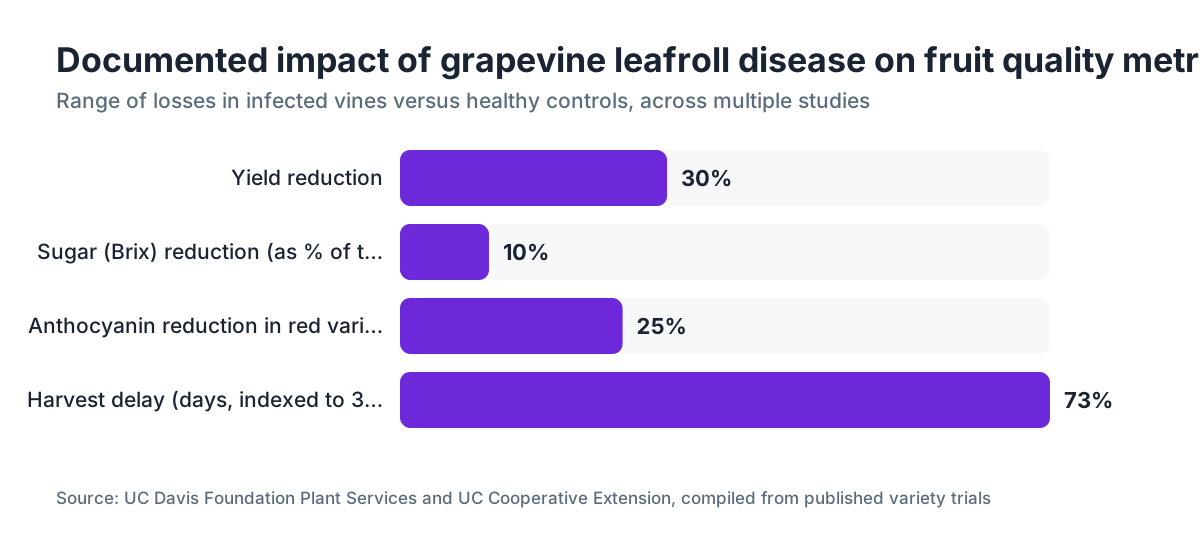
- It drops fruit sugar by 1 to 3 °Brix, pushes ripening back 2 to 3 weeks, and cuts yield 20 to 40%.
- No cure exists once a vine is infected.
- Management rests on certified clean stock, early detection, vector control, and roguing.
What is grapevine leafroll disease and what causes it?
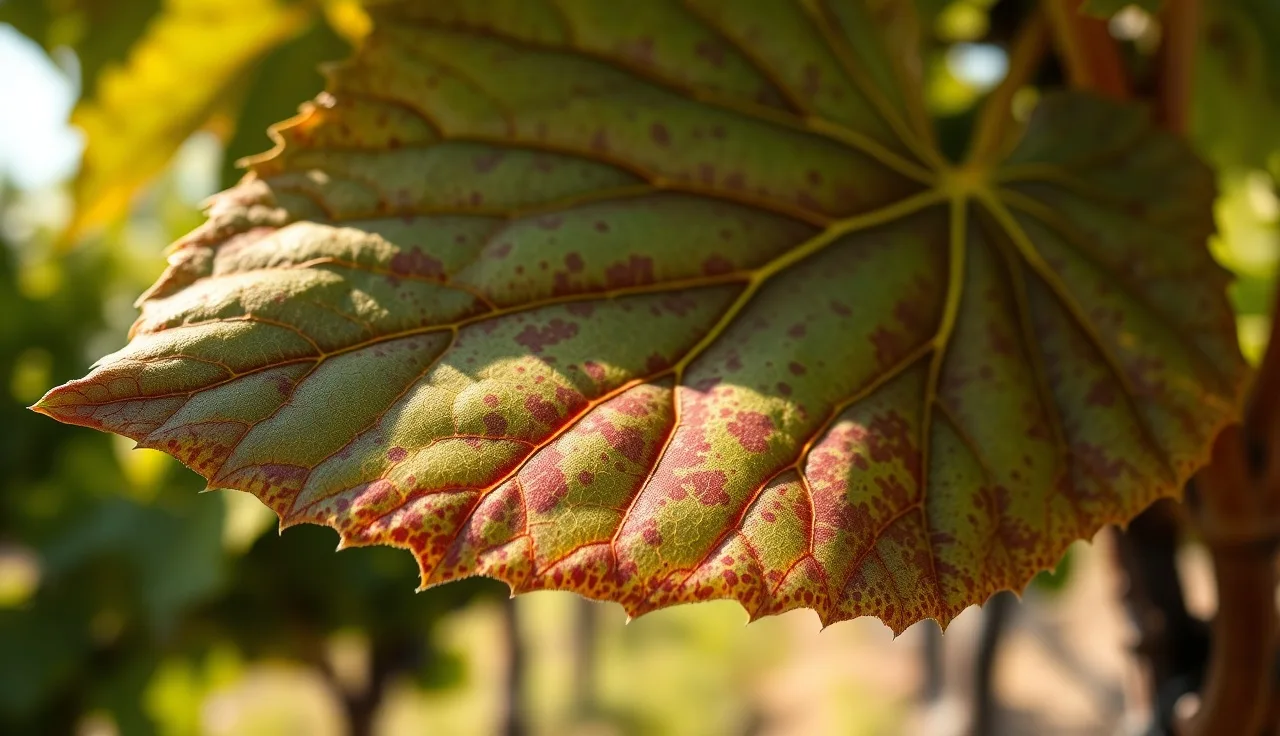
Grapevine leafroll disease (GLD) is one of the most economically damaging viral diseases in vineyards worldwide. The name comes from its most visible symptom: leaves that roll downward along their margins in late summer and fall, often turning red in red-fruited varieties while the veins stay green.
No single virus causes it. GLD comes from a complex of at least 13 serologically distinct closteroviruses, named Grapevine leafroll-associated virus 1 through 13 (GLRaV-1 through GLRaV-13) [1]. GLRaV-3 is the most widespread and most destructive member globally. In California and the Pacific Northwest, GLRaV-3 and GLRaV-2 are the variants most commonly detected in commercial blocks [2].
Every member of this complex belongs to the family Closteroviridae. They are phloem-limited, which means they replicate and move inside the plant's food-transport tissue. That's why they resist elimination. The phloem runs everywhere in a vine, and once the infection goes systemic, it never leaves.
White-fruited varieties show milder foliar symptoms, or none at all, which creates a silent reservoir problem. A Chardonnay block can carry a heavy infection without a single rolled, reddened leaf, and those vines still hand off virus that vectors move to neighboring rows.
How does leafroll virus spread from vine to vine?
Leafroll moves two ways: through planting material (propagative spread) and through insect vectors (field spread). Propagative spread is historically the bigger problem. Growers unknowingly replanted infected cuttings for decades before certified clean stock programs existed. A 2012 study estimated that most of New Zealand's leafroll problem traced back to propagation rather than in-field insect transmission [3].
In the field, the vectors are mealybugs and soft scale insects, in the families Pseudococcidae and Coccidae. In California, the grape mealybug (Pseudococcus maritimus) and vine mealybug (Planococcus ficus) are the main culprits. In some Virginia and North Carolina blocks, longtail mealybug (Pseudococcus longispinus) matters too. The obscure mealybug (Pseudococcus viburni) and several soft scale species, especially European fruit lecanium (Parthenolecanium corni), can also transmit GLRaV-3 [2].
Mealybug transmission is semi-persistent. Insects pick up the virus after feeding for as little as 15 to 30 minutes on an infected plant, and they can pass it on within hours of reaching a healthy vine. They don't hold the virus long, and molting resets their infectivity. Crawlers, the first-instar nymphs, are the most mobile stage and the most efficient at moving virus around a block.
Spread within a vineyard is slow but cumulative. WSU researchers tracking a Washington State Merlot block watched new infections appear in a predictable expanding front from the original foci over multiple growing seasons [4]. Without intervention, that front keeps moving.
Ants matter here too. Ants tend mealybugs, protect them from natural enemies, and carry them between vines. Fight mealybugs and ignore ants, and you're fighting with one hand tied behind your back.
What does leafroll disease actually do to fruit quality and yield?
Leafroll chokes phloem function, and that disrupts the flow of sugars from leaves to berries. Ripening slows, sugar accumulation drops, red varieties lose color, and berry size shrinks. This is where the economic argument for management gets real.
Studies across many varieties and regions consistently show sugar reduction of 1 to 3 °Brix at harvest in infected vines compared to healthy controls [1]. For a Cabernet Sauvignon targeting 25 °Brix, losing 2 °Brix means either picking underripe fruit or leaving it hanging two to three extra weeks, which runs up frost risk, botrytis risk, and harvest cost. Yield losses of 20 to 40% have been documented in heavily infected blocks [2].
Color loss in red varieties hits the wallet hardest. Anthocyanin accumulation depends on healthy phloem transport. Infected Pinot Noir berries show measurable drops in total anthocyanins, which shows up directly in wine color and perceived quality. UC Cooperative Extension variety trials in California have documented infected vines producing fruit worth less per ton at harvest than healthy vines in the same block [2].
Long-term vine decline is real too. Heavily infected vines, especially those co-infected with two or more GLRaV strains, lose canopy vigor over time and reach the end of their productive life sooner. The math compounds. You lose quality and yield now, and you burn down the vine's good years faster.
How do you identify leafroll disease in the vineyard?
Visual scouting works best from late summer through harvest. In red varieties, look for three things: downward leaf rolling along the margins, interveinal reddening or purpling of the blade, and veins that stay green while the rest of the leaf turns red. That contrast between red blade and green veins is the signature [1].
In white varieties, the disease hides. Mild chlorosis, slight downward rolling, smaller leaves. You can walk right past it. That's exactly why Chardonnay and Pinot Gris blocks turn into cryptic virus reservoirs.
Visual symptoms are not reliable enough for certification or replanting decisions. You need lab testing. The industry standard is ELISA (enzyme-linked immunosorbent assay) for detecting specific GLRaV strains, or RT-PCR (reverse transcription polymerase chain reaction) for higher sensitivity and strain differentiation [2]. UC Davis Foundation Plant Services and regional diagnostic labs in Washington and Oregon offer certified testing. Cornell's Plant Disease Diagnostic Clinic handles eastern US samples [5].
Timing decides your results. Test in late summer or early fall when virus titer peaks. Dormant cane samples can work but give more false negatives for some strains. Sample your symptomatic vines first, then take a random sample across the block to estimate incidence. A good rule from the UC Davis guidelines: sample at least 10% of vines in a block you suspect has GLD, and map the results by row and position so you can track spread across seasons [1].
Some growers are testing remote sensing, using drone-mounted multispectral or hyperspectral cameras to flag symptomatic canopy. The technology keeps improving, but right now it works as a screening tool to point your feet toward the right rows, not as a replacement for lab confirmation.
Which grapevine rootstocks or varieties are most vulnerable?
Every Vitis vinifera variety is susceptible to GLRaV infection. No commercial vinifera variety carries genuine resistance. Some hybrid or native American Vitis species show tolerance or resistance to specific strains, but that's mostly beside the point for commercial vinifera production.
Rootstock choice doesn't change susceptibility to leafroll viruses directly. A vine grafted onto healthy rootstock still goes systemically infected through the scion. Rootstock does affect mealybug habitat, though. Vine mealybug (Planococcus ficus) colonizes roots aggressively and shelters underground where sprays can't reach. Rootstocks with looser bark texture can give mealybugs more harborage at the graft union and below ground.
Variety matters for symptom visibility, and visibility matters for management. Red varieties with high anthocyanin potential, like Cabernet Sauvignon, Zinfandel, and Merlot, show symptoms clearly. Pinot Noir often takes a hard hit. White varieties, especially Chardonnay and Sauvignon Blanc, frequently show little or nothing despite carrying high virus loads, which makes them harder to watch and easier to miss.
Clone selection plays into this too. Some clones within a variety seem to express symptoms more strongly than others, though the research is thin. Nobody has good population-level data on clone-by-strain interactions across commercial conditions. The practical point: if you're planting white varieties where GLD pressure is known, build a systematic testing program instead of trusting your eyes.
What does an effective leafroll management program look like?
Managing GLD is a systems problem, not a spray problem. No treatment cures an infected vine. Every action you take is either preventive or aimed at slowing spread from the vines that already carry it.
Start with certified clean planting material. This is the highest-leverage action in any GLD plan, full stop. The National Clean Plant Network (NCPN) coordinates foundation plant services nationwide, and the Grapes program runs through UC Davis Foundation Plant Services and USDA APHIS [6]. Certified vines have been tested and found free of regulated viruses, including the major GLRaV strains. Grabbing uncertified cuttings from a neighbor's vineyard, even one that looks healthy, is how most new plantings get infected before their first harvest.
Rogue infected vines. Find GLD in an established block and the question becomes manage in place or remove and replant. Research from both New Zealand and California supports roguing infected vines when incidence sits below roughly 20%, paired with replanting certified stock in the same holes after a waiting period [3]. Above 20 to 30% incidence, block removal and full replanting usually pencils out better over a 20-year horizon. The math is painful but honest: infected vines drag down their neighbors as mealybugs cycle virus through the block year after year.
Control vectors. Mealybug management needs both soil and canopy tactics. Systemic neonicotinoids (imidacloprid, thiamethoxam) applied as soil drenches protect roots against vine mealybug. Foliar organophosphates or spirotetramat target crawlers in the canopy. Biological control with the parasitic wasp Anagyrus pseudococci and predatory beetles shows genuine results in some California programs [2].
Manage ants. Most guides underplay this. Argentine ants (Linepithema humile) are the key pest species in California and coastal regions. They farm mealybugs, ferry crawlers between vines, and knock back natural enemies. Bait stations and trunk barriers cut ant pressure meaningfully. WSU extension treats ant control as a co-primary target alongside mealybugs where both are present [4].
Control weed hosts. Certain broadleaf weeds and cover crop species host mealybugs. Keeping the vine row and under-trellis strip clean removes alternative refugia. That doesn't mean bare dirt. It means knowing which cover crop species harbor mealybugs and keeping them out of high-pressure blocks.
Record everything. Vine-by-vine incidence maps, test results tied to date and vine position, vector counts from pheromone traps, treatment logs. These are the backbone of a sound program. You're managing a slow-moving spatial problem, and without records you can't tell whether your interventions are working or whether spread just keeps grinding forward. Tools like VitiScribe let you log vine health observations, attach lab results, and map disease incidence by block, which matters when you're making replanting calls off multi-year trends.
What insecticides and biologicals actually work against leafroll vectors?
The mealybug toolbox has grown over the past decade, but it's still not simple. No single product or timing works across all mealybug species, vineyard layouts, and regional climates.
For vine mealybug, soil-applied neonicotinoids (imidacloprid as a drench or through drip) move systemically into the vine and give residual activity against root-colonizing populations. Time the drip application to hit peak crawler emergence in spring for the best result. The downside is pollinator risk and regulatory tightening. California's Department of Pesticide Regulation has an ongoing review of neonicotinoid uses near crops in bloom, and label compliance is non-negotiable [7].
Spirotetramat (Movento) is a foliar product that moves both up and down in the phloem. That makes it unusually good against phloem-feeding insects at root and crown sites even when you spray the leaves. It works best on crawlers and young nymphs. Mature females are harder to kill. Two applications timed to crawler emergence, usually 10 to 14 days apart, beat a single pass.
Organophosphates like chlorpyrifos used to anchor mealybug programs in some regions, but restrictions have clamped down. California banned chlorpyrifos for agricultural use in 2020. Check your state's current label before you assume a product you sprayed five years ago is still legal.
Biological control is real and worth the investment, especially if you run a certified organic block or want to cut chemical inputs. The parasitic wasp Anagyrus pseudococci attacks mealybug nymphs and females. Commercial releases, combined with protecting the wasps you already have by skipping broad-spectrum sprays, can knock grape mealybug down hard. Vine mealybug is tougher to control biologically because so much of its population lives underground.
Worker protection under the EPA Worker Protection Standard (WPS, 40 CFR Part 170) applies to every pesticide application in a vineyard [8]. Restricted-entry intervals (REIs), PPE, and decontamination facilities have to be in place before workers enter treated areas. Keep your spray records current, accurate, and reachable. A WPS audit can land any time.
How do you build a leafroll monitoring program that actually catches spread early?
The best monitoring programs run three things at once: systematic visual surveys, targeted lab testing, and vector population tracking. None of the three alone is enough.
For visual surveys, break your vineyard into units of no more than 100 to 150 vines. Walk each unit from late August through September, when symptoms peak. Record symptomatic vines by row and position. A simple percentage incidence per block lets you track year-over-year spread. If incidence jumps from 4% to 8% in one season, something changed: a new virus introduction, a mealybug population spike, or both.
For lab confirmation, submit a stratified sample of symptomatic vines plus a random selection of apparently healthy ones. The random draw catches cryptic infection in white varieties and in red varieties that carry virus but haven't shown symptoms yet. UC Davis Foundation Plant Services, Cornell's diagnostic clinic, and WSU's Plant Pest Diagnostic Clinic all run PCR-based GLRaV testing [5].
For vector monitoring, hang pheromone-baited sticky traps for vine mealybug (commercial lures exist for Planococcus ficus). Set traps at block edges and at known infestation foci. Count weekly through the growing season. Population spikes in late spring and late summer line up with crawler emergence peaks, and those are your prime spray windows.
Then tie your vector counts to your disease maps over time. See a mealybug spike in rows 15 to 22 in June, and check that stretch closely for new infections the following August. That spatial-and-temporal read is what separates a reactive spray program from a real management strategy.
What does leafroll management cost, and when does roguing pencil out?
Every vineyard manager eventually has to work this through, and the honest answer is that the numbers swing hard by region, variety, and land value. The framework stays the same, though.
On the cost side, certified clean planting stock runs roughly $5 to $12 per vine in the western US depending on variety and rootstock combination. Replanting a one-acre block at 454 vines per acre costs $2,270 to $5,450 in plant material alone, before labor, trellis work, and the three-to-five year wait before the block reaches full production.
On the benefit side, an infected Cabernet Sauvignon vine producing 20 to 30% below its potential, or fruit that tops out at $1,000 to $1,500 per ton instead of $2,000 to $3,000 per ton because of color and sugar deficits, bleeds real money every year. New Zealand modeling published by Plant & Food Research found roguing and replanting turns economically favorable over a 20-year vineyard life once GLD incidence passes roughly 15 to 20% and the vineyard has more than 10 years of productive life left [3].
Mealybug management in California runs roughly $150 to $400 per acre annually depending on materials and method, per UC Cooperative Extension cost-of-production studies [10]. Those costs continue whether you're stopping disease spread or just holding an established population in check.
The rogue-versus-manage call is genuinely case-specific. A 5% infected Cabernet block in a high-value Napa district warrants roguing. A 15% infected Grenache block in a lower-value district might not. Do the math on your own numbers: your actual fruit price, your vine planting cost, and a realistic read on how fast spread is moving.
What are the regulatory and certification requirements growers need to know?
Planting material certification is the regulatory area that matters most for GLD. The National Clean Plant Network Grapes program, run under a USDA-APHIS cooperative agreement, sets standards for foundation vineyard testing and maintenance [6]. States layer their own nursery stock certification programs on top, referencing or adopting NCPN standards. California's Department of Food and Agriculture regulates the Foundation Plant Services program at UC Davis, the primary source of certified foundation material for the western US [6].
Not all certified stock is equal. Foundation stock is the top tier, kept under insect-proof conditions and tested annually. Increase block or registered nursery stock has gone through another propagation step, which adds a small amount of risk. Certified commercial stock has passed through two to three propagation steps. Know what tier you're buying and what it was tested for, because not every nursery tests for the full suite of GLRaV strains.
Pesticide use in mealybug management is regulated at the state level under the Federal Insecticide, Fungicide, and Rodenticide Act (FIFRA) and carried out by state departments of agriculture. California requires pesticide applications to be reported within a set window for restricted-use materials, and many mealybug products qualify as restricted-use [7]. Keep spray records complete: applicator license number, product name and EPA registration number, acres treated, rate, and date.
The EPA Worker Protection Standard (40 CFR Part 170) requires agricultural employers to post pesticide safety information, train agricultural workers before they enter treated areas, and provide PPE and decontamination supplies [8]. GLD programs often run multiple applications through a season, which turns WPS compliance into an ongoing operational task rather than a one-time checkbox. VitiScribe's spray log module helps you keep the application records WPS requires, with fields mapped to the federal standard.
For organic operations, mealybug options narrow. Kaolin clay, insecticidal soaps, and approved biological controls are the main tools. Check the USDA National Organic Program materials list and your certifier's approved materials list before you apply anything [9].
How does leafroll management differ between young vineyards and established blocks?
Young vineyards and established blocks carry different risks and call for different playbooks.
In a new planting, the goal is zero establishment of GLD. That means certified clean stock (non-negotiable), planting into ground that has had time to collapse underground mealybug populations from any prior vineyard, and running a monitoring program from year one. Vine mealybug can survive in old root debris for at least one to two seasons after vine removal, so a fallow period or fumigation may be worth it before replanting into heavily infested ground.
For young vines, the stakes of early infection run higher than in a bearing block. A vine infected in its first or second leaf never reaches full productive potential. Early infection also gives the disease more time to spread in-block before you can spot it by eye. In young vineyards, lean on lab testing over visual scouting. The visual symptoms aren't reliable until vines reach full maturity.
In established blocks, the calculus turns on spread rate and economic threshold. If GLD sits in part of a block, your job is to map the spatial extent, estimate the spread rate, and decide whether management or removal makes more sense for each affected zone. Map infected vines every year. A block holding steady at 5% for three seasons is a completely different situation from one that ran 5% to 18% in two.
Older vines also offer more complex mealybug habitat. Thick trunk bark, sprawling root systems, and organic matter piled around the base all give shelter. This is where soil-applied systemics or trunk injection can beat canopy sprays. Work with your pest control adviser to match the method to the mealybug species and life stage you're actually targeting.
Are there regional differences in leafroll pressure across US wine regions?
Yes, and the differences run large enough to change your strategy.
California carries the highest documented GLD pressure in the US, driven by vine mealybug (Planococcus ficus) spreading widely starting in the early 2000s. The San Joaquin Valley, Napa, and Sonoma all hold significant vine mealybug populations. UC Cooperative Extension has published regional cost-of-production studies and GLD management guides built for California conditions [2].
Washington State has GLD pressure concentrated in the Yakima Valley and Columbia Basin, where vine mealybug is established. WSU Extension runs active GLD research, including the multi-year block-level spread studies cited earlier [4]. Oregon's Willamette Valley mostly deals with grape mealybug and counts as lower risk for vector-driven spread, though GLRaV-3 shows up in propagative material.
Eastern US regions, including the Finger Lakes, Virginia, and North Carolina, face a different vector complex. Grape mealybug and longtail mealybug are present. Vine mealybug isn't yet widespread across most eastern regions, though it has turned up in some Mid-Atlantic vineyards. Cornell Cooperative Extension tracks GLD incidence in New York and publishes management recommendations tuned to the northeastern growing environment [5].
Mediterranean climates favor mealybug buildup thanks to warm, dry summers with predictable crawler emergence. Continental climates with cold winters get some natural mealybug suppression, though underground vine mealybug populations ride out cold better than canopy populations do.
Where vector pressure is lower, propagative spread through infected nursery stock matters proportionally more than field spread. That makes certified clean stock even more important relative to vector control in those regions.
Frequently asked questions
Can you cure a grapevine that already has leafroll virus?
No. Nothing chemical or biological clears GLRaV from an infected vine. Heat therapy (thermotherapy) can clear virus from dormant cuttings used to produce foundation stock, but that's a lab propagation technique, not a field treatment. Once a vine in your vineyard is systemically infected, your only options are to manage it in place, accepting ongoing yield and quality losses, or pull it and replant with certified clean material.
How quickly does leafroll virus spread through a vineyard?
Spread rate hinges on mealybug species and population size. In Washington State Merlot blocks with active vine mealybug, researchers documented spread expanding a few rows per season from the initial foci. In low-vector-pressure regions, spread can be slow enough that a block holds fairly stable incidence for several seasons. WSU Extension research found incidence can double within two to three growing seasons in high-pressure blocks with no intervention [4].
What lab tests confirm leafroll disease, and where do I send samples?
ELISA and RT-PCR are the two standards. RT-PCR is more sensitive and can tell GLRaV strains apart. ELISA is cheaper and fine for most management decisions. Send samples to UC Davis Foundation Plant Services (western US), WSU's Plant Pest Diagnostic Clinic (Pacific Northwest), or Cornell's Plant Disease Diagnostic Clinic (eastern US). Sample in late summer when virus titer peaks. Specify which strains you want tested, since not every panel covers all 13 GLRaV types.
Is certified clean planting stock actually worth the premium?
Yes, consistently. Infected planting material is the main way GLD enters new vineyards. The premium for certified foundation or certified commercial stock usually runs $2 to $6 per vine over uncertified material. A vine infected at planting stays below full potential for its entire productive life, which in a wine grape vineyard can be 25 to 40 years. The economics favor certified stock in essentially every realistic scenario. Cutting corners on plant material is the most expensive mistake a new vineyard makes.
Do cover crops or floor management practices affect leafroll spread?
Indirectly, yes. Certain broadleaf weeds and some cover crop species host mealybug populations, giving vectors refuge between vine feedings. Keeping the undervine strip clean cuts that effect. Ground cover management also shapes ant populations, and Argentine ants farm mealybugs and move them around. Dense cover crops that invite ant colonization under the trellis can worsen mealybug pressure, and leafroll spread with it.
What's the difference between GLRaV-1, GLRaV-2, and GLRaV-3?
All three are distinct closteroviruses that cause leafroll disease, but they differ in geographic prevalence, vector associations, and severity. GLRaV-3 is the most widespread and most damaging worldwide, and multiple mealybug species move it efficiently. GLRaV-2 can cause more severe symptoms in some rootstock and scion combinations, including graft union problems. GLRaV-1 is linked to European fruit lecanium scale as a vector. Lab testing tells them apart. The management strategy is similar regardless of strain.
How do I know if mealybugs in my vineyard are actually transmitting leafroll?
You can't know for certain without both species identification and virus testing, but the question that matters for management is simpler: do you have a mealybug population, and is GLD present or entering the block? If both are true, assume transmission is happening. Species ID drives your control tactics. Vine mealybug needs soil-applied systemics because of its underground populations. Grape mealybug is more reachable with canopy sprays. Send preserved samples to a diagnostic lab or your county farm advisor for identification.
At what incidence level should I consider removing and replanting an infected block?
New Zealand Plant & Food Research modeling, often cited in US extension guidance, suggests roguing and replanting turns economically favorable once incidence passes roughly 15 to 20% in a block with more than 10 years of productive life left [3]. Below that threshold, roguing infected vines one by one and replacing them with certified stock, paired with vector control, usually wins. Above 30% incidence, whole-block removal is almost always the right long-term call. Your fruit price and replanting cost shift the threshold.
Can leafroll disease be confused with other grapevine problems?
Yes. Potassium deficiency causes interveinal reddening and marginal leaf scorch that mimics leafroll. Magnesium deficiency causes interveinal chlorosis. Red blotch disease (Grapevine red blotch virus, GRBV) produces red leaf discoloration that's easy to mistake for leafroll in the field. The key differences: red blotch marks irregular areas across the blade without consistent vein greening, and its vector (treehoppers) and management differ. Lab testing is the only reliable way to tell them apart.
Does leafroll affect wine quality beyond what Brix measurements show?
Yes, measurably. Beyond lower sugar, infected red-variety fruit shows reduced total anthocyanins (which hurts wine color and aging potential), lower phenolic content, and altered flavor compounds. Some winemakers describe wines from infected blocks as thinner on the palate and shorter on the finish, consistent with reduced phenolic maturity. The ripening delay also stretches exposure to fall weather, including botrytis and rain, which stacks onto the quality hit a Brix deficit alone won't capture.
Are there any resistant grapevine varieties or rootstocks that prevent leafroll?
No commercially viable Vitis vinifera variety resists GLRaV infection. Some native Vitis species show tolerance or resistance to specific strains, but they aren't relevant for commercial wine production. Rootstock choice doesn't prevent viral infection of the scion. Research into genetically engineered resistance has run for years without producing commercial varieties approved for production. For now, disease management rests entirely on clean planting material, vector control, and roguing.
How does leafroll management fit into an organic or biodynamic vineyard system?
The fundamentals hold: certified clean planting material, monitoring, and roguing. Vector control gets harder organically. Approved options include insecticidal soaps and oils against crawlers, kaolin clay as a deterrent, and biological controls such as Anagyrus pseudococci wasps. Neonicotinoids and most synthetic organophosphates are off the table. Ant management with approved baits matters especially in organic programs, since ants amplify mealybug pressure. Check each product against your certifier's approved materials list and the USDA NOP before applying [9].
What records do I need to keep for a leafroll management program to satisfy compliance requirements?
At minimum: vine health survey records with date, block, row, and vine position for any symptomatic vines; lab test results with vine ID, test date, strain tested, and result; pesticide application records including product name, EPA registration number, application date, rate, acres treated, applicator license number, and REI; and planting records showing the source and certification status of all plant material. California requires reporting of restricted-use pesticide applications to the county agricultural commissioner [7]. WPS posting and training records are separate requirements [8].
Sources
- UC Davis Foundation Plant Services, Grapevine Leafroll Disease: GLD is caused by at least 13 serologically distinct GLRaV strains; visual symptoms include downward leaf rolling and interveinal reddening with green veins; sugar losses of 1 to 3 Brix documented
- UC Cooperative Extension, Grape Mealybug and Vine Mealybug Management in California Vineyards: GLRaV-3 and GLRaV-2 most common in California; vine mealybug and grape mealybug are primary vectors; yield losses of 20 to 40% documented; biological control with Anagyrus pseudococci effective in some programs
- Plant & Food Research New Zealand, Leafroll Virus Economic Modeling: Most New Zealand leafroll spread traced to propagative material; roguing economically favorable when incidence exceeds 15 to 20% with more than 10 years of remaining vineyard life
- Washington State University Extension, Grapevine Leafroll Disease and Management: WSU researchers tracked GLD spread as an expanding front from infection foci in Washington Merlot blocks over multiple growing seasons; ant management recommended as co-primary target with mealybugs
- Cornell Cooperative Extension, Plant Disease Diagnostic Clinic: Cornell's diagnostic clinic offers RT-PCR testing for GLRaV strains and provides GLD management guidance for eastern US vineyards
- California Department of Pesticide Regulation, Pesticide Use Reporting: California requires pesticide use reporting for restricted-use materials to the county agricultural commissioner; neonicotinoid use near blooming crops under ongoing regulatory review; chlorpyrifos banned for agricultural use in 2020
- US EPA, Worker Protection Standard 40 CFR Part 170: WPS requires agricultural employers to post pesticide safety information, provide worker training before entry, and ensure PPE and decontamination access for all pesticide applications
- USDA Agricultural Marketing Service, National Organic Program: NOP materials list governs which pesticides and biological inputs are permitted in certified organic production; growers must verify materials with their certifier
- UC Cooperative Extension, Cost of Production Studies for Wine Grapes: Mealybug management costs in California vineyards range approximately $150, $400 per acre annually depending on materials and application method
Last updated 2026-07-10