Grapevine leafroll disease: causes, spread, and what actually works

TL;DR
- Grapevine leafroll disease comes from a group of closteroviruses (GLRaV-1 through -7) spread mainly by mealybugs and soft scales.
- There is no cure once a vine is infected.
- Management rests on certified clean planting stock, hard vector control, and pulling infected vines before they become virus reservoirs.
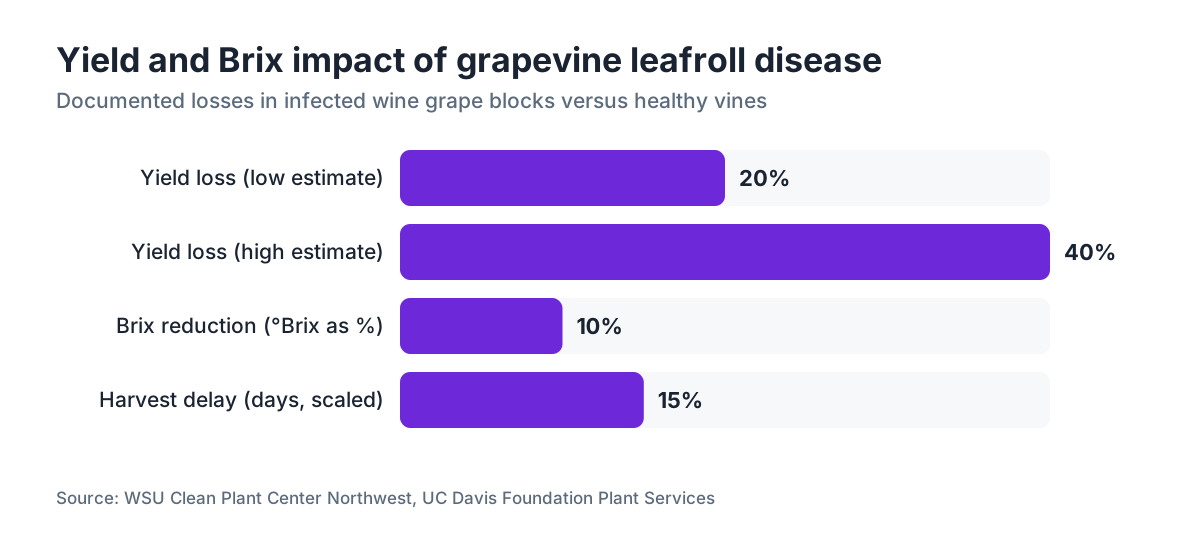
- Research vineyards document yield losses of 20-40% and Brix drops of 2-3 points.
What is grapevine leafroll disease and what causes it?
Grapevine leafroll disease (GLD) is a viral disease complex that hits Vitis vinifera and many hybrid cultivars worldwide. The name comes from the symptom you can't miss: leaves on red-fruited varieties roll downward and turn deep red or purple late in the season, while leaves on white-fruited varieties go pale yellow instead of the usual gold. The vines look almost beautiful in October. They're dying slowly.
The cause is a group of single-stranded RNA viruses in the family Closteroviridae. At least seven distinct Grapevine leafroll-associated viruses (GLRaV-1 through GLRaV-7) have been identified globally, with GLRaV-1 and GLRaV-3 doing the most damage in North American wine regions [1]. GLRaV-3 is the species most studied for insect transmission and vineyard spread.
Each virus species moves through a vineyard a little differently and rides different vectors, which is part of why this disease is so frustrating to manage. One site might be dominated by GLRaV-1 on mealybugs. Another might have GLRaV-3 moving on soft scale. You usually won't know which one you have until you test. UC Davis recommends ELISA or RT-PCR testing for accurate identification, and knowing the species changes your vector decisions [1].
What are the symptoms of leafroll in vineyards?
On red varieties, the classic picture is downward-rolling leaf margins, brilliant red interveinal color, and green veins that stay green well into September and October. The contrast is striking. Shoots stay green longer than healthy neighbors, and berry ripening lags the rest of the block.
On white varieties (Chardonnay, Pinot Gris, Riesling), rolling still happens but the interveinal tissue turns yellow or chlorotic rather than red. This is harder to spot in the field. Growers confuse it with nutrient deficiency, potassium stress, or plain autumn senescence. If you're scouting white blocks, look for the uneven ripening and the rolled margins on vines that seem nutritionally fine. That combination is the tell.
Fruit symptoms are where the economics get ugly. Infected vines ripen 10 to 21 days later than healthy vines in the same block [2]. Soluble solids at harvest can run 2 to 3 °Brix lower. Anthocyanin accumulation in red varieties drops hard, which hits color, mouthfeel, and marketable wine quality. Washington State University research documented yield reductions of 20 to 40% in infected Merlot and Cabernet Sauvignon blocks [2].
One symptom that muddies diagnosis: leafroll can coexist with grapevine trunk diseases like Eutypa dieback and Esca. A vine showing leaf symptoms might have two problems at once. Trunk disease cankers cause sector-shaped wood discoloration and their own foliar symptoms, and the two get mixed up all the time. Open a symptomatic vine with a saw and find brown wood streaking, and you're probably dealing with both. They are separate problems that need different responses.
How does leafroll disease spread through a vineyard?
Spread happens two ways: vegetative propagation and insect vectors. Propagation is the bigger one historically. Any cutting taken from an infected mother vine carries the virus. That's how GLD moved across continents and into new wine regions for most of the 20th century before certification programs existed. A lot of older Napa and Sonoma plantings went in on infected budwood. Nobody knew.
Insect-vectored spread inside an established vineyard is the immediate problem once the disease is present. The main vectors in North American vineyards are mealybug species (mainly grape mealybug, Pseudococcus maritimus, and obscure mealybug, Pseudococcus viburni) and several soft scale species, especially European fruit lecanium scale (Parthenolecanium corni) [3]. The insects pick up virus feeding on an infected vine, then move to a healthy vine and pass it on. GLRaV-3 spreads semi-persistently with mealybugs, meaning the insect has to feed for some time to acquire the virus and again to transmit it.
Spread from infected to healthy vines is not instant, but it speeds up. Cornell research in New York found that in untreated blocks with mealybug pressure, new infections showed up within 10 to 15 meters of existing infected vines in a single season [4]. The disease expands in a roughly circular pattern outward from initial infection foci, which is exactly why early detection and rouging matter. Once you hit 15-20% incidence in a block, the economics of vine-by-vine roguing change fast.
Ants make mealybug management harder. They tend mealybug colonies and shield them from natural predators. If leafroll spread is picking up speed, look down at the soil around the base of affected vines.
How much yield and quality loss does leafroll actually cause?
The honest answer: it varies a lot by cultivar, climate, virus species, and vine age, but the central estimates from replicated trials line up well enough to act on.
WSU Extension published data showing 20-40% yield loss and 2-3 °Brix reduction in infected Washington wine grape blocks [2]. A South African study out of Stellenbosch (not a US source, but cited constantly in extension literature) found Cabernet Sauvignon losses as high as 50% yield under severe GLRaV-3 infection. UC Davis Cooperative Extension work in Napa found that infected Pinot Noir vines produced fruit worth roughly $2,400 less per ton at premium pricing tiers than certified clean vines from the same block, on the Brix and color differentials alone [1].
For planning, the conservative number most farm advisors use is 20-30% value reduction per infected vine per year. That compounds fast. A 10-acre Pinot Noir block with 20% infection at $3,000/ton economics loses roughly $72,000 to $108,000 in annual value. The replacement cost for those 10 acres, counting vine removal, soil prep, certified plant material, and three to five years of non-bearing time, runs probably $150,000 to $300,000 depending on region and labor. Neither option is cheap. That's why the rouging versus replanting call is genuinely hard.
Long-term, vines do not recover. Virus titer swings seasonally, so you might see a vine that looks clean on one scouting pass and symptomatic the next fall. That's not recovery. It's a detection artifact.
Is there a treatment or cure for grapevine leafroll disease?
No. No chemical treatment, no pruning trick, and no biological control eliminates GLRaV from an infected vine. That sets GLD apart from most fungal problems in the vineyard, including grapevine trunk disease, where you at least have preventive tools like Topsin-M on pruning wounds for Eutypa.
Thermotherapy (hot water treatment of dormant cuttings at around 38°C for 30 days, or 45-50°C for shorter durations) combined with shoot tip meristem culture can produce clean plants from infected source material in a nursery [5]. UC Davis Foundation Plant Services uses this approach in its virus elimination program. But thermotherapy done in the field on established vines does nothing for leafroll. You can't clear the virus from a mature vine. The wood mass is too large and the virus sits distributed throughout the phloem.
What you can do for an infected vine is support its production while it's still in the ground. Keep nutrition adequate, especially potassium (infected vines can show exaggerated potassium-deficiency-like symptoms), manage vine water status, and adjust harvest timing for the delayed ripening. None of this changes the trajectory. It buys time while you make replanting decisions.
The one partial exception: some growers in tight-spacing blocks have tried topworking, grafting over to new certified scion material on existing rootstocks. If the rootstock isn't infected with a rootstock-transmissible strain, this can work. California trial results are mixed, and you need clean scion wood certified by a program like UC Davis Foundation Plant Services [5] or a state-certified nursery. If the rootstock carries GLRaV, you've just grafted clean wood onto an infected plant and you're back where you started.
How do you manage and control leafroll in an existing vineyard?
Managing an established vineyard with known infection comes down to four things: hard scouting, vector control, infected vine removal (rouging), and replanting with certified material.
Scouting: Red varieties are easiest to scout in late September and October, when symptoms peak. Walk every row, or use the 10% random sample method where you check every 10th vine and flag suspects for follow-up testing. Scout white varieties earlier in the season when yellow interveinal chlorosis still shows. Confirm suspicious vines with serological testing (ELISA) or PCR. Cornell's Plant Disease Diagnostic Clinic and UC Davis Foundation Plant Services both test [4][1].
Vector control: The goal is to knock mealybug and scale populations below economic thresholds before they move virus. Organophosphates like chlorpyrifos have been used historically but face tightening restrictions. Spirotetramat (Movento) and buprofezin have good efficacy against mealybugs and are registered for California wine grapes [3]. Soil-applied systemic insecticides (imidacloprid as a soil drench) can cut mealybug populations on roots and at the vine base. Under the EPA Worker Protection Standard, workers must observe the restricted-entry interval, which is 12 hours for many of these materials but can run 24-48 hours for some formulations. The label is the law [6].
Roguing: Infected vines should come out. The threshold question is economic. At low incidence (under 5%), removing infected vines and replanting the gaps with certified stock generally pays. Above 15-20% incidence, block removal and complete replanting often pencils better over a 20-year horizon. Leaving infected vines in place is subsidizing your mealybug population and re-exposing your healthy vines every season.
Replanting: Always replant with material certified under a recognized program. In California, that's UC Davis Foundation Plant Services [5]. In Washington, WSU Clean Plant Center Northwest [2]. In New York and the Northeast, Cornell's foundation block or a state-certified nursery. Using material of unknown status after you went to the trouble of pulling infected vines throws away the whole effort.
Recording where symptomatic vines appear, what testing confirmed, what you sprayed and when, and what you removed is the agronomic and compliance backbone of a GLD program. If you want a structured way to track all of that in one place, VitiScribe was built for this field-to-records workflow, including spray records that satisfy state pesticide use reporting requirements.
What role does certified planting material play in prevention?
It's the single most important preventive step. Period. Start with infected material and you're fighting the disease from day one, before you've sprayed an insecticide or pulled a vine.
Certified clean planting material in the US comes through two main pathways. UC Davis Foundation Plant Services (FPS) keeps a repository of grape varieties tested and declared virus-free or indexed clean, and produces foundation-level cuttings that California nurseries build from [5]. WSU Clean Plant Center Northwest does the same for Washington and ships to other states [2]. Both use multi-year virus indexing, biological assays on indicator plants, and increasingly PCR-based testing to verify material.
The price premium for certified material is real but small next to the alternative. Certified budwood costs maybe $0.50 to $2.00 more per vine equivalent than uncertified cuttings, depending on variety and nursery. Over a 25-year vine life, that's nothing against the cost of managing a leafroll epidemic. The math is not close.
Be careful with material swapped informally between growers or pulled from your own old blocks without testing. It's a common transmission path for GLD and several other viruses. If you're propagating from your own vines, test them first. Diagnostic lab testing costs roughly $15 to $40 per sample for ELISA and $40 to $80 for a PCR panel, depending on the lab and how many virus species you cover.
How does leafroll interact with grapevine trunk diseases?
Grapevine trunk diseases, including Eutypa dieback (Eutypa lata), Botryosphaeria dieback, Esca, and Petri disease, are fungal infections that colonize woody tissue and slowly wreck the vascular system. They're completely separate pathogens from the viruses behind leafroll, but they turn up together often enough that it pays to know how they interact and how to tell them apart.
Both leafroll and trunk diseases cause foliar symptoms. Both slow maturation. In older blocks (15-plus years), Eutypa and Esca incidence climbs, and a vine with leaf rolling, poor fruit set, and delayed ripening might have trunk disease, leafroll, or both. Opening the cane and cordons to look for internal wood discoloration is the fastest field diagnostic. Sector-shaped brown to grey wood staining in the cordon is classic Eutypa. A black streaking pattern in the cane cross-section suggests Petri disease or Botryosphaeria. No wood staining, just red or yellow leaf color with rolling, points back to leafroll.
For grapevine trunk disease, current best practice is pruning wound protection with registered fungicide applications (thiabendazole, thiophanate-methyl, or newer biological products like Trichoderma-based treatments) right after cuts are made, before the wounds dry [7]. Double-pruning, where you make a rough cut early and a final cut later in dormancy, reduces fresh wound exposure to winter spore dispersal. None of this treats an existing trunk infection once the fungus is established in the wood. It prevents new infections in healthy tissue.
A vine carrying both leafroll and trunk disease is a rouging call, almost every time. You're not saving that vine.
What does a leafroll scouting and testing program look like in practice?
The practical answer from extension recommendations and working advisors: start early, test what you flag, and keep records that support both agronomic decisions and compliance requirements.
For a 50-acre wine grape operation, a realistic program runs like this. In mid to late September, walk all red-variety blocks systematically and flag any vine with rolling and red interveinal color. Estimate block incidence. If you find symptomatic vines, collect tissue from 10 to 20 of them and send it to a certified diagnostic lab for ELISA at minimum, PCR if the budget allows. Test white-variety blocks a bit earlier, late August to early September. Keep GPS or row-and-vine coordinates for every positive result.
In late winter, use those results to plan the season's roguing and vector management. Order certified replants early, because clean material on popular varieties sells out. Schedule mealybug monitoring from bud break onward, using sticky traps and vine-base inspections to catch first-generation crawler emergence.
Spray records for any insecticides applied for vector control have to meet state pesticide use reporting requirements. In California, that means pesticide use reports (PURs) to the county agricultural commissioner within 30 days of the application month [8]. In Washington, the Washington State Department of Agriculture requires annual pesticide use reports for commercial operations [9]. Cornell's IPM program summarizes record-keeping requirements for New York [4]. Keeping all of it in one place, scouting notes, test results, spray records, roguing maps, and replant history, is exactly the workflow VitiScribe organizes for compliance-conscious vineyard managers.
The vineyard management fundamentals don't change with leafroll: good records, consistent scouting, and fast decisions once you have data.
How do you make the roguing versus block removal decision?
This is the hardest call in GLD management and the one where reasonable people disagree. Here's how to think it through.
At low incidence (under 5% of vines symptomatic and confirmed positive), rouging individual vines and replanting the gaps is almost always right. You're pulling virus reservoirs, cutting mealybug host material, and keeping the block productive. The cost is manageable.
At high incidence (over 20% confirmed positive), the economics usually favor whole-block removal and replanting. You have too many virus reservoirs to control spread with rouging alone, your remaining healthy vines sit under constant re-inoculation pressure, and your block yield is already so degraded that the income lost by taking the block out is smaller than you'd guess.
The middle ground, 5% to 20%, is genuinely hard. A few questions change the math. How old is the block? A 10-year-old block hurts more to replant than a 25-year-old one near the end of its economic life anyway. What's the mealybug pressure? On a high-pressure site, even roguing at 10% incidence may not slow spread enough to justify keeping the block. What variety and what market? A premium Pinot Noir at $5,000/ton has different tolerance for quality loss than a commodity variety.
Nobody has great decision-tree data on this exact tradeoff. The closest published economic analysis is from UC Davis Cooperative Extension, which modeled Napa Cabernet Sauvignon at various incidence levels and found rouging was cost-effective below 15% incidence and whole-block removal favored above 20% under most price assumptions [1]. Between 15% and 20%, it came down almost entirely to vine age and fruit price.
What states and regions have the worst leafroll pressure?
Grapevine leafroll disease is present in every significant wine grape region in the US and around the world. This is not a niche problem. The 2010 National Grape Registry survey found leafroll viruses in samples from California, Washington, Oregon, New York, and Virginia, and that survey was not exhaustive [10].
Regions with year-round warm climates and diverse crop hosts for mealybugs tend to carry heavier vector pressure, which speeds vineyard spread. Central Coast California, including areas around Paso Robles wineries and San Diego-area vineyards, has documented mealybug pressure. The warm, dry conditions favor mealybug populations. Napa and Sonoma carry high historical infection in older blocks, with some estimates putting GLRaV incidence above 50% in pre-1990s plantings.
Washington's Columbia Valley runs lower mealybug pressure in many sites thanks to the semi-arid climate and fewer alternative mealybug hosts, but GLRaV-3 still spreads in established vineyards once infection arrives. Cornell's research program in the Finger Lakes has documented active spread in Riesling blocks [4].
The honest reality is that no region is safe. Source from uncertified material and you're probably starting with infected vines in many varieties. The regional variation is mostly in how fast the disease spreads once it's in, driven by vector populations and climate.
What are the regulatory and compliance considerations for leafroll management?
GLD itself is not a quarantine pest in the US, so there's no federal mandate to remove infected vines or report incidence to a regulatory body. Several compliance dimensions are real anyway.
Pesticide applications for vector control are fully regulated. Under the EPA Worker Protection Standard (WPS), all workers entering treated areas must get safety information, and restricted-entry intervals have to be observed to the hour [6]. The WPS requires that handlers be trained, that safety information be centrally posted, and that emergency information stay accessible. This is not paperwork you can skip, and EPA enforcement actions against agricultural employers for WPS violations are real.
State pesticide use reporting: California requires all commercial pesticide applications to be reported to the county agricultural commissioner, a requirement under the California Department of Pesticide Regulation's pesticide use reporting program [8]. Washington State requires annual reporting to the Washington State Department of Agriculture [9]. Oregon has similar requirements under OAR 603-057. Violations carry fines.
Certification programs for plant material carry their own documentation requirements. If you're selling cuttings or budwood commercially, you'll deal with state plant quarantine regulations and potentially USDA APHIS import/export requirements if material crosses state lines or international borders.
For most vineyard operations, the practical compliance workflow is straightforward: maintain spray records with all required fields (product, rate, REI, applicator, target pest, date, location), file pesticide use reports on schedule, and keep records of planting material source and any diagnostic test results. That paper trail protects you in an inspection and supports replanting decisions years later when you need the history of a block.
Frequently asked questions
Can infected grapevines recover from leafroll disease?
No. Once a vine tests positive for grapevine leafroll-associated virus, no field treatment eliminates the virus. Virus titer swings seasonally, so a vine may look symptom-free some years and show obvious symptoms in others, but it stays a permanent virus reservoir. Thermotherapy can produce clean plants from infected material in a nursery setting but is not practical or effective on established vineyard vines.
How long does it take for leafroll symptoms to appear after infection?
It depends on when in the season infection happens and the vine's vigor. A vine infected early by a mealybug vector may not show foliar symptoms until the following fall, sometimes two growing seasons later. Young vines and high-vigor vines mask symptoms longer. This latent period is one reason GLD spreads quietly in vineyards before growers notice and test.
What is the best insecticide for controlling mealybugs that spread leafroll?
Spirotetramat (Movento) and buprofezin have documented efficacy against grape mealybug and are registered for California wine grapes. Soil-applied imidacloprid can cut mealybug populations at the vine base. Chlorpyrifos was historically effective but faces severe restrictions. Always check your state's current registrations and observe all EPA Worker Protection Standard restricted-entry intervals. No single insecticide is a complete solution without cultural management.
How do I tell the difference between leafroll and grapevine trunk disease symptoms?
Both can cause leaf discoloration and delayed ripening, but the mechanisms differ. Cut into a symptomatic cordon: Eutypa dieback shows sector-shaped brown wood staining; Esca and Petri disease show black streaking in the vascular tissue. Pure leafroll infection shows no wood staining on cross-section. Foliar symptoms on white varieties (yellow interveinal chlorosis with green veins) can mimic trunk disease. Lab testing and wood inspection together give the most reliable diagnosis.
What does certified clean planting material actually mean, and where do I get it?
Certified clean material has been tested and confirmed free of known grapevine viruses through indexing on indicator plants and laboratory assays (ELISA, PCR). In California, UC Davis Foundation Plant Services is the primary source. In Washington, WSU Clean Plant Center Northwest provides certified material. In New York, Cornell's foundation program covers many varieties. Buying from a licensed nursery using certified source material is the minimum standard. Ask for the certification documentation.
At what incidence level should I consider removing an entire block rather than rouging?
UC Davis Cooperative Extension economic modeling for Napa Cabernet Sauvignon found rouging was cost-effective below 15% confirmed incidence and whole-block removal penciled out better above 20%, with the range between depending on vine age and fruit price. Younger blocks with high-value fruit and strong mealybug pressure tip toward block removal at lower incidence. These thresholds are not universal laws, just guidelines from one regional analysis.
Does leafroll affect all grape varieties equally?
No. Red-berried varieties like Cabernet Sauvignon, Merlot, and Pinot Noir typically show more obvious foliar symptoms and greater yield and Brix losses than white varieties. White varieties (Chardonnay, Riesling) still suffer economically from delayed ripening and color or aromatic changes but are harder to spot in the field. Rootstocks can harbor some GLRaV strains without visible symptoms, which complicates detection.
Is grapevine leafroll disease the same as red blotch?
No. They are distinct viral diseases with some overlapping foliar symptoms. Grapevine red blotch disease is caused by Grapevine red blotch virus (GRBV), a circular DNA virus in the family Geminiviridae, with different vectors and epidemiology than leafroll viruses. Both cause red discoloration in red varieties and delayed ripening, and they can coexist in the same vine. Accurate diagnosis requires laboratory testing to tell them apart.
How does leafroll affect wine quality beyond sugar accumulation?
Beyond the well-documented 2-3 °Brix reduction, leafroll infection lowers anthocyanin accumulation in red varieties, hitting wine color intensity and stability directly. Malic acid levels are affected, which can shift final wine pH and tartrate stability. Tannin maturation is also delayed, which can mean green or harsh tannin in wines made from infected fruit harvested at conventional timing. The compounding effect on wine style can be significant in premium markets.
What pesticide use reporting is required when managing leafroll vectors in California?
California requires all commercial pesticide applications to be reported to the county agricultural commissioner under the California Department of Pesticide Regulation's pesticide use reporting program. Reports must include the product name, EPA registration number, amount used, application date, target site, and acreage treated. Reports are due within 30 days of the application month. Failure to report violates the California Food and Agricultural Code. The county ag commissioner's office processes these reports.
Can I use biological controls to manage mealybugs spreading leafroll?
Biological control agents, including parasitic wasps like Anagyrus pseudococci and Leptomastix dactylopii, attack grape mealybug and can cut populations in low-pressure settings. They work best inside a broader IPM program that also controls ants (which protect mealybug colonies). Biological control alone rarely stops virus spread once an infection focus exists. WSU and UC Davis extension both recommend combining biocontrol with targeted insecticide applications.
How do I test vines for leafroll virus and what does it cost?
ELISA testing is the standard screen, typically $15 to $40 per sample depending on the lab and number of virus species tested. RT-PCR panels are more sensitive and cover more species but cost $40 to $80 or more per sample. UC Davis Foundation Plant Services, Cornell Plant Disease Diagnostic Clinic, and WSU Plant Pest Diagnostic Clinic all offer testing. Collect petioles or leaf tissue from symptomatic vines in late summer when virus titer is highest.
What record-keeping is required under the EPA Worker Protection Standard for leafroll spray programs?
Under the EPA Worker Protection Standard (40 CFR Part 170), handlers applying pesticides for vector control must be trained, and employers must maintain safety data sheets and central posting of pesticide application information. The WPS does not specify a record format, but records must capture the product used, location, application date, REI, and who applied it. Most states layer added requirements on top of federal WPS minimums. California's requirements under CDPR are more detailed than the federal floor.
Sources
- UC Davis Foundation Plant Services, Grapevine Leafroll Disease: GLRaV-1 and GLRaV-3 are the most damaging strains in North American wine regions; ELISA and RT-PCR recommended for identification; economic modeling for Napa Cabernet Sauvignon incidence thresholds
- WSU Clean Plant Center Northwest / WSU Extension, Grapevine Leafroll Disease: 20-40% yield loss and 2-3 Brix reduction documented in infected Washington wine grape blocks; infected vines ripen 10-21 days later; WSU provides certified clean material
- UC Integrated Pest Management Program, Mealybugs in Vineyards: Pseudococcus maritimus and P. viburni primary mealybug vectors in California; spirotetramat and buprofezin registered efficacy for grape mealybug
- Cornell University Cooperative Extension, Grapevine Leafroll and Virus Diseases: New infections appeared within 10-15 meters of existing infected vines in a single season in untreated New York blocks; Cornell diagnostic clinic testing services and NY record-keeping summary
- UC Davis Foundation Plant Services, Thermotherapy and Virus Elimination: Thermotherapy combined with meristem culture can produce clean plants from infected source material; FPS foundation-level cuttings are the California standard for clean material
- EPA Worker Protection Standard, 40 CFR Part 170: Workers must observe restricted-entry intervals; handlers must be trained; central posting of pesticide application safety information required under WPS
- UC Agriculture and Natural Resources, Trunk Disease Management in Grapevines: Pruning wound protection with registered fungicides (thiabendazole, thiophanate-methyl, Trichoderma-based products) applied immediately after pruning is best practice for Eutypa and trunk disease prevention
- California Department of Pesticide Regulation, Pesticide Use Reporting: California requires all commercial pesticide applications to be reported to the county agricultural commissioner within 30 days of the application month
- Washington State Department of Agriculture, Pesticide Management Division: Washington State requires annual pesticide use reports for commercial agricultural operations
- USDA Agricultural Marketing Service / APHIS National Clean Plant Network: Leafroll viruses found in samples from California, Washington, Oregon, New York, and Virginia in national surveys; USDA APHIS coordinates the National Clean Plant Network for virus-tested grapevine material
Last updated 2026-07-09