Grapevine trunk disease management: a field guide that actually works
TL;DR
- Grapevine trunk diseases, including Eutypa dieback, Botryosphaeria dieback, Esca, and Petri disease, are fungal infections that enter through pruning wounds and can kill vines within years.
- Managing them means pruning late in the dormant season, protecting cuts within hours, removing infected wood aggressively, and keeping detailed spray and pruning records for compliance.
What are grapevine trunk diseases and why do they matter so much?
Trunk diseases are a group of fungal and oomycete infections that colonize the permanent woody structure of a grapevine: the trunk, cordons, and spurs. Unlike foliar diseases, you can't wash them off or spray them away once they're inside. The wood is infected. The vine slowly starves.
The economic damage is large. A 2013 study published in Plant Disease estimated the annual cost of Eutypa dieback alone across U.S. wine grape production at roughly $260 million in lost revenue [1]. That figure doesn't include Botryosphaeria dieback, Esca, or Petri disease, which are each capable of wiping out blocks in their own right. In California's Central Valley, some surveys have found 80% of mature Cabernet Sauvignon blocks show visible trunk disease symptoms [2].
New Zealand growers face equally serious pressure. Surveys of Marlborough vineyards have documented Botryosphaeriaceae and Eutypa lata in a high proportion of sampled vines, and grapevine trunk disease NZ researchers at Lincoln University have been tracking how rapidly pathogen populations expand after single pruning seasons without wound protection [3].
So: these diseases are everywhere, they're expensive, and they're nearly impossible to reverse once established. That's the bad news. The good news is that the biology of infection gives you a real, workable management window.
Which fungal pathogens are you actually dealing with?
There are four disease complexes you need to know by name, because they have different timelines, different visible symptoms, and slightly different management responses.
Eutypa dieback is caused by Eutypa lata and spreads through airborne ascospores released during rain events in fall and winter. Infection happens through pruning wounds. Symptoms show up 3-8 years later as stunted, chlorotic shoot growth and, in cross-section, a wedge-shaped area of dead wood (necrosis) in the cordon or trunk [4]. By the time you see the canopy symptoms, you've already lost years.
Botryosphaeria dieback is a complex of about a dozen Botryosphaeriaceae fungi, including Neofusicoccum parvum and Diplodia seriata, the two most aggressive species in California and Australia. These move faster than Eutypa, sometimes causing arm death within one or two seasons. Their spores are released in both wet and dry conditions, which makes wound protection timing less forgiving [2].
Esca (sometimes called black measles) is a slow-moving disease complex involving multiple wood-rotting fungi, most notably Phaeomoniella chlamydospora and Phaeoacremonium species. It causes tiger-stripe leaf symptoms, berry shrivel, and in its acute form, sudden vine collapse called apoplexy. Esca is common in old European vineyards and is showing up more frequently in California, Oregon, and parts of New Zealand [5].
Petri disease is the young vine version of Esca, caused by the same pathogens. It kills young vines before they ever establish. Infected nursery material is often the source [5].
| Disease | Primary Pathogen(s) | Spore Release | Symptom Onset | Main Entry Point |
|---|---|---|---|---|
| Eutypa dieback | Eutypa lata | Wet weather, fall-spring | 3-8 years | Pruning wounds |
| Botryosphaeria dieback | Neofusicoccum, Diplodia spp. | Wet and dry conditions | 1-3 years | Pruning wounds, stress cracks |
| Esca | Phaeomoniella, Phaeoacremonium spp. | Wet weather | 5-10+ years | Old wounds, soil |
| Petri disease | Phaeomoniella, Phaeoacremonium spp. | Nursery stock | 1-2 years | Roots, graft unions |
How do you identify trunk disease in the field before the vine dies?
Early diagnosis is where most growers fall short. Canopy symptoms are the last thing to appear, not the first.
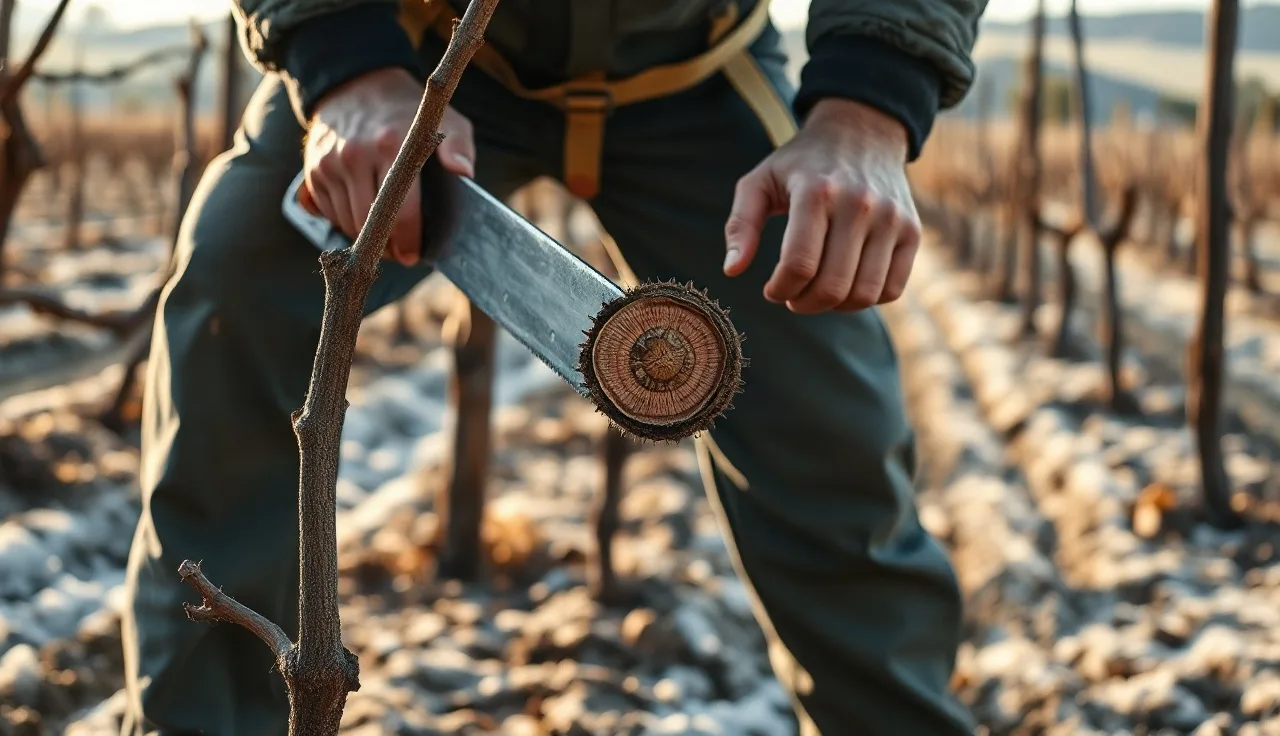
The most reliable field diagnostic is a cross-section cut. Take a sharp handsaw, make a perpendicular cut through a suspect cordon or arm, and look at the wood face. Eutypa produces a characteristic V-shaped or wedge-shaped brown to gray necrosis sector. Botryosphaeria tends to produce a darker, more uniform brown discoloration, sometimes with a clear boundary between healthy cream-colored wood and dead tissue. Esca shows a soft, white spongy rot in the heartwood, sometimes with black streaking.
Leaf symptoms are worth knowing but are unreliable for early detection. Eutypa gives you stunted shoots with small, cupped, chlorotic leaves early in the season. Botryosphaeria often kills whole arms suddenly. Esca's tiger-stripe pattern (interveinal chlorosis and necrosis on leaves, starting at the margins and working inward) is visually dramatic and useful for flagging vines for closer inspection [4].
In winter, before budbreak, walk your rows and flag vines that had poor shoot growth the prior season. Those are your candidates for cross-section diagnosis. A 10% sample of flagged vines, cut and examined, will tell you a lot about the disease pressure in a given block.
Some growers send wood samples to a plant diagnostic lab for pathogen confirmation. UC Davis's Plant Pathology Department and several state extension labs (Cornell, WSU) run trunk disease diagnostics. Confirmation matters when you're making replanting decisions, because you want to know which pathogen you're dealing with before choosing a management strategy [6].
Does pruning timing actually reduce trunk disease infection rates?
Yes. This is the best-supported intervention in the literature, and it costs you nothing but a schedule change.
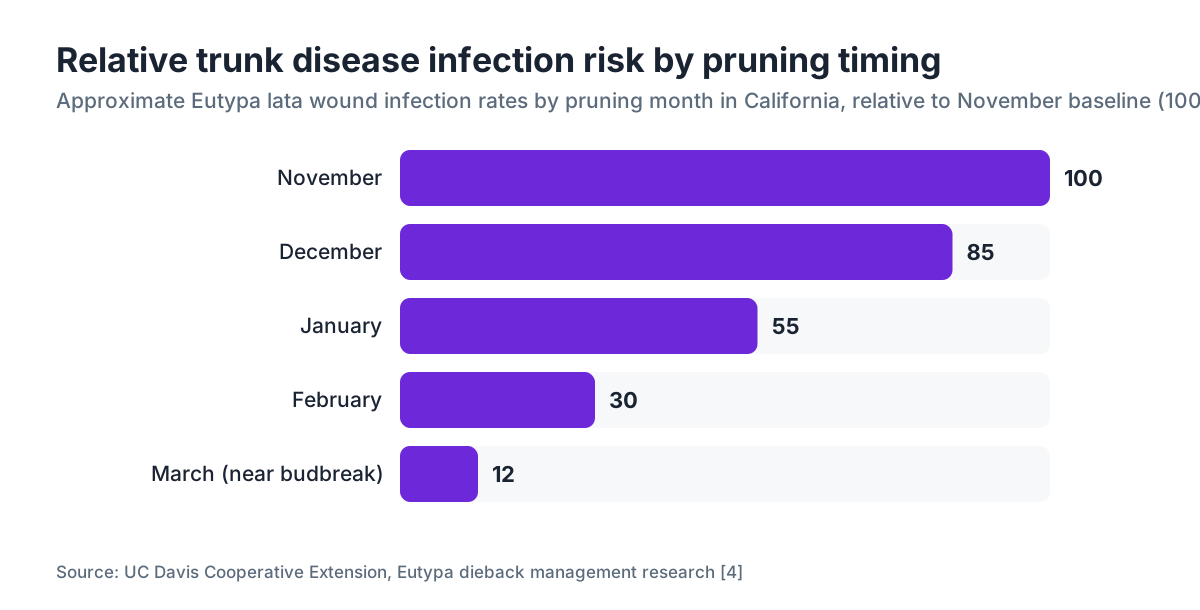
Spore release for most trunk disease pathogens, especially Eutypa lata, peaks during fall and winter rain events. Wounds made during those high-spore periods have much higher infection rates. UC Davis research showed that wounds made in January and February in California had significantly lower Eutypa infection rates than wounds made in November and December, with infection rates dropping as the season progressed toward budbreak [4].
The general guidance from UC Cooperative Extension is to prune as late in the dormant season as is practical, ideally within 4-6 weeks of budbreak [4]. In a wet winter, even a few weeks' delay matters. Double pruning, where you make a rough cut in late fall to remove most of the cane and then make the final precision cut close to budbreak, is one way to protect the permanent wood while still managing the workload.
In practice, this is hard to pull off across a large estate. Labor scheduling, cold snaps, and equipment availability all push against it. The honest trade-off is this: late pruning reduces infection risk on the fresh wound, but it also compresses your workload right before budbreak when you're already slammed. Most growers land somewhere in the middle and compensate with wound protectants.
In New Zealand, grapevine trunk disease NZ extension guidance from Plant & Food Research says the same thing: delay pruning where possible and combine with protectant applications [3].
What wound protectants actually work, and what's a waste of money?
Wound protectants are the second line of defense after timing. They work by physically or chemically blocking fungal spore germination at the cut surface. The window is narrow: research from multiple institutions shows the highest infection risk is in the first 24-48 hours after a wound is made, so 'apply within a few hours' isn't overcautious, it's what the biology requires [4].
Here's what has real evidence behind it:
Topsin-M (thiophanate-methyl) is one of the most widely used fungicides for wound protection and has good efficacy data against Eutypa and Botryosphaeria in multiple trials. It comes in various formulations including paint-on gels. Apply at label rates immediately after cutting.
Luna Experience (fluopyram + tebuconazole) and other SDHI/DMI combinations have shown strong efficacy against Botryosphaeriaceae in recent California and Australian trials [2]. These are now what most researchers recommend for growers in high-pressure situations.
Biological protectants using Trichoderma species (products like Vinevax or RootShield in various markets) have decent evidence for reducing pathogen colonization at wound surfaces [7]. They're not as reliably effective as synthetic fungicides alone, but they're an option for organic programs or as a tank-mix partner.
Bordeaux mixture and lime sulfur are traditional options, particularly relevant in organic and biodynamic programs. Their efficacy against trunk disease pathogens is real but lower than modern fungicides in head-to-head trials.
Wax-based sealants alone, without a fungicide, are not worth buying. The physical barrier degrades quickly, and there's no antimicrobial activity.
Application method matters. Paint-on formulations give you better coverage on a fresh cut than a sprayer. If you're running a large crew, a simple small pump bottle carried by each pruner is more practical than a backpack sprayer following behind. Consistent coverage beats product choice in most scenarios.
Cost ranges for commercial wound protectant products run roughly $30-90 per liter for concentrate, depending on product and vendor. Labor to apply adds maybe $3-8 per vine per treatment in high-cost labor markets, so don't ignore that in your budget.
How do you remove trunk disease from an infected vine without losing it?
Surgical remediation is possible, but only if you catch the disease before it has moved too far into the permanent structure.
The process is called trunk renewal or cordon renewal, depending on how far the infection has progressed. The basic principle: you remove all infected wood back to at least 5-10 cm below the visible margin of discoloration (disease can hide in wood that looks healthy) and train up a new shoot from below the infected zone [4].
For cordon-trained vines (VSP, Scott Henry), you can often remove an infected arm and re-train a sucker or watersprout from the lower trunk over 2-3 seasons. The vine keeps producing while the new arm grows. For trunk infections that have moved into the base, you're looking at cutting back to near the graft union and re-training from a basal shoot, which sets you back 2-4 years of production.
Here's the honest truth about remediation: it works well when you do it early and consistently. When disease has reached the point that 40-50% of the vine's wood volume is infected, removal is usually more economical than surgery. And if you've had a block at 50%+ infection for several years, you're not looking at a vine-by-vine fix, you're looking at replanting decisions.
After any removal or surgery, protect the new pruning wounds immediately. You've just created fresh entry points in a vineyard that clearly has active fungal pressure.
Tool sanitation is non-negotiable during removal work. A 10% bleach solution or 70% ethanol wipe between vines won't sterilize your shears perfectly, but it materially cuts cross-vine spread. Some pathologists prefer sodium hypochlorite at 1-2% for its broad-spectrum activity. Change the solution often; it degrades fast.
What do spray and pruning records need to include for trunk disease compliance?
Record-keeping for trunk disease management crosses paths with state pesticide use reporting, the EPA Worker Protection Standard, and in some states, extra requirements tied to restricted-use pesticides.
At the federal level, the EPA Worker Protection Standard (WPS) requires that any time a pesticide is applied in an agricultural setting, a specific set of records be kept: the product name and EPA registration number, the crop treated, the application date, the location, and the applicator's name and certification status where applicable [8]. If your wound protectant contains thiophanate-methyl or any other restricted-use active ingredient, those records are mandatory and must be kept for at least 2 years.
California growers face additional requirements under the Department of Pesticide Regulation (CDPR) system: all pesticide applications, including general-use products, must be reported to the County Agricultural Commissioner within 7 days of application [9]. That report needs the site ID, the acres treated, the amount of product applied, and the pest targeted.
Pruning records themselves aren't federally mandated, but they're worth keeping for your own management and for any certification audits (organic, sustainable, third-party). A simple log recording the date of pruning by block, the crew, weather conditions at time of cutting, and whether wound protectant was applied gives you a defensible record if disease pressure shows up later and you want to understand why.
Managing all this manually on paper is where most vineyard operations fall apart. If you're juggling multiple blocks with different pruning dates, overlapping spray applications, and varying product choices, a digital field record system saves real time and cuts errors. VitiScribe was built for this kind of vineyard compliance documentation, letting you log pruning events and spray applications in the field rather than reconstructing them later from memory.
WSU Extension has published guidance on what a complete pesticide application record should contain, and UC Davis Cooperative Extension has resources on California's specific reporting requirements [6][9].
How do nursery practices and planting stock affect trunk disease risk?
Petri disease and Esca arrive in many new vineyards via infected nursery material. This isn't speculation: multiple studies have found Phaeomoniella chlamydospora and Phaeoacremonium species inside commercially propagated grapevine cuttings before they ever go into the ground [5].
The practical takeaway is to ask your nursery what disease-testing protocols they use. The best nurseries hot-water treat cuttings and rootstock before grafting: 50°C (122°F) for 30 minutes is the standard protocol recommended by UC Davis for eliminating Petri disease pathogens from planting material [5]. Not every nursery does this, and it's worth asking directly.
When you receive new vines, inspect a random sample. Pull 5-10 plants per thousand and make a cross-section cut at the base of the rootstock. Healthy wood is cream-colored and uniform. Discolored, brown, or vascular-streaked wood is a red flag. If you find consistent discoloration, contact your nursery and extension service before planting the entire order.
Planting vines into a block that previously had trunk disease without fumigation or adequate fallow time is also a risk factor, because some Botryosphaeria and Esca pathogens persist in old root debris. Most extension recommendations suggest a minimum 1-2 year fallow with tillage to break down infected root material, though this is often impractical economically.
What are the best long-term management strategies for a high-pressure vineyard block?
If you're already managing a block with significant trunk disease, you need a multi-year strategy, not a single season of intervention.
Year one priorities: do a thorough disease census. Walk every row, flag symptomatic vines, and cut a 10-20% sample for cross-section confirmation. This tells you your infection rate and the likely pathogens. If you're at less than 20-25% infection, surgical remediation plus aggressive wound protection going forward is defensible. Above 40%, start running replanting economics.
For ongoing management, Cornell University's extension program recommends integrating pruning timing, wound protection, and vine monitoring as a package, not individual interventions [6]. Any one of those alone is much less effective. Pruning timing cuts infection rate. Wound protectants reduce the odds further. Monitoring catches new infections before they spread.
Biostimulants and foliar nutrition programs are sometimes marketed as trunk disease management tools. The evidence is weak. Keeping vines vigorous and avoiding stress (especially water stress, nutrient deficiency, and mechanical injury) reduces susceptibility somewhat, but no nutrition program substitutes for physical management of wounds.
Cover crop management and canopy management also matter indirectly: anything that reduces prolonged wood wetness after pruning reduces the infection window. Good air circulation isn't a cure, but it helps.
For vineyards with a long time horizon, trunk disease management is really about protecting the investment in permanent structure. A vine that took 4-5 years to come into production represents real capital. Losing it to preventable disease is expensive in a way that doesn't always show up in a single year's P&L but compounds badly over a decade.
Are there approved organic or low-toxicity options for trunk disease management?
Organic growers have fewer options but real ones.
Trichoderma-based biocontrols are OMRI-listed and have documented activity against Eutypa and Botryosphaeria at wound sites, though efficacy in field trials is more variable than synthetic fungicides [7]. The key is application timing: get them onto the fresh wound within hours, same as any protectant.
Bordeaux mixture is allowed in most organic certification programs and has long been used as a wound sealant and protectant. Copper-based materials have some activity against fungal pathogens at wound surfaces, though again, not as reliably as modern SBIs.
Lime sulfur (calcium polysulfide) is another organic option used in dormant-season spray programs. Some New Zealand growers apply it over freshly pruned vines as a broad-spectrum protectant, and grapevine trunk disease NZ extension has documented its use in integrated management programs [3].
The honest assessment: organic trunk disease management takes more discipline and more frequent application than conventional programs. You're not getting the same margin of error. Late application of a Trichoderma product is much less effective than timely application of a synthetic protectant. In a high-pressure situation with a certified organic program, treat wound protection as a non-negotiable first-day task after every pruning crew passes through.
How do other major wine regions approach trunk disease differently?
The fundamentals are universal: wound protection, late pruning, aggressive removal of infected wood. But regional emphasis varies by climate, pathogen pressure, and regulatory environment.
In California, Eutypa dieback has historically been the dominant concern, particularly in older Cabernet Sauvignon blocks in Napa and Sonoma. UC Davis has produced some of the foundational research on the disease cycle and wound protectant efficacy [4]. More recently, Botryosphaeria dieback has become the primary concern in Central Valley regions with hot, dry summers, where vine stress speeds up symptom expression.
In Washington State, WSU Extension has focused heavily on Botryosphaeria and Eutypa in Riesling and Chardonnay, and the WSU viticulture team has published management guides for the Columbia Valley climate, where wet spring conditions create high infection pressure during early pruning [6].
In New Zealand, grapevine trunk disease NZ research, particularly out of Marlborough, has found high prevalence of Botryosphaeriaceae species adapted to cool, wet conditions. Plant & Food Research in New Zealand has documented that infection rates in unprotected vines in Marlborough can run substantially higher than in California trial sites, partly because Marlborough's pruning season coincides with frequent rain [3].
In Europe, Esca is the dominant concern in older vineyards in France, Italy, and Spain. The European approach historically involved arsenic-based wood treatments, now banned, and the shift to modern biological and chemical protectants has been a major research focus there.
If you're managing a vineyard across multiple climate zones, you may face different dominant pathogens in different blocks. That's worth mapping explicitly.
What's the realistic cost of a trunk disease management program?
Costs vary widely depending on operation size, existing infrastructure, and how much disease is already present. Here's a realistic breakdown:
Wound protectant product: $30-90 per liter of concentrate, applied at roughly 0.5-1 mL per wound cut. A well-managed 10-acre block might have 5,000-8,000 pruning cuts per year depending on training system. Total product cost for that block: $50-200 per season, which is genuinely low relative to the value at stake.
Labor to apply: this is the bigger number. If each pruner stops to apply protectant at each cut, productivity drops noticeably. A realistic estimate from growers interviewed in extension publications is 10-20% slower pruning with protectant application versus without. On a $25/hour labor rate, that adds $2.50-5.00 per hour per pruner. For a crew of 8 pruning for 10 days, that's $2,000-4,000 in additional labor cost.
Surgical remediation: 30-45 minutes per vine for trunk or cordon removal, trained replacement, and follow-up staking. At $25-30/hour labor, that's $12-22 per vine just in labor. If you have 100 vines to remediate in a 5-acre block, that's $1,200-2,200 before materials.
Replanting: the true cost of losing a vine includes vine purchase ($4-8 each for grafted vines), replanting labor, 3-4 years of deferred production, and training costs. Per-vine total cost of replacement is commonly estimated at $15-30 per vine all-in, though this varies enormously by region and variety.
For record-keeping and compliance tracking, digital systems like VitiScribe cut the administrative labor around spray records and pruning logs, which adds up when you're managing multiple blocks with different treatment schedules.
The math strongly favors prevention over remediation.
Frequently asked questions
What is the best time of year to prune grapevines to minimize trunk disease infection?
Prune as late in the dormant season as is practical, ideally within 4-6 weeks of budbreak. Spore release from Eutypa lata peaks during fall and winter rain events, so wounds made in November and December carry higher infection risk than wounds made in February or March. UC Cooperative Extension data from California shows measurable reduction in Eutypa infection rates as pruning is delayed toward budbreak.
How quickly do I need to apply a wound protectant after pruning?
Within a few hours of making the cut. Research consistently shows the highest infection risk is in the first 24-48 hours after a pruning wound is made. Application the next day is better than nothing, but you've already lost much of your protection window. Some growers have each pruner carry a small pump bottle so the wound is treated in the same pass as the cut.
Can grapevine trunk diseases spread from vine to vine through tools?
Yes, though the primary transmission route is airborne spores landing on fresh wounds. Tool-to-tool spread is a real secondary risk, particularly with Esca and Petri disease pathogens. Wiping blades with a 10% bleach solution or 70% ethanol between vines reduces cross-contamination. Change your bleach solution frequently; sodium hypochlorite degrades within hours of dilution and loses efficacy.
Is Esca the same as black measles?
Black measles is an older common name for Esca. They describe the same disease complex, which involves multiple fungi including Phaeomoniella chlamydospora and Phaeoacremonium species. The term 'black measles' comes from the dark, measles-like spots that appear on berries in acute cases. Esca is now the standard scientific and industry term, though black measles still appears in older California literature.
How do I know if my nursery vines already have trunk disease before planting?
Pull a random sample of 5-10 vines per thousand received and make a cross-section cut at the base of the rootstock. Healthy wood is cream-colored. Brown or discolored vascular tissue is a warning sign. Ask your nursery whether they hot-water treat cuttings: 50°C for 30 minutes is the UC Davis-recommended protocol for eliminating Petri disease pathogens from propagation material.
What pesticide records do I need to keep for trunk disease spray programs in California?
California requires all pesticide applications, including general-use products, to be reported to your County Agricultural Commissioner within 7 days. Records must include the product name, EPA registration number, date, location or site ID, acres treated, and amount applied. Restricted-use pesticide applications require additional applicator certification documentation. The EPA Worker Protection Standard requires records be kept for at least 2 years.
Are Trichoderma-based products effective for organic grapevine trunk disease management?
They have documented efficacy in reducing pathogen colonization at wound sites, but they're less reliably effective than synthetic fungicides in head-to-head field trials. OMRI-listed Trichoderma products are a real option for certified organic operations, but they require timely application within hours of pruning. Bordeaux mixture and lime sulfur are also allowed in most organic programs and have broader antimicrobial activity.
How prevalent are trunk diseases in New Zealand vineyards?
Surveys of Marlborough vineyards have found Botryosphaeriaceae and Eutypa lata in a significant proportion of sampled vines. Lincoln University and Plant & Food Research in New Zealand have documented that infection rates in unprotected vines can run higher than in many California trial sites, partly because Marlborough's pruning season frequently coincides with wet weather. Grapevine trunk disease NZ extension guidance recommends late pruning combined with protectant application.
At what trunk disease infection rate should I consider replanting rather than remediating?
There's no universal cutoff, but most viticulture extension advisors suggest that blocks above 40-50% visible infection are usually better candidates for replanting than vine-by-vine surgery. Below 20-25%, aggressive surgical remediation plus wound protection going forward is economically defensible for most varieties. The economics also depend on vine age, variety value, and how much productive life remains.
Does double pruning really reduce trunk disease, and is it worth the extra labor?
Double pruning, making a rough removal cut in fall and a precision final cut near budbreak, is a real strategy backed by the pathogen biology. The fall cut removes most cane material on a non-permanent shoot that you'll cut again anyway. The final cut on the permanent cordon wood happens later, when spore pressure is lower. Extra labor is real but modest compared to the cost of losing arms or vines.
Can trunk disease kill a grapevine outright, or does it just reduce yield?
It can kill vines, and faster than most growers expect. Botryosphaeria dieback can kill individual arms in 1-2 seasons and whole vines in 3-5 years in high-pressure situations. Eutypa is slower, often reducing yield for years before outright vine death. Esca's apoplexy form causes sudden, complete vine collapse. Petri disease kills young vines before they produce their first commercial crop.
What does Eutypa dieback look like when you cross-section infected wood?
A characteristic V-shaped or wedge-shaped sector of brown to gray necrotic wood, usually visible as a distinct discoloration from the healthy cream-colored tissue around it. The necrosis typically starts at a pruning wound site and fans out into the cordon. If you cut progressively further down the arm toward the trunk, you can trace how far the disease has moved into the permanent wood structure.
Are there any fungicides registered specifically for grapevine trunk disease wound protection?
Yes. Thiophanate-methyl (Topsin-M) is widely registered and used as a wound protectant in several formulations including paint-on gels. Fluopyram plus tebuconazole (Luna Experience) has shown strong efficacy in recent California and Australian trials against Botryosphaeriaceae. Always verify current registration status in your state, as labels and registrations change. Check the CDPR or your state's department of agriculture pesticide database for current listings.
How long does it take to see results after implementing a trunk disease management program?
You won't see dramatic improvement in year one. Trunk diseases move slowly, and existing infected wood doesn't recover. What you're doing in year one is stopping new infections. Visible improvement in block health typically takes 3-5 years of consistent management: late pruning, wound protection, and removal of already-infected wood. Blocks with moderate infection rates often show measurable improvement in shoot vigor within 2-3 seasons after aggressive remediation.
Sources
- Plant Disease, Gubler et al. / Urbez-Torres et al. (2014) - estimated cost of Eutypa dieback: Annual cost of Eutypa dieback across U.S. wine grape production estimated at roughly $260 million
- UC Agriculture and Natural Resources, Botryosphaeria Dieback of Grapevines: Some California surveys found 80% of mature Cabernet Sauvignon blocks show visible trunk disease symptoms; Luna Experience efficacy data
- Plant & Food Research New Zealand, Grapevine Trunk Disease program: Marlborough vineyards show high Botryosphaeriaceae and Eutypa lata prevalence; grapevine trunk disease NZ management guidance including lime sulfur use
- UC Davis Cooperative Extension, Eutypa Dieback Management: Late dormant pruning within 4-6 weeks of budbreak reduces infection; wounds made in January and February have lower Eutypa infection rates; wedge-shaped necrosis description; wound protection window of first 24-48 hours
- UC Davis Plant Pathology, Petri Disease and Esca of Grapevines: Petri disease caused by Phaeomoniella chlamydospora and Phaeoacremonium species in nursery material; hot-water treatment at 50°C for 30 minutes recommended
- Cornell University Cooperative Extension, Grapevine Trunk Diseases: Integrating pruning timing, wound protection, and vine monitoring as a package; pesticide record-keeping guidance
- WSU Extension, Viticulture and Enology, Grapevine Disease Management: Trichoderma biocontrol products have documented activity at wound sites; WSU management guides for Columbia Valley trunk disease
- EPA Worker Protection Standard (40 CFR Part 170): WPS requires pesticide application records including product name, EPA registration number, crop, date, location, and applicator; records kept at least 2 years
- California Department of Pesticide Regulation, Pesticide Use Reporting: All pesticide applications in California must be reported to the County Agricultural Commissioner within 7 days, including general-use products
- Phytobiomes Journal / APSNET, Trunk Disease Pathogen Reviews: Botryosphaeriaceae fungi including Neofusicoccum parvum and Diplodia seriata are among most aggressive trunk disease pathogens; spore release in wet and dry conditions
- UC Cooperative Extension, Integrated Pest Management for Grapes: Thiophanate-methyl (Topsin-M) efficacy against Eutypa and Botryosphaeria; double pruning strategy described
Last updated 2026-07-09