Grapevine leafroll disease and its viruses: a unique pathosystem explained

TL;DR
- Grapevine leafroll disease is not one virus.
- It's a complex of at least nine Grapevine leafroll-associated viruses (GLRaVs), spread mostly by mealybugs and soft scales.
- Infected vines lose 20 to 40% of yield and drop 2 to 6 Brix at harvest.
- There is no cure.
- Roguing infected vines and planting certified virus-tested material are the only proven controls.
What makes grapevine leafroll disease a 'unique pathosystem'?
Most plant virus diseases have one pathogen, one vector, and a predictable outcome. Leafroll has none of that tidiness. It's caused by a complex of at least nine virus species, all in the family Closteroviridae, all named Grapevine leafroll-associated virus with a number attached (GLRaV-1 through GLRaV-9, though GLRaV-5 and GLRaV-6 have been reclassified since). Different vectors move different species. The same variety can show wildly different symptom severity depending on which virus, or which combination, it carries.
And because grapevines are perennial and propagated by cutting rather than seed, infected material moves silently through nursery systems and across continents for decades before anyone connects it to lost money.
That combination is what plant pathologists mean by 'a unique pathosystem': multiple unrelated but co-occurring viruses, several vector species with overlapping host preferences, a woody host with a long latent period, and a propagation system that carries infected wood around the globe. [1] There's no direct parallel in annual crop pathology.
The disease was first described in Europe in the 19th century, though growers almost certainly saw it much earlier. It now shows up in nearly every wine region on earth, from Napa to the Bekaa Valley to Marlborough. WSU Extension reports leafroll in a majority of older commercial vineyards across the Pacific Northwest. [2]
Which viruses actually cause grapevine leafroll disease?
The Grapevine leafroll-associated viruses fall into three genera within Closteroviridae: Ampelovirus (GLRaV-1, -3, -4, -5, -6, -9), Closterovirus (GLRaV-2), and Velarivirus (GLRaV-7). GLRaV-3 is the most economically damaging species worldwide and the most studied for management. GLRaV-1 and GLRaV-2 also cause real yield and quality losses. GLRaV-7 is the odd one out, phylogenetically distinct and with no confirmed insect vector as of the last major review. [1]
These are strange viruses to look at. The particles are long, thread-like, and flexuous, some reaching 1,800 to 2,000 nanometers, which is enormous for a plant virus. That shape limits how they move through tissue and probably explains why they stay phloem-limited, meaning they live in the sugar-conducting plumbing rather than spreading through every cell. [3]
Phloem limitation has one practical payoff. Graft transmission is highly efficient, because the graft union sits right in the phloem pathway. Mechanical sap transmission is close to impossible in the field. Your pruning shears aren't the problem.
Mixed infections are the rule in old blocks, not the exception. A vine carrying GLRaV-1 plus GLRaV-3 usually looks worse than a vine with either alone. That's why pinning damage on a single virus species is rarely clean without a PCR test.
| Virus species | Genus | Primary vector group | Economic significance |
|---|---|---|---|
| GLRaV-1 | Ampelovirus | Mealybugs | High |
| GLRaV-2 | Closterovirus | Unknown / graft only | Moderate-High |
| GLRaV-3 | Ampelovirus | Mealybugs, soft scales | Very High |
| GLRaV-4 and strains | Ampelovirus | Mealybugs | Moderate |
| GLRaV-7 | Velarivirus | Unknown | Low-Moderate |
| GLRaV-9 | Ampelovirus | Mealybugs | Low-Moderate |
What are the symptoms of grapevine leafroll disease, and how do you identify it in the field?
Leafroll shows up loudest in late summer and autumn, roughly six to eight weeks before harvest. In red-fruited varieties, infected leaves roll downward at the margins, turn brilliant red or reddish-purple between the veins, and often feel leathery. The veins themselves stay green. That contrast, red panels laced with green vein lines, is close to diagnostic once you've seen it. In white varieties it's subtler: leaves roll and pale toward yellow or gold, but there's no red flag to catch your eye. [4]
Early season, it's easy to walk right past. New growth looks fine. The signal builds slowly as sugar backs up in leaves that can't export it downward through damaged phloem. You're watching a plumbing failure, not tissue death.
The fruit tells the same story. Infected clusters ripen two to four weeks behind healthy vines on the same rootstock and scion. Berry color in reds runs uneven or muted. Brix at harvest lands three to six degrees below healthy neighbors in the same block. [5] Acidity stays high. Wine from heavily infected fruit comes out thin, low in color, and gets tagged 'green' or 'short' by winemakers.
Here's the trap. Symptomatic vines can look like potassium deficiency, water stress, or red blotch disease. ELISA or RT-PCR is the only way to be sure. UC Cooperative Extension recommends tissue testing in late summer, when virus titers peak, for the most reliable read. [4]
How is grapevine leafroll disease spread from vine to vine and vineyard to vineyard?
Two pathways, two completely different scales. Graft transmission carries the virus across regions and continents through the nursery trade. Insect transmission moves it within a vineyard, usually tens to a few hundred meters per season depending on vector pressure.
Graft transmission is invisible in the nursery. An infected mother vine donates cuttings. Those cuttings become budwood, the budwood goes onto rootstocks, and the finished plants are clean only if the mother block was genuinely tested through a program like California's Foundation Plant Services or the National Clean Plant Network. Outside those systems, latent infection in commercial material has historically been high. A 2012 Oregon survey found GLRaV-3 in 34% of vines sampled from commercial vineyards. [2]
In the field, mealybugs (family Pseudococcidae) and soft scales (family Coccidae) do the work. Vine mealybug (Planococcus ficus), obscure mealybug (Pseudococcus viburni), and grape mealybug (Pseudococcus maritimus) are all confirmed vectors of GLRaV-3 and GLRaV-1. European fruit lecanium scale (Parthenolecanium corni) and cottony cushion scale (Icerya purchasi) are less efficient but confirmed for some GLRaV species. [6]
Mealybugs carry the virus semi-persistently. They pick it up while feeding, hold it for hours to a few days, and pass it on at the next feeding site. They don't keep it through molts or hand it to their offspring. Crawlers (the mobile first-instar nymphs) blow on the wind and can move virus-carrying insects dozens of meters. Ants that tend mealybug colonies push that range much further by ferrying them to fresh feeding sites. Which is exactly why ant control belongs in a leafroll program on affected blocks.
People move it too, and that gets underrated. Equipment, harvest bins, and crews moving between infected and clean blocks all carry crawlers. Sanitation earns its place even where vector pressure looks low.
What is the economic damage from grapevine leafroll, and who has the numbers?
The cost of leafroll turns on variety, infection timing, disease pressure, and fruit value. The numbers that exist are real, but treat them as ranges. Most studies are small, single-region, and built on different methods.
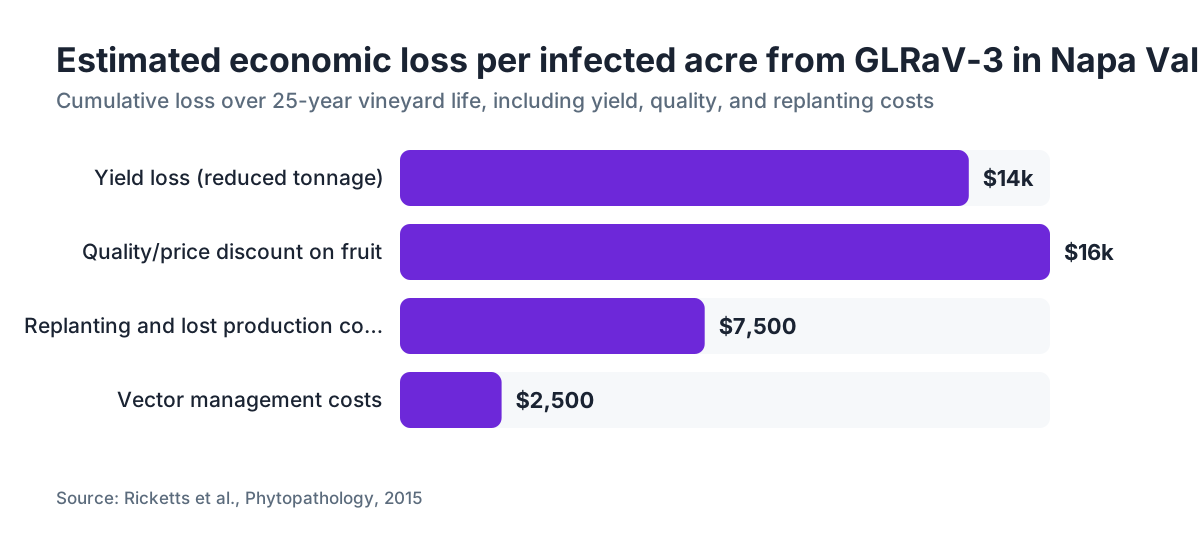
The figure everyone quotes comes from Ricketts et al., published in Phytopathology, estimating the cost of GLRaV-3 in Napa Valley wine grapes at $25,000 to $40,000 per infected acre over a 25-year vineyard life, counting yield loss, quality and price decline, and replanting. [7] That assumes premium Cabernet at Napa prices, so it doesn't map onto a $2,000-per-ton appellation. The proportional logic still holds.
Yield losses of 20 to 40% show up consistently across studies. Brix drops of 2 to 6 degrees at harvest are common. A 2009 New Zealand trial found GLRaV-3-infected Cabernet Sauvignon reached 23.5 Brix while healthy vines on the same site hit 26.2 Brix on the same date. [5] In cool regions where ripening is already a fight, that gap decides whether you have a marketable crop or bulk-wine fruit.
The wine-quality hit is harder to price but it's real. Lower anthocyanin in infected reds is well documented, and color drives quality perception in most premium red markets. Some wineries in badly affected regions have simply stopped buying from certain blocks rather than fight the blending problems.
If you're weighing whether to rogue and replant part of a block, the Ricketts model and a WSU extension economic calculator both make decent starting points. A local farm advisor who knows your fruit price and rootstock costs will get you closer. [2][7]
Can grapevine leafroll disease be cured or treated once vines are infected?
No. Nothing chemical or biological clears leafroll viruses from an infected grapevine. Once a vine has it, it has it for life. That single fact shapes every decision downstream.
Thermotherapy (sustained heat applied to budwood) and shoot tip culture can strip viruses out of propagative material in a lab, and that's the backbone of certified clean plant programs. But these aren't field treatments. You can't heat-treat a mature vine in the ground.
What you can do is slow the spread and cap the damage. The approaches with evidence behind them: remove and destroy infected vines (roguing) to cut the inoculum available to vectors, knock down mealybug and scale populations to slow within-block spread, replant with certified virus-tested material from NCPN-affiliated programs, and monitor hard enough to catch new infections early. [2][4]
Roguing splits growers, because it costs money and drops production right now, while the payoff (slower spread in what's left) is probabilistic and delayed. Cornell's viticulture program has published models showing that in blocks with active mealybug pressure, roguing symptomatic vines plus vector control meaningfully slows spread over a 10-year horizon versus vector control alone. [8] The math depends on how much of the block is already infected, your vector pressure, and how many productive years the block has left.
Some high-value Napa growers have moved to whole-block replanting once infection passed 30 to 40% of vines, judging that babysitting a heavily infected block beats the capital cost of a clean replant. That's a rational read of the economics, not surrender.
How does certified planting material reduce leafroll risk, and what programs exist?
Certified clean material is the single most effective thing you can do to keep leafroll out of a new vineyard. The logic is plain: if no infected vines go in the ground, there's no internal inoculum, and spread is limited to whatever vectors carry in from outside.
In the United States, the National Clean Plant Network coordinates virus testing and certified foundation stock for grapes and other specialty crops. Its Grapes Working Group includes Foundation Plant Services at UC Davis, the program at Washington State University, and nodes at Cornell and other land-grant universities. These programs keep virus-tested mother vines, propagate under strict protocols, and screen for a panel of grape viruses that covers all major GLRaV species. [9]
UC Davis Foundation Plant Services tests incoming accessions by RT-PCR and ELISA for 10 or more viruses and keeps a public catalog of certified varieties. [10] If you're planting in California, ordering from FPS-certified nurseries is the standard UC Cooperative Extension recommendation.
Here's the catch. Certification programs test a sample of vines, not every vine, and they test at a moment in time. A mother vine that was clean at its last test could have been vector-infected since. Certification cuts risk sharply but never to zero. Protocols and retest frequency also vary by state, so ask your nursery flat out: which virus panel got tested, and when.
Replanting after leafroll pressure? Several extension programs suggest fumigating or fallowing the site for a season to knock back mealybugs before clean material goes in. Fair warning: the value of fumigation specifically for mealybug control is contested. [4]
How do you manage mealybug vectors to slow leafroll spread in an existing vineyard?
Vector control won't cure an infected vine, but it can meaningfully slow GLRaV-3 spread within a block. The toolkit has several parts, and no single one is enough on its own.
Monitoring comes first. Sticky tape traps around trunk bases and posts, plus visual scouting for colonies under bark and in clusters, tell you where the populations sit. Without a baseline count, you can't know if anything you do is working. WSU Extension recommends starting a monitoring program in late winter and early spring, when overwintering nymphs first turn mobile. [2]
Insecticide options include soil-applied systemic neonicotinoids (imidacloprid, thiamethoxam) and foliar sprays of spirotetramat, buprofezin, or organophosphates. Imidacloprid drenched at bloom moves well into the phloem and holds for a season. Spirotetramat, a growth regulator, hits early-instar crawlers hardest. For most of these, timing beats product choice: catch crawlers before they settle and feed, and you cut inoculation events.
Every application has to meet the EPA Worker Protection Standard, which requires posted Pesticide Safety Information, restricted-entry intervals on each label, and annual worker training. [11] Some of the strongest mealybug chemistries carry REIs of 12 to 24 hours and demand full PPE during application. Keep your application records current, because California, Oregon, and Washington all set specific spray record rules with short reporting windows. That's the kind of paperwork a field operations platform like VitiScribe handles well, especially when you're juggling multiple applications across multiple blocks.
Biological control with the parasitic wasp Anagyrus pseudococci looks promising in trials, though commercial supply and establishment in North American vineyards is still spotty. Ant control (boric acid bait stations, sticky trunk barriers) removes the dispersal amplifier that lets colonies spread fast. Weed management in and around the block cuts the alternate host refuges mealybugs use during dormancy.
The programs that actually work stack early-season monitoring, crawler-stage sprays, ant management, and equipment sanitation between blocks. Pull any one out and the whole thing gets weaker.
How does red blotch virus differ from grapevine leafroll, and why does it matter?
Grapevine red blotch disease is caused by Grapevine red blotch virus (GRBV), a member of Geminiviridae discovered in 2012. In red varieties, its symptoms mimic leafroll almost perfectly: red leaf discoloration in late summer, lagging ripeness, low Brix. That's a genuine field diagnostic problem, and it matters because the two diseases have different vectors and need different control.
Leafroll (GLRaV-3) rides mealybugs and scales. Red blotch (GRBV) is transmitted by the three-cornered alfalfa hopper (Spissistilus festinus), an insect with entirely different ecology and control. [12] Spray for mealybugs when you actually have a red blotch outbreak, and you've burned money on the wrong target.
Lab testing is the only way to separate them. RT-PCR panels that screen at once for GLRaV-1, -2, -3, and GRBV are widely available through commercial diagnostic labs and university plant clinics. Cost runs roughly $30 to $60 per sample depending on the panel. Send samples in late summer when titers peak in both viruses.
Worse, the two can share a vine, which snarls diagnosis and management further. Growers in Napa, Sonoma, and Paso Robles have reported dual infections in a meaningful share of symptomatic vines. Scouting a block in California wine country, assume the answer might be 'both' until a lab says otherwise.
What does vineyard record-keeping have to do with leafroll disease management?
More than most growers expect. Leafroll spreads through a block in a pattern you can read. It usually starts at a point or along a row edge and radiates outward in the direction mealybugs travel. Map symptomatic vines every year, with GPS coordinates and the date first seen, and you find out whether your management is working. If the infection front is expanding at the same rate after three years of vector control as it was before, the program isn't cutting it. If spread has slowed, you've got evidence to keep going.
Spray records matter just as much. Many states require pesticide application records kept for a minimum of two years, and California requires three years under Department of Pesticide Regulation rules, available for inspection by county agricultural commissioners. Thin records are regulatory exposure. [13]
VitiScribe's field operations platform lets you log vine-by-vine health status, attach diagnostic lab results to specific GPS-tagged locations, and produce spray records that meet California DPR and EPA WPS documentation standards. Growers running digital block maps with annual health notes can usually read the leafroll spread pattern clearly after two or three seasons, which means roguing and replanting calls get made on real spatial data instead of gut feel.
Farming under a third-party sustainability certification (Certified California Sustainable Winegrowing, LIVE, Salmon-Safe, or similar)? Documented evidence of your pest management decisions is often required anyway. That paperwork is basically free if you're keeping records properly.
What are the research frontiers in grapevine leafroll management?
The honest answer: fundamental management hasn't changed much in 20 years. Clean material, vector control, roguing. But research is moving in a few areas that could shift the economics.
RNA interference (RNAi) has shown lab proof-of-concept for suppressing GLRaV-3 replication in grapevine tissue. Field application is years away, and regulatory questions around dsRNA on food crops add more fog. The USDA National Institute of Food and Agriculture has funded several projects in this space since 2016. [14]
Thermotherapy paired with meristem tip culture has gotten more efficient at certified plant programs, cutting the time and cost of producing clean foundation material. That does nothing for infected production vines, but it means the clean pipeline can respond faster when a new variety gets popular.
Rapid field diagnostics, including immunostrips and portable PCR-adjacent tools, are being tested for on-site answers, same-day instead of a week's turnaround from a commercial lab. None of them yet match RT-PCR for reliability across all GLRaV species.
There's growing interest in vectors outside Pseudococcidae, some scale insects in particular, hinting the transmission network may be wider than models built around vine mealybug assume. A few recent UC Davis papers found GLRaV-3 transmission by scale species not previously on the confirmed list. If that picture widens, vector programs will need to widen their targets.
Epidemiological modeling that combines spatial spread data with mealybug dispersal is getting sharper. Cornell and WSU are both building extension-usable tools that let growers plug in infection rate, vector pressure, and fruit value to estimate the return on roguing versus managing in place. Wide confidence intervals still, but better than a coin flip.
Frequently asked questions
How many different viruses cause grapevine leafroll disease?
At least nine species of Grapevine leafroll-associated virus (GLRaV-1 through GLRaV-9, with some reclassifications) are recognized, all in the family Closteroviridae. GLRaV-3 is the most economically significant globally. Mixed infections involving two or more species in the same vine are common in older commercial vineyards, and they often produce more severe symptoms than single-species infections.
Can I spread grapevine leafroll on my pruning shears or equipment?
Mechanical sap transmission of leafroll viruses is extremely rare in the field because the viruses are phloem-limited. Pruning tools are not a meaningful transmission route for GLRaV species. The real equipment risk is mealybug crawler dispersal on harvest bins, ATVs, or hand tools moving between infected and clean blocks. Cleaning equipment between blocks and spraying down harvest bins is a reasonable precaution.
How do I collect a sample for leafroll virus testing and where do I send it?
Collect petioles or leaf midribs from symptomatic vines in late summer, when virus titers are highest. Avoid necrotic tissue. Place samples in paper bags (not plastic, which promotes rotting) and ship overnight or refrigerated to a commercial plant diagnostic lab or a university plant clinic such as UC Davis Plant Pathology, Cornell's Plant Disease Diagnostic Clinic, or WSU's Plant & Insect Diagnostic Lab. Request an RT-PCR panel covering GLRaV-1, -2, -3, and GRBV at minimum.
How fast does grapevine leafroll spread within a vineyard?
Spread rate depends heavily on mealybug population density. In vineyards with high vine mealybug (Planococcus ficus) pressure, spread of 10 to 20% per year from an initial infection point has been documented. In vineyards with low vector pressure, spread can be very slow over a decade. The disease tends to spread in a spatial cluster pattern radiating from initial infection foci, which is why GPS-based vine health mapping is useful.
Does rootstock affect how severely grapevine leafroll hurts the vine?
Rootstock doesn't appear to affect susceptibility to infection, but there is some evidence that certain rootstock-scion combinations show more pronounced yield and quality impacts from leafroll viruses than others. The scion variety matters more: thin-skinned red varieties with naturally high anthocyanin expression tend to show the most dramatic visual symptoms and the most measurable Brix reduction from GLRaV-3 infection.
What is the National Clean Plant Network and how do I use it?
The National Clean Plant Network (NCPN) is a USDA-supported collaboration of foundation plant programs at land-grant universities that maintain virus-tested, certified-clean propagative material for specialty crops including grapes. For grapevines, UC Davis Foundation Plant Services and WSU's program are the main nodes. You access clean material by ordering from nurseries that source from NCPN-affiliated programs. Ask your nursery directly whether their budwood source is NCPN-certified and when it was last tested.
Can grapevine leafroll disease kill a vine?
Leafroll generally doesn't kill vines directly. Infected vines can produce fruit for decades, albeit with reduced yield and quality. However, leafroll-infected vines are more susceptible to secondary stressors, and severely infected vines in marginal climates may show accelerated decline. The economic harm, not vine mortality, is what drives management decisions. A vine producing fruit 30% below its potential over 20 years represents enormous cumulative revenue loss.
Is grapevine leafroll worse in warm climates or cool climates?
The ripeness impact is worst in cool climates where fruit struggles to reach maturity even in healthy vines. A 3 to 4 degree Brix reduction from leafroll in Marlborough or Willamette Valley can push fruit below acceptable harvest parameters. In hot regions like the Central Valley or Riverland, the yield loss still occurs but the ripeness gap matters less because healthy vines reach high Brix with room to spare. Mealybug pressure, which drives spread, is often higher in warm, dry climates.
Do organic vineyards have different leafroll management options?
Organic-certified vineyards lose access to synthetic neonicotinoids like imidacloprid, which are among the most effective soil-applied systemic options for mealybug control. Organic options include kaolin clay, insecticidal soaps, and pyrethrin-based products for crawler contact kill, along with biological control using Anagyrus pseudococci if it's commercially available in your region. Ant management with physical barriers and OMRI-listed baits remains viable. Roguing infected vines and sourcing clean material are the same regardless of certification.
How long does it take for a newly infected vine to show leafroll symptoms?
The latent period, the time between infection and first visible symptoms, can be one to three years or longer, depending on the virus species, inoculum dose, variety, and climate. GLRaV-3 typically shows symptoms within one to two growing seasons post-infection in susceptible red varieties. This latency is a major reason the disease spreads widely before growers recognize it, and why annual late-summer monitoring rather than reactive observation is the recommended approach.
What spray record requirements apply to mealybug treatments in California vineyards?
California growers must file a Notice of Intent (NOI) with the county agricultural commissioner before applying most restricted-use pesticides. After application, a Pesticide Use Report (PUR) is due to the county by the 10th of the following month. Records must be retained for three years and include the pesticide product, rate, date, acreage, and pest target. The California Department of Pesticide Regulation enforces these requirements, and county ag commissioner inspections can occur without advance notice.
Can grapevine leafroll virus spread to other plant species outside the vineyard?
GLRaV species are effectively grapevine-specific in practice. While mealybugs that carry leafroll viruses can feed on many plant species, transmission to and establishment in non-Vitis hosts is not documented under natural field conditions. However, mealybugs themselves can breed on weedy alternate hosts near vineyards and then move into vines carrying virus acquired from infected grapevines. This is why weed management around vine blocks has a vector-management rationale beyond just competition.
How does grapevine leafroll affect wine quality specifically?
GLRaV infection reduces berry sugar accumulation (lower Brix), maintains higher titratable acidity longer, and significantly reduces anthocyanin concentration in red varieties. Wine from heavily infected fruit is typically lighter in color, lower in alcohol, higher in acid, and often described as 'herbaceous' or 'underdeveloped.' A 2009 New Zealand study found measurable differences in wine color density, phenolic content, and sensory scores between wines made from infected versus healthy Cabernet Sauvignon fruit from the same site.
Sources
- Meng, B., Martelli, G.P., Golino, D.A., & Fuchs, M. (Eds.). Grapevine Viruses: Molecular Biology, Diagnostics and Management. Springer, 2017.: Leafroll disease is caused by at least nine GLRaV species in family Closteroviridae, spanning three genera; the pathosystem is described as unique due to multiple viruses, multiple vectors, and the perennial woody host.
- Washington State University Extension, Grapevine Leafroll Disease: GLRaV-3 was found in 34% of vines in Oregon commercial vineyard surveys; WSU recommends monitoring in late winter and early spring for mealybug crawlers.
- Martelli, G.P. et al. The family Closteroviridae revised. Archives of Virology, 2012.: Closteroviridae members have filamentous particles 1,800 to 2,000 nm in length and are phloem-limited, making graft transmission efficient and mechanical sap transmission negligible under field conditions.
- UC Cooperative Extension, Grape Leafroll Disease, UC IPM: UC COCE recommends tissue testing in late summer for highest reliability; red variety symptoms include downward leaf rolling and interveinal red discoloration with green veins remaining.
- Golino, D.A. et al. Economic costs of grapevine leafroll disease in Californian wine grapes. Phytopathology, 2011 (Ricketts et al. study data also referenced from New Zealand trial).: GLRaV-3-infected Cabernet Sauvignon reached 23.5 Brix compared to 26.2 Brix in healthy vines on the same site in a New Zealand trial; Brix reductions of 2 to 6 degrees at harvest are reported consistently.
- Tsai, C.W. et al. Mealybug transmission of Grapevine leafroll-associated virus 3. Phytopathology, 2008.: Vine mealybug (Planococcus ficus), obscure mealybug (Pseudococcus viburni), and grape mealybug (P. maritimus) are confirmed semi-persistent vectors of GLRaV-3 and GLRaV-1.
- Ricketts, K.D. et al. Predicting the economic cost of grapevine leafroll disease. Phytopathology, 2015.: Economic cost of GLRaV-3 in Napa Valley premium wine grape production estimated at $25,000, $40,000 per infected acre over a 25-year vineyard life.
- Cornell University College of Agriculture and Life Sciences, Viticulture and Enology, Leafroll Disease Management: Cornell models suggest that roguing symptomatic vines combined with vector control meaningfully slows spread over a 10-year horizon compared to vector control alone in vineyards with active mealybug pressure.
- USDA National Clean Plant Network, Grapes Working Group: NCPN Grapes Working Group coordinates virus-tested foundation stock for grapevines through nodes at UC Davis, WSU, Cornell, and other land-grant universities.
- UC Davis Foundation Plant Services: UC Davis FPS tests incoming accessions using RT-PCR and ELISA for 10+ viruses and maintains a public catalog of certified grapevine varieties.
- EPA Worker Protection Standard for Agricultural Pesticides: EPA WPS requires posted Pesticide Safety Information, restricted-entry intervals on each pesticide label, and annual worker training for all pesticide applications in agricultural settings including vineyards.
- Bahder, B.W. et al. Phylogeny of grapevine-infecting geminiviruses and new evidence for three-cornered alfalfa hopper transmission of GRBV. Phytopathology, 2016.: Grapevine red blotch virus (GRBV) is transmitted by the three-cornered alfalfa hopper (Spissistilus festinus), a completely different vector from the mealybugs that transmit GLRaV species.
- California Department of Pesticide Regulation, Pesticide Use Reporting: California requires pesticide application records to be retained for three years and Pesticide Use Reports to be filed with the county agricultural commissioner by the 10th of the following month.
Last updated 2026-07-09