Electrostatic vineyard sprayer: how it works and whether it's worth it

TL;DR
- An electrostatic vineyard sprayer charges spray droplets so they wrap around leaf undersides and cluster interiors instead of piling onto the outer canopy.
- University trials show 25 to 65 percent cuts in pesticide volume with the same disease control.
- It costs more upfront, demands careful calibration, and pays off fastest on dense canopies and big blocks.
- It is not magic.
What is an electrostatic vineyard sprayer and how does it work?
A conventional airblast sprayer throws a cloud of droplets at the canopy and hopes enough of them land somewhere useful. An electrostatic sprayer puts an electrical charge on each droplet, usually 30 to 100 kilovolts, before it leaves the nozzle. The vine is grounded through the soil, so the charged droplets get pulled toward it. Their flight path bends. They wrap around leaf backs, cluster interiors, and stem surfaces that a straight-shot droplet flies right past. [1]
Same principle as a laser toner cartridge or an auto paint booth. Charged particles chase grounded surfaces. In a canopy, a droplet coming at a leaf from above curves around to coat the underside, which is exactly where downy mildew sporulates and where mites hide. The charge bleeds off within seconds of contact, so nothing lingers on the plant or in the soil.
Most commercial systems mount the charging electrode near the air outlet of a standard airblast fan, so the carrier air still drives spray into the canopy. Some use a direct-charge atomizer that charges the liquid before it breaks into droplets. Others use an induction ring downstream of a conventional nozzle. The hardware differences matter for maintenance and calibration. The coverage physics are the same. [2]
Droplet size drives everything here. Electrostatic attraction works best on droplets in the 50 to 150 micron range, because their surface-area-to-mass ratio is high enough for the charge to actually redirect them. Coarse droplets above 300 microns are too heavy for the electrostatic force to steer. So the technology pushes you toward finer atomization, which raises drift risk as the wind picks up. Most operators hold their spray days to 8 to 10 mph or less. [3]
How much pesticide does an electrostatic sprayer actually save?
Real answer: 25 to 65 percent versus conventional airblast, and where you land in that range depends almost entirely on your canopy and your calibration. Manufacturer sheets sometimes claim 50 to 75 percent. University trials are more conservative, and more honest. Read the fine print before you build a budget on a brochure number.
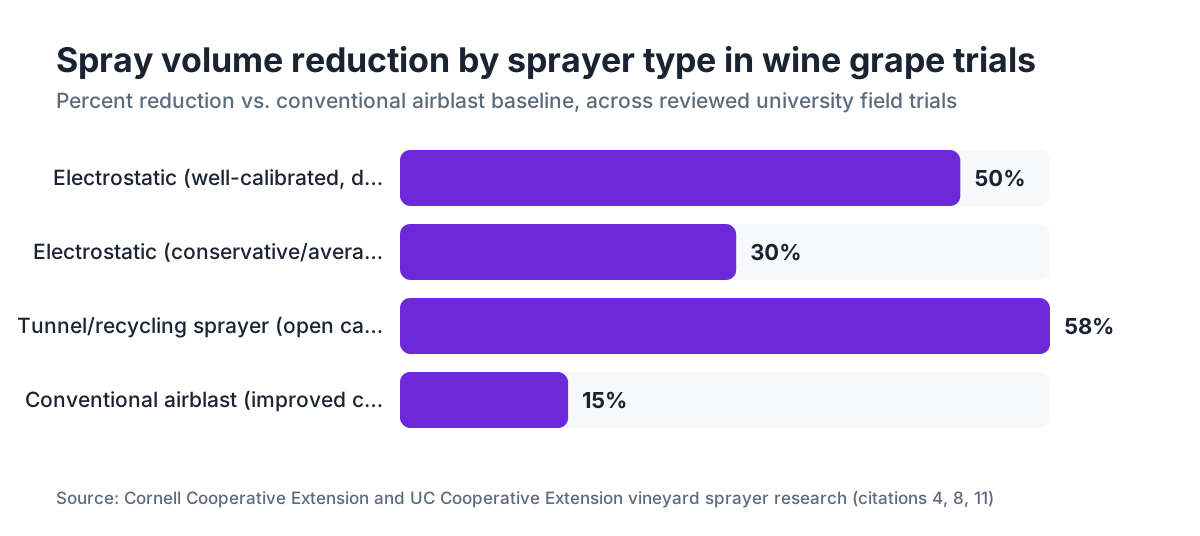
A Cornell Cooperative Extension review of electrostatic sprayer trials reported reductions of 25 to 65 percent compared to conventional airblast, depending on canopy density, product, and calibration quality. [4] The high end shows up in dense bilateral cordon systems with good canopy management. The low end shows up in open lyre or GDC systems where a conventional sprayer already gets in.
WSU's tree fruit and wine grape work, though weighted toward tree fruit, found that equipment setup and operator training moved coverage as much as the electrostatic technology itself. A well-calibrated conventional sprayer often beat a poorly calibrated electrostatic unit. [5] Sit with that for a second. The technology raises the ceiling on what's possible. It does not set a floor.
A 2019 study in Pest Management Science measured deposit on grape leaf undersides at 1.8 times higher with an electrostatic system than conventional airblast under identical conditions, with total spray volume cut by 30 percent. [6] That is probably the most honest single number to carry into a buying conversation.
Plan for 25 to 35 percent as your working assumption. With excellent canopy management and careful calibration, 50 percent is reachable. Build the payback math on 30 percent so the machine surprises you upward instead of down.
What does an electrostatic vineyard sprayer cost, and what's the payback period?
Budget $8,000 to $15,000 for a retrofit kit that bolts onto an existing airblast unit, and $25,000 to $60,000 or more for a purpose-built tractor-mounted electrostatic system with its own air delivery. Self-propelled units start around $80,000 and run past $150,000 for GPS-guided precision models. [7] Vendor and inflation move all of these, so treat them as order-of-magnitude.
Payback comes down to your spray program cost and your acres. A 50-acre Napa Cabernet block spending $400 per acre per year on materials (realistic for a full sulfur, copper, and synthetic fungicide program) spends $20,000 a year on chemistry alone. A 30 percent cut saves $6,000. A $30,000 retrofit pays back in five years on materials, before you count any labor you save by consolidating passes.
The math turns ugly on lower-input programs. A dry-climate operation at $120 per acre saves about $1,800 a year on a 50-acre block. That same $30,000 system takes over 16 years to pay back on chemistry. For those growers, worker exposure, compliance, or a premium story carries more weight than the spreadsheet.
Here is a simplified payback comparison across operation sizes:
| Block size (acres) | Annual spray cost/acre | 30% material savings | Retrofit kit cost | Payback (years) |
|---|---|---|---|---|
| 20 | $400 | $2,400 | $30,000 | 12.5 |
| 50 | $400 | $6,000 | $30,000 | 5.0 |
| 100 | $400 | $12,000 | $30,000 | 2.5 |
| 50 | $150 | $2,250 | $30,000 | 13.3 |
Big blocks with high per-acre spray cost are the sweet spot. Under 30 acres on a low-input program, the financial case is genuinely weak, and I would not pretend otherwise.
Which vine diseases and pests does electrostatic application help most?
The two diseases where underside coverage matters most are downy mildew (Plasmopara viticola) and botrytis bunch rot (Botrytis cinerea). Downy mildew sporulates on the abaxial (under) leaf surface. Botrytis moves through cluster interiors where air barely stirs. Both sit exactly where electrostatic wrap-around deposition is strongest. [1]
Powdery mildew is a different animal. Erysiphe necator infects the upper surface and young growing tips, and a conventional sprayer with decent coverage already reaches those. Electrostatic systems still help with powdery mildew. The margin is just smaller. You are not leaving much control on the table with a well-run conventional program.
On the insect side, leafhoppers and spider mites are the clearest winners because both feed on leaf undersides. Grape leafhopper nymphs stay on the abaxial surface through most of their development. UC Cooperative Extension trials have shown better mite control when electrostatic application replaced conventional airblast with the same miticide, though the grape-specific mite data is thinner than the downy mildew literature. [8]
Caterpillar pests feeding on cluster surfaces benefit from better cluster penetration too. Grape berry moth, a headache in many Eastern vineyards, is one target where getting spray into the cluster interior has practical value.
Where it helps least: soil-applied and systemic products, where foliar coverage distribution barely matters. Do not pay for electrostatic deposition on herbicides or soil drenches. That is spending money to charge droplets that do not care.
How do you calibrate an electrostatic vineyard sprayer correctly?
Calibration is where most operations leave the technology's benefit on the ground, and where a sloppy setup loses to a basic airblast sprayer. Get this part right or skip the whole investment.
Start with water-sensitive paper. Clamp cards on the upper and lower surfaces of leaves at several canopy positions: shoot tips, mid-shoot, and cluster zone, on both the windward and leeward sides of the row. Run the sprayer at your planned speed and PTO setting through a test row, then pull the cards before they dry. You want coverage on both surfaces and inside the cluster zone. Heavy deposits on card tops with light or absent deposits on the backs means your droplets are too coarse for the charge to steer, or your voltage is low. [2]
Verify voltage. Most systems have a charge light or meter, but there is a better field check: hold a fluorescent tube near the spray stream, not in it. A properly charged system lights the tube without contact. If it stays dark, your charging electrode is dirty, wet, or dead.
Ground the system. The tractor needs solid electrical contact with the soil through its tires or a trailing ground chain. Dry or sandy soil raises ground resistance. Some operators drag a wire or a ground stake in very dry conditions.
Speed and fan RPM push against each other. Slower ground speed gives droplets more time in the canopy zone. Most manufacturers recommend 2.5 to 3.5 mph for vineyard rows. Fan RPM sets the air volume that carries droplets into the interior, so cutting fan speed to fight drift can also gut penetration and kill the underside-coverage benefit you paid for.
Write down your settings every time you change product viscosity, ambient temperature, or canopy density. Those records are a compliance requirement under many state pesticide use reporting rules, and they are exactly the kind of structured field data VitiScribe was built to capture without a fresh spreadsheet per application.
What are the EPA and WPS worker safety requirements for electrostatic sprayer use?
The EPA Worker Protection Standard (WPS) covers every pesticide application in an agricultural setting, no matter the spray technology. An electrostatic sprayer does not change your restricted-entry interval (REI), your personal protective equipment (PPE) requirements, or your duty to post treated areas. [9]
The WPS defines an application as beginning when the pesticide is mixed and ending when the equipment is cleaned. The REI clock starts when application ends, not when you shut the sprayer off. If electrostatic coverage lets you finish in fewer passes over two days instead of three, you shorten the total application window. Crews can re-enter sooner relative to when the job started, but never sooner than the label REI.
One WPS wrinkle with fine-droplet systems: smaller droplets hang in the air longer. The WPS bars applicators from applying pesticides in a way that contacts workers or other people. Push toward finer mist for electrostatic performance and drift management becomes a more active job. EPA drift guidance recommends keeping droplets "at the coarsest size consistent with effective deposition." [9] That is a real tension you have to manage, not a footnote.
California's Department of Pesticide Regulation piles on state requirements, including mandatory pesticide use reporting and restricted materials permits for certain products. Other states run similar programs. The electrostatic method exempts you from none of them.
Keep the same records regardless of sprayer type: applicator name, license number, product, EPA registration number, rate per acre, acres treated, date, start and end time, wind speed, and any REI or PPE notes off the label. The federal record-keeping period is two years. Some states require three. [10]
How does an electrostatic sprayer compare to a conventional airblast or tunnel sprayer?
Three sprayer types show up in commercial wine grapes: conventional airblast, tunnel (recycling) sprayers, and electrostatic. Each earns its keep somewhere. The short version: airblast wins on price and simplicity, tunnel wins on recovery in open canopies, electrostatic wins on underside coverage across most real-world blocks.
Conventional airblast is the workhorse. Cheap to buy ($15,000 to $50,000 new), simple to fix, and it runs in any condition. Its weakness is that it leans entirely on air volume and velocity to shove liquid into the canopy, so underside and cluster coverage rides on fan design, speed, and how open the canopy is. Open, well-managed canopy, it does fine. Dense canopy, you are painting the outer leaf wall and wasting the rest.
Tunnel sprayers wrap a recovery shroud around the row, catch overspray, and pump it back to the tank. They cut spray use 40 to 75 percent in open vine systems and shine in wide-row, gobelet, or VSP-trained vines. [11] The catch: they are heavy, expensive ($60,000 to $150,000), and slow, and they hate hilly terrain and narrow rows.
Electrostatic sits between the two. It costs less than a tunnel (especially as a retrofit), runs in most terrain, and delivers underside coverage a conventional airblast cannot match without dumping volume. It does not recover overspray, so on very open canopies a tunnel may still cut total chemical use more.
For most commercial operations with moderate to dense canopy (VSP, bilateral cordon, Scott Henry), electrostatic, retrofit or dedicated, is probably the best balance of cost, coverage, and terrain flexibility. Go tunnel if your canopy is very open and your rows are wide enough for the hardware. Stick with conventional airblast on tight budgets where disease pressure is low.
| Feature | Conventional airblast | Tunnel/recycling | Electrostatic |
|---|---|---|---|
| New unit cost | $15K-$50K | $60K-$150K | $25K-$60K (purpose-built) |
| Retrofit option | N/A | Rare | $8K-$15K |
| Underside coverage | Moderate | Moderate | High |
| Spray recovery | None | 40-75% | None |
| Terrain flexibility | High | Low | High |
| Dense canopy performance | Poor | Moderate | High |
| Calibration complexity | Low | Moderate | High |
Can you use any pesticide in an electrostatic sprayer, or are some products incompatible?
Most conventional fungicides, insecticides, and miticides mix and spray fine through an electrostatic system. The chemistry compatibility question is the same as for any airblast job: follow the label's tank mix guidelines, check pH compatibility, and use the right water volume. A handful of materials need extra attention.
Adjuvants and spreader-stickers are the category to watch. Some spreading agents drop surface tension hard, which can interfere with charge retention. A droplet that spreads flat on the nozzle tip before charging may not hold its charge well. Test new adjuvants with water-sensitive paper before you commit to a full season. [2]
Copper products (copper hydroxide, copper sulfate, copper oxychloride) spray fine but are abrasive and wear charging electrodes faster than organic or synthetic fungicides. Inspect and clean electrodes more often during copper-heavy stretches, roughly every 8 to 10 spray hours instead of the usual 15 to 20.
Sulfur is the trickiest material you will run. Wettable sulfur at high concentrations can partly insulate the electrode as it builds up. Flush thoroughly after every sulfur application. Plenty of operators run a plain water flush pass right after a sulfur tank to keep the electrode clean.
Oil-based and emulsifiable concentrate formulations are generally fine. Water-dispersible granules (WDGs) work well once fully dispersed, so pre-mix them in a little water before adding to the tank.
Here is the real conflict: drift-reducing adjuvants that build droplet size push diameter above the 150-micron sweet spot and quietly cancel part of your electrostatic advantage. Handle drift with lower fan speed and slower ground speed instead of coarsening-adjuvants when you are running an electrostatic system. You cannot chase both goals with the same additive.
What vineyard canopy types benefit most from electrostatic spraying?
Dense training systems are where electrostatic application earns its price. VSP (vertical shoot positioning) with shoot densities above 12 shoots per foot of cordon, bilateral cordon with a heavy fruit load, and Scott Henry double curtain systems all build interior canopy zones that airblast alone struggles to reach. Electrostatic wrap-around deposition adds real coverage there. [4]
Open systems, including gobelet, GDC (Geneva double curtain in open form), and wide-spaced lyre, already expose their leaf surfaces. A conventional airblast holds its own here, and the electrostatic gap narrows. UC Cooperative Extension work in Napa and Sonoma consistently found the biggest coverage gains in VSP blocks with shoot densities at or above industry average. [8]
Row spacing matters too. Tight rows (5 to 6 feet) pack the canopy volume the sprayer has to penetrate. Wider rows (8 feet and up) give the airstream more path length before the next wall of leaves, and conventional airblast handles them better.
Terraced hillside vineyards, which describe a lot of Napa Valley and parts of Sonoma, are a traction and slope problem for heavy tunnel sprayers. The light weight of most electrostatic retrofit kits riding on an existing airblast tractor is a genuine operational win on steep ground.
If you are weighing a new purchase, look at your canopy density data first. Leaf area index (LAI) above 3.0 is a reasonable threshold where the electrostatic advantage shows up most consistently in the research. No LAI numbers? A decent proxy is whether you already run more than one spray tank per acre per application on an 8-row block. If you do, your canopy is dense enough to reward the technology.
What do UC Davis, Cornell, and WSU research programs say about electrostatic sprayers in vineyards?
These three programs produced most of the credible independent research on precision spray application in wine grapes, and their findings line up more than they clash. The shared conclusion: electrostatic coverage gains are real in dense canopies, and they live or die on calibration.
Cornell's viticulture and pest management group has documented that leaf-underside deposition improves with electrostatic application, with the most reliable data from downy mildew trials in New York's Finger Lakes and Hudson Valley. Their extension guidance notes that "deposit efficiency improvements of 40 to 60 percent on abaxial leaf surfaces are achievable with proper electrostatic calibration" in VSP systems. [4] Cornell researchers also stress that canopy management, keeping shoot density and leaf layers in check, matters as much as sprayer type.
UC Davis and the UC Cooperative Extension system have published field evaluations comparing conventional airblast, air-shear, and electrostatic systems in Napa and Sonoma VSP blocks. The UC work stands out for including multi-year disease outcome data, more than deposition measurements. It found electrostatic application delivered equivalent botrytis and powdery mildew control at 25 to 40 percent lower fungicide volume in well-managed canopies. [8] The UC Integrated Pest Management (UC IPM) program's viticulture pages carry sprayer calibration guides that apply to electrostatic units.
WSU's work is heavier on tree fruit, but its air-assisted electrostatic research overlaps with viticulture on method. WSU found operator training and pre-season calibration were the single biggest variables in season-long deposition uniformity, driving more variation than the hardware differences between units. [5] Same message from all three programs: the sprayer is only as good as its setup and its operator.
The honest summary: electrostatic technology delivers measurable coverage gains in dense canopies. The benefit is conditional, not guaranteed, and it rides on calibration discipline that most operations underinvest in.
How do you keep spray records when using an electrostatic sprayer, and what records are required?
Federal pesticide record-keeping under FIFRA (the Federal Insecticide, Fungicide, and Rodenticide Act) requires certified applicators to record each restricted-use pesticide application within 14 days and retain those records for two years. [10] Most states layer more on top, including California's strict pesticide use reporting (monthly filing to county ag commissioners) and Washington's retention rules.
For an electrostatic sprayer, the required record elements are no different from any other method: date, product name and EPA registration number, application site, acres treated, amount of product applied, applicator name and license number, and target pest. Some states also want wind speed, temperature, and equipment type.
Where electrostatic operations gain from extra detail: calibration logs. The coverage advantage depends entirely on correct voltage, droplet size, and ground speed, so a calibration log per spray event tells you why a disease control outcome landed where it did. Get a botrytis outbreak after three electrostatic applications and you need to know whether the voltage indicator read correctly, what ground speed you ran, and what the canopy density was at the time. Without records, you are guessing in the dark.
A digital spray record system pulls the friction out of capturing that detail in the field. VitiScribe's spray record module logs electrostatic-specific fields, including voltage setting, ground speed, fan RPM, and water-sensitive paper results, right beside the required regulatory fields, so compliance data and performance data live in one record.
Export your records in a format your PCA or state ag commissioner will accept before you need it. The worst moment to find a format problem is with an inspector standing in your barn.
Frequently asked questions
Does an electrostatic sprayer reduce pesticide drift compared to a conventional airblast?
It can, but not automatically. Electrostatic systems often use finer droplets that are more drift-prone by size, but the droplets' attraction to grounded canopy surfaces reduces the fraction that escapes the row. Net drift depends heavily on wind and calibration. Above 10 mph, fine electrostatic droplets can drift as badly as any conventional system. Operate below 8 mph for reliable drift reduction.
Can I retrofit my existing airblast sprayer with an electrostatic kit, or do I need a new machine?
Retrofit kits exist for most major airblast platforms and cost roughly $8,000 to $15,000, far less than a purpose-built unit. They attach charging electrodes at the air outlet. Compatibility depends on your fan shroud geometry and nozzle layout. Contact the kit manufacturer with your sprayer make and model before buying. Retrofit performance is generally close to purpose-built systems when properly installed, though warranty terms differ.
How often do I need to clean and inspect the electrostatic charging electrodes?
Every 8 to 10 spray hours during copper or sulfur programs, and every 15 to 20 hours with synthetic fungicides or insecticides. Contaminated or wet electrodes lose charge efficiency fast, and you will catch it on water-sensitive paper before you catch it in disease outcomes. Wipe electrodes with a dry cloth before each spray event and inspect the insulating mounts for cracks or residue buildup.
Is an electrostatic sprayer approved for organic viticulture with OMRI-listed materials?
The sprayer is equipment, not an input, so there is no certification issue with the machine. You can apply any OMRI-listed or NOP-compliant material, copper, sulfur, neem, Bacillus subtilis, spinosad, through an electrostatic system without organic concerns. The usual label and rate rules still apply. Confirm that any adjuvants you add are also on your certifier's approved list.
What is the ideal droplet size for electrostatic vineyard spraying?
The research consensus points to 50 to 150 microns, the range where electrostatic charge meaningfully redirects droplet flight toward grounded canopy surfaces. Below 50 microns, drift risk climbs sharply. Above 200 to 300 microns, droplet mass overwhelms the electrostatic force and you lose the wrap-around advantage. Most electrostatic nozzle setups target 80 to 120 microns as a practical operating center.
Does an electrostatic sprayer work in a high-humidity environment like the Finger Lakes or Willamette Valley?
Yes, with attention to electrode condition. High humidity does not stop electrostatic charging, but moisture on the electrode insulator can create a partial short to ground and drop charge efficiency. Dry the insulating mounts before startup. Some operators apply a light coat of dielectric grease to insulator surfaces at the start of each season. Cornell's Finger Lakes trials confirm the technology works well in humid conditions when the hardware is maintained.
How does ground speed affect coverage with an electrostatic sprayer?
Slower is better, up to a point. At 2.5 to 3.5 mph, charged droplets spend more time in the canopy zone and the air-assist stream penetrates deeper before you pass. Above 4 mph, you start outrunning the air column's reach in a dense VSP canopy. Below 2 mph, you can oversaturate the near leaf wall while the extra dwell time adds little to interior penetration. Most calibration guides target 3 mph as the default.
What PPE do I need to operate an electrostatic vineyard sprayer?
PPE comes from the pesticide label, not the sprayer type. The technology adds one safety point: keep hands away from the charging electrode during operation. It runs high voltage at low amperage, which will shock rather than seriously hurt a healthy adult, but the startle reflex near moving equipment is a real hazard. Follow the manufacturer's lockout procedure when cleaning electrodes. Standard WPS training and label PPE still apply.
How long does it take to see a return on investment from switching to electrostatic spraying?
Using conservative 30 percent material savings and a $30,000 retrofit cost: a 50-acre block spending $400 per acre saves roughly $6,000 a year and breaks even in five years. A 20-acre block at the same spend breaks even in about 12 years. Operations with low material costs or small acreage have weak financial cases. Factor in labor savings if fewer spray passes become possible.
Are there electrostatic sprayer systems designed for steep hillside vineyards?
Retrofit kits on existing airblast tractors already suited to hillside work are the most common solution. Purpose-built electrostatic units tend to be heavier, and their fuel tanks and electronics add mass that can hurt stability on grades above 15 to 20 percent. Check the manufacturer's slope rating before buying. Some operators run lighter, narrower electrostatic units on steep blocks and conventional airblast on the flatter sections of the same property.
Does electrostatic application improve the efficacy of contact fungicides more than systemics?
Yes, generally. Contact fungicides like copper, sulfur, and captan depend entirely on physical coverage of the target surface, so poor underside deposition directly cuts efficacy. Systemics like sterol inhibitors (DMIs) or QoI fungicides enter the plant and translocate, so moderate coverage still delivers most of their activity. The coverage gain from electrostatic application matters more for contact materials, which is why sulfur and copper programs see the largest practical benefit.
Can I use water-sensitive paper to verify electrostatic performance, and how do I interpret the results?
Water-sensitive paper (yellow cards that turn blue where droplets hit) is the standard field calibration tool. Clamp cards on upper and lower leaf surfaces and in the cluster zone on both sides of the row. Good electrostatic coverage shows blue marks on the lower card surfaces, more than the top. If lower surfaces stay clean while upper surfaces saturate, your droplets are too coarse or your charge is insufficient. Most extension guides recommend at least 30 to 50 droplets per square centimeter on abaxial surfaces.
What are the main failure modes of an electrostatic vineyard sprayer during the season?
The four common ones: electrode contamination (pesticide or water buildup kills charge), grounding failure (dry soil or a worn ground chain raises resistance), power supply issues (vibration loosens the high-voltage connections on the tractor PTO), and speed creep (ground speed drifts above calibration as the day drags on). A 15-minute pre-spray checklist covering these four catches most in-season performance losses before they turn into disease escapes.
Sources
- UC ANR Publication 3339, Grape Pest Management, UC Agriculture and Natural Resources: Downy mildew sporulates on the abaxial (under) leaf surface; electrostatic wrap-around deposition improves coverage to that surface
- Cornell Cooperative Extension, Vineyard Sprayer Calibration Guide: Electrostatic charging systems and electrode maintenance requirements for vineyard sprayer calibration
- EPA, Reducing Pesticide Drift, US Environmental Protection Agency: Finer droplets under 150 microns increase drift risk; operating below 10 mph reduces drift
- Cornell Cooperative Extension, Electrostatic Sprayer Research for New York Viticulture: Electrostatic sprayers reduce pesticide use 25 to 65 percent in vineyard trials; deposit efficiency improvements of 40 to 60 percent on abaxial leaf surfaces are achievable with proper calibration in VSP systems
- Washington State University Extension, Air-Assisted Sprayer Research: Operator training and pre-season calibration accounted for more deposition variability than hardware differences between sprayer units
- Pest Management Science, Vol. 75, 2019, Electrostatic vs. conventional airblast deposition efficiency in grape canopies: Electrostatic sprayer achieved 1.8 times higher deposit efficiency on grape leaf undersides versus conventional airblast with 30 percent less spray volume
- USDA NASS, Farm Production Expenditures Survey: Commercial vineyard sprayer price ranges for retrofit kits and purpose-built electrostatic units
- UC Cooperative Extension, Precision Spray Application in North Coast Vineyards: Electrostatic application achieved equivalent botrytis and powdery mildew control at 25 to 40 percent lower fungicide volume in well-managed VSP canopies; largest coverage gains in VSP blocks with shoot densities at or above industry average
- EPA, Agricultural Worker Protection Standard (WPS), 40 CFR Part 170: WPS REI, PPE, and area posting requirements apply regardless of sprayer technology; applicators must not apply pesticides in a manner that results in contact with workers or other persons; drift guidance recommends the coarsest droplet size consistent with effective deposition
- USDA AMS, Pesticide Recordkeeping Program (FIFRA), US Department of Agriculture: Federal FIFRA rules require certified applicators to record each restricted-use pesticide application within 14 days and retain records for two years
- Oregon State University Extension, Recycling and Tunnel Sprayer Evaluation: Tunnel/recycling sprayers cut spray use 40 to 75 percent in open vine systems, strongest in wide-row and VSP-trained vines
Last updated 2026-07-10