Engustment vs veraison: what each stage means for your vineyard
TL;DR
- Veraison is the visible color change in grape berries, usually 40 to 70 days before harvest, when softening and sugar loading start.
- Engustment is a later phase inside ripening: sugars climb fast, acids fall, and flavor compounds build to their final character.
- Growers treat them as synonyms.
- They aren't.
- Veraison starts ripening; engustment finishes the flavor.
What is veraison and when does it happen?
Veraison is the point when red and black varieties turn from green to red, purple, or blue, and white varieties go from hard green to translucent gold. It's the most recognizable event on the vineyard calendar. Growers have tracked it for centuries.
The word comes from French viticulture and names the color change specifically, though color is just the visible symptom of a much larger biochemical switch. At veraison the berry stops growing by cell division, starts to soften as pectin in the pericarp breaks down, and flips from importing acids to importing sugars [1]. Chlorophyll degrades. In red varieties, anthocyanin synthesis fires up. The berry quits acting like a leaf and starts acting like a fruit.
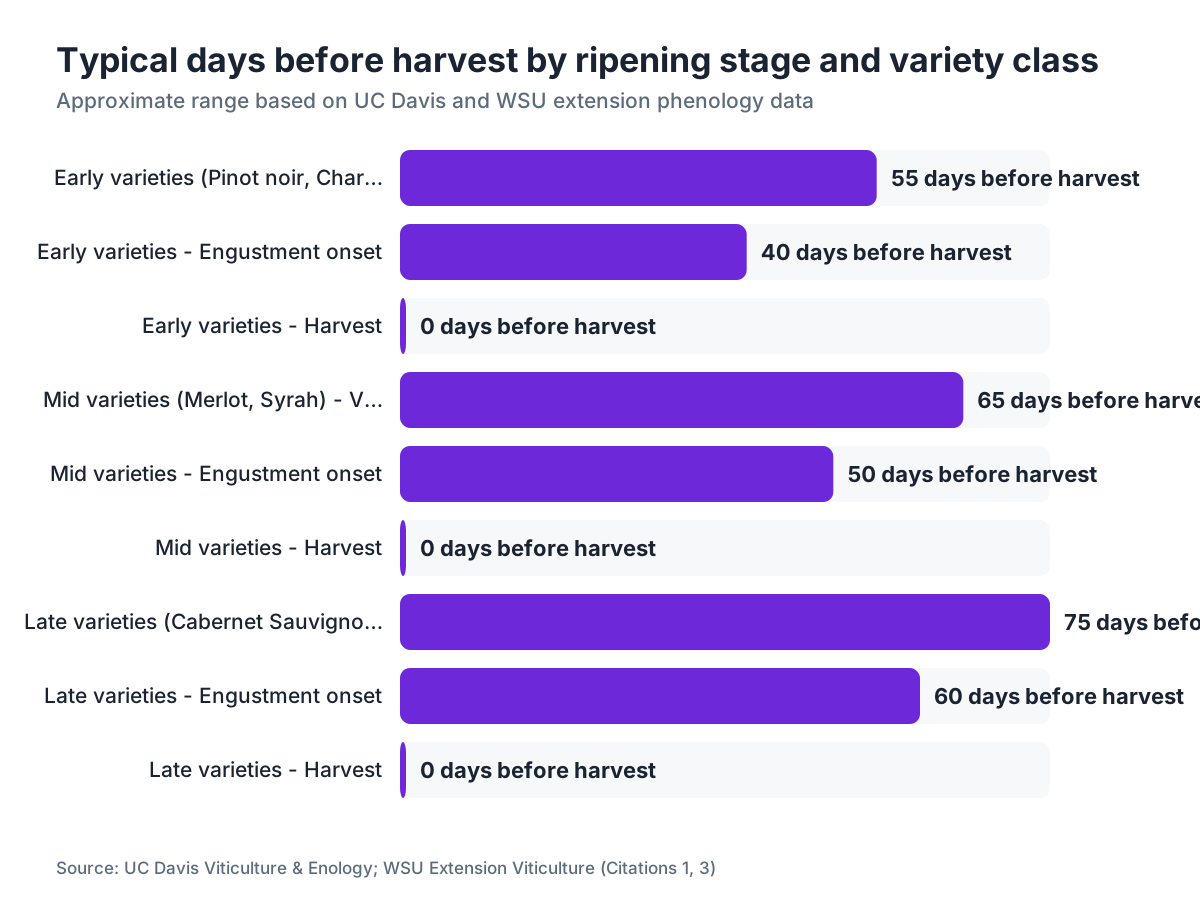
Timing swings hard by variety and climate. In warm regions like Paso Robles or the San Joaquin Valley, veraison for an early variety like Pinot noir can land in late June or early July. In a cold coast appellation, Cabernet Sauvignon might not hit it until August or early September. UC Davis phenology work puts the average window for California varieties somewhere between 40 and 70 days before harvest, depending on the variety [1].
From a field standpoint, veraison is a hard scheduling deadline. Canopy work should be mostly done. Your fungicide program has to account for botrytis pressure rising the moment berries soften. And sugar, which you track in Brix, starts its climb from around 8 to 10 Brix at veraison toward the 20 to 26 Brix you want at harvest.
What is engustment and how is it different from veraison?
Engustment is the flavor-building phase inside ripening, the stretch after veraison when aroma compounds accumulate fast, sugar concentration accelerates, and malic acid burns off through respiration [2]. American viticulture programs rarely teach it by name. European and Australian literature use it as a distinct sub-phase. The term comes from the Latin "gustus," meaning taste.
Here's the clean distinction. Veraison is the start of ripening. Engustment is what happens once ripening is underway. Think of veraison as opening a door and engustment as walking through it.
Several things happen at once during engustment. Glucose and fructose load faster, often gaining 0.3 to 0.5 Brix per day in warm weather [3]. Malic acid degrades, and the warmer it is, the faster it goes. Terpenes, methoxypyrazines, and other aroma-active compounds either build or volatilize depending on variety and temperature. In Muscat and Riesling, monoterpene accumulation runs hardest during engustment. In Cabernet Sauvignon, the methoxypyrazine that gives the green bell pepper note actually falls as engustment progresses and the fruit gets full sun.
No single agreed date splits veraison from engustment. Most researchers treat engustment as starting once 50 to 100% of berries on a cluster have finished color change and the berry has hit maximum volume, so cell enlargement is clearly over and only chemistry remains [2]. In practice that's roughly 7 to 14 days after veraison for a given block.
Why the distinction matters in the field: the calls you make during engustment (irrigation cuts, leaf pulling, crop thinning) swing final flavor concentration and acid balance more than almost anything else. Wait until post-engustment to make them and you've usually missed the window.
How does the berry change at a cellular level during each stage?
The two stages are easier to remember once you know what's happening inside the berry.
At veraison the berry moves out of the "lag phase" (slow growth after the first round of cell division) into the second rapid growth phase. Cell walls loosen. The berry takes on water, which is why a brief shot of irrigation just before veraison can make berry size jump. Vacuoles in the mesocarp cells swap their solute load from organic acids to sugars. The whole switch runs on abscisic acid (ABA), a plant hormone that spikes at veraison and triggers the color machinery in red varieties [1].
During engustment, cell division is long finished. The berry isn't growing. The work is all chemistry: phloem keeps importing sucrose from the leaves, invertase enzymes in the vacuole split that sucrose into glucose and fructose, and malic acid either migrates to other tissues or gets respired in the mitochondria. Potassium import climbs sharply during engustment, which partly explains why must pH keeps rising even when titratable acidity looks stable. Potassium salt formation buffers the juice [3].
For spray records, this matters because of pre-harvest intervals (PHIs). Some fungicide and growth regulator labels anchor re-entry intervals and PHIs to "post-veraison." Read those labels closely and you need to know what the label writer meant by veraison, which is almost always 50% color change across the block.
Veraison vs engustment: a side-by-side comparison
This table sums up the differences for quick field reference.
| Feature | Veraison | Engustment |
|---|---|---|
| Timing relative to harvest | ~40-70 days before | ~10-40 days before |
| Visual cue | Color change begins | Color change complete; berry shriveling may begin |
| Berry size | Rapid increase (second growth phase) | Stable or slight decrease |
| Brix | 8-12 Brix typical at onset | 15-22+ Brix, gaining fast |
| Acid trend | Acids begin to fall | Malic acid degrades rapidly |
| Hormone driver | ABA spike triggers transition | ABA still elevated; ethylene may increase |
| Key flavor event | Anthocyanin synthesis begins (red) | Terpenes, varietal compounds peak |
| Irrigation impact | Moderate effect on berry size | Strong effect on sugar/acid concentration |
| Fungicide concern | Botrytis window opens | Botrytis pressure highest; PHIs become critical |
Sources: UC Davis Viticulture & Enology extension [1], Australian Wine Research Institute [2], Washington State University extension [3].
The upshot is simple. Growers who track only veraison are watching the starting gun. Growers who also track engustment completion have a real read on how many days to harvest and whether the flavor chemistry has landed where they want it.
Why do growers and winemakers mix up these two terms?
Honest answer: American viticulture education doesn't always teach engustment as a named stage.
The UC Davis curriculum and most California extension materials use a ripening continuum that covers veraison, post-veraison, and harvest maturity without formally naming engustment as a sub-stage [1]. Australian and New Zealand programs, plus a lot of European technical literature, use the term consistently. The Australian Wine Research Institute's technical review literature references engustment when describing flavor compound accumulation through mid-to-late ripening [2].
Some of the confusion is just the word. "Veraison" sounds like it should cover the whole ripening arc, and in casual talk it usually does. A vineyard manager will say "we're two weeks post-veraison" to describe what is technically engustment. That's fine for scheduling over the radio. It gets messy when you're writing spray records, tying PHIs to phenological stages, or lining up tasting notes against picking logs from different vintages.
WSU's extension viticulture program takes a practical route, describing ripening sub-stages by Brix and acid thresholds instead of named phenological events. That sidesteps the naming fight while capturing the same information [3].
How do you track veraison and engustment in the field?
Tracking veraison is simple. Walk the block, pull a 100 to 200 berry sample from a spread of rows and canopy positions, count the berries that have started color change or softening, and turn it into a percentage. When 50% of berries show color change, that's what most people call veraison for scheduling. Some growers hold out for 80% or 100% before they call it.
Engustment is harder to pin to a single look. The most useful field signal is a combination: Brix above roughly 15 for the variety, berries uniformly soft to a gentle squeeze, and seeds that have shifted from white-green and astringent to brown and cracking cleanly. Cornell Cooperative Extension recommends berry sampling on a fixed schedule starting at veraison, pulling samples every 5 to 7 days and measuring Brix, pH, and titratable acidity each time to build a ripening curve for the vintage [4].
The slope of the Brix curve tells you a lot. A steep rise means you're in peak engustment. A flattening slope with rising pH and falling TA usually means engustment is winding down and harvest calls need to happen soon. In warm, arid sites that slope gets steep enough that missing a week of sampling in late summer puts you behind the fruit.
Keep digital field logs, and you should, then record the date of observed 50% veraison and the date of 80 to 100% completion as two separate events. That gives you a real phenological record to compare year over year. Tools like VitiScribe let you log both observations by block and attach the matching Brix readings, so your spray record and ripening record sit in the same place.
How do spray programs and pre-harvest intervals change across these stages?
This is where the veraison-vs-engustment distinction grows regulatory teeth.
Pre-harvest intervals, the days between last application and harvest, are printed on every registered pesticide label under federal law (FIFRA, 7 U.S.C. § 136). For vineyard fungicides, PHIs run from zero days (some copper products and sulfur) up to 7, 14, 28, or even 35 days for certain systemic fungicides common in botrytis programs [5]. The EPA Worker Protection Standard (40 CFR Part 170) layers on re-entry interval (REI) rules that overlap with late-season spray decisions [6].
Here's the practical trap. You apply a fungicide with a 28-day PHI at the moment you think is "post-veraison," but you're actually three weeks past veraison and deep in engustment. Now your PHI may not clear before the fruit is ready. That's a live compliance risk for early-ripening blocks and hot vintages.
Under EPA label requirements, "post-veraison" language ties to color change, not to the broader engustment phase. Nothing stops a label from specifying a Brix threshold or a calendar restriction instead. Read the specific label language every time. The National Pesticide Information Center (NPIC) and your state department of agriculture are the authoritative sources on interpretation. The label is the law [5].
Botrytis pressure runs highest during engustment because berries are fully soft, clusters tighten, and dew periods stretch longer in late summer. That's exactly when PHIs bind hardest. Maximum disease pressure against a minimum spray window is a tension every vineyard manager works through every single year.
Does water stress affect veraison and engustment differently?
Yes, and the direction of the effect flips depending on the stage.
Before veraison, moderate water stress (a stem water potential around -1.0 to -1.2 MPa) slows shoot growth and opens up cluster zone light without hurting yield much. Regulated deficit irrigation (RDI) protocols in many California and Washington vineyards apply this stress in the pre-veraison window on purpose [7].
At veraison itself, a brief pulse of irrigation is sometimes used to sync berry development across the cluster and cut the share of late-coloring green berries. This one is debated. Some research backs it, other trial data shows minimal effect on uniformity. Nobody has clean consensus data here. The closest controlled work I've seen comes from Australian RDI research in the 1990s and 2000s (the Dry and Loveys work cited by AWRI) rather than a clean California replicated trial [2].
During engustment, water deficit concentrates everything: sugar, acid, flavor compounds, skin tannin. That's the basis for late-season stress protocols in premium Shiraz and Cabernet from warm climates. The cost is berry shrivel, which drops yield by weight and can push a must concentrated enough to risk a stuck fermentation. Drip irrigation cutoff timing during engustment is probably the highest-leverage water decision of the season [7].
WSU extension research on irrigation timing in Washington Cabernet Sauvignon found that late-season deficit irrigation during engustment raised anthocyanin concentration and phenolic maturity ratings versus well-watered controls, at a cost of roughly 8 to 12% lower berry weight at harvest [3].
How does temperature affect the engustment phase in particular?
Temperature during engustment shapes wine style more than most growers give it credit for.
Malic acid respiration is temperature-sensitive. Daytime highs above 35°C (95°F) speed up malic breakdown fast, which is why warm-climate vineyards in the Central Valley or inland Paso Robles often carry must pH of 3.7 or higher even at moderate Brix. Cool sites hold malic acid through engustment, giving the high-acid profiles you see in Willamette Valley Pinot or Finger Lakes Riesling.
For flavor compounds the story is more layered. Cool nights during engustment (below 15°C / 59°F) appear to help terpene retention and anthocyanin stability in reds. The diurnal swing, the gap between daytime high and nighttime low, gets cited as a quality marker precisely because of its effect on engustment-phase chemistry [2][10].
On the practical side: if you grow in a region prone to heat spikes in August or September, a daily max-min temperature log by block is more useful than it sounds. Pair it with your Brix data and you'll start to see the link between a heat event and a sudden pH jump. That's engustment chemistry playing out in real time, and the record matters when you're explaining to a winemaker why the acid correction bill went up.
What variety-specific differences should growers know about?
Varieties don't move through veraison and engustment at the same pace or with the same character.
Early-ripening varieties like Pinot noir, Chardonnay, and Muscat Blanc tend to run a compressed post-veraison window. Engustment in Pinot noir can be as short as three to four weeks in warm years, so decisions come fast. Cool-climate growers hit the opposite problem: a long, slow engustment that drags harvest calls into wet fall weather and botrytis risk.
Cabernet Sauvignon is the other end. It's a late ripener with a drawn-out engustment in many climates, which gives growers more room to read the ripening curve and time the pick. The downside is exposure to early autumn rain in cool regions.
Aromatic varieties like Gewurztraminer and Muscat show the sharpest flavor changes during engustment. Terpene accumulation peaks in the mid-to-late engustment window and falls if you delay picking past peak. Harvest early in engustment and you get high monoterpene concentration but lower sugar. Wait past peak and you recover sugar but may lose aromatic character. That tradeoff is the winemaker's call, but the grower has to sample often enough to hand over the data.
For a vineyard running multiple varieties, like most mixed-block operations at places like Gervasi Vineyard or South Coast Winery, tracking veraison and engustment timing block by block is the only way to sequence a harvest schedule that holds together.
How should vineyard records document veraison and engustment?
The minimum record set most state departments of agriculture expect for pesticide compliance is application dates, product names, rates, REIs, and PHIs by block. That record alone tells you nothing about biological context. Better record-keeping ties phenological observations to spray events.
For each block, log first observed veraison (date and estimated percent color change), 50% veraison (date), and 80 to 100% veraison / engustment onset (date). Then log your Brix, pH, and TA sampling dates and results on a consistent interval from there forward. When you spray a fungicide in this window, your record now shows how many days post-veraison the application was, what the ripening stage looked like, and what the PHI was. From that you can calculate the earliest legal harvest date by block.
If you ever land in an audit or need to rebuild a spray record for a buyer's certification, phenological observations timestamped next to your pesticide records are the difference between an easy conversation and a bad one. VitiScribe's field log lets you attach berry sample data and phenological stage notes straight to spray records by block, which makes that reconstruction quick.
Cornell Cooperative Extension recommends keeping ripening records for at least three years to build a vintage-comparison baseline [4]. That baseline is what lets you say, with confidence, whether engustment is running early or late in a given year and adjust harvest estimates accordingly.
If you're growing grapes for the first time or scaling up to multiple blocks, the vineyard operations fundamentals are worth a look alongside this phenology work, because record systems need to be built before the season starts, not during it.
Frequently asked questions
Is engustment the same thing as veraison?
No. Veraison is the start of ripening, marked by color change and berry softening, usually 40 to 70 days before harvest. Engustment is a later phase within ripening, generally starting 7 to 14 days after veraison completion, when flavor compounds and sugar concentration climb fast and malic acid degrades. They're sequential, not synonymous.
Does the term engustment appear in American viticulture textbooks?
Rarely in mainstream American texts. UC Davis extension materials usually describe ripening as a continuum without formally naming engustment as a separate phase. The term shows up more consistently in Australian and European technical viticulture literature, especially from the Australian Wine Research Institute. WSU and Cornell tend to use Brix and acid thresholds instead of named sub-stages.
How many days after veraison does engustment begin?
Most researchers put engustment onset at roughly 7 to 14 days after 100% veraison completion, once berry size has stabilized and cell enlargement is clearly over. The transition isn't a single day, it's a gradient. Practically, treat it as the point when Brix is rising faster than 0.3 per day and the berry is uniformly soft across the cluster.
What Brix level is typical at veraison versus engustment?
At veraison onset, Brix is typically 8 to 12 in most varieties. Once engustment is well underway, 15 to 20 Brix is common, and berries can reach 22 to 26 Brix or higher by the end of engustment at harvest. The rate of gain during engustment in warm weather runs 0.3 to 0.5 Brix per day.
Does veraison happen at the same time for every berry on a cluster?
No. Veraison is asynchronous even within one cluster. Berries near the cluster tip and those with the most sun change color first. Berries deeper in the cluster or on the canopy interior can lag by days or weeks. That's why growers measure veraison as a percentage across a berry sample rather than as a single event date.
Can you spray fungicides during engustment?
Yes, but you have to check the pre-harvest interval against your expected harvest date for that block. Botrytis pressure peaks during engustment, exactly when PHIs bind hardest. Some fungicides carry 28 to 35 day PHIs; if you're 20 days from picking, those are off the table. Zero-PHI options like copper and some biologicals stay available, but read the specific label every time. The label is the law under FIFRA.
How does water stress interact with engustment in wine grapes?
Water deficit during engustment concentrates sugars, acids, and flavor compounds and raises anthocyanin levels in reds. WSU research on Washington Cabernet found late-season deficit irrigation raised phenolic maturity at a cost of roughly 8 to 12% lower berry weight. The risk is berry shrivel, which can complicate fermentation. Irrigation cutoff timing in this phase is one of the highest-impact decisions of the growing season.
Does the engustment phase differ between red and white varieties?
Yes. In reds, anthocyanin accumulation and tannin polymerization dominate the biochemistry during engustment. In aromatic whites like Muscat and Gewurztraminer, monoterpene accumulation peaks in mid-engustment and can fall if picking is delayed. In neutral whites like Chardonnay, the main changes are sugar accumulation and malic acid degradation, with less dramatic flavor compound dynamics.
What's the best way to determine when engustment is complete?
There's no single hard marker, but the combination signals it: stable berry size (no weight gain between weekly samples), seed color fully brown and seeds that crack rather than bend, a Brix plateau or slowing rate of increase, and TA falling toward target range. Regular berry sampling every 5 to 7 days from veraison forward is the only reliable way to catch this window.
How do I record phenological stages for compliance and buyer certification?
Log the date and estimated percent color change at veraison for each block, then log engustment-phase berry sample results (Brix, pH, TA) on a fixed interval. Tie your spray records to these observations so PHI compliance can be reconstructed by block. Cornell extension recommends at least a three-year record baseline for vintage comparison. State audit requirements vary; check with your state department of agriculture for minimums.
Does high temperature during engustment hurt wine quality?
It depends on what you're making. High temperatures speed malic acid respiration, which can push must pH above 3.7 even at moderate Brix and drive acid correction costs in the winery. For bold reds in warm climates, some pH rise is expected and managed. For whites and aromatics, excessive heat during engustment can volatilize terpenes and flatten the profile. Cool nights during engustment are broadly linked with better flavor retention.
Is engustment the same as lag phase?
No. The lag phase is the stretch between the first and second berry growth phases, before veraison, when cell division has stopped but the berry isn't yet ripening. Engustment comes after veraison, after the second growth phase, when the berry is at full size and undergoing rapid chemical change. Lag phase precedes veraison; engustment follows it.
How do I tell the difference between veraison and color change from disease?
True veraison softening and color change moves from the cluster tip upward and from sun-exposed berries inward. It's gradual and fairly uniform across the block as the season runs. Disease-driven color change from botrytis, phytophthora, or other issues tends to be localized to specific clusters or areas, often with shriveling, visible mycelium, or lesions. If color change shows up suddenly in isolated spots, sample for disease before assuming it's veraison.
Sources
- UC Davis Viticulture & Enology, Grape Berry Development: Veraison marks the transition from lag phase to the second rapid growth phase; ABA spikes at veraison; timing is 40-70 days before harvest depending on variety and climate
- Australian Wine Research Institute, Berry Ripening Technical Review: Engustment is referenced as the flavor-building sub-phase of ripening following veraison; terpene accumulation and malic acid degradation are primary events; diurnal variation affects engustment-phase flavor chemistry; Dry and Loveys RDI research on veraison irrigation pulses
- Washington State University Extension, Viticulture and Enology: WSU research on Cabernet Sauvignon found late-season deficit irrigation during engustment increased anthocyanin concentration at cost of 8-12% lower berry weight; Brix accumulation rate 0.3-0.5 per day in warm weather; potassium import rises sharply post-veraison
- Cornell Cooperative Extension, Viticulture Program: Cornell recommends berry sampling every 5-7 days from veraison forward measuring Brix, pH, and TA; records should be kept minimum three years for vintage comparison baseline
- US EPA, Pesticide Labels (Label is the Law): Pre-harvest intervals are required on every registered pesticide label under FIFRA 7 U.S.C. 136; the label is the law; vineyard fungicide PHIs range from 0 to 35 days
- US EPA Worker Protection Standard for Agricultural Pesticides, 40 CFR Part 170: EPA Worker Protection Standard establishes re-entry intervals that apply to late-season vineyard spray operations and overlap with PHI calculations
- UC Agriculture and Natural Resources, Regulated Deficit Irrigation for Vineyards: Pre-veraison water stress at stem water potential of -1.0 to -1.2 MPa slows shoot growth without significantly harming yield; late-season deficit irrigation concentrates sugar, acid, and flavor compounds during engustment
- USDA National Agricultural Library, FIFRA reference: Federal Insecticide, Fungicide, and Rodenticide Act requires PHI labeling on all registered agricultural pesticides sold in the United States
- UC ANR, Integrated Pest Management for Grapes in California: Botrytis pressure in vineyards increases significantly after veraison as berries soften; spray program PHI constraints are most critical during the engustment period
- Oregon State University Extension, Viticulture Resources: Cool night temperatures during late ripening are associated with terpene retention and anthocyanin stability in aromatic and red wine grape varieties
Last updated 2026-07-09