Where to find the EPA registration number on a pesticide label

TL;DR
- Every registered pesticide sold in the U.S.
- carries an EPA Registration Number printed on its front panel label, formatted as EPA Reg.
- No.
- XXXXX-XXXX.
- Federal law requires commercial agricultural applicators to record this number in spray records within 14 days of each application.
- It identifies the exact product and formulation for compliance, worker protection, and pesticide use reporting purposes.
Where exactly is the EPA registration number on a pesticide label?
The EPA Registration Number sits on the front panel of the pesticide label, almost always near the bottom third. Look for the text "EPA Reg. No." followed by two sets of numbers separated by a hyphen, for example EPA Reg. No. 62719-556. On some products the number wraps to the back panel when the front is crowded, but EPA's labeling regulations under 40 CFR Part 156 require it to appear prominently and legibly on the label. [1]
The first number in the sequence (before the hyphen) is the company or registrant number, assigned to the manufacturer or formulator. The second number identifies the specific product registered under that company. If you see a third set of numbers, that's a distributor product number, meaning another company is selling the same formulation under a different brand name. The underlying chemistry is still tied to the first two segments.
On concentrate jugs, drums, and small bottles alike, the format is consistent. If the label has a fold-out accordion section, the EPA Reg. No. will appear on the outermost face or the first interior panel when unfolded. It never hides in fine print alone. The number has to meet the minimum type-size requirements in 40 CFR 156.10. [1]
What does the EPA registration number actually mean?
The number isn't branding. It's a legal identifier. When EPA registers a pesticide under FIFRA (the Federal Insecticide, Fungicide, and Rodenticide Act), it assigns the registrant a unique number that ties the product to the exact label language EPA reviewed and approved. [2] If the label changes, the registration can get a new product number or a registration amendment. The number you record in your spray log pins the application to a specific, approved label with specific use directions, REI (restricted entry interval), and PHI (pre-harvest interval).
That link matters in an audit. If a state agricultural department inspector pulls your pesticide use records, they can look up EPA Reg. No. 62719-556 in their database and immediately confirm the crop, the application rate limits, the REI, and whether you had a valid basis to apply the product. Mismatching numbers or leaving the field blank signals sloppy record-keeping at minimum, and can open the door to a FIFRA violation citation.
For vineyard managers, the registration number also determines whether a product is approved for wine grapes versus table grapes versus raisins. Same active ingredient, different label, different EPA Reg. No., potentially different clearances. Never assume a product you used on a neighbor's table grape block is legal on your wine grape block without reading the label tied to its specific EPA Reg. No.
What federal law requires you to record the EPA registration number?
The federal requirement comes from FIFRA Section 8 and the implementing regulations at 40 CFR Part 170 (the Worker Protection Standard) and the Pesticide Record-Keeping Requirements under 7 U.S.C. 136i-1 for certified private applicators. [2][11] For commercial applicators (which covers most hired vineyard spray crews and licensed PCAs directing applications), state laws typically mirror or exceed federal minimums.
The core federal rule for agricultural pesticide use records says that restricted-use pesticide (RUP) applications must be recorded and those records kept for two years. Required fields include the product name, EPA Registration Number, total amount applied, size of area treated, location of the application, date, and name and certification number of the certified applicator. [3]
General-use pesticides have a lighter federal footprint, but California (under the California Food and Agriculture Code) requires records for all pesticide applications, RUP or not, and those records go to the county agricultural commissioner. [4] Washington State has similar all-pesticide reporting requirements under RCW 15.58. [5] If you operate in either state, the EPA Reg. No. is required for every product applied, full stop.
The EPA Worker Protection Standard, revised in 2015, also requires that workers have access to pesticide application information including product name, active ingredients, and EPA Registration Number for applications made in the last 30 days. [3] That's a separate disclosure obligation from your spray records, and it applies even to general-use products.
How do spray records and the EPA registration number connect to the Worker Protection Standard?
Under the 2015 revision to the WPS (40 CFR Part 170), agricultural employers must post pesticide application information in a central location that workers can access. [3] The posted information must include the product name, the EPA Registration Number, and active ingredient information for any pesticide applied in the past 30 days in areas where workers are working.
This isn't theoretical. EPA has cited growers in enforcement actions for failing to post complete pesticide information, including missing EPA Reg. Nos., even when the application itself was lawful. The posting requirement and your spray log record-keeping requirement are related but separate: one is for the workers, one is for regulatory inspection.
Cornell's pesticide management guidelines for New York vineyards flag this dual requirement and recommend keeping a spray record binder at the farm office with a separate "WPS information posting" page updated after every application. [6] That way one document serves both the record-keeping audit trail and the WPS posting obligation without confusion about which version of your records is the "official" one.
Record the EPA Reg. No. at the time you fill the sprayer, not hours later. The label is in your hand. The number is right in front of you. Recording it then takes ten seconds and kills the transcription errors that come from trying to remember which product you used four hours ago.
What is the difference between the EPA registration number and the EPA establishment number?
This trips people up constantly. The label carries both numbers, and they look similar.
The EPA Registration Number (EPA Reg. No.) identifies the pesticide product and the company that registered it. This is the number that goes in your spray records.
The EPA Establishment Number (EPA Est. No.) identifies the physical manufacturing or packaging facility where this particular batch was produced. It tells you where the product was made, not what the product is. You do not record the establishment number in your pesticide use records for compliance purposes. [1]
Both numbers appear on the label, often in the same area of the front or back panel. The establishment number is formatted differently, typically with a state abbreviation: for example, EPA Est. No. 12345-CA-1. If you accidentally record the establishment number in your spray log instead of the registration number, the record is technically incomplete for compliance. A label auditor cannot identify the product from the establishment number alone.
When in doubt: EPA Reg. No. is the one with two number groups separated by a hyphen (and sometimes a third group for distributor products). That's your number. Write that one down.
How do you find the EPA registration number when the original label is damaged or missing?
This happens. Jugs sit in the spray shed, labels peel in the heat, and by the time you're doing end-of-season record reconciliation the label on that empty drum is gone. A few options work.
First, check the product's Safety Data Sheet (SDS). The SDS is required to list the EPA Registration Number in Section 1 or Section 15 (Regulatory Information) for registered pesticides. [7] If you download SDS sheets for every product you purchase, keeping them in a folder makes this easy.
Second, use the EPA's pesticide registration database at the National Pesticide Information Center or directly through EPA's website. Searching the product name and manufacturer will pull the current registration, including the EPA Reg. No. [2]
Third, call your ag supplier. They have the full label on file and can give you the number quickly.
Washington State University Extension's pesticide record-keeping guidance recommends keeping copies of product labels or the front-panel information page filed with your purchase records specifically to handle this situation. [8] Buying by invoice also helps: most distributors list the EPA Reg. No. on the sales invoice, so cross-referencing your purchase history can reconstruct missing label information.
For digital record-keeping workflows, a tool like VitiScribe lets you store a product library where each product is entered once with its EPA Reg. No., then pulled into spray records by product name. That eliminates the "I can't read the label" problem entirely because you only need to read the label correctly once.
What does a correctly completed pesticide spray record look like?
A compliant spray record for a vineyard block application should contain, at minimum, the following fields. [3][4]
| Field | Example |
|---|---|
| Application date | 2025-06-14 |
| Vineyard block / field ID | Block 7 - Cabernet Sauvignon |
| Crop | Wine grapes (Vitis vinifera) |
| Acres treated | 4.2 |
| Product name | Pristine 38WG |
| EPA Registration Number | EPA Reg. No. 7969-294 |
| Active ingredient(s) | Boscalid + pyraclostrobin |
| Amount of product applied | 14.7 oz/acre |
| Application method | Airblast sprayer |
| Applicator name | J. Garcia |
| Applicator cert. number | CA-12345678 |
| PHI (days) | 0 days |
| REI (hours) | 12 hours |
| Purpose (pest/disease) | Powdery mildew (Erysiphe necator) |
State-specific forms may require additional fields. California's Pesticide Use Report (PUR) system, managed by CDFA, also requires the grower information, site ID, and use type codes that go beyond federal minimums. [4] The EPA Reg. No. is a required field in the CDFA PUR system, and pesticide commissioners use it to cross-reference legal use on the crop.
The two-year retention requirement under FIFRA applies to RUP records at the federal level, but California requires three years for all pesticide use records submitted to the county commissioner. [4] Keep your records longer than the minimum. If a worker's compensation claim or a water quality investigation arises, records from four or five years back can matter.
How do California's pesticide use reporting requirements affect what you record?
California has the most detailed pesticide record-keeping system of any state. Under the California Food and Agriculture Code sections 12979-12981 and the regulations at 3 CCR Sections 6618-6624, growers must report all pesticide applications, including those with general-use products, to their county agricultural commissioner within seven days of application. [4]
The Pesticide Use Report form requires the EPA Reg. No. as a mandatory field. Reports submitted with missing or incorrect EPA Reg. Nos. are kicked back, and late corrections can result in a violation notice. County commissioners report aggregate data to CDFA, which publishes annual PUR summaries that researchers, environmental groups, and regulators use to track pesticide use trends across crops and regions.
UC Davis's Integrated Pest Management program has published guidance for wine grape growers on California's PUR requirements, including how to correctly identify and transcribe the EPA Reg. No. from label to report form. [9] The UC Davis guidance also notes that distributor products (with a third number segment in the EPA Reg. No.) must be reported with the full three-segment number, more than the first two. That detail catches people regularly.
For small vineyard operations doing their own record-keeping by hand, the practical advice from county ag commissioners' offices is to fill out the PUR form after each spray day rather than batching a week's worth. Memory errors and label confusion multiply when you're reconstructing three applications from memory on Friday afternoon.
How do you handle the EPA registration number for tank mixes?
Tank mixing is the norm in vineyard spray programs: a fungicide, an insecticide, and sometimes a nutritional all go in the same tank. Each product in the mix has its own EPA Registration Number, and each one must appear in your spray record as a separate product entry for that application date and block. [3]
There's no consolidated tank-mix EPA Reg. No. The way to record a tank mix is to list each product on its own line in the spray log, all tied to the same application date, block, and applicator. On paper forms this means multiple rows per spray event. In spreadsheet or software records it means multiple product rows per application record.
WSU Extension's pesticide record-keeping guide for Washington growers is explicit about this: each pesticide product in a tank mix requires a separate record entry with its own EPA Registration Number, rate, and amount applied. [8] Lumping them together under one entry, or recording just the EPA Reg. No. of the primary product, is a record-keeping deficiency.
One operational tip works well. Before mixing, pull out all the product labels, confirm the tank mix is legal (check each label for tank mix language or restrictions), and record the EPA Reg. No. for each product at that moment. It's a natural pause in the workflow, and it means your paperwork is complete before the sprayer even leaves the yard.
How long do you have to record a pesticide application and keep the records?
Federal law under FIFRA Section 8 and 40 CFR 171 requires that restricted-use pesticide application records be completed within 14 days of the application. [2] That 14-day window is the outside limit, not a target. Most state regulations are tighter: California requires reporting to the county commissioner within seven days, and the application record itself should be completed same-day or next-day.
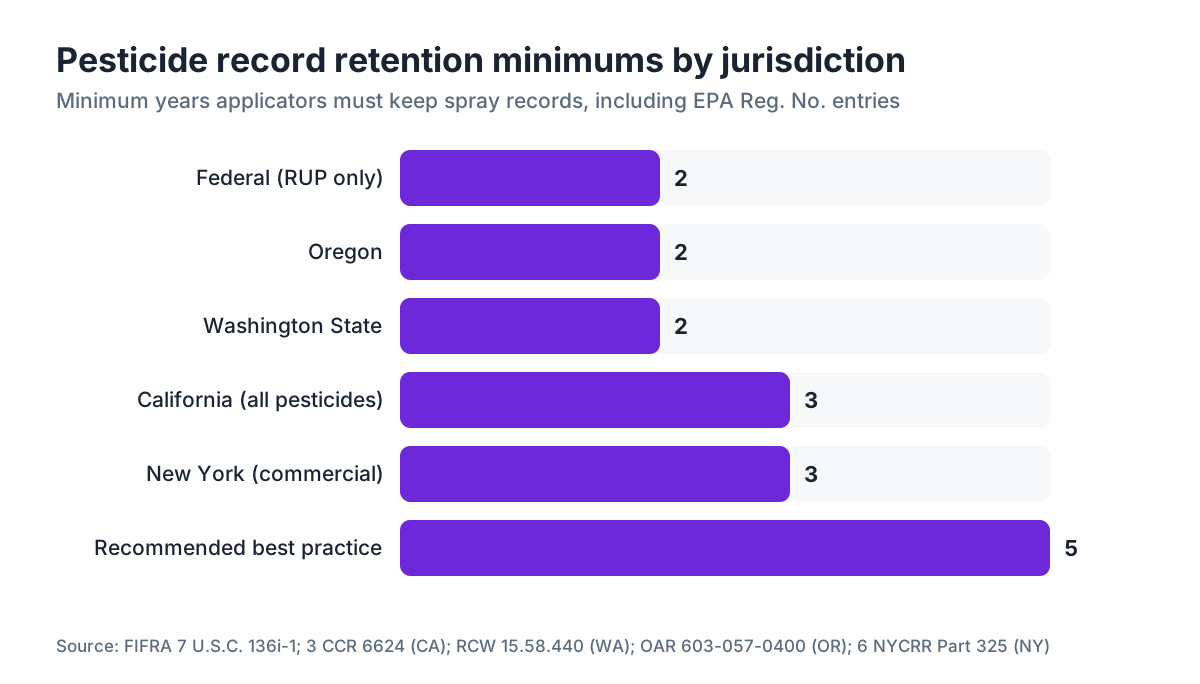
Record retention minimums by jurisdiction (these are floors, not ceilings):
| Jurisdiction | Minimum retention period | Authority |
|---|---|---|
| Federal (RUP only) | 2 years | 7 U.S.C. 136i-1 |
| California (all pesticides) | 3 years | 3 CCR 6624 |
| Washington State | 2 years | RCW 15.58.440 |
| Oregon | 2 years | OAR 603-057-0400 |
| New York | 3 years (commercial) | 6 NYCRR Part 325 |
The practical recommendation from extension programs at Cornell and UC Davis is to keep records for at least five years regardless of the legal minimum, because crop residue questions, insurance claims, and buyer audits routinely reach back further than two or three years. [6][9]
Records can be kept in paper or electronic formats as long as they're legible, accurate, and accessible for inspection. EPA does not specify a required format. Paper spray logs in a binder, spreadsheets, and dedicated agricultural software all satisfy the requirement as long as the required data fields are present and complete.
What happens if your spray records have missing or wrong EPA registration numbers?
Missing EPA Reg. Nos. are one of the most common deficiencies found during state pesticide record inspections. The consequences range from a written warning for first-time, good-faith errors to civil penalties for repeat or willful violations.
Under FIFRA, civil penalties for recordkeeping violations can reach $1,000 per violation per day for commercial applicators. [2] California's penalties for pesticide use reporting violations under the Food and Agriculture Code can reach $5,000 per violation, and repeated violations can result in pesticide dealer license suspension or revocation.
Beyond fines, a spray record with missing EPA Reg. Nos. creates evidentiary problems if you ever need to defend an application in a worker exposure investigation or a residue complaint. You can't prove what product you applied, at what rate, or whether you respected the REI. The label tied to the EPA Reg. No. is your legal defense.
For organic operations, a missing or incorrect EPA Reg. No. can also complicate your organic system plan audit. Your certifier needs to verify that every product you applied was on the approved materials list, and the EPA Reg. No. is how they cross-reference that. An incomplete record can delay certification renewal.
If you discover a batch of old spray records with missing EPA Reg. Nos. and you still have purchase invoices or SDS sheets from that period, it's worth reconstructing the numbers and annotating the records with a note explaining the correction. That beats leaving the gap, and most state ag departments accept corrected records with a clear audit trail. A platform like VitiScribe builds the EPA Reg. No. into every spray record at the point of entry, so gaps don't accumulate in the first place.
Where can you look up an EPA registration number for a product you can't identify from memory?
Several reliable lookup paths exist.
EPA's pesticide registration system is the authoritative source. The agency maintains a searchable database where you can find active registrations by company name, product name, or registration number. The direct access point is through EPA's pesticide registration pages. [2]
The National Pesticide Information Center (NPIC), operated by Oregon State University in cooperation with EPA, also offers label lookup tools and can help identify products by active ingredient or manufacturer name. [10]
CDFA's pesticide information portal lets California growers search by EPA Reg. No. to confirm whether a product is registered for use on a specific crop in California, which is a useful verification step before application. [4]
For vineyard-specific questions, your local UC Cooperative Extension farm advisor or WSU Extension viticulture specialist can often help you identify products by description and confirm the correct EPA Reg. No. [8][9] County ag commissioners' offices are also a practical resource: they see every product reported in their county and can often identify a product from partial information.
Purchase invoices are underrated here. Most chemical distributor invoices list the EPA Reg. No. alongside the product name and lot number. Keeping your purchase invoices filed by season gives you a searchable paper trail for products you may not be able to identify from memory months later.
Frequently asked questions
Where on the label is the EPA registration number located?
It's on the front panel of the pesticide label, typically in the lower third, formatted as "EPA Reg. No." followed by two hyphenated number groups. On products with fold-out labels it appears on the outermost face or the first interior panel. Heavily crowded labels may place it on the back panel, but EPA's 40 CFR Part 156 requires it to be prominent and legible.
Is the EPA registration number the same as the EPA establishment number?
No, they're different. The EPA Registration Number identifies the product and its registrant. The EPA Establishment Number identifies where the product was physically manufactured. For spray records, you record the EPA Reg. No., not the establishment number. The establishment number typically includes a state abbreviation, such as EPA Est. No. 12345-CA-1, while the registration number is two numeric groups separated by a hyphen.
How long do you have to record a pesticide application after it happens?
Federal law under FIFRA gives commercial applicators 14 days to complete restricted-use pesticide records. California requires reporting to the county agricultural commissioner within seven days of application. Best practice is same-day or next-day recording, regardless of jurisdiction, because memory errors and label mix-ups multiply when you batch records at the end of the week.
What happens if you record the wrong EPA registration number in a spray log?
The record is technically deficient, which can result in a written warning or civil penalty during a state inspection. More practically, an incorrect EPA Reg. No. means the logged product doesn't match the actual application, creating legal exposure if a worker exposure complaint or residue issue arises. If you catch the error, annotate the correction with the correct number and note the source you used to verify it.
Do you need to record the EPA registration number for general-use pesticides or only restricted-use ones?
Federally, the FIFRA recordkeeping mandate targets restricted-use pesticides. But California and Washington State require records for all pesticide applications, general-use included, and both require the EPA Reg. No. as a mandatory field. If you operate in any state with all-pesticide reporting requirements, record the EPA Reg. No. for every product you apply, regardless of use classification.
How do you record EPA registration numbers for a tank mix application?
Each product in the tank mix gets its own record entry with its own EPA Registration Number, rate, and amount applied. There's no combined tank-mix EPA Reg. No. On a paper spray log that means multiple rows per spray event tied to the same date and block. WSU Extension's pesticide record-keeping guide for Washington growers specifically requires separate entries per product in a mix.
Where can I look up an EPA registration number if the label is damaged or missing?
Check the product's Safety Data Sheet (Section 1 or Section 15 lists the EPA Reg. No.), search EPA's pesticide registration database by product name, or check your purchase invoice from the ag supplier (most invoices list the number). Your county agricultural commissioner's office or NPIC, operated by Oregon State University in partnership with EPA, are also fast lookup resources.
What does the number format of an EPA registration number mean?
The first number identifies the company or registrant. The second identifies the specific product. If there's a third number segment, it's a distributor product number, meaning another company is selling the same formulation under a different brand. For compliance reporting, California's CDFA requires the full three-segment number for distributor products, more than the first two segments.
How long do you have to keep pesticide spray records?
Federal FIFRA minimum for restricted-use pesticide records is two years. California requires three years for all pesticide use records. New York requires three years for commercial applicators. Oregon and Washington require two years. Extension programs at UC Davis and Cornell recommend keeping records for at least five years because insurance claims, buyer audits, and residue investigations often reach back further than the legal minimum.
Does the EPA registration number matter for organic vineyard certifications?
Yes. Your organic certifier verifies that every product applied during the certification period appears on the approved materials list. They cross-reference your spray records using the EPA Reg. No. to confirm the specific formulation you used was approved. A missing or incorrect EPA Reg. No. in your records can delay certification renewal because the certifier can't confirm compliance without it.
Is the EPA registration number required on the WPS pesticide information posting?
Yes. The 2015 revision to the Worker Protection Standard (40 CFR Part 170) requires agricultural employers to post pesticide application information accessible to workers for any application made in the last 30 days. That posting must include the product name, EPA Registration Number, and active ingredient information. The WPS posting requirement is separate from your spray log record-keeping obligation and applies even to general-use products.
Can vineyard owners use electronic records to satisfy EPA registration number requirements?
Yes. EPA does not require a specific format for pesticide use records. Electronic records, including spreadsheets and dedicated agricultural software, satisfy the requirement as long as all required data fields, including the EPA Registration Number, are present and the records are legible and accessible for inspection. California accepts electronic records for PUR submissions and has a direct electronic reporting pathway for large-volume applicators.
What is the penalty for failing to keep pesticide records with EPA registration numbers?
Under FIFRA, civil penalties for recordkeeping violations can reach $1,000 per violation per day for commercial applicators. California's penalties under the Food and Agriculture Code can reach $5,000 per violation, and repeated violations can lead to license suspension. First-time good-faith errors typically result in a written warning, but willful or repeated omissions of required fields like the EPA Reg. No. carry higher penalty exposure.
How does the EPA registration number differ between a branded product and a distributor product?
A brand-name product has two number segments (company-product). A distributor product carries the same formulation but sold under a different brand name, and its EPA Reg. No. has three segments: the original registrant's company number, the product number, and a distributor identifier. The underlying chemistry and approved label language are the same, but the full three-segment number must be recorded accurately in spray records, particularly for California PUR reporting.
Sources
- EPA, 40 CFR Part 156: Labeling Requirements for Pesticides and Devices: EPA labeling regulations require the registration number to appear prominently on the pesticide label and specify minimum type size requirements.
- EPA, Pesticide Registration: Federal Insecticide, Fungicide, and Rodenticide Act (FIFRA): FIFRA requires EPA to register pesticides and assign registration numbers; Section 8 requires certified applicators to keep records of restricted-use pesticide applications, with civil penalties up to $1,000 per violation per day for recordkeeping violations.
- EPA, Worker Protection Standard, 40 CFR Part 170: The 2015 WPS revision requires posting pesticide application information including product name, EPA Registration Number, and active ingredients for applications in the last 30 days; required records for RUP applications include EPA Reg. No., product name, amount applied, area treated, location, and date.
- California Department of Pesticide Regulation, Pesticide Use Reporting: California requires reporting all pesticide applications (general-use and restricted-use) to the county agricultural commissioner within seven days; EPA Registration Number is a mandatory field; records must be kept three years.
- Washington State Legislature, RCW 15.58: Washington Pesticide Control Act: Washington State requires pesticide use records including EPA registration numbers for all agricultural pesticide applications, with a two-year retention minimum.
- Cornell Cooperative Extension, Pesticide Safety and Worker Protection for New York Vineyards: Cornell's pesticide management guidelines recommend keeping a spray record binder with a separate WPS information posting page updated after every application, and retaining records at least three years for commercial applicators.
- OSHA, Hazard Communication Standard: Safety Data Sheets, 29 CFR 1910.1200: The Safety Data Sheet is required to list regulatory information, including the EPA Registration Number for registered pesticides, in its Section 1 and Section 15 fields.
- Washington State University Extension, Pesticide Record-Keeping Requirements for Washington State: WSU Extension's pesticide record-keeping guide specifies that each pesticide product in a tank mix requires a separate record entry with its own EPA Registration Number and rate applied; recommends keeping copies of product labels with purchase records.
- UC Davis Integrated Pest Management Program, Pesticide Use Reporting for Wine Grape Growers: UC Davis IPM guidance for wine grape growers explains that distributor products must be reported with the full three-segment EPA Reg. No., and recommends same-day or next-day PUR completion; advises keeping records at least five years regardless of the three-year legal minimum.
- National Pesticide Information Center (NPIC), Oregon State University: NPIC, operated by Oregon State University in cooperation with EPA, provides pesticide label lookup tools and product identification assistance by active ingredient or manufacturer name.
- EPA, Pesticide Worker Safety and 7 U.S.C. 136i-1 Recordkeeping: 7 U.S.C. 136i-1 requires certified private applicators to keep records of restricted-use pesticide applications for two years at the federal minimum.
Last updated 2026-07-11