How to correct an error on a pesticide application record without voiding it

TL;DR
- Draw a single line through the error, write the correct information above or beside it, then initial and date the change.
- Never use correction fluid.
- This method preserves the original entry and satisfies EPA Worker Protection Standard recordkeeping rules, California DPR requirements, and most state pesticide regulations.
- The record stays valid.
- The original mistake remains readable.
What is the legally accepted way to correct a pesticide application record?
One line. That's the whole method.
Draw a single horizontal line through the incorrect information so the original text is still readable underneath. Write the correct information directly above it, or next to it in the margin. Then add your initials and the date of the correction. That's it.
This approach comes from the same document-integrity rules used in pharmacy records, medical charts, and agricultural compliance audits. The California Department of Pesticide Regulation's enforcement guidance says corrections must leave the original entry legible [1]. The EPA Worker Protection Standard (40 CFR Part 170) doesn't spell out a specific correction method in its text, but the underlying principle is audit integrity: a regulator reviewing the record must be able to see what was originally written and when the change was made [2].
Correction fluid (Wite-Out, Liquid Paper, any of them) is never acceptable. Neither is heavy scribbling that obliterates the original. Neither is tearing out the page and rewriting it. All of those turn a simple mistake into something that looks like falsification, which carries penalties that are completely out of proportion to the original error.
Washington State University Extension's pesticide recordkeeping guidance puts it plainly: altered records that cannot be read in their original form are treated the same as falsified records under state enforcement [3].
Why does the correction method matter so much legally?
Because regulators tell an honest mistake from a cover-up based almost entirely on whether the original information is still visible.
A crossed-out entry with initials says: "I made an error, I know exactly what it was, and here is the correct information." That's an honest record. An obliterated entry or a rewritten page says nothing about what changed or why, which is exactly what falsification looks like.
Under the Federal Insecticide, Fungicide, and Rodenticide Act (FIFRA), section 8, records must be maintained for inspection and must accurately reflect actual pesticide use [4]. California's Food and Agriculture Code section 12981 imposes similar requirements at the state level, and county agricultural commissioners can inspect records with little notice [1]. Oregon, Washington, and New York all tie their own recordkeeping rules to the same audit-integrity standard.
The penalty spread is wide. A first-time administrative violation for a paperwork error (say, wrong date format) might result in a warning or a fine under $500 in most states. A finding of falsification, even for the same underlying mistake, can escalate to license suspension, civil penalties in the tens of thousands of dollars, and in egregious cases, criminal referral under FIFRA section 14 [4]. The correction method is the one thing separating those two outcomes.
There's also the worker safety angle. The EPA WPS requires that central posting and records be available to workers, handlers, and their designated representatives within 15 days of a request [2]. If a record has been improperly altered, that request becomes a compliance problem on two fronts at once.
What information has to be on the correction itself?
At minimum: initials of the person making the correction and the date the correction was made.
Some states want a bit more. California's pesticide use report system recommends that significant corrections (wrong pesticide name, wrong acreage, wrong application rate) include a brief note explaining what happened, especially if the corrected record changes the reported use total [1]. That's not legally required everywhere, but it's smart practice. A one-line note like "entered wrong block number, corrected to Block 7" costs nothing and answers the inspector's first question before they ask it.
Here's a practical checklist for what a valid correction entry looks like:
| Element | Required | Notes |
|---|---|---|
| Single line through original text | Yes | Original must remain readable |
| Correct information written nearby | Yes | Above, beside, or in margin |
| Initials of person correcting | Yes | Full signature not required, but acceptable |
| Date of correction | Yes | Not the date of application, the date you fixed it |
| Brief explanation of reason | Recommended | Required in some CA county programs |
| Correction fluid or heavy scribbling | Never | Treated as falsification |
If you're using a paper logbook and the error is in a cell that's too small for both the strikethrough and the correction, write the correction in the margin and draw an arrow. Courts and inspectors understand spatial constraints. What they don't forgive is illegibility.
Can you void a pesticide record page and start over?
Technically yes, but you should almost never do it.
If a page is so badly garbled that it genuinely cannot be read, some regulatory programs let you mark the original "VOID" (still with a single line, not obliteration), keep the voided original in your records, and attach a clean rewritten version. The voided original must stay physically with the record. You cannot throw it away. California DPR guidance is explicit that the original voided record is part of the file [1].
The practical problem is that voiding a page raises immediate questions about why the entire record needed to be redone. If an inspector sees a voided page, they're going to look harder at everything around it. For a single wrong date or transposed field number, the single-line correction is always the better path. Voiding is a last resort for catastrophic data entry failures, not routine mistakes.
Digital records handled in certified recordkeeping software present a different situation. Many platforms maintain an immutable audit log that timestamps every change and records both the original and corrected values automatically. That audit trail is the digital equivalent of the single-line correction and is generally accepted by state programs that have approved electronic recordkeeping. Check your state's specific approval status before relying entirely on a digital system for compliance.
What kinds of errors are most common on pesticide application records, and which need correction most urgently?
Wrong date is the most common. Block or field ID comes second. Third is the applicator's license number, often left blank when someone fills in a record under time pressure.
Errors that affect the pesticide use report numbers (acreage treated, rate applied, product EPA registration number) are the highest priority to fix because those feed into state reporting systems and can trigger compliance flags if the numbers don't match your purchase records. California PUR submissions, for example, are cross-checked against licensed dealer sales records. If your reported use of a product in a quarter is significantly different from what a dealer reported selling you, DPR notices [1].
Errors that affect worker safety information, specifically re-entry intervals (REIs) and restricted-entry interval start times, need to be corrected and communicated immediately. The EPA WPS requires that REI information be posted at a central location accessible to workers [2]. If the posted REI is wrong because of a record error, that's more than a paperwork problem. It's a potential exposure violation. Fix the record, fix the posting, and document when you did both.
Typos in the applicator's name, or minor address errors, are low priority but should still be corrected before the next inspection cycle. Leaving known errors uncorrected signals sloppiness, which inspectors notice.
How long do you have to correct a pesticide application record?
As soon as you catch it.
There's no grace period defined in FIFRA or the WPS for correcting a mistake, which sounds ominous but is actually liberating. It means you can fix an error the day after you make it, a week later, or six months later, as long as you date and initial the correction when you make it. The date on the correction tells the inspector exactly how long the error existed in the record.
What states do define are deadlines for submitting records in the first place. California requires that pesticide use reports (PURs) for restricted materials be submitted to the county agricultural commissioner within seven days of application, and monthly summary reports for all other pesticides must be submitted by the 10th of the following month [1]. If you catch an error after a PUR has already been submitted, you'll need to submit a corrected report, more than fix your field copy. The process for amended PURs varies by county. Contact your local agricultural commissioner's office directly.
WSU Extension recommends reviewing pesticide application records at the close of each application day, not at the close of the season, specifically because catching errors early keeps corrections simple [3]. By the time you're trying to remember what block you were actually in on a specific Tuesday in June, three months later, you've created a much harder problem for yourself.
What if the error is on a digital pesticide record?
Digital records need an audit trail that works the same way the single-line correction does on paper. The system must record the original value, the corrected value, who made the change, and when.
EPA's approach to electronic records in the agricultural context is grounded in the agency's general electronic recordkeeping guidance and in state-by-state approvals of specific software platforms [7]. As of 2024, California DPR accepts electronic pesticide use records if the system meets specific data integrity and accessibility requirements [1]. Oregon Department of Agriculture, Washington State Department of Agriculture, and New York State Department of Environmental Conservation each have their own approval processes.
The practical risk with off-the-shelf spreadsheets (Excel, Google Sheets) is that they don't automatically maintain an audit log. If you change a cell, the original value is gone unless you've enabled version history. Version history in Google Sheets or OneDrive does exist, but it's not a purpose-built compliance audit trail, and whether a state inspector accepts it depends on the inspector. Purpose-built agricultural recordkeeping software, including platforms like VitiScribe, logs every change with a timestamp and user identity, which mirrors the paper correction standard cleanly.
If you're using a spreadsheet and you catch an error, the safest digital equivalent is to keep the incorrect version visible (strikethrough formatting in the cell), add the correction in a note or adjacent cell, and add a column with your initials and the date of correction. It's awkward, but it preserves the audit logic.
Does correcting a record protect you during an inspection?
Yes, almost always. A properly corrected record is evidence of a functioning compliance program.
Inspectors from the county agricultural commissioner's office and state departments of agriculture are looking for patterns, not isolated mistakes. A single transposed field number with a clean single-line correction, dated and initialed, is a non-event. A pattern of missing dates, unsigned records, and obliterated entries is a red flag regardless of whether the underlying applications were done correctly.
UC Davis's Agricultural and Natural Resources program on pesticide safety education makes the point that inspectors care whether the information in your records matches your actual pesticide use, not whether your handwriting is neat or your format matches a template exactly [5]. Corrections that are honest and legible support that consistency. They don't undermine it.
There's also a worker-safety enforcement angle. OSHA and EPA can both review pesticide records in conjunction with a worker protection investigation. In those situations, records that show you caught and corrected your own errors actually strengthen your position. They demonstrate an active recordkeeping practice rather than a set of forms you fill out once a year to satisfy an audit.
Are there state-specific rules that go beyond the federal standard?
Yes, and California is the most demanding by a significant margin.
California's pesticide regulatory program, administered by DPR with county agricultural commissioners, requires pesticide use reports for all pesticides used in agricultural production, not only restricted materials [1]. That's broader than the federal WPS requirement, which focuses on agricultural pesticides used in an agricultural establishment where workers are employed [2]. The California program also requires employer identification numbers, site IDs, and commodity codes that aren't part of federal forms.
For California growers, errors on a PUR that has already been filed must be corrected by filing an amended report. The process: contact your county agricultural commissioner's office, explain the error, and submit a corrected PUR marked as an amendment. Most counties have a specific form or a cover letter template for this. Don't assume that correcting your field copy also corrects the official submission.
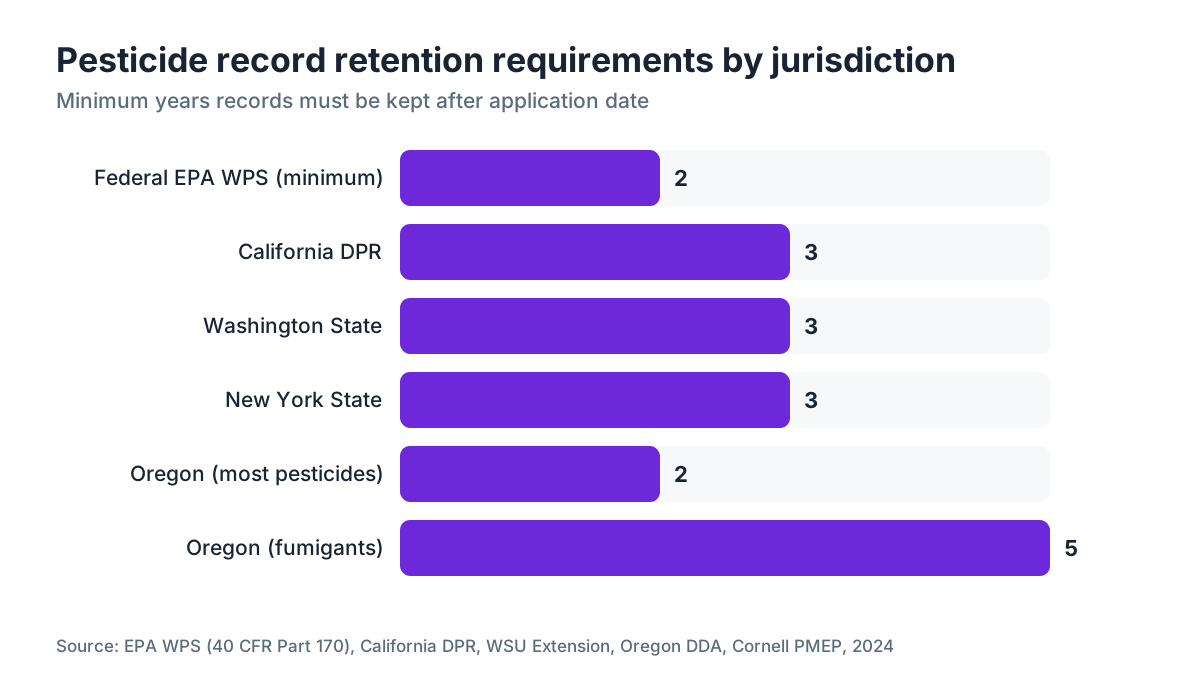
Washington State requires that records be available for inspection for at least three years [8]. Oregon requires two years for most pesticides and five years for fumigants [9]. Federal WPS requires records for at least two years [2]. California's PUR records must be kept for three years [1]. If you operate across state lines, default to the strictest retention period in any state where you have operations.
New York's Department of Environmental Conservation requires that certified pesticide applicators complete records of each application within 24 hours and make those records available for inspection for three years. Cornell University's pesticide management education program has detailed guidance on New York-specific requirements [6].
What's the best way to prevent errors on pesticide records in the first place?
Fill out the record before you load the sprayer, or right after the application. Not at the close of the day from memory.
This sounds obvious but it's the single most effective practice extension programs have identified. WSU's pesticide recordkeeping guidance recommends pre-filling as much of the record as possible before going to the field: product name, EPA registration number, target pest, field or block ID, planned rate [3]. Then the applicator only has to add actual start time, end time, equipment calibration note, and signature in the field. That cuts the error surface in half.
For paper records, use a clipboard with a waterproof field card or a dedicated spray record book that stays in the cab. Don't rely on scraps of paper transferred later. Transcription is where most errors happen.
For vineyards managing multiple blocks across a season, a block-by-block matrix posted in the spray room, showing which pesticides went on which blocks and when, gives the crew a real-time double-check before they start filling records. It also catches the "wrong block number" error before it's written down.
For operations ready to move beyond paper, VitiScribe is built specifically for vineyard spray records and compliance tracking. The system pre-populates product details from EPA registration data and timestamps applications at entry, which removes the most common manual errors before they happen. That said, any system is only as good as the person entering the data.
The Cornell Pesticide Management Education Program's record-keeping resources include field-ready templates that prompt for every required field in a logical order, which reduces the chance of simply forgetting a required entry [6].
What records does the EPA Worker Protection Standard actually require you to keep?
The EPA WPS, codified at 40 CFR Part 170 and updated significantly in 2015, requires agricultural employers to keep records of each pesticide application made to an agricultural establishment where workers or handlers are employed [2].
Required record elements under the WPS include: the product name, EPA registration number, and active ingredient(s); the location and description of the area treated; the date of application; and the restricted-entry interval (REI) for the pesticide used. These records must be kept for two years and made available to workers, their designated representatives, and state or federal officials upon request.
The WPS states, in its regulatory text, that application-specific records "must be maintained for a period of 2 years following the date of application" [10]. That two-year floor is the federal baseline. States can and do require longer retention, as noted in the previous section.
One thing the WPS does not do is tell you what paper form to use, or how to format the record. The required elements can live in a dedicated spray log, a farm management software record, or a field notebook, as long as all the required fields are present and the record is legible and accessible. That flexibility is real, and it means there's no single "right" form. But the required elements are non-negotiable.
Frequently asked questions
Can I use correction fluid (Wite-Out) on a pesticide application record?
No. Correction fluid obliterates the original entry and is treated as falsification by most state pesticide regulatory programs and federal inspectors. The standard correction method is a single line through the error so the original text stays readable, with the correct information written nearby, plus your initials and the date you made the change. Using correction fluid on a record can turn a minor paperwork error into a much more serious compliance violation.
Do I need to correct every small error on a pesticide record, or just major ones?
Every known error should be corrected, even small ones like a typo in the applicator's name. Leaving known errors in a record signals that you don't review your own documentation, which is what inspectors look for. The correction itself is quick: one line, initials, date. Errors affecting reported use quantities, pesticide identity, or re-entry intervals carry the highest regulatory risk and should be corrected immediately.
What if I submitted a pesticide use report to the state with an error in it?
You'll need to file an amended report, more than fix your field copy. Contact your county agricultural commissioner's office (in California) or the relevant state pesticide agency and ask for their amended PUR process. Most counties and states have a specific procedure for this. Correcting only the field record without amending the official submission leaves a discrepancy between your files and the state database, which creates problems at the next inspection or cross-check.
How long do I have to keep pesticide application records?
Federal EPA Worker Protection Standard requires a minimum of two years from the date of application. California requires three years for pesticide use reports. Washington State requires three years. Oregon requires two years for most pesticides and five years for fumigants. If you operate in multiple states, keep all records for the longest applicable retention period. Never discard records before that period has passed, even if the operation that created them is no longer active.
Can a corrected pesticide record be used in a worker's compensation or exposure claim?
Yes, and a properly corrected record is actually better evidence than an uncorrected one. A single-line correction with initials and a date shows active record management. What matters in a claim is whether the record accurately reflects the pesticide used, the date, the re-entry interval, and the area treated. Corrections that preserve that information support your position. Obliterated or missing records do the opposite.
What does a pesticide record correction look like if I'm using a spreadsheet instead of paper?
Use strikethrough formatting on the incorrect cell so the original value is still visible, add the correct value in an adjacent cell or a cell comment, and add a column noting your initials and the date of correction. Preserve the version history if your platform supports it. A purpose-built recordkeeping system with an automatic audit log is cleaner for compliance, but the strikethrough method in a spreadsheet at least preserves the logic of a proper correction.
Does the EPA Worker Protection Standard specify exactly how to correct a record?
No. The WPS at 40 CFR Part 170 requires that records be maintained and accessible but does not prescribe a specific correction method. The single-line correction standard comes from general audit-integrity principles applied by state agricultural commissioners and EPA inspectors. The consistent interpretation across programs is that the original entry must remain readable after a correction is made. California DPR's enforcement guidance is the most explicit published statement of this standard.
Who can make a correction on a pesticide application record, the applicator or the manager?
Either, in most programs. The initials on the correction identify who made the change, not who must make it. If a manager catches an error on an applicator's record and corrects it, the manager's initials go on the correction. Some county programs in California prefer that corrections to submitted PURs be made by the designated record-keeper or permit holder. When in doubt, ask your county agricultural commissioner's office before making corrections to submitted records.
What happens if a pesticide record error is discovered during an inspection?
The outcome depends on the nature of the error and whether the record has been properly maintained overall. An isolated, uncorrected error in an otherwise complete record typically results in a notice or warning on a first inspection. A pattern of errors, missing fields, or any sign of falsification raises the severity significantly. Correcting known errors before an inspection, with proper single-line corrections dated and initialed, demonstrates an active compliance program and generally results in better outcomes.
Does the same correction method apply to restricted-use pesticide records specifically?
Yes, and restricted-use pesticide (RUP) records get more scrutiny because RUP use requires a certified applicator and is tracked more closely by state agencies. The correction method is identical: single line, initials, date. But errors on RUP records, especially involving the applicator's license number or the specific product applied, should be corrected immediately and documented carefully. Some states require that RUP record errors affecting compliance with use restrictions be reported to the county agricultural commissioner.
Can a voided pesticide record page be thrown away?
No. If you void an entire page and rewrite it, the voided original must stay physically attached to or filed with the corrected version for the full retention period. California DPR guidance is explicit on this point. Discarding the voided original removes the audit trail that shows what was wrong and when it was corrected, which defeats the purpose of the void-and-rewrite process entirely.
Are there any pesticide record errors that require immediate reporting to a regulatory agency?
Generally no, for pure record errors. But if an error on the record reflects or conceals an actual application problem, the reporting requirements change. For example, if a re-entry interval was recorded incorrectly and workers entered too early based on the wrong information, that's a WPS violation that may require reporting and corrective action beyond fixing the record. The record correction is necessary but not sufficient in that situation.
Does UC Davis or Cornell have field-ready templates for pesticide application records?
Yes. Cornell University's Pesticide Management Education Program publishes record-keeping resources and templates designed for New York's specific requirements that are broadly applicable to most states. UC Davis Agricultural and Natural Resources has pesticide safety education materials including guidance on record content. WSU Extension has specific Washington State-focused recordkeeping guidance. All three are free to download and use. Links to these programs are in the citations section of this article.
Sources
- California Department of Pesticide Regulation, Pesticide Use Reporting: California requires pesticide use reports for all agricultural pesticides, submission within 7 days for restricted materials, 3-year record retention, and corrections must leave original entries legible
- U.S. EPA, Worker Protection Standard, 40 CFR Part 170: WPS requires agricultural employers to keep pesticide application records including product name, EPA registration number, location, date, and REI for at least two years, available within 15 days of request
- Washington State University Extension, Pesticide Recordkeeping: WSU Extension recommends pre-filling records before field work to reduce transcription errors, and states that records that cannot be read in their original form are treated the same as falsified records under state enforcement
- U.S. EPA, Federal Insecticide, Fungicide, and Rodenticide Act (FIFRA): FIFRA section 8 requires records to accurately reflect actual pesticide use and be maintained for inspection; section 14 authorizes civil and criminal penalties for violations including falsification
- UC Davis Agriculture and Natural Resources, Pesticide Safety Education Program: UC Davis ANR pesticide safety guidance states that inspectors are primarily interested in whether records are consistent with actual pesticide use, not format compliance
- Cornell University, Pesticide Management Education Program: Cornell PMEP provides field-ready recordkeeping templates and guidance on New York State pesticide record requirements including 24-hour completion and 3-year retention rules
- U.S. EPA, Pesticides program: EPA accepts electronic pesticide records when systems maintain data integrity and audit trails equivalent to paper record standards, with state-by-state approval processes
- Washington State Department of Agriculture, Pesticide Licensing and Recordkeeping: Washington State requires pesticide application records to be maintained for at least three years and available for inspection by WSDA personnel
- Oregon Department of Agriculture, Pesticide Regulations: Oregon requires pesticide application records to be kept for two years for most pesticides and five years for fumigants
- U.S. EPA, WPS Application-Specific Information, 40 CFR 170.309: 40 CFR 170.309 states that application-specific records 'must be maintained for a period of 2 years following the date of application'
Last updated 2026-07-10