Pierce's disease of grapevine: causes, symptoms, and what actually works
TL;DR
- Pierce's disease is a lethal bacterial infection of grapevines caused by Xylella fastidiosa and spread by sharpshooter leafhoppers.
- There is no cure.
- Infected vines die within one to five years.
- Management means early detection, pulling infected vines, controlling the vector insects, and in some regions planting resistant varieties.
- California loses an estimated $56 million a year to it.
What is Pierce's disease and what causes it?
Pierce's disease is a fatal bacterial disease of Vitis vinifera grapevines caused by a xylem-limited bacterium, Xylella fastidiosa. The bacteria colonize and clog the water-conducting xylem inside the vine, so it essentially dies of thirst even when the soil holds plenty of moisture. Once a vine is infected, there is no cure.
Newton B. Pierce first described the disease in California in 1892, which is where the name comes from. It has been in the southeastern United States for even longer. Warm winters there let sharpshooter populations thrive year-round and made commercial vinifera viticulture in that region historically impossible. [1]
X. fastidiosa is a gram-negative bacterium with an unusually broad host range. It infects more than 100 plant species, including almonds, oleander, peaches, and blueberries, though different strains tend to be host-specific. The strain that hits grapevines is X. fastidiosa subsp. fastidiosa. [2]
The bacteria multiply inside the xylem vessels and build a biofilm that plugs water flow. The vine can't compensate. It starves for water, and the symptoms you see (described in the next section) follow straight from that blockage.
What are the symptoms of Pierce's disease in grapevines?
Symptoms move through the season in a predictable order. Learning that sequence pays off, because pulling infected vines early is the strongest management tool you have.
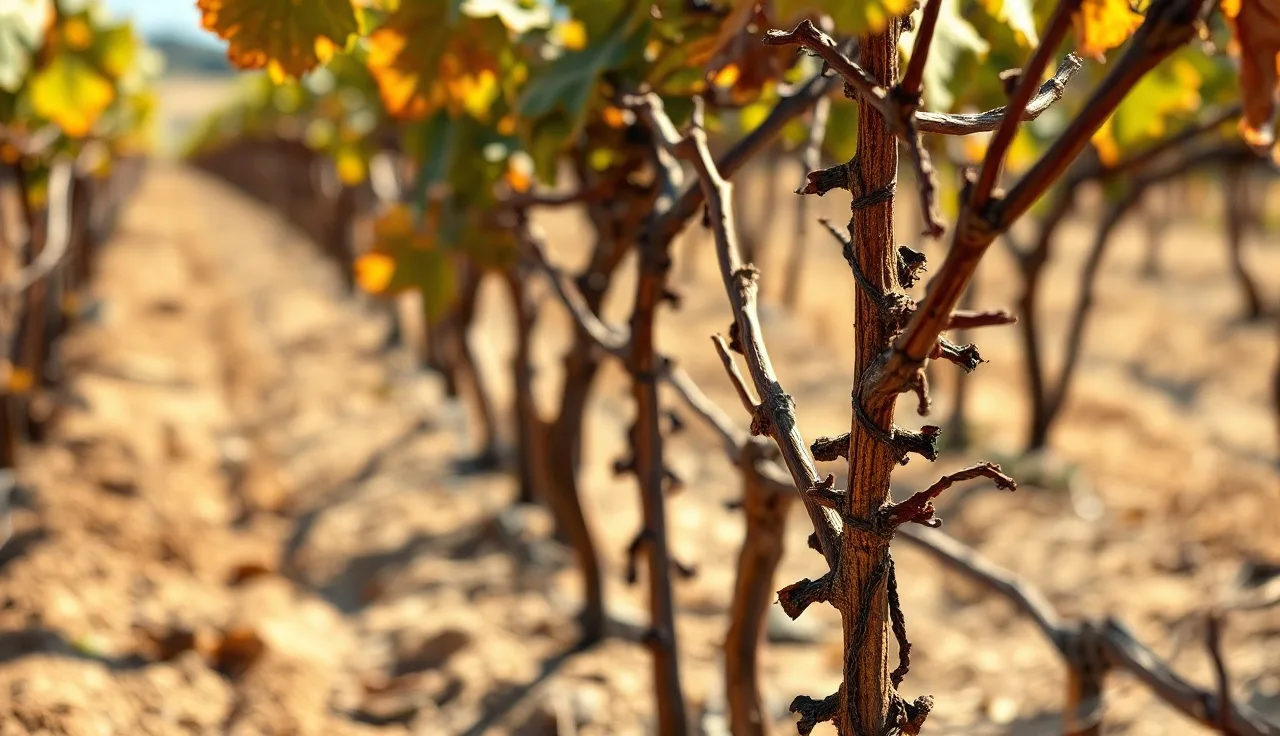
In summer, leaves show a distinctive scorch where green tissue dies from the margins inward. Here's the tell: the leaf blade drops off while the petiole (the leaf stem) stays attached to the cane. Those dried, attached petioles are one of the most reliable field signs you'll ever get. [3]
By late summer and into fall, affected canes lignify unevenly. Bark hardens in patches instead of uniformly from the base up. Growers call the untanned patches "green islands" on canes that are otherwise brown. Fruit clusters on infected shoots shrivel and dry.
Spring brings delayed or weak shoots off infected spurs. Some vines push shoots that collapse within weeks.
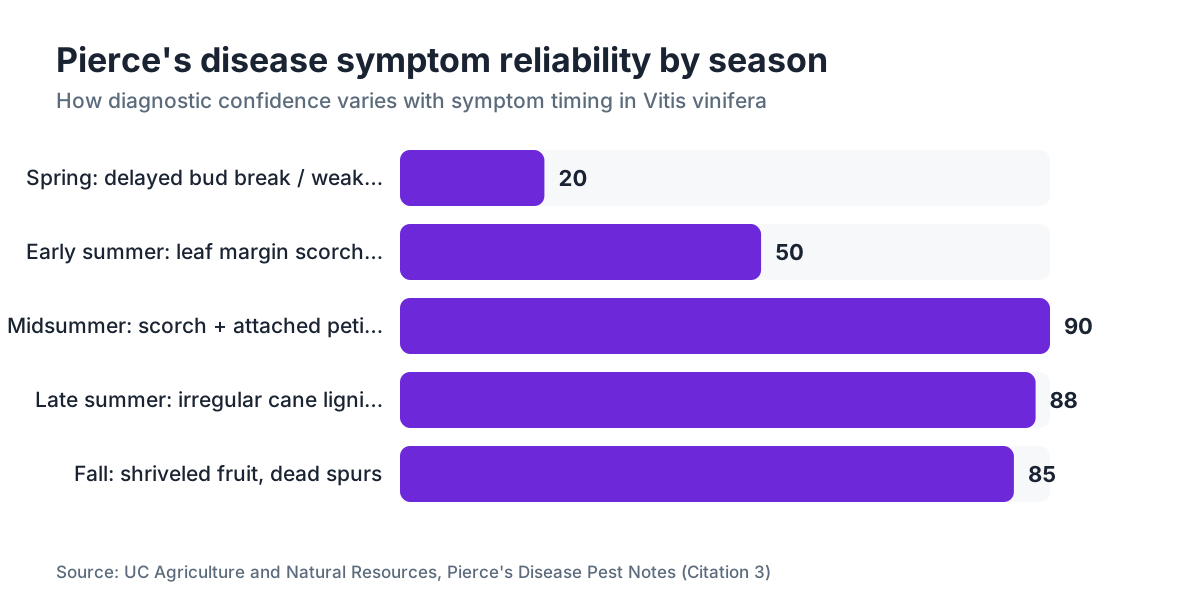
Here is the symptom progression by season:
| Season | Visible symptom | Diagnostic reliability |
|---|---|---|
| Spring | Delayed bud break, weak shoots | Low (easy to confuse with cold damage) |
| Early summer | Leaf margin scorch beginning | Moderate |
| Midsummer | Full leaf scorch, petioles attached after blade drop | High |
| Late summer | Irregular cane lignification (green islands) | High |
| Fall | Shriveled fruit, dead spurs | High |
One detail trips up a lot of growers: symptoms can take 12 to 18 months to appear after infection. A vine that scorches in year two was probably infected in year one. That lag makes early-season scouting deceptive. [3]
The symptoms mimic other troubles too, including water stress, salt buildup, and some nutrient deficiencies. Lab confirmation by ELISA or PCR is the only way to be sure. Your local UC Cooperative Extension farm advisor or state plant pathologist can point you to a testing lab.
How does Pierce's disease spread through a vineyard?
Xylella fastidiosa spreads only through xylem-feeding insects, mainly sharpshooter leafhoppers and spittlebugs. Nothing moves on pruning tools, in soil, or through irrigation water. That sets it apart from many other vine diseases and changes how you fight it. [1]
In California, the two historically important vectors were the blue-green sharpshooter (Graphocephala atropunctata) and the green sharpshooter (Draeculacephala minerva). Both feed on weeds and riparian plants in spring, then push into vineyards as those plants dry out in summer. That's why vineyard edges near streams, riparian corridors, and weedy ground usually show disease first. [4]
The glassy-winged sharpshooter (Homalodisca vitripennis) rewrote the rules when it reached California in the 1990s. Unlike the native sharpshooters, GWSS feeds and breeds on a huge range of hosts, ranges far from riparian zones, and moves X. fastidiosa more aggressively within and between vineyards. It set off what California's legislature named a Pierce's Disease emergency in 1999, and the state has spent well over $30 million on control programs since. [5]
Once a sharpshooter picks up the bacteria from an infected plant, it can pass them on immediately and for the rest of its life. There's no latent period. A single insect can infect several vines in one feeding bout.
Infection rates run highest along the perimeter and fall off toward the interior. That spatial pattern is your first clue during a disease survey. Secondary spread inside the block happens too, but it's usually slower.
Which grapevine varieties are most susceptible to Pierce's disease?
Every Vitis vinifera cultivar, the whole European wine grape family, is highly susceptible. Cabernet Sauvignon, Chardonnay, Merlot, Pinot Noir, Zinfandel: none of them tolerate infection for long. Most die within two to five years. [1]
Some American Vitis species and interspecific hybrids show partial or full tolerance. Vitis arizonica, native to the desert Southwest, carries naturally high tolerance and became a key parent in UC Davis breeding work. The Pierce's Disease Control Program at UC Davis spent more than two decades building wine-quality hybrids from V. arizonica genetics. By 2019, varieties including Errante Noir, Ambulo Blanc, and Camminare Noir had California state approval for commercial sale. [6]
These carry a genetic locus called PdR1 that limits bacterial movement inside the vine. They aren't immune, but they hold far lower bacterial populations than susceptible varieties.
The catch is wine quality. Winemakers in high-pressure regions are still learning what these grapes can do. They perform better in some climates than others. Nobody has good long-term data yet on how they hold up across a 20-year planting. That's an honest gap to weigh in any replanting decision.
In the southeastern US, where the disease has been brutal for more than a century, muscadine grapes (Muscadinia rotundifolia) are effectively the only vines that survive without constant intervention. They make distinct wine styles with a regional following, but they won't stand in for a Napa Cabernet program.
What are the treatment options for Pierce's disease in grapevines?
There is no approved cure for Pierce's disease in commercial vineyards. Start there. Any product that promises to clear the bacteria from an infected vine is overstating the evidence. The honest toolkit has three parts: thermotherapy, antimicrobials still in trials, and removal followed by replanting.
Thermotherapy is the best-studied intervention. Research at UC Riverside showed that heating infected dormant canes in hot water (about 45 degrees Celsius for 3 hours) or heat chambers can cut or clear X. fastidiosa from the tissue. [7] It works on nursery material and produces clean planting stock. Doing it to established vineyard vines is not practical at scale. Great for the propagation pipeline. Useless in the field.
Antibiotics are not an approved solution in the US for field-grown grapevines. Oxytetracycline has been studied and can suppress bacterial populations for a while, but it does not clear the infection, resistance is a real worry, and US EPA registration for this vineyard use isn't in place in most states. Active research, not an approved tactic.
Zinc-based compounds and other mineral treatments float around online viticulture forums. The evidence for them as a Pierce's disease treatment is thin to nonexistent. Spend your money elsewhere.
Pulling and destroying infected vines is the single most effective thing you can do at the vineyard level. An infected vine is a bacterial reservoir that vectors feed on before carrying the bug into healthy vines. The economics hurt, but the biology is plain. Pull diseased vines fast, destroy them (burn where regulations allow, chip and haul otherwise), and replant with certified clean nursery stock. [3]
Insecticide programs against the vectors matter in an area-wide strategy, especially where glassy-winged sharpshooter pressure runs high. California's Pierce's Disease Control Program coordinates county agricultural commissioner offices on GWSS monitoring and treatment. In heavy years, systemic insecticides applied early, before GWSS moves into the vines, cut transmission. Check with your county ag commissioner and follow every label direction and Worker Protection Standard requirement under 40 CFR Part 170 before you spray. [8]
How serious is the economic impact of Pierce's disease on California and US viticulture?
California's Department of Food and Agriculture pegged the annual cost of Pierce's disease to state viticulture at roughly $56 million a year in the early 2000s, and that number drove the legislative emergency response to the glassy-winged sharpshooter. [5] The figure is old and the methodology has been argued over. Actual losses swing a lot by region and year depending on vector pressure, but it tells you the scale of the thing.
Temecula, in Southern California wine country near where GWSS first landed, took the worst of it. The outbreak in the late 1990s and early 2000s wrecked vineyards. Some growers lost 80 percent or more of their plantings in a few seasons. The Ponte Winery and other Temecula operations that came through it did so with hard replanting programs and coordinated area-wide vector control.
In the southeastern US, the disease shut out commercial Vitis vinifera for more than a century. Georgia, the Carolinas, and Florida have real wine industries today because of muscadine grapes and modern hybrids. Vinifera plantings stay a high-risk bet across most of those climates.
The Paso Robles region, home to hundreds of Paso Robles wineries, runs ongoing GWSS monitoring. Napa and Sonoma to the north get cooler winters that hold down sharpshooter overwintering, which buys some natural protection, though warming climate is a real long-term concern that researchers are watching.
For a small vineyard, losing even 10 percent of your vines in a season is a serious hit once you add up lost production, replanting cost (typically $15,000 to $25,000 per acre in California for full establishment), and the three-to-five-year wait before replants come back into full production. [9]
How do you correctly diagnose Pierce's disease vs. other vine disorders?
Visual diagnosis is a starting point, not a verdict. Several conditions mimic Pierce's disease well enough to send you down the wrong management path.
Water stress and heat damage produce a leaf scorch that looks like Pierce's disease scorch in photos but reads differently up close. Pierce's disease scorch starts at the leaf margins and moves inward in a fairly even band, with the inner green tissue staying green at first. Water stress browns more diffusely. The deciding field indicator is the attached petiole after blade drop. If the blade falls and the stem hangs on, that points hard at Pierce's disease. [3]
Nutrient deficiencies, magnesium in particular, can throw interveinal chlorosis and margin necrosis. A tissue test sorts those out.
Fanleaf degeneration, from Grapevine Fanleaf Virus, distorts leaf shape and causes shot berries and yield loss, but not the specific scorch and petiole retention of Pierce's disease.
For lab confirmation, two methods dominate:
- ELISA (enzyme-linked immunosorbent assay): widely available, cheap ($15 to $40 per sample depending on the lab), reliable for confirming active infection in symptomatic tissue. Collect petioles from scorched leaves in summer.
- PCR (polymerase chain reaction): more sensitive than ELISA, detects lower bacterial loads, useful earlier in the infection timeline. Costs more, worth it when ELISA comes back ambiguous.
UC Cooperative Extension farm advisors in California can steer you to tested diagnostic labs. Cornell's Plant Disease Diagnostic Clinic handles samples from the Northeast. [10] Washington State University Extension covers Pacific Northwest diagnostics. [11]
Timing your sample matters. Pull symptomatic tissue in midsummer when bacterial populations peak. Dormant-season sampling throws more false negatives.
What does Pierce's disease management look like on a practical field schedule?
Here's a workable calendar for a California vineyard under moderate glassy-winged sharpshooter pressure.
Winter (December to February): Read your county's Pierce's Disease / GWSS monitoring reports. Coordinate block-level management with neighbors, because treating one property while surrounding parcels go untreated barely works. Order certified clean planting stock for any replanting. Go over insecticide options with your PCA, watching pre-harvest intervals and Worker Protection Standard requirements. [8]
Early spring (March to April): Scout the perimeters, especially edges next to riparian areas, citrus, and ornamentals, which are prime GWSS hosts. If your county runs a GWSS treatment program, confirm timing with the county agricultural commissioner. Apply systemic insecticides per label if indicated, and log them.
Late spring to early summer (May to June): Keep scouting the perimeter. Start symptom scouting inside the block, on the edge rows first. Flag any vine with early leaf scorch or odd shoot growth.
Midsummer (July to August): This is your main scouting window. Walk every row if you can. Look for the attached petiole. Pull tissue from suspicious vines and send it for ELISA. Mark confirmed or suspected infections with flagging tape.
Late summer to fall (August to October): Remove confirmed infected vines before harvest or right after, cutting the reservoir down before GWSS move off to winter hosts. Log removals with GPS coordinates if you keep digital records.
A tidy spray record and vine health log is non-negotiable, both for compliance and for management. If you're running all this on paper, you're losing information and building audit risk. That's the exact record chain a tool like VitiScribe is built for, keeping spray applications, scouting notes, and disease removals in one timestamped log that answers to internal management and regulatory review alike.
What are the regulations and compliance requirements around Pierce's disease management?
Pierce's disease itself isn't a quarantine pest in most US states, but its main vector, the glassy-winged sharpshooter, is regulated under a California quarantine program. The California Department of Food and Agriculture set up a GWSS quarantine across multiple counties. Moving certain plant material out of quarantine zones requires inspection and certification. [5]
Pesticide applications for vector control carry the same rules as any other ag pesticide use. Under the EPA Worker Protection Standard (40 CFR Part 170), workers must get annual safety training, and restricted-entry intervals on the label must be honored. [8] The systemic insecticides used for GWSS include neonicotinoids (imidacloprid, thiamethoxam), which draw extra regulatory scrutiny in some states and carry pollinator protection requirements. California's Department of Pesticide Regulation has specific bee-protection notice rules for certain products.
Some county agricultural commissioners in high-pressure regions require reporting of GWSS detections. Check with your local commissioner's office. Requirements vary by county and get updated periodically.
Organic operations have a shorter toolkit. No organic-approved material has shown reliable Pierce's disease control. Biocontrol research on egg parasitoids of sharpshooters (notably Gonatocerus ashmeadi) looks promising within California's GWSS biological control program, but it's an area-wide tool run at the landscape level, not something you deploy alone on your own acreage. [5]
If your state requires a certified crop advisor (CCA) or pest control adviser (PCA) license for pesticide recommendations, and California does, your vector-management spray decisions have to route through that licensed channel. Document all of it.
Is there promising research on Pierce's disease that could change management in the next decade?
Yes, and some of it is further along than most growers realize.
The UC Davis Pierce's Disease Control Program has run the longest-sustained grapevine resistance breeding effort. By 2019, the first commercial PdR1-carrying wine grape varieties won approval. A second resistance locus (PdR2) has been identified in V. arizonica, and UC Davis researchers are stacking both genes into higher-quality wine grape backgrounds. [6] Varieties carrying both loci may hold up better where single-locus resistance starts to break down under intense bacterial pressure.
RNAi-based approaches, using engineered gene-silencing molecules aimed at X. fastidiosa itself, sit in early-stage research at several institutions. In theory they'd be sprayed on, leaving the plant genome alone while disrupting bacterial reproduction. They're years from commercial use and face regulatory review, but the concept is biologically sound.
Biological control of the vectors continues. USDA ARS and the California Department of Food and Agriculture have established egg parasitoid populations in Southern California that suppress GWSS reproduction in some settings. Their field impact shifts with landscape complexity and is hard to measure at the single-farm level.
Heat treatment for nursery stock is now standard for clean-stock production. The UC Davis Foundation Plant Services program produces X. fastidiosa-free certified grapevine material. [12] Planting certified clean stock is something you can act on today, and it should be non-negotiable for any replanting after disease removal.
For growers in the southeastern US, the picture is genuinely different and improving faster than for California vinifera growers. A collaboration among USDA, university extension programs, and grower associations has produced hybrid varieties with better wine quality than the first-generation resistant lines. Nobody should plant vinifera in interior Georgia and expect it to live without extraordinary intervention, but today's hybrid options beat what existed 15 years ago.
How does Pierce's disease management differ by region in the US?
Region matters enormously, because Pierce's disease severity tracks winter temperature and vector populations, and both vary dramatically across US wine regions.
California coast (Napa, Sonoma, Santa Barbara): Cooler winters hold down sharpshooter survival. Blue-green sharpshooter is the main vector, and its activity concentrates near riparian corridors. GWSS monitoring runs on, but populations stay lower than inland. Edge-row removal and perimeter monitoring keep pressure manageable. High-pressure years still crop up.
California inland valleys (Temecula, San Joaquin Valley): Hot summers, year-round GWSS survival, heavy disease pressure. These regions saw the worst GWSS-driven outbreaks. Active quarantine programs and coordinated treatment are essential. Some growers here have switched to resistant varieties out of plain necessity.
Arizona: V. arizonica is native here, and some growers pair resistant rootstocks with new hybrid scion varieties and get good results. The region is still defining its wine identity. Winter cold keeps some vector populations lower than in California's desert zones.
Texas Hill Country: Heavy disease pressure, GWSS present, warm winters. The Texas A&M AgriLife Extension program publishes region-specific Pierce's disease guidance. [13] Hybrid varieties and careful site selection are increasingly necessary for commercial survival.
Southeastern US (Georgia, Carolinas, Florida): Historically the hardest hit. Commercial vinifera stays very high-risk across most of these areas. Muscadine and American hybrid production is the economic reality. Interest in newer PdR varieties is growing, but commercial-scale results are limited so far.
Pacific Northwest (Oregon, Washington): Generally low pressure. Cold winters kill most sharpshooter populations. Pierce's disease isn't a primary focus of WSU Extension guidance, which centers on fungal diseases instead. [11]
What records should vineyard managers keep related to Pierce's disease?
Good Pierce's disease recordkeeping does three real jobs: it tracks disease spread spatially so you catch moving infections early, it documents pesticide compliance, and it protects you if you ever file an insurance claim or face a regulatory investigation.
At minimum, you need:
Scouting logs with date, block, row, vine number, observed symptoms, and action taken. Flagging tape fades and falls off. Your written or GPS-tagged record is what lasts.
Lab test results for every ELISA or PCR test, with date, vine source, and result. Keep copies.
Spray records with application date, product name, EPA registration number, rate, total product used, target pest, applicator name, and REI posting records. California requires pesticide use reports (PURs) filed monthly with the county agricultural commissioner. Federal Worker Protection Standard rules under 40 CFR Part 170 add documentation, including safety data sheet access and application exclusion zone records. [8]
Vine removal logs with date, block, row numbers, and disposal method. When you replant, note the source nursery and certification status of the new stock.
GWSS monitoring data from county traps or your own, with dates and counts.
If you're running this on paper forms or spreadsheets, you're fighting uphill as block size and compliance complexity grow. The VitiScribe platform is built for this field-to-office record chain, but whatever system you pick, the records have to be timestamped, legible, and retrievable on short notice.
Keep records at least three years, which covers most state pesticide recordkeeping rules. California requires PUR records for three years. Confirm your own state's requirement.
Frequently asked questions
Can Pierce's disease be cured once a grapevine is infected?
No. There is no approved, commercially viable cure for Pierce's disease in field-grown grapevines. Thermotherapy can clear the bacteria from nursery cuttings, and some antibiotic research shows temporary suppression, but neither clears the infection in an established vine. The only practical response to a confirmed infected vine is removal and destruction so it stops feeding vectors that carry the bug to healthy vines.
How quickly does Pierce's disease kill a grapevine?
Most susceptible Vitis vinifera varieties die within one to five years of infection, with real variation by infection timing, vine age, and disease pressure. Younger vines and vines infected early in the season tend to decline faster. Some infected vines hang on for several seasons in a weakened state before dying, all while harboring bacteria that vectors can pick up and spread to healthy vines.
What insects spread Pierce's disease and how do I identify them?
Sharpshooter leafhoppers and spittlebugs spread Xylella fastidiosa. In California the key species are the glassy-winged sharpshooter (Homalodisca vitripennis, about 12mm, brownish with white spots on head and abdomen), the blue-green sharpshooter (Graphocephala atropunctata, bright blue-green, about 6mm), and the green sharpshooter (Draeculacephala minerva, green, 7-9mm). Your county cooperative extension office has photo identification guides.
Is Pierce's disease the same in all US wine regions or does it vary?
The same bacterium, Xylella fastidiosa subsp. fastidiosa, causes Pierce's disease throughout the US, but severity varies enormously. Cold winters kill vectors and limit spread, which is why Pacific Northwest vineyards rarely have trouble while inland Southern California and the Southeast face severe pressure. Growers in high-pressure regions need aggressive, coordinated management. Those in cold-winter areas may only need perimeter monitoring.
Are there Pierce's disease-resistant grape varieties I can plant?
Yes. UC Davis has released several wine grape varieties with resistance from Vitis arizonica genetics, including Errante Noir, Ambulo Blanc, and Camminare Noir. They carry the PdR1 resistance locus and show much lower susceptibility than Vitis vinifera. Wine quality is improving but still differs from classic vinifera cultivars. Muscadine grapes are effectively immune and are the standard in the hardest-hit southeastern US regions.
How do I know if my vine has Pierce's disease or just heat stress?
The most reliable field indicator is the attached petiole. When Pierce's disease scorches a leaf, the blade drops but the stem stays on the cane. Heat stress and water deficit usually drop the whole leaf, blade and petiole together, or show more diffuse browning. Irregular cane lignification (patchy green islands on otherwise ripened canes) in late summer is another strong sign. Confirm with ELISA or PCR on symptomatic tissue collected in midsummer.
What pesticides are used to control the glassy-winged sharpshooter, and what do I need to know about compliance?
Neonicotinoid systemic insecticides including imidacloprid and thiamethoxam are among the most used for GWSS control, applied early in the season as soil drenches or foliar treatments before vectors move into the vines. Every application requires compliance with the EPA Worker Protection Standard (40 CFR Part 170), including worker safety training and posted restricted-entry intervals. California also requires monthly pesticide use reports. California organic operations have very limited approved options.
How do I submit a sample for Pierce's disease testing?
Collect petioles (leaf stems) from leaves showing active scorch in midsummer, when bacterial populations peak. Seal samples in a plastic bag on ice and ship overnight to a qualified plant diagnostic lab. UC Cooperative Extension farm advisors can direct California growers to approved labs. Cornell's Plant Disease Diagnostic Clinic serves the Northeast, and WSU Extension covers the Pacific Northwest. ELISA testing usually runs $15 to $40 per sample.
Does Pierce's disease spread through pruning tools?
No. Xylella fastidiosa does not spread through contaminated pruning tools, soil, or water. Transmission needs a xylem-feeding insect vector. That separates Pierce's disease management from many fungal and viral diseases where tool sanitation is a front-line control. You still want to pull infected vines fast, but the spread runs entirely through sharpshooter leafhoppers and related insects feeding on infected plants and moving to healthy ones.
What did California's Pierce's disease emergency program actually accomplish?
California's response to the glassy-winged sharpshooter outbreak, starting in 1999, included quarantine regulations, statewide monitoring networks, biological control releases (egg parasitoid wasps), and over $30 million in control funding through the early 2000s. GWSS populations in many areas were suppressed, especially in Southern California, and the spread into Northern California wine regions slowed. The program is widely cited as a successful area-wide effort, though GWSS remains established in California.
Can cover crops or vineyard floor management affect Pierce's disease pressure?
Indirectly, yes. Cover crops and weedy vineyard floors that stay green into summer can hold sharpshooter populations that would otherwise move off as surrounding vegetation dries. Managing the vineyard floor so it doesn't stay a lush green island into hot dry months can cut vector pressure at the edges. Removing or mowing riparian-edge vegetation near vineyards is also cited by UC Cooperative Extension as a way to reduce blue-green sharpshooter habitat, though you have to balance erosion and habitat concerns.
How does Xylella fastidiosa affect grapes differently from other crops it infects?
X. fastidiosa infects over 100 plant species, but the grapevine strain (subsp. fastidiosa) hits Vitis vinifera hardest because these European grapes carry no co-evolved resistance. Almonds infected with a related strain (almond leaf scorch) show milder symptoms and rarely die quickly. Oleander leaf scorch, from another strain, is also lethal but affects a different host. Different strains can share insect vectors, which creates cross-contamination risk in mixed-crop landscapes.
Is Pierce's disease a concern for vineyards in Europe?
It's becoming one. X. fastidiosa turned up in olive trees in Puglia, Italy in 2013 and has since spread widely in southern Europe, causing enormous olive losses. European wine grape cultivation has so far been largely spared serious outbreaks, but the European Food Safety Authority flags Pierce's disease strains as a significant phytosanitary risk to European viticulture, and the EU keeps strict import rules on plant material from affected regions as a result.
How much does it cost to replant vines after removing those with Pierce's disease?
Full vineyard establishment in California typically costs $15,000 to $25,000 per acre, covering land prep, trellis, vines, labor, and irrigation. The per-vine cost of replacing scattered vines in an otherwise intact block is lower but still substantial once you add vine cost, labor, and the three-to-five-year production gap. This is exactly why early detection and prompt vector management, rather than waiting until a block is half gone, makes financial sense.
Sources
- UC Davis Integrated Pest Management Program, Pierce's Disease of Grapevines: Pierce's disease is caused by Xylella fastidiosa, has been present in the southeastern US historically preventing vinifera viticulture, and all Vitis vinifera cultivars are highly susceptible
- CABI Compendium, Xylella fastidiosa (Pierce's disease of grapevines): X. fastidiosa is a gram-negative bacterium infecting more than 100 plant species; the strain affecting grapevines is X. fastidiosa subsp. fastidiosa
- UC Cooperative Extension, Sharpshooter Vectors of Pierce's Disease: Blue-green and green sharpshooters move from riparian vegetation into vineyards in summer as host plants dry; vineyard edges near streams show disease first
- California Department of Food and Agriculture, Pierce's Disease Control Program: CDFA estimated annual economic loss of approximately $56 million; California established a GWSS quarantine and has spent over $30 million on control programs since 1999
- UC Davis Department of Viticulture and Enology, Pierce's Disease Resistant Grape Varieties: By 2019, UC Davis-bred PdR1-carrying wine grape varieties including Errante Noir, Ambulo Blanc, and Camminare Noir received California state approval for commercial sale
- UC Riverside, Thermotherapy for Pierce's Disease Research: Hot water treatment at approximately 45 degrees Celsius for 3 hours can reduce or eliminate X. fastidiosa from infected dormant cane tissue; effective for nursery stock production
- US EPA, Worker Protection Standard 40 CFR Part 170: The Worker Protection Standard requires annual worker safety training, posting of restricted-entry intervals, and application exclusion zone records for agricultural pesticide applications
- UC Cooperative Extension, Cost and Return Studies for Wine Grape Production: Full vineyard establishment in California typically costs $15,000 to $25,000 per acre accounting for land preparation, trellis, vines, labor, and irrigation
- Cornell University Plant Disease Diagnostic Clinic: Cornell's Plant Disease Diagnostic Clinic provides laboratory testing including ELISA for Pierce's disease confirmation for growers in the Northeast
- Washington State University Extension, Pacific Northwest Grape Disease Management: WSU Extension covers Pacific Northwest plant disease diagnostics; Pierce's disease is not a primary concern in the region due to cold winters limiting sharpshooter populations
- UC Davis Foundation Plant Services, Certified Grapevine Planting Material: UC Davis Foundation Plant Services produces X. fastidiosa-free certified grapevine planting material using heat treatment protocols
- Texas A&M AgriLife Extension, Pierce's Disease Management in Texas: Texas A&M AgriLife Extension provides region-specific Pierce's disease guidelines for Texas Hill Country, citing high disease pressure and warm winters sustaining GWSS populations
Last updated 2026-07-09