Esca disease in established vineyards: identification and management decisions
TL;DR
- Esca is a fungal trunk disease complex driven mainly by Phaeomoniella chlamydospora, Phaeoacremonium species, and Fomitiporia mediterranea.
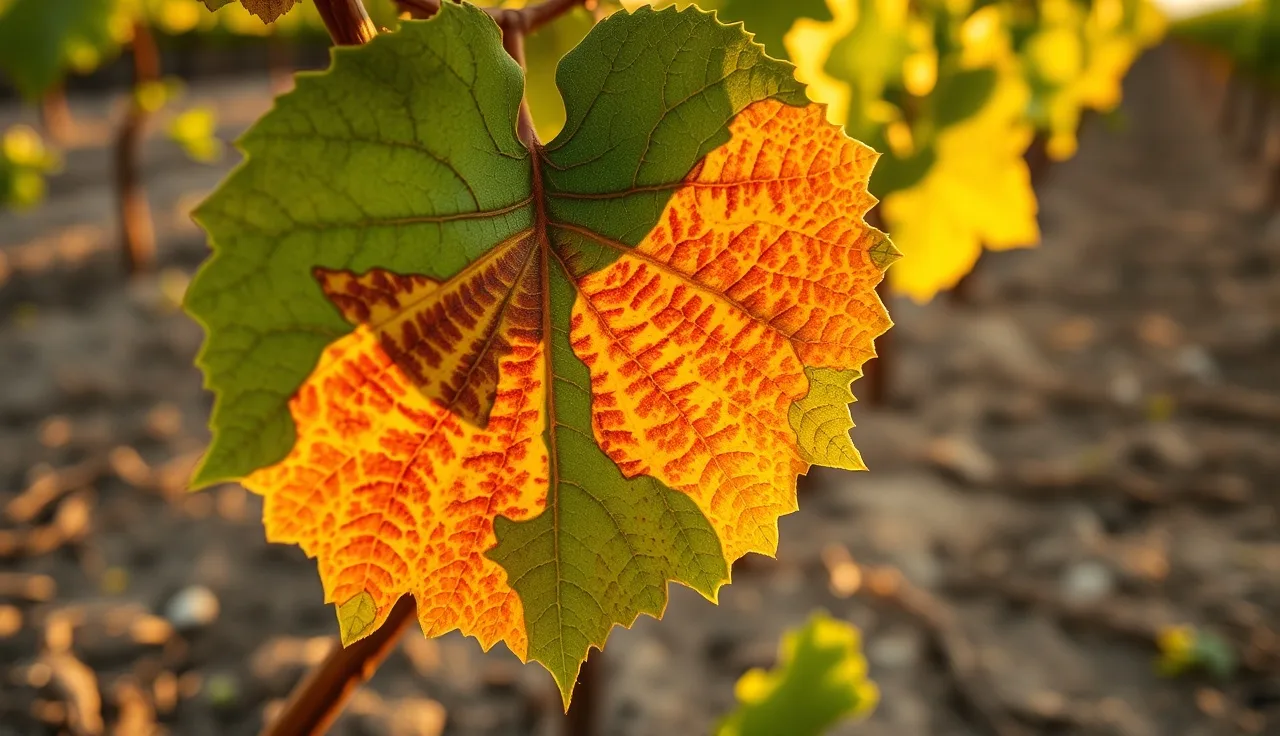
- It shows as tiger-stripe leaves, white-rot wood decay, and sudden vine collapse called apoplexy.
- There is no cure.
- Management means slowing spread, protecting pruning wounds, and deciding when a symptomatic vine is no longer worth keeping.
What is esca disease and what causes it?
Esca is not one disease. It's a complex, meaning several fungal pathogens work together inside the same vine, and which one dominates shifts by region, season, and vine age. Three players do most of the damage: Phaeomoniella chlamydospora (Pch), Phaeoacremonium minimum and its relatives (Pm), and Fomitiporia mediterranea (Fm) [1]. Pch and Pm cause Petri disease in young vines and the slow-dieback phase of esca in older ones. Fm is the white-rot fungus behind the spongy, discolored heartwood you find when you cut open a badly infected trunk [2].
Some growers and researchers also fold in black foot disease (Dactylonectria and Ilyonectria species), which attacks roots and the base of the trunk. That's technically loose, but it's useful in the field, because the symptoms and the decisions overlap enough that pulling them apart on paper can lead you astray.
These fungi get in mostly through pruning wounds. The spores are everywhere in a mature vineyard. They have a window of roughly 14 to 30 days after a cut to colonize fresh wood before the vine's own wound response seals things off [3]. Rain during pruning or right after raises the risk sharply. Most of the infection pressure in your vineyard almost certainly arrived during early pruning seasons, years or even decades before the first sick leaf showed up.
How do you identify esca in the vineyard, leaf by leaf?
The classic sign is tiger striping. Yellow and brown necrosis starts at the leaf margins and moves inward, leaving green tissue hugging the veins while the tissue between them turns yellow, then brown, then papery. On red varieties that yellow goes red or purple before it browns [4]. Once you've seen it, you won't mistake it for much else mid-season.
A few things fool people. Potassium deficiency scorches the margins but skips the sharp interveinal banding. Leaf roll virus discolors between the veins on reds, but the rolling and the timing run differently. Sulfur burn in heat hits the sun-facing leaves evenly instead of making a tiger pattern. When you're not sure, cut the cane and look at the wood.
Berry symptoms turn up on the same vines: dark-spotted, shriveled, or off-color fruit. Berries from symptomatic vines carry elevated levels of phytotoxic compounds including vitisinol and oxyresveratrol, one reason winemakers in Tuscany and elsewhere fight to keep symptomatic fruit out of their lots [5].
Apoplexy is the acute form. A vine that looked fine on Monday is fully wilted by Thursday, leaves still attached but limp, like someone cut the water line. In hot weather it can happen inside 48 hours. Apoplexy clusters in warm, humid summers and can take out 5 to 15 percent of susceptible vines in one season in heavily infected blocks [1]. Once a vine goes apoplectic, it almost never comes back.
What does infected wood look like inside the vine?
Cut an affected vine at the base of the cordon or the trunk and you'll usually see one of two pictures inside, sometimes both.
The first is dark brown-to-black streaking in the xylem, running lengthwise through the wood. That's the vascular discoloration from Pch and Pm, the same complex behind Petri disease. It reads like dark veins across the cross-section.
The second is white rot: a soft, cream-to-white spongy breakdown of the wood in the center of the trunk, ringed by a dark brown margin. This is Fomitiporia mediterranea, and it's the mark of "true" esca as opposed to Petri disease [2]. The rot can hollow out big sections of an old trunk while the vine limps along on whatever functional wood is left.
A fast field check: cut back into the cordons of symptomatic vines with a handsaw. Find both vascular streaking and any softening of the central wood in a vine over 10 years old, and you're looking at a mature esca infection. Pin the location with GPS or a row and vine number right then, because that vine stays on your monitoring list no matter what it does above ground next spring.
How does esca spread in a vineyard over time?
Spread runs mostly through pruning wounds, with an important wrinkle. Fomitiporia mediterranea grows fruiting bodies (basidiocarps) on dead wood and old stumps, and those release airborne spores that ride to fresh cuts across the block [6]. Pch and Pm spread the same way from infected wood debris left on the vineyard floor. This is why leaving dead wood in the row works against you.
Vine age matters a lot. Blocks under 10 years rarely show leaf symptoms even when Pch and Pm colonized the vascular system years back. Symptoms climb sharply in vines 15 years and older, and by year 20 to 25 most unmanaged vineyards in high-pressure regions show measurable yield loss [1]. Spanish surveys have found leaf symptom incidence as high as 80 percent in vines over 30 years old in affected blocks.
Some varieties run more susceptible than others, though no commercial variety is fully resistant. Chardonnay, Sauvignon Blanc, and Grenache tend to show symptoms earlier and at higher rates than Cabernet Sauvignon or Syrah in most comparative trials. The literature is messy enough that I'd treat variety as a modifier, not a reliable predictor. Climate history and pruning practice probably matter more [4].
One thing is clear. Blocks with a history of mechanized pruning or skipped wound protection are consistently worse. Every unprotected cut is a possible infection, compounded across every dormant season the vineyard has been open.
What management options actually work for esca?
No chemical treatment eradicates esca once a vine is systemically infected. Sodium arsenite, the only material that ever showed real field efficacy, was banned in the European Union in 2003 and is not registered for this use in the United States [7]. Anyone selling you a cure for esca is selling you something else.
What you can do falls into three buckets: preventive wound protection, cultural practices that slow spread, and trunk renewal or rogue-and-replant calls.
Wound protection at pruning has the best evidence behind it. Applying a registered wound sealant or a biological antagonist (products based on Trichoderma atroviride, for example) to fresh cuts within 24 to 48 hours reduces Pch and Pm colonization in trials [3]. UC Davis Cooperative Extension has documented real reductions in new infections in young vines treated this way, though the effect in older, already-infected vines is less clear [8]. The catch is labor. Covering every cut in a big vineyard inside the right window is expensive, and the economics turn ugly fast in a block already past 20 percent symptomatic.
Late pruning, closer to bud break, shrinks the colonization window because the wound response speeds up in warming tissue. Washington State University extension recommends pruning as late as frost risk and labor scheduling allow [9]. The trade-off is a compressed labor window and frost damage if you farm a marginal climate. In California's Central Valley, late pruning works well. In Washington's Horse Heaven Hills, it gets complicated.
Removing and destroying infected wood matters. Dead cordons, dead vines, and old stumps left in the row are spore factories. Pull them. Don't just cut them back and leave the stump. Chip or burn the material off-site if you can.
Trunk renewal, retraining a sucker or new shoot to replace an infected trunk, can extend vine life if the rootstock and base of the trunk are still sound. It works better as a targeted move on individual vines in an otherwise productive block than as a block-wide program. Expect two to four years before the renewed vine pulls its weight on yield.
When should you rogue an esca-affected vine versus trying to save it?
This is the question with real money on it, and the honest answer is that no formula gives you a clean cutoff. Here's how I'd think about it.
A vine that shows tiger-stripe symptoms one year in five, has no apoplexy history, and still produces near-normal yield is probably worth managing rather than pulling. Mark it, protect the pruning cuts around it hard, and watch the yield trend over two or three vintages.
A vine with an apoplexy history, visible white-rot wood on a cross-section cut, and three years of falling cluster counts is not coming back. Rogue it, take the stump out clean, and plan the replant. Leaving it in the row costs you the slot, spreads inoculum, and gives you nothing.
Block-level thresholds are harder. Some consultants use 10 to 15 percent symptomatic incidence as the trigger to run whole-block economics. At that level the spread is usually past the point where saving individual vines pays, and you're making a replant plan, not a treatment plan.
The other lever is block age against your cost recovery timeline. A 35-year-old block at 25 percent incidence with a lease renewal in four years is a different math problem than a 15-year-old block at 8 percent with 20 years of production ahead. Tracking incidence by row and vine across seasons gives you the numbers to make that call honestly. Keeping those records in a structured format, whether in a purpose-built tool like VitiScribe or a clean spreadsheet, is what separates a data-driven decision from a gut call.
How do you track and document esca incidence for compliance and insurance purposes?
Esca records earn their keep beyond just knowing where the sick vines are. Crop insurance claims for vine disease loss, replant decisions, and phytosanitary paperwork for vineyard transfers all lean on dated records of symptom incidence, actions taken, and vine mortality.
At minimum, log the date symptoms first appeared, the vine ID (row and vine number), the symptom type (foliar, apoplexy, or confirmed by internal wood inspection), any action taken (wound treatment, trunk renewal, roguing), and the date of that action. If you apply any registered fungicide or biological wound protectant, those go into your pesticide application records under the EPA Worker Protection Standard, which requires the product name, EPA registration number, active ingredient, application date, location, rate, and applicator [10].
Photo records are worth the two minutes. A dated photo of tiger-stripe leaves or a wood cross-section, stored with the vine ID, is the evidence that backs an insurance claim or a farm advisor visit years later when nobody remembers what the block looked like.
Cornell University's viticulture extension has published scouting and record-keeping protocols for trunk diseases worth adapting to your operation [11]. Their suggestion of a formal esca count on a representative 10 percent sample of each block once a season, during peak symptom expression in late July through August across most U.S. regions, gives you a repeatable incidence number you can trend over years.
What does esca cost growers, and how bad is the yield impact?
The economic data on esca is scattered, and anyone quoting you a precise national average is extrapolating from a handful of studies. The picture from European research, where esca has been tracked longer, is sobering all the same.
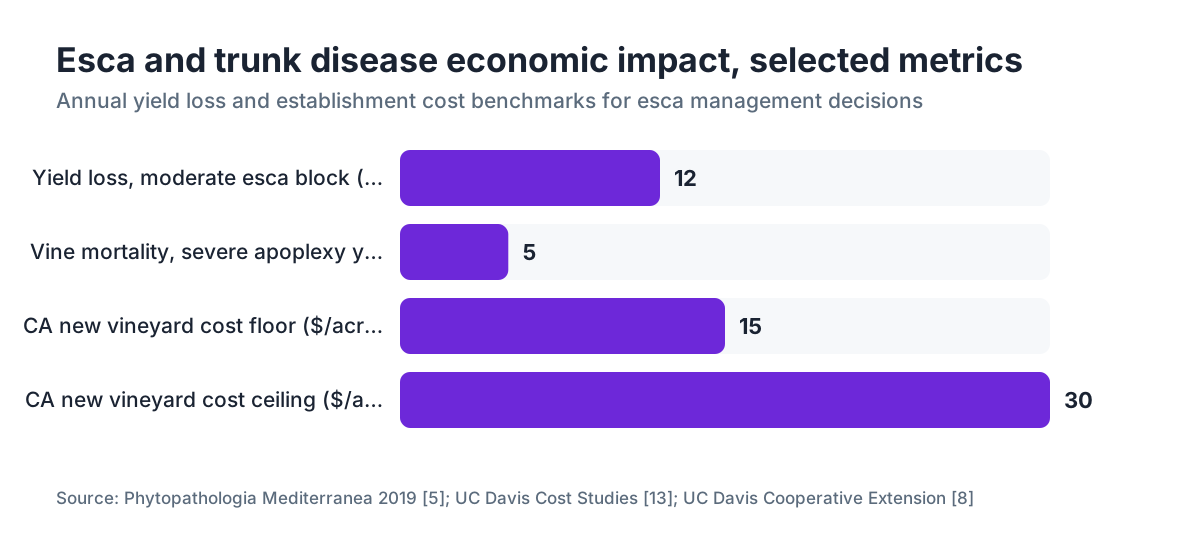
A study in Phytopathologia Mediterranea put annual losses in affected French vineyards at 10 to 15 percent of production in blocks with moderate incidence, rising toward total loss in severely affected old-vine blocks [5]. Italian surveys have recorded esca-related apoplexy killing 3 to 8 percent of vines per year during severe outbreak years in Tuscany [12].
In the United States, UC Davis estimates that trunk diseases as a group (esca, Eutypa, Botryosphaeria) cost California grape growers over $260 million a year in lost production and remediation, though pulling esca's specific share out of that number is not clean [8].
The replant side is clearer. Establishing a new vineyard in California runs roughly $15,000 to $30,000 per acre depending on variety, trellis, and land prep, with no commercial production for the first three to four years [13]. That's the real cost of losing a block to esca: the lost fruit, plus the replant investment, plus the gap in production while the new vines fill in.
Are there resistant rootstocks or varieties that reduce esca risk?
Short answer: no fully resistant rootstock or scion has been found. The longer answer has a few useful edges.
Some rootstock combinations show lower incidence in observational trials. 101-14 Mgt and 3309C have shown lower Pch colonization in some French trials than SO4 or 110R, but the results aren't consistent enough across regions to use rootstock choice as a primary control [4]. 5BB Kober, widely planted in Central Europe, runs more susceptible to black foot disease, the root-attacking part of the complex, which piles esca pressure on from below.
On the scion side, some clonal and varietal differences in symptom expression are real, but they seem to reflect how vines respond to infection rather than true resistance to colonization. A Chardonnay clone with fewer leaf symptoms may still be colonized just as heavily inside. That matters because you can't select your way out of the problem.
So if you're planting a new block on a site with esca history in nearby or previous plantings, your best moves are clean planting material from a certified nursery with low Petri disease rates, hard wound protection from the first pruning season, and late pruning. Rootstock selection is not a standalone strategy.
How does esca management interact with the EPA Worker Protection Standard?
Any biological or chemical wound protectant you apply triggers EPA Worker Protection Standard (WPS) requirements when workers or handlers are involved [10]. The WPS, at 40 CFR Part 170, requires agricultural employers to provide pesticide safety training, access to labeling, and personal protective equipment as the label specifies. It also sets a restricted-entry interval (REI) after application, during which only trained handlers in the right PPE may enter the treated area.
For wound protectants built on Trichoderma species (biologicals like Esquive WP and similar), the REI is typically 4 hours and PPE demands are light, but you still have to train workers and keep application records. For products containing thiophanate-methyl, registered for pruning wound use on grapevines in some states, PPE is more stringent and you follow the label exactly.
The WPS record-keeping requirement is separate from state pesticide record law, but in California, Oregon, Washington, and most other wine states, state law is at least as strict as federal WPS and often stricter. California's County Agricultural Commissioner system requires pesticide use reports (PURs) for all restricted materials, and many wound protectants qualify. Confirm what applies with your local County Agricultural Commissioner office.
VitiScribe's spray record module captures the fields both WPS and state PUR systems ask for, so one entry satisfies both and no gap surfaces in an inspection.
What does current research say about future esca management tools?
The esca research pipeline is busier now than it was ten years ago, partly because the European sodium arsenite ban forced growers to hunt for alternatives. A few threads are worth watching.
Biocontrol with Trichoderma remains the most advanced practical option. Trichoderma atroviride strain SC1, sold under various trade names in Europe, has shown steady wound-protection performance in multi-year Italian and French trials, cutting new Pch infections by 40 to 70 percent in young vines against untreated controls [3]. Not a cure, but a real effect.
Endotherapy, injecting fungicides straight into the trunk, has been tested with systemics including tebuconazole and propiconazole. Results are mixed. Some trials show temporary suppression of white-rot progression, others show nothing. The wood barrier is the problem: getting enough of anything to the infection site inside an old trunk is hard, and the evidence doesn't yet support recommending endotherapy as a reliable commercial tool.
Genetic work is ongoing. INRAE (France's national agricultural research institute) and several Italian groups are chasing genes tied to vine defense responses against Pch, aiming eventually to breed scion genotypes with better tolerance [6]. That work is at least a decade from commercial varieties even in the optimistic case.
For now the toolkit is late pruning, wound protection inside the proven 14 to 30 day window, removal of dead wood, and honest vine-by-vine monitoring so replant decisions rest on real trends instead of guesswork.
Frequently asked questions
Can you cure esca once a vine is infected?
No. No registered treatment eradicates esca fungi from a systemically infected vine. Sodium arsenite showed real field efficacy in older European trials but was banned in the EU in 2003 and is not registered for this use in the United States. Management means slowing disease progression, protecting healthy vines from new infections, and deciding when a symptomatic vine is no longer worth keeping.
How do I tell the difference between esca leaf symptoms and potassium deficiency?
Esca tiger-stripe symptoms show sharp interveinal banding: tissue between the veins turns yellow or brown while the veins stay green. Potassium deficiency scorches the margins and works inward evenly, with no clear vein-sparing pattern. Esca also tends to show mid-season on scattered individual vines rather than across a whole block, and it correlates with trunk decay visible on a cross-section cut.
What is apoplexy in grapevines and how fast does it happen?
Apoplexy is the acute, sudden-collapse form of esca. A vine that looked healthy wilts completely within 24 to 72 hours, usually in hot, humid weather. Leaves stay attached but go limp, often without full browning. It comes from the same Fomitiporia-dominated trunk infection that drives chronic esca, though the trigger for the acute collapse isn't fully understood. Vines that go apoplectic almost never recover.
When should I prune to reduce esca infection risk?
Prune as late as is practical before bud break. Later pruning shrinks the window for fungal colonization because the wound response speeds up in warming tissue. Washington State University extension recommends delaying pruning as long as frost risk and labor logistics allow. In warmer climates this is easy to manage. In colder regions you're balancing late pruning against frost damage on tender new growth.
How long do esca symptoms take to appear after initial infection?
Usually years to decades. Phaeomoniella chlamydospora and Phaeoacremonium species infect pruning wounds early in a vine's life, often in the first few pruning seasons. Leaf symptoms rarely appear before year 10 and become common after year 15 to 20. The long latency means vines showing symptoms today were probably infected a decade or more ago, well before the leaf signs were visible.
Do biological wound protectants actually work against esca?
The evidence supports them as a preventive tool, not a cure. Trichoderma atroviride products have shown 40 to 70 percent reductions in new Phaeomoniella chlamydospora infections in young-vine trials in Italy and France. They work by colonizing fresh wound surfaces before the pathogen can, so they need to go on within 24 to 48 hours of the cut. They have no meaningful effect on already-infected wood.
What records do I need to keep when applying esca wound protectants?
Under the EPA Worker Protection Standard (40 CFR Part 170), record the product name, EPA registration number, active ingredient, application date, location, rate, and applicator identity. Most U.S. wine states also require pesticide use reports to the county or state. California growers report to the County Agricultural Commissioner. Check local rules, because state requirements are often stricter than federal minimums.
Which grapevine varieties are most susceptible to esca?
No commercial variety is resistant. Chardonnay, Sauvignon Blanc, and Grenache tend to show leaf symptoms earlier and at higher incidence than Cabernet Sauvignon or Syrah in most comparative studies, but results vary enough by region and climate that variety should be treated as a secondary factor. Pruning practices, wound protection, and vine age are more reliable predictors of disease pressure in a given block.
How much can esca reduce my vineyard yield?
European research in Phytopathologia Mediterranea estimates 10 to 15 percent annual yield loss in moderately affected French blocks, with higher losses in severely infected old-vine blocks. In acute apoplexy years, Italian surveys have recorded 3 to 8 percent vine mortality per season. UC Davis estimates trunk diseases collectively cost California growers over $260 million a year, though esca's specific share of that figure is not separated out.
Can esca spread from vine to vine through roots?
Root-to-root spread of the main esca complex fungi has not been documented as a significant pathway. The primary route is airborne spores landing on fresh pruning wounds. Fomitiporia mediterranea grows fruiting bodies on dead wood that release spores within the block. Removing dead wood and stumps promptly cuts the local spore load, which is why leaving infected material in the row is a bad idea even after a vine dies.
Should I replant a block with more than 15 percent esca incidence?
At 15 percent symptomatic incidence you're at or past the threshold where saving individual vines gets hard to justify in most blocks. The real question is your cost recovery timeline. A block with 20-plus productive years ahead warrants a harder look at replant economics than one you'll harvest for five more years on a lease. Track vine-by-vine trend data over two to three seasons before committing either way.
Does trunk renewal work to manage esca?
Trunk renewal, retraining a new shoot from a sucker or low bud to replace an infected trunk, can extend vine life when the rootstock and base of the original trunk are still sound and uninfected. It works best as a targeted move on individual vines in an otherwise productive block. Expect two to four years before the renewed trunk contributes meaningfully to yield. If the rootstock crown shows white-rot decay, renewal won't help and roguing is the right call.
Are there any new treatments or esca vaccines on the horizon?
Nothing commercially available qualifies as an esca vaccine or curative treatment. Active research includes endotherapy with systemic fungicides (mixed results so far), improved Trichoderma biocontrol formulations, and genetic work at INRAE and Italian institutions aimed at identifying vine defense genes tied to reduced susceptibility. Realistically, new commercial tools are at least a decade away. Wound protection and late pruning remain the best options available now.
How do I set up an esca monitoring program for my vineyard?
Cornell University extension recommends a formal incidence count on a representative 10 percent sample of each block once a season, ideally late July through August when leaf symptoms peak in most U.S. regions. Record row and vine number, symptom type (foliar, apoplexy, or confirmed by wood inspection), and severity. Photograph representative cases. Trend the number year over year. That data set turns a vague sense the block is getting worse into a decision you can defend.
Sources
- Mugnai L, Graniti A, Surico G. Esca (Black Measles) and Brown Wood-Streaking: Two Old and Elusive Diseases of Grapevines. Plant Disease, 1999.: Esca is caused by a complex including Phaeomoniella chlamydospora, Phaeoacremonium species, and Fomitiporia mediterranea; apoplexy events can remove 5-15 percent of susceptible vines in a single hot season.
- Bertsch C et al. Grapevine trunk diseases: complex and still poorly understood. Plant Pathology, 2013.: Fomitiporia mediterranea is the white-rot basidiomycete responsible for spongy heartwood decay defining true esca; vascular streaking from Pch and Pm constitutes the Petri disease component.
- Gramaje D, Armengol J. Fungal Trunk Pathogens in the Grapevine Propagation Process: Potential Inoculum Sources, Detection, Identification, and Management Strategies. Plant Disease, 2011.: Pruning wounds remain susceptible to Pch and Pm colonization for 14 to 30 days post-cutting; Trichoderma atroviride applications within 24-48 hours reduce new infections by 40-70 percent in trial conditions.
- UC Davis Cooperative Extension, Viticulture and Enology: Trunk Diseases of Grapevines: No commercial variety is fully resistant to esca; Chardonnay and Sauvignon Blanc tend toward earlier and higher incidence than Cabernet Sauvignon in California comparative observations.
- Guerin-Dubrana L, Fontaine F, Mugnai L. Grapevine trunk disease in French and European vineyards: occurrence, distribution and associated disease-affecting cultural factors. Phytopathologia Mediterranea, 2019.: Berries from esca-symptomatic vines carry elevated phytotoxic compounds including vitisinol and oxyresveratrol; annual yield losses in moderately affected French blocks estimated at 10-15 percent.
- INRAE (French National Institute for Agriculture, Food and Environment) - Grapevine Trunk Diseases Research Program: Fomitiporia mediterranea produces basidiocarps on dead wood releasing airborne spores; INRAE research targets vine defense gene identification for future tolerance breeding.
- European Commission Regulation (EC) No 2076/2002 - Sodium arsenite withdrawal from plant protection products: Sodium arsenite was banned in the European Union in 2003 as a plant protection product.
- UC Davis Plant Pathology: Trunk Diseases Cost and Management in California Vineyards: UC Davis estimates trunk diseases collectively cost California grape growers over $260 million per year in lost production and remediation costs.
- Washington State University Extension: Grapevine Trunk Disease Management: WSU extension recommends delaying pruning as late as frost risk and labor scheduling allow to reduce the fungal colonization window on pruning wounds.
- U.S. EPA: Worker Protection Standard for Agricultural Pesticides, 40 CFR Part 170: WPS requires records of product name, EPA registration number, active ingredient, application date, location, rate, and applicator; REI compliance required after wound protectant application.
- Cornell University Cooperative Extension: Trunk Disease Scouting and Record-Keeping Protocols for Vineyards: Cornell extension recommends formal esca incidence counts on 10 percent of each block once per season in late July through August for repeatable trend data.
- Mondello V et al. Grapevine Trunk Diseases: A Review of Fifteen Years of Trials for Their Control with Chemicals and Biocontrol Agents. Plant Disease, 2018.: Italian surveys recorded apoplexy-related vine mortality of 3 to 8 percent per year during severe esca outbreak seasons in Tuscany.
- UC Davis Agricultural and Resource Economics: Sample Costs to Establish a Vineyard and Produce Wine Grapes, California: Establishing a new vineyard in California costs roughly $15,000 to $30,000 per acre depending on variety, trellis system, and land preparation, with no commercial production for three to four years.
Last updated 2026-07-11