Protecting vineyards from frost: a complete field guide
TL;DR
- Grapevines are most at risk when new shoots emerge in spring, usually below 30°F (-1°C).
- The main protection tools are wind machines, overhead irrigation, heaters, and smart site selection.
- Pair passive site management with at least one active method for the best odds.
- Act at 34°F in the bud zone to buy time before damage starts.
Why do grapevines freeze so easily in spring?
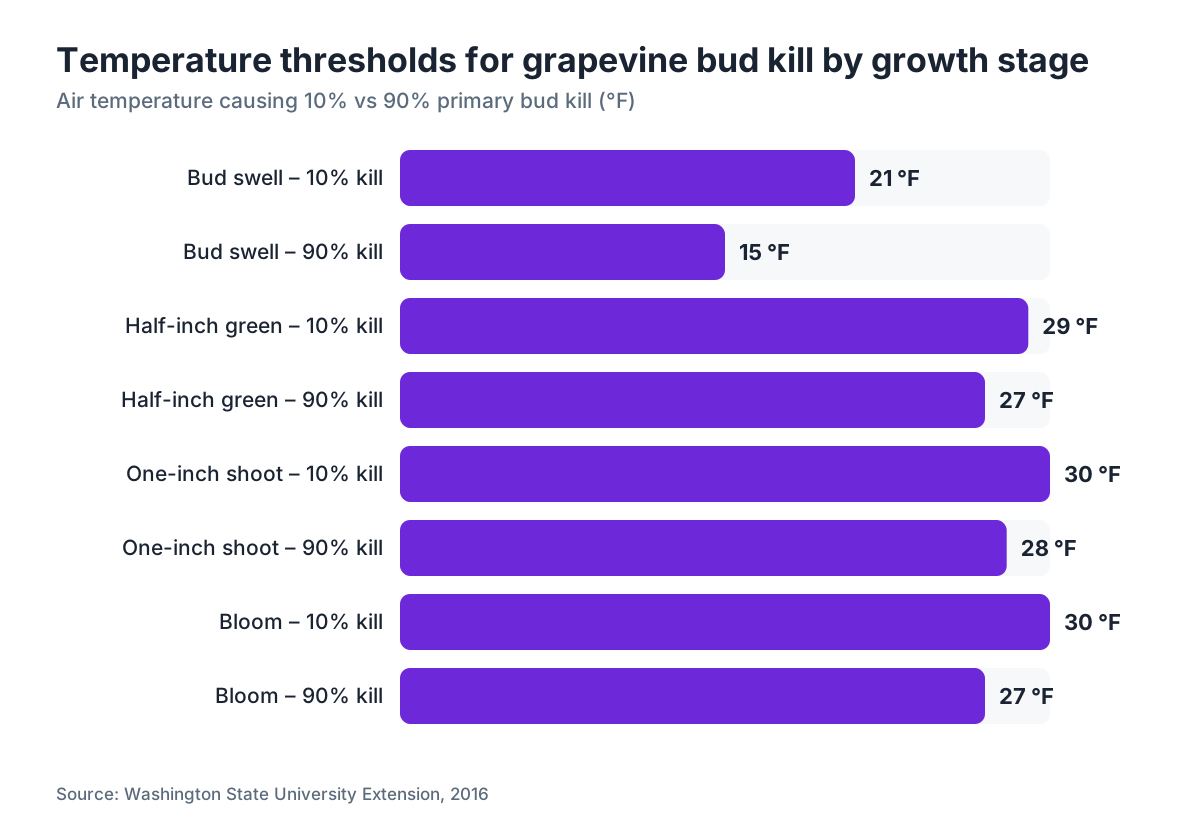
Grapes are tough in dormancy. A mature Vitis vinifera vine survives air temperatures well below 0°F in winter with little harm. Spring is the problem. Once buds break and new tissue starts growing, freeze tolerance drops fast. A green shoot at half-inch stage dies at 29°F (-1.7°C). A shoot at two inches is gone by 30°F (-1.1°C). [1]
The risky window runs from bud swell through bloom. After bloom the small berries tolerate slightly colder temperatures, but you're still not clear. Radiation frost, the most common vineyard type, happens on still, clear nights when the ground radiates heat upward and air temperature drops fastest right at ground level and in low pockets. That's why valley floors frost harder than hillside blocks. Cold air is denser and it drains downhill.
Advection frost is less common and harder to fight. It rides in on moving cold air masses, usually with wind, and blankets the whole landscape. Wind machines are nearly useless against it because there's no warm inversion layer above to mix down. Knowing which type you're facing changes your whole response.
The other thing that catches growers off guard is the gap between air temperature and bud temperature. On a clear, windless night, the bud surface can run 2 to 4°F colder than the air at four feet, where most weather stations sit. [2] Your thermometer says 33°F. Your Chardonnay buds are at 29°F. That gap has cost a lot of growers a lot of money.
What temperature damages grapevine buds and shoots?
It depends on growth stage, variety, and how long the cold lasts. Here's what the research consistently shows:
| Growth Stage | Temperature Causing 10% Bud Kill | Temperature Causing 90% Bud Kill |
|---|---|---|
| Dormant (mid-winter) | -5°F (-21°C) or lower | Varies widely by variety |
| Bud swell | 21°F (-6°C) | 15°F (-9°C) |
| Half-inch green | 29°F (-1.7°C) | 27°F (-2.8°C) |
| One-inch shoot | 30°F (-1.1°C) | 28°F (-2.2°C) |
| Two to four inches | 30°F (-1.1°C) | 28°F (-2.2°C) |
| Bloom | 30°F (-1.1°C) | 27°F (-2.8°C) |
Source: Washington State University Extension, 2016 [3]
Those thresholds assume the vine is exposed for at least 30 minutes. A quick dip to 29°F that recovers in ten minutes may do little. A sustained two-hour event at 28°F can wipe out the primary buds in a block entirely.
Variety matters too. Riesling and Gewurztraminer push early and sit more exposed than late-pushing varieties like Cabernet Sauvignon and Zinfandel. In cool climates, delaying dormancy with late pruning is one of the oldest tricks going, and we'll get to it below. [3]
Secondary buds are your backup. Each compound grapevine bud holds a primary, secondary, and tertiary growing point. If the primary dies, the secondary usually pushes within a week or two. The catch is that secondaries carry about 40 to 60 percent of the crop load of primaries in most Vitis vinifera varieties. You'll have a vine. You may have half a crop or less. [1]
What are the main active frost protection methods?
Active methods mean you do something during a frost event. They cost more to install and run, but they can hold your crop when temperatures fall past what passive management handles.
Wind machines. These are the most common active device in California, Washington, and Oregon wine regions. A standard propeller-style machine pulls warm air down from the inversion layer (the band of warmer air sitting 50 to 150 feet above the vineyard on radiation frost nights) and mixes it with the cold surface air. A well-sited machine protects 10 to 30 acres depending on terrain and fan power. [4] They work best when the difference between the inversion layer and the vineyard floor is at least 3 to 4°F. They do nothing against advection frost.
Electric machines are quieter and run remotely or automatically off a thermostat. Diesel machines cost less to install but carry more maintenance, and they don't run if you're out of fuel at 2 a.m. in March. Put temperature sensors at machine height and down near the bud zone so you can see whether the machine is actually doing anything.
Overhead sprinklers. When water freezes it releases latent heat, roughly 80 calories per gram. Overhead irrigation that keeps a thin layer of ice forming continuously on buds and shoots holds tissue near 32°F even when air temperature drops to 22°F or lower. [5] Continuous is the operative word. If the application rate is too low and the ice dries out, the evaporative cooling that follows speeds up the damage.
Application rates hinge on how fast the air is cooling and the wind speed. UC Davis extension says start at 34°F and don't stop until the ice melts on its own after sunrise. [5] Water use is heavy, often 0.10 to 0.15 inches per hour per acre, so water rights and storage are real limits. On drip irrigation, this method simply doesn't work.
Heaters and smudge pots. Propane and fuel oil heaters warm the air directly. They work on still nights but cost a lot per hour, and smoke from older smudge pots trips air quality violations in many California air districts. Modern propane heaters burn much cleaner. Plan on 30 to 40 heaters per acre for real coverage, and expect heavy fuel bills for a long event.
Helicopters. Helicopter protection runs on the same inversion-layer idea as wind machines but covers larger, irregular areas. Contract services operate in most major wine regions. The hourly cost is high (typically $400 to $800 per hour for a contract flight in California, depending on the agreement), but for a winery with one ultra-premium block it can pencil out. The pilot flies tight low circles, dragging warm air down.
Fogging systems. Microjet fogging throws a cloud of tiny droplets that raises humidity and slightly slows the temperature drop. Weaker than sprinklers, mostly a supplement. Don't lean on fog alone below 28°F.
What passive frost protection options work before a frost event?
Passive protection happens ahead of any frost, at planting or through seasonal management. You can't retrofit a hillside, but you can make smart calls every year.
Site selection. Cold air drains to the lowest point. Planting on a slope with open air drainage at the bottom, rather than a tree line or berm that dams up a cold pool, is the strongest long-term protection there is. A 5 to 10 percent slope facing south or west in the Northern Hemisphere also warms soils faster and pushes vines slightly later on average, trimming exposed days. [4]
Cover crop and tillage management. Bare soil soaks up more heat during the day and gives it back more slowly at night than soil under vegetation. Mowing or tilling cover crops before frost season and keeping the floor fairly bare raises nighttime bud-zone temperatures by 2 to 3°F. [4] Sounds trivial. It's the difference between 30°F and 33°F on a marginal night.
Delayed pruning. Pruning later holds the vine in a later dormancy phase and delays bud push by one to three weeks depending on timing. It's one of the cheapest tools you have, and it earns its keep on early-pushing varieties. Some growers leave longer spurs, then make a second pass to clean up once the main frost risk passes. The vine still crops normally, and you've shifted the phenology window to the right. [3]
Training system height. The temperature gradient near the ground on a frost night is steep. It can run 5 to 10°F colder at ground level than at waist height. Training vines higher, moving the fruiting zone from 12 inches to 24 or 30 inches, cuts exposure. High-wire cordon systems are popular in frost-prone regions partly for this reason.
Soil pre-wetting. Wetting the soil the day before a forecast frost adds thermal mass and slows the overnight drop. It's no silver bullet, but it's a free move if you already have irrigation.
How do you build a reliable frost monitoring and warning system?
No protection method helps if you're asleep when the temperature hits 29°F. A monitoring system isn't optional once you're running active protection.
Put temperature sensors at bud height (not the standard 4-foot meteorological height) in your two or three coldest blocks. Low spots, blocks near water bodies that drain cold air, and early-pushing varieties each deserve their own sensor. Log data at five-minute intervals or better.
Set alarms at 36°F, not 32°F. That 36°F trigger gives you 20 to 40 minutes to start a wind machine or get water flowing before the bud zone hits 30°F. Wake up at 32°F and you're already playing from behind.
Wireless monitoring with SMS or app alerts has gotten cheap over the past decade. Several systems run on cellular or LoRaWAN networks and cost $200 to $600 per sensor node plus $20 to $60 per month per node in subscription fees. That's cheap insurance against a lost vintage.
Public weather data is a starting point, not a stand-in for on-site sensors. The nearest NWS station may be two miles away and 200 feet higher. It will underpredict your frost risk every time. The National Weather Service frost forecasts and tools at weather.gov are useful for planning, but block-level decisions need block-level data. [6]
Many growers also run a simple wet-bulb calculation. Wet-bulb temperature accounts for humidity: on a dry night, evaporation off the vines themselves speeds up cooling. If relative humidity is below 40 percent at an air temperature of 34°F, your effective cooling rate outruns what the thermometer shows. Tools on WSU AgWeatherNet and CIMIS (California Irrigation Management Information System) factor this in. [7]
How much does vineyard frost protection cost?
Cost rides on method, block size, and how often you actually run the gear. Here's an honest range built from industry and extension estimates:
| Method | Installation Cost per Acre | Annual Operating Cost per Acre | Notes |
|---|---|---|---|
| Wind machine (electric) | $1,500 to $3,000 | $50 to $150 | Covers 10 to 30 acres per unit; per-acre cost drops with scale |
| Wind machine (diesel) | $1,200 to $2,500 | $100 to $300 | Fuel and maintenance add up |
| Overhead sprinklers | $1,800 to $3,500 | $80 to $200 | Water cost varies by event frequency |
| Propane heaters | $400 to $800 | $200 to $600 | High per-event fuel cost; rarely viable at scale |
| Frost monitoring sensors | $200 to $600/node | $240 to $720 (subscription) | Per-node, not per-acre |
Source: UC Cooperative Extension, Napa/Sonoma counties, cost of production estimates, 2022 [8]
For a 20-acre block, a single electric wind machine at $40,000 installed and amortized over 15 years runs about $180 per acre per year before electricity. Set that against the crop: at $3,000 per ton and 3 tons per acre, you have $9,000 per acre on the line. The math for active protection is usually plain.
Growers under 5 acres often find the per-acre economics of wind machines don't work unless they share a machine with a neighbor whose block sits next door. Overhead sprinklers scale down better if you already have the water infrastructure. A modest monitoring setup plus overhead sprinklers is often the best value for a 3 to 8 acre estate block.
What records do you need to keep for frost protection activities?
Frost protection itself isn't regulated the way pesticide application is, but the operations that run alongside it absolutely are, and your recordkeeping in the vineyard ties straight to your compliance standing.
Run propane heaters and your fuel logs matter for cost accounting and possibly for air quality permits in your district. California's South Coast AQMD and SJVAPCD both have rules around open burning and combustion during certain air quality conditions. Call your local air district before your first frost event of the season, not during one.
When frost damage leads to emergency pesticide applications (botrytis prophylactics after freeze injury are common), those applications require a Pesticide Application Record under California Food and Agricultural Code Section 12982, or the equivalent in your state. The EPA Worker Protection Standard (40 CFR Part 170) applies to any restricted-use pesticide your employees handle. [9] Log every application: product name, EPA registration number, rate, date, time, field ID, weather conditions, and applicator name.
Field records matter for crop insurance too. The USDA Risk Management Agency's Whole Farm Revenue Protection and its Nursery, Fruit Tree, and Vine program both want documentation of protection efforts and loss events for claim substantiation. [10] If frost hit and you ran your wind machines, log it: time on, time off, block, temperature readings. If you lost crop, photograph the damage with timestamps and keep the sensor data.
This is where a tool like VitiScribe pays off. Keep your temperature logs, equipment activation records, and frost notes in the same system as your spray records, and the paper trail is already sitting there when a crop insurance adjuster asks. It isn't extra work. It's the same work, organized once.
For operations in more than one state, note that Washington and Oregon run their own pesticide recordkeeping rules through their departments of agriculture. They parallel California's system without matching it exactly. WSU Extension's pesticide management guides are the clearest resource for Pacific Northwest operators. [11]
Which vine varieties handle frost better?
No Vitis vinifera variety is truly frost-tolerant in the spring growing season. The difference between varieties comes down to timing: when they push, and how well secondary buds crop when primaries die.
Late-pushing varieties are your friends on frost-prone sites. Cabernet Sauvignon usually pushes one to two weeks later than Chardonnay or Pinot Noir at the same location. On a marginal site, that timing gap can mean a full crop instead of a 50 percent crop in a bad year.
Varieties with fruitful secondary buds help you recover. Grenache, for one, carries better secondary fruitfulness than Cabernet Franc in most studies. Chardonnay has notoriously poor secondary fruitfulness, which is why a Chardonnay frost is so brutal: you lose the primaries and the backup plan is thin.
Hybrids like Marquette, Frontenac, and La Crescent, bred partly at the University of Minnesota, carry heavy cold-hardiness genes from native American Vitis species. They matter most to Midwestern and Northeastern growers, where winter kill is the bigger threat. Even they are exposed in spring once growth begins.
For a grower deciding what to plant in a known frost pocket, the honest advice is blunt: don't plant Chardonnay or Pinot Noir there. If they're already in the ground, delayed pruning plus overhead irrigation is your combination. Accept that some years run partial and price accordingly.
Cornell University's viticulture program has published widely on variety selection for cold climates in the Northeast, especially for sites in the Finger Lakes and Hudson Valley. [12] Their work applies directly to anyone dealing with marginal frost conditions.
How does climate change affect spring frost risk for vineyards?
The data here is genuinely messy, and the intuitive answer (warming means less frost) is only half right. Average spring temperatures are rising in most wine regions, and the average last frost date has shifted earlier by roughly one to two weeks over the past 50 years in California and the Pacific Northwest. [13]
But average dates don't capture the real risk. What growers keep seeing is vines pushing earlier on warmer cumulative March and early April temperatures, then late-season frost events that used to miss the vulnerable shoot stage now catching vines at half-inch or one-inch growth. The frost events themselves may not be more frequent or more severe. The phenological mismatch is worse.
A 2020 study in Nature Climate Change found freeze risk after bud burst has increased across European wine regions over the last 60 years, even as total frost days fell. The mechanism is exactly this: warming advances budbreak faster than it advances the frost-free date. [13]
For planning, that means sites that were marginal ten years ago may be reliably frost-damaged today with the varieties you planted back then. It also means frost protection gear that rarely ran in the 1990s may earn its operating cost every few years now.
Rethinking variety and rootstock selection to push phenology later, and putting money into better monitoring, are both reasonable moves. Waiting for the climate to settle down is not.
What should your vineyard frost response plan include?
A frost plan written down before the season starts beats heroic improvisation at 3 a.m. Here's what a working plan needs.
Know each block's risk profile. Which blocks sit low? Which carry early-pushing varieties? What's the earliest you've ever seen frost damage in your records? Map the risk zones.
Set clear action thresholds. When do you fire up wind machines? When does irrigation start? Most experienced growers set machine start at 34°F in the bud zone with temperatures still falling. Don't wait for 32°F.
Assign overnight monitoring. If it all lands on you alone, that's a fatigue risk over a multi-night event. Name who makes the call, who runs the equipment, and who checks fuel or water supply before a forecast frost.
Do pre-season equipment checks. Test your wind machine in February, not during the first frost. Fill propane tanks before March. Confirm irrigation pressure with the pump on.
Document every event. Temperature data, machine activation times, block observations the morning after: all of it. That feeds crop insurance, tax records, and your own year-over-year learning. After a few seasons of good records, you'll have a picture of your site that no forecast can match.
For a compact estate vineyard, a one-page laminated frost checklist tacked up in the pump house or equipment shed is a quietly effective tool. The 2 a.m. decision is not the moment to lean on memory.
How do you assess frost damage after an event?
Walk the vineyard the morning after a frost. Don't wait two days. Early assessment lets you make replanting, crop insurance, and spray timing calls while they still count.
Cross-section buds with a razor blade and read the tissue color. Green is alive. Brown or black is dead. Do this across each block, 10 to 20 buds per row, walking a grid. Keep a tally. If 60 percent of your primary buds are dead, you have a problem. If 20 percent are dead, you may recover close to normal yield when secondaries are fruitful.
Shoot damage shows up clearly by day one or two. Wilted, water-soaked shoots that turn black or gray are dead. Green shoots with no wilting are fine. Partly damaged shoots may look okay and then fail to set fruit properly.
Honest thresholds: if damage tops 50 percent in a premium block, call your crop insurance adjuster that day and start logging everything. Under 25 percent, secondary bud push and thinning management usually recover close to normal yield. The 25 to 50 percent range is the hardest call, and it turns on how fruitful your secondaries are.
After frost, botrytis pressure climbs sharply at wounded tissue. A fungicide application, ideally a botryticide labeled for early season, is often warranted within three to five days of the event. Record that application in your spray records.
To track spray applications, block notes, and frost event logs in one place, a tool like VitiScribe saves you the headache of pulling from three notebooks when you need a clean record for compliance or insurance.
Frequently asked questions
At what temperature should I start my wind machine?
Start at 34°F measured at bud height, not air temperature at standard weather station height. That threshold gives you 20 to 40 minutes before the bud zone drops to 30°F on a typical radiation frost night. Waiting until 32°F means you're already at risk. Set your automated alarm at 36°F so you're never catching up.
Can overhead irrigation protect vines below 25°F?
Under sustained, very high application rates, yes, but it gets difficult and risky below about 24°F. The ice layer must stay continuously wet. If application rate can't keep up with the heat loss at that temperature, the ice goes dry and evaporative cooling accelerates damage. Below 24°F for extended periods, overhead sprinklers alone usually aren't enough and heaters should supplement.
Does tilling the cover crop really help with frost protection?
Yes, meaningfully. Bare moist soil absorbs heat during the day and releases it more slowly than vegetated soil at night. UC Davis trials have shown a 2 to 3°F difference in nighttime bud zone temperature between bare tilled soil and a tall cover crop. That margin is enough to save a vintage on marginal frost nights in the 29 to 31°F range.
How far in advance can I predict a frost event accurately?
National Weather Service forecasts are reasonably accurate two to three days out for temperature ranges. At 24 to 36 hours, the forecast is usually reliable enough to start preparing equipment. Don't rely on five-day outlooks for protection decisions. Your own on-site sensor data from previous nights is the best short-term predictor: if temperatures dropped fast last night on the same synoptic pattern, they'll do it again tonight.
What is radiation frost versus advection frost and does it matter for protection?
Radiation frost happens on still, clear nights when the ground loses heat to the sky and surface air temperatures drop. It's the most common vineyard frost type, and it forms a warm inversion layer above the vineyard that wind machines can exploit. Advection frost arrives with moving cold air masses and often wind, and the inversion layer doesn't exist. Wind machines are largely useless against advection frost. Overhead irrigation is the better tool.
How late in spring can a damaging frost occur in California wine regions?
It depends heavily on location. On Napa Valley floor sites, late frosts have hit into early May in cold years. In the Willamette Valley, May frosts have damaged established vineyards. High-elevation Sierra Foothills sites can see frost through mid-May in cool years. Historical NOAA frost records for your county are the most reliable planning resource; don't assume the risk is over before bloom.
Do frost protection methods require any permits or compliance filings?
Generally no permit is required for wind machines or overhead irrigation. Propane or diesel heater use may need notification or be prohibited under air quality rules during certain conditions in California's Central Valley and South Coast districts. If you install a new pump or drill a well for frost water, water rights and permit requirements apply. Check with your county agricultural commissioner and local air quality management district before the season.
How do I estimate crop loss for insurance purposes after a frost?
Cross-section a representative sample of buds in each affected block (at least 50 buds per block) within 48 hours of the event. Record the percentage of dead primary and secondary buds per block, with photos. Contact your crop insurance agent or USDA Risk Management Agency adjuster immediately. Retain all temperature data from your sensors during the event. The RMA requires documented evidence of the event and protection measures taken.
Is delayed pruning really effective at avoiding frost damage?
Yes, and it's probably the most underused low-cost tool available. Delaying pruning by three to four weeks after your typical date can push bud break back by one to three weeks. Cornell and WSU Extension both document this effect. The tradeoff is that you may need a second pass to clean up canes, and in warm springs the delay narrows. But on frost-prone sites, the insurance value of later budbreak is real.
What happens to yield when only the primary buds are killed by frost?
It depends on the variety and how fruitful its secondary buds are. In Chardonnay, secondary fruitfulness is low: expect 30 to 50 percent of normal yield from secondaries. In Grenache or Zinfandel, secondaries can carry 60 to 80 percent of normal crop. Tertiary buds rarely produce commercially. Secondary shoot growth also arrives one to two weeks later, compressing the growing season and potentially affecting ripening in cool climates.
How much water does overhead frost protection irrigation require?
UC Davis recommends 0.10 to 0.15 inches per hour per acre as a baseline application rate for overhead frost protection. For a 10-acre block, that's 1 to 1.5 acre-inches per hour, or roughly 325,000 to 490,000 gallons per hour. Storage capacity, pump size, and water rights are real constraints. In water-limited regions, this method may simply not be feasible without significant infrastructure investment.
Do wind machines also help protect against advection frost?
No. Wind machines work by drawing down warm air from the inversion layer that forms above a vineyard on calm, clear radiation frost nights. In advection frost, the air mass is uniformly cold from ground level up through thousands of feet. There's no warm reservoir above to mix down. Running your wind machine in advection frost burns fuel or electricity for almost no benefit. Overhead irrigation is the only scalable active protection in that scenario.
What vine training height minimizes frost damage?
Higher is better. On a still frost night the temperature gradient near the ground is steep: 5 to 10°F colder at 12 inches than at 30 inches in many documented events. Moving the fruiting zone from 12 to 24 or 30 inches above the soil, as in a high-wire cordon system, reduces the frequency and severity of bud damage on marginal frost nights. It's not a complete solution but it costs nothing once the trellis is built.
Sources
- UC Davis Viticulture and Enology, Spring Frost and Grapevines: New grapevine shoot tissue can be killed at temperatures as low as 29 to 30°F during early spring growth stages; secondary buds carry 40 to 60 percent of primary bud crop potential in most Vitis vinifera varieties.
- UC Cooperative Extension, Napa County, Frost Protection in Vineyards: On clear still nights, bud surface temperature can be 2 to 4°F colder than air temperature measured at standard four-foot weather station height.
- Washington State University Extension, Frost and Freeze Protection for Horticultural Crops: Temperature thresholds for 10 percent and 90 percent bud kill by growth stage; delayed pruning can push bud break back one to three weeks.
- UC ANR Publication 21571, Frost Protection: Fundamentals, Practice, and Economics for Horticultural Crops: A standard wind machine protects 10 to 30 acres; bare soil management can raise nighttime bud zone temperatures by 2 to 3°F; hillside planting with open air drainage reduces frost exposure.
- UC Davis ANR, Overhead Sprinkler Frost Protection for Vineyards: Overhead irrigation should begin at 34°F and not stop until ice melts naturally; recommended application rate is 0.10 to 0.15 inches per hour per acre.
- NOAA National Weather Service, Frost and Freeze Forecasts: NWS provides frost forecasting tools and historical frost date data for planning seasonal vineyard frost risk windows.
- Washington State University AgWeatherNet: AgWeatherNet and CIMIS provide wet-bulb and humidity-adjusted temperature data useful for frost protection decisions.
- UC Cooperative Extension, Sample Costs to Establish a Vineyard and Produce Winegrapes, Napa and Sonoma Counties, 2022: Wind machine installation cost ranges from $1,200 to $3,000 per acre; overhead sprinkler system installation ranges from $1,800 to $3,500 per acre.
- EPA Worker Protection Standard, 40 CFR Part 170: The EPA Worker Protection Standard requires pesticide application records including product name, EPA registration number, rate, date, time, field ID, weather conditions, and applicator name for all restricted-use pesticide applications.
- USDA Risk Management Agency, Nursery, Fruit Tree, and Vine Insurance: USDA RMA crop insurance programs require documentation of frost protection measures and loss events for claim substantiation under the Whole Farm Revenue Protection and vine programs.
- Washington State University Extension, Pesticide Management Resources: Washington and Oregon maintain their own pesticide recordkeeping requirements that parallel but do not match California's system.
- Cornell University Viticulture and Enology, Cold Climate Viticulture Resources: Cornell research on variety selection for frost-prone sites in the Finger Lakes and Hudson Valley documents secondary bud fruitfulness differences across Vitis vinifera varieties and cold-climate hybrids.
- Nature Climate Change, 2020, Freeze risk to European viticulture: Freeze risk after bud burst has increased across European wine regions over 60 years even as total frost days decreased, because warming advances budbreak faster than the frost-free date.
Last updated 2026-07-09