Filter screen maintenance log for vineyard sprayer compliance
TL;DR
- A filter screen maintenance log records every inspection, cleaning, and replacement of the screens in your vineyard sprayer.
- Most state pesticide rules and the EPA Worker Protection Standard require you to keep equipment maintenance records for at least two years.
- A complete entry has the date, screen location, mesh size, condition found, action taken, and the initials of the person who did the work.
What is a filter screen maintenance log and why do regulators care about it?
A filter screen maintenance log is a written record, paper or digital, of every time someone on your crew inspected, cleaned, or replaced a filter screen on a vineyard sprayer. That's it. No mystery.
Regulators care for a simple reason: clogged or damaged screens are one of the most common causes of nozzle drift, uneven coverage, and off-target pesticide movement. When a state department of agriculture shows up for a pesticide use inspection, the first thing many inspectors pull is equipment maintenance records. If you can't show your sprayer was in working order when you made an application, you're on the wrong side of a potential violation. The label is a federal document with real teeth.
The EPA Worker Protection Standard (WPS), codified at 40 CFR Part 170, requires agricultural employers to keep application equipment maintained so it doesn't leak or expose workers. [1] The WPS doesn't name filter logs by title, but the maintenance obligation is real. State pesticide agencies, including the California Department of Pesticide Regulation (CDPR) and the Washington State Department of Agriculture (WSDA), go further by requiring written equipment maintenance records as part of pesticide use reporting. [2][3]
A log also saves you money. A screen that's 40% blocked cuts flow enough to change your application rate per acre without your rate controller catching it. That's wasted product and maybe a re-application. Growers who track screens on a schedule tend to find they're replacing them about half as often once they move from "clean it when it quits" to planned inspection.
What information does a filter screen maintenance log entry need to include?
Here's what a complete entry looks like. Each line in the log should carry:
- Date of inspection or service
- Sprayer ID or equipment name (if you run more than one machine)
- Screen location (tank strainer, pump inlet, line filter, nozzle body filter, end-cap filter)
- Mesh size or screen rating (mesh count or micron rating)
- Condition found (clean, partially blocked, damaged, torn)
- Action taken (cleaned and reinstalled, replaced, no action needed)
- Initials or full name of the person who did the work
- Application or field reference (optional but smart, ties the maintenance event to a specific spray record)
Some states want more. California's CDPR requires pesticide application records to include equipment identification as part of a complete pesticide use report. [2] Tying your maintenance log to your application records by sprayer ID makes an audit trivial to pass.
A field reference is optional on the maintenance log itself, but linking the two pays off. If a drift complaint ever surfaces, you pull the spray record, cross-reference the maintenance log, and show that all screens were clean and intact before that application. That paper trail matters.
One thing people routinely skip: mesh size. Write it down every time. Screens get swapped informally during the season, and a 50-mesh screen put back in a slot that needs 80-mesh changes your droplet spectrum without anyone realizing it. The log is the only way to catch that.
How often do vineyard sprayer filter screens need to be inspected?
There's no single federal number that says "inspect every X hours." That's the honest truth. What you find in authoritative sources is guidance keyed to equipment type, pesticide formulation, and operating conditions.
WSU Extension's pesticide program recommends inspecting all sprayer filters before every use during a spray season, cleaning or replacing as needed. [4] UC Davis recommends inspecting nozzle filters and end-cap screens before each application, and checking line filters and tank strainers at least every 10 operating hours, more often when running suspension concentrates or wettable powders. [5]
The table below gives a practical schedule that follows extension guidance:
| Screen location | Inspect | Clean | Replace (typical interval) |
|---|---|---|---|
| Tank strainer | Before every fill | When >10% blocked | Annually or when damaged |
| Pump inlet screen | Weekly during season | When restricted | Every 2-3 seasons |
| Line filter (main) | Before every use | When pressure drop >5 psi | Annually or when damaged |
| Nozzle body filter | Before every use | When blocked | Every season or when torn |
| End-cap filter | Before every use | When blocked | Every season or when torn |
Suspension concentrates and flowables plug nozzle filters faster than emulsifiable concentrates. If you're running a wettable powder or dry flowable, inspect end-cap filters mid-application on hot days, because product settles in lines and blinds screens quickly.
The honest answer on hours-based intervals: nobody has great universal data for wine grapes specifically. The closest guidance comes from USDA Agricultural Research Service sprayer work, which suggests high-volume tower sprayers running 8+ hours a day on dusty ranch roads should check line filters every 4 operating hours under those conditions. [6] Adjust for your own dust and formulation.
What are the compliance consequences of skipping sprayer filter records?
Missing records can cost you more than a lecture.
At the federal level, pesticide label violations under FIFRA Section 12 carry civil penalties up to $19,162 per violation per day (the inflation-adjusted figure as of 2024, per EPA's FIFRA civil penalty policy). [7] Equipment in disrepair that causes off-target movement is a separate potential violation. The label's directions for use, which include equipment maintenance language on many products, have the force of federal law.
At the state level, California's CDPR can issue notices of violation for incomplete pesticide application records, which legally include equipment identification, and can require corrective action plans for repeat offenders. Civil penalties under California Food and Agricultural Code Section 12999.5 reach up to $5,000 per violation. [8] Washington's WSDA has similar authority under RCW 17.21.
The more common real-world consequence isn't a fine. It's a failed audit that holds up your organic or sustainability certification. Programs like CCOF, Lodi Rules, and Fish Friendly Farming all require pesticide application equipment to be maintained and documented. An auditor who finds no filter maintenance records writes a corrective action request, and three of those in a certification cycle can cost you the certificate.
Worker protection is the other exposure. An employee who gets a pesticide exposure from a leaking or malfunctioning sprayer, where the leak traced back to a failed screen assembly, puts you in a much harder spot with OSHA if you have no maintenance records. The WPS specifically requires that application equipment be maintained so it doesn't drip or leak on workers. [1]
What mesh sizes and screen ratings do vineyard airblast sprayers typically use?
This is practical information that belongs in your log template so crews fill it in correctly.
Airblast sprayers in wine grape vineyards commonly run nozzle body filters in the 50-mesh to 100-mesh range. The match between screen mesh and nozzle orifice size matters. The general rule from Spraying Systems Co., confirmed by extension guidance, is that your screen should filter out particles larger than half the smallest orifice diameter in your nozzle set. [5]
Here's how mesh maps to micron size for the screens you'll encounter:
| Mesh count | Approximate opening (microns) | Common use |
|---|---|---|
| 20 mesh | 840 microns | Tank strainer (coarse pre-filter) |
| 50 mesh | 297 microns | Line filter for coarse nozzles |
| 80 mesh | 177 microns | Line filter for medium nozzles |
| 100 mesh | 149 microns | Nozzle body filter for standard flat fans |
| 200 mesh | 74 microns | Fine nozzle or drift-reduction nozzle bodies |
When a crew member replaces a screen and logs only "cleaned nozzle filter," you've lost the mesh information. Over a season, screens of different ratings end up in the wrong housings. Require mesh size on every log entry. It takes four extra seconds and kills a real source of application rate variability.
How do you build a filter screen maintenance log template from scratch?
You don't need special software to start, though a spreadsheet beats loose paper because it's searchable and harder to lose.
A workable paper log has six columns across a landscape page: Date, Sprayer ID, Screen Location, Mesh Size, Condition Found, Action Taken, and Tech Initials. Leave a narrow "Notes" column on the right for anything odd (unusual discoloration on a screen, suspected incompatibility residue, and so on).
A small operation running one sprayer might log 40-50 entries over a full season. A larger farm with three or four machines and active spray programs could pile up 150+ entries per season. At that scale, a spreadsheet with dropdown validation for screen location, condition, and action is much faster for crews to fill out, and much faster for you to filter when an auditor asks, "Show me every screen replacement on Sprayer 2 between April and June."
Record-keeping tools built for vineyard operations, like VitiScribe, let you attach filter maintenance entries directly to the matching spray record so the two are linked by date and equipment ID. That's genuinely useful during audits because you don't have to cross-reference two separate documents by hand.
One design tip: put the sprayer's filter map (a simple diagram showing where each screen sits) on the back of the paper log sheet. New employees who haven't seen your exact machine won't guess at location names and log "nozzle" when they mean the line filter. Ambiguous location names are the most common audit problem with these logs.
How long do you need to keep vineyard sprayer maintenance records?
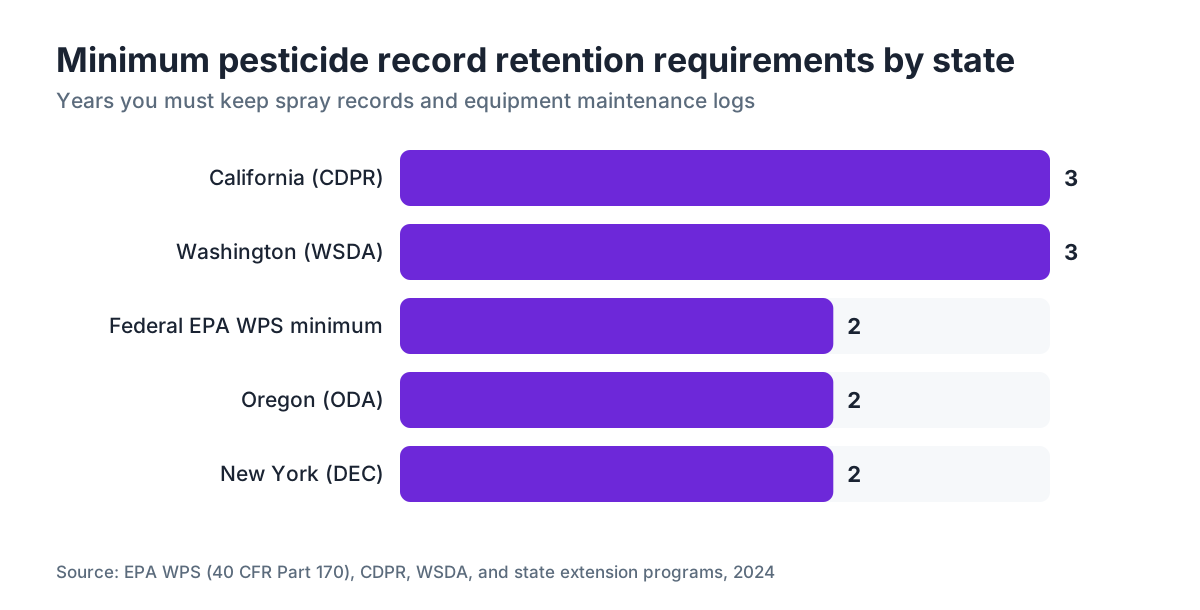
Two years is the federal floor. The EPA WPS requires pesticide application records, including equipment records, to be kept for two years from the date of application. [1]
California requires pesticide application records to be maintained for three years under California Food and Agricultural Code Section 12981. [8] Since your filter maintenance records tie to your application records, keep everything on the same retention schedule, which means three years if you farm in California.
Washington's WSDA also requires three years for pesticide use records. [3] Oregon's ODA requires two years. New York's DEC requires two years. If your state isn't listed here, check your department of agriculture website or extension service, because the floor is two years and several states have gone to three.
Digital records are fine in every state that has addressed the question, as long as you can produce a legible copy on request. Keep a backup. One farm I know of lost two years of spray records when a laptop died and the only backup lived on the same machine. Cloud sync or a weekly export to a second location solves this.
What does the EPA Worker Protection Standard actually say about sprayer maintenance?
The WPS at 40 CFR Part 170 is the primary federal regulation governing pesticide safety for agricultural workers and handlers. [1] The language on equipment maintenance sits in the handler employer requirements section.
Specifically, 40 CFR 170.309(a) requires that handler employers make sure all application equipment is "inspected for leaks, obstructions, and improper operation" before each use, and that malfunctioning equipment is repaired or replaced before it runs again. The regulation uses "obstructions" to cover blocked filters and screens, though it never uses those words directly.
EPA's WPS guidance states that handler employers "must ensure that handlers are trained, supervised, and provided with the appropriate personal protective equipment and safety requirements," and that equipment in a state of disrepair that leads to handler exposure is a WPS violation. [1]
Cornell's Pesticide Management Education Program, which produces some of the most practical WPS compliance resources out there, notes that equipment inspection records are the most auditable proof that an employer met the pre-use inspection requirement. [9] Without a log, you're relying on testimony.
The upshot is plain: the WPS doesn't hand you a filter log form, but it creates the legal duty to inspect before each use, and a log is the only defensible way to show you did it.
What's the best way to train vineyard crews to fill out filter screen logs correctly?
Training takes about twenty minutes if you do it at the sprayer, not in a conference room.
Start with a walk-around of the machine. Show each screen location, name it, and point out what mesh size lives in it. Have the trainee pull and reinstall one screen while you watch. Most incomplete log entries come from people who aren't sure what they're looking at, not from people who don't care.
Then set a completed log entry next to a blank one. Walk through each field. Have them fill out a practice entry on paper or in the software right there. Check it. Correct it.
WSU Extension's pesticide handler training materials include a section on equipment inspection you can build your own training documentation from. [4] If you're in California, CDPR's licensed pest control adviser network can help you draft a site-specific training outline. [2]
For seasonal workers who rotate through multiple machines, laminate a one-page reference card for each sprayer that lists screen locations, mesh sizes, and what "clean," "partially blocked," and "damaged" look like with photos. Attach it to the sprayer itself. The log gets filled out accurately when the reference material is right there.
Document the training. An attendance sheet with dates and the content covered goes in the same binder as the maintenance log. If a WPS inspector asks whether your handlers were trained on equipment inspection, you hand them the sheet.
How does filter screen maintenance connect to pesticide application record accuracy?
This connection is underappreciated, and it's where the agronomic and compliance worlds meet.
A partially blocked screen changes your effective nozzle flow rate. If end-cap filters on 30% of your nozzles are 50% blocked, your actual gallons per acre is lower than what your rate controller thinks. Your application record might say you applied 50 gallons per acre at the labeled rate, but you applied less. That's a material inaccuracy in a legal document.
The inverse happens with a screen that's missing entirely, which happens when a crew member reinstalls a housing without the screen. Flow through that nozzle jumps, droplets run larger or in a different pattern, and you're out of spec again.
State pesticide use reports require the application rate to be recorded accurately. California's CDPR treats a materially inaccurate use report as a separate violation from incomplete records. [2] The filter log is the document that lets you say with confidence that your sprayer performed as designed when the application went out.
There's also the efficacy angle. Botrytis control programs in wine grapes depend on complete, uniform coverage. A blocked filter that leaves a skip pattern in your canopy can mean a disease outbreak that costs far more than any fine. The log is both a compliance tool and a production quality control tool.
If you use VitiScribe or any other field operations software, link each maintenance log entry to the next spray event so you have a continuous audit trail from equipment prep through application to outcome.
Are there extension or university resources with free filter log templates?
Yes, a few.
UC Davis's Agriculture and Natural Resources (ANR) program publishes pesticide record-keeping resources that include equipment maintenance guidance, though a standalone filter-screen log template hasn't been published as of this writing. Their pest management guidelines live at ipm.ucanr.edu and include equipment calibration sections that cover screen maintenance. [5]
WSU Extension's integrated pest management program publishes sprayer calibration and maintenance worksheets. Their Pacific Northwest Extension publications include material on airblast sprayer maintenance that covers filter inspection. [4]
Cornell Cooperative Extension's Pesticide Management Education Program (PMEP) has a deep library of record-keeping templates and equipment inspection guides. Their site at pmep.cce.cornell.edu is the best single university resource for pesticide handler record templates in the Northeast. [9]
The National Pesticide Information Center (NPIC), a cooperative agreement between Oregon State University and EPA, keeps a grower resources section that links to state-specific record-keeping requirements and some downloadable templates. [10]
If you want a template right now and can't find one through extension: set up a spreadsheet with the eight fields listed in the earlier section, save it as a template, and you're done. It doesn't need to be a published form to be a valid legal record. What matters is that entries are made contemporaneously, meaning at the time of inspection, not reconstructed later.
Frequently asked questions
Is a filter screen maintenance log legally required for vineyard pesticide compliance?
No federal regulation names a filter screen maintenance log specifically, but the EPA Worker Protection Standard (40 CFR 170.309) requires handler employers to inspect application equipment for leaks and obstructions before each use. California CDPR and WSDA require equipment identification and maintenance documentation as part of pesticide use records. In practice, a log is the only defensible proof you met the inspection requirement.
How long do I need to keep sprayer maintenance records in California?
California requires pesticide application and related equipment records to be kept for three years under California Food and Agricultural Code Section 12981. Most other states require two years, matching the federal WPS minimum. Since filter maintenance records tie to application records, keep them on whichever retention schedule is longer for your state.
What mesh size should airblast sprayer nozzle filters be for wine grape applications?
Most wine grape airblast sprayer nozzle body filters run 80-mesh to 100-mesh (177 to 149 microns). The general rule is that screen openings should be smaller than half the narrowest nozzle orifice diameter in your set. Running suspension concentrates or wettable powders may call for finer filtration. Log the actual mesh size at every inspection so you can catch mismatched screens.
How do blocked filter screens affect my pesticide application rate?
A partially blocked screen reduces flow through affected nozzles, dropping your actual gallons per acre below what your rate controller calculates. That makes your spray record inaccurate, can constitute a label violation if the rate falls outside the labeled range, and reduces efficacy on the target pest or disease. Uniform coverage in wine grapes depends on every nozzle flowing at spec.
Can I keep vineyard sprayer maintenance records digitally, or do I need paper?
Digital records are accepted by EPA, CDPR, WSDA, and most state pesticide agencies, as long as you can produce a legible printed or on-screen copy on request. The key requirement is that entries are made at the time of inspection, not reconstructed after the fact. Back up digital records off-device; a single laptop failure has cost growers their entire compliance history.
What should I do if a crew member finds a torn or missing filter screen mid-season?
Stop. Replace the screen before the next application. Log the date, the damaged or missing screen, and what replacement went in, including mesh size. If an application already went out with the compromised screen in place, note that in the log and think through whether rate and coverage were materially affected. Talk to your licensed pest control adviser about whether a reapplication is warranted.
Does the EPA Worker Protection Standard require me to document sprayer filter inspections?
The WPS (40 CFR 170.309) requires pre-use equipment inspection for leaks and obstructions but doesn't specify a log format. EPA's WPS enforcement guidance, though, treats documentation as the practical proof of compliance. Cornell's Pesticide Management Education Program recommends equipment inspection records as the most auditable evidence that the WPS pre-use inspection requirement was met.
How often should I replace, rather than clean, vineyard sprayer filter screens?
Tank strainers and pump inlet screens typically last one to three seasons if they aren't physically damaged. Nozzle body filters and end-cap filters should be replaced whenever the screen material is torn, distorted, or corroded, and proactively each season for high-use machines. UC Davis guidance recommends replacing any screen showing visible deformation regardless of whether flow seems normal. Log every replacement with the mesh size of the new screen.
What should a vineyard sprayer filter screen log look like for an organic certification audit?
Organic certifiers like CCOF want to see that equipment is maintained to prevent contamination and ensure accurate application. Your log should show dated, contemporaneous entries for every pre-season setup and in-season inspection, with the technician's initials. Auditors commonly ask for the last two seasons of records. Entries that are clearly back-filled or grouped in batches raise questions. Keep the log current, one entry per actual inspection event.
Do Lodi Rules or Fish Friendly Farming require a specific sprayer filter log format?
Neither Lodi Rules for Sustainable Winegrowing nor Fish Friendly Farming prescribes a specific log format, but both programs require documented equipment maintenance as part of their pesticide risk reduction metrics. Any legible, contemporaneous log meeting the content standards in state pesticide records requirements will satisfy the audit. Ask your certifier for their specific checklist before your next audit cycle.
Can a state pesticide inspector ask to see my filter screen maintenance log during a field visit?
Yes. State pesticide inspectors in California, Washington, Oregon, and most other wine-producing states have authority to review all pesticide application records, which include equipment records, during a field or office inspection. You're generally required to produce records within a defined window, often 72 hours, though California can request them immediately for an ongoing investigation. Keep records accessible, not buried in off-site storage.
What's the difference between a tank strainer, a line filter, and a nozzle body filter?
A tank strainer sits inside the spray tank and catches gross debris during fill. A line filter sits in the plumbing between the pump and the boom or tower, protecting the whole system. Nozzle body filters (also called end-cap or tip strainers) sit inside each individual nozzle body and are the last line of defense before product leaves the nozzle. Each is a separate log entry because each has a different mesh size and failure mode.
Should my filter screen maintenance log be kept separate from my pesticide spray records or combined?
Either works legally, but linking them by sprayer ID and date is strongly recommended. A combined record, where one document or linked database entry shows both the maintenance status and the application made, is far easier to work through during an audit. If you keep them separate, use a consistent sprayer ID and date format in both so you can cross-reference quickly under pressure.
Sources
- EPA, Worker Protection Standard (40 CFR Part 170): EPA WPS requires handler employers to ensure application equipment is inspected for leaks and obstructions before each use and maintained to prevent handler exposure; records must be retained for two years.
- California Department of Pesticide Regulation, Pesticide Use Reporting: California CDPR requires pesticide application records to include equipment identification; records must be retained for three years under California Food and Agricultural Code Section 12981; civil penalties reach $5,000 per violation under Section 12999.5.
- WSU Extension, Pesticide Safety Education Program: WSU Extension recommends inspecting all sprayer filters before every use during the spray season and provides calibration and maintenance worksheets for airblast sprayers.
- UC Davis IPM, Pest Management Guidelines and Sprayer Calibration: UC Davis recommends inspecting nozzle filters and end-cap screens before each application and checking line filters and tank strainers at least every 10 operating hours; screen openings should be smaller than half the narrowest nozzle orifice diameter.
- USDA Agricultural Research Service, Pesticide Application Technology: ARS sprayer calibration work suggests high-volume tower sprayers operating 8+ hours per day in dusty conditions should check line filters every 4 operating hours under those conditions.
- EPA, FIFRA Civil Penalty Policy and Inflation Adjustments: FIFRA Section 12 civil penalties for pesticide label violations reach up to $19,162 per violation per day as of the 2024 inflation-adjusted penalty schedule.
- California Legislative Information, Food and Agricultural Code Sections 12981 and 12999.5: California Food and Agricultural Code Section 12981 requires three-year retention of pesticide application records; Section 12999.5 sets civil penalties up to $5,000 per violation for record-keeping violations.
- Cornell Cooperative Extension, Pesticide Management Education Program (PMEP): Cornell PMEP notes that equipment inspection records are the most auditable proof that an employer met the WPS pre-use inspection requirement and publishes pesticide handler record-keeping templates.
- National Pesticide Information Center (NPIC), Oregon State University and EPA cooperative: NPIC maintains grower resources linking to state-specific record-keeping requirements and downloadable templates for pesticide application records.
Last updated 2026-07-10