Vineyard spray equipment inspection checklist and maintenance log
TL;DR
- A full vineyard sprayer inspection covers nozzles, pressure gauges, hoses, filters, pump output, and calibration at least twice a season.
- Your maintenance log has to record each inspection date, product applied, operator name, and corrective actions to satisfy EPA Worker Protection Standard rules and most state pesticide reporting laws.
- A blank log during an audit or a drift complaint puts you on the defensive from the first question.
Why does spray equipment inspection matter for vineyard compliance?
Worn sprayers cost you twice: once in wasted chemical, again in regulatory exposure. A single worn nozzle can drift 20 to 40% off its rated output. That means you're over-applying (a label violation under FIFRA) or under-applying and leaving holes in your disease control. Neither is free.
The federal floor is clear. The EPA Worker Protection Standard (40 CFR Part 170) requires pesticide application equipment be inspected for leaks before each day of use [1]. That's not advice. If an inspector shows up after a drift complaint and your log is empty, you're already losing the argument no matter what actually happened in the field.
States stack more on top of that baseline. California's Department of Pesticide Regulation requires written pesticide use records within 30 days of application and can subpoena your equipment maintenance records during an investigation [2]. Washington State University Extension notes that calibration errors of 10% or more show up regularly in airblast sprayers nobody has touched since the last season [3].
The practical case is just as strong. A mid-season pump failure during a tight powdery mildew window costs you far more than the 30 minutes a spring inspection takes. And a log tells you things a memory won't: that the left-side manifold always clogs first, or that your diaphragm pump wants fresh valves every 200 operating hours. That pattern is worth real money.
What should a pre-season vineyard sprayer inspection cover?
The pre-season inspection is the one that matters most. Do it before you mix a drop of product, ideally 2 to 3 weeks ahead of your first planned application so you have time to order parts.
Work through these 15 points in order:
| # | Inspection Point | What to Check | Pass/Fail Criterion |
|---|---|---|---|
| 1 | Nozzle orifices | Wear, clogging, spray pattern | Output within ±10% of new nozzle rating [4] |
| 2 | Nozzle check valves | Drip after shutoff | No drip within 3 seconds of shutoff |
| 3 | Nozzle screens/filters | Debris, corrosion | Clean, no deformation |
| 4 | In-line filters (strainers) | Mesh damage, sediment buildup | Clean mesh, no bypass flow |
| 5 | Pressure gauge | Accuracy vs. known reference | Within ±5 PSI of reference gauge |
| 6 | Hoses and connections | Cracks, abrasion, swelling | No visible damage; no weeping at fittings |
| 7 | Pump output | Flow rate at rated RPM | Within ±5% of manufacturer spec |
| 8 | Tank and agitator | Cracks, residue, agitator function | Tank sound, agitator moves freely |
| 9 | Tank rinse system | Rinsate nozzle function | Full 360° coverage confirmed |
| 10 | PTO shaft and shields | Guard intact, shaft play | Guard present; no excessive play |
| 11 | Boom or air duct alignment | Physical damage, symmetry | Even airflow or boom level within 2° |
| 12 | Control valves | Smooth operation, no sticking | Opens/closes without excessive force |
| 13 | Pressure regulator | Holds set point under load | Stable within ±2 PSI over 30 seconds |
| 14 | Ground speed sensor/GPS unit | Calibration if rate-controller equipped | Speed reads within ±2% of measured speed |
| 15 | Safety equipment | First-aid kit, eyewash, PPE on board | All items present and within expiration |
The nozzle check earns extra time. UC Davis Cooperative Extension recommends testing each nozzle on its own with a graduated cylinder for 30 seconds at operating pressure [4]. Any nozzle running more than 10% above or below the average of every nozzle on the machine gets replaced before the season starts. Nozzles are cheap. Drift complaints are not.
Airblast sprayers get one more step. WSU Extension advises checking fan blade condition and belt tension separately, because fan blade erosion shifts your droplet size distribution in ways the pressure gauge never catches [3].
How do you calibrate a vineyard airblast sprayer and record it correctly?
Calibration confirms the sprayer actually puts out the volume per acre the label calls for. You need three numbers: nozzle output (gallons per minute), ground speed (miles per hour), and effective swath width (feet). Those three feed the standard formula:
GPA = (GPM × 5,940) / (MPH × W)
GPM is total nozzle output, MPH is your field speed, and W is effective spray width in feet. The 5,940 constant handles the unit conversion.
Run it on a flat, representative block at the exact speed you'll use in that block. Don't calibrate on the headlands and assume the number holds on a steep hillside row. Slope changes tractor speed enough to throw everything off.
The calibration record should capture the date, the operator, the tractor and sprayer serial numbers, the nozzle type and age, the measured GPM per nozzle, the average GPM, the measured ground speed, the calculated GPA, and the target GPA from the label. If those last two sit more than 10% apart, adjust and recalibrate before you spray anything.
Log the result even when it passes. State auditors and USDA organic certifiers both ask for calibration documentation, and "we always get it right" doesn't hold up without records behind it.
What does an in-season inspection checklist look like?
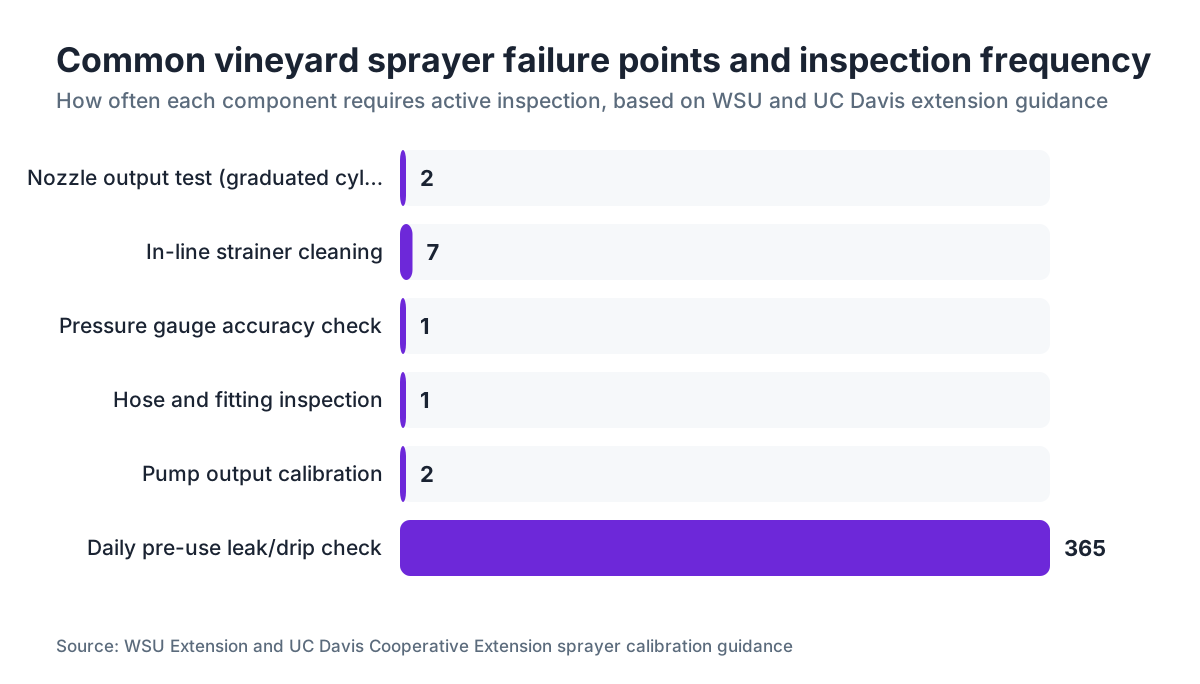
The pre-season inspection is thorough. The in-season one is fast, and it happens every single day of use. The EPA WPS requires it, and it takes under 10 minutes once it's habit [1].
Daily pre-use walk-around:
- Check all hose connections for seeping or spray mist while running water through the system
- Inspect nozzle spray pattern by eye (a flashlight helps in early morning)
- Confirm the pressure gauge reads at set point
- Check the PTO shield is in place before coupling to the tractor
- Verify safety equipment is on board (see item 15 above)
- Watch tank level and agitator function while filling
Weekly during active spray season:
- Pull and clean every in-line strainer
- Re-test at least one nozzle from each side of the machine with a graduated cylinder
- Torque check the hose clamps if you're running a high-vibration orchard sprayer
- Check pump oil level (piston/diaphragm pumps) or grease fittings (roller pumps vary)
Log each daily check with the date, operator initials, any anomaly found, and what you did about it. "No issues" is a valid entry. A blank line is not.
A digital field records platform like VitiScribe lets the daily checklist get done on a phone in the field, with the timestamp added for you. That kills the "I did it but never wrote it down" gap that sinks most paper systems.
What records does the EPA Worker Protection Standard require for spray equipment?
The EPA WPS (40 CFR Part 170, revised 2015) covers agricultural workers and pesticide handlers on farms that use hired or contracted labor [1]. The equipment rules live in the handler protection section.
The standard requires handlers inspect application equipment for leaks before each day of use and keep it in proper operating condition. The regulation states: "The handler employer must ensure that... pesticide application equipment is inspected for leaks, clogs, and other defects before each day of use and that damaged or leaking equipment is repaired before use or removed from service" [1].
The WPS doesn't dictate a log format, but it does require that training records, safety data sheets, and central posting information be kept. In practice, inspectors read your equipment maintenance records as evidence of whether the handler program is run seriously. A clean log is your best defense.
Separate from WPS, the Federal Insecticide, Fungicide, and Rodenticide Act (FIFRA, 7 U.S.C. § 136 et seq.) makes any application inconsistent with the label a federal violation [5]. If a worn nozzle caused off-label drift, a missing maintenance log makes it much harder to argue the equipment was sound.
Certified organic operations carry one more requirement. USDA National Organic Program regulations (7 CFR Part 205) require equipment used to apply prohibited substances be cleaned before use with organic materials, and that the cleaning be documented [6]. That's yet another reason the log has to exist.
How should you format a vineyard spray equipment maintenance log?
The format matters less than the habit of filling it in. Paper binders work. Spreadsheets work. Purpose-built field software works. What fails is anything that depends on someone remembering to write it up later.
A workable paper or spreadsheet log has these columns:
| Field | Why It Matters |
|---|---|
| Date | Time-stamps the record for audit purposes |
| Sprayer ID / serial number | You may have more than one machine |
| Operator name | WPS handler accountability |
| Pre-use inspection (pass/fail) | Documents the daily check |
| Defects found | Be specific: "left manifold nozzle #3 clogged," not "checked OK" |
| Corrective action | What you did, or "deferred to end of season" with a reason |
| Parts replaced | Part number, supplier, cost (handy for budgeting) |
| Calibration result | GPA calculated, GPA target, pass/fail |
| Operating hours (if meter present) | Tracks pump service intervals |
| Signature | Operator, plus supervisor for significant repairs |
Keep records at least two years. California DPR requires pesticide use records for three years [2]. Some crop insurance policies and GAP/GMP audits ask for up to five. When you're unsure, keep them longer.
One habit pays for itself: note the odometer or operating-hour reading every time you do a repair. After two or three seasons you'll have a real picture of your cost-per-acre to run the machine, which tells you when it's time to replace it.
How often should you replace vineyard sprayer nozzles?
This is where most small vineyards leave money on the table. Nozzles wear out. Ceramic outlasts stainless, stainless outlasts brass, but every one of them drifts out of spec eventually.
The threshold is simple: replace a nozzle when it outputs more than 10% above its rated flow [4]. Past that point you're over-applying by at least 10% across the whole machine, which hits your per-acre chemical cost, your label compliance, and sometimes your pre-harvest interval math.
A moderate-use vineyard sprayer running 15 to 20 applications a season through brass nozzles may need replacement every year. Stainless in the same pattern often lasts 2 to 3 seasons. Ceramic can run 5-plus seasons on clean water with good filtration. Nobody has solid population-level data on this for vineyards specifically. The closest work comes from orchard spray research at Cornell and UC Davis, which puts brass nozzle service life around 10,000 to 15,000 gallons of throughput before it crosses the 10% wear line [4].
Keep the old nozzles when you swap them. They make useful reference samples if anyone ever questions whether the equipment was worn on the day of an application.
What are the most common spray equipment failures in vineyards and how do you prevent them?
Pump failure tops the list, then nozzle clogging, pressure regulator drift, and hose failures at connections. Here's the honest breakdown by failure mode.
Pump wear is sneaky because it's gradual. Output drops 5% over a season and nobody notices until calibration is off by 15%. Check pump output at the start of each season, and again mid-season if you're doing more than 10 applications. Piston and diaphragm pumps need valve and diaphragm replacement on a schedule; most manufacturers say every 200 to 300 operating hours, but read your manual because it varies.
Nozzle clogging happens fast when there's product buildup or a filler material in a wettable powder formulation. The fix is a strainer mesh sized below your smallest nozzle orifice. Most airblast sprayers should run 50-mesh strainers at the tank screen and 100-mesh at the individual nozzle bodies.
Pressure regulator creep is maddening. You set 100 PSI, come back two hours later, and you're running 115. Clean the regulator seat at the start of each season. If it won't hold set point within ±5 PSI, replace it before you spray. A $40 regulator is not where you save money.
Hose failures at fittings almost always come from UV degradation plus vibration. Inspect the last 6 inches of hose at every connection point. Surface cracking or a stiff feel means replace it. A hose blowout during application is a stop, a cleanup, a possible exposure, and a lost application window all at once.
WSU Extension's pest management resources and Cornell's integrated pest management program both cover sprayer maintenance inside their disease management guides for wine grapes [3][7].
How does spray equipment maintenance connect to pesticide drift liability?
A drift complaint is the fastest way to get a state DPR investigator standing in your vineyard. When a neighbor reports drift, the investigator asks for your pesticide use records, your equipment maintenance log, and your calibration records. If those show worn nozzles run at too-high pressure on a day with 15 mph wind, you have a problem.
Flip it around. If the records show you calibrated the week before, replaced nozzles when they crossed the 10% wear threshold, and noted that you held the application two hours that morning to let winds drop below 10 mph, you have documentation. It doesn't automatically clear you, but it shifts the evidentiary picture a long way in your favor.
EPA's pesticide drift policy and FIFRA label requirements treat equipment condition as part of following the label [5][8]. Most fungicide and insecticide labels used in vineyards carry language prohibiting application when conditions cause off-target drift. A clean maintenance log is evidence you were trying to follow those directions.
Operations selling to large winery accounts or export markets face one more layer. Food safety audits ask for equipment maintenance records as part of Good Agricultural Practices documentation. Wine grapes are generally exempt from the FDA FSMA Produce Safety Rule, but your buyer's contract can require the records anyway, so check it [9].
What's the best way to track spray equipment maintenance records digitally?
Paper logs work, but they carry one failure mode: they live in the tractor cab or a shop binder, and when the audit lands in November you're hunting for a page from April. Digital records are searchable, date-stamped, and backed up on their own.
A spreadsheet is the minimum viable digital setup. Store it somewhere cloud-synced, never only on a local drive. Google Sheets or Excel 365 both do the job. Make one tab per sprayer per season, use the column format from the section above, and fold filling it in into the spray-day routine.
For operations that want the inspection checklist and the pesticide use record in one place, VitiScribe's field operations platform ties equipment maintenance logs to individual application records, so every spray event carries its equipment check with it automatically. That's the kind of audit trail that takes the scramble out of a compliance review.
Whatever system you pick, make the records reachable by more than one person. If the only person who knows the spreadsheet password walks out the door, your records are effectively gone.
How do you handle end-of-season sprayer winterization and document it?
End-of-season maintenance sets up next spring. Do it right after your last application, not three months later when you've forgotten what's still sitting in the lines.
A complete winterization log entry includes:
- Date of the last application and final rinse
- Triple-rinse or tank cleaning procedure used (note the rinsate disposal method and location)
- Any parts replaced at season end
- Any defects deferred to pre-season repair (written down and specific, not held in your head)
- Storage location and condition (drained vs. antifreeze in the lines, depending on climate)
- Scheduled pre-season maintenance tasks with a target completion date
Organic operations should triple rinse after the last material of the season and document it before storing the machine. Some certifiers ask for exactly this during annual review.
Cold-climate regions like Washington State need water fully evacuated from pump heads, hoses, and tanks, or freeze damage is close to certain. A cracked pump head in March is a rough way to open the season.
Note the operating hours at season end and use that number to plan winter parts ordering. If you ran 180 hours and your pump spec calls for valve replacement at 200, order the kit now, not when you're three days from first spray and the part ships in a week.
Managers who want to see how other operations structure their field records across multiple seasons can start with the vineyard overview for the full documentation picture.
Frequently asked questions
How often should I calibrate my vineyard airblast sprayer?
Calibrate at the start of each season, any time you change nozzle type or size, after any significant pump repair, and when application results shift unexpectedly. For active seasons with 15-plus applications, a mid-season calibration check is worth the 30 minutes. WSU Extension recommends correcting calibration errors of 10% or more before you continue applying.
What records does the EPA Worker Protection Standard require for spray equipment?
The WPS (40 CFR Part 170) requires handler employers ensure pesticide application equipment is inspected for leaks, clogs, and defects before each day of use, and that damaged equipment is repaired or removed from service before application. The rule sets no specific log format, but dated written records of each inspection are the practical standard in any compliance review.
How long do I need to keep vineyard spray equipment maintenance records?
The federal FIFRA minimum for pesticide use records is two years, but California DPR requires three years, and several other states follow that same three-year rule. USDA NOP certifiers typically review the most recent three years during renewal. When in doubt, keep five years and use digital storage so it costs you nothing.
What's the 10% nozzle replacement rule?
Any nozzle that outputs more than 10% above its rated flow when tested with a graduated cylinder at operating pressure should be replaced. At that wear level you're over-applying, which hits label compliance and per-acre cost. UC Davis Cooperative Extension recommends testing each nozzle for 30 seconds at operating pressure and comparing its output to the average across the machine.
Can I use a spreadsheet for my spray equipment maintenance log, or do I need special software?
A spreadsheet stored in a cloud-synced location works fine for most small and mid-sized vineyards. Each entry needs to be date-stamped, identify the sprayer and operator, note defects and corrective actions, and stay accessible for audit. Special software adds integration with application records and automatic timestamps, which cut missed entries, but it isn't legally required.
What pressure should I run my vineyard airblast sprayer at?
Operating pressure depends on your nozzle type, target droplet size, and label requirements for the product. Most airblast vineyard sprayers run nozzle pressures between 40 and 150 PSI, but the right range is nozzle-specific. Higher pressure raises drift risk. Check your nozzle manufacturer's chart for droplet size versus pressure, and stay in the range that delivers your target droplet class.
What mesh size should vineyard sprayer strainers be?
Most airblast sprayers use 50-mesh strainers at the tank screen and 100-mesh at the individual nozzle body screens. The nozzle-body mesh should be sized below the smallest orifice on the nozzles you're running, so particles that would clog a nozzle never reach it. Check your nozzle manufacturer's specification sheet, which lists the recommended screen mesh size.
Do USDA organic certification rules require spray equipment maintenance records?
Yes. USDA National Organic Program regulations (7 CFR Part 205) require equipment used in organic production be cleaned to prevent contamination from prohibited substances, and that the cleaning be documented. Certifiers review equipment maintenance and cleaning records during annual inspections. Operations transitioning fields to organic need extra care documenting that equipment was cleaned before first use in transitioning blocks.
How do I document a sprayer repair that happens mid-season?
Record the date, the sprayer ID, the specific defect and how you found it (routine inspection, operator report, or application anomaly), the repair performed, the parts replaced with part numbers if available, who did the repair, and whether you recalibrated afterward. If the defect could have affected a recent application, note that application date so the record links and you can judge whether a re-application was needed.
What's the best way to check that my pressure gauge is accurate?
Compare your sprayer's gauge against a calibrated reference gauge at two or three known pressure points. Reference gauges run roughly $30 to $50 from sprayer suppliers. If your working gauge reads more than 5 PSI off at any test point, replace it. Glycerin-filled gauges handle vibration better and hold calibration longer than dry gauges on high-vibration machines.
Does the EPA Worker Protection Standard apply to family-only vineyards?
The WPS applies to operations that employ workers or handlers other than the agricultural employer's immediate family. If your vineyard uses only the owner and immediate family as workers and handlers, the WPS requirements don't apply. FIFRA label requirements still apply regardless of who works the vineyard, and state pesticide use reporting rules vary. Check your state department of agriculture for specifics.
How do I calculate gallons per acre for my vineyard sprayer?
Use GPA = (GPM x 5,940) / (MPH x W), where GPM is total measured nozzle output in gallons per minute, MPH is ground speed in miles per hour, and W is effective spray width in feet. Measure GPM with a graduated cylinder at operating pressure. Measure ground speed with GPS over a marked course at field operating RPM. Run the calibration in the actual blocks you'll spray, not on the road.
Sources
- EPA, Revised Worker Protection Standard (40 CFR Part 170): The WPS requires that pesticide application equipment be inspected for leaks, clogs, and defects before each day of use and that damaged equipment be repaired or removed from service.
- California Department of Pesticide Regulation, Pesticide Use Reporting: California DPR requires written pesticide use records within 30 days of application and retains authority to subpoena equipment records during investigations; records must be kept for three years.
- Washington State University Extension, Airblast Sprayer Calibration: Calibration errors of 10% or more are common in vineyard and orchard airblast sprayers that have not been checked since the previous season; fan blade condition and belt tension affect droplet size distribution independently of pressure.
- UC Davis Cooperative Extension, Pesticide Application Technology: UC Davis recommends testing each nozzle individually with a graduated cylinder for 30 seconds at operating pressure; any nozzle outputting more than 10% above the average of all nozzles should be replaced. Brass nozzle service life is approximately 10,000-15,000 gallons of throughput before exceeding the 10% wear threshold.
- EPA, Federal Insecticide Fungicide and Rodenticide Act (FIFRA), 7 U.S.C. § 136: Applying a pesticide inconsistently with its label is a federal violation under FIFRA; equipment condition is part of following label directions, including drift prevention requirements.
- USDA National Organic Program, 7 CFR Part 205: NOP regulations require that equipment used to apply prohibited substances be cleaned before use with organic materials and that the cleaning be documented.
- Cornell University Cooperative Extension, Integrated Pest Management: Cornell IPM program covers sprayer maintenance as part of disease management guides for vineyard and orchard operations, including nozzle wear thresholds and pump maintenance intervals.
- EPA, Reducing Pesticide Drift: EPA pesticide drift policy treats equipment condition and operating parameters as factors in whether label directions for drift prevention are being followed.
- USDA Agricultural Marketing Service: Wine grapes are generally exempt from FDA FSMA Produce Safety Rule requirements, but buyer GAP audit requirements may independently require equipment maintenance records.
- UC Statewide IPM Program, Pest Management Guidelines for Grape: UC IPM guidelines for wine grapes include sprayer setup and calibration recommendations specific to canopy architecture and disease pressure timing.
Last updated 2026-07-09