Fertigating with nitrogen through drip irrigation in vineyards
TL;DR
- Fertigation pushes dissolved nitrogen fertilizer through drip lines straight to the vine root zone.
- Done right, it splits applications across the season, cuts total nitrogen inputs by 25 to 38%, and hits petiole targets more precisely than a broadcast spreader.
- Done wrong, it plugs emitters, leaches nitrate past the roots, and hands you a compliance mess under state and federal rules.
What is fertigation, and why do vineyard managers use it for nitrogen?
Fertigation means injecting fertilizer into an irrigation system so the nutrient rides the water to the roots. In a drip-irrigated vineyard, nitrogen solution enters the mainline through an injector head and leaves at each emitter, right where feeder roots are densest.
The appeal is precision. A broadcast spreader drops fertilizer over the whole soil surface, and then you're betting on rain or a later irrigation to carry it down. Drip fertigation skips the bet. You control when, how much, and for how long the nutrient pulse runs. That control pays off most in sandy soils where nitrogen moves fast, and in tight canopies where getting equipment down the row is a fight.
There's a fruit quality angle too. Grapevines hate excess nitrogen late in the season. High tissue nitrogen at veraison pushes canopy growth at the expense of sugar and raises Botrytis risk. Splitting a modest total across several small fertigation events, instead of one big pre-season dump, makes it easy to back off as the season winds down [1].
The tradeoff is infrastructure. You need a drip system that already runs clean, an injection unit (venturi, pump, or tank), and enough filtration that your nitrogen source doesn't precipitate and plug emitters. If your drip is marginal, fix it before you inject anything. A bad drip system doesn't get better with fertilizer in the water.
How much nitrogen do grapevines actually need per season?
Less than most growers think. The number moves with vine age, variety, rootstock, soil nitrogen supply, and target crop load, so anyone who quotes you a single rate for all blocks is guessing.
UC Cooperative Extension puts typical bearing vineyard nitrogen needs at 20 to 60 pounds of actual nitrogen per acre per year, with most well-managed blocks in the 20 to 40 lb range [1]. Young vines establishing in low-organic-matter soils may need more. Old vines on deep loam with strong organic matter mineralization may need close to nothing in a given year.
The number that should actually drive your decision is petiole nitrate nitrogen at bloom, not a calendar rate. UC Davis puts the sufficiency range for petiole nitrate nitrogen (NO3-N) at bloom at 350 to 500 ppm for most Vitis vinifera varieties [2]. Come in above 500 ppm off the prior year's reserve and soil supply, and you may not need to fertigate that block at all.
WSU Extension leans on tissue testing as the primary calibration tool for Washington vineyards, and notes that many Columbia Valley sites oversupply nitrogen relative to what tissue tests say the vines need [3].
Pre-plant soil tests and annual petiole tests are the foundation. Fertigation is a delivery mechanism, not a substitute for knowing your target.
What nitrogen sources work through drip lines, and which cause problems?
Not every nitrogen fertilizer plays nice with drip. Three requirements decide it: the product dissolves fully in water at field temperatures, it doesn't react with minerals in your water to form precipitates, and it stays stable in the tank long enough to inject.
| Nitrogen Source | N Content | Drip Compatible | Common Issues |
|---|---|---|---|
| Urea (CO(NH2)2) | 46% N | Yes, with care | Hydrolyzes to ammonia; pH and biuret purity matter |
| Urea ammonium nitrate (UAN 32) | 32% N | Yes | Can corrode uncoated steel fittings |
| Calcium nitrate | 15.5% N | Generally yes | Reacts with sulfates in water, watch hardness |
| Ammonium nitrate | 34% N | Yes | Regulatory restrictions in many states; security rules apply |
| Ammonium sulfate | 21% N | Yes, if water pH is managed | Drops soil pH over time; acidifying |
| Potassium nitrate | 13% N | Yes | Expensive; useful when K is also needed |
| Fish emulsion / organic N | 2-5% N | Risky | Often plugs emitters; heavy filtration required |
Urea is the workhorse because it's cheap, concentrated, and dissolves well. The catch: urea hydrolyzes to ammonium and then to nitrate in the soil, and that conversion takes time and depends on temperature. In cold soils below about 50F, hydrolysis slows and some urea moves past the root zone before it converts [4]. UAN-32, which already carries both urea and ammonium nitrate forms, acts faster and shows up in a lot of commercial vineyards.
Calcium nitrate is popular because it's immediately plant-available and adds calcium at the same time. But it reacts hard with sulfates. If you're also injecting sulfate-based fertilizers or sulfuric acid for pH adjustment, never put calcium nitrate in the same tank or flush cycle. Precipitates will plug emitters inside one irrigation event.
Organic nitrogen is fertigatable on paper and painful in practice. Fish emulsion and compost teas carry particle loads that swamp most 200-mesh filters. Farming certified organic and need to fertigate nitrogen? Call your certifier and your drip supplier before you buy a product, not after.
When in the growing season should you fertigate nitrogen in a vineyard?
Timing is where the wheels come off for most growers. The vine's nitrogen demand follows a predictable seasonal curve, and mistimed fertigation either misses peak demand or fires nitrogen into the canopy at the worst possible moment.
Peak demand runs bud break through bloom, roughly March through May in most of California, April through June in the Pacific Northwest. In this window the vine is drawing on reserves while also starting to pull soil nitrogen actively. A pulse at or just before bud break, once soil temperatures allow root uptake, catches this window well [1].
After fruit set, apply smaller maintenance amounts through veraison only if petiole tests show deficiency. After veraison, stop. Full stop. Late-season nitrogen is tied to delayed ripening, elevated berry pH, and Botrytis pressure in tight-clustered varieties. Cornell's viticulture extension program reports that post-veraison nitrogen is rarely justified and frequently damaging in Northeastern vineyards [5].
A practical schedule for a bearing vineyard targeting 30 lb actual N per acre:
- Bud break (50% bud swell): 12-15 lb N per acre
- Bloom: 10-12 lb N per acre, contingent on bloom petiole test
- Fruit set to lag phase: 5-8 lb N per acre only if petiole is below 350 ppm
- After veraison: zero
Those aren't universal prescriptions. They're a starting frame. Your petiole data overrides the calendar every single time.
How do you calculate fertigation rates and injection concentrations?
The math is simple, but it has to be right. Miss on concentration or flow rate and you either underfeed the block or, worse, burn roots with a slug of concentrated solution.
Step 1: Know your drip system's flow rate. Sum the emitter outputs across the zone you're treating. A 1 gph emitter at 6-foot spacing on a 10-acre block running 100 rows at 600 feet each gives you a calculable total flow. Your controller or a bucket-and-stopwatch test at several emitters confirms actual output.
Step 2: Set your application window. A 60-minute fertigation event with a 15-minute pre-flush and a 15-minute post-flush (to push fertilizer out of the lines) means 60 minutes of actual injection time.
Step 3: Calculate target fertilizer volume. To apply 10 lb actual N per acre over 10 acres using UAN-32 (32% N, density roughly 11.06 lb per gallon): 100 lb N total divided by 0.32 is 312.5 lb of product, divided by 11.06 gives about 28.3 gallons of UAN-32 [4].
Step 4: Set injector rate. 28.3 gallons over 60 minutes needs an injector delivering about 0.47 gallons per minute. Most proportional pump injectors set this precisely.
Step 5: Check solution concentration at the emitter. Keep injected concentration below 1,000 ppm total nitrogen at the emitter tip. Above that, you risk root-zone salt stress, especially in low-flow conditions. WSU recommends testing emitter output concentration during the first fertigation event by collecting a sample and reading EC or sending it to a lab [3].
One more thing. Always flush the mainline with plain water for at least 15 minutes after the event ends. Nitrogen sitting in warm PVC grows bacteria and degrades. More practically, if you skip the flush and a lateral breaks or an emitter blows overnight, you've dumped concentrated fertilizer on the ground.
What equipment do you need to fertigate through drip lines?
The baseline setup has three parts: a fertilizer tank, an injection device, and a backflow preventer. Everything else is refinement.
Fertilizer tanks run from a simple 55-gallon poly drum for small operations to 500 to 1,000 gallon poly or stainless tanks with agitators for large blocks. Poly handles most liquid nitrogen sources. If you're running acid-containing or low-pH materials, get the chemical compatibility specs from your supplier before you buy anything.
Injection devices come in three types. Venturi injectors are cheap (often under $200) and reliable, but they need a pressure differential across the device, so they work best on systems with good pressure. Bladder-style batch injectors, where fertilizer is pre-mixed in a tank feeding the suction side of the pump, work at lower pressures. Positive-displacement metering pumps are the most accurate and most expensive, typically $500 to $2,500 by capacity, and they're what most commercial vineyards run because they hold a consistent injection ratio no matter how system pressure wobbles.
The backflow preventer is not optional. Most states require one by law, and the EPA's Pesticide General Permit under the Clean Water Act separately requires protection of water sources from fertigation backflow [6]. A reduced-pressure zone (RPZ) assembly is the highest-protection option and is required on most agricultural wells under state drinking water rules. Your local irrigation district or county ag commissioner will tell you what's required where you farm.
Filtration matters more than people expect. Run a disc or screen filter at 200 mesh or finer on the injection line. Some operators add a second inline filter just downstream of the injector. It's cheap insurance against emitter plugging, which is slow and miserable to diagnose across a big block.
What are the regulatory and record-keeping requirements for vineyard nitrogen fertigation?
This is where small operations get caught short. Fertigation is an agricultural chemical application. It trips multiple overlapping requirements depending on your state, your water source, and whether the nitrogen product carries a pesticide co-formulant.
At the federal level, the Clean Water Act's agricultural exemption does not cover fertigation that discharges directly to surface water or tile drains. If your drip system runs to a retention pond, or you have subsurface drainage tiles, call your state's NPDES permitting office before you inject [6].
Many states now run groundwater protection programs aimed straight at nitrate. California's State Water Resources Control Board operates the Irrigated Lands Regulatory Program (ILRP), which requires growers in many regions to track nitrogen applied and nitrogen removed in harvested crops, with annual reporting [7]. Oregon and Washington have similar nutrient management plan requirements above certain acreage thresholds.
Ammonium nitrate carries federal reporting under the Emergency Planning and Community Right-to-Know Act (EPCRA) if you store more than 400 lb at a facility [8]. Most vineyard operators dodge ammonium nitrate for exactly this reason and run UAN-32 or urea instead.
For record-keeping, log at minimum: date, block or zone treated, product name and EPA registration number if applicable, rate applied (gallons of product and lb actual N per acre), operator name, water source, and irrigation system used. That's the data set California's ILRP requires and the one most state ag commissioner offices ask for during a compliance audit.
Want one place to keep fertigation records next to spray records and irrigation logs? That's what a field operations platform like VitiScribe is built for. One searchable record makes ILRP reporting and audits far less painful than a shoebox of scribbled notes.
Cornell Extension's nutrient management resources include a farm nitrogen tracking spreadsheet template that covers the basic data fields most northeastern states require [5].
How does fertigating nitrogen affect soil health and pH over time?
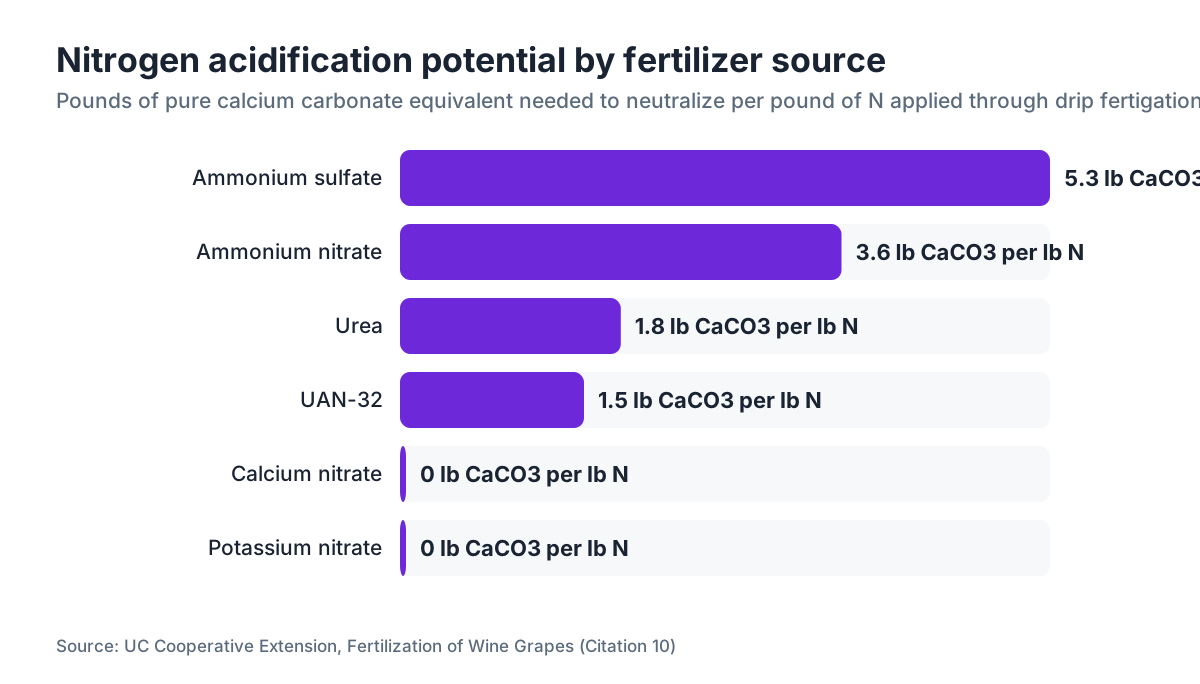
This is the slow problem nobody watches until it bites. Repeated nitrogen fertigation, especially with ammonium-based sources, acidifies the root zone over years. The nitrification step (ammonium to nitrate) releases hydrogen ions. On sites already naturally acidic (parts of Oregon, Washington, and the Finger Lakes), this can push pH below 5.5 within five to ten years of regular ammonium fertigation with no lime correction.
UC Cooperative Extension figures the acidification load per source. Urea and urea-based fertigation runs a moderate effect, roughly 1.8 lb of pure calcium carbonate equivalent per pound of nitrogen applied [2]. Ammonium sulfate is far more aggressive at 5.3 lb CaCO3 equivalent per pound of N [10]. Calcium nitrate and potassium nitrate are close to pH-neutral [10].
Here's the practical part. If you're fertigating heavily with urea or ammonium-based nitrogen, pull soil samples every two to three years at both the 0-12 inch and 12-24 inch depths, more than the surface. Drip fertigation concentrates acidification in the 0-18 inch root zone, right where feeder roots live, and pH problems down there are harder to correct than surface pH.
Liming through drip is a nonstarter because lime particles won't stay in suspension. Surface-applied or pelletized lime broadcast before your next cultivation cycle is the fix. Catch pH drift early (5.8 to 6.0) and one well-timed lime application at 1 to 2 tons per acre usually gets you back. Let it slide to 5.2 and you're looking at multiple years of correction.
What can go wrong with nitrogen fertigation, and how do you prevent it?
Most failures fall into four buckets: emitter plugging, poor distribution uniformity, wrong rates, and blown compliance.
Emitter plugging from fertilizer is almost always chemical precipitation. The usual suspects are calcium-phosphate precipitates (don't inject phosphorus and calcium-containing fertilizers in the same event without an acid flush between), urea decomposition in hot lines (inject in the morning, flush hard), and biological growth from urea or organic sources sitting in warm pipe. A preventive flush with dilute acid (pH 2-4 with citric or sulfuric acid) at season's end clears most biological and mineral deposits [4].
Poor distribution uniformity is a drip problem that fertigation exposes. If emitter flow varies more than 15 to 20%, some areas get double the nitrogen dose and others get half. Before your first fertigation, run a catch-can test across representative zones. WSU Extension publishes a standard protocol for this [3].
Wrong rates, specifically too much nitrogen in one event, cause two things: salt stress at the root zone (ammonium toxicity is real when concentration spikes) and nitrate leaching below the roots if you're also running long irrigation sets. Keep single-event applications below 10 to 15 lb actual N per acre and run a moderate set, enough to wet the root zone but not shove water past 24 inches.
On compliance: missing application records are the single most common violation in California ILRP audits. The fix is boring and free. Log it the same day you do it, not in a panic the week before your report is due.
How does fertigation compare to other nitrogen application methods in vineyards?
The comparison that matters for most vineyard managers is fertigation versus broadcast granular versus foliar spray. Each one wins in a different situation.
Broadcast granular nitrogen (urea or ammonium sulfate spread by machine) is cheap per pound and needs no drip infrastructure. The downside is timing. You apply it ahead of a rain event or you drag an irrigation set across the field, and you can't easily hit bloom or fruit set windows if weather won't cooperate. On sloped ground, granular urea can wash off-site in heavy rain.
Foliar nitrogen (urea sprayed at 0.5 to 1.5% concentration) is fast and precise for correcting an acute deficiency but impractical as a primary source. At rates you can spray without burn risk, you'd need five to eight events to reach 30 lb N per acre. UC Cooperative Extension treats foliar nitrogen as a supplemental tool, not a primary method, except in cases like correcting mid-season deficiency in organic systems [1].
Fertigation sits in the middle. Higher infrastructure cost than broadcast, far lower labor and better timing than repeated foliar sprays. On a drip-irrigated block of any real size, the split-application precision and timing control of fertigation usually deliver better nitrogen use efficiency than either alternative.
For more on vineyard operations and infrastructure decisions, see the vineyard overview.
A peer-reviewed comparison in the American Journal of Enology and Viticulture found that split fertigation through drip reduced total nitrogen input by 25 to 38% versus pre-season broadcast while holding equivalent petiole nitrogen at bloom across three seasons of California trials [9].
How do you track fertigation applications for compliance and future planning?
Good records do two jobs. They protect you in an audit, and they teach you what's actually working in your blocks. The second one is where growers leave money on the table.
At minimum, every fertigation event needs a same-day log entry: date, zone or block ID, product name, amount of product injected, calculated lb of actual N applied per acre, irrigation run time, operator name, and water source used. That's the data California's ILRP requires under the Nitrate Control Program, and it's what most state nutrient management plans ask for regardless of where you farm [7].
Beyond compliance, matching your fertigation log against your annual petiole records is how you get smarter year over year. Applied 35 lb N per acre last year and your bloom petiole came back at 620 ppm (above the 500 ppm sufficiency ceiling)? Cut your rate this year. Applied 30 lb and came in at 280 ppm (below the 350 ppm floor)? You have a soil supply problem that fertigation alone won't fix.
Field operations software that links spray records, irrigation events, and tissue results in one searchable log makes that comparison quick. VitiScribe lets vineyard managers attach lab results to block records so the petiole data and the fertigation log live in the same place. Useful for your own learning and for any third-party audit.
Send petiole samples to a lab calibrated to your state's interpretive ranges. The UC Davis plant and soil lab and Washington State University's soil testing lab both publish interpretive ranges for wine grapes tied to their regional research [2][3].
Frequently asked questions
Can you fertigate nitrogen in an organic-certified vineyard?
Yes, but your choices are tight. USDA NOP prohibits synthetic nitrogen in certified organic production. Allowed organic sources for fertigation include fish hydrolysate, feather meal (if solubilized), and other OMRI-listed liquid formulations. These run lower in nitrogen (typically 2-5% N) and need heavy filtration to avoid plugging emitters. Confirm any product with your certifier before use, since formulations vary and some carry prohibited additives.
How often should you clean drip lines that are used for fertigation?
Flush lines with plain water after every fertigation event, minimum. Run a preventive acid flush (citric or sulfuric acid, diluted to pH 2-4) at the start and end of each irrigation season. Using urea or organic nitrogen? Add a mid-season acid flush. UC extension recommends checking emitter flow rates with catch cans at least twice per season on blocks where fertigation runs regularly.
What is the risk of nitrate leaching from drip fertigation?
Nitrate leaches readily when irrigation water pushes it below the root zone, usually below 24-36 inches in most vineyard soils. Risk is highest with long irrigation sets after a nitrogen application, or on coarse sandy soils with fast percolation. Keep single-event N rates below 10-15 lb per acre, match irrigation set length to root zone depth, and use soil moisture monitoring to avoid over-irrigating after events. State groundwater programs watch for this specifically.
Does fertigating with nitrogen affect wine quality or grape flavor?
Excess nitrogen, whatever the delivery method, ties to lower sugar accumulation, elevated berry pH, and higher Botrytis susceptibility. Research in the American Journal of Enology and Viticulture links high vine nitrogen status at veraison with elevated must pH and reduced color intensity in reds. Delivery method matters less than total amount and timing. Split low-dose fertigation that stops at veraison lowers quality risk compared to a single heavy pre-season application.
What nitrogen rate is safe for a single fertigation event without burning roots?
Most extension guidance caps single-event applications at 10-15 lb actual N per acre through drip. Above that, concentrated ammonium solutions near emitters can cause localized root injury, especially in dry soils where the salt doesn't dilute fast. The practical check is measuring EC at the emitter during the event: keep it below 2.5 dS/m at the emitter tip to stay in the safe zone for most rootstocks.
Do you need a fertilizer license or permit to inject nitrogen through drip irrigation?
In most states, no special fertilizer license is required for on-farm fertigation of your own crops with commercial fertilizers. But California's ILRP requires enrollment and annual nitrogen reporting for growers in regulated watersheds. Ammonium nitrate storage above 400 lb triggers federal EPCRA reporting. Your county agricultural commissioner's office is the right first call to confirm what applies to your location and operation size.
Can you mix nitrogen fertilizer with other fertigation materials in the same injection event?
Sometimes, but test compatibility before you mix anything. Calcium nitrate reacts with phosphates and sulfates to form insoluble precipitates that plug emitters. Urea generally mixes safely with most potassium sources. Safest practice is separate injection events for nitrogen and other nutrients, with a plain-water flush between. A jar test (mix the two solutions in a glass jar, watch for cloudiness over 30 minutes) catches most incompatibility before it reaches your drip system.
How do you know if your drip system has enough uniformity to fertigate accurately?
Run a catch-can test before your first fertigation event. Place containers under emitters at 15-20 locations across the zone: inlet, middle, end of laterals, and across different rows. Run 30-60 minutes and measure output volume at each point. Calculate distribution uniformity (DU) as the average of the lowest quarter of readings divided by the overall average, times 100. DU above 85% is fine for fertigation. Below 75%, fix the system first.
What type of injector pump is best for small vineyard operations under 20 acres?
For under 20 acres, a venturi injector or a small piston-type metering pump usually does the job. Venturi injectors cost $100-250 and work without electricity, handy in remote blocks, but they need a minimum pressure differential of about 10 PSI and drop system pressure slightly. Electric diaphragm metering pumps at $400-900 hold a more consistent injection ratio across varying pressures, worth it if your irrigation pressure jumps between zones.
How do petiole tests guide fertigation nitrogen decisions?
Petiole nitrate nitrogen at bloom is the primary diagnostic. UC Davis puts the sufficiency range at 350-500 ppm NO3-N. Below 350 ppm suggests the vine is undersupplied; above 500 ppm suggests adequate to excess. Sample at the same phenological stage each year (opposite the basal cluster at 50% bloom) for comparable data. One year's results guide next year's nitrogen budget, and mid-season results decide whether you apply the second or third installment.
What states have the strictest rules on nitrogen fertigation in vineyards?
California is the most regulated, through the State Water Resources Control Board's Irrigated Lands Regulatory Program, which requires annual nitrogen management plans and reporting in most regulated watersheds. Washington and Oregon both have nutrient management requirements tied to groundwater protection areas, especially in the Columbia Basin. Vermont and New York run agricultural nutrient management programs that track nitrogen from fertigation. Check your state department of agriculture or water quality board for current requirements.
Is there a rule of thumb for how long to run irrigation before and after injecting nitrogen?
Standard extension guidance is a 15-minute pre-flush to wet the soil and confirm all emitters work before injection starts, and a 15-30 minute post-flush to push fertilizer solution out of the drip lines and into the root zone. Skip the post-flush and you leave concentrated nitrogen sitting in lateral lines, which invites biological growth, corrosion, and incomplete delivery to emitters at the end of long laterals.
Can fertigation replace pre-plant nitrogen applications in a new vineyard block?
Not reliably in the first year or two. Young vines have limited root systems, and drip placement may not match where establishing roots are actively growing. Pre-plant or post-plant broadcast nitrogen sets a uniform soil supply while roots spread. Once a vine has a functional root system inside the drip zone (usually year two or three), fertigation becomes a practical primary method. WSU recommends soil nitrogen testing before planting to see whether any pre-plant nitrogen is actually needed.
Sources
- UC Davis Plant Sciences, Grapevine Nutrition: Petiole nitrate nitrogen sufficiency range at bloom is 350-500 ppm NO3-N; urea acidification effect is approximately 1.8 lb CaCO3 equivalent per lb N applied
- Washington State University Extension, Irrigation and Nutrient Management for Wine Grapes: Tissue testing is the primary calibration tool for N management; many Columbia Valley sites oversupply nitrogen; emitter concentration and distribution uniformity testing protocols
- UC ANR Publication 3523, Drip Irrigation for Row Crops: Urea hydrolysis slows below 50F soil temperature; acid flushing protocols for drip lines; UAN-32 density approximately 11.06 lb per gallon
- Cornell Cooperative Extension, Nutrient Management for Vineyards in the Northeast: Post-veraison nitrogen applications are rarely justified and frequently damaging in Northeastern vineyards; farm nitrogen tracking spreadsheet template available
- US EPA, NPDES Agricultural Stormwater Exemption and Irrigation Return Flow: Clean Water Act agricultural exemption does not cover fertigation discharge to surface water or tile drains; backflow protection required
- California State Water Resources Control Board, Irrigated Lands Regulatory Program: ILRP requires growers in regulated watersheds to track nitrogen applied and removed with annual reporting under the Nitrate Control Program
- US EPA, Emergency Planning and Community Right-to-Know Act (EPCRA): Ammonium nitrate storage above 400 lb at a facility triggers federal EPCRA reporting requirements
- American Journal of Enology and Viticulture, Split Fertigation and Nitrogen Use Efficiency in Drip-Irrigated Vineyards: Split fertigation applications through drip reduced total nitrogen input by 25-38% compared to pre-season broadcast while maintaining equivalent petiole nitrogen at bloom across three seasons of California trials
- UC Cooperative Extension, Fertilization of Wine Grapes: Ammonium sulfate acidification effect is approximately 5.3 lb CaCO3 equivalent per lb N applied; calcium nitrate and potassium nitrate are approximately pH-neutral
Last updated 2026-07-11