How to document a fertigation application through a drip irrigation system
TL;DR
- Every fertigation application through drip irrigation needs a written record covering the date, product name and EPA registration number, rate, water volume, block or zone, applicator name, and equipment used.
- Federal worker protection standards and state pesticide laws may require additional fields.
- A good log takes under 10 minutes to complete and keeps you audit-ready for county ag commissioner visits.
Why does fertigation documentation matter for vineyard compliance?
Run drip through your blocks and inject nutrients or registered plant-nutrition products, and the paperwork stacks up fast. Incomplete records are one of the top reasons growers get cited during county agricultural commissioner audits. A single missing entry can turn a routine walk-through into a correction order that costs you time and money.
Fertigation sits at the intersection of two regulatory worlds. Inject a fertilizer that carries no EPA pesticide registration, and your documentation requirements come mostly from state fertilizer laws and any third-party certification programs you run under (Certified California Sustainable Winegrowing, LIVE, Fish Friendly Farming, and the rest). Inject a material that does carry an EPA registration number, like certain copper-based nutritional sprays applied through the drip, and the Federal Insecticide, Fungicide, and Rodenticide Act (FIFRA) record-keeping provisions apply. In many states the Pesticide Application Record (PAR) is legally mandatory within a set number of days of application [1].
Here's the practical answer. Document everything the same way regardless of registration status. One consistent record format costs you nothing extra and protects you in every scenario.
What exact information do you need to record for each fertigation event?
The minimum fields for a complete fertigation log, before any state-specific additions, are:
| Field | What to record | Source requiring it |
|---|---|---|
| Date and time of application | Exact calendar date; start and end time if possible | State PAR regulations; third-party audits |
| Block/zone identifier | Row numbers, GPS block ID, or map reference | Sustainability program audits |
| Product name (full label name) | As it appears on the label | FIFRA / state ag dept |
| EPA registration number | If product is a registered pesticide | FIFRA 40 CFR Part 171 [1] |
| Manufacturer/formulation | Brand and formulation type | State fertilizer regs |
| Active ingredient or nutrient | Nitrogen %, potassium %, etc. | State audit programs |
| Amount of product used | Gallons or lbs per acre, and total quantity | PAR; sustainability audits |
| Dilution / injection rate | Concentration in the line, or tank mix ratio | Good practice; equipment calibration |
| Total water volume applied | Gallons or acre-inches per block | Water use reporting (some states) |
| Application method | Drip/subsurface drip, injector type | Equipment log / warranty records |
| Applicator name and license number | License number only if applying a restricted pesticide | FIFRA; state licensing |
| Reason for application / crop growth stage | E.g., pre-bloom nitrogen push, post-harvest potassium | Sustainability certification; GAP audits |
| Equipment ID | Injector model, venturi or pump type | Internal equipment log |
| Weather at time of application | Temperature, wind, if relevant to the material | Best practice; required for some registered materials |
That looks like a lot of fields. In practice, most of them are static or rarely change. The block, the injector type, and your name don't change run to run. A pre-filled template means you're actually filling in five or six variable fields per event: date, product, rate, volume, growth stage, and notes. That's the 10-minute job.
Cornell Cooperative Extension's nutrient management guidance for New York vineyards calls for tracking fertilizer application timing relative to vine growth stage, because that timing context is what makes your records useful agronomically, more than legally [2].
What are the legal record-keeping requirements under federal and state law?
At the federal level, FIFRA section 8 requires commercial pesticide applicators to keep records of restricted-use pesticide (RUP) applications for two years [1]. The EPA's Worker Protection Standard (WPS), codified at 40 CFR Part 170, requires that certain application information be available to workers and handlers on request, and that records support the central display information posted at the agricultural establishment [3].
The WPS requires the handler employer to retain pesticide application and hazard information for 30 days after the restricted-entry interval (REI) ends for each pesticide applied, and to provide that information to workers or handlers who may have been exposed [3]. The EPA's WPS guidance is explicit that the handler employer must make application-specific information, including the product name, EPA registration number, and REI, available before any worker enters a treated area [3].
State requirements build on that floor, and they vary a lot:
- California: The county agricultural commissioner requires a pesticide use report (PUR) for any pesticide application within one calendar month of the application date [4]. Fertilizers without a pesticide registration are generally exempt, but many copper and sulfur products used in drip do carry registrations.
- Washington: Washington pesticide law (RCW 15.58) requires written records of all commercial pesticide applications to be kept for five years [5].
- Oregon: The Oregon Department of Agriculture requires commercial applicators to keep pesticide application records within seven days of application.
For materials that are straight fertilizers with no pesticide registration, federal law doesn't mandate a specific record format. State fertilizer laws in most wine-growing states require purchase and use records be kept for at least three years. Check your state department of agriculture for the current rule.
Certified organic under CCOF or pursuing any organic label? The USDA National Organic Program (NOP) requires records sufficient to demonstrate compliance for five years, and every input you apply must be documented with enough detail for the certifier to verify it was an allowed material [6].
How does injector type affect what you document?
The type of injection equipment you use changes a few fields in your record, and it changes how you calculate and verify the rate you actually applied.
Venturi injectors (Mazzei or similar) run on a differential pressure principle. No moving parts, no calibrated flow meter built in. Your injection rate is a function of system pressure and the product viscosity on that day. If you're on a venturi, note the system pressure at injection, the tank start and end volume (so you can back-calculate actual product used), and the run time. UC ANR's irrigation management resources point out that venturi injection rate can drift with mainline pressure, so logging tank volumes is the only reliable way to confirm the actual dose [7].
Dosatron-style positive-displacement injectors have a fixed injection ratio (say 1:100, or 0.5% of water flow). Your record should note the ratio setting and confirm the meter reading before and after. These are much easier to document accurately.
Electric metering pumps (peristaltic or piston-type) with flow meters are the most auditable setup, because the controller logs flow data you can pull straight into your record. If your system logs data, attach the export or note the file reference in your manual record.
For subsurface drip (SDI), note the injection depth if the material's label restricts it.
What does a completed fertigation record actually look like?
Here's a realistic entry for a conventional Cabernet Sauvignon block:
Application Record - Fertigation
Date: June 14, 2025
Start time: 6:30 AM | End time: 8:15 AM
Block ID: CS-4 (Cabernet Sauvignon, 3.8 acres, planted 2009)
Growth stage: Early shoot elongation, approx. 8-inch shoots
Product: Potassium Thiosulfate 0-0-25 (Tessenderlo Kerley)
EPA Reg. No.: N/A (fertilizer, not a registered pesticide)
Application method: Drip, Dosatron injector set at 1:200 ratio
Product quantity used: 12 gallons total (3.16 gal/acre)
Total water applied: 2,400 gallons (633 gal/acre)
System pressure at header: 28 psi
Applicator: [Name], [License # if applicable]
Reason: Pre-bloom potassium supplementation per tissue test results (May 28 test, K at 1.1% DW, target 1.5%)
Equipment: Dosatron D14MZ2 inline injector, header valve gate 3
Notes: No wind, 62°F at start. Tank diluted 1:4 in clean water before injection. No system anomalies.
That entry took about eight minutes to fill in, and it answers every question a county inspector or certifier would ask: what, where, when, how much, who, and why. The tissue test reference is optional but genuinely useful. It ties the application to an agronomic decision, and that's what separates a defensible record from a box-checking exercise.
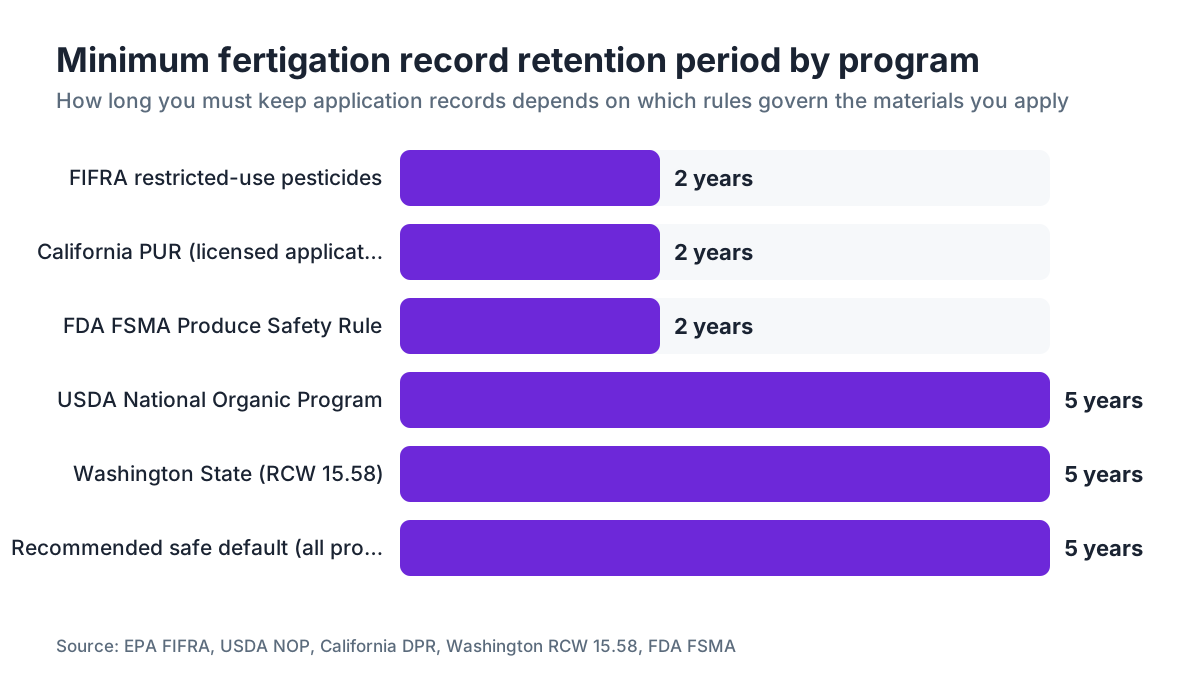
How long do you need to keep fertigation records?
The retention period depends on which rules apply to the materials you applied:
- FIFRA restricted-use pesticides: 2 years from application date [1]
- California PUR records: State regulations require the licensed applicator to retain copies for 2 years; the county agricultural commissioner retains a copy permanently [4]
- Washington commercial applicator records: 5 years under RCW 15.58 [5]
- USDA NOP organic certification: 5 years [6]
- Third-party sustainability programs (CCSW, LIVE, Lodi Rules): Generally 3 years of records requested during audits
- Food safety / GAP (Good Agricultural Practices): The FSMA Produce Safety Rule doesn't apply to winegrapes used exclusively for wine, but if you're dual-cropping or selling any fresh fruit, keep records for at least 2 years under FDA FSMA [8]
The safe default is five years for everything. Storage is cheap. Re-creating a missing record during an audit is not.
Digital records are fine everywhere, as long as they're retrievable and the system has some form of access control. A locked shared folder with timestamped entries works. A photo of a handwritten page in cloud storage works too. What matters is that you can print it and hand it to an inspector within a reasonable time.
How do you track fertigation records for multiple blocks or zones efficiently?
The hard part of fertigation documentation for most vineyard managers isn't knowing what to record. It's keeping the records consistent when you're running four or five blocks on overlapping irrigation schedules during a busy June.
A few approaches that work in practice:
Spreadsheet templates. A shared Google Sheet or Excel file with one row per application event, pre-populated with static fields (injector model, block acreages, common products), works well for operations under about 50 acres. Lock the header row, force a date format on the date column, and use a dropdown for product names so spelling variants don't create lookup headaches at audit time.
Field notebooks with structured pages. Some managers prefer paper in the field because it doesn't need a signal or a charged battery. A pre-printed field book with all required fields listed works fine, as long as you transfer or scan records into durable storage within 48 hours. Originals in a binder in the pump house plus a scanned copy offsite is a reasonable two-copy system.
Vineyard operations software. Tools like VitiScribe let you log application events from a phone in the field, auto-populate block size and equipment fields, and export a formatted record that meets most state PAR requirements. The real value is that structured input forces you to fill every required field, so you don't find a missing product registration number six months later with an auditor standing in your office.
Whatever system you use, set a clear rule for who enters the record. That's the person running the injection that day, not whoever happens to be in the office that afternoon. Delayed or delegated data entry is the single biggest source of errors in fertigation logs.
What are the most common mistakes in fertigation recordkeeping?
After county ag inspector feedback and extension program checklists, the recurring gaps are predictable:
No EPA registration number when it's required. Inject any product that carries a pesticide label (copper, certain biologicals, soil fumigant-adjacent materials) without noting the EPA reg number, and the record is incomplete under FIFRA and state law. Check the label. If there's an EPA registration number on it, it goes in your log.
Vague quantity field. "About 10 gallons" is not a rate. Record the tank start level, end level, and calculate the exact amount used. Your injector setting and run time serve as a cross-check.
Logging the block but not the zone. Large blocks may run multiple irrigation zones on different schedules. If you only ran zone 3 of block CS-4, your record should say zone 3, more than CS-4. Otherwise your application map doesn't match your records.
Missing applicator license number. For any material requiring a licensed applicator, the license number is mandatory in most states. An employee name without a license number is an incomplete record for a licensed pesticide.
No post-application notation. Injector malfunction, a flow meter reading that didn't match, running short on product and reducing the rate mid-set. That needs a note. Clean records that don't reflect reality are worse than messy records that do.
Washington State University Extension pesticide record-keeping guidance calls out the failure to record application end time as a frequent audit deficiency, because end time is what you use to calculate REI start [5].
How does fertigation documentation connect to nutrient management plans?
In California's Central Coast and parts of Napa and Sonoma under Regional Water Quality Control Board orders, vineyards above a certain acreage threshold may fall under Irrigated Lands Regulatory Program (ILRP) requirements, which include a nutrient management plan and matching application records [9]. Your fertigation log is the real-time data that feeds that plan.
At minimum, a nutrient management plan requires you to track cumulative seasonal nitrogen applied per acre. Make three fertigation passes with potassium nitrate and two with urea ammonium nitrate across a season, and your individual application records need to add up into a seasonal total. That means your rate field has to be in consistent units (lbs actual N per acre, not gallons of product) so you can sum across events.
UC ANR's viticulture and enology extension program recommends tying all fertigation records back to a seasonal soil and tissue testing calendar, so each application traces to a diagnostic trigger [7]. That's not a legal requirement for most growers. It's the difference between records that help you make better decisions next year and records that just satisfy the minimum.
For operations pursuing Lodi Rules or similar wine industry sustainability certifications, fertigation records get audited specifically to confirm that nitrogen applications are based on demonstrated crop need, not a calendar default. The record's "reason for application" field is where that justification lives.
Does the worker protection standard apply to fertigation through drip irrigation?
The Worker Protection Standard applies when you apply a registered pesticide. Inject a fertilizer with no EPA pesticide registration, and WPS doesn't apply to that application.
Here's where it gets nuanced. Some products commonly injected through drip, including certain copper chelates, potassium phosphite, and biological fungicide programs, do carry EPA pesticide registrations. Apply any of these through drip and WPS requirements apply in full: the REI posting, application information at the central display, and the requirement that workers stay out of the treated area during the REI [3].
For subsurface drip, where product goes in below grade, there's sometimes a question about whether WPS field posting applies since there's no foliage contact. EPA's position under the 2015 revised WPS rule is that the label REI governs regardless of application method, unless the label specifically provides a different REI for drip or soil injection [11]. Read the specific label every time. The EPA-approved pesticide label is legally binding and supersedes any general guidance [11].
Practically, document the REI alongside your application record and note the date and time the REI expires. That timestamp is what protects you if a worker exposure question comes up later.
How do you verify that the rate you documented was actually applied?
This is the gap that separates a real record from a theoretical one. You can write down a target rate, but if your injector wasn't calibrated or your mainline pressure dropped during the run, the actual dose may be meaningfully off.
Three ways to verify the applied rate:
- Tank volume method: Fill your mix tank to a known level before the run. Measure the level after. The difference, adjusted for block acreage, is your actual dose. This works for any injection system.
- Catch cup / flow meter cross-check: If your system has a flow meter on the supply line and a separate meter on the injection feed, compare the ratio. On a Dosatron set to 1:100, you should see the injection meter running at 1% of the mainline flow. See 0.7% instead, and the ratio has drifted.
- Conductivity logging: For soluble fertilizers, injecting into a drip system raises the EC of the water. A simple inline EC meter at the header, logged before, during, and after injection, gives you real-time confirmation that product is going in at the expected concentration. Handy for fertigation in high-value blocks where rate accuracy matters.
Log whichever verification method you used. An auditor who reads "verified by tank volume: started at 20 gallons, ended at 8 gallons, applied 12 gallons to 3.8 acres = 3.16 gal/acre" has no reason to doubt the number. An entry that just says "3.16 gal/acre" with no source for the figure is less credible.
What template fields should a fertigation log form include?
Building a paper or digital template from scratch? Here's the field set I'd use, ordered the way an inspector typically reviews them:
- Record number (sequential, for audit trail)
- Grower name / operation name
- Farm address or APN
- Date of application
- Start time / end time
- Block ID and acreage treated
- Irrigation zone(s)
- Growth stage at time of application
- Product name (full label name)
- EPA registration number (leave blank and note "fertilizer/non-pesticide" if not applicable)
- Active ingredient or nutrient and concentration
- Target dose (lbs/acre or gal/acre)
- Actual dose applied (with verification method noted)
- Total product used (gallons or lbs)
- Total water volume applied (gallons)
- Injection method and equipment ID
- System pressure at header
- Reason for application / agronomic justification
- Tissue or soil test reference (date and lab if applicable)
- Weather conditions
- REI (if applicable) and REI expiration date/time
- Applicator name and license number
- Signature line
- Notes / anomalies
That's 24 fields. Most take under 30 seconds each. Build the template once, with static fields pre-populated per block, and the actual per-event entry runs under 10 minutes.
For operations running five or more blocks with multiple inputs per season, a digital system that generates a record you can export as PDF or CSV to hand a county inspector or certifier earns back its setup time. Digging through a binder of handwritten pages for one block's nitrogen history during a June audit week is not a good use of anyone's day. Tools like VitiScribe are built around this workflow and keep your block and equipment data in one place, so you're not re-entering it each run.
Frequently asked questions
Is a fertigation application the same as a pesticide application for record-keeping purposes?
Only if the product you're injecting carries an EPA pesticide registration number. Plain fertilizers like calcium nitrate or potassium sulfate are not pesticides and don't trigger FIFRA record-keeping rules. But products like copper chelates or potassium phosphite-based fungicides often carry EPA registrations and must be logged as pesticide applications, including the EPA reg number, applicator license, and REI posting.
How soon after a fertigation do I need to file the application record?
It depends on state law and material type. California requires the Pesticide Use Report be submitted to the county ag commissioner within one month of application for registered pesticides. Oregon requires commercial applicators to keep records within seven days. Washington requires records be kept but doesn't set a specific filing deadline. For non-pesticide fertilizers, most programs expect the record to exist within 24 to 48 hours of application as a practical audit standard.
Do I need a pesticide applicator license to apply fertilizers through drip?
For plain fertilizers with no EPA pesticide registration, no license is required in most states. The moment the product carries a pesticide registration, state licensing kicks in. California requires a Qualified Applicator License or Certificate, or work done under the supervision of a licensed applicator, for any registered pesticide application, including through drip irrigation.
Can I use a digital spreadsheet instead of paper records for fertigation logs?
Yes, in virtually every US wine grape-producing state. Digital records are acceptable as long as they're retrievable, backed up, and can be printed or exported on request. A date-stamped, locked spreadsheet in cloud storage satisfies most county ag commissioner and third-party certification audits. Confirm with your certifier if you're pursuing organic certification, as some require a signature and may prefer paper originals.
What's the REI for materials applied through drip irrigation?
The restricted-entry interval is product-specific and set by the EPA-approved label. Applying a product through drip doesn't automatically shorten or eliminate the REI. Read the specific product label, which is the legally binding document. Some labels have separate REI language for soil injection versus foliar application, but you can't assume a reduced REI without label language that says so.
Do organic vineyards have different fertigation documentation requirements?
Yes. USDA NOP certification requires records sufficient to show every input applied is on the allowed materials list, kept for five years, with enough detail for the certifier to verify the material, rate, and location. You'll also need purchase invoices, product labels, and in many cases a letter of compliance from the manufacturer. That's a higher documentation bar than conventional state pesticide records.
How do I document fertigation when using multiple products in one injection event?
Create a separate record line for each product, or use a multi-product section within one record. Each product needs its own dose, EPA reg number if applicable, and any product-specific notes. Mixing documentation matters: note the order of addition to the tank, the tank water volume, and the final EC or pH of the mix if you measure it. A tank mix that goes wrong is much harder to troubleshoot without that detail.
What happens if my injector malfunctions mid-application and I can't confirm the actual dose?
Document exactly what happened in the notes field: the time the malfunction occurred, what you observed (backflow, injector stopped, pressure drop), and what you did (shut down, restarted, abandoned the run). Estimate the dose from tank volume consumed up to the point of failure. An honest record of an incomplete application beats a fabricated rate. Note the corrective action and any follow-up application.
Does my fertigation record need to show the nitrogen rate in pounds per acre for water board reporting?
If your operation falls under California ILRP requirements or a similar state water quality program, yes. You'll need to convert product rate to actual nutrient load per acre. Apply 3 gallons per acre of calcium nitrate (15.5% N) and that's about 1.5 lbs actual N per acre per application. Keeping fertigation records in product units and nutrient units from the start saves real recalculation work at annual report time.
How do I connect fertigation records to my soil and tissue test data?
Add a reference field that cites the test date, lab, and the specific finding that triggered the application. For example: 'Tissue test 05/28/25, Petiole K = 1.1% DW, target 1.5%.' This links your application to an agronomic decision rather than a calendar default, which is what sustainability certification auditors want to see and what makes the records genuinely useful for season-to-season management.
What block or zone identifier system works best for large vineyard operations?
The best system is the one you'll actually use consistently. Most experienced managers use a short alphanumeric block code (CS-4 for Cabernet Sauvignon block 4), a variety name, a planted year, and a map reference. For drip-irrigated operations with multiple zones per block, add a zone suffix (CS-4Z2). Pre-load these identifiers into your template once and don't deviate. Inconsistent naming is the most common reason records can't be aggregated at audit time.
How often should I calibrate my fertigation injector, and do I need to document that too?
UC ANR extension recommends checking injector calibration at least once per season and after any maintenance or repair. Document the calibration check itself: date, method (timed catch, tank volume comparison, flow meter check), result, and any adjustment made. This record lives in your equipment maintenance log but should cross-reference your fertigation records, especially if the calibration shows the injector was running off-ratio during prior applications.
Sources
- EPA, Federal Insecticide, Fungicide, and Rodenticide Act (FIFRA) Section 8, Recordkeeping: FIFRA section 8 requires commercial pesticide applicators to keep records of restricted-use pesticide applications for two years.
- Cornell Cooperative Extension, Nutrient Management for Vineyards: Cornell Cooperative Extension's nutrient management guidance calls for tracking fertilizer application timing relative to vine growth stage.
- EPA, Agricultural Worker Protection Standard (WPS), 40 CFR Part 170: The WPS requires handler employers to retain pesticide application and hazard information for 30 days after the REI ends and to make product name, EPA registration number, and REI available to workers before they enter a treated area.
- California Department of Pesticide Regulation, Pesticide Use Reporting: California requires the Pesticide Use Report to be submitted to the county agricultural commissioner within one calendar month of the application date.
- Washington State University Extension, Pesticide Record-Keeping for Commercial Applicators: Washington pesticide law (RCW 15.58) requires written records of all commercial pesticide applications to be kept for five years; failure to record application end time is a frequent audit deficiency.
- USDA National Organic Program, Record-Keeping Requirements: The USDA NOP requires that operations keep records sufficient to demonstrate compliance for five years, with every input documented in enough detail to verify it was an allowed material.
- University of California Agriculture and Natural Resources (UC ANR), Irrigation and Nutrient Management in Vineyards: UC ANR recommends tying all fertigation records to a seasonal soil and tissue testing calendar and notes that venturi injectors can vary actual injection rate depending on mainline pressure fluctuations.
- FDA, FSMA Produce Safety Rule, 21 CFR Part 112: Under the FSMA Produce Safety Rule, operations subject to the rule must retain records for a minimum of two years.
- California State Water Resources Control Board, Irrigated Lands Regulatory Program: California's ILRP requirements for vineyards above certain acreage thresholds include a nutrient management plan and corresponding application records tracking cumulative seasonal nitrogen applied per acre.
- Washington State University Extension, Viticulture and Irrigation Management: WSU Extension guidance on drip irrigation management addresses injection equipment calibration and documentation practices for Washington wine grape growers.
- EPA, Pesticide Labels: EPA pesticide label language is legally binding and governs application method, REI, and use restrictions regardless of how the product is applied, including through drip irrigation.
Last updated 2026-07-10