Field hygiene training documentation for harvest crew compliance

TL;DR
- Under the EPA Worker Protection Standard (40 CFR Part 170), every agricultural employer must train workers before they enter pesticide-treated areas and keep signed training records for two years.
- For harvest crews, that means documenting safety training, sanitation facility inspections, and decontamination procedures before the season starts.
- This article walks through every required record, common audit failures, and how to build a paperwork system that holds up.
What does the EPA Worker Protection Standard actually require for harvest crew training?
Workers have to get WPS safety training before they enter any area where a pesticide has been applied or an REI is in effect, and you have to keep records proving they got it. That's the core of it. [1]
The full rule is at 40 CFR Part 170. The 2015 revision (effective January 2, 2017) tightened the documentation requirements. Under the current rule, agricultural employers must train workers using EPA-approved materials, delivered by a trained trainer, and must keep records of that training for two years after the date it was given. [1]
For a vineyard harvest crew, this breaks into three overlapping layers. There's the WPS safety training itself, covering pesticide hazards, label comprehension, decontamination, and emergency contacts. There's the field-specific sanitation and hygiene piece, which means showing workers where toilets, handwashing water, and clean drinking water are before their first field entry. And there are state rules stacked on top of the federal baseline. California, Washington, and New York each add record-keeping requirements that go past 40 CFR Part 170. [2][3][4]
EPA guidance is blunt about the location piece: employers must inform workers of "the location of the pesticide safety information, the location of the decontamination supplies, and the location of any application and hazard information" before workers enter a treated area. [1] That disclosure happens every time a crew moves to a new block, not once per season.
One thing managers miss all the time: training has to be in a language the worker understands. If your crew speaks mostly Spanish, an English-only handout does not satisfy the rule. EPA-approved WPS materials come in Spanish, and several land-grant extension programs publish bilingual versions. [5]
What records do you actually need to keep, and for how long?
Two years is the federal floor. Some states, California chief among them, require three years for certain pesticide records, so the practical move is to keep everything for three years unless your state clearly says less. [2]
Here's what the record set covers.
WPS training record (required per worker, per year):
- Worker's full name
- Date training was completed
- Trainer's name and, if applicable, their trainer certification number
- Description or title of the training materials used (EPA registration number helps)
- Employer signature (or designated representative)
Field-specific safety information disclosure:
This one trips people up. The WPS requires you to tell workers about the specific pesticide safety information for each field they'll be working in. That's a separate act from general safety training, and it should generate its own log. Date, block ID, product applied, REI end time, worker names or crew ID.
Decontamination site log:
Document that decontamination supplies (water, soap, single-use towels) were provided within a quarter-mile of where workers are working. Some operations photograph the setup and attach it to a dated log sheet. That works fine.
Injury and illness records:
Any pesticide-related illness or injury has to be documented. Under the WPS, workers must be told they can access those records. Under OSHA's 300 log requirements, injuries meeting the recordable threshold go there too. [6]
Audit reality: EPA enforcement inspections and state agriculture department audits both pull these records first. Missing or incomplete training documentation is one of the most common WPS violations cited in enforcement actions. [8] If you can't produce a signed, dated training record, you have no defense, no matter how well you actually trained the crew.
| Record Type | Minimum Retention (Federal) | California Requirement | Key Content Fields |
|---|---|---|---|
| WPS safety training | 2 years | 3 years (DPR) | Name, date, trainer, materials |
| Field safety information disclosure | 2 years | 3 years | Block, product, REI, date |
| Decontamination site setup | Not specified federally | Recommended | Location, supplies present, date |
| Pesticide application records | 2 years (WPS) | 3 years (DPR) | Product, rate, block, REI |
| OSHA 300 log | 5 years | 5 years | Recordable injuries/illnesses |
What are the required elements of a WPS-compliant hygiene and sanitation training?
The WPS training curriculum is spelled out in 40 CFR 170.401. It's a specific list, not a loose "cover food safety" session. For harvest crews, the elements that matter most are:
- How to recognize pesticide poisoning symptoms and what to do if exposure happens
- Why washing before eating, drinking, using tobacco, or using the toilet matters
- Where and how to wash (decontamination supply location and procedure)
- How to handle pesticide-contaminated clothing
- The location of the nearest emergency medical facility
- Workers' rights under the WPS, including the right to request pesticide application records
The handwashing emphasis isn't filler. Dermal and oral exposure from contact with treated foliage during harvest is a real pathway. UC Davis agricultural safety research flags harvest workers as high dermal-exposure risk because the work means repeated close canopy contact. [5]
Beyond the WPS floor, most food safety audits (GLOBALG.A.P., USDA Harmonized GAP) want hygiene training to cover proper handwashing technique, toilet use protocols, procedures for workers with illness or open wounds, and handling of personal items in the field. [7] Those aren't WPS requirements, but if you're selling to buyers who require GAP certification, your training documentation has to cover them. Keep one combined training log that satisfies both WPS and GAP rather than running two systems.
WSU Extension publishes a bilingual (English/Spanish) WPS training record template that meets 40 CFR 170 requirements and takes about 15 minutes per worker to complete. [4] It's free. It's built for tree fruit and vineyard operations in the Pacific Northwest, but the record format holds up in any state.
Who is qualified to deliver WPS safety training to harvest workers?
Under the revised WPS, training has to be delivered by a "trained trainer," meaning someone who completed an EPA-approved train-the-trainer program or who holds a certified pesticide applicator license. [9] A crew foreman who got trained last year is not automatically qualified to train their crew. That distinction has surprised a lot of managers at audit time.
Your practical options:
- Your certified pesticide applicator runs the training. Most vineyard operations have at least one CPA on staff or on call, and this is often the cleanest path.
- A qualified trainer from your county agricultural commissioner's office or extension service. Several California counties run seasonal WPS train-the-trainer workshops before harvest. [2]
- A licensed pest control adviser (PCA) who has completed an approved trainer program.
- A farm labor contractor with a certified trainer on staff. If you're using an H-2A or FLC crew, ask for the trainer's credentials and keep a copy.
Do one thing before harvest: call your county agricultural commissioner and ask whether your intended trainer qualifies. The answer takes five minutes and removes all doubt. State reads on "trained trainer" vary a little, and a phone call is cheaper than a violation.
When does training have to happen, before or during the harvest season?
Before field entry. That's the rule. [1]
The WPS says training must occur before workers enter treated areas or areas where an REI is in effect. In a harvest vineyard, nearly every block qualifies at some point. The safest approach is to train every crew member before the first shift of the season, document it, then run field-specific safety disclosures as crews rotate through blocks.
For farms using seasonal H-2A labor, the timing is tight. Workers arrive and go to the field within 24 to 48 hours. Training has to fit in that window. A documentation packet that travels with the crew, pre-built and ready to run on arrival day, is the only reliable way to stay compliant on fast-turnaround crews.
Returning workers need annual retraining. The WPS gives no carryover credit from the prior year. A worker who got full training in August last year has to be retrained before their first field entry this year. [1]
New mid-season hires need training before their first field entry, period. There is no grace period.
What does field hygiene documentation look like in practice?
The difference between a system that passes an audit and one that fails usually comes down to three things: specificity, completeness, and access.
Specificity means every record names the specific worker, date, block or treated area, and materials used. A generic "harvest crew trained, August 2024" entry doesn't cut it. Individual names matter.
Completeness means every field in your template is filled in, trainer name and credential included. Inspectors treat blank fields as missing information.
Access means you can produce records within a reasonable time during an unannounced inspection. Electronic storage is fine if you can print or display them. Paper binders locked in an off-site office are a problem.
A minimal working kit for a harvest crew looks like this:
- A pre-season training sign-in sheet (one per worker, dated, with trainer info)
- A field safety information disclosure log (one per block entry, crew ID or names, REI confirmation)
- A decontamination site checklist (dated, location marked, supplies confirmed present)
- A copy of the WPS pesticide safety information poster posted at the central location
- An emergency contact sheet (nearest medical facility with address and phone)
Keep the originals. Some operations photocopy for field supervisors and hold originals in the office. Fine. What you can't do is let the field supervisor hold the only copy, because those disappear.
For vineyards running several crews across many blocks, a digital log that ties training records to specific workers, blocks, and application dates makes audit prep fast. VitiScribe is one tool built for this workflow, connecting spray records to worker safety documentation in one place. Software or a well-organized binder, the structure matters more than the medium.
What specific sanitation facilities does the WPS require in the vineyard?
The WPS sets specific decontamination thresholds. Under 40 CFR 170.411, agricultural employers must provide:
- At least one gallon of water per worker for routine washing
- Soap and single-use towels
- A clean change of clothes if a worker's clothing becomes contaminated
- Eyeflush water if the pesticide label requires it
Water, soap, and towels must be within a quarter-mile of workers in the field, or at the work site if it's within a quarter-mile of the work area. [1]
With portable facilities, the quarter-mile rule is the practical headache. On a 200-acre ranch with spread-out crews, that can mean multiple water stations. State enforcement has cited farms for having decontamination supplies only at the barn while workers were more than a quarter-mile out.
California adds that toilet facilities must be within 200 meters of where workers are working under Cal/OSHA's field sanitation standard (8 CCR 3457), with one toilet per 20 workers. [10] Federal OSHA's field sanitation standard at 29 CFR 1928.110 sets a parallel bar for agricultural workers under federal OSHA, requiring potable drinking water, toilets, and handwashing facilities at the work site. [6]
Document your sanitation setup at the start of each shift. A timestamped photo with a location note is low effort and high value at audit time. Some managers staple a simple paper checklist to the daily crew sheet.
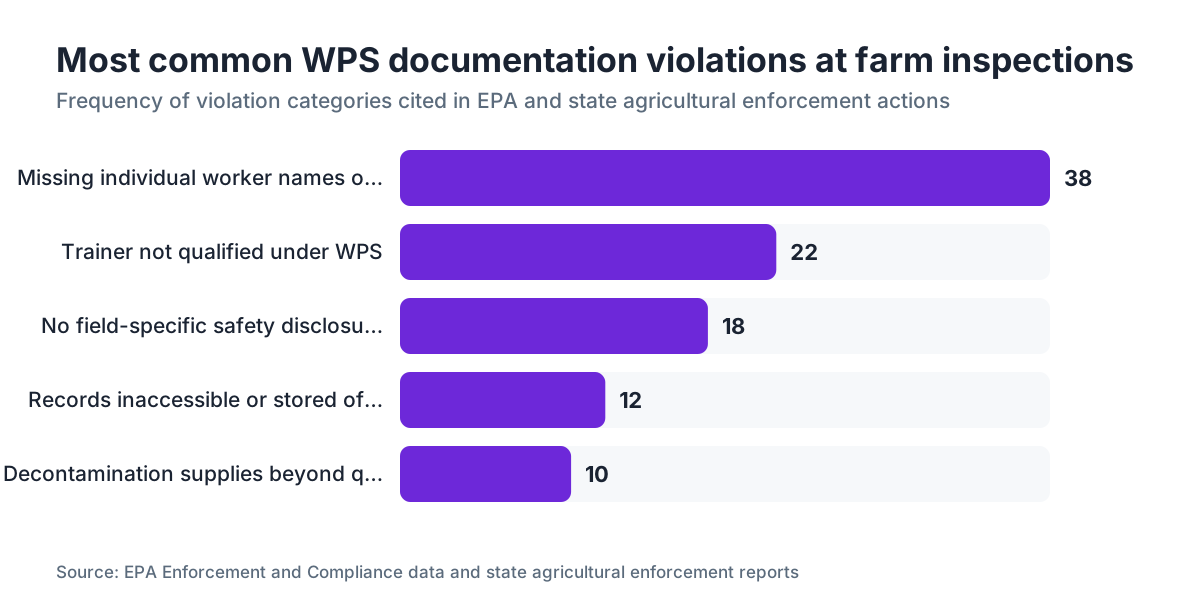
What are the most common documentation violations found during WPS inspections?
Based on EPA enforcement data and state department of agriculture inspection reports, these are the violations that come up most often at vineyard and farm operations.
Missing worker names on training records. "Crew of 15 trained" is not enough. Each worker has to be named individually.
Trainer not qualified. The person who signed the record as trainer hadn't completed a train-the-trainer program. This voids the training record for the whole crew.
Records stored off-site. Documentation kept at a home office or accounting firm instead of at the farm or accessible on demand.
No field-specific disclosure. Farms that nail general WPS training but never document that workers were told the specific pesticide safety information for each block.
Expired or missing pesticide safety information poster. The WPS requires a specific poster at a central location. Generic "read labels" signs don't count.
Decontamination supplies not within quarter-mile. Supplies at the equipment shed, crew working on the far end of the property.
Training materials not EPA-approved. A handout someone typed up, instead of materials from EPA's approved training program list or an accredited provider.
Missing individual worker names is the single most common finding. It's fixable in 30 seconds per worker if you build the right template.
How do food safety audits (GLOBALG.A.P., USDA GAP) intersect with WPS hygiene records?
WPS and food safety audit requirements overlap but aren't identical, and knowing where they split saves you from running two documentation systems.
Both the WPS and GLOBALG.A.P. require documented hygiene training for harvest workers. Both require evidence of decontamination and handwashing facilities. The difference is scope. GAP audits go further on personal hygiene, illness reporting, and what happens when a worker has an open wound or gastrointestinal illness. [7]
USDA's Harmonized GAP standard calls for written policies on worker health and hygiene, records showing workers were trained on those policies, and documentation that ill workers were kept away from harvest activities. [7] A clean WPS training record doesn't automatically satisfy the GAP hygiene training requirement, but you can design a combined form that does both.
The smart move is a single pre-season session covering WPS-required content, GAP personal hygiene content, and any state-specific pesticide safety topics, with one signature page per worker that references all three. Your GAP auditor and your state inspector both get what they need from the same document.
For wineries sourcing from outside growers, you may need to request training documentation from those growers as part of your food safety supplier verification. Knowing what a compliant record looks like is the only way to judge what you receive.
What should a training documentation template actually include?
Here's a working field list. Copy it, adapt it to your operation, and have your agricultural labor attorney or county farm advisor review it once before the season.
Header:
- Farm/operation name and address
- Date of training
- Location (ranch, block, or facility name)
- Trainer full name and credentials (CPA number, training certification number)
- Training materials used (title and EPA approval number or edition date)
- Language in which training was delivered
Worker record (one row per worker or one page per worker):
- Full legal name (print)
- Worker signature
- Date
- Confirmation that WPS poster location was disclosed (yes/no checkbox)
- Confirmation that decontamination site location was disclosed (yes/no checkbox)
- Confirmation that emergency medical facility was identified (yes/no checkbox)
- Preferred language (for trainer qualification documentation purposes)
Trainer certification:
- Trainer signature
- Credential number or type
- Statement: "I certify that the above-named workers received WPS safety training as required by 40 CFR Part 170 on the date shown."
Attached:
- Copy of EPA-approved training materials used (or reference to binder location)
- Decontamination site checklist for this date/block
This structure satisfies 40 CFR Part 170 and lines up with WSU Extension's published guidance for WPS record-keeping. [4] Run it through your state's department of agriculture website to catch any state-specific additions. California DPR keeps a checklist of required documentation that's worth printing for your compliance binder. [2]
How does electronic record-keeping compare to paper for harvest crew compliance?
Paper still works. Plenty of operations run clean audits on paper binders. The case for electronic records isn't that paper is wrong, it's that paper scales poorly when you have 40 workers rotating across 12 blocks over a six-week harvest.
The WPS doesn't require electronic records and doesn't ban them. EPA has confirmed electronic records are acceptable as long as they can be attributed to a specific individual and produced on demand. [1]
For operations with more than 15 to 20 harvest workers, or operations facing multiple overlapping audits (WPS, GAP, state ag, OSHA), a digital system that links training records to spray records is faster to manage and audit-ready. Being able to pull up "show me every worker who entered Block 14 in the 72 hours after the July 12 mancozeb application" in under a minute is worth real money in a live inspection.
For smaller operations, a well-organized paper binder with a table of contents, indexed by worker name and date, handles the job fine. The discipline of filling in every field matters more than the medium.
For vineyard managers who want spray records, REI tracking, and training documentation in one place, VitiScribe is worth a look. The trial is free and it's built for this multi-layer compliance workflow.
Back up your records either way. An entire season's documentation in a binder that gets wet, or on a laptop that dies, is a serious problem. Cloud backup or offsite paper copies, pick one.
What are the penalties for WPS training documentation violations?
Civil penalties under the Federal Insecticide, Fungicide, and Rodenticide Act (FIFRA), which is the enforcement vehicle for WPS violations, can reach roughly $22,000 per violation under current inflation-adjusted EPA penalty tables (the statutory base was $5,000 per violation, adjusted annually under the Federal Civil Penalties Inflation Adjustment Act). [8] EPA publishes the current adjusted figures each year, so confirm the exact number for the year you're in.
In practice, first-time documentation violations at smaller operations often draw a warning and a corrective action requirement rather than the maximum penalty. Repeat violations, violations tied to actual worker exposure, or violations found after a worker illness complaint draw far higher penalties, and egregious cases can involve criminal referral.
State penalties layer on top. California DPR fines for WPS documentation violations have run from a few hundred dollars for minor paperwork gaps to tens of thousands for systemic failures or violations tied to worker illness. [2]
The math is simple. A season of good documentation costs a few hours of staff time. A penalty action costs that many times over, plus legal fees, plus the damage with labor contractors and buyers.
For operations selling to retailers or restaurants with supplier compliance terms, a documented WPS violation can trigger a supply agreement review. That's a business risk that never shows up in the penalty schedule but hits hard.
Frequently asked questions
Does WPS training need to be repeated every year for returning harvest workers?
Yes. The WPS requires annual retraining. Workers who got full training in a prior year must be retrained before their first field entry in the new year. There is no carryover credit. Document each year's training separately with its own signed record and dated trainer certification.
Can a crew foreman train their own crew under the WPS?
Only if the foreman completed an EPA-approved train-the-trainer program or holds a certified pesticide applicator license. Receiving WPS training yourself does not qualify you to deliver it to others. Verify the foreman's specific credential before the season and keep a copy of that credential in your records.
What language does WPS training have to be in?
The training must be in a language the worker understands. If your crew speaks mostly Spanish, English-only materials do not satisfy the requirement. EPA-approved WPS training materials come in Spanish, and WSU and UC Davis extension programs publish bilingual resources. Document the language used on every training record.
How far away can decontamination supplies be from harvest workers under the WPS?
No more than a quarter-mile from where workers are working, under 40 CFR 170.411. That means water, soap, and single-use towels within that distance. On large properties with spread-out crews, you may need multiple stations. Photograph each station setup with a timestamp and location note as your documentation.
Do farm labor contractors have to provide WPS training, or does the grower?
Both parties carry responsibility under the WPS. The agricultural employer, which can mean the grower, the labor contractor, or both depending on who controls the work, must ensure training happens before field entry. In practice, the grower should confirm in writing that the contractor's trainer is qualified and request copies of training records for every worker entering the property.
Are electronic signatures acceptable on WPS training records?
EPA has confirmed that electronic records, including electronic signatures, are acceptable under the WPS as long as they are attributable to a specific individual and can be produced on demand during an inspection. The key requirement is that the record is accessible and complete, not that it's on paper.
Do I need separate training documentation for GLOBALG.A.P. versus WPS compliance?
Not necessarily. A well-designed combined training form can satisfy both. The WPS covers pesticide safety content; GLOBALG.A.P. adds personal hygiene, illness reporting, and open wound protocols. One signature page per worker referencing all covered content works for both audits. Design the form once and get your farm advisor or GAP auditor to review it before the season.
How many toilets are required for vineyard harvest workers under federal and California law?
Federal OSHA's field sanitation standard (29 CFR 1928.110) requires one toilet per 20 workers for operations with 11 or more workers. California's field sanitation rule (8 CCR 3457) requires facilities within 200 meters of the work area. For harvest crews over 20 workers, plan for multiple units and document their placement on your decontamination site log.
What is the WPS pesticide safety information poster and where does it have to be posted?
The EPA's WPS safety poster must be displayed at a central location workers pass through or gather at, such as a tool shed or break area. It covers emergency procedures, worker rights, and decontamination information. Workers must be told where it's posted as part of their field-specific safety information disclosure.
Can I use a generic hygiene training video instead of WPS-approved materials?
No. The WPS requires training using EPA-approved materials or a curriculum that meets the specific content requirements in 40 CFR 170.401. A generic hygiene or food safety video does not satisfy the WPS unless it covers every item on the required content list. Check EPA's list of approved training programs or use materials from an accredited extension program.
How quickly do I have to produce training records during an inspection?
The WPS doesn't specify an exact time, but inspectors expect records to be accessible on demand during a field inspection. Records kept in an off-site office or on a laptop with no mobile access have resulted in citation findings. Keep originals or cloud-accessible copies reachable within the inspection window, which is typically the same business day.
What do I need to document when a new worker joins mid-harvest?
Train them before their first field entry, full stop. There's no grace period or abbreviated version for late-season hires. Complete a full training record with their name, the date, trainer credential, materials used, and confirmation of field-specific safety information disclosure. Add them to your decontamination site log from their first shift forward.
Does the WPS apply to workers hand-harvesting grapes who have no direct pesticide contact?
Yes. The WPS applies to any agricultural worker entering a treated area or an area where a restricted-entry interval is in effect, whether or not they handle pesticides. Harvest workers picking grapes in a block that received a fungicide application within the REI window are covered, and training plus documentation requirements apply in full.
Sources
- EPA, Worker Protection Standard for Agricultural Pesticides (40 CFR Part 170): WPS requires training before field entry, records retained for two years, and use of EPA-approved training materials delivered by a trained trainer
- California Department of Pesticide Regulation, Worker Health and Safety Branch: California DPR requires pesticide-related records to be kept for three years and adds state-layer requirements above the federal WPS baseline
- Cornell Cooperative Extension, Cornell University: Cornell extension provides New York agricultural safety and WPS compliance guidance for farm operations
- Washington State University Extension: WSU Extension publishes bilingual English/Spanish WPS training record templates valid under 40 CFR Part 170 for vineyard and tree fruit operations
- UC Davis Western Center for Agricultural Health and Safety: UC Davis agricultural safety research identifies harvest workers as high dermal-exposure risk due to repeated close canopy contact during hand harvesting
- OSHA, Field Sanitation Standard (29 CFR 1928.110): Federal OSHA field sanitation standard requires potable water, toilet facilities, and handwashing facilities at agricultural work sites, one toilet per 20 workers for operations with 11 or more workers
- USDA Agricultural Marketing Service, Good Agricultural Practices (GAP) Audit Program: USDA Harmonized GAP requires written worker health and hygiene policies, training documentation, and records that ill workers were redirected from harvest activities
- EPA, Enforcement and Compliance (FIFRA civil penalties): Civil penalties under FIFRA for WPS violations are inflation-adjusted annually under the Federal Civil Penalties Inflation Adjustment Act; missing training documentation is a commonly cited violation
- EPA, Pesticide Worker Safety and WPS Training Requirements: WPS training must be delivered by a trained trainer who has completed an EPA-approved train-the-trainer program or holds a certified pesticide applicator license
- California Code of Regulations, Title 8 Section 3457, Field Sanitation: California field sanitation rule requires toilet facilities within 200 meters of where workers are working and one toilet per 20 workers
Last updated 2026-07-10