Harvest bin sanitation records and documentation requirements
TL;DR
- Federal FDA Food Safety Modernization Act rules, state ag department regulations, and buyer audit requirements all demand written harvest bin sanitation records.
- At minimum, document the sanitizer used, concentration, contact time, date, and who did the work.
- Most buyers and certifiers want records kept three to five years.
- Missing records are a top reason vineyards fail third-party food safety audits.
Why do harvest bins need sanitation records at all?
Short version: pathogens survive on bin surfaces, and auditors, buyers, and regulators all want paper proof that you dealt with it. Salmonella and Listeria monocytogenes have been isolated from harvesting equipment in published produce surveys, and the FDA has cited field sanitation failures in enforcement actions against fresh produce operations, including some that grow wine grapes for crushing rather than fresh eating [1].
The FSMA Produce Safety Rule, codified at 21 CFR Part 112, applies directly to covered produce farms. Wine grapes fall outside most Subpart C provisions because they go through fermentation instead of getting eaten raw. The equipment and tools subpart (Subpart L) still applies to farms covered under the rule [2]. Subpart L at 21 CFR §112.123 requires that equipment and tools contacting covered produce be kept in sanitary condition. Even if your crush program has a kill step that pulls you out of Produce Safety Rule coverage entirely, your grape buyer or wine buyer can still require equivalent documentation by contract.
The real driver for most vineyards is not the federal rule. It's the third-party audit.
GlobalG.A.P., Primus GFS, and California LGMA-style audits have all expanded to cover winegrape operations over the past decade. Each one wants documented evidence of cleaning and sanitizing, not a verbal assurance that it happened. Auditors specifically hunt for bin sanitation logs with dates, chemical identities, and responsible-party signatures. Those three fields are where most logs fall apart.
Which federal rules actually apply to vineyard harvest bins?
This is where growers get tangled, so let's be specific. Three separate rules can touch your bins: FSMA, EPA's Worker Protection Standard, and your state ag framework. They cover different things.
The FSMA Produce Safety Rule (21 CFR Part 112) covers farms growing produce for human consumption with more than $25,000 in average annual produce sales [2]. Wine grapes headed for fermentation count as covered produce under the broad definition, but the rule carves out activities where a kill step gets applied. FDA guidance treats wine grapes sold to a manufacturer who applies a kill step as outside the Subpart C commodity-specific provisions. Subpart L equipment provisions still apply if the farm meets the coverage threshold and isn't a qualified exempt facility.
Qualified exempt facilities (farms under $1 million in average total food sales AND selling more than half to qualified end-users in the same state or within 275 miles) face reduced requirements but still must disclose their farm name and address on records [2]. Small family vineyards often land here. That reduces the recordkeeping load without erasing it.
The EPA Worker Protection Standard (WPS), 40 CFR Part 170, is a separate layer. It governs pesticide-treated equipment, not food safety sanitation, but the two intersect when bins have held fruit carrying pesticide residues. Under the 2015 WPS revision, employers must keep pesticide application records for two years and make them accessible to employees who may contact treated surfaces, including the inside of bins that held treated fruit [3]. If part of your sanitizing protocol is meant to reduce residue transfer, your bin log can reference the matching pesticide application record.
California adds its own layer. The California Department of Food and Agriculture (CDFA) and county agricultural commissioners enforce pesticide use reporting, and the California Retail Food Code can apply once you process at the winery. Washington and Oregon run analogous frameworks through their own departments of agriculture [4].
For most vineyards, your buyer's audit requirement is stricter than the federal floor. Write your records to satisfy the strictest standard you're actually subject to, and you'll clear the rest.
What specific information belongs in a harvest bin sanitation log?
A defensible bin sanitation record needs at least seven data fields. Miss one and an auditor can reject the whole log.
| Field | What to record | Why auditors care |
|---|---|---|
| Date and time | Calendar date, AM/PM or 24-hr time | Verifies sanitizing happened before bins re-entered service |
| Bin ID or batch | Individual ID numbers or a count/lot description | Traceability back to which bins held which fruit |
| Cleaning step | Detergent used, concentration, water temperature, rinse step | Soil removal before sanitizing affects efficacy |
| Sanitizer product name | Full registered product name, more than "bleach" | Must match the label registered with EPA |
| Sanitizer concentration | PPM or percent, measured with a test strip or meter | Most validators specify a target range (e.g., 50-200 ppm for sodium hypochlorite) |
| Contact time | Minutes the sanitizer dwelled on the surface | Efficacy data is contact-time dependent |
| Responsible party | Printed name and signature or initials | Accountability and regulatory requirement |
| Water source | Municipal, well, surface (if relevant to your approval) | Some certifications require potable water source documentation |
| Post-sanitize rinse | Yes/No and rinse water type | Matters where sanitizer residues are a concern |
For sodium hypochlorite (household bleach type products), University of California Cooperative Extension guidance targets 100-200 ppm free chlorine on hard food-contact surfaces, with a contact time of at least one to two minutes at ambient temperature, followed by a potable water rinse [5]. Record the ppm you actually measured, not the theoretical dilution. Test strip readings drift. Note the brand of test strip too.
For quaternary ammonium (quat) sanitizers, label concentrations typically run 200-400 ppm, and many labels prohibit a potable water rinse because the leftover quat residue is the antimicrobial barrier. Read your specific product label. The registered label is the legal document, and 40 CFR §156.10 plus the Federal Insecticide, Fungicide, and Rodenticide Act (FIFRA) make using a pesticide (which sanitizers are) inconsistent with its label a federal violation [6].
One field most managers skip: bin condition at the start of the cycle. A note reading "bins arrived with visible organic debris, scrubbed before sanitizing" is worth more than a spotless log that pretends equipment came off a harvest day clean.
How long do you need to keep harvest bin sanitation records?
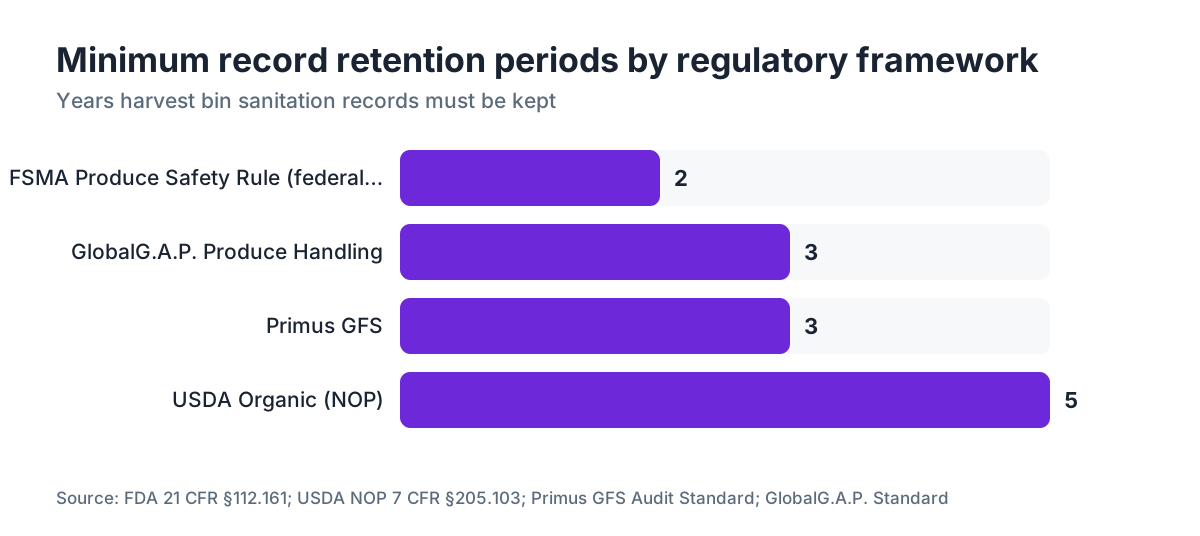
Retention rules vary by which regulation governs you, and they don't agree. The federal floor is two years. Organic pushes it to five. Pick the longest one that applies and use it for everything.
Under FSMA Produce Safety Rule 21 CFR §112.161, records must be kept at least two years after the date they were created [2]. That's the federal minimum for covered farms.
Many audit schemes want three. GlobalG.A.P. specifies a minimum three-year retention for produce handling records. Primus GFS standards also default to three years for sanitation documentation.
USDA National Organic Program rules at 7 CFR §205.103 require organic operations to keep records for five years, because that's how far back inspectors may audit [7]. If your vineyard is certified organic, make five years your standard and apply it to every record type. Running different retention clocks for different documents is an operational headache that manufactures gaps.
Buyer contracts sometimes set their own periods, and those can run longer than any regulation. Read your supply agreement. Some large winery purchasers hold audit rights that reach five or seven years back.
Storage is cheap. A missing record during a buyer audit or a regulatory inspection is not. Set your retention to the longest applicable period and forget about it.
What format do the records need to be in? Paper vs. digital
Neither FSMA nor the EPA WPS mandates paper or digital. What FSMA does require, under 21 CFR §112.161, is that records be "accurate, indelible, and legible," available for FDA inspection within 24 hours of a request for records held off-site, or immediately if on-site [2]. Format is your call. Consistency is not.
Paper logs work fine if you actually fill them out. The failure mode isn't the medium, it's the blank line. A half-completed log is worse than none in some audit frameworks, because it signals the process is unreliable.
Digital records have real advantages. Time-stamps happen automatically, fields can be made mandatory before a form submits, and records are searchable when an auditor asks for every sanitation event on Bin Lot 47 from the 2023 harvest. Vineyard compliance platforms like VitiScribe let field crews log bin sanitation from a phone right at the cleaning station, which shrinks the gap between doing and recording from days to seconds.
Go digital and you need a backup protocol. FDA guidance on electronic records doesn't require 21 CFR Part 11 electronic-signature compliance for farms (that standard targets pharmaceutical manufacturers), but your records still have to be protected from alteration. Use a system with audit-trail capability so you can show a record wasn't edited after the fact.
Add photos for any non-routine event. A shot of a visibly contaminated bin before cleaning, and one after, takes 30 seconds. That pair can be the difference between passing and failing when a buyer's quality team starts asking about a lot.
What sanitizers are approved for use on food-contact surfaces like harvest bins?
Only EPA-registered sanitizers with an approved food-contact surface use pattern on the label are legal for bin sanitation. "Approved" in practice means the product's EPA registration number and label carry language permitting use on surfaces that contact food or food crops. If the label doesn't say it, you can't do it.
The categories vineyards actually reach for:
Sodium hypochlorite (chlorine bleach) products are the most common. Look for NSF International registration (NSF/ANSI Standard 60 for food processing chemicals) or an EPA registration that includes food-contact surface use. Standard household bleach at 5.25-6% active chlorine can be diluted to working concentrations, but the specific product you buy must allow food-contact use on its label. Plenty of janitorial-grade bleach products don't.
Peroxyacetic acid (PAA) sanitizers show up more and more in premium wine country. They work well in cold water, leave minimal residue, and break down into acetic acid and oxygen. Most food-contact uses need no rinse at label concentrations. PAA-based products carry EPA registrations that specifically list food processing equipment.
Quaternary ammonium compounds (quats) are effective but can leave residue on wood surfaces and some plastics. Certain organic programs restrict or prohibit quats because they persist. Check your certification requirements before switching.
Citric acid and hydrogen peroxide blends have entered the market. Efficacy varies by formulation, and you need the product's own efficacy data for the pathogens your risk assessment flags.
Whatever you choose, file the current label and Safety Data Sheet with your sanitation records every season. Labels get revised. An auditor who sees a 2021 log for a product whose label changed in 2022 may want proof you had the right label at the time.
How do third-party audit programs evaluate bin sanitation records?
Most third-party food safety audits run a scored or pass/fail system where sanitation documentation is a critical control point. A critical finding usually means automatic audit failure, no matter how well you score on non-critical items. Sanitation records are exactly the kind of thing that draws a critical finding when they're thin.
GlobalG.A.P.'s Produce Handling module treats equipment hygiene as a major must, and major musts are required for certification. The current standard's equipment cleaning and disinfection control points call for both documented procedures and records showing actual compliance, more than the procedure sitting in a binder [11].
Primus GFS audits are common across California and Pacific Northwest winegrape operations. The Primus standard requires that cleaning and sanitizing schedules be documented, that records list chemical name, concentration, frequency, and responsible personnel, and that the program get reviewed at least annually [8].
The Lodi Rules for Sustainable Winegrowing, used by many Central Valley and foothill growers, references food safety documentation in its scorecard. It doesn't prescribe a federal-equivalent record format, but it does require growers to produce evidence of food safety practices on request.
For CCOF or USDA organic certification, the focus shifts. The certifier verifies that only allowed materials touched food-contact surfaces and that records prove it. An accidental use of a non-allowed sanitizer, even one that's perfectly effective, can trigger a certification violation.
Corner case worth knowing: some buyers run their own unannounced audits with proprietary checklists tougher than any published standard. If your supply agreement allows surprise audits, your records need to be current and physically at the operation, not in a home-office filing cabinet 40 minutes away.
What's a practical bin sanitation SOP that satisfies most audit requirements?
An SOP is not a log. The SOP describes what you're supposed to do. The log proves you did it. Auditors want both, and they'll cross-check one against the other.
A defensible SOP for harvest bin sanitation covers:
- Scope: which equipment is covered (picking bins, macro-bins, gondolas, lugs, forklifts that contact bins).
- Frequency: when sanitation happens (after each use, at the start of harvest, after exposure to diseased fruit, and so on).
- Cleaning step: detergent type and concentration, water temperature, scrubbing method, rinse protocol.
- Sanitizing step: product name and EPA registration number, working concentration, application method, contact time, rinse requirement.
- Verification: how concentration is confirmed (test strips, colorimetric meter), the acceptable range, what happens when it's out of range.
- Corrective action: what to do if a bin fails visual inspection or the sanitizer tests out of spec.
- Recordkeeping: which form is used, where it's stored, who completes it.
- Training: who must be trained before performing bin sanitation, and how training gets documented.
WSU Extension food safety resources for tree fruit and small farms (which apply cleanly to vineyard equipment) recommend that SOPs be reviewed and re-signed by the operation manager annually, with the review date recorded on the SOP itself [9]. That annual review builds a paper trail proving the procedure was active and current during the harvest season in question.
One practical note: your SOP should say what happens when bins come back from a co-op, a custom harvesting contractor, or a neighbor. Bins of unknown sanitation history are an audit red flag and a genuine food safety concern. Your procedure should require sanitizing any bin whose chain of custody isn't fully documented before it re-enters your operation.
How should vineyards handle bin sanitation records for custom harvest operations?
Custom harvest contractors open a documentation gap that trips up a lot of operations. When a contractor brings their own bins, your food safety plan usually can't vouch for how those bins were cleaned before they showed up.
The clean fix is a written contract requirement that the contractor hand over bin sanitation logs before harvest starts. That goes in the service agreement, and you keep a copy of their log with your own records. If the contractor can't or won't produce documentation, you sanitize their equipment on arrival and record it yourself.
From a buyer audit standpoint, you're responsible for the food safety of fruit that leaves your vineyard, no matter who owns the bin. Cornell's Produce Safety Alliance grower training materials make this explicit: the grower keeps responsibility for food safety practices during harvest even when using third-party equipment [10].
For co-op or shared-bin programs, name a single party responsible for the sanitation log and write that into the co-op agreement. Ambiguity about who's responsible reliably means nobody does it.
A simple tracker showing Bin Lot ID, owner, date sanitized, sanitized by (contractor or your crew), and the sanitizer used satisfies most audit documentation requests for custom harvest. Build it into your harvest planning template before the season, not the morning an auditor asks.
What records should accompany bin sanitation logs for a complete compliance file?
A bin sanitation log doesn't stand alone. Auditors and regulators look for a cluster of supporting documents that make the log credible. A log with no supporting paper reads like a form someone filled in the night before the audit.
What should sit alongside your bin sanitation records:
Current product labels and Safety Data Sheets for every sanitizer and cleaning compound you use. Labels are the legal document of record under FIFRA [6]. Keep the label version that was current during the season.
Calibration records for any metering equipment (dosing pumps, injectors) and verification records for the test strips or meters you use to confirm concentration. If you use test strips, log the lot number and expiration date periodically. Expired strips give unreliable readings.
Employee training records showing who was trained on the SOP and when. The EPA WPS requires agricultural employers to keep worker training records and make them available to workers and their designated representatives on request [3].
Water test results if you use well water for sanitation. Some audit schemes require annual potable water testing. A result showing no total coliform is a quick effort through your county extension office, and it closes a common audit finding.
Pesticide application records for the season, cross-referenced to bin sanitation events. If bins held fruit from blocks with late-season applications, that link matters for residue traceability.
Corrective action records for any out-of-spec event: a sanitizer concentration that tested low, a bin that arrived visibly soiled, a procedure deviation. These actually raise your audit score, because they show the system caught the problem and responded.
For operations using VitiScribe or a similar vineyard compliance platform, all of these document types can be linked to the same harvest event record. Producing a complete compliance file becomes a matter of filtering by date range instead of pulling paper from four binders.
What are the most common bin sanitation record failures found during audits?
Pull the published deficiency summaries from Primus GFS and GlobalG.A.P., add UC Cooperative Extension food safety training materials, and the same handful of failures shows up over and over [1][8]. None of them are exotic. All of them are preventable.
Missing concentration verification is the single most common gap. The log says "sanitized with bleach" and there's no record of the actual ppm measured. A dilution calculation is not a substitute for a field measurement.
Incomplete records from peak harvest. Logs are full in week one and progressively thinner by week three, when everyone's tired and the crew is running flat out. An auditor who spots that pattern flags it as a systemic failure, not a one-day miss.
No record of the cleaning step before sanitizing. Sanitizers don't work reliably on surfaces carrying visible organic soil. If your log shows only the sanitizing step with no mention of pre-cleaning, an auditor will question whether it was done at all.
Generic product names. "Bleach" and "quat" aren't acceptable entries. The record must carry the registered product name and, ideally, the EPA registration number.
No records for equipment that contacts bins indirectly (forklift tines, bin dumps, conveyor belts at the crush pad). The sanitation requirement follows the food-contact surface, more than the bin.
Records signed only by the manager, with no crew-level documentation. If the field supervisor is the only signature on every log, it reads like paperwork finished after the fact instead of a real-time field record. Train crew members to sign off on the work they personally performed.
Out-of-date SOPs. An SOP dated two seasons back that hasn't been reviewed since fails a document control requirement in most schemes. Annual review, documented on the SOP itself, is the fix, and it takes ten minutes.
Frequently asked questions
Do wine grape vineyards have to follow the FSMA Produce Safety Rule for bin sanitation?
Partially. Wine grapes headed for fermentation with a kill step are excluded from Produce Safety Rule Subpart C commodity-specific provisions, but equipment sanitation under Subpart L (21 CFR §112.123) still applies to farms that meet the coverage thresholds. Farms under $25,000 in produce sales or that qualify as very small businesses face reduced requirements. Confirm your specific coverage status with your local FDA district office or a FSMA-trained extension agent.
What concentration of bleach should I record for harvest bin sanitation?
UC Cooperative Extension guidance targets 100-200 ppm free chlorine for hard food-contact surfaces, with at least one to two minutes of contact time. Record the measured ppm from a test strip or colorimetric meter, not the calculated dilution. A 200 ppm working solution is typically made from a 5.25% sodium hypochlorite product at roughly 1/3 cup per gallon of water, but test and record the actual concentration every time.
How long do I need to keep harvest bin sanitation records?
The federal FSMA floor is two years (21 CFR §112.161). Most third-party audit schemes require three years. USDA Organic certification requires five years. Buyer contracts sometimes specify longer. The practical answer: use the longest retention period that applies to your operation and apply it to all records uniformly. Five years is a defensible default that satisfies almost every requirement you'll face.
Can I use digital records instead of paper logs for bin sanitation?
Yes. FSMA at 21 CFR §112.161 allows electronic records as long as they are accurate, indelible, and legible, and can be produced for FDA inspection within 24 hours if stored off-site. Digital systems with audit-trail capability (showing who entered or edited a record and when) beat paper because they're harder to back-fill. Set up a data backup protocol so records survive a hardware failure.
What sanitizers are approved for use on harvest bins?
Only EPA-registered sanitizers with a food-contact surface use pattern on the label are legally appropriate. Common options are sodium hypochlorite (chlorine bleach) products, peroxyacetic acid (PAA) sanitizers, and quaternary ammonium compounds. The registered product name and EPA registration number should appear in your log. Using any pesticide (sanitizers are regulated as pesticides under FIFRA) inconsistent with its label is a federal violation.
Do I need to sanitize bins that a custom harvest contractor brings in?
Yes, unless you have documented proof the contractor sanitized them to your standard before arrival. You stay responsible for the food safety of fruit leaving your vineyard regardless of who owns the bin. The clean solution is a contract clause requiring the contractor to provide sanitation logs, plus your own incoming bin inspection record. If you can't verify their sanitation, perform and document it yourself before use.
What happens if my bin sanitation records are incomplete during an audit?
Incomplete records for a critical control point typically produce a major or critical finding, which can mean automatic audit failure under schemes like Primus GFS and GlobalG.A.P. A failed audit can suspend you from a buyer program or force a costly corrective action audit. Partial logs are often treated more harshly than no logs, because they suggest process breakdowns rather than a single administrative miss.
Does the EPA Worker Protection Standard require bin sanitation records?
The WPS (40 CFR Part 170) mainly governs pesticide application safety, including access to treated areas and personal protective equipment, rather than food-contact sanitation. But if pesticide residues on bin surfaces are a risk, the WPS requirement to keep two-year pesticide application records intersects with your bin safety program. Employees who contact pesticide-treated bin surfaces must be informed of the hazard under WPS requirements.
How often should harvest bins be sanitized during the harvest season?
Best practice is to sanitize bins after each use, before they return to service. At minimum, sanitize at the start of harvest, after contact with diseased or damaged fruit, after contact with bins from outside your operation, and before any lot transition that affects traceability. Your SOP should define frequency explicitly. Auditors look for frequency language in the SOP and then verify the log matches it.
What training records do I need related to bin sanitation?
Your training records should show that each employee who performs bin sanitation was trained on the SOP before doing the task, the date of training, the trainer's name, and what was covered. The EPA WPS requires agricultural employers to keep training records accessible to workers and their representatives. Most audit schemes require training records be kept for at least the duration of employment plus one harvest season.
Do I need water quality records alongside my bin sanitation log?
Some audit programs require documented evidence that the water used in sanitation is potable (no total coliform detected). If you use municipal water, a copy of the utility's annual water quality report is usually enough. If you use a well, an annual water test result filed with your compliance records closes the requirement. The frequency and testing parameters depend on which scheme or buyer standard applies to your operation.
How should I document a corrective action when sanitizer concentration tests out of range?
A corrective action record should include the date, which bins were affected, the measured concentration versus the target range, the immediate step taken (re-sanitize, re-test, hold bins out of service), the result of that step, and who completed the action. File it with the original log entry for that day. Auditors view corrective action records positively because they show the monitoring system is actually working.
Sources
- UC Cooperative Extension, Food Safety on the Farm: Salmonella and Listeria monocytogenes have been isolated from harvesting equipment in produce operations; field sanitation failures cited in produce food safety surveys
- FDA, FSMA Final Rule for Produce Safety, 21 CFR Part 112: Covered farms must maintain equipment sanitation records for at least two years (21 CFR §112.161); equipment Subpart L applies regardless of produce-specific coverage status
- EPA, Agricultural Worker Protection Standard (WPS), 40 CFR Part 170: Employers must maintain pesticide application records for two years and make them accessible to workers who may contact treated surfaces
- California Department of Food and Agriculture: California requires county agricultural commissioners to enforce pesticide use reporting requirements applicable to vineyard operations
- UC Agriculture and Natural Resources: UC Cooperative Extension guidance targets 100-200 ppm free chlorine on hard food-contact surfaces with one to two minutes contact time followed by a potable water rinse
- EPA, Federal Insecticide, Fungicide, and Rodenticide Act (FIFRA); 40 CFR §156.10: Using a pesticide, including a sanitizer, in a manner inconsistent with its label is a federal violation under FIFRA
- USDA National Organic Program, 7 CFR §205.103: Organic certified operations must retain all records for five years and make them available to certifying agents on request
- Primus GFS, Food Safety Audit Standard: Primus GFS requires documented cleaning and sanitizing schedules including chemical name, concentration, frequency, and responsible personnel, reviewable on audit
- WSU Extension, Food Safety for Farms: WSU Extension recommends SOPs be reviewed and re-signed annually with the review date recorded on the SOP itself
- Cornell Produce Safety Alliance, Grower Training: Growers retain responsibility for food safety practices during harvest even when using third-party or contractor-owned equipment
- GlobalG.A.P.: GlobalG.A.P. classifies equipment hygiene records as a major must in its produce handling requirements, required for certification
Last updated 2026-07-10