Pruning second year grape vines: the complete field guide
TL;DR
- In year two, your only job is building the permanent trunk and picking the first fruiting canes or spur positions.
- Skip the fruit.
- Most extension programs say leave one or two canes tied to a single wire, cut everything else back hard, and hold the vine to 6-10 buds total.
- Get this right and year three pays you back.
What is the actual goal of pruning a second year grape vine?
Year two is not about fruit. That sounds obvious, but it's the thing growers get wrong most often, especially when a vine is vigorous and throwing long canes in every direction. The goal is structure. One strong, straight trunk reaching the first fruiting wire, and one or two renewal canes that become the scaffold for year three.
UC Cooperative Extension puts it plainly: the second growing season should be used to 'train one shoot to become the trunk and select fruiting canes for the following year' [1]. That framing matters. You aren't picking fruit positions yet. You're choosing which wood carries the vine's permanent architecture.
Push a vine for fruit in year two and you divert carbohydrate reserves away from root development and trunk thickening. Root mass in years one and two is what makes a vine productive at year five and beyond. Short-circuit that process and you'll spend years chasing under-performing vines with irrigation and inputs a better-established block would never need.
So when you walk into the dormant vineyard in February or March, ask two questions. Which single cane on this plant is the best one to extend or tie as trunk? And which one or two canes closest to my wire should I keep for next year's fruiting positions? Everything else comes off.
When should you prune second year vines, and does timing change by region?
Dormant pruning is the standard, and the window runs from leaf drop through bud swell. In most North American wine regions that means December through early March. Warm coastal climates (think Southern California AVAs around Paso Robles or Temecula) can push that window later into February and March with no penalty [2].
The rule most viticulturists follow: prune after a solid cold period pushed the vine into true dormancy, and finish before buds swell past a half-inch of green tip. Swell matters because wounded tissue near actively growing buds is more open to fungal infection, particularly Eutypa lata, the pathogen behind Eutypa dieback. WSU Extension reports that Eutypa infection risk drops when large cuts happen during mid-dormancy rather than at the tail end of it [3].
For young vines there's a school of thought that says prune last. The logic: young vines carry smaller carbohydrate reserves than mature ones, so delaying pruning lets the vine's own phenological signals protect the cuts. This isn't universal advice, but it's worth knowing if you're in a region where late spring frosts are a real threat, since delayed pruning delays bud push and cuts frost exposure.
In the coldest regions, the Finger Lakes and similar, some growers hold off until March or even early April on young vines precisely for frost management. The tradeoff is a tighter labor window that collides with the mature block pruning schedule. Plan accordingly.
How many buds should you leave on a second year vine?
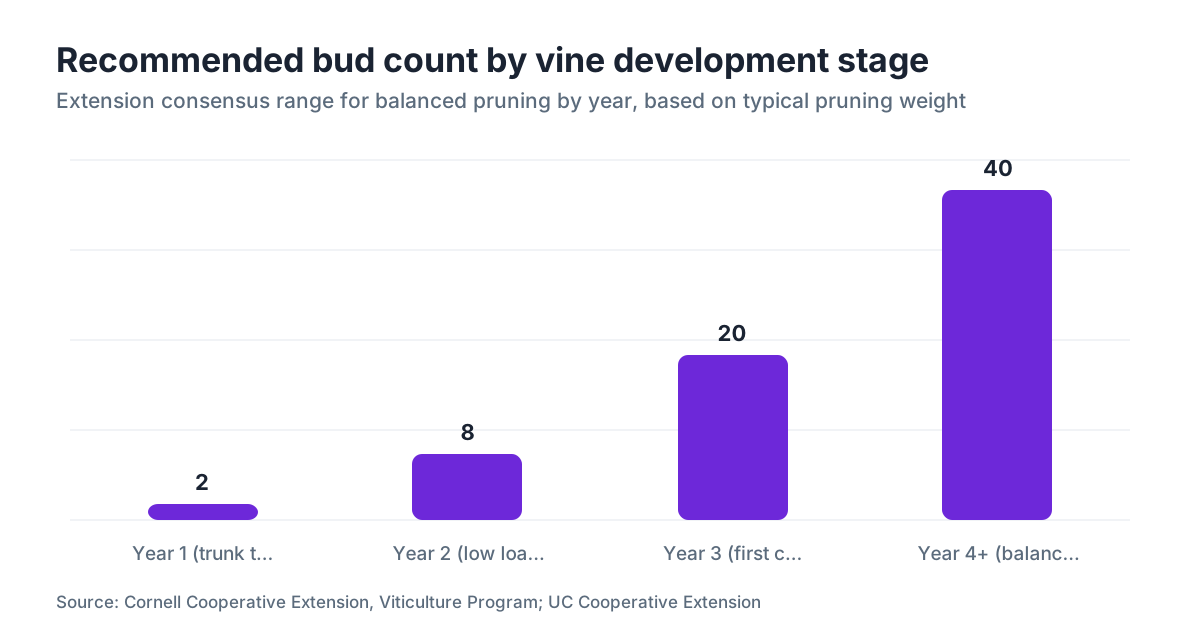
The consensus from extension programs is 6-10 buds total on a second year vine, with many advisors landing at the low end unless the vine had exceptional growth in year one [1][4].
Here's the reasoning. The number of buds you keep sets the shoot load the vine carries next season. Too many shoots on a young vine compete for resources at the exact time the root system is still expanding. You end up with weak, thin shoots, poor lignification going into fall, and winter damage risk you created yourself. Leave too few and you're fine, maybe slightly under potential, and the vine recovers easily.
Cornell Cooperative Extension recommends adjusting the bud count to vine weight. Their concept of balanced pruning says to leave roughly 20-30 buds per pound of one-year-old dormant cane weight removed [4]. On a second year vine that weight is usually modest, which is exactly why the bud counts land low. A vine that produced 0.25 pounds of pruning weight in year one gets something like 5-8 buds retained. A vigorous vine at 0.5 pounds might justify 10-12.
Don't force a weak second year vine to carry more buds because you want it to catch up. Weak vines need energy in roots, not shoots. Accept the lower count, dial in irrigation and nutrition, and let year three be when you push the canopy harder.
Cane pruning vs. spur pruning: which system do you commit to in year two?
Year two is when you make the first real commitment to your training system, even if the vine won't be fully shaped until year three or four. The two main systems are cane pruning (selecting long canes of 8-15 buds each dormant season and tying them to the fruiting wire) and spur pruning (keeping permanent cordons with short spurs of 2-3 buds).
The variety and trellis should drive this, not convenience. Varieties with poor basal bud fruitfulness, like Pinot Noir and Chardonnay, need cane pruning because the buds closest to the base of a cane often produce no fruit or very weak clusters. Prune those to short spurs and you're left with a lot of unproductive wood. Varieties with high basal fruitfulness, like Grenache, Zinfandel, and Cabernet Sauvignon, spur prune with good results [2][10].
In year two the physical difference is subtle. For a cane-pruned system, you select one or two canes closest to the trunk head (or the fruiting wire) with good diameter, good internode spacing, and well-developed buds, then cut them to 8-15 buds. Everything else goes. For a spur-pruned system, you start laying down the cordon arms along the fruiting wire and leaving the first short spurs of 2-3 buds at intervals that eventually become your permanent spur positions.
Unsure? Lean toward what your neighbors use for the same variety. Local experience with what actually sets fruit in your microclimate beats textbook recommendations. WSU Extension's viticulture resources carry detailed training guides for each major Pacific Northwest variety [3].
| Training System | Best Varieties | Buds Per Cane/Spur | Year 2 Action |
|---|---|---|---|
| Cane pruning | Pinot Noir, Chardonnay, Riesling | 8-15 per cane | Select 1-2 canes, tie to wire |
| Spur pruning | Cabernet Sauvignon, Zinfandel, Grenache | 2-3 per spur | Begin cordon, place first spurs |
| VSP (cane) | Pinot Noir, Pinot Gris | 8-12 per cane | Establish trunk, tie cane to wire |
| GDC (spur) | High-vigor varieties | 2-3 per spur | Extend cordon bilaterally |
What does a healthy second year cane look like, and how do you choose which one to keep?
A good cane for retention has a few qualities you can read by sight and feel. Diameter should run about pencil-width to finger-width, roughly 6-12mm. Smaller than that and the wood is weak; the buds push slowly and the shoots come out thin. Much larger than pencil-width can signal excessive vigor, which isn't automatically bad but warrants attention to spacing and load.
Internode length matters too. Long internodes, say over 4 inches, often come from shaded or excessively vigorous growth and may carry less fruitful buds. Shorter, compact internodes in the 2.5-3.5 inch range tend to signal balanced growth and well-differentiated buds. You want buds that look plump and full, not flattened or dried out.
Position on the plant is as important as quality. For a head-trained or VSP system, you want the retained cane to come off near the top of the trunk, close to the fruiting wire. A cane that starts low on the trunk means you're training the vine's energy to travel further, and you're setting up trunk disease entry points at old pruning wounds scattered along the lower vine.
When two canes look equally good, take the one growing in the direction that fits your trellis orientation. A cane pointing the wrong way along the wire is awkward to tie and creates crossing wood you'll be correcting for years.
Cut the others off clean. Don't leave stubs. Stubs die back and create dead wood that opens the door to Botryosphaeria, Esca, and other trunk disease pathogens [8].
What tools do you need and how should you sanitize them between vines?
For second year vines, hand pruning shears are usually all you need. The wood is young and the cuts are small. A quality bypass pruner, like Felco or ARS models, handles the job cleanly and earns its price in blade longevity and cut quality. Skip anvil-style pruners on young vines. They crush rather than slice, and crushed tissue heals poorly and invites infection.
Sanitation matters more than most growers admit. The EPA Worker Protection Standard covers pesticide safety for agricultural workers, but for disease management between vines the standard to follow is the plant pathology guidance from your state extension: a 10% bleach solution or 70% isopropyl alcohol between cuts when you're working in blocks with any known trunk disease history [3][7]. Neither is a perfect sterilant, and both break down fast in sunlight, but they sharply cut the mechanical transfer of fungal spores from vine to vine.
Blades dull faster in bleach, so rotate a second pair of shears. Some growers prefer 70% isopropyl for that reason. The research on which solution wins isn't decisive, honestly. What matters is doing something consistently rather than cutting 300 vines with contaminated blades.
Using a wound sealant (like Topsin-M paste or a similar fungicide-based pruning paint)? Apply it right after the cut on any wound wider than a finger's diameter. On second year vines the cuts are usually small enough that this is optional. In a high-Eutypa pressure region, the extra 30 seconds per vine is worth it.
Track your tool sanitation in your spray and field records. EPA WPS compliance requires documentation of pesticide applications, and some states treat wound sealants as materials requiring log entries [5].
What mistakes in second year pruning cause problems in year three and beyond?
The biggest one is leaving too many buds because the vine looks vigorous and you want more fruit. Overcropped young vines carry measurably lower root starch reserves going into winter. The vine looks fine all summer, then a cold snap hits and the crown damage runs worse than a properly managed vine of the same variety planted the same year. Nobody has clean large-scale data on exactly how much worse, but the physiological mechanism is well documented in viticulture literature going back to Winkler's foundational work [6].
Second mistake: leaving long stubs when you remove canes. Every stub is a potential Botryosphaeria and Eutypa entry point. Cut flush or nearly flush to the parent wood. The vine calluses over clean cuts far better than stubs, which die back into the trunk [8].
Third mistake: picking a cane on length instead of position and quality. A 6-foot cane off the right spot on the trunk beats a 4-foot cane off the wrong spot every time. Where the cane comes from sets your long-term trunk architecture.
Fourth: not tying the trunk to the stake properly before pruning, so the vine's weight distribution is wrong all season. The trunk needs to be upright and supported. A vine that leans or curves from poor staking in year two often develops a permanent lean that creates uneven sap flow and differential vigor between the two cordon arms later.
Fifth, and this one stings: ignoring disease pressure in adjacent mature blocks when you prune young vines in the same pass. If your older block has trunk disease, prune the young vines first, before you've touched the infected wood. It's one of the simplest disease steps and one of the most commonly skipped.
How does the second year pruning differ for own-rooted vs. grafted vines?
Grafted vines carry an extra concern: the graft union. On a grafted vine you want the union above the soil line by at least 2-4 inches in most climates (higher in freeze-risk regions) so the scion can't root and cancel out the rootstock's benefits [1]. When you select your trunk cane in year two, trace where it starts relative to the union. Work with scion wood above the union, never with suckers pushing from below it.
Suckers from below the graft union (from the rootstock) need to come off completely. They're worse than unproductive. They actively compete for resources and, left long enough, can take over the vine. On second year vines this is a common pruning-season task that's easy to miss when you're locked in on cane selection.
Own-rooted vines skip that concern but bring others. In phylloxera-present regions, own-rooted vinifera vines carry long-term risk, and that decision was already made at planting; pruning in year two doesn't change the equation. In phylloxera-free regions like parts of Washington and Oregon, own-rooted vines are common for some varieties, and the pruning approach is identical to grafted vines minus the sucker patrol below the union.
For both vine types, watch the base of the trunk. If your vine sent up multiple shoots from the crown in year one and you trained the best one as the trunk, year two is the time to fully remove any secondary trunk competitors left partially in place. One trunk. No exceptions at this stage.
How do you handle a second year vine that had poor growth in year one?
This happens more than people admit, especially after a rough establishment year with drought stress, pest pressure, or late planting. A vine that barely grew in year one, maybe reaching 12-18 inches of shoot growth, is physiologically still at the year-one stage. Treat it that way.
Don't prune it hard to compensate. Assess the wood you have, pick the single best shoot to continue as the trunk extension, and cut back to 2-3 buds on it. You're buying another year of vegetative growth rather than pushing toward the wire. Cornell's training guides note that vines not reaching the first wire by the end of year two should be treated as re-establishment cases and given another season of trunk training before any fruiting structure is built [4].
Commercially this is a hard call when 5-10% of a block is lagging, because it means accepting another year of non-production from those vines. But the alternative, forcing a weak vine into a fruiting role before it's ready, usually leaves you with a vine that never catches up and becomes a permanent underperformer in the block.
Document these lagging vines by row and position. If you're tracking field operations in a system like VitiScribe, flagging weak vines by GPS position lets you correlate underperformance with soil variability, irrigation coverage gaps, or planting date differences. That data is worth having when you're making replanting decisions in years four and five.
What records do you need to keep after pruning young vines?
At minimum, record the date of pruning, the person or crew who did the work, the block or row, and any pesticide applications or wound sealants used. If you applied any restricted-use pesticide during or after pruning, EPA WPS requires you to keep application records for two years and make them available to inspectors on request [5].
Beyond compliance, the records that actually sharpen your decisions are these: pruning weight per vine (a representative sample per block, not every vine), bud count per vine in the sample, and any notes on disease, winter damage, or abnormal growth. That data feeds straight into balanced pruning calculations in year three and beyond.
State pesticide rules stack on top of EPA WPS minimums. California, for one, requires County Agricultural Commissioner reporting for many pesticide applications, and the thresholds and required detail run stricter than federal minimums [9]. Washington State runs its own Worker Protection Standard implementation with added training requirements [3].
Certified organic? Your certifier will want field records showing what was applied, when, and at what rate, including any allowed materials used as wound treatments. Missing records can cost you certification during an audit.
For operations managing multiple blocks or varieties, a simple spreadsheet works if you're disciplined about it. The format matters less than the habit. The goal is that in March of year three, when you're deciding bud counts, you have real numbers from your own vines instead of a guess.
How does second year pruning set up your year three strategy?
Year three is the first season most training systems produce a real, if still modest, crop. What you do in year two decides whether that happens or whether you're still doing corrective trunk training.
If year two went right, you enter dormancy with a straight trunk reaching the fruiting wire, one or two well-positioned canes tied to that wire, and a root system that had a full season to expand without a heavy shoot load. That vine is ready for a real balanced pruning calculation in year three, a proper cane selection or cordon development, and a first crop of maybe 0.5-1.5 pounds of fruit per vine depending on variety and region.
If year two went wrong, with too many buds left, poor wood selection, or weak trunk support, you'll see it in the canopy by June: shoots off poor positions, a crooked trunk that spreads shoots unevenly, or a vine that sets a fair crop but runs out of steam by veraison. Correcting structural problems at year three is possible but takes aggressive pruning that delays commercial production further.
The money side is real. UC Cooperative Extension enterprise budgets for California wine grapes put establishment costs at roughly $15,000 to $30,000 per acre depending on region, variety, and trellis, with break-even on that investment typically not landing until year four or five of production [1][2]. A lost year from poor second-year training is more than agronomic. It's a financial hit that compounds across the block's productive life.
For operations planning vineyard development across multiple blocks with staggered planting years, consistent pruning records by block let you benchmark development and catch lagging blocks before they fall too far behind. That record-keeping discipline, whether it's a notebook or a field management platform like VitiScribe, is what separates operations that hit commercial production on schedule from those that don't.
Frequently asked questions
Can you let a second year vine produce any fruit at all?
Most extension programs say no. A cluster or two won't kill the vine, but intentional fruiting in year two pulls carbohydrate reserves away from root development. UC Davis and Cornell both recommend removing any flower clusters that form in year two so the vine's energy stays in roots and trunk. The lost fruit is worth it. Vines not cropped in year two consistently show better long-term production and longevity.
How long should the trunk be on a second year vine before pruning?
Ideally the trunk reaches the first fruiting wire, typically 30-42 inches depending on your trellis, by the end of year two's growing season. If it does, prune the tip just above the wire and select canes from near that height. If the trunk hasn't reached the wire, don't force it. Cut back to 2-3 buds on the best shoot and give it another season of trunk training. Forcing a short vine to fruit before the trunk is set costs you years later.
What is balanced pruning and should you use it on second year vines?
Balanced pruning ties your bud count to the dormant cane weight you remove: roughly 20-30 buds per pound of prunings is the Cornell-recommended formula. On second year vines the pruning weight is usually low (0.2-0.5 lbs), which puts you at 4-10 buds, in line with general second year guidance. The formula earns its keep more in year three and beyond, when vine-to-vine variation makes a fixed bud count less reliable than a weight-based approach.
Does the grape variety affect how you prune second year vines?
The variety affects the training system you're committing to, not the core second-year principle of low bud counts and trunk focus. That said, high-vigor varieties (Grenache, some Merlot clones) may push harder in year two and tempt you to leave more buds. Resist it. Varieties prone to trunk diseases (Chardonnay, Syrah) benefit from extra care on clean cuts and wound sealant. Variety-specific fruitfulness differences matter much more starting in year three.
How do you handle frost risk when pruning second year vines?
In frost-prone regions, delay pruning as close to bud swell as your labor schedule allows. Later pruning delays bud push by a week or two, which can be the difference between a frost hit and a clean escape. WSU Extension recommends this delayed pruning strategy specifically for young vines with smaller carbohydrate reserves. If frost does hit after bud swell, assess damage before cutting further. Secondary buds often push on young vines if you give them a few weeks.
Should you use a wound sealant after pruning second year vines?
For cuts under about 1cm diameter, which is most cuts on second year vines, wound sealants have limited proven benefit. They matter on larger cuts, like when you remove a thick shoot close to the trunk. In high Eutypa pressure regions (much of California, parts of Oregon), applying a fungicide-based wound paint like Topsin-M paste to larger cuts right after making them is supported by WSU and UC Davis research. Make sure the product is registered in your state for this use.
How many people does it take to prune an acre of second year vines?
Second year vines prune faster than mature vines because there's less wood to read and remove. A skilled pruner typically moves through 200-400 second year vines per hour, depending on trellis complexity and vine spacing. At 400-600 vines per acre (common spacings), one pruner covers an acre in one to three days. The variation comes from how much corrective work is needed and whether the crew is also tying canes right after pruning.
What is the right way to tie canes after second year pruning?
Tie the selected cane to the fruiting wire with a material that won't girdle it as it thickens: paper-coated wire twist ties, grafting tape, or Bud Tape strips all work. Skip standard wire or zip ties directly against young wood. The tie should hold the cane roughly horizontal along the wire without sharp kinks. Some growers make a single tie at the far end and let the base rest on the wire naturally, which cuts girdling risk.
Can you use a mechanical pruner on second year vines?
No. Mechanical pre-pruners and full mechanical pruners are built for established vines with consistent canopy structure. Second year vines vary too much in trunk height, cane position, and development stage for any mechanical approach to make reliable cuts. Every vine in year two needs individual evaluation and hand cuts. This is non-negotiable. Mechanical damage to a second year trunk or graft union can set the vine back by a full year.
What records does the EPA Worker Protection Standard require after pruning and applying wound treatments?
Under EPA WPS (40 CFR Part 170), if you apply any pesticide, including wound sealants classified as fungicides, you must keep records of the product name, EPA registration number, application date, location, and rate for two years. You must make those records available to inspectors and to workers who request exposure information. State rules often add requirements; California, for example, requires submission to the County Agricultural Commissioner within defined timeframes.
How do cover crops and floor management affect second year vine pruning decisions?
Floor management doesn't directly change how you prune, but it shapes vine vigor going into the decision. A highly competitive cover crop in a dry year can suppress year-two growth enough that you'd treat the vine as a year-one repeat and cut back harder. Under-vine herbicide strips with fertigation can push vigorous growth, which might tempt you to leave more buds than the vine should carry. Assess each block's floor management before finalizing bud count targets.
Is there a difference between second year pruning for wine grapes vs. table grapes?
The structural goals are identical: build the trunk, select permanent wood, stay light on bud count. The differences show up in the training system target. Table grapes often use pergola or overhead trellis systems that need longer cordon development than typical VSP wine grape systems. Bud counts can differ too, because table grape economics favor fast canopy establishment for shading and cluster development. But the rule against overcropping a second year vine applies equally.
Sources
- UC Cooperative Extension, UC Davis Viticulture Program: Second growing season should be used to train one shoot to become the trunk and select fruiting canes for the following year; graft union placement guidance; establishment cost budgets for California wine grapes.
- UC Cooperative Extension, Wine Grape Cost and Return Studies: Establishment costs for California wine grapes run roughly $15,000 to $30,000 per acre depending on region and trellis system; Cabernet Sauvignon basal bud fruitfulness supports spur pruning.
- Washington State University Extension, Viticulture and Enology: Eutypa infection risk drops when large cuts are made during mid-dormancy; delayed pruning strategy recommended for young vines in frost-prone regions; tool sanitation guidance; Washington WPS implementation.
- Cornell Cooperative Extension, Viticulture Program: Balanced pruning formula of 20-30 buds per pound of dormant cane weight removed; vines not reaching first wire by end of year two should receive another season of trunk training.
- U.S. EPA, Worker Protection Standard (40 CFR Part 170): WPS requires pesticide application records including product name, EPA registration number, date, location, and rate to be kept for two years and made available to workers and inspectors.
- Winkler et al., General Viticulture, University of California Press: Physiological documentation that overcropped young vines show lower root carbohydrate reserves and increased winter damage susceptibility.
- WSU Extension, Eutypa Dieback Management in Vineyards: Pruning wound fungicide paints and tool sanitation protocols reduce Eutypa lata transmission between vines.
- UC ANR Publication 3456, Grape Pest Management: Trunk disease pathogens including Botryosphaeria and Esca enter through pruning wounds, with clean flush cuts reducing infection points versus stubs.
- California Department of Food and Agriculture, Pesticide Regulation: California requires County Agricultural Commissioner reporting for pesticide applications with stricter thresholds and detail requirements than federal WPS minimums.
- Cornell Cooperative Extension, Training and Trellising Grapevines: Cane pruning recommended for varieties with poor basal bud fruitfulness including Pinot Noir and Chardonnay; spur pruning suited to varieties with high basal fruitfulness.
Last updated 2026-07-09