Green pruning grape vines: what to cut, when, and why it matters
TL;DR
- Green pruning removes shoot or cluster material from grapevines during the growing season, after budbreak.
- The goal is controlling crop load, opening the canopy to air and light, and pushing the vine's energy into fewer, better clusters.
- Done right, it raises fruit quality measurably.
- Done late, it's expensive remediation of a crop you already half-lost.
- There are five main techniques, each with a different timing window.
What is green pruning on grape vines?
Green pruning is any pruning done on a grapevine while the tissue is still green and growing, as opposed to dormant (cane or spur) pruning done in winter when the vine is leafless. The term covers a family of canopy work: shoot thinning, shoot positioning, lateral shoot removal, leaf removal, and cluster thinning (also called crop thinning or green harvest). Each one targets a different part of the vine's above-ground structure, at a different point in the season.
The logic is simple. Grapevines are vigorous by nature. Left alone, most Vitis vinifera varieties in moderate climates set far more fruit than they can ripen to quality. A Cabernet Sauvignon vine that sets eight to twelve clusters may only ripen five or six to 24+ Brix with good color and seed maturity. The rest dilutes flavor and drags harvest dates later. Green pruning steps in early enough to redirect photosynthate, before the vine has sunk too much carbon into fruit it can't finish.
This is a different job from vineyard management in general. Dormant pruning sets the vine's structure and its potential crop load. Green pruning adjusts the actual crop load based on what you see that season: how vigorous the vine is, what the weather has done, what your yield target is for the appellation or your winemaker's spec. The two practices work together. Neither replaces the other.
The University of California Cooperative Extension and Cornell's viticulture extension program both file these operations separately from dormant pruning in their training guides, because the physiology is different and the windows are short [1][2].
What are the five main green pruning techniques?
Shoot thinning is the first operation of the season, usually at 4 to 8 inches of shoot growth (roughly 2 to 4 weeks after budbreak). You're removing excess shoots from the spur or cane: doubles coming from one bud, non-count shoots, water shoots off the trunk or cordon. The goal is your target shoot density, commonly 12 to 18 shoots per meter of cordon for most VSP-trained varieties, though high-vigor sites push past that range [1]. This is also where you pull shoots that are badly placed and would jam up the canopy later.
Shoot positioning sometimes gets grouped with shoot thinning, but it's its own practice. Shoots get guided into the trellis wires, tucked or tied, so they grow vertically instead of flopping or crossing. On cane-pruned vines or non-VSP systems, this often takes two passes as shoots elongate. Position them well now and you're not fighting a tangled mess at veraison, right when you need air moving through the fruit.
Lateral shoot removal (also called suckering or deshooting of laterals) removes the secondary shoots that pop out of leaf axils on the main shoot. It opens the fruiting zone to light and air. That matters most in humid climates where Botrytis pressure is real. WSU Extension's canopy management guide treats lateral removal in the fruiting zone on rot-prone varieties as a disease management tool first, a quality tool second [3].
Leaf removal in the fruiting zone is probably the most-studied green pruning operation. You're pulling leaves that shade the clusters directly. Cornell research showed that early leaf removal (pre-bloom) can actually cut cluster compactness by affecting berry set, which is a structural way to reduce Botrytis risk without reaching for the sprayer [2]. Timing matters more than most people realize. Leaf removal at bloom or just after has a different effect than leaf removal at veraison. Late leaf removal is mostly reactive.
Cluster thinning (green harvest) is the heaviest hand: physically cutting off whole clusters or parts of clusters. On most varieties it should happen before or right after veraison for the strongest quality effect, because past veraison the vine no longer treats removed clusters as a meaningful sink. UC Davis research on Pinot Noir and Cabernet found that cluster thinning before veraison consistently advanced maturity and improved color and anthocyanin concentration compared to late or no thinning [4]. The trade-off is obvious. You're cutting yield, and yield is revenue.
Not every operation makes sense for every site. On a low-vigor, head-pruned old-vine Zinfandel in Lodi, you might do light shoot thinning and skip cluster thinning most years. On a high-vigor Chardonnay on deep soils in a cool coastal appellation, you might run all five and still fight crop load.
When should you do each green pruning operation?
Timing is where most vineyard managers get burned. Green pruning has hard biological windows. Miss them and you've either wasted labor or done real harm.
| Operation | Optimal timing | Growth stage (Eichhorn-Lorenz) | What you lose if late |
|---|---|---|---|
| Shoot thinning | 4 to 8 in shoot growth | EL 9 to 12 | Vine energy already split; congestion set |
| Shoot positioning (pass 1) | 10 to 14 in shoot growth | EL 14 to 16 | Mechanical damage when tucking stiffened shoots |
| Lateral removal (fruiting zone) | Pre-bloom to bloom | EL 17 to 19 | Less light penetration; fungicide timing compromised |
| Leaf removal (fruiting zone) | Bloom to 2 to 3 weeks post-bloom | EL 19 to 23 | Berry set effect lost; cluster compactness already fixed |
| Cluster thinning | Berry set to veraison | EL 29 to 35 | Maturity advancement drops off sharply after veraison |
The Eichhorn-Lorenz scale is the standard phenological scale used in viticulture research [1]. Your local UC Cooperative Extension farm advisor or WSU extension viticulture specialist can give you the regional calendar dates that match these stages in your appellation, because absolute dates swing 4 to 6 weeks between a San Joaquin Valley floor and the Willamette Valley.
One honest note on cluster thinning timing. There's some debate in the literature about exactly when the window closes. The UC Davis "before veraison" guideline holds up well, but the size of the effect tapers across the two to three weeks before veraison [4]. If you're making the call in a season that's running hot, earlier is almost always better.
How does green pruning differ from head pruning grape vines?
This is a common point of confusion, so let's be direct. Head pruning (also called gobelet or bush vine training) is a dormant pruning system, not a green pruning technique. When people say head pruning grape vines, they mean a vine architecture where canes or spurs come off the top of a short trunk, with no cordon and usually no trellis wire. It's the classic free-standing bush vine you see in old Grenache blocks in the Southern Rhone or old Zinfandel in the Sierra Foothills.
Green pruning still happens on head-pruned vines. Shoot thinning and shoot positioning can actually take more labor on them, because there's no wire system to guide shoots into. Workers hand-position or the canopy just sprawls. Some old-vine growers in Paso Robles accept the sprawl on purpose. It creates a micro-shaded environment that helps in hot climates. Others do careful shoot thinning on head-pruned vines to keep the canopy open.
Here's the distinction that matters: head pruning defines structure. Green pruning manages the season's growth inside whatever structure you've built. You can run all five green pruning operations on a head-pruned vine, a VSP cordon vine, a lyre-trained vine, or a Scott Henry. The structure changes the mechanics and the labor. It doesn't change the physiological goal.
What does green pruning actually do to fruit quality?
The honest answer: it depends on which operation, how early, and what your baseline crop load is. The evidence is strongest for cluster thinning and early leaf removal.
A UC Cooperative Extension study on Cabernet Sauvignon in Napa found that cutting crop load from 8 to 9 tons per acre down to 4 to 5 tons per acre through cluster thinning advanced Brix accumulation by 3 to 5 days and measurably raised anthocyanin and total phenol concentrations [4]. That's not marginal. In a year with an early rain event at the end of harvest, those 5 days can be the difference between a sound crop and a compromised one.
Cornell's research on Concord and hybrid varieties in New York showed that fruiting-zone leaf removal raised soluble solids (Brix) by 1 to 2 degrees in years when canopy shade was the limiting factor, and cut Botrytis incidence by 25 to 40 percent in wet seasons [2]. The Botrytis number matters because chemical control alone rarely gets you below 15 to 20 percent incidence in susceptible varieties in a wet year.
Shoot thinning's quality effect is more indirect. It doesn't change the fruit directly. It improves air circulation and light penetration, and those cascade into better spray coverage, better disease control, and more even ripening. WSU Extension's guidelines for Washington Riesling call target shoot density "among the highest-return canopy practices for cool-climate white varieties" in fruit quality per dollar spent [3].
Where the evidence thins out is lateral shoot removal as a standalone quality driver. The research supports it as a disease tool more than a direct Brix or flavor lever. If you're deciding where to spend labor dollars, cluster thinning and early leaf removal have the clearer return.
How much does green pruning cost in labor, and is it worth it?
This is the question most extension guides soft-pedal, and it's the one that actually decides whether you do the work.
Labor is the dominant cost. As of 2024, vineyard pruning and canopy management labor in California runs roughly $18 to $28 per hour for experienced crew, with supervisors higher [5]. Oregon and Washington ranges are similar or slightly lower in some regions. The H-2A agricultural worker wage rate, which sets a floor in many regions, was $18.64 per hour for California in 2024 [6].
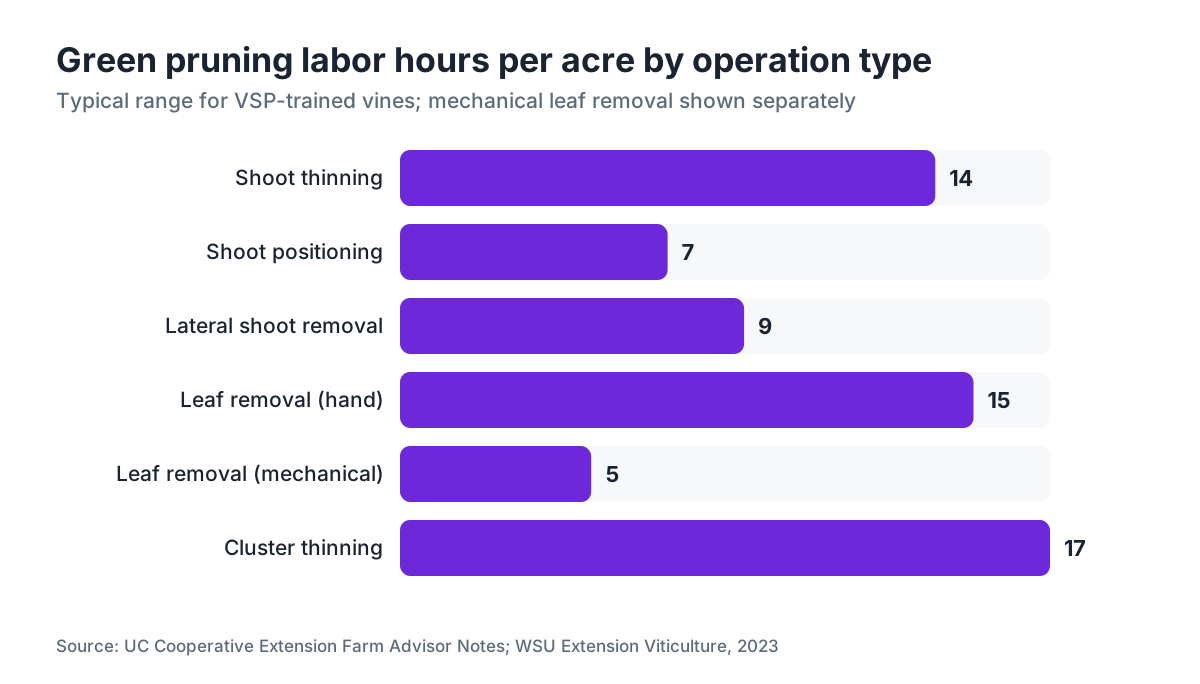
Here's what each operation typically costs in labor time per acre, based on ranges reported in UC Cooperative Extension farm advisor notes:
- Shoot thinning: 8 to 20 hours per acre depending on vine spacing and vigor
- Shoot positioning: 4 to 10 hours per acre, sometimes combined with shoot thinning
- Lateral removal: 6 to 12 hours per acre in the fruiting zone
- Leaf removal (hand): 10 to 20 hours per acre; mechanical leaf removers cut this by 60 to 70 percent on VSP-trained vines
- Cluster thinning: 8 to 25 hours per acre depending on intensity and variety
A full program runs 30 to 80 hours per acre per season. At $22 per hour mid-range, that's $660 to $1,760 per acre. For a 50-acre vineyard, you're looking at $33,000 to $88,000 in green pruning labor alone, on top of dormant pruning.
Is it worth it? At $1,500 per ton and a 3 to 4 ton per acre target for premium fruit, the math only works if the quality premium is real and you capture it in your contract or your own bottle price. For growers selling on the bulk market at $400 to $600 per ton, heavy cluster thinning almost never pays on its own. For estate wineries pushing into the $40 to $80 retail tier, it often does.
Many operations now track these labor hours operation by operation with a field management platform that logs crew time against block records. VitiScribe is built for this kind of vineyard block-level record-keeping, so you can see your real per-acre cost at season's end instead of guessing.
Mechanical leaf removal is the clearest labor win on the table right now. Purpose-built leaf removers (Clemens, Lipco, and similar brands) run roughly $8,000 to $25,000 for a tractor-mounted unit, but they drop leaf removal labor from 15 hours to 4 to 5 hours per acre [7]. On 50-plus acres, payback often lands under 3 seasons.
What are the worker safety and WPS requirements for green pruning?
Green pruning often happens right alongside early-season spraying, and the EPA's Worker Protection Standard (WPS) applies to any agricultural worker entering a treated area [8].
The WPS, at 40 CFR Part 170, sets restricted entry intervals (REIs) for pesticide-treated areas. If you've applied a contact fungicide before bloom and workers are going in to do shoot thinning or leaf removal, you have to comply with the REI on the product label. The EPA revised the WPS in 2015 (effective January 2, 2017) to require, among other things, that handlers and workers get pesticide safety training before first entry into a treated area, that you keep a pesticide application and safety data sheet registry workers can reach, and that you post REI information [8].
For green pruning specifically, a few issues come up again and again:
- Leaf removal sometimes follows within 24 hours of a fungicide application. Know your product's REI before scheduling crews.
- Workers doing leaf removal and cluster thinning are in direct contact with foliage and fruit. PPE requirements on early-season copper or sulfur applications can be significant, and they have to be covered in training.
- The WPS requires decontamination supplies (water, soap, single-use towels) within a quarter mile of workers in treated areas [8].
The Agricultural Worker Protection Standard, as revised, states that "agricultural employers must provide workers and handlers with safety training before their first entry into pesticide-treated areas during the season," per EPA's WPS guidance [8]. That's not an optional pre-season formality. It applies to seasonal and H-2A workers, and you need documentation.
State-level requirements in California (Cal/OSHA and CDFA), Washington (WSDA), and Oregon (ODA) layer on top of federal WPS. In California, the county agricultural commissioner system requires pesticide use reports that should line up with your spray records. Keeping those records in sync with your canopy management timing matters for compliance audits.
How do you decide how much cluster thinning is actually needed?
This is the hardest judgment call in green pruning, and anyone who hands you a simple formula is oversimplifying.
The starting point is your target yield. If your winery contract says 3.5 tons per acre for Pinot Noir, and your vine count is 1,000 vines per acre, you need 7 pounds per vine on average. At fruit set, count clusters on a representative sample of vines (minimum 10 to 20 vines across the block, spanning different parts to capture vigor variation). Estimate cluster weight from berry count per cluster and berry weight. Then do the math.
Most varieties show wide variation in natural fruit set. A Grenache block on a hot site might set 4 clusters per shoot with high shoot count and land well above target. A Syrah on a rocky hillside might set light and need no thinning after a cool, wet spring that hurt set. Check before you thin.
For variety-specific targets, UC Cooperative Extension has published regional benchmarks [1]. As a rough guide, 1 to 1.5 clusters per shoot is a reasonable starting point for most premium Cabernet, Merlot, and Pinot Noir programs. Zinfandel is famously variable and often needs heavier thinning because of its uneven berry development ("raisining") in large clusters.
On head-pruned old vines, cluster thinning is less common because those vines are often inherently low-vigor and self-limiting in crop set. That's part of the appeal of old-vine fruit, and why growers with old head-pruned blocks tend to see less intervention required in green pruning overall.
Does mechanical leaf removal actually work as well as hand leaf removal?
For VSP-trained vines with a single fruiting zone, yes. Mechanical leaf removal matches hand removal in most published comparisons. The limitation is selectivity. Machines pull leaves without discrimination across the zone they pass through. Skilled hand crews can be more precise about which leaves come out, especially where the canopy is thin or uneven.
A WSU Extension trial comparing pneumatic leaf removers to hand removal on Riesling found no significant difference in Brix accumulation or disease incidence at harvest, but the mechanical pass was 65 percent faster and cut labor cost by an estimated $120 to $180 per acre under that study's cost assumptions [3]. The work was done in Washington's Yakima Valley, so the numbers won't translate directly to regions with different labor costs and vine spacing.
The practical limit on mechanical leaf removal is variety and training system. On head-pruned bush vines it essentially doesn't work. On Guyot-cane-pruned vines with an asymmetric canopy, pass geometry gets harder. For high-density plantings under 4 feet row spacing, standard tractor-mounted equipment often can't fit.
Timing matters mechanically too. Running a leaf remover at EL 17 to 19 (just before bloom) on a shatter-prone variety like Grenache can increase shatter. The airstream is directional but not perfectly controlled. Most operators run a calibration pass on a test row before committing a full block.
What records should you keep for green pruning operations?
Record-keeping for green pruning is less regulated than spray records, but it matters for three reasons: labor compliance, lease or contract audits, and your own year-over-year management decisions.
For each operation, the minimum useful record includes the date, the block or vineyard section, the operation type (shoot thin, leaf removal, cluster thin, and so on), the crew size and hours, the estimated intensity (percent shoots removed, clusters per vine before and after), and the growth stage at the time of the work.
Why growth stage? Because if you're sitting with your records in January trying to figure out why block 4 underperformed, knowing you did leaf removal at EL 23 instead of EL 19 explains a lot. Calendar dates without phenological context lose meaning year to year, because harvest timing shifts.
For cluster thinning specifically, tracking pre-thin and post-thin cluster count per vine is worth the trouble if you want to validate your yield estimates. Sample 10 to 20 vines per block, record it, and compare to eventual yield at harvest. After two or three seasons you'll have your own block-specific calibration data, which beats any regional average.
If you're running field operations in VitiScribe, you can log these operations at the block level and tie them to your spray records and harvest data in one system. Having all of it in one place helps when you're presenting records to a winery auditor or building an organic certification application.
For workers doing green pruning in pesticide-treated fields, WPS-required records (spray applications, REI postings, worker training documentation) have to be kept for at least two years under federal WPS requirements [8].
Are there any risks or downsides to green pruning?
Yes, and the extension literature is honest about them even when the sales pitch for every technique is always upbeat.
Cluster thinning too early, before berry set is confirmed, can leave you with less crop than you wanted if the weather then hurts fruit set. You've cut clusters before you know how the remaining ones will fill. Most experienced managers wait for berry set to finish before making final cluster thinning decisions, giving up the slightly better timing advantage.
Leaf removal on the afternoon sun-exposed side in hot climates causes sunburn. In California's Central Valley or Paso Robles during heat waves, pulling too much cover on the west-facing side of a VSP canopy leaves you with bleached berries or cracking. UC Cooperative Extension guidance for inland California often recommends leaf removal only on the east-facing (morning sun) side, or minimal removal on the west side, to keep some shade buffer [1][9].
Shoot thinning strips photosynthetic area early in the season. Follow an aggressive shoot thin with a late frost or a run of cold cloudy weather and you've cut the vine's ability to build reserves right when it needs them. That risk is worst in cool-climate regions.
The labor cost risk is real too. Put $800 per acre into a full green pruning program, then take a hail event in July or a heat spike at harvest that flattens fruit quality anyway, and that labor is sunk with nothing to show. Green pruning manages what you can control. It doesn't insulate you from weather.
Nobody has great data on how aggressive early-season green pruning interacts with vine health over 20-plus-year timelines. The closest work comes from studies on carbohydrate reserve depletion in vines running chronically low leaf-to-fruit ratios, which points to keeping a minimum of 7 to 10 leaves per shoot above the top cluster to support reserve accumulation [4].
How do regional climate differences change your green pruning approach?
Climate decides which operations matter most and how hard you push them.
In cool, humid climates (Finger Lakes, Willamette Valley, parts of coastal California), disease pressure from Botrytis, powdery mildew, and downy mildew makes leaf removal and lateral shoot removal the operations that count most. The Botrytis reduction from an open canopy can be the difference between a clean crop and a 30 percent loss. Cornell's work in New York shows this again and again [2]. Cluster thinning still helps with maturity, but canopy openness is the priority.
In hot, dry climates (Central Valley, interior Paso Robles, eastern Washington's Yakima Valley), disease pressure is lower, but heat and water stress are the constraints. Here the canopy works as a shade buffer. Leaf removal, if overdone, creates sunburn problems. WSU's guidance for Yakima Valley blocks recommends leaving a partial leaf layer on the afternoon side through August [3]. Cluster thinning matters mainly for sugar accumulation rate and avoiding overripe, jammy profiles.
In moderate maritime climates (Napa, Sonoma, Santa Barbara, Walla Walla), you're balancing both. The standard full-program approach (shoot thin, lateral removal, fruiting-zone leaf removal on one side, cluster thin pre-veraison) is the version most widely described in the literature for these conditions, which is probably why it's become the default recommendation even in regions where it doesn't quite fit.
If you're farming a climate you're new to, call your local extension viticulture advisor before committing to a full program. UC Cooperative Extension farm advisors are county-based and genuinely know local microclimates [1]. WSU's extension viticulture program covers Washington, Oregon, and Idaho with regional detail [3]. Cornell's viticulture extension covers the northeast including the Finger Lakes and Hudson Valley [2].
Growers visiting established wine regions, even as a tourist stopping at paso robles wineries or a south coast winery, can often read the local training and canopy management style just by walking the rows. It's one of the more practical ways to train your eye for what a well-managed canopy in that climate actually looks like.
Frequently asked questions
When is the best time to do shoot thinning on grapevines?
Shoot thinning should happen when shoots are 4 to 8 inches long, roughly 2 to 4 weeks after budbreak. That corresponds to Eichhorn-Lorenz stages 9 to 12. At this length shoots snap off cleanly without damaging the spur or cane, the vine's energy split between shoots is still early enough to benefit from correction, and you can clearly spot doubles, water shoots, and non-count positions.
Does cluster thinning always improve wine quality?
Not always, and the returns fall off below a certain crop load threshold. The clearest quality gains show up when you're cutting a vine from well above its carrying capacity down to a realistic target. If your vines are already setting lightly and the cluster count is near target, thinning further rarely produces measurable gains and directly cuts revenue. UC Davis research on Cabernet showed the largest quality response when thinning reduced crop load by 30 percent or more.
How many clusters per vine should I leave after cluster thinning?
It depends on variety, vine age, vigor, and your yield target. A common starting point for premium Cabernet Sauvignon and Pinot Noir is 1 to 1.5 clusters per shoot, or roughly 20 to 35 clusters per vine on a cordon-trained vine with 20 to 25 shoots. Back-calculate from your contract tonnage: divide target tons per acre by vine count per acre, convert to pounds, then divide by expected cluster weight. That gives you cluster count per vine.
Can I use a mechanical leaf remover on head-pruned vines?
No, not practically. Mechanical leaf removers are tractor-mounted and built for VSP or other wire-trained systems where the fruiting zone sits in a consistent horizontal position. Head-pruned bush vines have an irregular, multi-directional canopy with no fixed fruiting zone. Leaf removal on head-pruned vines has to be done by hand, which is one reason green pruning labor costs more on untrellised vineyards.
What is the difference between leaf removal and lateral shoot removal?
Leaf removal pulls individual leaves, usually in the fruiting zone, to let in light and air. Lateral shoot removal takes out the secondary shoots that grow from leaf axils on the main shoot. Laterals are not the same as leaves; they are new growing points with their own leaves. Removing laterals opens the canopy more aggressively than pulling single leaves, and it's especially effective in dense canopies in humid climates where Botrytis is the main concern.
Does leaf removal before bloom reduce berry size?
Yes. Pre-bloom leaf removal can reduce berry size by affecting cell division during the earliest stages of berry development. Cornell research found that leaf removal at bloom or pre-bloom reduced cluster compactness in varieties prone to tight clusters, which in turn cut Botrytis incidence in wet seasons. The effect on berry size is modest, typically a 5 to 15 percent reduction, but the disease management benefit can be significant in susceptible varieties.
What EPA rules apply to workers doing leaf removal in recently sprayed vineyards?
The EPA's Worker Protection Standard (40 CFR Part 170) requires that workers observe the restricted entry interval (REI) on the pesticide label before entering treated areas. Workers must get safety training before first entry into treated areas each season, and decontamination supplies must be within a quarter mile. Your spray application records must be accessible. These requirements apply to leaf removal and every other green pruning operation done in recently treated blocks.
How does green pruning affect vine carbohydrate reserves?
Aggressive green pruning, especially early shoot thinning combined with heavy cluster thinning, reduces total leaf area and fruit load. Leaf area drives photosynthesis and reserve accumulation. The standard guideline is to keep at least 7 to 10 leaves per shoot above the top cluster to ensure adequate reserve return to the vine. Chronically low leaf-to-fruit ratios over multiple seasons can deplete carbohydrate reserves and shorten vine life, though long-term data on this is limited.
Is green pruning required for organic or Biodynamic certification?
No, but organic and Biodynamic programs lean hard on canopy management as a disease control strategy because it cuts reliance on fungicides. An open, well-ventilated canopy from green pruning reduces Botrytis, powdery mildew, and downy mildew pressure, which means fewer spray passes and easier compliance with organic approved material lists. Many certified organic vineyards treat leaf removal and lateral removal as a front-line disease tool rather than a quality-only practice.
How much does a full green pruning program cost per acre?
A full program (shoot thinning, positioning, lateral removal, leaf removal, cluster thinning) typically runs 30 to 80 hours per acre per season. At current California farm labor rates of $18 to $28 per hour, that's $660 to $2,240 per acre. Washington and Oregon are broadly similar. Mechanical leaf removal can cut the leaf removal portion by 60 to 70 percent. The cost is significant, and the return depends heavily on your fruit price and quality targets.
What records do I need to keep for green pruning operations?
No federal rule mandates green pruning records specifically, but you should track date, block, operation type, growth stage, crew hours, and intensity (clusters per vine before and after, shoot count). This data helps with year-over-year management, yield estimation calibration, winery contract audits, and organic certification records. If green pruning follows a spray application, WPS records for that application and REI compliance must be kept for at least two years.
Does aggressive green pruning stress old vines?
Old vines, particularly those on their own roots or on low-vigor rootstocks, are generally lower in vigor and carry fewer shoots naturally. They usually need less green pruning intervention than young or high-vigor vines. Aggressive cluster thinning on low-yield old vines offers diminishing quality returns. Some growers with old head-pruned blocks report that minimal intervention is their whole approach, precisely because the vine has self-regulated to a sustainable balance over decades.
How does sunburn risk change my leaf removal strategy in hot climates?
In hot inland climates, pulling too many leaves on the afternoon (west-facing) side of the canopy exposes clusters to direct afternoon sun and temperatures that can top 100 degrees F on the berry surface, causing bleaching, cracking, and flavor loss. UC Cooperative Extension guidelines for interior California recommend limiting leaf removal to the morning-sun (east-facing) side, or removing only the innermost shading leaves, leaving a partial exterior leaf layer on the west side as a heat buffer through summer.
Can I do cluster thinning after veraison and still get a quality benefit?
Minimally. After veraison, the vine has largely finished cell division and the early sugar loading of berries. Removing clusters at that point stops some continued sugar import to those clusters, but the maturity advancement and anthocyanin concentration effects that come from pre-veraison thinning are essentially gone. Post-veraison thinning may be justified in a season where crop load is extreme and you're trying to salvage even ripening, but it's a remediation move, not a proactive quality tool.
Sources
- UC Cooperative Extension, UC Davis Viticulture & Enology - Canopy Management: Shoot density targets of 12-18 shoots per meter of cordon and growth stage benchmarks for green pruning operations in California vineyards
- Cornell Cooperative Extension - Viticulture and Enology, New York State: Leaf removal at bloom reduces cluster compactness and Botrytis incidence by 25-40 percent in wet seasons; Brix improvement of 1-2 degrees from fruiting zone leaf removal
- Washington State University Extension - Viticulture: Lateral shoot removal as a disease management tool in Washington Riesling; mechanical leaf removal 65 percent faster than hand removal with comparable quality outcomes in Yakima Valley trials
- UC Davis Department of Viticulture and Enology - Crop Load and Fruit Quality Research: Cluster thinning before veraison advanced Brix accumulation by 3-5 days and increased anthocyanin and total phenol concentrations in Cabernet Sauvignon; minimum 7-10 leaves per shoot above top cluster recommended for carbohydrate reserve maintenance
- USDA National Agricultural Statistics Service - Farm Labor: Vineyard and farm labor wage ranges of $18-$28 per hour for experienced crop production workers in California
- U.S. Department of Labor - H-2A Adverse Effect Wage Rates: H-2A adverse effect wage rate for California was $18.64 per hour in 2024
- UC Cooperative Extension - Farm Advisor Notes on Mechanical Leaf Removal: Mechanical leaf removers reduce leaf removal labor from approximately 15 hours to 4-5 hours per acre; equipment costs of $8,000-$25,000 for tractor-mounted units
- U.S. EPA - Agricultural Worker Protection Standard (WPS), 40 CFR Part 170: WPS requires worker safety training before first entry into pesticide-treated areas each season, REI compliance, accessible application records, and decontamination supplies within a quarter mile of workers; records must be maintained for at least two years
- UC Cooperative Extension - Inland California Canopy Management Guidelines: Recommendation to restrict leaf removal to morning-sun (east-facing) side in hot inland California climates to prevent berry sunburn
- Cornell Cooperative Extension - Botrytis Management in Vinifera and Hybrid Grapes: Pre-bloom leaf removal reduces cluster compactness in tight-clustered varieties, providing a structural defense against Botrytis that complements fungicide programs
Last updated 2026-07-09